
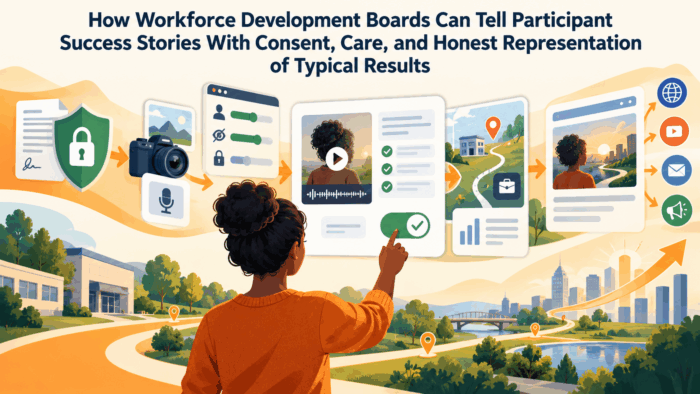
How Workforce Development Boards Can Tell Participant Success Stories With Consent, Care, and Honest Representation of Typical Results
Every workforce board has a favorite story. Perhaps it is the young man who left a juvenile facility, enrolled in a youth program, earned his welding certification, and now supervises a crew. Perhaps it is the mother of three who lost her job when a plant closed, trained as a medical coder while her children slept, and now earns more than she ever had. These stories appear in annual reports, are told at board meetings and budget hearings, anchor social media campaigns, and sometimes reach the local news. They move audiences in ways that statistics cannot. Elected officials remember them. Funders cite them. Residents who hear them may believe, for the first time, that the career center could help someone like them.
Stories this powerful carry responsibilities to match. The people whose stories are told have entrusted the workforce board with some of the most difficult chapters of their lives: job loss, poverty, incarceration, addiction, homelessness, disability, family crisis. They may have agreed to share their story at a moment when they felt grateful, vulnerable, or obligated, without fully understanding where it would appear or how long it would remain public. Years later, the story may still be online, read by a new employer, a neighbor, or their own children. The board that told it may have moved on; the participant has not.
There is a second responsibility, owed to the audience. Success stories are, by design, stories of success. They are selected because they are inspiring, which usually means they are exceptional. When boards present exceptional stories without context, audiences may conclude that such outcomes are typical. A resident who hears that participants double their earnings may enroll expecting the same, and be disappointed. An official who hears only triumphant stories may form unrealistic expectations of what the system can deliver, and lose faith when ordinary results arrive.
This article examines how workforce development boards can tell participant success stories with consent, care, and honest representation of typical results. Its central argument is that storytelling is an ethical practice as much as a communication technique, and that boards can tell stories that are powerful and honest at the same time by treating consent as an ongoing process, interviewing and writing with care for participants’ dignity and privacy, choosing a range of stories rather than only the most dramatic, pairing stories with clear information about typical outcomes, and maintaining policies that govern how stories are collected, used, updated, and retired.
Why Success Stories Are Powerful and Risky
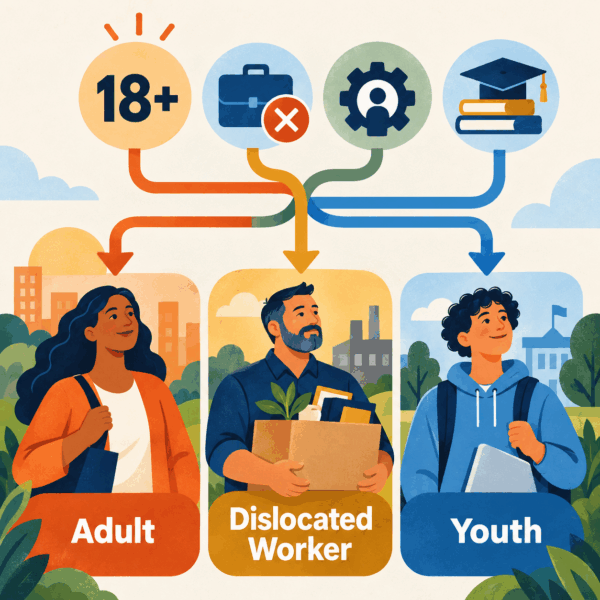 Stories persuade in ways that data alone cannot. A statistic tells an audience how many people found jobs; a story shows what finding a job meant to one person. Research in communication and psychology has long suggested that people respond more strongly to individual, identifiable stories than to aggregate numbers, a pattern sometimes discussed as the identifiable victim effect. For workforce boards, which must explain complex, abstract services to audiences who may have little direct experience with them, stories make the work tangible.
Stories serve several purposes in workforce communication. They help residents imagine themselves using services, which can encourage people who doubt that the career center is for them. They help employers see the capabilities of workers trained through the system. They help elected officials and funders understand the human consequences of their decisions. They help staff and board members connect their daily work to its purpose. And they give the media a human angle that makes workforce stories newsworthy.
The same features that make stories powerful also make them risky. Because stories persuade emotionally, they can mislead even when every fact in them is true. A single dramatic story can create an impression of typical outcomes that the data do not support. Because stories are personal, they expose individuals. A participant’s struggles with addiction, incarceration, or homelessness, once published, may affect how employers, landlords, and neighbors see them for years. Because stories are selected by the organization telling them, they reflect the organization’s interests, which may not align with the participant’s.
The power imbalance between workforce boards and participants deepens these risks. Participants often depend on the workforce system for services, training funds, or supportive services. When staff ask a participant to share her story, she may feel unable to refuse, or may agree out of gratitude without considering the consequences. A participant who is still receiving services may worry, consciously or not, that declining could affect her support. True consent is harder to obtain when one party has power over the other.
Stories also carry risks for the organization. A story that later proves inaccurate, or a participant who later objects to how her story was used, can damage the board’s credibility. A story that reveals details a participant did not intend to share can create legal and ethical problems. A pattern of stories that present only dramatic successes can lead audiences to distrust the board when they discover that typical outcomes are more modest.
Recognizing both the power and the risks of stories does not mean abandoning them. Stories remain one of the most effective ways to communicate the value of workforce services. It means telling stories in ways that honor the people whose lives they describe and respect the audiences who hear them. The remaining sections describe how to do this: addressing the problem of exceptional stories, building genuine consent, choosing stories thoughtfully, interviewing and writing with care, pairing stories with honest data, and establishing policies that guide the practice.
Skilled & Connected: Communication Strategies for Workforce Development Agencies, Career Centers, and Local Employment Services
This article is part of our series on strategic communication for Workforce Development Agencies, Career Centers, and Local Employment Services. To learn more and to see the parent article, which links to other content just like this, click the button below.
The Problem of the Exceptional Story
The stories workforce boards tell are rarely typical. Staff naturally gravitate toward the most dramatic transformations: the participant who overcame the most, achieved the most, or whose journey makes the most compelling narrative. These stories are genuine, and they deserve to be told. But when they are the only stories told, or when they are told without context, they create a distorted picture of what the workforce system typically achieves.
The distortion has several effects. For prospective participants, exceptional stories can create expectations that most will not meet. A resident who hears that a participant went from unemployment to a six-figure salary after a short training program may enroll expecting similar results. When she finds a job paying a modest wage, she may feel that the program failed her, even if her outcome is typical and represents real progress. Disappointment of this kind can undermine trust in the system and discourage persistence.
For elected officials and funders, exceptional stories can create unrealistic expectations of what workforce investment produces. Officials who hear only dramatic successes may expect every participant to achieve similar results and may become skeptical when aggregate data show more modest outcomes. Ironically, overreliance on exceptional stories can make typical results look like failure.
For the public, exceptional stories can reinforce a narrative that success depends mainly on individual determination. Stories that emphasize a participant’s grit and perseverance, without acknowledging the services, supports, and circumstances that made success possible, may suggest that those who do not succeed simply did not try hard enough. This narrative can obscure the real barriers many participants face and the value of the supports that help them.
For participants whose outcomes are more modest, exceptional stories can feel alienating. A participant who found steady work at a modest wage after training may see the board’s stories and feel that her own achievement does not count. Stories of ordinary success, such as finding stable employment after a long search, earning a first credential, or gaining enough income to stop relying on public assistance, are meaningful achievements that deserve recognition.
Addressing the problem of the exceptional story does not mean refusing to tell remarkable stories. It means telling them alongside other stories and data that represent the range of outcomes. Several practices help. Boards can tell a variety of stories, including stories of modest but meaningful progress. They can frame exceptional stories as exceptional, acknowledging that this participant’s results were unusually strong. They can pair stories with data on typical outcomes, so audiences understand the broader picture. They can avoid language that implies stories are representative, such as presenting an exceptional result as what participants can expect. And they can emphasize the supports and services that contributed to success, not only individual determination.
The Federal Trade Commission’s guidance on endorsements and testimonials in commercial advertising offers a useful parallel. That guidance has addressed the concern that testimonials describing exceptional results can mislead consumers about typical results, and has called for clear disclosure of what consumers can generally expect when testimonials do not reflect typical experiences. While workforce boards are public entities rather than commercial advertisers, and this guidance may not apply to them directly, the principle is instructive: when a story describes results most people will not achieve, audiences deserve to know it.
Honest representation of typical results protects participants, audiences, and the board’s credibility. It allows stories to inspire without misleading.
Informed Consent as an Ongoing Process
Consent is the foundation of ethical storytelling. Many workforce boards treat consent as a form: a release signed once, often at intake or shortly after a participant agrees to share her story, granting broad permission to use her name, image, and story in any communication indefinitely. A signed release may provide some legal protection, but it does not ensure that consent is genuinely informed, voluntary, or ongoing. Ethical storytelling treats consent as a process that begins before the story is gathered and continues for as long as the story is used.
What Informed Means
Consent is informed only when participants understand what they are agreeing to. They should know how their story will be used, including which channels, such as annual reports, websites, social media, presentations to officials, or news media; who might see it, including the possibility that employers, neighbors, family members, and strangers will encounter it; how long it will remain public, and that content shared online may persist even after it is removed; what details will be included, such as their name, photograph, workplace, and personal history; and what risks might arise, such as being recognized or having past difficulties become known. Explaining these matters in plain language, in the participant’s preferred language, and checking understanding are essential.
What Voluntary Means
Consent is voluntary only when participants feel genuinely free to decline. Because participants may depend on the workforce system for services, staff should make clear that declining will not affect services in any way, and should mean it. Requests to share stories should come from staff who do not control the participant’s services where possible, or should be framed carefully to avoid pressure. Participants should be given time to consider the request, not asked to decide on the spot. Asking participants who are in crisis or newly enrolled, when they may feel most dependent, should be avoided.
Levels of Consent
Participants should be able to choose how much to share. Options might include sharing the story with their full name and photograph, sharing with first name only, sharing without a photograph, sharing anonymously with identifying details changed, or sharing only for internal use, such as staff training. Offering a range of options lets participants participate on terms they are comfortable with.
Review Before Publication
Participants should have the opportunity to review their story before it is published, to confirm accuracy and to object to any details or framing they find uncomfortable. Review is especially important when stories are edited or condensed, since editing can change meaning.
Consent for New Uses
Consent given for one use should not be assumed to cover others. A participant who agreed to have her story in the annual report may not have agreed to a video for social media or a presentation to the state legislature. Boards should seek renewed consent for significantly different uses.
Withdrawal
Participants should be able to withdraw consent at any time, and boards should honor withdrawal promptly by removing the story from channels they control. Participants should understand that content already distributed, such as printed reports or shared social media posts, may not be fully retrievable, which is part of why initial consent must be informed.
Young People and Others Needing Additional Protection
For participants under eighteen, consent from a parent or guardian is typically required in addition to the young person’s own assent, and boards should consider whether sharing a minor’s story serves the young person’s interests at all. Particular care is also warranted for participants whose circumstances, such as involvement with the justice system, immigration matters, domestic violence, or health conditions, could expose them to harm if disclosed.
Treating consent as an ongoing process takes more time than a single signed form. But it ensures that participants remain in control of their own stories, which is both an ethical obligation and a foundation of trust.
Choosing Whose Stories to Tell
The stories a workforce board tells shape how audiences understand the system: who it serves, what it does, and what outcomes are possible. Choosing stories deliberately, rather than defaulting to the most dramatic ones that staff happen to know, produces a more accurate and inclusive picture.
The first consideration is range of outcomes. A balanced collection of stories includes not only dramatic transformations but also stories of steady, meaningful progress: a participant who found stable employment after months of searching, a dislocated worker who returned to work at a similar wage in a new industry, a young person who earned a high school equivalency and entered training, a worker who earned a credential that led to a raise. These stories reflect what many participants experience and help audiences understand the value of typical outcomes.
The second consideration is range of services. Stories that feature only training participants may obscure the value of career services, job search assistance, supportive services, and business services. A range of stories can illustrate the different ways the system helps people.
The third consideration is range of participants. Stories should reflect the diversity of people the system serves, including different ages, backgrounds, occupations, geographic areas, and circumstances. Audiences who see people like themselves in stories are more likely to believe the system can help them. At the same time, stories should not tokenize participants or reduce them to representatives of a demographic group.
The fourth consideration is avoiding stories that reinforce stereotypes. Stories that repeatedly frame participants from certain groups as needing to be rescued, or that emphasize deficits and dysfunction, can reinforce harmful stereotypes. Stories that present participants as capable people who used services to pursue their own goals are more respectful and more accurate.
The fifth consideration is the participant’s interests. Before asking a participant to share her story, staff should consider whether sharing serves her interests. A participant who recently started a new job may not want her employer to learn about her past. A participant whose story involves sensitive circumstances may be better served by not sharing it publicly, even if she is willing. Staff should be prepared to suggest alternatives, such as anonymous sharing, or to decide not to pursue a story when the risks seem too great.
The sixth consideration is timing. Stories gathered too soon after a participant’s success may not reflect lasting outcomes; a participant celebrated for a new job may leave it weeks later. Stories gathered after outcomes have stabilized are more reliable. At the same time, stories should not be gathered so long after services that details are lost.
The seventh consideration is the audience and purpose. Different audiences and purposes call for different stories. Recruiting participants for a training program may call for stories of people who completed that program. Explaining the value of business services may call for stories from employers. Making the case for funding may call for a range of stories paired with data.
The eighth consideration is avoiding exploitation. Stories should not be chosen because they are the most painful or shocking. Emphasizing trauma for emotional impact, sometimes criticized as poverty tourism or inspiration porn, can exploit participants and distort public understanding. Stories should be chosen for what they reveal about the system’s value and participants’ achievements.
Choosing stories deliberately requires a process for identifying potential stories across the system, not only from the staff most engaged in communication. Asking career advisors, business services staff, and providers to suggest participants whose experiences illustrate different aspects of the system, and then approaching those participants thoughtfully, produces a richer collection.
Interviewing With Care
Gathering a participant’s story usually involves an interview, whether a structured conversation with communication staff, a recorded video session, or an informal exchange with a career advisor. The interview itself can affect participants. Asking someone to recount job loss, poverty, incarceration, or other difficult experiences can bring up painful memories. Interviewing with care, drawing on trauma-informed principles, protects participants and produces better stories.
The first principle is preparation. Before the interview, participants should understand what the interview will involve, what topics may be discussed, how long it will take, and how the story will be used. They should know they can decline to answer any question, pause, or stop at any time. Sharing sample questions in advance allows participants to think about what they want to say and what they prefer to keep private.
The second principle is choosing the right interviewer. Participants may feel more comfortable with someone they know and trust, such as their career advisor, or with someone outside their service relationship, which can reduce pressure. The interviewer should be trained in respectful interviewing and should understand the participant’s circumstances enough to avoid unintentionally harmful questions.
The third principle is a comfortable setting. Interviews should take place in a private, comfortable location, at a time convenient for the participant. Participants should be compensated for their time where appropriate and permitted, or at least supported with transportation or other practical needs. Interpreters should be provided for participants who prefer another language.
The fourth principle is letting participants lead. Interviewers can invite participants to tell their story in their own way, rather than steering them toward dramatic details. Open-ended questions, such as asking what led them to the career center, what was most helpful, and what they are proudest of, allow participants to emphasize what matters to them. Interviewers should not press for details about trauma, criminal history, health, or other sensitive matters that participants do not raise or do not want to discuss.
The fifth principle is focusing on strengths and agency. Questions that emphasize participants’ goals, decisions, and achievements, and the supports that helped them, produce stories that reflect participants as capable agents rather than passive recipients. Asking what advice they would give others in similar situations can elicit insights that are both respectful and useful.
The sixth principle is attending to distress. If a participant becomes upset during the interview, the interviewer should pause, check in, and offer to stop or take a break. Interviewers should know how to connect participants with support if needed. The participant’s wellbeing takes priority over completing the interview.
The seventh principle is accuracy. Interviewers should take careful notes or record interviews with permission, and should verify facts such as dates, programs, credentials, and employers. Errors in a published story can embarrass participants and undermine the board’s credibility.
The eighth principle is closing well. At the end of the interview, the interviewer should thank the participant, explain next steps including review of the draft story, remind the participant of their right to withdraw, and provide contact information for questions.
The ninth principle is avoiding conflicts with services. The interview should not be combined with service delivery in ways that blur roles. A career advisor conducting an interview should make clear that the conversation is separate from the participant’s services, and that nothing said will affect them.
Interviewing with care treats participants as partners in telling their own stories, not as sources of material. It also tends to produce more authentic and compelling stories, because participants who feel respected and in control share more genuinely.
Telling Stories Accurately and With Dignity
Once a story is gathered, how it is written shapes how audiences see the participant and the system. The same facts can be told in ways that honor participants or diminish them, that clarify the system’s role or distort it. Writing stories accurately and with dignity requires attention to framing, language, and balance.
The first principle is presenting participants as agents. Stories should show participants making decisions, pursuing goals, and taking action, with the workforce system as a resource they used. A story that says the career center transformed a participant’s life frames her as passive; a story that says she decided to pursue a new career and used training funds and coaching from the career center to get there frames her as the protagonist. The second framing is usually more accurate and more respectful.
The second principle is avoiding deficit language. Descriptions such as broken, troubled, at-risk, or hopeless reduce participants to their difficulties. Person-first and strengths-based language, such as describing someone as a person who had been out of work for a year, rather than labeling them by their circumstances, respects participants. Labels for disability, health, or justice involvement should be used only when relevant, with the participant’s agreement, and in language the participant prefers.
The third principle is balancing struggle and achievement. Some stories over-emphasize hardship to make achievements seem more dramatic. Others gloss over difficulties entirely, making success seem effortless. Honest stories acknowledge challenges the participant chose to share without dwelling on them, and describe achievements without exaggeration.
The fourth principle is crediting supports accurately. Stories should describe the services and supports that contributed to the participant’s success, such as training, supportive services, coaching, or employer partnerships, without overstating the board’s role. Participants’ own efforts, family support, employer decisions, and other factors also matter. Accurately describing the system’s contribution helps audiences understand what services do, while avoiding implausible claims that services alone caused success.
The fifth principle is factual accuracy. Every detail, including program names, credentials, employer names, dates, and wages, should be verified. Wages and other figures should be described as the participant reported them, with permission, and should not be exaggerated. If a story includes a quotation, it should accurately reflect what the participant said, with light editing for clarity approved by the participant.
The sixth principle is avoiding sensationalism. Headlines and framing should not exaggerate. Describing an outcome as a miracle or a complete transformation may be dramatic but is rarely accurate. Plain, specific descriptions are more credible.
The seventh principle is preserving the participant’s voice. Where possible, stories should include the participant’s own words, describing their experience in their own terms. Participants’ perspectives on what helped and what was difficult can also be valuable to the board in improving services.
The eighth principle is participant review. As discussed earlier, participants should review drafts before publication and should be able to request changes. Writers should be prepared to revise framing that participants find uncomfortable, even if it seems compelling.
The ninth principle is acknowledging that stories are individual. Stories should not imply that the participant’s experience represents everyone in a group. Phrases such as like many single mothers, she struggled can generalize inappropriately. Each story is one person’s experience.
Stories written with dignity are not less powerful than sensational ones. They are often more powerful, because audiences recognize authenticity and respect. They also protect participants from being defined publicly by the hardest moments of their lives.
Pairing Stories With Typical Results
The most effective way to address the problem of exceptional stories is to pair them with information about typical outcomes. Stories show what is possible and what the experience means to individuals; data show what typically happens across all participants. Together, they give audiences both emotional understanding and accurate expectations.
The first approach is placing data alongside stories. When a story appears in an annual report, on a website, or in a presentation, nearby information can describe typical outcomes for the relevant program. A story about a participant who completed a medical assistant program and found a well-paying job can be accompanied by a brief note on the share of program participants who found employment and their typical earnings, presented in plain language as discussed in reporting outcome data. Audiences then understand that the story illustrates one person’s experience within a broader pattern.
The second approach is framing stories explicitly. Where a story describes an exceptional result, the text can say so. A sentence such as her results were stronger than most, and her story shows what is possible when training aligns with strong local demand is honest and still inspiring. Where a story describes a typical result, it can say that too, which validates typical outcomes as meaningful.
The third approach is telling multiple stories together. Presenting several stories that represent a range of outcomes, such as one participant who found a job quickly, one who needed more time and support, and one who is still working toward a goal, gives audiences a more realistic picture than a single dramatic story.
The fourth approach is using composite or aggregated narratives carefully. Some organizations describe a typical participant’s journey based on patterns across many participants. This can illustrate typical experiences, but composites must be clearly labeled as composites, not presented as real individuals. Presenting a composite as a real person would be deceptive.
The fifth approach is aligning stories with outcome reporting. Boards that produce plain-language outcome reports can integrate stories into those reports, with stories illustrating the data rather than replacing it. This integration ensures that stories are always presented in context.
The sixth approach is caution in recruitment materials. Recruitment materials for training programs and services carry particular responsibility, because they influence decisions. Stories in recruitment materials should be accompanied by accurate information about program requirements, typical outcomes, and the effort involved. Avoiding implied promises, such as suggesting that everyone who completes a program will achieve the featured participant’s wage, protects prospective participants.
The seventh approach is honesty with officials and funders. When stories are told to elected officials and funders, they should be presented as illustrations, with aggregate data providing the evidence. Officials who understand that stories illustrate typical patterns, rather than representing typical results, are better equipped to make informed decisions and less likely to be disappointed by aggregate data.
Pairing stories with typical results does not diminish their power. Audiences remain moved by individual stories even when they know the stories are not typical. What changes is that their expectations are grounded, which protects participants who might otherwise feel they fell short and protects the board from appearing to have overpromised.
Protecting Privacy and Sensitive Details
Participant stories often involve information that participants would not want widely known: past incarceration, substance use, health conditions, disabilities, domestic violence, homelessness, immigration circumstances, receipt of public assistance, or family difficulties. Even with consent, publishing such details can expose participants to stigma, discrimination, or harm. Protecting privacy requires judgment about what details are necessary to the story and what risks they create.
The first principle is minimum necessary detail. Stories should include only the details needed to convey their point. A story about a participant who found work after training may not need to mention her criminal record, even if it was part of her journey and she is willing to share it. Including sensitive details only when they are essential to the story, and only with the participant’s explicit agreement to each one, reduces risk.
The second principle is considering future consequences. Information published today may be found years later by employers, landlords, schools, or others. A participant who is comfortable sharing her history now, while celebrating a new job, may feel differently in the future. Staff should discuss this possibility with participants and should err on the side of caution when details could affect future opportunities.
The third principle is considering third parties. Stories may involve family members, former employers, or others who have not consented to being described. Details about a participant’s children, partner, or former employer should be included only when necessary and in ways that do not identify or harm them.
The fourth principle is legal and program confidentiality requirements. Workforce programs handle personally identifiable information subject to confidentiality requirements, and some participants receive services from partner programs, such as vocational rehabilitation, with their own confidentiality rules. Information about a participant’s disability or medical condition, for example, may be subject to specific protections. Staff should understand applicable requirements and consult appropriate advisors when stories involve protected information.
The fifth principle is protecting location and safety. For participants affected by domestic violence or other safety concerns, publishing their name, photograph, workplace, or location could endanger them. Stories involving such participants should be anonymized carefully or not published at all.
The sixth principle is anonymization done well. When participants prefer anonymity, changing the name alone may not be enough if other details, such as a specific employer, rare occupation, or small town, could identify them. Effective anonymization considers the combination of details and alters or omits those that could identify the participant, while preserving the story’s essential truth. Anonymized stories should be labeled as such, for example by noting that names and some details have been changed.
The seventh principle is secure handling of story materials. Interview notes, recordings, photographs, and consent forms contain personal information and should be stored securely, accessed only by those who need them, and retained only as long as needed.
The eighth principle is respecting decisions to keep details private. If a participant decides not to share a detail, even one that would make the story more compelling, that decision should be respected without pressure.
Privacy protection sometimes means telling less dramatic stories. But it ensures that sharing a story does not harm the person who shared it, which is a fundamental obligation of any organization that serves people in vulnerable circumstances.
Photography, Video, and Visual Storytelling
 Photographs and video make stories more vivid and memorable, and they are increasingly central to workforce communication, especially on social media. They also make participants identifiable in ways that text alone does not. A face in a photograph can be recognized by anyone who sees it, and video can circulate widely beyond its original context. Visual storytelling requires its own attention to consent, dignity, and accuracy.
The first principle is specific visual consent. Consent to share a written story does not automatically include consent to be photographed or filmed. Participants should agree specifically to visual use, understanding where images will appear and that images can be shared, copied, and persist online. Options should include participating in a written story without photographs, being photographed in ways that do not show the face, or using images that do not depict the participant.
The second principle is dignified portrayal. Images should portray participants as capable people, such as at work, in training, or in settings they choose, rather than in images that emphasize hardship or vulnerability. Participants should have a say in how they are photographed and which images are used. Images should not be staged to suggest circumstances that are not accurate.
The third principle is accuracy of images. Images used with a story should depict the actual participant or be clearly identified as illustrative. Using stock photographs of models to illustrate a real participant’s story, without disclosure, misleads audiences. If stock images are used, they should not imply that they depict real participants.
The fourth principle is caution with group images. Photographs of career center lobbies, training classes, hiring events, or other settings may include people who have not consented to appear in published materials. Staff should obtain consent from identifiable people in images, use images in which people are not identifiable, or post notices at events explaining that photography will occur and offering a way to opt out, consistent with organizational policy.
The fifth principle is attention to minors and protected settings. Images of young people require consent from parents or guardians as well as the young person’s assent. Images taken in settings such as correctional facilities, shelters, or treatment programs raise additional privacy and safety concerns and should be approached with great care, if at all.
The sixth principle is video-specific considerations. Video captures voice, mannerisms, and surroundings that can identify participants and reveal more than intended. Participants should review video before publication. Editing should not alter the meaning of what participants said. Captions should be provided for accessibility, and transcripts can make video content accessible to more audiences.
The seventh principle is accessibility. Images should include alternative text describing their content for people using screen readers. Videos should include captions and, where appropriate, audio description.
The eighth principle is managing distribution. Images posted on social media can be shared, downloaded, and repurposed beyond the board’s control. Participants should understand this before consenting. Boards should consider whether certain images should be used only in channels with more control, such as printed reports.
Visual storytelling can powerfully convey participants’ achievements and humanity. Done with care, it honors participants and engages audiences. Done carelessly, it can expose participants to risks they did not anticipate.
Stories From Employers, Staff, and Partners
Participant stories are the most common form of workforce storytelling, but they are not the only form. Stories from employers, staff, and partners can illustrate the system’s value from different angles, often without the privacy and power concerns that participant stories raise. A balanced storytelling practice includes these perspectives alongside participant stories.
Employer stories describe how the workforce system helped a business. An employer might describe how the career center helped fill hard-to-fill positions, how on-the-job training reduced the cost of training new hires, how a sector partnership led to a training program aligned with its needs, or how Rapid Response services helped during a difficult layoff. Employer stories are particularly persuasive to other employers and to officials concerned with economic development. They also convey the system’s dual customer mission.
Employer stories still require care. Employers should consent to being featured and should review stories for accuracy. Stories should not disclose confidential business information. When employer stories mention workers hired through the system, those workers’ consent is needed before they are identified. Boards should exercise reasonable care, as with employer recognition, before featuring employers publicly, to avoid praising employers whose practices may later embarrass the system.
Staff stories describe the work of career advisors, business services representatives, and other staff. They can illuminate what services actually involve, humanize the system, and recognize staff contributions. A career advisor describing how she helps jobseekers navigate training options, or a business services representative describing how he works with employers, helps audiences understand the system. Staff stories must avoid disclosing participant information; staff should describe their work in general terms or with consent from participants mentioned.
Partner stories describe collaboration among organizations: a community college that developed a program with employer input, a community organization that helped residents access services, a library that hosts job search programs. Partner stories illustrate the system’s breadth and the value of collaboration.
Combined stories can show how multiple perspectives fit together. A story might describe how an employer, a training provider, a career advisor, and a participant each contributed to a successful hire, with each person’s consent. Such stories convey the system’s coordinated nature and avoid presenting success as the result of any single actor.
These alternative stories offer several benefits. They reduce reliance on participant stories, which lessens pressure on participants to share personal experiences. They convey aspects of the system that participant stories may not, such as business services and partnerships. They appeal to different audiences. And they reinforce that the system’s value comes from collaboration among many people and organizations.
All stories, regardless of source, should be accurate, consented, and paired with context where they imply outcomes. An employer story describing excellent results from hiring through the system should be one illustration among many, not a claim that all employers experience the same.
Supporting Participants Through Public Attention
Sharing a story is not always a single, contained event. A participant whose story appears in a news article may be contacted by reporters, recognized by strangers, or approached by people who want to hear more. A participant invited to speak at a board meeting, legislative hearing, or community event faces an audience whose reactions she cannot predict. A participant whose video is shared widely on social media may receive comments, some supportive and some hostile. Boards that ask participants to share their stories take on a responsibility to support them through whatever public attention follows.
The first form of support is preparing participants for what may happen. Before publication or appearances, staff can explain the kinds of attention a story might attract, from congratulatory messages to questions from reporters to unkind online comments. Participants who understand these possibilities can make better decisions about whether and how to share, and are less likely to be caught off guard.
The second form is preparing participants for speaking roles. When participants speak at public meetings, events, or hearings, they deserve preparation: an explanation of the setting and audience, help deciding what they want to say and what they want to keep private, an opportunity to practice, and clarity about how long they will speak and whether they will be asked questions. Staff should make clear that participants can decline to answer any question. Transportation, childcare, compensation where permitted, and time off work should be addressed so that speaking does not impose costs on participants.
The third form is managing media contact. When reporters want to interview participants featured in board materials, staff should check with participants before sharing contact information, help them decide whether to participate, and prepare them for the interview if they agree. Participants should understand that reporters may ask about matters the board’s story did not include, and that they can decline or set limits. Staff can offer to be present or to help participants review their boundaries in advance.
The fourth form is monitoring online response. When stories are posted on social media, staff should monitor comments, remove abusive or harassing content consistent with the platform’s tools and the board’s moderation policy, and check in with participants if responses turn negative. Participants should never feel left alone to face hostile reactions to a story the board chose to publish.
The fifth form is maintaining contact after publication. A brief check-in a few weeks after a story is published, asking how the participant feels about it and whether anything unexpected happened, demonstrates care and surfaces problems early. If a participant reports that the story has caused difficulties, the board should respond promptly, including by modifying or removing the story if she wishes.
The sixth form is avoiding repeated demands. Participants whose stories prove especially effective may be asked again and again to appear at events, speak to officials, or give interviews. Even willing participants can become fatigued or feel that their identity is being reduced to a single story. Boards should track how often participants are asked, respect requests to step back, and broaden their range of storytellers rather than relying on a few.
The seventh form is honoring participants’ growth. Over time, participants move on. Some may wish to be known for their current work rather than their past. Others may want to tell their stories differently as their perspective changes. Boards can invite participants to update their stories in their own words or to retire them when they no longer reflect who they are.
Supporting participants through public attention extends the ethic of care beyond the moment of consent. It recognizes that a participant who shares her story is doing the board a service, and that the board owes her ongoing respect and protection in return.
Where Stories Live and How Long They Stay
A story’s life does not end when it is published. It may appear in an annual report, then on a website, then in a social media post, then in a presentation to legislators, then in a grant application, each time reaching new audiences. It may remain online for years. The participant’s circumstances change over that time: she may change jobs, move, face new difficulties, or simply prefer that her past no longer be public. Managing where stories live and how long they stay is part of ethical storytelling.
The first practice is tracking where stories are used. Boards should maintain a record of each story, including the participant’s consent, the scope of consent, where the story has been published, and when. This record allows the board to locate and remove a story if consent is withdrawn and to confirm that uses remain within the scope of consent.
The second practice is setting review dates. Stories should not remain in use indefinitely without review. Boards can set a period, such as one or two years, after which stories are reviewed. At review, staff can check with the participant whether they are still comfortable with the story’s use and whether any details need updating. Stories that cannot be reconfirmed can be retired from active use.
The third practice is keeping stories current. A story describing a participant’s new job may become inaccurate if she later leaves that job. Continuing to present outdated stories as current can mislead. Stories should include dates or be framed in the past tense, and outdated stories should be updated or retired.
The fourth practice is honoring withdrawal. When a participant asks to withdraw her story, the board should remove it promptly from websites, social media accounts, and materials it controls, and should stop using it in presentations and future publications. The board should explain to the participant what can and cannot be removed, such as printed materials already distributed.
The fifth practice is controlling repurposing. Stories written for one purpose are often repurposed for others. A story gathered for an annual report may be excerpted for a social media post, a funding proposal, or a presentation. Each repurposing should remain within the scope of consent, and significantly different uses should prompt renewed consent. Excerpts should not change the story’s meaning.
The sixth practice is managing sharing with partners. Partners, funders, or state agencies may ask to use stories in their own communications. Sharing stories with other organizations extends their reach beyond the board’s control and should occur only with the participant’s consent to that specific sharing. Partners should be asked to follow the same principles regarding accuracy and context.
The seventh practice is archiving and deletion. Story materials, including interview recordings, notes, photographs, and consent forms, should be retained according to a defined schedule and securely deleted when no longer needed, consistent with applicable records retention requirements.
The eighth practice is attention to search engines. Stories published online with a participant’s full name may appear in search results for that name for years, potentially affecting job searches and other opportunities. Participants should understand this when deciding whether to use their full name. Boards can consider using first names only or other approaches that reduce searchability for sensitive stories.
Managing the lifespan of stories respects the reality that participants’ lives continue after their stories are told. It ensures that sharing a story at one moment does not bind a participant indefinitely.
Building a Storytelling Policy
Ethical storytelling depends on consistent practice across staff, programs, and time. When storytelling is left to individual judgment, practices vary, and the board’s commitments to participants may not be honored consistently. A written storytelling policy establishes shared standards, clarifies responsibilities, and provides a basis for training and accountability.
A useful storytelling policy typically addresses several elements:
-
Purpose and principles, stating why the board tells stories and the commitments it makes to participants and audiences, such as consent, dignity, privacy, accuracy, and honest representation of typical results.
-
Consent procedures, including how participants are approached, what information they receive, the levels of consent available, how consent is documented, how review before publication works, when renewed consent is required, and how withdrawal is handled.
-
Who may request stories, specifying that requests should avoid pressure from staff who control participants’ services and should not occur during crises.
-
Interviewing standards, including trauma-informed practices, the participant’s right to decline questions, interpreter provision, and compensation or support where appropriate.
-
Writing and editing standards, including strengths-based language, accuracy verification, participant review, and avoiding sensationalism.
-
Privacy rules, including minimum necessary detail, anonymization standards, special protections for minors and participants with safety concerns, and compliance with confidentiality requirements.
-
Visual standards, including specific consent for images, dignified portrayal, accuracy, group image practices, and accessibility.
-
Context requirements, specifying that stories implying outcomes be accompanied by information about typical results, especially in recruitment and funding materials.
-
Record keeping, including tracking of stories, consent, uses, review dates, and secure storage.
-
Review and retirement, specifying how often stories are reviewed and when they are retired.
-
Sharing with partners, specifying conditions under which stories may be shared with other organizations.
-
Responsibility, designating who oversees storytelling practice and resolves questions.
The policy should be developed with input from staff who work directly with participants, communication staff, legal or compliance advisors, and ideally participants themselves. Participants who have shared stories can offer valuable perspectives on what felt respectful and what did not.
The policy should apply to everyone who gathers or uses participant stories on behalf of the board, including board staff, service providers, partners, and contractors. Contracts with providers can require adherence to the policy.
Training makes the policy real. Staff who gather or use stories should receive training on the policy’s principles and procedures, including consent conversations, trauma-informed interviewing, and strengths-based writing. Brief guides and templates, such as consent forms written in plain language and story review checklists, support consistent practice.
The policy should be reviewed periodically and updated based on experience, participant feedback, and changes in communication channels or legal requirements.
A storytelling policy signals to participants that the board takes their trust seriously. It also protects the board, ensuring that stories are gathered and used in ways that withstand scrutiny.
Ethical Storytelling in Practice
The following hypothetical example illustrates how a workforce development board might strengthen its storytelling practice. It does not describe an actual board or participant.
A workforce board has relied for years on a handful of dramatic participant stories, collected informally by staff and used repeatedly in annual reports, presentations, and social media. Consent was obtained through a general release signed at intake. One story, about a participant who overcame addiction and incarceration to become a skilled tradesperson, has appeared in budget presentations for several years. When a new communication manager reviews the board’s materials, she discovers that the participant has not been contacted since his story was first gathered, that the story mentions his criminal history and his employer by name, and that it is presented in a way suggesting that such transformations are typical.
The communication manager reaches out to the participant. He says he was proud of his story when it was first told, but that he has since changed jobs and would prefer that his criminal history not appear alongside his full name. The board updates the story with his agreement, using his first name only, removing his former employer’s name, and adjusting the framing. He also agrees to continue sharing it for another year.
The experience prompts the board to develop a storytelling policy. A working group including the communication manager, career advisors, a provider representative, the board’s legal advisor, and two former participants drafts the policy. It establishes a separate consent process for stories, distinct from intake, with plain-language explanation of uses and risks, multiple levels of consent, review before publication, renewed consent for new uses, and an easy withdrawal process. It specifies that requests should come from communication staff rather than participants’ current career advisors, and that participants in crisis or recently enrolled should not be approached.
The policy requires that stories implying outcomes be paired with information about typical results. The board’s annual report is redesigned so that each story appears alongside a brief, plain-language summary of outcomes for the relevant program. Recruitment materials for training programs include typical outcomes and program requirements next to participant stories.
The board broadens its collection of stories. Career advisors are asked to suggest participants whose experiences illustrate a range of services and outcomes, including steady progress and modest gains. The board also gathers stories from employers and staff. A story log tracks consent, uses, and review dates, and stories are reviewed annually.
Staff receive training on consent conversations, trauma-informed interviewing, and strengths-based writing. New stories are written with participants as protagonists, with sensitive details included only when essential and explicitly approved.
Over time, the board’s storytelling becomes more varied and more credible. Officials comment that the pairing of stories and data helps them understand both the human impact and the overall results. Participants who share stories report feeling respected and in control. The board’s communication remains compelling while honoring the people it describes.
The example illustrates the core principles: reviewing existing practice, re-engaging participants, treating consent as ongoing, developing a policy with participant input, pairing stories with typical results, broadening the range of stories, tracking and reviewing stories, and training staff.
Measuring Storytelling Practice
Storytelling is often evaluated informally, by whether stories seem compelling or generate positive reactions. Ethical storytelling also requires attention to how stories are gathered and used, and to their effects on participants and audiences. Measuring storytelling practice helps boards ensure that commitments are honored and that stories serve their purposes.
The first area is consent practice. Boards can track whether each story in use has documented, current consent appropriate to its uses, whether participants reviewed stories before publication, and whether renewed consent was obtained for new uses. Periodic audits of the story log can identify gaps.
The second area is participant experience. Brief follow-up conversations or surveys with participants who shared stories can ask whether they felt free to decline, understood how their story would be used, felt respected during the interview, were satisfied with how their story was told, and would recommend sharing a story to others. These perspectives reveal whether practices feel respectful from the participant’s side.
The third area is range and representation. Boards can review their collection of stories to assess whether it reflects a range of outcomes, services, participants, and perspectives, including employers and staff. A collection dominated by a few dramatic stories signals a need to broaden.
The fourth area is context. Boards can review materials to check whether stories that imply outcomes are accompanied by information about typical results, particularly in recruitment and funding materials.
The fifth area is review and retirement. Tracking whether stories are reviewed on schedule and retired when consent cannot be reconfirmed or details become outdated shows whether lifespan practices are followed.
The sixth area is audience understanding. Testing how audiences interpret stories, for example by asking a small group of residents what they expect after reading a story with and without accompanying data, reveals whether pairing stories with typical results shapes expectations as intended.
The seventh area is withdrawals and concerns. Tracking requests to withdraw stories and concerns raised by participants, and how they were handled, provides information about where practice may need improvement.
Several questions help boards assess their practice:
-
Does every story currently in use have documented consent covering its current uses and a recent review?
-
Do participants who shared stories report that they felt free to decline and were satisfied with how their stories were told?
-
Does the collection of stories reflect a range of outcomes, services, and participants?
-
Are stories in recruitment and funding materials paired with information about typical results?
-
Have withdrawal requests been honored promptly?
Measurement should be proportionate to the volume of storytelling. A board that tells a few stories each year may need only an annual review; one that produces frequent content may need more systematic tracking.
Findings should inform improvements to the storytelling policy, training, and practice. Sharing findings with staff reinforces the importance of ethical storytelling and recognizes good practice.
How Workforce Storytelling Compares With Other Agency Types
Many organizations that serve people in difficult circumstances tell their stories, and their experiences have shaped emerging norms for ethical storytelling.
Nonprofit organizations, particularly in international development and human services, have engaged in extensive discussion of ethical storytelling. Critiques of fundraising imagery that portrayed people as helpless victims, sometimes called poverty pornography, led many organizations to adopt guidelines emphasizing dignity, agency, consent, and participant voice. Several networks and organizations have published ethical storytelling principles that workforce boards can draw on.
Health care organizations tell patient stories for education and promotion, under strict privacy requirements. The Health Insurance Portability and Accountability Act requires specific authorization for many uses of protected health information, including in marketing. Health care experience illustrates the importance of specific, documented consent and careful handling of sensitive information.
Higher education institutions feature student and alumni success stories in recruitment. Concerns about misleading outcome claims, particularly in some sectors of higher education, have led to regulatory attention to how institutions describe graduate outcomes. This experience reinforces the importance of pairing stories with accurate typical results.
Commercial advertisers using testimonials are subject to Federal Trade Commission guidance on endorsements and testimonials, which has addressed the risk that testimonials describing exceptional results mislead consumers about typical results. While this guidance applies to commercial advertising, its principle is instructive for any organization using success stories to influence decisions.
Journalism has developed ethical standards for interviewing people who have experienced trauma, protecting vulnerable sources, and minimizing harm. Trauma-informed journalism practices offer guidance for workforce staff conducting interviews.
Public agencies in social services, corrections, and child welfare have particular obligations around confidentiality and often limit or prohibit public storytelling about individuals. Their caution reflects the significant risks that disclosure can create for vulnerable people.
What distinguishes workforce storytelling is the combination of a public agency with power over participants’ services; stories used to influence both prospective participants’ decisions and public funding decisions; participants whose stories often involve stigmatized circumstances; outcome claims that can be compared against published performance data; and a dual audience of jobseekers and employers. These features make voluntary consent, privacy protection, honest representation of typical results, and policies governing story lifespans especially important. Workforce boards can draw on nonprofit ethical storytelling principles, health care consent practices, higher education outcome standards, advertising guidance on typical results, and journalism ethics, adapting them to the public workforce context.
Tying It All Together
Participant storytelling is not a side function of workforce communication. It is one of the most powerful ways a workforce board conveys its value to residents, employers, officials, and funders. That power carries obligations to the people whose stories are told and to the audiences who hear them. Ethical storytelling honors both.
Stories persuade emotionally and make abstract services tangible, but they also expose individuals, reflect the interests of the organization telling them, and can mislead when exceptional results are presented as typical. The power imbalance between boards and participants makes genuine consent harder and more important.
The problem of the exceptional story is addressed by telling a range of stories, framing exceptional results as exceptional, pairing stories with typical outcomes, avoiding language that implies representativeness, and crediting supports alongside individual effort. Consent is treated as an ongoing process: informed through plain explanation of uses and risks, voluntary through freedom from pressure, flexible through levels of participation, confirmed through review before publication, renewed for new uses, revocable through withdrawal, and specially protected for young people and others at risk.
Choosing stories deliberately ensures range in outcomes, services, and participants, avoids stereotypes and exploitation, and considers participants’ interests and timing. Interviewing with care, through preparation, appropriate interviewers, comfortable settings, participant-led conversation, strengths focus, attention to distress, accuracy, and clear separation from services, protects participants. Writing with dignity presents participants as agents, avoids deficit language, balances struggle and achievement, credits supports accurately, verifies facts, avoids sensationalism, preserves participants’ voices, and invites review.
Pairing stories with typical results, through nearby data, explicit framing, multiple stories, clearly labeled composites, integration with outcome reporting, caution in recruitment, and honesty with officials, grounds audiences’ expectations. Privacy protection uses minimum necessary detail, considers future and third-party consequences, follows confidentiality requirements, protects safety, anonymizes effectively, secures materials, and respects decisions to keep details private. Visual storytelling requires specific consent, dignified and accurate portrayal, care with groups and minors, video review, and accessibility.
Stories from employers, staff, and partners broaden perspectives and reduce reliance on participant stories. Managing story lifespans through tracking, review dates, updates, prompt withdrawal, controlled repurposing, careful sharing, secure archiving, and attention to search engines respects participants’ changing lives. A storytelling policy, developed with participant input and supported by training, makes these practices consistent. And measurement of consent practice, participant experience, range, context, review, audience understanding, and concerns keeps practice honest.
Strategic Communication Support
 Building an ethical storytelling practice requires reviewing existing stories and consent, designing consent processes, training staff in trauma-informed interviewing and strengths-based writing, developing policies and tracking systems, and integrating stories with outcome data. These tasks require both communication expertise and sensitivity to the circumstances of the people workforce boards serve. Many boards tell stories regularly but have never stepped back to examine how they gather and use them. External support can help boards build practices that honor participants while keeping their communication compelling.
Stegmeier Consulting Group (SCG) helps public agencies communicate about the people they serve with care and accuracy. For workforce boards, that work can begin with a review of current storytelling: examining the stories in use, how consent was obtained, how stories are framed, whether they are paired with typical results, and how long they have been in circulation, along with conversations with staff and, where appropriate, participants who have shared stories. This review identifies where practice falls short of ethical standards and where risks exist.
From that foundation, SCG can help boards develop a storytelling policy with participant input, design plain-language consent materials with multiple levels of participation, create story logs and review procedures, and develop guidance on anonymization, visual storytelling, and sharing with partners. SCG can help redesign annual reports, recruitment materials, and presentations so that stories appear alongside clear information about typical outcomes.
Implementation support can include training for staff on consent conversations, trauma-informed interviewing, and strengths-based writing; templates and checklists; and approaches for gathering stories from employers, staff, and partners. SCG can also help boards broaden their collection of stories to reflect the range of outcomes and participants they serve.
Evaluation support helps boards audit consent and review practices, gather participant feedback on their experience, assess the range of stories, and test how audiences interpret stories with and without accompanying data. The aim is storytelling that moves audiences, respects participants, and tells the truth about what the workforce system achieves.
Future Trends
Several established developments are shaping how workforce boards tell participant stories. Short-form video and social media have become central to public communication. Platforms that reward brief, emotional, highly shareable content create pressure to tell stories quickly and dramatically, which can conflict with careful consent and context. Content shared on these platforms can spread far beyond the board’s audience and persist indefinitely. Boards will need to adapt their storytelling policies to these channels, ensuring that participants understand how widely video content can travel and that context about typical results accompanies stories even in short formats.
Norms around ethical storytelling continue to develop across the nonprofit and public sectors. Organizations increasingly emphasize participant voice, including approaches in which participants tell their own stories in their own words, sometimes with training and compensation, rather than having their stories told for them. Participatory storytelling approaches can give participants greater control and produce more authentic stories, though they also require attention to support and consent.
Artificial intelligence tools capable of generating text, images, and video raise new questions for storytelling. These tools could be used to create illustrative images, edit video, or draft stories. They also create risks: AI-generated images presented as real participants would mislead audiences, and AI-assisted editing could alter meaning. Boards using such tools should disclose their use where relevant, never present generated content as depicting real people, and ensure human review. Norms for appropriate use in public agency communication are still developing.
Privacy expectations and requirements are evolving. Public awareness of how personal information spreads online has grown, and some participants may be more cautious about sharing stories publicly. Data privacy laws in various jurisdictions continue to develop. Boards should monitor applicable requirements and respect participants’ growing awareness of digital permanence.
Attention to outcome claims is increasing. Policymakers, funders, and the public increasingly expect organizations to support claims about results with data. Boards that pair stories with honest outcome information will be better positioned as these expectations grow.
Finally, the structure and funding of federal workforce programs may change. Budget proposals in recent cycles have contemplated consolidating workforce funding streams, which could increase pressure on boards to demonstrate value compellingly, potentially through more prominent storytelling. Whether such changes occur is uncertain. Boards with strong ethical storytelling practices will be able to make a compelling case without compromising the trust of the participants whose stories they tell.
Conclusion
The favorite story every workforce board tells belongs, first, to the person who lived it. When a participant agrees to let the board share it, she is extending trust at a moment when she may still depend on the system, and she is allowing strangers, employers, and officials to see some of the hardest chapters of her life. Honoring that trust means asking in a way she can refuse, explaining honestly where her story will go and how long it will stay, letting her review and revise it, presenting her as the author of her own progress, and taking it down when she asks.
The audience is owed honesty as well. A story that inspires a resident to enroll in training should not lead her to expect a result that most participants do not achieve. A story told to a legislator should illustrate the data, not replace it. Pairing stories with clear information about typical outcomes does not weaken them; it lets them do their work without creating disappointment or distrust later.
For workforce board leaders and communication staff, the implication is that storytelling deserves a policy, a process, and the same care given to any other practice involving participants’ personal information. Boards that build that practice will continue to tell stories that move people, while ensuring that every person whose story is told can look at it years later and recognize herself, accurately and with dignity.
Stegmeier Consulting Group’s Strategic Approach to Communication Systems
SCG approaches participant storytelling as a communication system with obligations in two directions: to the people whose stories are told and to the audiences who hear them. That approach begins by reviewing how stories are currently gathered, consented, framed, and kept in circulation, then builds consent processes that are informed, voluntary, flexible, and ongoing. It equips staff to interview with care and write with dignity, broadens the collection of stories beyond the most dramatic cases, and pairs every story that implies an outcome with honest information about typical results.
For workforce development boards, this means storytelling policies developed with participant input, story logs and review dates that respect participants’ changing lives, privacy protections proportionate to the sensitivity of each story, and visual storytelling handled with specific consent and accessibility. It means stories from employers, staff, and partners alongside participant stories, and measurement that confirms commitments are kept and audiences come away with accurate expectations.
Use the form below to connect with our team and explore how strategic communication support can help your workforce development board tell participant success stories with consent, care, and honest representation of typical results.