
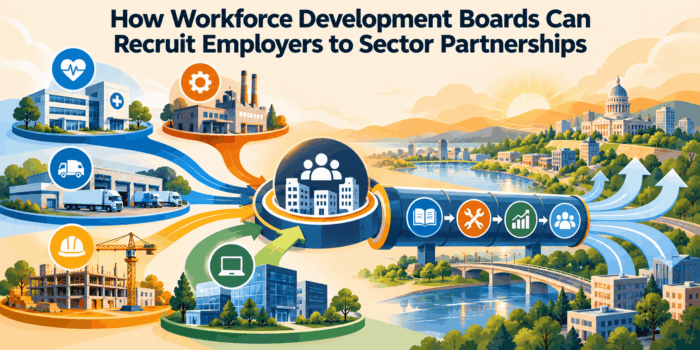
How Workforce Development Boards Can Recruit Employers to Sector Partnerships
A sector partnership asks employers to do something that runs against much of their competitive instinct. It invites businesses that recruit from the same labor pool, sometimes poach each other’s workers, and compete for the same customers to sit at the same table and talk openly about their workforce problems. It asks them to give time they do not have to meetings whose payoff is uncertain and delayed. It asks them to trust a public agency, often one they have had little contact with, to convene the conversation fairly and turn it into something useful. And it asks them to commit to actions, such as shaping curriculum, hosting work-based learning, or interviewing graduates, that require effort from people already stretched thin. When a sector partnership works, employers discover that their shared problems are larger than their competitive differences, and that solving them together produces benefits none could achieve alone. But getting employers to that discovery requires communication that most workforce boards are not accustomed to.
Sector partnerships have become a central strategy in workforce development. The Workforce Innovation and Opportunity Act calls for local boards to lead efforts to engage employers and to develop and implement industry or sector partnerships, and state and local plans commonly describe sector strategies. The logic is compelling: by organizing workforce efforts around the needs of a particular industry in a regional labor market, and by bringing employers together with training providers, workforce agencies, and other partners, sector partnerships can align training with real demand, create clear pathways for jobseekers, and help employers address shared challenges such as skill gaps, recruitment difficulties, and turnover.
The strategy depends entirely on employer participation. A sector partnership without engaged employers is a meeting of public agencies talking about industry needs on industry’s behalf. Yet recruiting employers to sector partnerships is difficult. Employers may not understand what a sector partnership is, may doubt that it will produce results, may be wary of sharing information with competitors, may see it as another government initiative that will consume time and produce reports, or may simply be too busy. Workforce boards that approach recruitment as an invitation to a meeting, rather than as an effort to engage employers around problems they care about, often struggle to attract and retain the employers they need.
This article examines how workforce development boards can recruit employers to sector partnerships. Its central argument is that employers join and stay in sector partnerships when they see a shared problem worth solving, believe that collaboration can solve it better than acting alone, trust the convener to respect their time and lead fairly, and have a real role in shaping the work. It addresses why partnerships depend on employer leadership, how to explain sector partnerships plainly, how to choose a sector and frame a shared problem, how to identify and approach employers, how to make the invitation, how to address concerns about collaborating with competitors, how to run a first convening that earns a second, how to sustain engagement and build employer ownership, the role of the convener, communication with public partners, equity, and measurement.
Why Sector Partnerships Depend on Employer Leadership
 Many public initiatives are designed by agencies and then presented to stakeholders for input. Sector partnerships work differently. Their value comes from employers’ direct knowledge of the skills their industry needs, the jobs that are hard to fill, the career paths available, and the changes affecting their workforce. When employers lead, the partnership’s priorities reflect real industry needs, training aligns with actual jobs, and employers commit to the solutions because they helped design them. When agencies lead and employers merely advise, the partnership risks pursuing priorities employers do not share, producing training employers do not value, and losing employer participation over time.
Employer leadership matters for several reasons. The first is accuracy. Employers know their workforce needs better than any labor market report. Public data can show broad trends, but employers can describe specific skills, credentials, equipment, and work conditions that determine whether training prepares people for real jobs. Partnerships that rely on employer knowledge produce more relevant solutions.
The second is commitment. Employers are more likely to hire graduates, host work-based learning, provide equipment or instructors, and stay engaged when they have shaped the partnership’s direction. Ownership produces investment. Employers who feel they were consulted only after decisions were made are less likely to commit resources.
The third is credibility with other employers. Employers are most persuaded by other employers. A partnership visibly led by respected industry figures attracts additional employers more effectively than one led by a public agency. Employer champions become the partnership’s most effective recruiters.
The fourth is sustainability. Public initiatives often depend on particular staff, grants, or political priorities, and they may fade when those change. Partnerships with strong employer leadership can persist through changes in public staffing and funding, because employers have a direct stake in their continuation.
Employer leadership does not mean that public agencies step back. Workforce boards and their partners play essential roles as conveners, facilitators, data providers, and connectors to training and jobseekers. But the communication posture changes. Instead of presenting a plan and asking employers to endorse it, the board invites employers to identify problems and shape solutions, and positions itself as the partner that helps them act on their decisions.
This posture has direct implications for recruitment. Employers are more likely to join a partnership when the invitation emphasizes their leadership role and the problems they care about, rather than the agency’s program goals. Messages such as join other employers in the region to tackle the technician shortage together, with the workforce board providing support, speak to employers’ interests and agency. Messages such as the workforce board is launching a sector partnership and invites your participation position employers as participants in someone else’s initiative.
The principle of employer leadership also shapes how boards measure recruitment success. Success is not simply the number of employers who attend a meeting but the number who take on active roles, shape the agenda, commit resources, and recruit peers. Boards that recruit for leadership, not only for attendance, build stronger partnerships. The sections that follow describe how to communicate in ways that invite this leadership.
Skilled & Connected: Communication Strategies for Workforce Development Agencies, Career Centers, and Local Employment Services
This article is part of our series on strategic communication for Workforce Development Agencies, Career Centers, and Local Employment Services. To learn more and to see the parent article, which links to other content just like this, click the button below.
What a Sector Partnership Is, in Plain Terms
Many employers have never heard the term sector partnership, and those who have may associate it with vague collaborations that produce little. Before recruiting employers, boards need a clear, plain-language explanation of what a sector partnership is, what it does, and what participating involves. This explanation should be concise enough to share in a brief conversation and concrete enough that employers can picture the work.
In plain terms, a sector partnership is a group of employers in the same industry in a region, working together with training providers, the workforce board, and other partners to address workforce challenges they share. Rather than each employer struggling separately to find skilled workers, train new hires, or reduce turnover, the employers identify common needs and work with partners to develop solutions, such as training programs designed around their requirements, recruitment pipelines, work-based learning opportunities, career pathways, or shared approaches to retention. The employers set the priorities; the partners help carry them out.
Several features distinguish sector partnerships from other forms of employer engagement. They focus on a single industry or closely related group of occupations, such as healthcare, advanced manufacturing, construction, logistics, or information technology, which allows employers to address shared needs in depth. They are regional, reflecting the labor market in which employers recruit. They are employer-led, with employers defining priorities and providing direction. They involve multiple partners, including community colleges, training providers, economic development organizations, labor organizations, community organizations, and the workforce board. And they are action-oriented, focused on concrete solutions rather than discussion alone.
Employers often want to know what participation involves. A plain-language description might explain that participating employers attend periodic meetings, perhaps quarterly or monthly at the start, to identify needs and review progress; share information about their workforce needs, such as hard-to-fill positions, required skills, and hiring plans; help shape solutions, such as reviewing training curriculum or defining skill standards; and, depending on their capacity and interest, contribute in other ways, such as hosting site visits, providing work-based learning, interviewing graduates, or recruiting other employers. It should be clear that employers can participate at different levels and that the partnership will respect their time.
Employers also want to know what they will get. Potential benefits include a stronger pipeline of qualified candidates, training aligned to their needs, reduced recruitment and training costs, access to public resources such as training funds, relationships with peers and partners, a collective voice with educators and policymakers, and improved regional capacity to attract and retain workers. These benefits should be described realistically, since outcomes depend on the partnership’s work and take time to materialize.
The explanation should also be honest about what a sector partnership is not. It is not a staffing service that will immediately fill positions. It is not a vehicle for employers to coordinate wages or hiring practices in ways that would raise legal concerns. It is not a one-time event. And it is not a government program that employers simply receive; it requires their engagement.
Boards can develop a short written summary, a brief presentation, and a few talking points that staff and employer champions can use consistently. Where sector partnerships already exist in other industries or regions, concrete examples of what those partnerships have accomplished, described accurately, help employers picture what is possible.
Choosing the Sector and Framing the Shared Problem
Employer recruitment begins before the first employer is contacted, with the choice of sector and the framing of the problem the partnership will address. Employers respond to problems they recognize and care about. A partnership organized around a sector where employers feel acute workforce pressure, framed around a problem they already discuss among themselves, is far easier to recruit for than one organized around a sector chosen for administrative reasons or framed in abstract terms.
Choosing the sector involves both data and conversation. Labor market information can identify industries that are significant to the regional economy, growing, facing workforce shortages, offering good wages and career paths, or undergoing change that creates skill needs. State and local plans often identify target sectors. But data alone does not reveal whether employers in a sector feel enough pressure to invest in collaboration. Conversations with employers, industry associations, economic development partners, and business services staff reveal where employers are actively worried about workforce issues and open to working together. A sector where data shows need and employers express urgency is the strongest candidate.
Framing the shared problem is the next step. A sector partnership needs a reason to exist that employers find compelling. Rather than framing the partnership as a general effort to address workforce needs in healthcare, boards can identify a specific problem, such as a shortage of certified nursing assistants and medical assistants that is driving overtime costs and burnout, or difficulty finding maintenance technicians able to work on automated equipment. Specific problems are easier for employers to recognize, discuss, and act on. They also suggest concrete solutions, which helps employers see the partnership’s potential value.
The framing should be grounded in what employers themselves say. Before launching recruitment, board staff can conduct a series of individual conversations with employers in the sector, asking about their workforce challenges and whether they see these challenges as shared across the industry. Patterns in these conversations reveal the problems employers care most about and the language they use to describe them. Using employers’ own language in recruitment messages signals that the partnership is responding to their concerns.
The framing should be honest about what collaboration can achieve. Some workforce problems, such as low wages relative to competing industries or difficult working conditions, are within employers’ control and may not be solved by training alone. A partnership framed as solving a shortage through training, when the underlying issue is job quality, may disappoint. Boards can raise these issues thoughtfully, recognizing that employers may be willing to address job quality as part of a broader strategy, but should not promise that training will solve problems it cannot.
The scope of the partnership matters as well. A partnership that tries to address every workforce issue in a large sector may become unfocused. One that focuses on a few priority occupations or problems is more manageable and can produce visible results sooner. Scope can expand as the partnership matures and builds trust.
Finally, framing should consider the region. Sector partnerships are most effective when they reflect the labor market in which employers actually recruit, which may span multiple local workforce areas. Coordinating with neighboring boards and regional partners to define the partnership’s geography ensures that it includes the employers and partners relevant to the labor market.
A well-chosen sector and a clearly framed problem give recruitment a compelling starting point. Employers who hear that a partnership is forming to tackle a problem they recognize, using language that reflects their concerns, are far more likely to engage.
Identifying and Approaching the Right Employers
Not every employer in a sector will join a partnership, and not every employer that joins will play the same role. Recruitment is more effective when boards identify the employers most likely to engage and lead, approach them through the right channels and messengers, and build momentum from early commitments.
Finding Champions
Every successful sector partnership has employer champions: leaders who care about the problem, are respected by their peers, and are willing to invest time in convening others. Champions may be executives, human resources leaders, operations managers, or owners of influential businesses. They may already serve on the workforce board, an industry association, or a community college advisory committee. Identifying and recruiting one or two champions before broader recruitment begins gives the partnership credibility and provides employer voices to invite others. Champions should be approached individually, with a clear explanation of the problem, the partnership concept, and the leadership role they could play.
Seeking a Mix of Employers
A strong partnership includes employers that reflect the sector’s diversity: large and small, established and growing, located in different parts of the region, and representing different segments of the industry. Large employers bring resources and hiring volume; small employers bring perspectives on challenges they face without dedicated human resources staff. Including employers owned by members of underrepresented groups, and employers in underserved areas, broadens the partnership’s relevance and equity. Boards should avoid recruiting only employers with which they already have relationships, since this can narrow the partnership’s perspective.
Reaching the Right People
Within each employer, the right participant is someone with knowledge of workforce needs and authority to commit resources. In small businesses, this may be the owner. In larger organizations, it may be a human resources director, operations leader, or plant manager. Recruiting someone without decision-making authority may produce attendance without commitment. At the same time, partnerships benefit from including people who understand the work itself, such as supervisors or training managers, who can contribute practical knowledge about skills and training.
Using Trusted Channels
Employers are more likely to respond to invitations from people they know and trust. Industry associations, chambers of commerce, economic development organizations, community college workforce divisions, labor organizations, and board members with industry ties can make introductions and lend credibility. Personal invitations from employer champions to their peers are particularly effective. Business services staff with existing employer relationships can identify and approach employers they already serve. Cold outreach from the workforce board alone is less likely to succeed.
Approaching Individually First
Before inviting employers to a group meeting, boards can meet with them individually to discuss their workforce challenges, explain the partnership concept, and gauge interest. These conversations build relationships, gather information that shapes the partnership’s agenda, and allow employers to ask questions privately. Employers who have had an individual conversation are more likely to attend a convening and to participate actively.
Building Momentum
Early commitments make later recruitment easier. When a few respected employers have agreed to participate, others are more willing to join. Recruitment messages can name participating employers, with their permission, signaling that the partnership is credible and that peers are involved. Each additional commitment strengthens the case for others.
Recruitment is not a one-time effort. Partnerships should continue recruiting employers as they mature, bringing in new participants to broaden perspectives and replace those who leave. A partnership that remains open and actively welcomes new members stays vital.
Making the Invitation: Value and Commitment
The invitation to join a sector partnership is a request for time, attention, and eventually resources. Employers will accept only if they believe the value outweighs the cost. The invitation must therefore communicate value clearly, describe the commitment honestly, and make it easy to say yes to a first step.
The invitation should lead with the problem, not the partnership. Employers do not want to join a partnership for its own sake; they want to solve a problem. An invitation that begins by naming the problem, such as the region’s healthcare employers are struggling to fill medical assistant and nursing assistant positions, and overtime and agency staffing costs are rising, captures attention because it reflects what employers are experiencing. The partnership is then introduced as a way to address that problem collectively.
The value proposition should be specific. Rather than promising generic benefits, the invitation can describe what the partnership might accomplish, such as designing a training program with local colleges that produces graduates ready for employers’ specific requirements, creating a shared recruitment pipeline, developing work-based learning opportunities that let employers evaluate candidates, or making a collective case to educators and policymakers. Where the board can bring resources, such as training funds, labor market data, facilitation, or connections to colleges, the invitation should say so. Where other partnerships have achieved results, accurately described examples can make the value tangible.
The commitment should be described honestly and modestly at first. Employers are more likely to agree to a defined, limited commitment than to an open-ended one. An initial invitation might ask employers to attend a first meeting of about ninety minutes to discuss shared challenges and decide whether to proceed, with no further obligation. Subsequent commitments, such as quarterly meetings, participation in a working group, or reviewing a curriculum, can be introduced as the partnership develops and employers see value. Being honest about the time involved builds trust; underestimating it and then asking for more erodes trust.
The invitation should emphasize employers’ leadership role. Messages such as employers will set the priorities and direct the work, and the workforce board will provide support and resources, signal that employers will shape the partnership rather than serve as an audience. Naming employer champions who are leading the effort reinforces this message.
The invitation should come from a credible messenger. An invitation from an employer champion, an industry association leader, or a respected peer carries more weight than one from a public agency alone. Joint invitations, signed by an employer champion and the workforce board director, combine industry credibility with public support.
The format of the invitation matters. A personal phone call or meeting, followed by a brief written invitation summarizing the problem, the partnership’s purpose, the initial commitment, and logistics, is more effective than a mass email. Written materials should be concise, professional, and free of public program jargon.
The invitation should make it easy to respond. Clear logistics, such as date, time, location, and how to confirm, along with options for those who cannot attend, such as an individual follow-up conversation, reduce friction. Scheduling meetings at times convenient for employers, such as early morning or over lunch, and in locations accessible to them, signals respect for their time.
Finally, the invitation sets expectations that must be met. If the invitation promises an efficient, action-oriented meeting led by employers, the meeting must deliver. The first convening, discussed below, is where the credibility of the invitation is tested.
Addressing Concerns About Collaborating With Competitors
One of the most significant barriers to employer participation in sector partnerships is reluctance to collaborate with competitors. Employers may worry that sharing information about their workforce needs will reveal competitive weaknesses, that competitors will use the partnership to recruit their workers, that their investment in training will benefit competitors who did not contribute, or that collaboration could raise legal concerns. These concerns are legitimate and must be addressed directly and honestly in recruitment communication.
The first response is to focus on shared problems. Most workforce challenges in a sector, such as a regional shortage of qualified technicians, lack of training programs aligned to industry needs, or poor public awareness of careers in the industry, affect all employers. No single employer can solve them alone, and each employer benefits when the regional talent pool grows. Communication that emphasizes these shared problems, and the collective benefit of addressing them, helps employers see collaboration as expanding the pie rather than dividing it.
The second response is to clarify what will and will not be shared. Employers should understand that participation does not require disclosing proprietary information, business strategies, or confidential data. The partnership focuses on shared workforce needs, such as common skills and occupations, which are generally not competitively sensitive. Employers can decide what to share. Ground rules established at the outset, such as treating discussions as confidential and focusing on common needs, provide reassurance.
The third response concerns legal considerations. Federal antitrust enforcement agencies have issued guidance indicating that agreements among competing employers about wages, benefits, or not recruiting each other’s employees can violate antitrust law, and that sharing competitively sensitive information about compensation can raise concerns. Sector partnerships should be designed to avoid these risks. Conveners should establish clear guidelines that discussions will not involve setting or coordinating wages, benefits, or hiring restrictions, and should consult legal counsel when designing ground rules. Communicating these guidelines to employers both protects the partnership and reassures employers that participation will not expose them to legal risk. Employers’ own counsel may wish to review the guidelines.
The fourth response addresses concerns about free riders and poaching. Employers may worry that they will invest in training only to see competitors hire the graduates. Communication can acknowledge this concern and describe how partnerships address it, such as by producing enough graduates to meet multiple employers’ needs, by giving participating employers early access to graduates through work-based learning and interviews, or by recognizing that a larger regional talent pool benefits everyone even if individual workers move between employers. Partnerships cannot eliminate competition for talent, but they can make the overall supply of talent larger.
The fifth response is the role of a neutral convener. Employers are more comfortable collaborating when a neutral party, such as the workforce board or an intermediary, convenes the partnership and manages discussions fairly. The convener ensures that no single employer dominates, that ground rules are followed, and that the partnership serves shared interests. Communicating the convener’s role and commitment to neutrality reassures employers.
The sixth response is peer reassurance. Employer champions who have participated in sector partnerships, or who have thought through these concerns, can speak to peers about why they believe collaboration is worthwhile. Their reassurance carries more weight than the convener’s.
Addressing these concerns openly, rather than hoping employers will not raise them, demonstrates respect and builds the trust that collaboration requires. Employers who see that their concerns have been anticipated and addressed thoughtfully are more willing to participate.
The First Convening
The first meeting of a sector partnership is the moment when the promises of recruitment are tested. Employers who attend have given their time based on an invitation that described a problem worth solving and a partnership worth joining. If the meeting confirms that description, with a clear purpose, efficient use of time, genuine employer voice, and a credible path to action, employers are likely to return. If the meeting feels like a government presentation, a vague discussion, or a waste of time, many will not come back, and their impressions will spread to other employers. The first convening is therefore as much a recruitment event as a working meeting, and its design deserves careful attention.
The meeting should be employer-centered from the start. An employer champion, rather than a public official, can open the meeting, welcome participants, and frame the problem. Public partners can introduce themselves briefly, but the agenda should prioritize employer discussion over agency presentations. A common mistake is to fill the first meeting with presentations about workforce programs, labor market data, and the board’s plans, leaving little time for employers to speak. Employers attending a first convening want to hear from each other and to be heard.
The central activity of the first meeting is usually a facilitated discussion of shared workforce challenges. Employers describe their hardest-to-fill positions, the skills candidates lack, the challenges they face in training and retaining workers, and their expectations for the coming years. A skilled facilitator draws out these perspectives, identifies common themes, and helps the group see where their challenges overlap. Labor market data can be presented briefly to provide context, but it should support rather than replace employer discussion.
The meeting should move toward priorities. By the end, participants should have identified one or a few shared problems they want the partnership to address. Prioritizing focuses the partnership and gives employers a sense of progress. Facilitation techniques, such as asking employers to identify the problems that most affect their businesses and where collaboration could make the biggest difference, help the group converge.
The meeting should establish ground rules and roles. Brief discussion of how the partnership will operate, including confidentiality, the antitrust guidelines discussed earlier, meeting frequency, and the roles of employers and partners, builds trust and clarity. Employers can be invited to take on roles, such as co-chairing the partnership or participating in a working group on a particular priority.
The meeting should respect time. Starting and ending on time, keeping presentations brief, and maintaining focus show that the convener values employers’ time. A meeting that runs long or wanders loses credibility.
The meeting should end with clear next steps. Employers should leave knowing what will happen next, when the next meeting will occur, what they are being asked to do in the meantime, and what the convener will do. A summary sent promptly after the meeting, capturing the priorities identified, the next steps, and commitments made, reinforces progress and demonstrates follow-through.
The convener should follow up individually. Brief conversations with participants after the meeting, asking for their impressions and inviting them to take on roles, deepen engagement. Employers who were invited but did not attend can receive the summary and an invitation to the next meeting, keeping the door open.
Finally, the first convening sets the tone for the partnership. If it demonstrates that the partnership will be employer-led, focused, efficient, and action-oriented, employers will return and invite their peers. If it does not, recruitment will become much harder.
Keeping Employers Engaged After the First Meeting
Recruiting employers to a first meeting is difficult; keeping them engaged over months and years is harder. Employer participation in sector partnerships often declines after initial enthusiasm, as competing priorities reassert themselves and the partnership’s work moves into slower phases. Sustaining engagement requires communication that demonstrates progress, respects employers’ time, and keeps the partnership connected to the problems employers care about.
The most important factor in sustaining engagement is visible progress. Employers stay engaged when they see that the partnership is producing results: a training program designed, a curriculum revised, a cohort recruited, graduates hired, a work-based learning program launched. Partnerships that spend long periods planning without visible action lose employers. Conveners can identify early wins, achievable within a few months, that demonstrate the partnership’s value while longer-term work proceeds. An early win might be a shared job description for a common position, a joint career fair, a site visit for career counselors, or a pilot training cohort.
Regular communication about progress keeps employers informed between meetings. Brief updates, such as a monthly email summarizing what has happened, what is coming, and how employers can contribute, maintain connection without demanding time. Updates should highlight employer contributions and results, reinforcing the partnership’s value.
Meetings must remain valuable. As the partnership matures, meetings should focus on decisions and action rather than status reports. Employers should have meaningful roles in meetings, such as leading discussions, reporting on working group progress, or making decisions about priorities. Meetings that become routine information sessions lose attendance.
Flexible participation helps. Not every employer can attend every meeting or contribute to every activity. Offering different ways to participate, such as working groups focused on specific priorities, occasional surveys or input requests, site visits, or hosting a single event, allows employers to contribute according to their capacity. Communicating that partial participation is valued keeps employers connected who might otherwise drop out entirely.
Recognition sustains engagement. Acknowledging employers’ contributions publicly, with their permission, such as in newsletters, at events, or in reports to the workforce board and elected officials, signals appreciation and enhances employers’ reputations. Employers who host work-based learning, hire graduates, or lead working groups deserve particular recognition.
Responsiveness to employer input sustains trust. When employers raise concerns or suggest changes, the convener should respond and act where possible. Employers who see that their input shapes the partnership’s direction remain invested.
The partnership should evolve with employers’ needs. Workforce challenges change as business conditions change. A partnership that continues to focus on a problem employers no longer consider urgent will lose relevance. Periodic review of priorities, led by employers, keeps the partnership aligned with current needs.
Transitions in employer representatives require attention. When an employer’s representative leaves the company or changes roles, the partnership can lose that employer’s engagement. Conveners should maintain relationships with more than one person at key employers where possible, and should promptly reach out to new representatives to brief them and invite continued participation.
Finally, celebrating milestones, such as the first graduating cohort, the first anniversary of the partnership, or a significant hiring achievement, provides occasions to reinforce engagement, recognize contributions, and invite new employers to join.
Building Employer Leadership and Ownership
 Sector partnerships are most durable when employers do not simply participate but lead and own the work. Ownership means that employers see the partnership as theirs, set its direction, and take responsibility for its success. Building ownership is a gradual process that depends on how the convener communicates and shares authority.
The first step is formal leadership roles. Employer co-chairs or a steering committee of employers can lead the partnership, set agendas, facilitate meetings, and represent the partnership publicly. These roles should carry real authority over priorities and direction, not merely ceremonial titles. The convener supports these leaders with staff work, facilitation assistance, and resources, but the leaders make decisions.
The second step is employer-led working groups. As the partnership identifies priorities, working groups focused on specific problems, such as curriculum development, recruitment, or work-based learning, allow employers to lead concrete efforts. Employer chairs of working groups take ownership of particular outcomes and report progress to the full partnership.
The third step is employer voice in communication. When the partnership communicates externally, to other employers, educators, policymakers, or the public, employer leaders should be the primary voices. Employer leaders presenting the partnership’s work at industry events, testifying before policymakers, or speaking to media signals that the partnership is industry-led and builds its credibility.
The fourth step is employer contribution of resources. Ownership deepens when employers contribute resources, such as equipment for training, instructors, work-based learning placements, funding for specific activities, or staff time. Contributions should be invited according to employers’ capacity, and all contributions should be recognized. Employers who have invested resources are more committed to the partnership’s success.
The fifth step is shared decision-making with partners. Employers lead, but training providers, workforce agencies, labor organizations, and community partners also contribute expertise and resources. Effective partnerships establish processes for these partners to contribute to decisions in their areas of expertise, such as curriculum design or student support, while respecting employers’ leadership on industry needs. Clear communication about how decisions are made prevents confusion and conflict.
The sixth step is gradual transfer of responsibilities. In early stages, the convener often carries much of the work: scheduling meetings, preparing materials, following up. As the partnership matures, employers and partners can take on more of these responsibilities, building capacity and ownership. Some partnerships eventually become independent organizations or are hosted by industry associations, with the workforce board as a partner rather than convener.
The convener’s communication posture is central to building ownership. Conveners who speak of the partnership as their initiative, make decisions without employer input, or present employers with finished plans undermine ownership. Conveners who consistently defer to employer leaders, ask for employer decisions, and credit employers for progress build it. Language matters: referring to the partnership’s priorities, the employers’ plan, or the partnership’s decisions, rather than the board’s program, reinforces employer ownership.
Ownership also requires honest communication about what the convener can and cannot provide. Employers who lead the partnership need to understand the resources available, the constraints on public funds, and the timelines of public processes. Transparency about these realities allows employer leaders to make informed decisions.
When employers own the partnership, they become its most effective recruiters, advocates, and sustainers, and the partnership becomes far more resilient than one dependent on a public agency’s continued effort.
The Role of the Convener
Every sector partnership needs a convener: an organization that brings participants together, facilitates their work, manages logistics, connects them with resources, and keeps the partnership moving. Workforce boards often serve as conveners, but intermediaries such as industry associations, community colleges, economic development organizations, labor-management organizations, or nonprofit workforce intermediaries may play this role instead or alongside the board. The convener’s communication shapes employers’ experience of the partnership and significantly influences whether employers join and stay.
The convener’s first communication task is to establish credibility. Employers need to believe that the convener understands their industry, will use their time well, and can deliver resources and results. Conveners build credibility through industry knowledge, professional facilitation, reliable follow-through, and connections to useful resources. A convener whose staff understand the sector’s occupations, challenges, and language, and who can bring labor market data, training partners, and funding, is far more credible than one that appears to be learning about the industry from scratch.
The second task is neutrality. Employers in a partnership include competitors, and the convener must manage discussions fairly, ensuring that no employer dominates and that the partnership serves shared interests. The convener should communicate its commitment to neutrality, enforce ground rules consistently, and avoid favoring particular employers in allocating resources or recognition.
The third task is facilitation. Productive partnership meetings require skilled facilitation that draws out diverse perspectives, manages conflict, keeps discussions focused, and moves the group toward decisions. Conveners should invest in facilitation skills or engage skilled facilitators, particularly for early meetings that set the partnership’s tone.
The fourth task is information management. The convener prepares materials, summarizes discussions, tracks commitments, and communicates progress. This work is often invisible but essential. Concise, accurate summaries distributed promptly after meetings, regular progress updates, and well-organized materials demonstrate professionalism and keep participants engaged.
The fifth task is connecting resources. Employers join partnerships in part because conveners can connect them with resources they could not access alone: training funds, community college programs, labor market data, recruitment channels, apprenticeship assistance, and connections to policymakers. The convener should communicate clearly what resources are available, how they can be accessed, and what constraints apply, so that employers can plan realistically.
The sixth task is translating between worlds. Sector partnerships bring together employers, educators, workforce agencies, and community organizations, each with its own language, timelines, and constraints. Employers may not understand why a community college cannot launch a new program immediately; educators may not understand why employers need graduates on a particular timeline. The convener helps each group understand the others, translating needs and constraints so that the partnership can find workable solutions.
The seventh task, as discussed earlier, is fostering employer ownership. The convener’s ultimate goal is a partnership that employers lead and own, with the convener in a supporting role.
Where a workforce board is not the best convener, for example when an industry association has stronger employer relationships or a community college has deeper industry expertise, the board can support another convener while contributing resources and connections. Communicating clearly about roles, so that employers understand who convenes and how the board contributes, prevents confusion. Whatever the arrangement, the convener’s communication should consistently reflect respect for employers’ time, leadership, and interests.
Communicating With Public and Community Partners
Sector partnerships are led by employers but depend on many other partners: community colleges and training providers that design and deliver training, economic development organizations that understand industry trends and business attraction strategies, labor organizations that represent workers and operate apprenticeship programs, K-12 schools that prepare future workers, community organizations that reach jobseekers facing barriers, one-stop partners that provide career and supportive services, and elected officials who influence policy and funding. Communication with these partners shapes the partnership’s capacity to act on employers’ priorities, and it also influences employer recruitment, since employers are more likely to join partnerships that have credible, engaged partners.
Community colleges and training providers are often the partnership’s most important partners after employers. They translate employer needs into training programs, and their responsiveness determines whether the partnership can deliver results. Communication with colleges should clearly convey employer needs, invite college staff to participate in partnership meetings, and acknowledge the constraints colleges face, such as curriculum approval processes, faculty availability, and funding cycles. Colleges that participate actively and respond to employer input strengthen the partnership’s credibility with employers.
Economic development organizations bring knowledge of industry trends, business expansion and attraction, and regional economic strategy. Aligning sector partnerships with economic development priorities ensures that workforce efforts support regional growth, and economic development partners can help recruit employers through their business relationships. Communication should coordinate messages so that employers hear a consistent story about regional talent strategy.
Labor organizations represent workers in many industries and operate apprenticeship programs. Including labor organizations where relevant brings worker perspectives, apprenticeship expertise, and in some cases training resources. Communication should respect labor organizations’ roles and relationships with employers.
K-12 schools and career and technical education programs prepare future workers. Connecting sector partnerships with schools allows employers to influence early career exposure and pathways. Communication with schools should identify concrete opportunities for collaboration, such as career exploration activities, work-based learning, and curriculum alignment.
Community organizations connect the partnership with jobseekers who may face barriers to entering the industry. Their participation helps ensure that training and recruitment reach diverse candidates and that support services are available. Communication should invite community organizations into the partnership’s work, particularly on recruitment and support.
One-stop partners, including career centers, adult education, and vocational rehabilitation, provide the services jobseekers need to prepare for and enter training. Communication within the workforce system ensures that career advisors know about partnership training opportunities and can refer suitable jobseekers.
Elected officials can support partnerships through policy and funding and can amplify their visibility. Periodic briefings on partnership progress, with employer leaders presenting, can build political support. Communication should emphasize employer leadership and concrete results.
Across all partners, the convener’s communication should clarify roles, align messages, share progress, and connect each partner’s contributions to employers’ priorities. Partners should understand that the partnership is employer-led, and that their role is to help employers’ priorities succeed. Regular communication, such as partner updates and joint planning, keeps everyone aligned and demonstrates to employers that the partnership has the capacity to act.
Equity and Inclusion in Sector Partnerships
Sector partnerships shape who gains access to careers in an industry. The training programs they design, the recruitment channels they use, the requirements they set, and the employers they include all influence whether opportunities reach a broad range of residents or remain concentrated among those already connected to the industry. Building equity and inclusion into sector partnerships, and communicating about them thoughtfully, ensures that partnerships serve the whole community and fulfill the public workforce system’s mission.
Equity begins with which employers are recruited. Partnerships dominated by large, established employers may overlook the needs and perspectives of small businesses, businesses owned by members of underrepresented groups, and businesses in underserved neighborhoods. Deliberately recruiting a diverse set of employers broadens the partnership’s relevance and ensures that its solutions work for different kinds of businesses.
Equity extends to which partners are included. Community organizations that serve residents facing barriers, organizations serving specific populations, and labor organizations bring perspectives that employers and educators may lack. Including them in the partnership helps ensure that training and recruitment reach diverse candidates and that barriers are recognized and addressed.
Equity shapes how the partnership defines requirements. Employers may set hiring requirements, such as degrees, years of experience, or particular credentials, that exceed what the work actually requires and exclude qualified candidates. Partnerships can examine whether requirements are necessary and whether skills-based approaches could broaden access. Communication with employers about this topic should be respectful and evidence-based, focusing on how broader requirements can expand the talent pool.
Equity influences recruitment for partnership training. Recruitment that relies on employers’ existing networks or traditional channels may reach mainly residents already connected to the industry. Partnering with community organizations, adult education programs, reentry programs, and other channels reaches residents who might not otherwise hear about opportunities. Recruitment materials should reflect diverse candidates and should be available in multiple languages and accessible formats.
Equity requires attention to support. Residents facing barriers may need supportive services, such as transportation, childcare, and help with costs, to participate in training. Partnerships that coordinate with workforce agencies and community organizations to provide these supports enable broader participation.
Equity includes job quality. Sector partnerships can discuss with employers the quality of the jobs they offer, including wages, benefits, schedules, advancement opportunities, and working conditions. Jobs that offer family-sustaining wages and advancement are more likely to retain workers and to provide real economic mobility. Partnerships can encourage employers to consider job quality as part of their workforce strategy, framing it as a means to improve recruitment and retention.
Equity involves inclusive workplaces. Workers from underrepresented groups who enter an industry through partnership training may face hostile or unwelcoming workplaces. Partnerships can encourage employers to support inclusive workplaces, mentoring, and retention efforts.
Communicating about equity in sector partnerships requires care. Some employers may perceive equity discussions as criticism or as imposing social goals on business decisions. Framing equity in terms of expanding the talent pool, improving retention, and meeting the industry’s workforce needs, while being honest about the partnership’s commitment to broad access, makes equity relevant to employers’ interests. Employer champions who value equity can lead these conversations among their peers.
Finally, equity should be measured. Tracking the demographics of partnership training participants, completers, and hires, where data can be appropriately collected, shows whether the partnership is broadening access and guides adjustments.
Recruiting a Sector Partnership in Practice
The following hypothetical example illustrates how a workforce development board might recruit employers to a sector partnership. It does not describe an actual region or partnership.
A workforce board in a region with a large and growing advanced manufacturing sector hears repeatedly from business services staff that manufacturers struggle to find maintenance technicians who can work on automated equipment. Labor market data confirms high demand and wages above the regional median. The board decides to explore a sector partnership focused on maintenance technician talent.
Before inviting anyone to a meeting, board staff conduct individual conversations with about fifteen manufacturers of different sizes. They ask about workforce challenges, hardest-to-fill positions, and whether employers see these challenges as shared. The conversations confirm that maintenance technician shortages are widespread and that employers are frustrated with the lack of training aligned to their equipment. Several employers mention that they have tried to train technicians internally but cannot afford to do so alone. Two employers, a plant manager at a large manufacturer and the owner of a mid-sized machine shop, express strong interest in leading a collaborative effort.
The board recruits these two employers as co-chairs. Together, they develop a brief invitation, signed by both co-chairs and the board director, describing the problem in employers’ own language, proposing a partnership to design training with the local community college and create a shared pipeline, and inviting manufacturers to a ninety-minute breakfast meeting to discuss whether to proceed. The invitation emphasizes that employers will set priorities and that participation beyond the first meeting is optional. The co-chairs personally call several peers. The regional manufacturers’ association shares the invitation with members.
In preparation for the meeting, the board consults legal counsel and develops brief ground rules, including that discussions will not address wages, benefits, or hiring restrictions among competitors.
Twenty-two manufacturers attend. The co-chairs open the meeting and frame the problem. Board staff present a few minutes of labor market data. A facilitator leads a discussion in which employers describe the skills technicians need, the equipment they use, and the gaps they see. The community college’s workforce dean describes what the college can offer and asks for employer input. By the end, employers agree on two priorities: a short-term training program for entry-level maintenance technicians aligned to common equipment, and a work-based learning component in which participating employers host trainees. Several employers volunteer for a curriculum working group. A summary is sent the next day.
Over the following months, the working group, led by an employer, works with the college to design the curriculum. Employers donate equipment for the training lab. The board coordinates recruitment for the first cohort with career centers, adult education, and community organizations, with attention to reaching residents historically underrepresented in manufacturing. The first cohort begins within the year, and participating employers host work-based learning. Most graduates are hired by partnership employers.
The partnership publicizes its results through the manufacturers’ association, with employer co-chairs presenting. Additional manufacturers ask to join.
The example illustrates the core principles: choosing a sector with urgent, shared need; conducting individual conversations first; recruiting employer champions; making an invitation that leads with the problem and asks for a modest commitment; addressing legal concerns; running an employer-centered first meeting; producing early, visible results; and building on success to recruit more employers.
Measuring Employer Recruitment and Engagement
Sector partnerships are often evaluated by their outcomes, such as training completions, credentials, and hires. These outcomes are essential, but they emerge only after employers have been recruited and engaged. Measuring recruitment and engagement directly helps conveners understand whether they are building the employer participation partnerships need, and where communication should be strengthened.
The first area is recruitment reach. Tracking the number of employers contacted, the number who had individual conversations, the number invited, and the number who attended the first convening shows how effectively recruitment converts interest into participation. Comparing these figures across employer types, such as size, location, and ownership, shows whether recruitment reaches a diverse set of employers.
The second area is sustained participation. Tracking attendance over successive meetings, the number of employers active in working groups, and the duration of employer participation shows whether the partnership retains employers. Declining attendance signals a need to examine whether meetings remain valuable and whether progress is visible.
The third area is depth of engagement. Tracking the roles employers play, such as co-chairs, working group leads, curriculum reviewers, work-based learning hosts, equipment donors, and hiring partners, shows whether employers are moving from attendance to active contribution and ownership.
The fourth area is employer contributions. Tracking employer contributions of time, equipment, instructors, work-based learning placements, and funding provides evidence of employer investment, which is both an indicator of engagement and a demonstration of the partnership’s value to funders and policymakers.
The fifth area is employer satisfaction. Brief surveys of participating employers can ask whether the partnership is addressing their priorities, whether meetings are a good use of time, whether they see progress, and whether they would recommend participation to peers. Responses reveal whether the partnership is meeting employer expectations.
The sixth area is recruitment by employers. The number of new employers recruited by existing employer participants indicates employer ownership and advocacy.
Several questions help conveners monitor recruitment and engagement:
-
How many employers have moved from an individual conversation to attending a convening to taking on an active role?
-
Is attendance stable or declining across successive meetings, and what do employers say about the value of meetings?
-
Are employers contributing resources such as work-based learning placements, equipment, or instructors?
-
Does the mix of participating employers reflect the sector’s diversity in size, location, and ownership?
-
How many new employers have joined through invitations from existing participants?
These measures should be reviewed with employer leaders, who can help interpret results and decide on adjustments. Sharing engagement data with the partnership reinforces accountability and shows employers that their participation matters.
Finally, recruitment and engagement measures should be linked to outcomes. Over time, partnerships with strong employer engagement should produce training aligned to employer needs, graduates hired by participating employers, and improvements in employers’ workforce challenges. Tracking these connections demonstrates the value of investing in employer recruitment and engagement.
How Sector Partnership Recruitment Compares With Other Agency Types
Bringing competing organizations together around shared interests is a challenge many public and civic institutions face. Comparing sector partnership recruitment with other contexts highlights transferable practices and distinctive features.
Economic development organizations frequently convene industry clusters, bringing together businesses in a sector to address shared challenges such as infrastructure, supply chains, and talent. Their experience shows that clusters succeed when they focus on concrete problems, have strong industry leadership, and produce tangible results. Workforce sector partnerships often overlap with or complement these cluster efforts, and coordination can strengthen both.
Industry associations bring competitors together routinely around shared interests such as standards, advocacy, and professional development. They have established practices for managing competitive concerns, including antitrust guidelines, and they hold the trust of their members. Workforce boards can learn from these practices and often partner with associations, which may serve as conveners or co-conveners.
Community colleges convene employer advisory committees for their technical programs. These committees provide input on curriculum and equipment. Their experience shows that employers engage more when their input visibly shapes programs and when meetings are efficient. Sector partnerships can build on advisory committees, expanding them into broader collaborations with greater employer leadership.
Collective impact initiatives in social sectors bring together organizations around shared goals, with a backbone organization coordinating the work. Their emphasis on shared measurement, mutually reinforcing activities, continuous communication, and backbone support parallels the convener’s role in sector partnerships. The collective impact literature also highlights the importance of patience, since such initiatives take time to produce results.
Public health coalitions bring together diverse partners around health issues, often including competing health systems. Their experience with neutral convening, data sharing, and focusing on community-wide benefits offers lessons for managing competitive dynamics.
What distinguishes sector partnership recruitment is the combination of a focus on workforce, where employers compete directly for the same workers; a convener that is often a public agency with its own program goals and constraints; the need to integrate employers with education and training systems that operate on different timelines; and the dual purpose of meeting employer needs and expanding opportunity for jobseekers. These features make honest framing, careful attention to competitive concerns, employer leadership, and equity especially important. Workforce boards can adopt practices from economic development, associations, colleges, and collective impact, but must adapt them to the specific dynamics of competing employers collaborating on talent.
Tying It All Together
Employer recruitment is not a side function of building sector partnerships. It is the foundation on which every partnership rests. Without employers who participate, lead, and invest, a sector partnership is a meeting of public agencies speaking on industry’s behalf. With them, it becomes a vehicle for aligning training with real needs, creating pathways for jobseekers, and addressing challenges no employer could solve alone.
Recruitment succeeds when it is grounded in employer leadership. Employers bring accurate knowledge of industry needs, commit more when they shape the work, persuade peers more effectively than agencies can, and sustain partnerships through changes in public staffing and funding. The convener’s communication posture should consistently invite and support that leadership.
Recruitment begins with a plain explanation of what a sector partnership is and what participation involves, a sector chosen for urgent and shared need, and a specific problem framed in employers’ own language. It proceeds through champions, a diverse mix of employers, the right decision-makers, trusted channels, individual conversations, and momentum built from early commitments. The invitation leads with the problem, offers specific value, asks for a modest first commitment, emphasizes employer leadership, and comes from credible messengers.
Concerns about collaborating with competitors must be addressed directly: by focusing on shared problems, clarifying what will be shared, establishing ground rules that avoid antitrust risks, acknowledging concerns about poaching, ensuring neutral convening, and drawing on peer reassurance. The first convening must deliver on the invitation’s promise through employer-centered, efficient, action-oriented design.
Sustained engagement depends on visible progress, regular updates, valuable meetings, flexible participation, recognition, responsiveness, evolving priorities, and attention to transitions. Ownership grows through formal employer leadership, employer-led working groups, employer voices in external communication, employer contributions, shared decision-making, and gradual transfer of responsibilities. The convener establishes credibility, maintains neutrality, facilitates skillfully, manages information, connects resources, translates between partners, and fosters ownership.
Public and community partners, from colleges to community organizations to elected officials, must be engaged in ways that support employer priorities. Equity and inclusion, in which employers are recruited, how requirements are set, who is recruited for training, and the quality of jobs offered, ensure that partnerships broaden opportunity. And measuring recruitment reach, sustained participation, depth of engagement, contributions, satisfaction, and peer recruitment shows whether the partnership is building the employer foundation it needs.
Strategic Communication Support
 Recruiting employers to sector partnerships requires research into employer needs, careful framing, skilled facilitation, attention to competitive and legal concerns, coordination among many partners, and sustained communication over months and years. Workforce boards often understand the value of sector strategies but lack the time and specialized capacity to recruit employers effectively, design convenings that earn return attendance, and build employer ownership. External support can help boards launch and sustain partnerships that employers want to join.
Stegmeier Consulting Group (SCG) helps public agencies convene diverse stakeholders around shared problems. For workforce boards building sector partnerships, that work can begin with research: individual interviews and surveys with employers in target sectors, conversations with industry associations, colleges, economic development partners, and labor organizations, and analysis of labor market information. This research identifies the problems employers care most about, the language they use, potential champions, and concerns that could limit participation.
From that foundation, SCG can help boards frame the partnership’s purpose in employers’ terms, develop plain-language explanations of sector partnerships and participation, and craft invitations that lead with the problem and ask for modest, clear commitments. SCG can help design and facilitate first convenings and subsequent meetings that are employer-centered, efficient, and action-oriented, and can help develop ground rules that address confidentiality and competitive concerns, in consultation with legal counsel.
Implementation support can include communication plans for sustaining engagement, such as progress updates, recognition approaches, and working group structures; materials that employer champions can use to recruit peers; coordination with colleges, economic development organizations, community organizations, and one-stop partners; and strategies for inclusive recruitment of employers and jobseekers. Leadership toolkits can help board staff and employer co-chairs lead the partnership effectively.
Evaluation support helps conveners track recruitment reach, sustained participation, depth of engagement, employer contributions, satisfaction, and peer recruitment, and use findings with employer leaders to strengthen the partnership. The aim is a sector partnership that employers lead, value, and recommend to their peers.
Future Trends
Several established developments are shaping how workforce boards recruit employers to sector partnerships. Sector strategies have become a mainstream expectation in workforce policy. WIOA calls for local boards to lead industry and sector partnerships, and state and local plans commonly describe them. Federal and state funding opportunities have frequently emphasized sector-based approaches. This mainstreaming means that many employers may have already encountered partnership invitations, some of which delivered value and some of which did not. Boards recruiting employers today must distinguish their partnerships from past efforts that employers found unproductive, which makes credible framing, employer leadership, and early results even more important.
Regional collaboration across workforce areas is increasing. Labor markets rarely align with local workforce area boundaries, and employers recruit from regions that span multiple boards. Partnerships organized at the regional level, with multiple boards collaborating, can reach the full set of relevant employers and avoid duplicative outreach. This trend requires coordination among boards and clear communication to employers about who is convening and how the effort is organized.
Attention to job quality within sector strategies has grown. Some public funders and workforce leaders encourage sector partnerships to address wages, benefits, scheduling, and advancement alongside training. This trend creates opportunities for partnerships to improve outcomes for workers, and it also requires careful communication with employers so that job quality discussions are framed as serving recruitment and retention goals.
Skills-based hiring continues to receive attention, with some employers and public agencies reconsidering degree requirements. Sector partnerships can provide forums where employers examine requirements collectively and develop shared skill standards, potentially broadening access to industry careers. The pace and durability of these changes vary across industries and employers.
Technological change in many industries, including automation and the adoption of artificial intelligence tools, is a subject of employer interest and concern. Partnerships may increasingly focus on how skill needs are changing and how training can adapt. The extent and pace of change remain uncertain and vary by industry, and partnerships should rely on employers’ direct observations rather than generalized predictions.
The extension of Pell Grant eligibility to certain short-term workforce training programs, under federal legislation enacted in 2025 and beginning with the 2026 to 2027 award year, may affect how partnership training programs are funded and structured, particularly short-term programs designed with employer input. Partnerships should follow implementation guidance and consider how this funding source might support training they design.
Finally, the structure and funding of federal workforce programs may change. Budget proposals in recent cycles have contemplated consolidating workforce funding streams, which could affect the resources boards have for convening partnerships. Partnerships with strong employer ownership and diverse partners will be more resilient to changes in public funding.
Conclusion
A sector partnership succeeds when competing employers discover that their shared workforce problems are larger than their differences, and that solving them together is worth their time. That discovery does not happen because a workforce board announces a partnership. It happens because the board listens first, frames the work around a problem employers already feel, recruits respected employers to lead, addresses honestly the concerns that make competitors wary of collaborating, and runs a first meeting good enough that employers want to come back.
For workforce board leaders, the implications go beyond the recruitment pitch. Boards must be willing to share authority with employers, to measure success by employer leadership and investment rather than attendance, and to staff the convening role with people who understand the industry and can facilitate well. They must coordinate with colleges, economic development partners, labor organizations, and community organizations so that employers’ priorities can actually be carried out. And they must hold to the public purpose of the work, ensuring that partnerships broaden access to industry careers rather than simply serving the employers already at the table.
Boards that approach recruitment this way will find that employers become the partnership’s strongest recruiters and its most durable foundation. The partnership then becomes what sector strategies were always meant to be: a shared effort, led by industry and supported by public partners, to build the regional workforce that employers need and residents deserve.
Stegmeier Consulting Group’s Strategic Approach to Communication Systems
SCG approaches sector partnership recruitment as a communication system built around employer leadership. That approach begins with listening, through individual conversations and research that reveal the workforce problems employers feel most urgently and the language they use to describe them. It continues by recruiting employer champions, framing invitations around shared problems with modest and honest commitments, establishing ground rules that address competitive and legal concerns, and designing convenings that give employers the floor and move quickly toward action.
For workforce development boards, this means partnerships that employers recognize as their own, conveners who facilitate rather than direct, early results that justify continued participation, and communication with colleges, economic development organizations, labor, and community partners that keeps everyone aligned behind employer priorities. It means inclusive recruitment of employers and jobseekers, attention to job quality and access, and measurement that tracks whether employers are moving from attendance to ownership.
Use the form below to connect with our team and explore how strategic communication support can help your workforce board recruit employers to sector partnerships they will lead and sustain.