
How State Workforce Agencies Can Communicate Technical Changes, Policy Guidance, and Implementation Expectations to County and Regional Workforce Offices
Late on a Friday afternoon, a state workforce agency issues a new policy guidance letter on supportive services. It runs to more than twenty pages, cites several federal regulations and prior state issuances, rescinds one earlier policy and modifies two others, and takes effect the following month. Over the weekend and into the next week, local workforce directors across the state read it. One concludes that the cap on transportation assistance has changed; another concludes that it has not. One decides that existing participants are grandfathered under the old policy; another decides they must be transitioned immediately. One forwards the letter to frontline staff with no explanation; another holds it until she can ask the state a question, which takes two weeks to answer. A month later, participants in neighboring counties are receiving different assistance under what is supposed to be the same statewide policy, and the state’s monitoring team is preparing to find local areas out of compliance with guidance they understood differently.
This scenario captures a persistent challenge in the public workforce system. State workforce agencies translate federal law, regulations, and guidance into state policy, issue their own policies and technical requirements, and set implementation expectations for local workforce development boards and the county and regional offices that deliver services. Local areas, in turn, must implement this guidance consistently, adapt local policies, train staff, update procedures and systems, and explain changes to participants and employers. The quality of communication between the state and local areas determines whether policy is implemented as intended, how much effort implementation requires, and whether the relationship between state and local partners is collaborative or strained.
State-to-local guidance is often treated as a matter of issuing documents. Policies are written, approved, and posted to a website or distributed by email, and local areas are expected to comply. But issuing a document is not the same as communicating a change. Effective guidance tells local offices what changed, why, who is affected, what they must do, by when, and where to get help. It arrives with enough lead time to prepare. It is accompanied by summaries, tools, and training. It is shaped by input from those who must implement it. And it is managed over time, so that local areas can always find the current version and understand how it relates to earlier guidance.
This article examines how state workforce agencies can communicate technical changes, policy guidance, and implementation expectations to county and regional workforce offices. Its central argument is that guidance succeeds when it is designed for implementation: written in plain, structured language, delivered with adequate lead time, informed by local input, layered with summaries and tools, supported by training and consistent answers to questions, managed in a reliable central repository, and improved through feedback from the field.
The Guidance Gap Between State and Local
 Between the moment a state agency issues guidance and the moment a frontline career advisor applies it with a participant, there is a gap. Guidance must be read, interpreted, translated into local policy and procedure, built into case management systems and forms, taught to staff, and explained to participants and employers. Each step introduces opportunities for delay, inconsistency, and error. The guidance gap is the distance between what the state intends and what actually happens in local offices.
The gap has real consequences. Participants may be served inconsistently across local areas, receiving different services or assistance under the same statewide rules. Local areas may implement guidance incorrectly and later face monitoring findings, disallowed costs, or corrective action plans for errors that stemmed from unclear communication. Staff may spend substantial time interpreting ambiguous guidance, seeking clarification, and revising procedures, time that could have been spent serving participants. And the relationship between state and local partners may suffer, with local areas perceiving the state as issuing unclear or impractical directives and the state perceiving local areas as noncompliant.
The gap is often attributed to local capacity or compliance problems, but much of it originates in communication. Guidance written primarily for legal precision rather than implementation, released without enough lead time, lacking clear explanation of what changed, or unaccompanied by tools and training places a heavy interpretive burden on local areas. Local areas vary greatly in size and capacity; a large urban board with policy staff can absorb complex guidance more readily than a small rural board whose director handles policy, finance, and operations alone. Guidance that works for the largest areas may be unmanageable for the smallest.
Closing the gap requires state agencies to view guidance as a communication product designed for its users, not only as a legal or administrative document. This does not mean sacrificing accuracy or legal rigor. Guidance must remain accurate, consistent with federal requirements, and legally sound. It means adding the elements that help local areas implement it: clear summaries, explicit identification of changes, practical examples, implementation timelines, tools, training, and reliable channels for questions.
Closing the gap also requires recognizing that state and local partners share responsibility for the workforce system’s performance. States are accountable to the federal government for the use of funds and the achievement of performance levels, and they depend on local areas to deliver results. Local areas depend on states for clear direction and support. Communication that treats this relationship as a partnership, rather than a chain of command, produces better implementation.
The sections that follow examine why guidance is hard to implement locally, what local offices need, how to write and deliver guidance that works, and how to support implementation through training, consistent answers, good management of guidance over time, and feedback from the field.
Skilled & Connected: Communication Strategies for Workforce Development Agencies, Career Centers, and Local Employment Services
This article is part of our series on strategic communication for Workforce Development Agencies, Career Centers, and Local Employment Services. To learn more and to see the parent article, which links to other content just like this, click the button below.
Why Policy Guidance Is Hard to Implement Locally
Understanding the specific reasons local areas struggle with state guidance helps state agencies design communication that addresses them.
The first reason is complexity of the underlying rules. Workforce programs operate under federal statutes, regulations, federal guidance letters, uniform grant requirements, state law, state policy, and local policy. A single topic, such as supportive services or eligibility documentation, may be governed by several layers of rules. State guidance must reflect this complexity, and local areas must understand how state guidance relates to federal requirements and their own policies.
The second reason is legalistic writing. Guidance is often written by policy and legal staff whose priority is accuracy and defensibility. The result can be dense text, extensive citations, and qualified language that is precise but difficult to translate into practice. Local staff may struggle to identify what they are actually required to do.
The third reason is unclear identification of changes. When guidance revises earlier policy, local areas need to know exactly what changed. Guidance that restates an entire policy without highlighting changes forces readers to compare old and new versions themselves, a time-consuming and error-prone task.
The fourth reason is insufficient lead time. Local implementation requires revising local policies, sometimes with board approval; updating procedures, forms, and systems; training staff; and informing partners and participants. Guidance with short effective dates leaves too little time, leading to rushed or inconsistent implementation.
The fifth reason is ambiguity. Guidance may not address situations local staff encounter, such as how a change applies to participants already enrolled, how it interacts with other policies, or how to handle exceptions. When guidance is silent or ambiguous, local areas fill gaps differently.
The sixth reason is inconsistent answers. When local areas ask questions, they may receive different answers from different state staff, or answers that are not shared with other areas. Inconsistent answers produce inconsistent implementation.
The seventh reason is system lag. Changes in policy often require changes in state case management systems, data fields, or reporting requirements. When systems are not updated in time, local staff must use workarounds or cannot implement changes fully.
The eighth reason is volume. State agencies issue many guidance documents, and local areas may struggle to keep track of which are current, which have been rescinded, and how they relate to one another. Important changes can be lost among routine issuances.
The ninth reason is variation in local capacity. Local areas differ in staff size, expertise, and resources. Small areas may lack dedicated policy staff and may depend heavily on state support to interpret guidance.
The tenth reason is limited local input. Guidance developed without consulting local areas may overlook practical implementation challenges, creating requirements that are difficult or costly to implement.
Each of these reasons points to a communication response: plain, structured writing; clear identification of changes; adequate lead time; anticipation of implementation questions; consistent answers; coordination with system changes; well-organized guidance libraries; tailored support for smaller areas; and local input during development. The sections that follow describe these responses.
What Local Offices Need From Guidance
Local workforce directors, managers, and frontline staff approach state guidance with practical questions. Guidance that answers these questions clearly and early is far easier to implement than guidance that leaves them to be inferred.
What Changed
The first question is what is different. Local offices need a clear statement of what the guidance changes compared with current policy and practice. If guidance is new, they need to know what it establishes. If it revises earlier guidance, they need to know which provisions changed, which remain the same, and which earlier issuances are rescinded or modified. A brief summary of changes at the beginning of the guidance, and redlined or side-by-side comparisons for significant revisions, answer this question directly.
Why It Changed
The second question is why. Local offices implement guidance more effectively when they understand its purpose, such as a new federal requirement, a monitoring finding, a performance concern, or a state priority. Understanding purpose helps local staff apply guidance sensibly in situations it does not explicitly address and explain changes to participants and partners.
Who Is Affected
The third question is who the guidance affects: which programs, which participants, which staff roles, which partners, and which employers. Guidance that clearly defines its scope prevents both under-application and over-application.
What Local Offices Must Do
The fourth question is what action is required. Local offices need to know specifically what they must do: revise local policy, update procedures, change data entry, notify participants, retrain staff, or submit documentation to the state. Distinguishing requirements from recommendations, and state actions from local actions, helps local offices plan.
When
The fifth question is timing: when the guidance takes effect, whether there is a transition period, how it applies to participants already enrolled or agreements already in place, and when any required local actions are due. Clear timelines prevent inconsistent application.
How It Fits
The sixth question is how the guidance relates to other policies, both state and federal. Local offices need to know which other guidance remains in effect, whether the new guidance supersedes local policies, and how it interacts with related requirements.
What It Looks Like in Practice
The seventh question is how to apply the guidance in common situations. Examples, scenarios, and frequently asked questions help local staff translate general rules into specific decisions.
Where to Get Help
The eighth question is where to direct questions. Local offices need a clear contact or channel for questions, an expected response time, and assurance that answers will be shared consistently.
Guidance that addresses these eight questions explicitly reduces interpretation burden, improves consistency, and speeds implementation. State agencies can build these elements into a standard template for guidance, so that every issuance answers them in a consistent location and format.
Communicating Implementation Expectations and Accountability
Guidance tells local areas what the rules are. Implementation expectations tell them how and by when the state expects those rules to be put into practice, and how the state will know whether they have been. Local areas often receive clear requirements but unclear expectations: they know what the policy says but not what evidence of implementation the state will look for, how the state will treat early implementation errors, or how a change will be reflected in monitoring and performance review. Communicating implementation expectations explicitly reduces anxiety, focuses local effort, and makes later accountability fair.
The first element is defining what implementation looks like. For significant changes, the state can describe the concrete signs of successful implementation: a revised local policy adopted by the board, updated forms in use, staff trained, data entered in new fields, participants notified. Describing these markers helps local areas plan their work and know when they are done.
The second element is specifying deliverables and deadlines. If the state expects local areas to submit revised local policies, certify training, or report on implementation, the guidance should say so clearly, with deadlines and instructions for submission. Deliverables scattered across emails or announced after the fact create confusion and resentment.
The third element is explaining how compliance will be reviewed. Local areas want to know when and how the state will monitor implementation, what documentation monitors will look for, and how the change will appear in monitoring tools. Sharing updated monitoring guides or checklists alongside new guidance aligns expectations and allows local areas to self-assess.
The fourth element is clarifying the treatment of early errors. Implementation of significant changes almost always involves early mistakes. States can specify whether there will be a period during which good-faith implementation efforts are treated as technical assistance opportunities rather than findings, and how errors discovered during that period will be corrected. This clarity encourages local areas to implement promptly and to report problems rather than conceal them.
The fifth element is connecting changes to performance. Some guidance affects how outcomes are measured or reported, such as changes in data definitions or documentation. Local areas need to know how such changes will affect their performance results and whether performance targets or comparisons will account for the transition.
The sixth element is differentiating support by capacity. Expectations can be uniform while support varies. States can offer additional help to areas that request it or that show signs of difficulty, without lowering requirements. Communicating that support is available, and how to request it, ensures that expectations are achievable for every area.
The seventh element is consistency over time. Expectations communicated at issuance should match how the state actually reviews implementation later. When the state changes its expectations, it should say so explicitly and allow time to adjust.
Clear implementation expectations turn guidance from a set of rules into a shared plan of work. They allow local areas to focus on what matters, give the state a fair basis for accountability, and reduce the tension that arises when local areas feel judged against expectations they never saw.
Writing Guidance That Can Be Implemented
The way guidance is written determines how easily it can be understood and applied. State agencies can improve implementation significantly by adopting writing practices that serve readers who must act on the guidance, while preserving the precision that legal and compliance considerations require.
The first practice is a consistent structure. Guidance documents that follow a standard template, with sections in the same order every time, help readers find information quickly. A useful structure might begin with a brief summary, followed by a statement of what changed, the purpose, the effective date and transition provisions, the scope, the requirements, local actions required, examples or frequently asked questions, references, rescissions, and contact information. Readers who know where to look spend less time searching.
The second practice is a plain-language summary at the top. A short summary, a paragraph or a few bullet points, stating the guidance’s purpose, key changes, effective date, and required local actions, gives busy readers the essentials immediately. Many readers will rely on the summary, so it must be accurate.
The third practice is plain language in the body. Guidance can be written in plain language without sacrificing precision: active voice, short sentences, common words, defined terms used consistently, and direct statements of requirements. Phrases such as local boards must and local boards may distinguish requirements from options clearly. Legal citations can be placed in a references section rather than interrupting the text.
The fourth practice is distinguishing requirements, recommendations, and information. Readers need to know which provisions are mandatory, which are recommended practices, and which are background. Consistent language and formatting, such as labeling sections or using consistent verbs, helps.
The fifth practice is highlighting changes. When guidance revises earlier policy, a table or list of changes, or a redlined version, shows exactly what is different. This practice alone can save local areas many hours of comparison.
The sixth practice is anticipating implementation questions. Before issuing guidance, drafters can ask how it applies to participants already enrolled, to agreements in progress, to special populations, and to common edge cases. Addressing these questions in the guidance or an accompanying set of questions and answers reduces ambiguity.
The seventh practice is using examples. Concrete examples showing how requirements apply in typical situations help readers understand abstract rules. Examples should be realistic and reviewed for accuracy.
The eighth practice is appropriate length. Guidance should be as long as necessary to be clear and complete, but no longer. Background information that local areas already know, or extensive restatement of federal requirements, can be referenced rather than repeated.
The ninth practice is accessibility. Guidance documents should be accessible to people using assistive technology, with proper headings, alternative text for any images or charts, and accessible formats. This serves local staff with disabilities and supports compliance with accessibility requirements.
The tenth practice is review by implementers. Before issuance, having a few local staff review a draft for clarity and practicality, as discussed later, catches problems that drafters may miss.
Adopting these practices may require changes in how state policy staff work, including training in plain-language writing and templates that build in the recommended structure. The investment pays off in fewer questions, more consistent implementation, and fewer compliance problems.
Timing and Lead Time
Even well-written guidance can fail if it arrives too late for local areas to implement it properly. Timing is one of the most frequent sources of frustration in state-to-local relationships, and one of the most controllable.
Local implementation takes time. Depending on the change, local areas may need to revise local policies, which may require approval by the local board at a scheduled meeting; update procedures and forms; coordinate with providers and partners; adjust contracts; update case management practices or wait for state system changes; train staff; and inform participants and employers. A substantial change may require weeks or months. Guidance issued with an effective date days away forces rushed, inconsistent implementation, or effectively requires local areas to be out of compliance until they catch up.
The first principle is providing reasonable lead time. Where possible, state agencies should issue guidance well before its effective date, allowing time for local implementation. The appropriate lead time depends on the scope of the change; minor clarifications may need little time, while significant changes in eligibility, services, or reporting may need months. Agencies can establish a standard minimum lead time for substantive guidance, with exceptions explained when circumstances require faster action.
The second principle is advance notice of upcoming changes. When the state knows that guidance is coming, such as in response to new federal requirements, it can notify local areas in advance, describing the expected changes and timeline even before final guidance is issued. Advance notice allows local areas to begin planning and to schedule board approvals.
The third principle is aligning with local governance calendars. Local boards typically meet on regular schedules, and some changes require board action. State agencies that understand local governance calendars can time guidance to allow board consideration.
The fourth principle is coordinating with system changes. When guidance requires changes in the state case management system or reporting, the guidance effective date should align with the date systems are updated, or the guidance should explain interim procedures. Requiring local areas to implement changes that systems cannot yet support creates confusion and data problems.
The fifth principle is transition provisions. Guidance should specify how it applies to participants, agreements, and activities already in progress. Clear transition provisions, such as applying new rules only to participants enrolled after the effective date, or allowing a phase-in period, reduce disruption.
The sixth principle is honesty when timelines are compressed. Sometimes federal requirements or other external factors force short timelines. In these cases, state agencies should explain why the timeline is short, acknowledge the burden on local areas, provide maximum support, and, where possible, allow flexibility during the transition, such as a period during which good-faith implementation efforts will not result in findings.
The seventh principle is avoiding unnecessary end-of-week or holiday releases. Guidance released on Friday afternoons or before holidays may not be read promptly and gives local areas less effective time to prepare. Releasing guidance early in the week, with notice of what is coming, supports timely review.
The eighth principle is a predictable release rhythm. Some states release routine guidance on a regular schedule, such as monthly, which helps local areas anticipate and plan for review. Urgent guidance can still be released as needed.
Attention to timing signals respect for local partners’ workload and governance processes. It also improves the quality and consistency of implementation, which ultimately benefits participants and supports the state’s own accountability.
Involving Local Areas Before Guidance Is Final
Guidance developed without input from those who must implement it often contains requirements that are unclear, impractical, or costly, problems that become apparent only after issuance. Involving local areas before guidance is final allows state agencies to identify and resolve these problems early, improves the quality of guidance, and builds local ownership.
The first approach is early consultation on direction. When the state is developing significant new policy, it can consult local areas about the problem being addressed and possible approaches before drafting. Local directors and staff can describe current practices, practical constraints, and likely consequences of different options. Early consultation shapes guidance at the stage when changes are easiest.
The second approach is draft review. Sharing draft guidance with local areas for comment, with a defined comment period, allows them to identify ambiguities, practical problems, and unintended consequences. State agencies should consider comments seriously and, when issuing final guidance, briefly explain how comments were addressed. Local areas that see their input reflected are more invested in implementation.
The third approach is working groups. For complex topics, a working group of state and local staff can develop guidance jointly. Working groups bring diverse perspectives, including from large and small areas and from different roles such as directors, fiscal staff, and frontline managers. Working group members can also serve as champions and resources for implementation.
The fourth approach is testing with implementers. Before issuance, the state can ask a few local staff to review guidance from the perspective of implementation, asking whether they understand what to do, whether anything is unclear, and whether requirements are feasible. This usability review catches problems that policy staff may miss.
The fifth approach is engaging local workforce associations. Many states have associations of local workforce boards or directors. These associations can coordinate local input, convene discussions, and communicate state proposals to members. Partnering with associations extends the state’s reach and provides a structured channel for feedback.
The sixth approach is transparency about constraints. Some aspects of guidance are dictated by federal requirements and cannot be changed in response to local input. State agencies should be transparent about which elements are fixed and which are open to input, so local areas can focus their comments productively and do not feel ignored when non-negotiable requirements remain.
The seventh approach is respecting local time. Local areas have limited capacity, and frequent requests for input can become burdensome. State agencies should focus consultation on significant guidance, provide reasonable comment periods, and make it easy to provide input, such as through brief surveys or structured comment forms.
Involving local areas does not mean that the state abdicates its responsibility to set policy. The state remains accountable for compliance with federal requirements and for statewide direction. But informed by local input, the state can set policy that is more practical, better understood, and more consistently implemented.
Involvement also strengthens the state-local relationship. Local areas that are consulted feel respected as partners rather than subordinates, and they are more likely to raise implementation concerns constructively rather than resisting or quietly diverging from guidance.
Layered Communication: Policy, Summary, and Tools
A single guidance document cannot serve every reader. Local directors need to understand implications for policy and budget. Managers need to understand procedural changes. Frontline staff need to know what to do differently with participants. Fiscal staff need to understand financial requirements. Partners may need a high-level understanding. Layered communication provides different products for different readers, all consistent with the official guidance.
A layered set of products for a significant guidance change might include several components:
-
The official guidance document, which remains the authoritative source for requirements.
-
A one-page summary for directors and board members, describing the change, its purpose, key requirements, effective date, and required local actions.
-
A frontline staff brief, describing in practical terms what staff will do differently, with examples of common situations.
-
A side-by-side comparison or redline showing what changed from prior guidance.
-
Implementation tools, such as updated forms, checklists, sample local policy language, desk aids, and process flowcharts.
-
A frequently asked questions document, updated as questions arise.
-
Participant-facing materials, such as plain-language notices or explanations local areas can adapt, when the change affects participants directly.
-
Training materials, such as slides or recorded webinars, for local areas to use with their staff.
Not every guidance change requires all these products. Minor clarifications may need only the guidance and a brief summary. Significant changes affecting many staff and participants warrant the full set. State agencies can develop criteria for which products accompany which types of guidance.
Consistency across products is essential. Summaries and tools must accurately reflect the official guidance. If summaries simplify, they should refer readers to the guidance for details. A process for reviewing all products against the guidance before release prevents discrepancies.
Sample local policy language deserves particular mention. Many local areas, especially smaller ones, must adopt local policies to implement state guidance. Providing sample language that local areas can adapt saves time, improves consistency, and reduces the risk of local policies that conflict with state requirements. Sample language should be clearly identified as optional where local discretion exists.
Desk aids and checklists help frontline staff apply guidance consistently. A one-page desk aid summarizing new eligibility documentation requirements, for example, can be kept at each workstation. Checklists for complex processes reduce errors.
Participant-facing templates help local areas explain changes to participants consistently. When changes affect participants, such as new documentation requirements or changes in available assistance, templates in plain language and common languages support accurate communication.
Layered communication requires more effort from state agencies than issuing a single document. But it shifts work from many local areas, each of which would otherwise create its own summaries and tools, to the state, where it can be done once and done consistently. This efficiency benefits the whole system, particularly smaller local areas with limited capacity.
Training and Technical Assistance
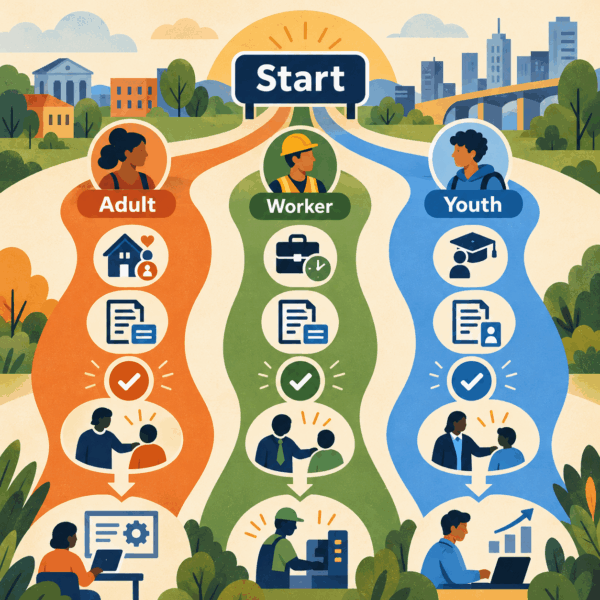 Written guidance, however clear, rarely suffices for significant changes. Local staff benefit from opportunities to hear explanations, ask questions, discuss application to real situations, and learn alongside peers. Training and technical assistance turn guidance into practice.
The first form is guidance webinars. For significant guidance, a webinar shortly after issuance, presented by state policy staff, can walk local staff through the changes, explain the reasoning, demonstrate tools, and answer questions. Recording webinars allows staff who could not attend to view them later and supports onboarding of new staff. Questions raised during webinars can be added to the frequently asked questions document.
The second form is role-specific training. Different roles need different training. Directors need to understand policy implications; fiscal staff need to understand financial requirements; frontline staff need to understand practical procedures. Separate sessions or materials for different roles make training more relevant.
The third form is train-the-trainer approaches. For changes affecting many frontline staff across the state, training local trainers or supervisors who then train their own staff can extend reach. State agencies provide materials and support; local trainers adapt delivery to local context.
The fourth form is regional sessions. In-person or virtual regional sessions bring together staff from nearby areas to discuss implementation, share approaches, and learn from one another. Peer learning is often as valuable as instruction from the state.
The fifth form is individualized technical assistance. Some local areas need more support than others, because of capacity, unique circumstances, or difficulties with implementation. State staff assigned to work with particular areas can provide individualized assistance, such as reviewing draft local policies, helping configure procedures, or answering complex questions.
The sixth form is office hours. Regular, scheduled times when state policy staff are available to answer questions, by phone or video, give local staff predictable access to help without formal requests.
The seventh form is communities of practice. Ongoing networks of local staff in similar roles, such as youth program managers or business services leads, facilitated by the state, provide forums for sharing practices and raising implementation issues.
The eighth form is onboarding resources. Local staff turnover means that new staff continually need to learn existing guidance. Recorded trainings, guidance summaries, and orientation materials help new staff get up to speed without depending entirely on colleagues.
Training and technical assistance should be timed to support implementation. Training delivered after the effective date leaves staff implementing without understanding. Training delivered well before the effective date may be forgotten. Ideally, training occurs shortly after guidance is issued and before it takes effect, with refreshers or follow-up sessions after implementation begins to address questions that arise in practice.
Training should also be evaluated. Brief surveys after sessions, and observation of whether questions and errors decline after training, show whether training is effective.
State agencies sometimes view training as a separate function from policy development. Integrating the two, so that training plans are developed alongside guidance and policy staff participate in training, ensures that training reflects the guidance accurately and that policy staff hear implementation concerns directly.
Supporting Small and Rural Local Areas
Local workforce areas vary enormously in size and capacity. Some serve large metropolitan regions with dozens of staff, dedicated policy analysts, fiscal teams, and communications specialists. Others serve sparsely populated rural regions with a handful of staff, where the executive director may personally handle policy interpretation, fiscal management, board relations, and partner coordination. State guidance that is manageable for a large area can overwhelm a small one. Communication that accounts for this variation ensures that guidance is implementable everywhere.
The first practice is designing guidance with the smallest area in mind. When drafting guidance, state staff can ask whether a director with no policy staff could understand and implement it within the time allowed. If not, additional summaries, tools, sample language, or lead time may be needed. Guidance that works for the smallest areas generally works for the largest as well.
The second practice is providing ready-to-use materials. Small areas benefit most from sample local policy language, templates, desk aids, participant notices, and training materials they can adopt with minimal adaptation. Each tool the state provides saves a small area time it does not have.
The third practice is assigning state liaisons. A designated state contact who knows a small area’s circumstances and can answer questions, review draft local policies, and provide guidance proactively is especially valuable for areas without internal policy expertise. Liaisons can also alert state leadership when guidance is creating particular difficulties for smaller areas.
The fourth practice is scheduling training accessibly. Small areas often cannot release staff for long trainings or travel to distant locations. Recorded webinars, short sessions, and virtual regional meetings make training accessible. Materials that a small area’s director can use to train a few staff locally extend reach.
The fifth practice is facilitating peer support. Small areas can benefit from connections with peers facing similar challenges, and sometimes with larger areas willing to share policies and procedures. States can facilitate peer networks and encourage sharing of local materials, with attention to ensuring that shared materials remain consistent with state guidance.
The sixth practice is considering proportional requirements. Where state policy allows discretion, the state can consider whether certain reporting or documentation requirements could be simplified for smaller areas without compromising accountability. Any such differentiation should be clearly explained and consistent with federal requirements.
The seventh practice is attending to rural service realities. Rural areas face distinct challenges, such as long travel distances, limited broadband, fewer training providers, and small employer bases. Guidance that assumes urban conditions, such as frequent in-person contact or access to many providers, may be difficult to implement in rural areas. Consulting rural areas during guidance development helps identify these issues.
The eighth practice is listening for capacity signals. Delayed responses, repeated questions, or monitoring findings concentrated in smaller areas may signal capacity strain rather than unwillingness. States can respond with targeted support rather than only compliance action.
Supporting small and rural areas is not a matter of lowering expectations. It is a matter of recognizing that the same expectation requires different levels of support depending on local capacity, and communicating in ways that make implementation achievable for every area in the state.
Answering Questions Consistently
No guidance anticipates every situation. Local staff will have questions, and how the state answers them shapes implementation as much as the guidance itself. Inconsistent answers, given to different areas by different state staff, produce inconsistent implementation and can lead to monitoring findings for areas that followed advice later contradicted. Answering questions consistently, and sharing answers broadly, is essential.
The first practice is a single channel for policy questions. When local staff can ask any state employee, they may receive different answers depending on whom they ask. Establishing a designated channel, such as a policy mailbox, an online question form, or designated policy contacts, routes questions to staff who can answer them consistently. Field staff who receive questions can direct them to this channel or consult policy staff before answering.
The second practice is a defined response time. Local staff need answers in time to act. Setting and communicating a target response time, such as a few business days for routine questions, and meeting it, builds confidence. For complex questions requiring more research or federal consultation, an acknowledgment with an expected timeline keeps local staff informed.
The third practice is documenting answers. Every substantive answer should be recorded, so that the same question receives the same answer later and so that answers can be reviewed for consistency with guidance.
The fourth practice is sharing answers broadly. A question asked by one area is often relevant to others. Publishing answers in a frequently asked questions document, updated regularly and organized by topic, ensures that all areas benefit and that implementation remains consistent. Personal or identifying details should be removed.
The fifth practice is distinguishing interpretation from new policy. Some questions reveal genuine gaps or ambiguities in guidance that require policy decisions, not simply interpretation. When answers effectively create new requirements, they should be incorporated into formal guidance, so that requirements are not scattered across informal answers.
The sixth practice is consistency between technical assistance and monitoring. Local areas often report that advice received from state program staff was later contradicted by state monitors. Coordinating between program and monitoring staff, and ensuring that monitors are aware of published answers, prevents this problem. Where monitors and program staff disagree, the disagreement should be resolved internally and the resolution communicated, rather than penalizing local areas that followed earlier advice.
The seventh practice is federal consultation when needed. Some questions involve interpretation of federal requirements on which the state is uncertain. In these cases, the state can consult its federal regional office and share the answer when received. Communicating that a question has been referred, and when an answer is expected, keeps local areas informed.
The eighth practice is acknowledging errors. If the state realizes that an earlier answer was incorrect, it should issue a correction promptly, explain the change, and address how areas that relied on the earlier answer will be treated.
Consistent answers build trust in the state as a reliable source of guidance. Local areas that trust state answers are more likely to ask questions before acting, which improves compliance and reduces errors.
Passing Federal Changes Through to Local Areas
Much state guidance originates in federal changes: new legislation, regulations, Training and Employment Guidance Letters and other Department of Labor issuances, uniform grant guidance revisions, or changes in federal reporting requirements. States serve as intermediaries, interpreting federal changes and translating them into state policy and local expectations. This intermediary role has its own communication challenges.
The first challenge is timing. Federal guidance may arrive with limited lead time, or its implications may take time to analyze. Local areas may learn about federal changes through national associations or news before the state has issued guidance, creating uncertainty about what they should do. States can address this by quickly acknowledging significant federal changes, telling local areas that the state is reviewing them, and indicating when state guidance will follow. Interim instructions, such as continue current practice until state guidance is issued, prevent premature or inconsistent action.
The second challenge is distinguishing federal requirements from state choices. When state guidance implements federal changes, local areas benefit from knowing which provisions are federally required and which reflect state discretion. This distinction helps local areas understand where flexibility exists and where it does not, and it clarifies accountability. Guidance can indicate the source of each requirement, through citations in a references section or brief notes.
The third challenge is federal uncertainty. Federal guidance sometimes leaves questions unanswered, or federal policy may be in flux, such as during reauthorization debates, budget negotiations, or changes in administrative priorities. States must communicate under this uncertainty, distinguishing what is settled from what is pending, as discussed in change communication generally. Honest acknowledgment of uncertainty is better than guidance that may need to be reversed.
The fourth challenge is volume. Federal agencies issue many documents, not all of which require state action or local implementation. States can help local areas by filtering federal issuances, identifying which require local action, which are informational, and which do not apply. A periodic summary of federal issuances, with the state’s assessment of their relevance, reduces the burden on local areas to track federal developments themselves.
The fifth challenge is cross-program changes. Some federal changes affect multiple programs or partner agencies, such as changes in public assistance work requirements or uniform grant rules. States may need to coordinate guidance across agencies, so that local workforce areas and partner programs receive consistent information. Federal legislation enacted in 2025 broadening SNAP work requirements and introducing Medicaid community engagement requirements, for example, involves human services agencies as well as workforce agencies, with implementation phased in by states.
The sixth challenge is federal deadlines that compress state and local timelines. When federal effective dates are near, states face pressure to issue guidance quickly. In these cases, states should communicate the federal deadline and its implications, provide the best guidance possible, and indicate where further clarification will follow.
The seventh challenge is federal monitoring alignment. Federal monitors review state compliance, and states review local compliance. States should ensure that their guidance aligns with federal expectations, consulting federal regional offices where uncertain, so that local areas following state guidance are not later found out of compliance with federal requirements.
By serving as a thoughtful intermediary, filtering, interpreting, clarifying, and coordinating federal changes, state agencies save local areas significant effort and improve the consistency of implementation across the state.
Managing Guidance Over Time
State workforce agencies issue guidance continuously, and over years the body of guidance can become large, fragmented, and difficult to navigate. Local staff may not know which guidance is current, which has been rescinded, how documents relate to one another, or where to find the answer to a particular question. Managing guidance over time, as a coherent and accessible body of policy, is essential to consistent implementation.
The first practice is a central, searchable repository. All current guidance should be available in one place, organized by topic and searchable. Local staff should not need to search email archives or multiple websites to find policy. The repository should clearly distinguish current guidance from rescinded or superseded guidance, which may be retained in an archive for reference.
The second practice is consistent numbering and naming. A consistent system for numbering and titling guidance, such as a sequential number with a descriptive title, makes guidance easy to reference and track. Titles should describe content clearly.
The third practice is explicit rescission and supersession. When new guidance replaces or modifies earlier guidance, the new guidance should state explicitly which earlier issuances are rescinded or modified, and the repository should be updated accordingly. Guidance that silently conflicts with earlier issuances creates confusion about which applies.
The fourth practice is version control. When guidance is revised, the revision date and changes should be clearly noted. Local staff should be able to see the current version and, if needed, earlier versions with dates of effect. This matters for monitoring, since local actions should be evaluated against the guidance in effect at the time.
The fifth practice is periodic review and consolidation. Over time, guidance on a topic may accumulate across multiple issuances, amendments, and frequently asked questions. Periodic review, perhaps on a regular cycle, allows the state to consolidate related guidance into comprehensive policies, rescind outdated issuances, and incorporate informal answers into formal guidance. Consolidation reduces the number of documents local staff must consult.
The sixth practice is topic-based policy manuals. Some states organize guidance into comprehensive manuals by topic, such as eligibility, supportive services, or training, updated as policy changes. Manuals provide a single reference for each topic, which is easier to use than a collection of separate issuances.
The seventh practice is notification of changes. Local staff need to know when guidance is issued, revised, or rescinded. Email notifications, subscription services, or regular digests summarizing new and changed guidance keep staff informed. Notifications should include a brief summary and a link to the guidance.
The eighth practice is linking guidance to tools and training. The repository can link each guidance document to its summaries, tools, frequently asked questions, and training recordings, so that local staff find all related resources together.
The ninth practice is accessibility. The repository and documents should be accessible to people using assistive technology and usable on different devices.
Good guidance management reduces the time local staff spend searching for and reconciling guidance, prevents reliance on outdated policy, and supports consistent implementation and fair monitoring. It also reflects the state’s respect for local partners’ time and its commitment to clear governance.
Feedback Loops From Local Offices to the State
Communication between state and local partners should flow in both directions. Local offices observe how guidance works in practice: where it is unclear, where it creates unintended consequences, where it conflicts with other requirements, and where it could be improved. Feedback loops that bring these observations back to the state allow guidance to be refined and strengthen the state-local partnership.
The first loop is post-implementation review. After significant guidance takes effect, the state can ask local areas how implementation is going, through brief surveys, regional meetings, or calls with directors. Questions might include whether guidance was clear, what difficulties arose, and what changes would help. Findings can inform clarifications, revisions, or additional support.
The second loop is question analysis. Questions submitted by local areas reveal where guidance is unclear. Analyzing patterns in questions, such as many questions on a particular provision, signals a need for clarification or revision.
The third loop is monitoring insights. State monitoring identifies where local areas struggle with compliance. When many areas have similar findings, the cause may be unclear guidance rather than local failure. Sharing monitoring patterns with policy staff, and considering whether guidance changes would help, turns monitoring into a source of improvement.
The fourth loop is regular state-local forums. Standing meetings between state leadership and local directors, often coordinated with the state’s local workforce association, provide a venue for raising implementation issues, discussing upcoming changes, and building relationships. These forums work best when they include genuine dialogue, not only state presentations.
The fifth loop is frontline input. Directors may not always know the practical difficulties frontline staff face. Periodic opportunities for frontline staff to share feedback, such as through surveys or focus groups, provide information that might not otherwise reach the state.
The sixth loop is responding to feedback visibly. Feedback has value only if it leads to action or explanation. When the state revises guidance in response to local feedback, it should say so. When it cannot make requested changes, such as because of federal requirements, it should explain why. Local areas that see their feedback taken seriously continue to provide it.
The seventh loop is a culture of candor. Local areas may hesitate to report difficulties if they fear that doing so will lead to monitoring findings or perceptions of incompetence. States can encourage candor by framing feedback as a contribution to improvement, by separating feedback channels from compliance review where appropriate, and by responding constructively to reported problems.
Feedback loops transform state-local communication from a one-way flow of directives into a collaborative process of continuous improvement. They help the state issue better guidance, help local areas implement it more effectively, and build the trust that makes the workforce system work as a coordinated whole.
Implementation-Ready Guidance in Practice
The following hypothetical example illustrates how a state workforce agency might improve its guidance communication. It does not describe an actual state.
A state workforce agency’s monitoring team notices that many local areas have findings related to eligibility documentation, and that the findings vary widely in nature. A review reveals that the state’s eligibility guidance consists of an original policy issued years earlier, three amendments, a separate issuance on documentation for youth, and dozens of answers to questions given to individual areas by different staff, some inconsistent with one another. Local directors report that they are unsure which provisions are current and that answers from program staff have sometimes been contradicted by monitors.
The agency’s leadership decides to consolidate and reissue eligibility guidance. A working group of state policy, program, and monitoring staff, along with directors and eligibility staff from four local areas of different sizes, reviews all existing guidance and answers. The group identifies inconsistencies, resolves them, and drafts a single consolidated policy. Elements dictated by federal requirements are identified as such; areas of state discretion are discussed with local members.
The draft follows a new standard template: a one-paragraph summary, a table of changes from prior guidance, purpose, effective date with transition provisions for participants already enrolled, scope, requirements written in plain language, required local actions, examples, references, rescissions, and contacts. The draft is shared with all local areas for a thirty-day comment period. The agency receives comments, revises the policy, and publishes a brief summary of how comments were addressed.
The final policy is issued sixty days before its effective date, timed after local board meetings so that boards can adopt revised local policies. It is accompanied by a one-page summary for directors, a desk aid for eligibility staff, a side-by-side comparison with prior guidance, sample local policy language, an updated documentation checklist, and a frequently asked questions document. The state case management system is updated to align with the policy by the effective date.
The agency holds a webinar the week after issuance, recorded for later viewing, and regional sessions in which eligibility staff discuss application. A dedicated policy mailbox handles questions with a target response time of five business days, and answers are added to the frequently asked questions document weekly. Monitoring staff participate in training and commit to reviewing compliance against the consolidated policy, with a grace period for good-faith implementation during the first months.
The agency rescinds all prior eligibility issuances and updates its online repository so that the consolidated policy is the single current source. Six months after implementation, the agency surveys local areas and reviews monitoring results. Eligibility-related findings have declined, and local directors report greater clarity. Feedback identifies two provisions that remain confusing, which the agency clarifies in a brief update.
The example illustrates the core principles: consolidating fragmented guidance, involving local areas, using a standard template, providing lead time, layering products, coordinating system changes, training, answering questions consistently, aligning monitoring with guidance, managing the repository, and gathering feedback.
Measuring Guidance Communication
State agencies typically track guidance by counting issuances. Counting tells little about whether guidance is understood and implemented consistently. Measuring guidance communication more directly helps agencies identify where communication succeeds and where it needs improvement.
The first area is clarity. After significant guidance is issued, brief surveys of local staff can ask whether the guidance was clear, whether they understood what to do, and whether summaries and tools were helpful. Comprehension checks, such as asking staff to apply guidance to sample scenarios, provide more direct evidence.
The second area is questions. The volume and nature of questions after guidance is issued indicate clarity. Many questions on the same issue suggest that guidance needs clarification. Tracking response times shows whether the state is meeting its commitments.
The third area is timeliness. Tracking the lead time between guidance issuance and effective dates shows whether the state is providing adequate time. Tracking whether system changes align with guidance effective dates reveals coordination gaps.
The fourth area is consistency of implementation. Monitoring results, case file reviews, and data analysis can reveal whether local areas are implementing guidance consistently. Wide variation suggests communication problems.
The fifth area is compliance. Changes in monitoring findings related to particular guidance topics, before and after improved communication, indicate whether communication is supporting compliance.
The sixth area is repository use and currency. Tracking use of the guidance repository, and auditing whether it contains only current guidance with clear rescissions, shows whether guidance management is effective.
The seventh area is local satisfaction. Periodic surveys of local directors about the state’s guidance communication, including clarity, timeliness, consultation, training, and responsiveness, provide an overall assessment and track trends.
Several questions help agencies evaluate guidance communication:
-
Do local staff report that significant guidance was clear and that they knew what to do?
-
How much lead time did local areas receive, and were systems ready on the effective date?
-
Are questions answered within the target time, and are answers shared broadly?
-
Is implementation consistent across local areas, and are related monitoring findings declining?
-
Can local staff easily find current guidance and understand what has been rescinded?
Results should be reviewed by state leadership and policy staff and shared with local areas, along with steps the state will take to improve. Measurement demonstrates the state’s commitment to effective communication and invites ongoing partnership.
Measurement should be proportionate. A small state with few local areas may rely on informal conversations, while a large state may conduct systematic surveys and analysis. The goal is enough information to guide improvement.
How State-to-Local Guidance Compares With Other Agency Types
Many intergovernmental systems involve state agencies issuing guidance to local entities that implement programs. Their experiences offer lessons for workforce guidance communication.
State education agencies issue guidance to school districts on topics such as assessment, accountability, special education, and federal program compliance. They face similar challenges: complex federal requirements, local variation in capacity, and the need for consistent implementation. Some state education agencies have adopted practices such as plain-language summaries, guidance repositories organized by topic, regional support centers, and advisory councils of district leaders. The regional service center model, in which intermediate organizations support local districts, offers a parallel to state workforce agencies providing regional technical assistance.
State human services agencies issue policy to county offices administering programs such as SNAP, TANF, and Medicaid eligibility, particularly in county-administered states. Policy manuals, transmittal systems, and county liaison structures are common. These agencies have long experience with large, complex policy bodies and the need for version control and clear transmittals. Workforce agencies can learn from their approaches to policy manuals and change notices.
State public health agencies issue guidance to local health departments, sometimes rapidly during emergencies. Their experience shows the value of established communication channels, regular calls with local leaders, and rapid dissemination of updates, as well as the problems that arise from inconsistent or frequently changing guidance.
State environmental agencies issue technical guidance to local governments and regulated entities. Their use of guidance documents, frequently asked questions, and technical assistance offers parallels.
Federal agencies themselves issue guidance to states, and the quality of federal guidance affects state guidance. States can learn from both effective and ineffective federal communication practices they experience.
What distinguishes workforce guidance communication is the combination of federal requirements under WIOA and related programs, a governance structure in which local boards and chief elected officials have significant authority, service delivery through contracted providers, multiple programs and partners with different rules, and wide variation in local area size and capacity. These features make consultation with local areas, layered products, consistent answers aligned with monitoring, clear distinction between federal and state requirements, and attention to small areas especially important. Workforce agencies can borrow from education’s regional support models, human services’ policy manual practices, and public health’s communication channels, adapting them to the workforce system’s structure.
Tying It All Together
State-to-local guidance communication is not a side function of administering workforce programs. It determines whether policy is implemented as intended, whether participants are served consistently across the state, whether local areas can comply with requirements, and whether the state-local relationship is collaborative or strained. Issuing a document is not the same as communicating a change.
The guidance gap, the distance between what the state intends and what happens in local offices, arises from complex rules, legalistic writing, unclear identification of changes, insufficient lead time, ambiguity, inconsistent answers, system lag, volume, variation in local capacity, and limited local input. Much of it originates in communication and can be closed through communication.
Local offices need guidance that tells them what changed, why, who is affected, what they must do, when, how it fits with other policy, what it looks like in practice, and where to get help. Guidance written for implementation follows a consistent structure, begins with a plain-language summary, uses plain language throughout, distinguishes requirements from recommendations, highlights changes, anticipates implementation questions, uses examples, keeps appropriate length, is accessible, and is reviewed by implementers.
Timing matters: reasonable lead time, advance notice, alignment with local governance calendars, coordination with system changes, clear transition provisions, honesty about compressed timelines, sensible release timing, and a predictable rhythm. Involving local areas through early consultation, draft review, working groups, usability testing, local associations, transparency about constraints, and respect for local time improves guidance and builds ownership.
Layered communication provides the official guidance alongside summaries, staff briefs, comparisons, tools, frequently asked questions, participant templates, and training materials, all consistent with one another. Training and technical assistance, including webinars, role-specific training, train-the-trainer, regional sessions, individualized assistance, office hours, communities of practice, and onboarding resources, turn guidance into practice. Consistent answers flow through a single channel with defined response times, documentation, broad sharing, distinction from new policy, alignment with monitoring, federal consultation, and correction of errors.
As intermediaries for federal changes, states acknowledge changes quickly, distinguish federal from state requirements, communicate uncertainty, filter federal issuances, coordinate across programs, manage compressed deadlines, and align with federal monitoring. Guidance managed over time through a central repository, consistent numbering, explicit rescission, version control, periodic consolidation, topic manuals, notifications, linked resources, and accessibility remains usable. And feedback loops from local offices, through post-implementation review, question analysis, monitoring insights, forums, frontline input, visible responses, and a culture of candor, allow continuous improvement, guided by measurement of clarity, questions, timeliness, consistency, compliance, repository use, and local satisfaction.
Strategic Communication Support
 Improving state-to-local guidance communication requires reviewing existing guidance and processes, developing templates and writing standards, consolidating fragmented policy, designing layered products, establishing consistent question-answering processes, aligning program and monitoring staff, and building feedback loops. State policy teams are often fully occupied with issuing required guidance and may lack capacity to redesign how guidance is communicated. External support can help state agencies build communication systems that improve implementation across all local areas.
Stegmeier Consulting Group (SCG) helps public agencies communicate complex requirements to the organizations that implement them. For state workforce agencies, that work can begin with an assessment of current guidance communication: reviewing guidance documents, repositories, question-answering processes, and training; interviewing state policy, program, and monitoring staff; and gathering perspectives from local directors and frontline staff of different sizes and regions. This assessment identifies where guidance creates confusion, delay, or inconsistency.
From that foundation, SCG can help develop a standard guidance template and plain-language writing standards, train policy staff in implementation-focused writing, and design layered product sets including summaries, staff briefs, desk aids, sample local policy language, and participant templates. SCG can help design processes for consultation with local areas, question management with shared answers, and coordination between program and monitoring staff.
Implementation support can include facilitating working groups to consolidate guidance on priority topics, redesigning guidance repositories for usability, developing training and onboarding materials, and establishing regular state-local forums. Evaluation support helps agencies measure clarity, timeliness, consistency of implementation, and local satisfaction, and use findings to improve. The aim is guidance that local areas can implement confidently and consistently, and a state-local relationship grounded in clear communication and mutual trust.
Future Trends
Several established developments are shaping state-to-local guidance communication. Federal workforce policy faces significant uncertainty. Budget proposals in recent cycles have contemplated substantial changes to federal workforce programs, including consolidating funding streams. If such changes occur, states would need to issue extensive new guidance to local areas, often under compressed timelines. Federal administrative priorities and guidance can also shift. States with established guidance communication systems, including templates, consultation processes, repositories, and training infrastructure, will be better able to manage large volumes of change.
Changes in partner programs require cross-agency guidance. Federal legislation enacted in 2025 broadened work requirements associated with SNAP and introduced community engagement requirements for certain Medicaid enrollees, with implementation phased in by states. Where workforce systems play roles in helping people meet these requirements, state workforce and human services agencies will need to coordinate guidance to local workforce areas and county human services offices. Implementation details are still developing in many states.
The extension of Pell Grant eligibility to certain short-term workforce training programs, under federal legislation enacted in 2025 and beginning with the 2026 to 2027 award year, may require guidance on coordinating funding sources for participants in short-term training.
Digital tools for guidance management continue to improve. Searchable knowledge bases, policy management platforms, and integration of guidance with case management systems, such as contextual help that surfaces relevant policy within system screens, can make guidance easier to find and apply.
Artificial intelligence tools are being explored for answering policy questions and summarizing guidance. Such tools might help local staff find relevant provisions quickly, but they also carry risks of inaccurate or inconsistent answers, which in a compliance context could lead to errors and findings. Any use of these tools should include safeguards, human review, and clarity about the authoritative source. Their appropriate role in policy communication is still being worked out.
Accessibility requirements for government digital content are becoming more concrete, including the Department of Justice’s 2024 rule establishing technical standards for state and local government web content and mobile applications, with compliance deadlines phased by government size. State guidance repositories and documents will need to meet these standards.
Workforce staff turnover, which affects both state and local agencies, increases the importance of well-organized guidance and onboarding resources, so that institutional knowledge does not depend on individuals.
States that invest in implementation-focused guidance communication now will be better prepared for whatever changes the coming years bring.
Conclusion
The twenty-page guidance letter released late on a Friday did not fail because its policy was wrong. It failed because it asked every local director in the state to reconstruct, alone and in a hurry, what had changed, how it applied to participants already enrolled, and what to tell staff on Monday. Different directors reached different answers, participants in neighboring counties received different assistance, and the state’s own monitors were left to cite local areas for following guidance they had understood in good faith.
For state workforce agency leaders and policy staff, the implication is that guidance should be treated as a communication product designed for the people who must act on it. That means a consistent template that opens with what changed and what to do, plain language that keeps legal precision, enough lead time for local boards and systems to catch up, consultation before guidance is final, summaries and tools that spare every local area from building its own, training before effective dates, one channel for questions with answers shared statewide, monitors and program staff who give the same advice, and a repository where the current version is always easy to find.
States that build these practices will find that local areas implement guidance faster and more consistently, ask fewer avoidable questions, and accumulate fewer findings. Just as important, they will build a state-local relationship in which local partners trust the state’s direction, raise problems early, and work alongside the state to serve participants well.
Stegmeier Consulting Group’s Strategic Approach to Communication Systems
SCG approaches state-to-local guidance as a communication system designed for implementation. That approach begins by examining how guidance is currently written, timed, distributed, explained, and monitored, and where local areas struggle to turn it into consistent practice. It then helps state agencies adopt standard templates and plain-language writing, build consultation with local areas into policy development, pair official guidance with summaries, desk aids, sample local policy language, and training, and route questions through a single channel whose answers are shared statewide and honored by monitors.
For state workforce agencies, this means county and regional offices that understand what changed and what to do, enough lead time to update local policy, systems, and staff, a guidance repository that always shows the current version, and feedback loops that let the field improve the guidance it receives. It means fewer avoidable findings, more consistent service for participants across the state, and a state-local partnership built on clear direction and mutual trust.
Use the form below to connect with our team and explore how strategic communication support can help your state workforce agency communicate technical changes, policy guidance, and implementation expectations that local offices can act on.