
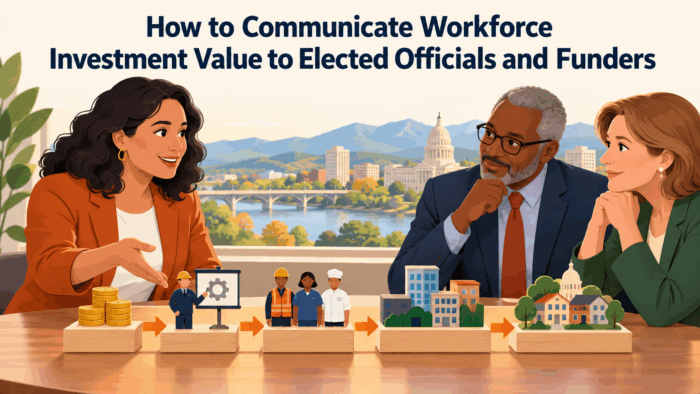
How to Communicate Workforce Investment Value to Elected Officials and Funders
A workforce board director waits her turn at a county budget hearing. Ahead of her, the sheriff has described rising calls for service, the public works director has shown photographs of crumbling bridges, and the parks department has presented a petition signed by hundreds of residents. Each presentation was concrete, visual, and tied to something commissioners could see or their constituents could feel. When the director’s turn comes, she has a few minutes to explain why the county should continue its contribution to the workforce system, whose primary funding comes from federal formulas few commissioners understand, whose services are delivered through partners and contractors many have never visited, and whose results are measured in indicators with names like employment rate in the second quarter after exit. She knows the work matters. The question is whether she can make the commissioners know it too.
This scene repeats across the country in county commission chambers, city councils, state legislative committees, congressional offices, and philanthropic boardrooms. Workforce development competes for attention and resources with services whose value is easier to see. Its benefits are real but often diffuse: a resident who finds a better job pays more taxes and relies less on public assistance; an employer who fills positions grows and stays in the community; a region with a skilled workforce attracts investment. These benefits accrue over time, across many people, and through many contributing factors, which makes them harder to point to than a repaired bridge.
Communicating workforce investment value to elected officials and funders is therefore a distinct communication challenge. It requires understanding who decides and what they care about, translating workforce outcomes into terms that connect to decision-makers’ priorities, building an honest evidence base, handling return on investment claims carefully, maintaining relationships between budget cycles, and drawing on the voices of employers, participants, and partners. It also requires respecting the boundaries that apply to public agencies, including restrictions on using federal funds for lobbying and the importance of remaining nonpartisan.
This article examines how workforce boards and agencies can communicate the value of workforce investment to elected officials and funders. Its central argument is that decision-makers support workforce investment when they understand it in their own terms, trust the evidence presented, see its connection to their constituents and priorities, and hear about it consistently from credible voices over time, not only when budgets are at stake. It addresses the audiences involved, the special relationship with chief elected officials under WIOA, how to define and evidence value, the risks of overstated return on investment claims, relationship building, briefings and site visits, philanthropic and private funders, coalition voices, and the legal and ethical boundaries of advocacy.
The Five-Minute Window
 Most formal opportunities to communicate with decision-makers are brief. A budget hearing may allow a few minutes of testimony. A meeting with a legislator may last fifteen minutes, interrupted by calls. A funder’s program officer may skim a proposal among dozens of others. Even when meetings are longer, decision-makers’ attention is divided among many issues. Workforce leaders who prepare to explain everything about their programs will run out of time before they reach what matters. Those who prepare to make a few points clearly, memorably, and in the decision-maker’s terms are more likely to be heard.
The five-minute window imposes discipline. It forces workforce leaders to identify the single most important thing they want a decision-maker to understand, the two or three facts that support it, and the specific request they are making. It rules out program jargon, lengthy explanations of funding streams, and comprehensive lists of services. It rewards clarity, relevance, and concreteness.
Within that window, effective communication typically does several things. It states the request plainly, so decision-makers know what is being asked. It connects the request to something the decision-maker already cares about, such as local employers’ hiring needs, residents’ economic security, or reducing reliance on public assistance. It provides a small amount of credible evidence, such as a key outcome stated in plain language and a brief illustration. And it leaves the decision-maker with a clear sense of what will happen with the investment and what difference it will make.
The five-minute window also reveals the importance of what happens outside it. Decision-makers who already know the workforce board, have visited a career center, have heard from employers who value the system, and have received clear updates over time come to a budget hearing with context. Five minutes is enough to remind them of what they already understand. Decision-makers who have never heard of the board before the hearing start from nothing, and five minutes is rarely enough to build understanding from scratch. Much of the work of communicating investment value therefore happens between formal opportunities, through relationships and consistent communication.
Finally, the window applies to written communication as well. Decision-makers and their staff often read only the first page of a report, the summary of a proposal, or the first paragraph of an email. Written materials should put the most important information first, in plain language, with supporting detail available for those who want it. A one-page brief that a legislative aide can read in two minutes and summarize for a legislator is often more influential than a comprehensive report.
Preparing for the five-minute window is a useful exercise even when more time is available. If a workforce leader cannot state the value of the system’s work and the specific request in a few sentences, the message is not yet clear enough. The remaining sections describe how to develop that clarity and support it with evidence, relationships, and credible voices.
Skilled & Connected: Communication Strategies for Workforce Development Agencies, Career Centers, and Local Employment Services
This article is part of our series on strategic communication for Workforce Development Agencies, Career Centers, and Local Employment Services. To learn more and to see the parent article, which links to other content just like this, click the button below.
Who Decides and What They Need to Know
Workforce investment decisions are made by many people at different levels of government and outside it. Each has different responsibilities, constituencies, and information needs. Effective communication begins with understanding who these decision-makers are and what they need to know.
Local Elected Officials
County commissioners, mayors, city council members, and other local officials influence workforce investment in several ways. Under WIOA, chief elected officials of local areas appoint local board members, approve local plans and budgets in partnership with the board, and typically serve as grant recipients or designate one. Some local governments contribute their own funds to workforce services. Local officials care about their constituents’ economic wellbeing, local employers’ needs, the local economy, and responsible use of public funds. They need to know how the workforce system serves their jurisdiction specifically, what results it achieves for their residents and employers, and what their role and responsibilities are.
State Legislators and Executive Officials
State legislators appropriate state funds for workforce programs, and state executive agencies administer federal workforce funds and set policy. Governors designate local areas, approve state plans, and oversee state workforce agencies. State officials care about statewide economic competitiveness, workforce shortages in key industries, outcomes for their districts, and the efficiency of state programs. They need to know how workforce investment advances state priorities, what results it produces in their districts, and how state and federal funds work together.
Members of Congress and Their Staff
Congress authorizes and appropriates federal workforce funding. Members and their staff care about outcomes in their districts and states and about national workforce policy. Federal policy decisions, such as reauthorization or appropriations, may affect local programs significantly. Members need to know how federal investment works in their communities, what it achieves, and how policy changes would affect local services. Communication with congressional offices often occurs through district staff and during district visits.
Philanthropic Funders
Foundations and other philanthropic organizations fund workforce initiatives, often focused on particular populations, sectors, or innovations. They care about their mission priorities, evidence of effectiveness, sustainability, and learning. They need to know how a proposed initiative aligns with their goals, what results it is likely to achieve, how it will be measured, and how it fits with public investment.
Employers and Private Funders
Employers sometimes fund workforce initiatives directly, through contributions to training programs, sector partnerships, or intermediaries. They care about their workforce needs and return on their investment. They need to know how the initiative addresses their hiring and skill needs.
Staff and Advisors
Decision-makers rely heavily on their staff and advisors, who often read materials, prepare briefings, and shape recommendations. Communicating effectively with legislative aides, budget analysts, county administrators, and program officers is often as important as communicating with decision-makers themselves. Staff need clear, accurate, concise information they can summarize and defend.
Understanding these audiences allows workforce leaders to tailor communication. A message for a county commissioner focuses on local residents and employers; one for a state legislator connects to state priorities and district outcomes; one for a foundation emphasizes alignment with mission and evidence. The underlying facts remain consistent, but the framing and emphasis change.
The Chief Elected Official Relationship
Among all the decision-makers workforce boards communicate with, chief elected officials hold a unique position. Under WIOA, the chief elected official of a local area, which may be a county executive, mayor, chair of a county commission, or a body of officials representing multiple jurisdictions, has formal responsibilities for the local workforce system. Communicating effectively with these officials is not optional; it is part of the system’s governance.
Chief elected officials typically appoint local board members according to WIOA’s membership requirements, approve the local plan jointly with the board, approve the board’s budget, and share responsibility for selecting the one-stop operator and providers in some arrangements. Unless they reach another agreement with the governor, they are generally liable for misused grant funds. In multi-jurisdictional areas, the chief elected officials of each unit of government typically enter into an agreement specifying how they will carry out these responsibilities together.
This formal role means that chief elected officials have both authority over and accountability for the workforce system. Yet many are only loosely engaged. Local officials juggle many responsibilities, and workforce may receive limited attention unless problems arise. Some officials may not fully understand their responsibilities, the system’s structure, or its results. Board staff may communicate with officials mainly when approvals are needed, rather than building ongoing understanding.
Effective communication with chief elected officials begins with orientation. When new officials take office, the board can provide a concise orientation explaining the workforce system, the official’s responsibilities, the board’s structure and membership, key programs and funding, recent results, and current priorities. Orientation should be brief, practical, and offered in a format the official prefers, such as a meeting, a written brief, or a site visit.
Regular updates maintain engagement. Brief periodic updates, such as a quarterly summary of outcomes, notable developments, and upcoming decisions, keep officials informed without demanding much time. Updates should be written in plain language and focused on what matters to the official, such as results for their jurisdiction and issues requiring their attention.
Involvement in key decisions builds ownership. Officials who participate meaningfully in developing the local plan, setting priorities, and selecting board members are more invested in the system’s success. Boards can invite officials or their designees to planning sessions, share drafts for input, and explain how their input shaped decisions.
Transparency about risks protects the relationship. Because chief elected officials share liability for funds, they deserve prompt, candid information about monitoring findings, audit issues, or other risks. Officials who learn about problems from the state or the media, rather than from the board, may lose trust. Communicating problems early, with plans to address them, maintains confidence.
In multi-jurisdictional areas, communication must reach all participating officials, not only the designated lead. Officials from smaller jurisdictions may feel overlooked if communication focuses on the largest. Regular communication with all officials, including results specific to each jurisdiction where data allow, maintains support across the area.
Strong relationships with chief elected officials make them effective advocates for workforce investment. Officials who understand and value the system can speak for it in budget discussions, with state and federal officials, and with constituents. Their support is among the most valuable assets a workforce board can have.
Defining Value in Terms Decision-Makers Use
Workforce professionals naturally describe their work in program terms: participants served, services delivered, performance indicators met. Decision-makers think in different terms: constituents helped, problems solved, priorities advanced, money well spent. Communicating investment value requires translating program terms into decision-makers’ terms without distorting the facts.
The first translation is from services to outcomes. Decision-makers care less about what the system does than about what it achieves. Rather than reporting the number of workshops held or assessments conducted, communication can emphasize outcomes: residents who found jobs, credentials earned, employers who filled positions. Services matter as the means to outcomes, but outcomes are what decision-makers want to know about.
The second translation is from participants to constituents. To an elected official, participants are constituents, and employers are local businesses. Describing results in terms of the official’s jurisdiction, such as residents of the county who found jobs or businesses in the district that hired through the system, makes results personal to the official. Where data allow, reporting results by jurisdiction or district increases relevance.
The third translation is from performance indicators to plain outcomes. As discussed in reporting outcomes for the public, indicators such as employment rate in the second quarter after exit should be translated into plain language, such as about seven in ten adults who received services were working six months later.
The fourth translation is from program goals to community problems. Decision-makers respond to problems they recognize: employers unable to fill positions, residents struggling to support families, plant closures, young people disconnected from school and work, rising public assistance costs. Framing workforce investment as a response to these problems, rather than as a program with its own goals, connects it to decision-makers’ concerns.
The fifth translation is from federal funding to local value. Much workforce funding comes from federal formulas, and local officials may see it as federal money that would arrive regardless of their actions. Communication can explain how local engagement, matching funds, or local policy decisions affect how effectively those funds serve the community, and how local investment can extend services beyond what federal funding supports.
The sixth translation is from cost to investment. Workforce services cost money, and decision-makers weigh costs against other priorities. Framing workforce spending as an investment that produces returns, such as increased earnings, employer growth, or reduced reliance on public assistance, positions it differently from pure expenditure. This framing must be supported by honest evidence, as discussed in the next sections.
The seventh translation is from abstract to concrete. Decision-makers remember specific examples more than general statements. A brief, accurate story of a local employer who filled positions through the system, or a resident who completed training and found work, illustrates value concretely. Stories should be used with consent and paired with data on typical results.
Translation must not become distortion. Workforce leaders should not overstate outcomes, claim credit for results they did not cause, or use framings that mislead. Decision-makers who later discover that claims were exaggerated lose trust. The goal is to make true information meaningful to decision-makers, not to make weak results look strong.
Building an Evidence Base for Investment
Decision-makers increasingly expect evidence that investments work. Workforce leaders who can present credible, well-organized evidence are more persuasive than those who rely on assertions and anecdotes. Building an evidence base for investment means assembling the best available information about what the workforce system does and achieves, presenting it honestly, and understanding its strengths and limits.
The first layer of evidence is outcome data. Federal performance indicators, presented in plain language with context as discussed elsewhere, show what happened to participants after services. Outcome data for the local area, specific programs, and specific populations provide the foundation of the evidence base. Trends over time show whether results are improving.
The second layer is activity and reach data. Numbers of people served, employers served, training enrollments, credentials earned, and hiring events held show the scale of the system’s work. These numbers are not outcomes in themselves, but they help decision-makers understand what their investment supports.
The third layer is employer feedback. Employer satisfaction surveys, repeat use of services, and testimonials from employers provide evidence of value to the business community. Employer voices carry particular weight with officials concerned about economic development.
The fourth layer is participant feedback. Participant satisfaction and perspectives on what helped provide evidence of value to residents. Feedback should be gathered systematically, not only through selected testimonials.
The fifth layer is research evidence. Rigorous evaluations of workforce programs, conducted nationally or in other states, provide evidence about what kinds of services tend to produce results. Research on sector-based training programs, for example, has found positive earnings effects for participants in several rigorous studies, though results vary by program and context. Citing relevant research carefully, with attention to whether findings apply to local programs, strengthens the case for investment. Workforce leaders should avoid overstating research findings or applying them to programs that differ substantially from those studied.
The sixth layer is local evaluation. Some workforce boards conduct or commission evaluations of their own programs, ranging from simple pre-post comparisons to more rigorous designs. Local evaluation evidence, where available, is especially relevant to local decision-makers. Its limitations should be explained honestly.
The seventh layer is labor market context. Information about local employers’ hiring needs, skill gaps, and industry growth shows why workforce investment matters for the regional economy. This context connects workforce investment to economic development priorities.
The eighth layer is financial information. Clear information about funding sources, how funds are used, and costs relative to services helps decision-makers understand the investment. Financial information should be accurate and presented with context, since costs per participant vary with services and populations.
Assembling these layers into a coherent evidence base allows workforce leaders to draw on the most relevant evidence for each audience and occasion. A brief for a county commissioner might emphasize local outcomes, employer feedback, and a local example. A proposal to a foundation might emphasize research evidence and evaluation plans. Testimony to a legislative committee might emphasize outcomes by district and labor market context.
The evidence base should be maintained and updated regularly, so that current information is available when opportunities arise. A one-page summary of key evidence, updated annually, provides a ready resource for staff, board members, and advocates.
Handling Return on Investment Claims With Care
Decision-makers often ask about return on investment: for every dollar spent on workforce services, how much comes back in increased earnings, taxes, or reduced public assistance? Return on investment figures are appealing because they translate workforce value into terms that compare directly with other investments. They can also be among the most misleading claims workforce agencies make. Handling them with care protects credibility.
The central problem is attribution. A return on investment calculation typically compares the cost of services with the economic gains associated with participants, such as increased earnings after services. But participants’ earnings after services reflect many factors, including the labor market, their own efforts, other services, and changes that would have occurred without workforce services. Attributing all post-service earnings to the workforce program overstates its contribution. A credible return on investment estimate requires an estimate of what would have happened without services, which typically requires a comparison group or rigorous evaluation.
A second problem is incomplete accounting. Return on investment calculations may count benefits generously, such as including all post-service earnings or assumed multiplier effects, while counting costs narrowly, such as including only direct program costs and not participant time or other public services. Unbalanced accounting inflates returns.
A third problem is projection. Some calculations project benefits over many years, assuming that earnings gains persist or grow. Long-term projections involve substantial uncertainty and should be presented with caution.
A fourth problem is borrowed figures. Workforce agencies sometimes cite return on investment figures from national studies or other areas and apply them to local programs. Figures from studies of different programs, populations, or conditions may not apply locally.
Given these problems, several practices help workforce leaders handle return on investment claims responsibly. The first is relying on rigorous estimates where they exist. Some states and researchers have conducted net impact or cost-benefit analyses of workforce programs using comparison groups. Citing these, with attention to their applicability, is more credible than simple calculations.
The second practice is describing simpler measures honestly. Where rigorous impact estimates are not available, workforce leaders can present simpler information, such as participants’ earnings before and after services, without claiming that the difference represents the program’s return. A statement such as participants’ median earnings after training were substantially higher than before they enrolled, though some of this change would likely have occurred without services, is honest and still meaningful.
The third practice is explaining assumptions. If a return on investment figure is presented, its assumptions, data sources, and limitations should be stated clearly. Decision-makers and their staff can then evaluate it.
The fourth practice is avoiding precise-sounding figures without basis. A claim that every dollar invested returns a specific multiple sounds authoritative but may rest on weak assumptions. Precision should match the quality of the evidence.
The fifth practice is emphasizing multiple forms of value. Workforce investment produces value that is hard to monetize, such as employer relationships, community stability, and individual dignity. Presenting a range of evidence, rather than relying solely on a return on investment figure, gives decision-makers a fuller picture.
Decision-makers and their analysts are increasingly sophisticated about return on investment claims. Overstated claims may be challenged, undermining the agency’s credibility on other matters. Honest, carefully qualified evidence builds lasting trust.
Connecting Workforce Investment to Officials’ Priorities
 Elected officials support investments that advance their priorities and serve their constituents. Workforce investment can advance many priorities, but officials will not always see the connection unless workforce leaders make it explicit. Understanding officials’ priorities and showing how workforce investment serves them is one of the most effective ways to build support.
The first step is learning what officials care about. Officials’ priorities are often visible in their campaign platforms, public statements, committee assignments, legislation they sponsor, and local issues in their districts. Workforce leaders can review this information and, where possible, ask officials and their staff directly what concerns them most. Priorities might include economic development, small business growth, public safety, housing affordability, support for veterans, opportunities for young people, rural economic decline, healthcare staffing, infrastructure, or reducing public assistance costs.
The second step is identifying genuine connections. Many priorities connect naturally to workforce investment. An official concerned about economic development may care about the workforce system’s role in supplying talent to new and expanding businesses. One concerned about public safety may care about employment services for people returning from incarceration. One concerned about healthcare access may care about training for healthcare occupations. One concerned about young people may care about youth programs. One concerned about rural communities may care about services reaching rural residents. Connections should be genuine, based on what the workforce system actually does, not invented to fit any priority.
The third step is tailoring communication. Once connections are identified, workforce leaders can tailor briefings, materials, and examples to emphasize the relevant aspects of the system’s work. A briefing for an official focused on healthcare staffing might highlight healthcare training outcomes, partnerships with local hospitals, and employer feedback. The underlying facts are the same as those presented to other officials, but the emphasis differs.
The fourth step is offering opportunities to engage. Officials may be interested in visiting a training program related to their priority, meeting employers in an industry they care about, or participating in an event. These opportunities deepen understanding and give officials visibility on issues they champion.
The fifth step is respecting different perspectives. Officials hold different political views and priorities. Workforce leaders serve officials across the political spectrum and should communicate in ways that respect diverse perspectives. An official focused on fiscal responsibility may be persuaded by evidence of efficient use of funds and reduced public assistance; one focused on equity may be persuaded by evidence of opportunity for underserved residents. The same workforce system can be described accurately in ways that resonate with different values.
The sixth step is aligning with broader strategies. Officials often support comprehensive strategies, such as regional economic development plans or state workforce plans. Showing how workforce investment fits within these strategies positions it as part of a coherent approach rather than a standalone program.
The seventh step is anticipating concerns. Officials may have concerns about the workforce system, such as perceived inefficiency, duplication, or poor results. Understanding these concerns and addressing them directly, with evidence and candor, builds credibility. Ignoring concerns allows them to persist.
Connecting workforce investment to officials’ priorities transforms it from an abstract program into a tool for achieving what officials already want. This connection is often more persuasive than any amount of program data presented in isolation.
Building Relationships Between Budget Cycles
The most common mistake in communicating with decision-makers is appearing only when funding is at stake. Officials who hear from the workforce board only at budget time, or only when the board needs something, may view it as one more organization competing for resources. Officials who have an ongoing relationship with the board, built through regular, useful communication between budget cycles, approach funding decisions with understanding and trust. Relationship building is the foundation of effective communication about investment value.
The first element is regular, brief updates. A periodic update, such as a quarterly one-page summary of results, notable developments, and upcoming events, keeps officials informed without demanding much time. Updates should focus on information officials find useful, such as results in their jurisdiction, major employer partnerships, or responses to layoffs. They should be concise and written in plain language.
The second element is being a resource. Workforce boards have information officials need: labor market data, knowledge of local employers’ hiring needs, information about layoffs and plant closures, and expertise on workforce issues. Offering this information when officials need it, such as when a constituent asks about job training, when a major employer announces a layoff, or when an official is preparing for a meeting with businesses, makes the board valuable to officials. A board that helps officials serve their constituents builds goodwill that carries into budget discussions.
The third element is responsiveness to constituent inquiries. Officials’ offices often receive requests from constituents seeking jobs or training. Boards can establish a clear process for officials’ staff to refer constituents, and can follow up to let staff know the constituent was served. Reliable responses to constituent referrals demonstrate the system’s value directly.
The fourth element is informing officials before they hear elsewhere. When significant developments occur, such as a major layoff, a new employer partnership, a monitoring finding, or a change in services, officials should hear about them from the board before they hear from the media or constituents. Advance notice shows respect and allows officials to respond knowledgeably.
The fifth element is recognizing officials. Officials appreciate recognition for their support, such as acknowledgment at events, in reports, or in communications. Recognition should be sincere and nonpartisan, offered to officials who support the workforce system regardless of party.
The sixth element is engaging officials’ staff. Staff are often the officials’ primary connection to the workforce system. Building relationships with legislative aides, district staff, and county administrators ensures that information reaches officials accurately and that staff can answer questions on their behalf. Staff briefings, site visits for staff, and direct contact information help.
The seventh element is board member engagement. Workforce board members, many of whom are business leaders with their own relationships with officials, can be powerful ambassadors. Board members who share their perspectives with officials, attend meetings, and speak about the system’s value extend the board’s reach. Board members should be equipped with accurate talking points and should coordinate with staff.
The eighth element is consistency. Relationships require sustained attention. A burst of communication followed by long silence does not build trust. Assigning responsibility for relationships with particular officials, and maintaining a simple calendar of contacts, ensures consistency.
When budget time arrives, officials with whom the board has built relationships already understand its work and value. The budget conversation becomes a continuation of an ongoing dialogue rather than a cold request.
Communicating When Results Disappoint
Not every year brings good news. Performance may fall short of negotiated targets. A monitoring review may identify problems. A high-profile training program may produce fewer hires than expected. A provider may mismanage funds. Enrollment may drop. How workforce leaders communicate with decision-makers when results disappoint often matters more to long-term credibility than how they communicate success.
The first principle is telling officials first. Decision-makers who learn about disappointing results or problems from the state, an auditor, a journalist, or a constituent may feel blindsided and may question what else they have not been told. Officials, especially chief elected officials who share liability for funds, should hear about significant problems directly from the board, promptly, before they become public where possible.
The second principle is candor. Workforce leaders should describe what happened plainly, without minimizing it or burying it in qualifications. A statement such as our adult program fell short of its employment target this year, and here is what we believe contributed to that is more credible than an explanation that obscures the result. Officials respect leaders who acknowledge problems directly.
The third principle is explanation without excuse. Disappointing results often have real causes, such as an economic downturn, a shift toward serving participants with greater barriers, a data system transition, or provider performance problems. Explaining these causes helps officials understand the result. But explanations should not become excuses that deflect responsibility. Leaders should distinguish factors outside the system’s control from those within it and take ownership of the latter.
The fourth principle is a plan. Officials want to know what the board will do about the problem. Describing specific corrective actions, a timeline, and how progress will be reported reassures officials that the board is responding. Where the state has required a corrective action plan, sharing its key elements in plain language keeps officials informed.
The fifth principle is context without spin. If disappointing results occurred in a specific program or period, while other results remained strong, it is fair to provide that context. But leaders should avoid pivoting immediately to good news in ways that seem designed to distract. Officials notice spin and discount it.
The sixth principle is following through. After communicating a problem and a plan, leaders should report back on progress, including if the plan has not yet worked. Consistent follow-through turns a disappointing moment into evidence of responsible management.
The seventh principle is consistency with prior communication. Boards that have communicated honestly about limitations and typical results over time will find it easier to discuss disappointing results, because officials already understand that outcomes vary and that the board reports candidly. Boards that have communicated only successes may find that a single disappointment damages trust disproportionately.
Disappointing results are uncomfortable, but they are also an opportunity. Officials who see a board handle problems openly and responsibly often develop greater confidence in its leadership than they would from a record of uninterrupted success. Candor in hard moments is one of the most persuasive demonstrations that a board can be trusted with public investment.
Briefings, Testimony, and Site Visits
Formal communication opportunities, including briefings, testimony at hearings, and site visits, are where workforce leaders make their case most directly. Each format has its own conventions and opportunities, and preparation tailored to the format improves effectiveness.
Briefings are typically private or small-group meetings with officials or their staff. They allow more conversation than formal testimony and can address specific questions. Effective briefings begin with a clear purpose, such as updating the official on results, explaining an upcoming decision, or making a specific request. They are brief, ideally organized around a few key points, and supported by a one-page handout the official or staff can keep. Briefers should listen as much as they speak, asking about the official’s concerns and priorities. They should follow up promptly with any information requested.
Testimony at public hearings, such as budget hearings or legislative committee meetings, is more formal and public. Time is often strictly limited. Effective testimony states the request and key point at the outset, supports it with a small amount of compelling evidence, and closes with a clear restatement. Written testimony, submitted in advance, can provide more detail for the record. Testimony should be rehearsed and timed. Witnesses should anticipate questions and prepare concise answers. Including an employer or participant who can speak briefly, with appropriate preparation and consent, can add credibility and human perspective. Testimony should be accurate, since it becomes part of the public record.
Site visits allow officials to see the workforce system in action, which is often more persuasive than any presentation. A visit to a career center, a training program, an employer partner, or a hiring event shows officials what services look like and lets them meet the people involved. Effective site visits are well planned: they have a clear purpose, a manageable schedule, opportunities for officials to interact with participants, staff, and employers, and attention to logistics. Participants who interact with officials should consent and be prepared, and their privacy should be respected. Media coverage of site visits, if desired, should be coordinated with officials’ offices and with participants’ consent.
Across all formats, several practices improve effectiveness. Preparation includes understanding the official’s priorities, knowing the latest data, anticipating questions, and having materials ready. Materials should be concise, in plain language, and visually clear, with the most important information first. Messages should be consistent across formats and over time, so officials hear a coherent story. Follow-up after each interaction, such as a thank-you note with any promised information, reinforces the relationship.
Virtual formats have become common for briefings and some hearings. Virtual briefings can be efficient and allow participation by staff and partners who could not travel. They require attention to technology, visual materials suited to screen sharing, and shorter formats, since attention spans are often shorter online.
Workforce leaders should also be prepared for informal opportunities, such as encountering an official at a community event or receiving an unexpected call. A brief, well-practiced summary of the system’s value and current priorities, sometimes called an elevator speech, allows leaders to make the most of these moments.
Finally, every formal interaction should be documented. Notes on what was discussed, questions raised, commitments made, and follow-up needed help maintain relationships and ensure that commitments are kept.
Making the Case to Philanthropic and Private Funders
Philanthropic and private funders play an important role in workforce development, often supporting innovation, specific populations, or services that public funding does not cover. Communicating with these funders differs in important ways from communicating with elected officials, and workforce leaders benefit from understanding those differences.
The first difference is mission alignment. Foundations have defined missions and funding priorities, such as economic mobility, racial equity, youth opportunity, or particular geographic communities. They fund work that advances their missions. Effective communication begins with understanding a funder’s priorities, through its published guidelines, past grants, and conversations with program officers, and identifying genuine alignment. Proposals that stretch to fit a funder’s priorities without genuine alignment are rarely successful and can strain relationships.
The second difference is interest in innovation and learning. Many foundations are interested in testing new approaches, generating evidence, and influencing broader practice and policy. Workforce leaders can frame proposals in terms of what will be learned and how lessons might inform the broader field. Funders may value candor about what is uncertain and openness to learning from results, including disappointing ones.
The third difference is evidence expectations. Foundations increasingly expect proposals to describe the evidence base for proposed approaches, clear outcome goals, and plans for measurement and evaluation. Workforce leaders should present evidence honestly, including research supporting the approach and its limits, and should propose realistic, measurable outcomes.
The fourth difference is sustainability. Funders often ask how initiatives will be sustained after their funding ends. Explaining how philanthropic investment complements public funding, how successful approaches might be integrated into public programs, or how other funding sources will be developed addresses this concern. Foundations are wary of creating dependence on their grants.
The fifth difference is relationship and reporting. Philanthropic relationships often involve ongoing dialogue with program officers, regular reporting, and sometimes participation in learning communities with other grantees. Workforce leaders who communicate openly with program officers, report honestly on progress and challenges, and engage in learning build lasting relationships that may lead to future funding.
Private funders, such as employers and industry associations, have different motivations. Employers typically fund workforce initiatives that address their own talent needs, such as training programs for occupations they hire for. Communication with employers should emphasize how the initiative meets their workforce needs, what they will gain, and how their investment leverages public resources. Employers may value involvement in shaping the initiative, such as through sector partnerships.
Across philanthropic and private funders, several practices help. Workforce leaders should present a coherent picture of how different funding sources work together, so funders understand how their investment fits. They should avoid overpromising outcomes to secure funding. They should communicate promptly about challenges, rather than surprising funders in final reports. And they should acknowledge funders appropriately, consistent with funders’ preferences.
Philanthropic and private funders can be valuable partners not only for their resources but for their networks, convening power, and influence. Funders who understand and trust the workforce system may advocate for public investment, connect workforce leaders with other funders, and support policy changes. Building these relationships thoughtfully extends the system’s capacity and influence.
Employer, Participant, and Partner Voices
Decision-makers hear from workforce agencies regularly, and they understand that agencies have an interest in their own funding. Voices from outside the agency, such as employers who hire through the system, participants who benefited from services, and partners who collaborate with the system, often carry more credibility. These voices can corroborate the agency’s case, illustrate value concretely, and demonstrate broad community support.
Employer voices are particularly persuasive to elected officials concerned about economic development and local business. An employer who tells a county commissioner that the workforce system helped fill critical positions, or a manufacturer who testifies that a sector partnership produced the technicians the company needed, speaks to officials’ priorities directly. Employers on the workforce board, employer partners in sector initiatives, and businesses recognized for hiring through the system can be invited to share their perspectives. Employer voices should be authentic, reflecting employers’ actual experiences, and employers should be supported with information but not scripted.
Participant voices convey the human impact of workforce investment. A participant who describes how training led to a stable job, or a young person who explains how a youth program helped her return to school, makes the value of investment tangible. Participant voices require particular care, as discussed in ethical storytelling: participants must consent freely, understand how their words will be used, be prepared for the setting, and be protected from pressure or exposure. Participants should never feel that their services depend on advocating for the system. Their stories should be paired with data on typical results.
Partner voices demonstrate the system’s collaborative reach. Community colleges, community organizations, economic development agencies, labor organizations, and human services agencies can describe how collaboration with the workforce system benefits their missions and the community. Partner voices show that the system is part of a broader network, not an isolated program.
Coordinating these voices into a coalition can amplify their effect. When officials hear consistent messages from employers, participants, partners, and the workforce agency, they understand that support for workforce investment is broad. Coalitions can be informal, such as partners who agree to share their perspectives when opportunities arise, or more formal, such as a workforce advocacy network.
Several practices make coalition voices effective. Preparation helps employers, participants, and partners communicate clearly and accurately; they can be offered background information, data, and guidance on format, while speaking in their own words. Coordination ensures that voices complement rather than repeat one another, with each bringing a distinct perspective. Respect for partners’ independence means recognizing that partners have their own interests and positions, and not expecting them to endorse everything the agency proposes. Recognition acknowledges the time and effort coalition members contribute.
Coalition voices must also respect legal boundaries. Workforce agencies must be careful about using public funds to organize advocacy, as discussed in the next section. Employers, participants, and independent partners may advocate on their own behalf in ways that agencies cannot.
When decision-makers hear the value of workforce investment from the people who experience it, from the businesses that rely on it, and from the partners who work alongside it, the case becomes far more compelling than any agency presentation alone.
Nonpartisanship and Restrictions on Advocacy
Workforce boards and agencies are public bodies or publicly funded organizations, and their communication with elected officials is subject to legal and ethical boundaries. Understanding these boundaries protects the agency, maintains its credibility with officials across the political spectrum, and ensures that public funds are used appropriately.
The first boundary concerns the use of federal funds for lobbying. Federal law and grant requirements generally restrict the use of federal grant funds for lobbying, including attempts to influence legislation or appropriations before Congress or state legislatures, with certain exceptions. Department of Labor appropriations language and federal cost principles for grants include restrictions of this kind. The specific rules are technical, and workforce agencies should consult legal counsel and their state agency’s guidance to understand what is permitted. In general, providing factual information in response to requests from officials, educating officials about program operations and results, and testifying at the request of a legislative body are treated differently from grassroots lobbying campaigns or direct attempts to influence legislation funded with federal grant dollars. Agencies should track and fund any activities that may constitute lobbying from permissible non-federal sources, if any.
The second boundary concerns state and local rules. States and localities may have their own rules regarding lobbying by public agencies or contractors, use of public resources for advocacy, and registration of lobbyists. Workforce agencies should understand and comply with these rules.
The third boundary concerns nonpartisanship. Workforce systems serve residents and employers regardless of political affiliation and depend on support from officials of all parties. Communication should be nonpartisan: it should not endorse candidates, support political campaigns, or align the system with particular parties. Using public resources for political campaign activity is generally prohibited. Workforce leaders should be cautious about appearing at political events in their official capacity and should avoid language that frames workforce issues in partisan terms.
The fourth boundary concerns equal treatment of officials. Workforce agencies should provide information and access equally to officials of all parties. Favoring officials of one party, such as by inviting only some officials to events or sharing information selectively, undermines trust and nonpartisanship.
The fifth boundary concerns the use of participant and employer voices. Agencies should not pressure participants or employers to advocate, and should not condition services on advocacy. When employers or participants choose to share their perspectives with officials, they do so independently. Agencies can provide factual information to coalition members but should be careful about directing advocacy campaigns with public funds.
The sixth boundary concerns accuracy. Communication with officials must be accurate. Providing misleading information to officials, even in pursuit of funding for valuable services, violates public trust and may have legal consequences.
Within these boundaries, workforce agencies have substantial room to communicate the value of their work. Educating officials about programs and results, responding to requests for information, providing data, inviting officials to see services, and testifying when invited are generally appropriate activities. Independent organizations, such as associations of workforce boards, employer groups, and nonprofit advocates, may engage in advocacy that public agencies cannot, using their own resources.
Workforce leaders should establish clear internal guidance on these boundaries, train staff and board members, and consult legal counsel when questions arise. Respecting the boundaries protects the agency’s integrity and its relationships with officials across the political spectrum.
Communicating Investment Value in Practice
The following hypothetical example illustrates how a workforce board might strengthen its communication with elected officials and funders. It does not describe an actual board or jurisdiction.
A workforce board serving three counties has seen its county contributions decline over several years. County commissioners in two of the three counties have questioned the value of their contributions, noting that most workforce funding comes from federal sources. The board’s executive director realizes that the board communicates with commissioners mainly at budget time, through a lengthy annual report that few read.
The director develops a communication plan. She begins by meeting individually with each county’s chief elected official and key commissioners, asking about their priorities and concerns. One county is focused on attracting new manufacturers; another is concerned about rural residents’ access to services; the third is focused on reducing public assistance caseloads. She learns that two commissioners were unaware of their formal responsibilities under WIOA.
The board develops a brief orientation for chief elected officials and offers it to each county. It creates a quarterly one-page update for commissioners, reporting results for each county in plain language, along with notable developments such as employer partnerships and layoff responses. It establishes a process for commissioners’ staff to refer constituents and follows up on each referral.
The board tailors its communication to each county’s priorities. For the manufacturing-focused county, it highlights its sector partnership with manufacturers, outcomes for manufacturing training, and employer feedback. For the rural county, it describes mobile services and virtual access, with data on rural residents served. For the county focused on public assistance, it describes coordination with human services and outcomes for participants receiving public assistance, being careful not to claim that services caused reductions in caseloads without evidence.
The board invites commissioners to site visits: a manufacturing training lab, a rural service location, and a hiring event. Several commissioners attend, meet participants who have consented to speak with them, and talk with employers. Employer board members reach out to commissioners they know, sharing their perspectives.
When budget time arrives, the director’s testimony is brief. She states the request, reminds commissioners of results in their county, and invites an employer from each county to speak for two minutes. Written testimony provides additional detail. The board’s legal counsel has confirmed that the testimony and site visits are permissible uses of resources, and the board has avoided any activities that would constitute prohibited lobbying with federal funds.
All three counties maintain their contributions, and one increases its contribution to support expanded rural services. The commissioners who had questioned the board’s value now ask for its input on economic development proposals.
The example illustrates the core principles: understanding decision-makers’ priorities, orienting chief elected officials to their role, providing regular plain-language updates, serving as a resource, tailoring communication to priorities, offering site visits, engaging employer voices, keeping testimony brief, respecting legal boundaries, and building relationships between budget cycles.
Measuring Communication With Decision-Makers
Funding outcomes are the most visible result of communication with decision-makers, but they depend on many factors beyond communication, including overall budget conditions, political priorities, and competing demands. Measuring communication more directly helps workforce leaders understand whether their efforts are building the understanding and relationships that support investment.
The first area is reach and frequency. Workforce leaders can track which officials and funders they communicate with, how often, and through what channels. A simple contact log reveals whether communication is consistent and whether some officials are being overlooked, such as officials from smaller jurisdictions or newly elected officials.
The second area is engagement. Indicators of engagement include officials attending site visits or events, requesting information, referring constituents, asking questions in hearings, and mentioning the workforce system in their own communications. Increased engagement suggests growing understanding and interest.
The third area is understanding. Periodic informal conversations with officials and their staff can reveal whether they understand the system’s role, results, and their own responsibilities. Questions officials ask in hearings and meetings also indicate their level of understanding. Persistent misconceptions signal a need for clearer communication.
The fourth area is responsiveness. Tracking how quickly and completely the agency responds to officials’ requests and constituent referrals shows whether it is serving as a reliable resource.
The fifth area is coalition engagement. Tracking how many employers, participants, and partners share their perspectives with officials, and in what forums, shows the breadth of support.
The sixth area is funding and policy outcomes. Funding decisions, policy changes, and officials’ public statements provide ultimate indicators, though they should be interpreted in context, since many factors influence them.
Several questions help workforce leaders assess their communication:
-
Are we communicating regularly with all relevant officials, including newly elected officials and those from smaller jurisdictions?
-
Do officials and their staff understand the system’s role, results, and their own responsibilities?
-
Are officials using the agency as a resource, such as by referring constituents or requesting information?
-
Are employers, participants, and partners sharing their perspectives with decision-makers?
-
Do funding and policy decisions reflect informed understanding of workforce investment?
Measurement should inform adjustments. If certain officials remain disengaged, workforce leaders can try different approaches, such as site visits or employer outreach. If misconceptions persist, materials can be revised. If communication is concentrated on a few officials, it can be broadened.
Measurement should also be proportionate. A small workforce board may need only a simple contact log and periodic reflection, while a state agency may track communication more systematically.
Finally, measurement should respect boundaries. Tracking communication with officials should focus on education and relationship building, consistent with the restrictions on advocacy discussed earlier.
How Workforce Investment Communication Compares With Other Agency Types
Every public agency must communicate its value to the officials who fund it, and workforce systems can learn from how others approach this challenge.
Public safety agencies, such as police and fire departments, benefit from highly visible, tangible services and strong public concern about safety. Their communication often emphasizes response times, incidents, and visible equipment. Workforce agencies lack this visibility but can learn from public safety’s use of concrete, local examples and its relationships with officials built through constant community presence.
Public works and infrastructure agencies communicate value through visible projects: roads, bridges, water systems. They often use photographs, maps, and project lists that officials can see and share with constituents. Workforce agencies can borrow this concreteness by using site visits, local examples, and jurisdiction-specific results.
Public health agencies face a challenge similar to workforce: their successes are often invisible, consisting of diseases prevented or crises averted. Public health communicators have developed approaches to explaining prevention, using data on avoided costs carefully, and building relationships with officials before crises occur. Their experience with return on investment claims, including the risks of overstatement, is relevant to workforce.
Education systems communicate value to school boards, legislators, and funders, often with extensive outcome data. Education advocates have learned the importance of explaining data in context, engaging parents and employers as voices, and connecting education to economic development. Workforce agencies share many of these approaches.
Economic development agencies communicate value through jobs created and investment attracted. Their communication is often well tuned to officials’ priorities, but has sometimes been criticized for overstating job creation and attributing outcomes to incentives that may not have caused them. Workforce agencies can learn from economic development’s attention to officials’ priorities while avoiding overstatement.
Human services agencies communicate value for programs that serve vulnerable populations, often facing skepticism about effectiveness and cost. Their experience with using participant stories ethically and presenting evidence of outcomes is relevant.
What distinguishes workforce investment communication is the system’s complex funding, mostly federal but governed locally with chief elected officials sharing responsibility; its dual customers of jobseekers and employers; outcomes that occur after services and are influenced by many factors; and the need to communicate across many levels of government. These features make translation into officials’ terms, honest evidence, careful handling of return on investment, chief elected official engagement, and employer voices especially important. Workforce agencies can borrow from public works’ concreteness, public health’s approach to prevention value, education’s use of data in context, and economic development’s attention to priorities, adapting each to the workforce context.
Tying It All Together
Communicating workforce investment value to elected officials and funders is not a side function of workforce leadership. It determines whether the system has the resources, policy support, and political backing it needs to serve residents and employers. Workforce development competes with services whose value is more visible, and its benefits are real but diffuse, accruing over time and through many contributing factors. Making that value understood requires deliberate, honest, sustained communication.
Formal opportunities are brief, so workforce leaders must be able to state their request and the system’s value clearly in a few minutes, supported by a small amount of credible evidence. What happens outside those windows, through ongoing relationships and consistent communication, determines whether brief opportunities succeed.
Decision-makers include local officials, state legislators and executives, members of Congress and their staff, philanthropic funders, employers, and the staff and advisors who support them. Each has distinct responsibilities and information needs. Chief elected officials hold a unique role under WIOA, with formal responsibilities and liability, and deserve orientation, regular updates, involvement in key decisions, and candor about risks.
Value must be translated into decision-makers’ terms: from services to outcomes, participants to constituents, indicators to plain outcomes, program goals to community problems, federal funding to local value, cost to investment, and abstract to concrete, without distortion. An evidence base combining outcome data, activity data, employer and participant feedback, research, local evaluation, labor market context, and financial information supports the case. Return on investment claims must be handled carefully, relying on rigorous estimates, describing simpler measures honestly, explaining assumptions, avoiding false precision, and presenting multiple forms of value.
Connecting workforce investment to officials’ priorities, through genuine connections, tailored communication, engagement opportunities, respect for different perspectives, alignment with broader strategies, and attention to concerns, makes investment relevant. Relationships built between budget cycles, through updates, serving as a resource, responding to constituent referrals, informing officials early, recognizing support, engaging staff and board members, and consistency, provide the foundation. Briefings, testimony, and site visits, prepared for their formats and followed up promptly, make the case directly.
Philanthropic and private funders require attention to mission alignment, learning, evidence, sustainability, and relationships. Employer, participant, and partner voices add credibility and breadth, with care for participants and respect for partners’ independence. Restrictions on the use of federal funds for lobbying, state and local rules, nonpartisanship, equal treatment of officials, and accuracy define the boundaries within which all of this communication occurs. And measurement of reach, engagement, understanding, responsiveness, coalition breadth, and outcomes shows whether communication is building the support workforce investment needs.
Strategic Communication Support
 Communicating workforce investment value requires a clear message, credible evidence, tailored materials, sustained relationships, coordinated coalition voices, and careful attention to legal boundaries. Workforce leaders are often stretched by operational demands and may communicate with officials and funders reactively, at budget time or in response to problems. External support can help them build a proactive, sustainable approach.
Stegmeier Consulting Group (SCG) helps public agencies communicate their value to the officials and funders who support them. For workforce boards and agencies, that work can begin with an assessment of current communication with decision-makers: reviewing materials, testimony, and reports; mapping relationships with officials and funders; and interviewing officials, staff, employers, and partners about their understanding of the system and what would help them. This assessment identifies gaps in understanding, missed relationships, and opportunities to communicate more effectively.
From that foundation, SCG can help develop core messages that translate workforce value into decision-makers’ terms, a concise evidence summary with honest treatment of outcomes and return on investment, and tailored materials for chief elected officials, state legislators, congressional offices, and funders. SCG can help design orientation programs for chief elected officials, quarterly update formats, and processes for responding to constituent referrals.
Implementation support can include preparing leaders and board members for briefings, testimony, and site visits; planning site visits that respect participants’ privacy and consent; and developing approaches for engaging employer and partner voices, within the boundaries counsel identifies for public agencies. SCG can help train staff and board members on effective, nonpartisan communication with officials.
Evaluation support helps agencies track reach, engagement, understanding, and coalition breadth, and adjust their approach over time. The aim is decision-makers who understand the workforce system, trust its evidence, see its connection to their priorities, and support it because they know what it achieves for their constituents.
Future Trends
Several established developments are shaping how workforce agencies communicate their value to officials and funders. Uncertainty in federal workforce funding has increased the importance of this communication. Budget proposals in recent cycles have contemplated significant changes to federal workforce programs, including consolidating funding streams into broader grants and reducing funding levels. Whether and how such changes are enacted remains uncertain and subject to the legislative process. In this environment, workforce agencies that have built strong relationships with state and local officials, and that can clearly explain their value, are better positioned to make their case and to seek alternative or supplemental funding if federal funding changes.
State and local investment in workforce development has grown in some places, as states and localities fund their own initiatives to address workforce shortages in priority industries. This trend increases the importance of communicating with state legislators and local officials, who may become more significant funders.
Expectations for evidence continue to rise. Policymakers and funders increasingly ask for rigorous evidence of effectiveness, and some states have established offices or processes for evaluating public programs and assessing return on investment. Workforce agencies may face more sophisticated scrutiny of their claims, which rewards honest, carefully qualified evidence.
Public attention to labor shortages in particular industries, such as healthcare, skilled trades, and manufacturing, has made workforce development more visible to officials in some areas. Agencies can connect their work to these concerns, while being honest about what training can and cannot solve, since shortages also reflect wages, working conditions, and demographics.
Changes in public assistance policy may also affect communication. Federal legislation enacted in 2025 broadened work requirements associated with SNAP and introduced community engagement requirements for certain Medicaid enrollees, with implementation phased in by states. Workforce systems may play roles in helping people meet these requirements, which could create new communication opportunities and responsibilities with officials. Implementation details are still developing.
Digital communication channels continue to evolve. Officials and their staff increasingly consume information through email, social media, and digital dashboards. Workforce agencies can provide concise digital updates and accessible online data, while recognizing that personal relationships remain central.
Finally, political polarization affects how workforce issues are discussed. Workforce development has historically drawn support across the political spectrum, and maintaining that broad support requires nonpartisan communication that connects workforce investment to values held across perspectives, such as work, opportunity, economic growth, and responsible use of public funds. Agencies that remain carefully nonpartisan will be better positioned to maintain support regardless of political changes.
Conclusion
The workforce board director at the county budget hearing does not have to win commissioners over in five minutes. If the board has done its work in the months before, the commissioners already know what the system does for their residents and employers. They have read short updates written for them, referred constituents and seen them served, visited a training lab, and heard from local employers who rely on the system. The five minutes become a reminder and a request, not an introduction.
For workforce board leaders, state agency directors, and the board members who support them, the implication is that communicating investment value is a continuous responsibility rather than an annual event. It means learning what decision-makers care about and connecting workforce outcomes to those priorities honestly. It means building an evidence base that withstands scrutiny, treating return on investment claims with restraint, engaging chief elected officials as partners in governance, and inviting employers, participants, and partners to speak in their own voices. It also means respecting the legal limits on advocacy and remaining scrupulously nonpartisan, so that the system can count on support from officials across the political spectrum.
Agencies that take this approach will find that decision-makers increasingly see workforce investment as a tool for achieving what they already want for their communities. That understanding, built over time, is the most durable protection the workforce system can have.
Stegmeier Consulting Group’s Strategic Approach to Communication Systems
SCG approaches communication with elected officials and funders as a system built on understanding, evidence, and relationships rather than annual appeals. That approach starts by learning what each decision-maker cares about and how well they understand the workforce system, then develops core messages that translate workforce outcomes into their terms without distortion. It builds an honest evidence base, treats return on investment claims with appropriate caution, and designs regular communication that keeps officials informed between budget cycles.
For workforce boards and agencies, this means chief elected officials who understand and embrace their governance role, briefings and testimony that make the case clearly in the time available, site visits that show the system at work while respecting participants, and employer and partner voices that add credibility. It means communication that stays within legal limits on advocacy, treats officials of every party equally, and measures whether decision-makers are coming to understand what workforce investment achieves.
Use the form below to connect with our team and explore how strategic communication support can help your workforce agency communicate the value of workforce investment to elected officials and funders.