Beyond the Ballot: Election Office Communication Strategies for County Clerks, Secretaries of State, and Boards of Election

Introduction to Effective Communication Strategy for Election Administration Agencies
Effective public communication is mission-critical for election administration offices, boards of elections, county clerks, and secretaries of state offices nationwide. Whether it’s a county clerk updating voters about registration deadlines or a state elections director addressing concerns about ballot security, how an election agency communicates can literally determine whether citizens exercise their fundamental right to vote and whether they trust the democratic process.
Clear, timely information empowers voters to navigate registration, understand ballot options, and cast ballots confidently, while transparent communication about security measures and election results builds the public trust essential to democratic legitimacy.
Studies consistently show that effective communication by election officials is essential for voter confidence, especially in an era of widespread misinformation and declining institutional trust. In a world of instant social media and 24-hour news cycles, election agencies must proactively engage with voters and stakeholders long before Election Day, not only to inform but also to establish credibility and counter false narratives.
Election communication isn’t just about relaying procedural facts, it’s about connecting with the community and demonstrating respect for every citizen’s voice. A strong communication strategy strengthens trust between election officials and the public, which in turn improves participation (voters are more likely to register and show up when they understand the process and feel confident their vote will count).
As the Brennan Center for Justice emphasizes, “transparency and effective communication are the foundation for public confidence in elections.” The National Association of Secretaries of State likewise notes that election officials serve as “the front line in maintaining voter trust through accessible, accurate, and proactive communications.”
In short, strategic communication is as fundamental to election administration as secure voting equipment and accurate voter rolls. The following sections present a comprehensive “hub” of best practices, case examples, and tools to help election administrators and communication staff enhance their engagement with voters, media, and stakeholders, before, during, and after elections.
Election Administration Office Best Practices for On-the-Ground Communication
When election officials are in the field, at polling places, voter registration drives, or community outreach events, on-the-ground communication is the frontline of public engagement. Every sign, announcement, and interaction with staff shapes how voters perceive the election process and whether they feel confident enough to participate. Here are key best practices to ensure your in-person communications are effective:
Use Clear, Multilingual Signage
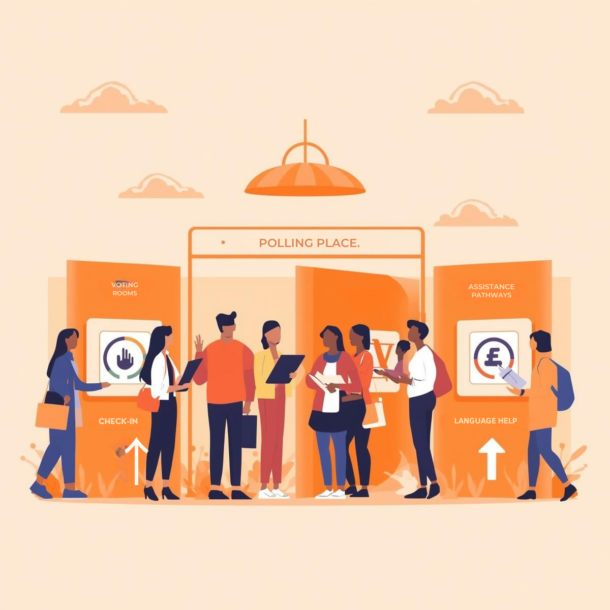
At polling places and early voting sites, signs should be highly visible, easy to understand, and where possible, multilingual. Simple language and universal symbols (arrows, checkmarks, ballot icons) help everyone grasp the message quickly. A directional sign might say “Voter Check-In → Room A” with arrows, and display the same information in Spanish, Chinese, or other prevalent local languages directly below. In diverse communities, translations should appear in the primary languages spoken locally. Federal law requires bilingual materials in jurisdictions covered under Section 203 of the Voting Rights Act, but best practice suggests going beyond minimum requirements. Prioritize key voter-facing messages: polling place locations, hours, ID requirements, ballot instructions, and provisional ballot procedures.
Consistency across locations trains voters to recognize official election signage. Use the same colors, fonts, and logo placement throughout all sites so voters know they’re looking at authoritative information. Placement matters tremendously: position signs where voters make decisions, at building entrances before they’re confused about where to go, at registration tables before they reach poll workers, and near exits with “I Voted” stickers to celebrate participation. Weather-resistant materials, proper lighting, and weighted bases keep signs readable and professional throughout long voting days. By combining crisp design, smart language choices, and strategic placement, signage does more than inform, it actively guides voters through the democratic process with confidence.
Make Public Announcements Count
Public address announcements at polling places or voter service centers work best when they are short, precise, and repeated on schedule. A simple structure keeps everyone on track: state what’s happening, specify where it applies, give one clear action, and note when the message will repeat. For example: “Attention voters: We are extending voting hours at this location until 8 PM due to earlier delays. If you are in line by 8 PM, you will be able to vote. This message will repeat in ten minutes.” Tone and pacing matter as much as content. A calm, steady voice at moderate pace helps anxious or confused voters focus. Avoid jargon and election administration codes; use consistent verbs like “Check in,” “Proceed to,” “Wait here” so actions are unmistakable. In multilingual communities, repeat announcements immediately in the second language or alternate languages each cycle so no voter waits too long.
When ambient noise is high, pair audio announcements with digital displays or printed updates posted prominently. Log announcement times and content so election supervisors know what information voters have received. Keep laminated cards with pre-approved language at check-in stations so all workers deliver consistent messages as shifts rotate. Repeating concise, plain-language messages on a reliable cadence prevents confusion and keeps voting flowing smoothly.
Ensure Accessibility for All Voters
Accessible communication is not optional, it’s a legal requirement and moral imperative. Under the Americans with Disabilities Act (ADA) and the Help America Vote Act (HAVA), every aspect of the voting experience must accommodate voters with disabilities. This means providing information in multiple modes: large-print materials, audio ballot instructions, ASL interpreters at voter assistance centers, and wheelchair-accessible routes clearly marked. Pair visual information with audio where possible. If your jurisdiction offers curbside voting, ensure visible signage with a phone number voters can call for assistance, and ensure someone answers promptly. Train poll workers to offer help respectfully without assuming what assistance is needed: “How can I help you today?” is better than “Let me do this for you.”
Digital materials linked via QR codes should be screen-reader friendly: avoid text embedded in images, include alt text for photos, use proper heading structure, and keep reading levels around 6th-8th grade. For critical printed materials like sample ballots and polling place information, high-contrast layouts and larger fonts improve readability for everyone, not just those with low vision. Stock support kits at polling places with large-print sample ballots, magnifying sheets, communication boards for non-verbal voters, and quick-reference cards in multiple languages. Redundancy across formats and human assistance ensures no eligible voter faces a barrier to casting their ballot.
Train and Empower Election Workers
Poll workers, voter registration staff, and election day troubleshooters are not just administrators, they are the human face of democracy and primary communicators with voters. Every interaction shapes whether a voter feels welcomed or discouraged, confident or confused. Comprehensive training on communication skills is as important as training on procedures. Train all staff to use respectful, patient tones and to listen actively when voters have questions or concerns. Something as simple as a poll worker calmly explaining why a voter was directed to a provisional ballot (“Your name isn’t showing in our pollbook yet, but this provisional ballot ensures your vote will count once we verify your registration”) can turn a potentially frustrating situation into a positive experience with democracy.
Encourage workers to de-escalate tensions and address questions when possible, but also to know when to escalate to supervisors. Role-playing scenarios during training helps workers practice responses to common situations: long lines, voter confusion about ID requirements, equipment malfunctions, and even confrontational observers or challengers. Every worker should understand key messages about your jurisdiction’s processes and be able to convey them in everyday language. During voter registration drives and community events, friendly, informed staff help demystify elections and build public confidence. When election workers feel prepared and empowered to communicate, voters feel respected and cared for.
Deploy Multilingual Staff and Materials
In diverse communities, it’s essential to have multilingual materials and bilingual staff available at every voter touchpoint. For planned outreach, voter registration drives, absentee ballot application assistance, and candidate forums, prepare materials in the languages spoken locally. The National Voter Registration Act and Voting Rights Act mandate language assistance in certain jurisdictions, but best practice means going beyond minimums wherever language barriers exist. During voting, have bilingual poll workers or phone interpretation services available to bridge language gaps. Many election offices now use tablets or phones connected to interpretation services covering dozens of languages. The presence of poll workers who speak voters’ native languages can dramatically ease anxiety, especially for immigrant communities or first-time voters who may already feel intimidated by the process.
Culturally competent communication extends beyond translation, it means understanding different cultural norms around authority, government institutions, and civic participation. Some communities may have experienced suppression or fraud in their countries of origin; showing patience and building trust through respectful engagement is critical. The goal is to meet voters where they are, linguistically and culturally, so that language is never a barrier to exercising the franchise. By following these on-the-ground best practices, clear signage, effective announcements, full accessibility, well-trained staff, and multilingual support, election agencies create an environment where every eligible voter can confidently participate. These practices reduce confusion, minimize delays, and demonstrate respect and inclusivity. In routine interactions and high-pressure moments alike, they prove that election officials are committed to serving every member of the community equally.
Our Comprehensive Guide to Public Communications for State and Local Government Agencies
This article is part of our series on strategic communication for state and local government agencies. To learn more and to see the parent article, which links to other content just like this, click the button below.
Voter Education, Registration, and Turnout Campaigns
Communicating about voter registration, election procedures, and civic participation is central to the mission of election agencies. Whether encouraging eligible citizens to register, explaining new voting methods, or simply reminding people that Election Day is approaching, these outreach campaigns help voters overcome barriers and exercise their rights. A common principle guides this work: “Democracy works best when everyone participates.” This idea, echoed in voter guides, social media posts, and community forums, reminds citizens that their voice matters and that voting is both a right and a responsibility. By reinforcing these messages across various touchpoints, agencies aim to turn basic awareness into action and build a culture of civic engagement. Below are several approaches election agencies use to promote voter registration, education, and turnout:
Making Registration Accessible and Visible
Many election agencies actively work to make voter registration as easy and visible as possible. Just as public health agencies promote vaccination at pharmacies and grocery stores, election officials meet potential voters where they already are. These efforts include:
-
Visible reminders throughout communities: On college campuses, one might see banners announcing “Register to Vote Today!” outside student centers. Libraries, post offices, DMV offices, and community centers display posters with QR codes linking to online registration. These constant visual cues normalize registration as an everyday civic activity.
-
Online and mobile registration: Most states now offer online voter registration, dramatically lowering barriers. Election agencies promote these tools through social media, text banking, and partnerships with civic organizations. A millennial or Gen Z voter scrolling Instagram might see a sponsored post from their county clerk: “Register to vote in 2 minutes, swipe up!” with a direct link to the registration portal.
-
Community registration drives: Election officials partner with nonprofits, churches, schools, and cultural organizations to hold registration events. Setting up tables at county fairs, music festivals, high school graduations, and citizenship ceremonies brings registration directly to new voters. Many jurisdictions deputize volunteers to register voters on behalf of the election office, extending reach into every neighborhood.
-
Motor Voter and agency-based registration: Under the National Voter Registration Act, state motor vehicle agencies must offer voter registration. Many states have expanded this to public assistance offices, disability services, and universities. Clear signage and well-trained staff at these locations ensure every eligible person knows they can register while conducting other business.
-
Automatic and same-day registration: Progressive jurisdictions have implemented automatic voter registration (AVR), where eligible citizens are registered when they interact with government agencies unless they opt out. Others offer same-day registration at polling places. Communicating these options clearly helps voters understand that registration doesn’t have to happen weeks in advance.
The key is repetition and accessibility: seeing voter registration messages in multiple places, on a billboard, in a text message, from a community leader, reinforces that registering is simple, important, and expected. Over time, agencies that make registration visible and frictionless see higher registration rates and more engaged electorates.
Educational Campaigns About Voting Methods
As voting options have expanded, early voting, vote-by-mail, ballot drop boxes, provisional ballots, election agencies must educate voters about how these methods work. Successful campaigns use clear messaging across multiple channels:
-
Vote-by-mail/absentee ballot education: In states with universal vote-by-mail or no-excuse absentee voting, agencies launch campaigns explaining the process: how to request a ballot, how to mark it correctly, how to return it securely, and deadlines to meet. Graphics showing each step (request → receive → mark → sign → return) make the process digestible. Video tutorials on websites and social media demonstrate proper ballot completion, signature matching, and envelope sealing.
-
Early voting promotion: “Don’t wait for Election Day, vote early!” campaigns encourage voters to take advantage of early voting periods. Election agencies publish early voting schedules, locations, and hours prominently on websites, social media, and through text alerts. Some jurisdictions brand their early voting efforts: Boulder County, Colorado, created “Vote Early Day” with community events and social media buzz to normalize early voting as convenient and patriotic.
-
Ballot drop box security messaging: As drop boxes become common, agencies communicate their security features, 24/7 video surveillance, tamper-proof seals, chain-of-custody protocols, to reassure voters that this method is safe. Clear maps showing drop box locations and hours help voters plan.
-
Voter ID and identification requirements: In states with voter ID laws, election agencies must clearly explain what forms of ID are acceptable, where to obtain them, and what happens if a voter lacks ID. Campaigns might feature wallet-sized cards listing acceptable IDs or social media graphics showing examples. FAQs address edge cases: expired IDs, student IDs, name changes.
-
Provisional ballot education: When voters face registration issues or ID questions, provisional ballots ensure they can still cast a vote. Election agencies explain what a provisional ballot is, why it might be used, and how voters can confirm their provisional vote was counted. Transparency about this process reduces anxiety and conspiracy theories.
Creative, multi-channel campaigns make these procedural details accessible. For example, an animated video showing a voter’s journey from receiving a mail ballot to dropping it in a secure box, narrated in multiple languages, can reach thousands on YouTube and Facebook. Local TV interviews with election directors explaining changes keep traditional media audiences informed. The goal is to demystify the process so every voter feels confident in whichever method they choose.
Get Out the Vote (GOTV) and Turnout Messaging for Election Office Agencies
As Election Day approaches, nonpartisan GOTV efforts remind and motivate registered voters to actually cast ballots. While partisan campaigns and advocacy groups run their own GOTV operations, election agencies play a neutral role in boosting turnout across the board:
-
Deadline reminders: Text alerts, emails, and social media posts remind voters of key dates: voter registration deadlines, absentee ballot request deadlines, early voting periods, and Election Day itself. Simple graphics with bold countdown clocks (“3 Days Until Election Day!”) create urgency.
-
Polling place locators: Agencies provide easy-to-use tools, websites, mobile apps, text-based lookup, where voters enter their address and instantly see their assigned polling location, hours, and sample ballot. Reducing confusion about “where do I vote?” removes a major participation barrier.
-
Sample ballots and voter guides: Publishing sample ballots weeks before the election allows voters to research candidates and issues at home. Many agencies mail sample ballots or make them downloadable. Nonpartisan voter guides with candidate information and ballot measure explanations (often produced in partnership with civic groups) help voters make informed choices. Clear, jargon-free explanations of ballot measures are especially important, legalese can intimidate voters into skipping questions.
-
Celebration of civic participation: Campaigns like “I Voted” stickers, social media frames, and community events frame voting as a positive, celebrated act. When people see their neighbors posting “I Voted” selfies, social proof kicks in: voting becomes the norm. Election agencies amplify this by sharing photos of community members voting, thanking voters for participating, and highlighting record turnout when it occurs.
-
Voter hotlines and assistance: Operating voter hotlines staffed with trained representatives who can answer procedural questions in real-time helps voters overcome last-minute obstacles. Publicizing these hotlines via mass media, websites, and polling place signage ensures voters know help is available.
The underlying message in all GOTV communication is empowerment: “Your voice matters. Voting is easy. We’re here to help.” By framing civic participation as a shared community value and providing practical support, election agencies boost turnout and strengthen democracy.
How Your Election Office Can Build Trust Through Transparency and Accuracy
Public trust in elections is not a given, it must be earned and maintained through consistent, transparent communication. In an era of misinformation, conspiracy theories, and hyper-partisanship, election officials face the challenge of demonstrating that elections are secure, fair, and accurately administered. Trust-building isn’t just a campaign; it’s a continuous commitment to openness, accuracy, and responsiveness.
Proactive Transparency About Election Security
Modern election security involves layers of physical, cyber, and procedural safeguards. Election agencies should communicate these measures proactively, not just reactively when challenged. This includes:
-
Publishing security protocols: Websites and public reports explaining ballot chain-of-custody procedures, equipment testing and certification, post-election audits, and cybersecurity protections. Videos showing ballot processing and counting, while protecting voter privacy, demystify the process and show the care taken at every step.
-
Pre-election public testing and demonstrations: Inviting media, candidates, and community members to observe pre-election logic and accuracy testing of voting equipment shows transparency. When stakeholders see machines tested with sample ballots before Election Day, it builds confidence that equipment works correctly.
-
Clear explanations of risk-limiting audits and recounts: After elections, many jurisdictions conduct statistical audits comparing hand counts to machine totals to verify accuracy. Communicating why these audits matter, how they work, and their outcomes reassures the public that results are verified. If a recount is triggered, explaining the legal process and providing regular updates prevents speculation.
-
Addressing misinformation head-on: When false claims about voter fraud or rigged machines circulate, election agencies must respond with facts. This might mean issuing press releases debunking specific myths, partnering with fact-checkers, or creating “rumor control” pages on websites. Silence in the face of misinformation allows falsehoods to spread; proactive, factual responses protect trust.
Transparency about security isn’t just about thwarting bad actors, it’s about reassuring the vast majority of voters that their ballots will be counted accurately. When voters understand the safeguards in place, they’re more likely to trust the outcome even if their preferred candidate loses.
Accurate, Timely Reporting of Results
Nothing erodes trust faster than confusion or delays in election night reporting. While speed is important, accuracy is paramount. Election agencies must communicate clearly about the timeline and process of counting votes:
-
Setting expectations in advance: Before Election Day, communicate that results take time. Explain why: mail ballots must be verified and counted, provisional ballots require research, and officials won’t sacrifice accuracy for speed. If state law prohibits processing absentee ballots until Election Day, voters need to know that delays don’t signal problems.
-
Regular, transparent updates on election night and beyond: Posting updated vote counts at predictable intervals (e.g., “We will update totals every hour until counting is complete”) gives media and the public a cadence to follow. Including information on how many ballots remain uncounted helps everyone understand how complete the picture is.
-
Clear communication about close races: When races are too close to call or trigger automatic recounts, explain the legal processes involved and the timeline. Transparency here prevents rumors that delays mean fraud or manipulation.
-
Accessible results reporting: County Clerks should publish results on websites with clear, user-friendly dashboards showing vote counts by precinct, candidate, and issue. Live-updating maps and charts make data accessible to the public without needing to wait for media interpretation.
-
Certification and final canvass communication: After unofficial results, the formal canvass and certification process verifies every ballot. Communicating this final step, when results become official, closes the loop and marks the democratic process as complete.
By maintaining transparency throughout counting and certification, election agencies show they have nothing to hide. Trust comes from consistency: doing what you said you’d do, when you said you’d do it, and explaining any changes clearly.
Responsiveness to Questions and Concerns
Trust is also built through dialogue. Boards of Elections that listen to voters, answer questions patiently, and address concerns seriously are more trusted than those that seem defensive or dismissive:
-
Accessible customer service: Voter hotlines, email inboxes, and social media channels staffed by knowledgeable, respectful representatives help voters get answers fast. Long wait times or unanswered questions breed frustration and distrust.
-
Public forums and town halls: Hosting community meetings where voters can ask election officials questions directly humanizes the process and allows for two-way communication. Even tough questions or complaints are valuable, they reveal what voters are worried about and give officials a chance to address concerns with facts.
-
Engaging with community leaders and stakeholders: Building relationships with civic groups, political parties, media, and advocacy organizations creates channels for concerns to surface early. When trusted community voices vouch for the integrity of the process, their credibility extends to the election agency.
-
Transparent handling of complaints and irregularities: When issues arise, machine malfunctions, long lines, allegations of intimidation, acknowledging them promptly, explaining what went wrong, and detailing corrective actions shows accountability. Ignoring or minimizing problems damages credibility; transparency and corrective action build it.
Ultimately, trust is a relationship, not a transaction. Boards of Elections that communicate openly, admit when they make mistakes, and consistently put accuracy and fairness first earn the public’s confidence over time. That trust, once established, becomes a buffer during crises or controversies, voters give officials the benefit of the doubt because the track record merits it.
Case Studies: Lessons from Election Communication Initiatives
 Real-world examples across election administration illustrate how strategic communication can yield impressive results in voter engagement, turnout, and public trust. Below are three case studies highlighting creative approaches that election agencies have used to connect with voters and strengthen democracy. Each offers practical lessons that other jurisdictions can adapt:
Fulton County, Georgia. From Awareness to Action: Engaging Voters Through Targeted Communication
After the 2020 election cycle brought intense scrutiny, Fulton County’s Department of Registration & Elections used targeted digital outreach, multilingual voter materials, community ambassadors, transparent security messaging, and rapid rumor-control responses to rebuild confidence and reduce confusion. The strategy helped increase registration and turnout among key groups, improved public understanding of election processes, and strengthened trust between election officials and the communities they serve.
Boulder County, Colorado. Messaging That Moves People: The Communication Strategy Behind Vote Early Day
To normalize early voting and reduce Election Day congestion, the Boulder County Clerk & Recorder’s Office turned Vote Early Day into a branded community campaign, pairing festive events, business partnerships, social media promotion, and clear logistical information with messaging focused on convenience and empowerment. The effort increased early voting participation, boosted community engagement, and helped make voting feel less like a chore and more like a shared civic ritual.
State of Missouri. Securing the Vote, Informing the Public: The Communication Strategy for HB 1878
When Missouri implemented new voter ID requirements and election security measures under HB 1878, the state supported rollout with a statewide public information campaign, local election toolkits, targeted outreach to affected groups, and extensive poll worker training. By clearly explaining the new rules, promoting access to free IDs, and maintaining transparency about implementation, the Missouri Secretary of State’s Office reduced confusion, supported voter preparedness, and helped maintain turnout levels during a major policy change.
How Election Office Agencies Can Leverage Digital Tools & Media Strategy for Success
Modern technology has revolutionized how election agencies inform and engage voters. A robust digital media strategy extends reach beyond in-person efforts, enabling real-time communication and broader audience interaction during registration periods, early voting, and Election Day. Here are key digital tools and tactics, and how County Clerks and Secretaries of State, alike, can align them with their overall communication approach:
Real-Time Information Systems and Voter Tools
When deadlines approach or voting is underway, voters need instant access to accurate information. Election agencies should provide multiple digital tools:
-
Online voter registration portals: User-friendly websites and mobile-optimized registration systems lower barriers to participation. Clear instructions, progress indicators, and immediate confirmation reduce anxiety and abandonment. Promote these portals through social media ads, QR codes on physical materials, and partnerships with organizations that serve eligible voters.
-
Polling place and ballot drop box locators: Interactive maps where voters enter their address and instantly see their assigned polling location, early voting sites, or nearest ballot drop box with hours and directions. Mobile-responsive design ensures access from phones. Integration with Google Maps and other navigation apps makes getting there seamless.
-
Ballot tracking systems: Many states now offer ballot tracking, voters can see when their mail ballot was sent, received, and counted. Email or text notifications at each stage provide peace of mind and reduce calls to election offices asking about ballot status. Transparency here combats conspiracy theories about lost or manipulated ballots.
-
Sample ballots and candidate information: Publishing sample ballots weeks before elections allows voters to research races and issues. Searchable databases of candidates, ballot measures, and nonpartisan analyses help voters make informed decisions. Some jurisdictions allow voters to mark sample ballots online and print or save them to bring to the polls as a reference.
-
Real-time election night results dashboards: User-friendly, live-updating websites showing vote counts by race and precinct give the public direct access to data without waiting for media interpretation. Clear labeling of “preliminary,” “unofficial,” and “certified” results manages expectations and prevents premature declarations.
The bottom line: meet voters on the platforms they use most. Digital tools should be tested for accessibility, translated into multiple languages, and promoted widely so every eligible voter knows they exist.
Social Media Engagement for Election Office Agencies
Social media is often the public’s first source for election information and updates. Platforms like Facebook, Twitter, Instagram, TikTok, and YouTube are indispensable for reaching voters where they already spend time:
-
Proactive information sharing: Use social media to push out registration reminders, voting deadlines, polling place changes, and ballot return information. Short videos explaining processes (“How to fill out your mail ballot in 60 seconds”) get shared widely and make complex information digestible.
-
Real-time updates during voting: On Election Day and during early voting, post updates about wait times at polling places, address equipment issues transparently, and celebrate high turnout. Live-tweeting or posting Instagram stories from polling sites (respecting voter privacy) shows the democratic process in action.
-
Countering misinformation: Social media is a primary vector for election misinformation. Agencies must monitor platforms for false claims and respond quickly with factual corrections. Partnerships with platform fact-checkers and using labels like “Verified Election Official” lend authority to corrections.
-
Humanizing election administration: Share behind-the-scenes content, meet the people who test voting machines, prepare mail ballots, or train poll workers. Show the care and professionalism involved. Humor, when appropriate, makes content shareable: a county clerk’s TikTok explaining voter registration in a funny but informative way can reach thousands of young voters who’d never read a press release.
-
Engagement and dialogue: Social media isn’t just broadcast, it’s conversation. Respond to voter questions in comments or direct messages when possible (within bounds of providing legal advice). Acknowledge concerns respectfully even when you disagree. Host live Q&A sessions with election directors or secretaries of state where voters can ask anything.
-
Paid social advertising: Modest ad budgets on Facebook and Instagram allow targeted outreach, geo-targeting college students for registration deadlines, reaching seniors about absentee voting, or reminding language minority communities about multilingual assistance.
Develop a social media policy covering tone, response protocols, and who is authorized to post. During crises or controversies, designate a social media manager who can post quickly with pre-approved language. Trust on social media is earned through consistency, honesty, and responsiveness.
Websites as Voter Information Hubs
Your election office agency’s website is the 24/7 command center for election information. It must be current, comprehensive, and accessible:
-
Clear navigation and organization: Voters should find what they need in two clicks: registration, polling locations, ballot information, results, contact info. Drop-down menus, search functions, and mobile-friendly design are essential.
-
Accessibility compliance: Websites must meet WCAG accessibility standards, screen reader compatibility, alt text for images, high color contrast, keyboard navigation. This ensures voters with disabilities can access information independently.
-
Multilingual content: Provide full translations of key materials in languages required by law and ideally beyond. Machine translation is better than nothing, but human translation ensures accuracy and cultural appropriateness.
-
Prominent alert sections: During active elections, feature a banner or alert box at the top of every page with urgent information, “Polls are open 7 AM.7 PM today,” “Deadline to return mail ballots: 5 PM tomorrow.” Remove or update these promptly to avoid confusion.
-
Transparency sections: Publish security protocols, audit results, poll worker training materials, and vendor contracts. FAQs addressing common questions and myths preempt confusion and demonstrate openness.
-
Media resources: A press page with recent releases, high-resolution photos, spokesperson contact info, and downloadable election data helps journalists tell accurate stories.
Regularly test your website’s performance, speed, mobile responsiveness, and uptime. Election offices often see huge spikes in traffic close to deadlines and on Election Day. Ensure your web infrastructure can handle it so voters aren’t greeted with error messages when they need information most.
Media Relations and Press Strategy
Election agencies must also work strategically with traditional media. Journalists cover elections intensely and can amplify both accurate information and misunderstandings. A proactive press strategy includes:
-
Regular press briefings: Before elections, hold media briefings explaining procedures, timelines, and changes. After elections, provide updates on ballot counts, audits, and certification. When journalists understand processes, they report more accurately.
-
Rapid response to misinformation: If false claims hit the news cycle, issue quick clarifications and offer spokesperson interviews. Provide evidence (audit results, official statements) and calm explanations.
-
Training spokespersons: Ensure election directors, clerks, or communications staff are trained to speak clearly and confidently on camera. They should be able to explain complex procedures in plain terms, avoiding jargon and defensive language.
-
Building relationships year-round: Don’t only contact media during crises. Establish rapport with local reporters by sharing educational content and offering tours of election operations. Familiarity builds trust and can make media more receptive when urgent issues arise.
By integrating digital tools, social media, websites, and press strategy, election agencies create a multi-channel communication ecosystem. This ensures voters can access accurate information quickly, reduces confusion, and strengthens trust in election administration across the community.
Video and Visual Content to Increase Clarity
Short videos and infographics are especially effective because many voters learn visually. Election agencies can use:
-
“How-to” videos: Show voters how to register, fill out mail ballots, use voting machines, and track ballots. Videos can reduce errors and increase confidence.
-
Infographics: Display deadlines, step-by-step processes, and ID requirements in simplified visual formats. Infographics are easy to share on social media and can be printed for in-person distribution.
-
Myth vs. fact graphics: Counter common misinformation with side-by-side comparisons, framed respectfully and backed by official sources.
-
Behind-the-scenes content: Show the election process. Ballot printing, equipment testing, secure storage, counting procedures. This demystifies administration and reinforces legitimacy.
Video production doesn’t have to be expensive. Smartphone cameras and free editing software can produce serviceable content. Authenticity often matters more than polish, voters appreciate genuine communication over slick advertising.
Fostering Community Engagement & Inclusivity for Election Office Agencies
A foundational principle in modern election administration is that democracy works best when everyone participates. Effective communication must therefore prioritize inclusivity, ensuring that language barriers, disabilities, cultural differences, age, income level, or geography never prevent eligible citizens from voting. Community engagement can turn passive voters into active participants and can transform a Secretary of State’s office from a distant bureaucracy into a trusted partner in democracy. Here’s how agencies foster inclusivity and engagement:
Build Trust Through Transparency and Dialogue
Transparency isn’t just about publishing data, it’s about ongoing, honest communication that invites scrutiny and responds to concerns:
-
Regular community forums and town halls: Host public meetings where voters can ask election officials questions directly. These forums humanize election administration and allow concerns to surface in a constructive environment. Bring the forums to communities rather than expecting everyone to come to you, libraries, community centers, churches, schools.
-
Advisory committees and stakeholder groups: Form committees that include diverse voices, political parties, advocacy organizations, disability rights groups, language minority representatives, students, seniors. Regular meetings with these stakeholders create feedback loops and ensure policies reflect community needs.
-
Open-door policies: Encourage voters to tour election facilities, observe ballot processing (where legally permissible), and ask questions. When people see the seriousness and security of election operations firsthand, skepticism often transforms into confidence.
-
Publish accountability reports: Annual or post-election reports detailing registration numbers, turnout by demographic, provisional ballot outcomes, equipment performance, and challenges faced show transparency and commitment to improvement.
Trust grows when communities see that election officials listen, respond to feedback, and continuously work to improve. When a jurisdiction implements a suggestion from a community group, publicizing that closes the loop and shows participatory governance in action.
Reflect Diversity in All Communications
Inclusive communication starts with ensuring everyone sees themselves represented:
-
Multilingual materials as standard practice: Beyond legal requirements, provide election information in every language spoken significantly in your jurisdiction. This means professional translation of registration forms, ballot instructions, sample ballots, press releases, and social media content. Use interpreters at community events and language lines for phone support.
-
Culturally competent imagery and messaging: Campaign materials, website photos, videos, and social media should feature diverse faces that reflect your community’s demographics. Avoid tokenism, authentically represent the full range of people you serve. Partner with cultural organizations to ensure messaging resonates and doesn’t inadvertently offend.
-
Accessibility by design, not accommodation: Build accessibility into everything from the start. High-contrast websites, large-print materials, captioned videos, ASL interpreters at events, and clear, jargon-free language benefit everyone, not just those with disabilities. Frame accessibility as universal design, not special treatment.
-
Age-appropriate outreach: Young voters respond to different messages and platforms than seniors. Meet each group where they are: TikTok and Instagram for Gen Z, Facebook and TV for older voters. Content for first-time voters might emphasize empowerment and ease, while content for long-time voters might focus on new processes or changes.
-
Messaging that respects varied civic backgrounds: Immigrant communities may have different experiences with government and elections. Messages emphasizing safety, privacy of the ballot, and nonpartisan administration can reassure those from countries where elections aren’t free or fair. Emphasize that voting is a right in America, not a risk.
Representation in communication sends a powerful signal: “This democracy includes you. Your voice matters. We want you to participate.” When everyone feels seen and valued, participation increases.
Partner with Community Organizations
Election agencies can’t reach every community alone. Partnerships multiply reach and lend credibility:
-
Civic and advocacy organizations: Groups like the League of Women Voters, NAACP, AARP, disability rights organizations, and immigrant services agencies have trusted relationships in their communities. County Clerks and Boards of Election should consider partnering with them to distribute voter guides, host registration drives, and disseminate accurate information. Provide them with toolkits, sample social media posts, print materials, talking points, they can customize.
-
Faith communities: Churches, mosques, synagogues, temples, and other houses of worship are community hubs. Many host voter registration Sundays or nonpartisan get-out-the-vote efforts. Providing religious leaders with nonpartisan information to share with congregants extends reach into communities that may not trust government directly but trust their spiritual leaders.
-
Schools and universities: Boards of Elections can partner with school districts for high school voter registration drives, student government elections that teach civic participation, and parent outreach about registration and voting. Universities are hubs for young voters; working with student affairs offices, campus media, and student organizations ensures students have the information they need to register and vote despite being away from home.
-
Businesses and employers: Employers can share voter registration and election information with employees. Some businesses offer time off to vote or host on-site registration drives. Chambers of commerce can distribute materials to members.
-
Libraries and community centers: Public libraries are trusted, accessible spaces. Providing them with voter registration materials, sample ballots, and information posters makes libraries voter resource hubs. Similarly, rec centers, senior centers, and YMCAs reach specific demographics that a County Clerk may be interested in contacting.
When trusted community voices echo official messages, reach expands and credibility grows. Partner organizations bring local knowledge that improves messaging, they know which concerns resonate, which languages are needed, and which messengers are most effective.
Election Office Agencies Should Create Two-Way Communication Channels
Engagement means dialogue, not monologue. Create opportunities for voters to communicate back:
-
Responsive customer service: Voter hotlines, email support, and social media channels should be staffed by knowledgeable, patient representatives who provide accurate answers quickly. Long hold times or unanswered questions breed frustration and distrust.
-
Feedback mechanisms: Post-election surveys asking voters about their experience identify pain points and improvement opportunities. Online suggestion forms or comment cards at polling places invite input. Importantly, publish summaries of feedback received and actions taken in response, this closes the loop and shows you’re listening.
-
Social media monitoring and engagement: Track what people are saying about elections on social media, questions, complaints, misinformation. Respond where appropriate, not defensively but helpfully. A voter tweeting confusion about ballot return gets a helpful reply and a link to information.
-
Public comment periods for policy changes: When proposing changes, new equipment, adjusted polling locations, updated procedures, hold public hearings and accept written comment. Demonstrate that community input shapes decisions.
Two-way communication builds relationships. When voters know they’ll be heard and their input might matter, they’re more likely to engage constructively. Election officials who listen and adapt earn reputations as responsive and voter-centered.
Proactive Outreach to Underserved Communities
Some communities face systemic barriers to participation, language, poverty, disability, homelessness, justice involvement, geographic isolation. Inclusive communication means going to them, not waiting for them to come to you:
-
Mobile registration and voting assistance: Bring voter registration to shelters, community meal programs, transitional housing, and isolated rural areas. Offer mobile assistance for absentee ballot applications and return in nursing homes and assisted living facilities.
-
Targeted language access: In neighborhoods where English proficiency is low, conduct outreach entirely in the community’s primary language. Partner with ethnic community-based organizations to hold information sessions in native languages.
-
Disability community engagement: Work with independent living centers, advocacy organizations, and service providers to ensure voters with disabilities know about accessible voting options, curbside voting, accessible machines, at-home ballot assistance. Hold focus groups with disabled voters to identify and fix barriers.
-
Justice-involved individuals: Many people with criminal records retain voting rights but don’t know it. Secretaries of State can partner with reentry programs, public defenders, and advocacy groups to educate about eligibility and registration. Clear messaging, “Most people with convictions CAN vote in [state]”, counters widespread confusion.
-
Students and transient populations: College students, military members, and others who move frequently face registration challenges. Clear guidance on residency rules, absentee voting, and address changes prevents disenfranchisement.
Proactive outreach to marginalized communities demonstrates that election agencies prioritize universal access over convenience. When historically excluded groups see their needs centered, trust builds and democracy strengthens.
Content Planning & Internal Alignment for Election Agency Communication Effectiveness
Behind every effective election office agency communication effort is careful planning and internal coordination. Election agencies juggle many messages, routine registration promotion, deadline reminders, security assurances, crisis responses, so it’s crucial to plan what to say, when, and who will say it. Equally important is ensuring the entire organization speaks with one voice. Below are strategies for content planning and internal alignment:
Develop a Communication Calendar for Your Election Office
Plan your communications like you plan elections. Create a calendar mapping the year’s key activities, deadlines, and events:
-
Registration drives and deadlines: Schedule campaigns around National Voter Registration Day, college registration weeks, and state-specific deadlines.
-
Election cycles: Mark primaries, general elections, special elections, and local contests. For each, plan the communication arc: pre-election education, early voting promotion, Election Day reminders, results reporting, post-election transparency.
-
Legislative and policy changes: If new laws affect voting procedures, plan education campaigns well in advance of implementation.
-
National observances: Constitution Day, Women’s Equality Day, and other civic holidays offer opportunities for voter education and engagement messaging.
-
Seasonal considerations: Summer messaging might target young people home from college; back-to-school season is ideal for campus outreach; winter holidays are slow periods for voter activity but good for reflective civic messaging.
A calendar prevents last-minute scrambles and ensures consistent engagement. It also allows for content preparation in advance, template messages, graphics, videos, so when the time comes, communication is fast. Of course, leave flexibility for breaking issues, but having a baseline plan keeps you proactive rather than reactive.
Train and Align Your Team
Consistent messaging starts with internal education. Everyone who interacts with the public should understand key messages and procedures:
-
Regular staff training: Poll workers, customer service representatives, and administrative staff should receive updated training before each election cycle on procedures, talking points, and how to handle common questions or challenging situations. Role-playing exercises prepare staff for real interactions.
-
Spokesperson preparation: Designated public information officers, election directors, and other spokespersons need media training, staying on message, handling tough questions, conveying confidence and empathy. Practice makes these high-pressure moments smoother.
-
Internal briefings: Before major announcements, new equipment rollout, policy changes, results certification, brief all staff so they’re aware and can answer questions or redirect voters appropriately. Internal newsletters or team meetings keep everyone informed.
-
Cross-training and collaboration: In jurisdictions with multiple departments involved in elections (IT, facilities, legal, communications), ensure they collaborate and share information. A unified understanding of goals and messages prevents silos.
When staff are well-informed and aligned, the public receives coherent information regardless of whom they contact. Recognition and appreciation for staff who communicate well reinforces a culture that values public engagement.
Ensure Message Consistency Across All Channels
Voters encounter election information through multiple touchpoints, website, social media, press coverage, phone calls, in-person visits. Consistency across all channels prevents confusion:
-
Develop core message documents: For major initiatives, create one-pagers outlining key messages, facts, and approved language. Distribute to all communicators, staff, partners, spokespeople, so everyone can stay on the same page.
-
Centralized approval for public-facing content: Establish a review process for significant communications. A designated communications lead or team approves press releases, major social posts, and public statements to ensure accuracy and tone consistency.
-
Coordinate timing across channels: When releasing important news, synchronize publication, update the website, post to social media, send email alerts, and notify media simultaneously. Staggered releases create confusion about what’s current.
-
Rapid correction protocol: When errors or inconsistencies occur, correct them immediately across all platforms and communicate the correction transparently. Credibility grows when you admit and fix mistakes quickly.
Consistency builds trust because voters know official channels are reliable. Inconsistent messages raise doubts about competence and honesty.
Measure Impact and Adapt
Track the effectiveness of your communications to improve continuously:
-
Quantitative metrics: Website traffic, social media engagement (likes, shares, comments), email open rates, text alert subscriptions, call volume to voter hotlines, and registration numbers tied to specific campaigns. Digital tools provide rich data on what’s working.
-
Qualitative feedback: Conduct post-election surveys of voters asking about their information sources, clarity of instructions, and overall experience. Focus groups with specific demographics reveal nuanced insights. Monitor social media sentiment and media coverage tone.
-
After-action reviews: After each election, hold internal debriefs focusing on communication: what messages resonated, what caused confusion, where gaps existed. Document lessons learned and update protocols accordingly.
-
A/B testing: Experiment with different messages, subject lines, or visuals to see what performs better. Data-driven refinement improves outcomes over time.
Use these insights to adjust strategies. If young voters aren’t seeing your Facebook posts, shift resources to Instagram or TikTok. If a certain community still has low registration, increase targeted outreach there. Continuous improvement based on evidence makes each election cycle’s communication stronger than the last.
Crisis Communication Planning
Not all communication is planned. Equipment failures, natural disasters affecting polling places, cyberattacks, or misinformation crises require rapid, coordinated responses:
-
Pre-drafted templates: Have template statements ready for common scenarios, polling place relocations, ballot shortages, equipment malfunctions. Customize details quickly rather than starting from scratch.
-
Chain of command: Clarify who has authority to release information during a crisis. Establish an incident command structure where communication flows through a designated PIO to ensure consistency.
-
Rapid response team: Identify staff who can be called on short notice to monitor social media, answer hotline calls, brief media, or update websites.
-
Scenario planning and drills: Conduct tabletop exercises simulating crises, ransomware attack on voter registration database, bomb threat at polling place, viral misinformation on Election Day. Practice how you’d communicate keeps everyone sharp.
Preparation turns chaos into coordinated action. When crises hit, agencies with plans communicate faster, more accurately, and more credibly than those caught flat-footed.
How Election Office Communication Compares with Other Agency Types
Government agencies across all sectors face the challenge of conveying critical information, engaging constituents, and maintaining public trust. Election office agencies, in particular, operate under intense scrutiny and in politically charged environments, making effective communication absolutely essential. While elections have unique characteristics, including partisan sensitivities, legal constraints, and cyclical intensity, many communication principles transfer across public sector work.
The lessons election officials learn about transparency, accessibility, and trust-building apply equally to other government communicators. Just as law enforcement agencies must build community trust before crises occur, election agencies must establish credibility during quiet periods so voters believe them during contested recounts or misinformation storms. Both rely on transparency, with police publishing crime data and use-of-force statistics, and election offices publishing audit results and security protocols, to demonstrate accountability. Public health agencies explaining vaccination processes also parallel election agencies explaining ballot counting. Complex technical procedures must be translated into plain language that builds rather than erodes confidence.
A cornerstone of effective communication across government is having a clear strategy defined in advance. Election agencies exemplify this through voter education campaigns that map out key messages, target audiences, and communication channels months before elections. Just as a parks department might plan seasonal recreation campaigns or a transit agency might promote new routes, election offices plan registration drives, early voting promotion, and security messaging. Success hinges on knowing your audiences and tailoring messages to their needs, whether addressing first-time college voters, elderly mail-ballot users, or non-English speaking communities. Meeting people where they are through multiple communication channels is another universal best practice. Election agencies have learned to blend traditional methods with modern technology to reach the widest audience, including press releases for TV news, social media for younger voters, text alerts for urgent information, community events for face-to-face engagement, and multilingual materials for diverse populations. During elections especially, relying on just one channel is not enough. Information needs to spread quickly across websites, social platforms, email, phone, and physical signage to ensure no eligible voter misses critical deadlines or procedural changes. This multi-channel approach mirrors how public health agencies communicate during disease outbreaks or how emergency management handles disaster warnings.
Accessibility and inclusion in communication is both a legal requirement and a moral imperative across government. Election agencies must comply with ADA, HAVA, and Voting Rights Act language access provisions, just as other agencies face accessibility mandates. Providing materials in multiple languages, offering assistance for people with disabilities, using plain language instead of jargon, and ensuring physical and digital accessibility are shared responsibilities across agencies. When election offices provide large-print ballots, ASL interpreters, and translated voter guides, they model inclusive communication that benefits any agency serving diverse populations.
Transparency and responsiveness build trust across public sector communication. Election officials who publish security protocols, audit results, and provisional ballot data demonstrate openness that builds confidence rather than suspicion. When questions arise, agencies that respond quickly, honestly, and respectfully, even to critics, strengthen credibility. This mirrors best practices in law enforcement transparency, public health data reporting, and environmental monitoring. Acknowledging issues, explaining corrective actions, and showing accountability builds trust more effectively than defensiveness or silence. Internal alignment and training ensure consistent external messaging. Election agencies train poll workers on voter ID rules, ballot procedures, and how to handle confused voters so every location delivers accurate information. When frontline staff understand and can clearly explain procedures, public confusion decreases and trust increases.
Crisis communication skills transfer across agencies. Election offices managing polling place changes or misinformation responses rely on rapid, coordinated communication similar to emergency management or public health crises. Pre-drafted templates, clear roles, and real-time updates across channels are universal best practices. Election agencies’ experience with misinformation and contested results offers lessons for any agency facing public skepticism. Data-driven evaluation improves communication across government. Tracking voter registration, website traffic, engagement, and survey feedback helps refine messaging. Other agencies similarly use program data to adjust outreach and improve results. Partnerships also strengthen communication. Election agencies working with civic groups, schools, and community organizations mirror how other public agencies collaborate with trusted local partners to extend reach and credibility.
In summary, while election administration has unique challenges, including legal complexity and high public scrutiny, the communication strategies it uses are widely applicable. Clear messaging, multi-channel outreach, accessibility, transparency, internal alignment, crisis readiness, data-driven improvement, and partnerships are core principles any public agency can use to strengthen communication and public trust. Election officials’ experience with misinformation, diverse audiences, and high-stakes environments provides valuable lessons for government communicators across sectors.
Tying it All Together for Your Election Office Communication Strategy
In election administration, communication is as critical as ballot security or accurate voter rolls. An election official may manage the most secure voting systems in the world, but if voters don’t understand how to use them, don’t trust the process, or never register in the first place, democracy fails.
As we’ve outlined, strategic communication, from on-the-ground signage to social media engagement to transparent security protocols, is foundational to effective election administration. Agencies that invest in clear, inclusive, and proactive communication don’t just improve voter turnout; they strengthen the legitimacy of democratic institutions themselves.
Election leaders should recognize that communication is not peripheral work delegated to a communications office, it is central to the mission. Every registration drive, every polling place interaction, every press conference, and every social media post contributes to whether citizens trust the system and exercise their franchise.
By planning ahead, engaging creatively with communities, and continuously learning from each election cycle, agencies can stay ahead rather than constantly reacting. In a world of instant information and widespread misinformation, being transparent, timely, and truthful establishes election officials as the trusted source communities turn to when questions or doubts arise.
The strategies discussed in this hub, accessible voter registration, multilingual outreach, transparent security communication, digital engagement, community partnerships, crisis preparedness, are interconnected. They create an ecosystem of trust where voters feel informed, respected, and confident that their participation matters.
When a first-time voter successfully navigates registration because the online portal was user-friendly, when a Spanish-speaking grandmother casts her ballot confidently because materials were in her language, when a skeptical citizen examines audit results and sees transparency, democracy works as intended.
In closing, strengthening your communication strategy is one of the most impactful investments any election agency can make. It means the next time misinformation spreads, your accurate information reaches voters first. It means registration and turnout increase because barriers were removed and participation was celebrated.
It means your poll workers, equipped with clear training and talking points, can calmly handle any situation, supported by a well-informed and cooperative public. Elections aren’t just about counting ballots, they’re about ensuring every eligible citizen can participate and every participant trusts the outcome. Communication is the thread that makes that possible.
By embracing the strategies in this hub, election agencies can move from reactive crisis management to proactive trust-building. Your voice as an election official, whether through a polling place announcement, a press conference, or a social media post, is one of your greatest assets.
Use it wisely, use it often, and the public will listen, participate, and trust. Democracy depends on it.
Strengthening Election Office Communications with Expert Support
 Managing public communication for election agencies, county clerks, boards of elections, secretaries of state, voter services departments, requires tight coordination, clear messaging, and deep understanding of legal requirements and community dynamics. Many agencies succeed with in-house teams that bring institutional knowledge, local relationships, and subject-matter expertise. With proper training, tools, and cross-functional workflows, internal teams can build robust communication capacity. At the same time, partnering with external experts can add surge bandwidth and specialized skills when needed, especially during high-stakes election cycles, major policy changes, or crisis situations. Communications consultants with election administration experience can provide strategic planning, message development, crisis response protocols, voter education campaign design, multilingual content creation, digital strategy, and media training. External support can be particularly valuable when:
-
Implementing new voting systems or major procedural changes that require extensive public education
-
Responding to misinformation campaigns or trust crises that threaten electoral integrity
-
Expanding language access and cultural competency beyond current internal capacity
-
Launching voter registration or turnout initiatives targeting hard-to-reach populations
-
Building long-term communication infrastructure, strategic plans, brand development, content libraries
-
Training staff on media relations, crisis communication, or voter engagement best practices
-
Conducting research, voter surveys, message testing, accessibility audits, to inform strategy
The key is balance: aligning communication approaches with your agency’s mission, legal obligations, community context, and resources. Whether managed internally, in partnership with consultants, or a hybrid model, the most successful strategies root themselves in transparency, accessibility, accuracy, and genuine commitment to serving every eligible voter. Election administration operates in an environment where communication credibility, speed, and cultural competence can determine whether citizens participate and whether they trust outcomes. Well-planned messaging, inclusive outreach, and crisis readiness aren’t luxuries, they’re essential components of electoral integrity.
Ready to Strengthen Public Communication for Your Election Agency?
At Stegmeier Consulting Group, we help election office agencies like yours develop clear, effective communication strategies. We’ll help you:
-
Build crisis and routine communication playbooks: Pre-approved messages, misinformation response protocols, and decision trees that enable fast, accurate updates during elections and year-round operations.
-
Clarify audience segments and message architecture: Define priority audiences (first-time voters, seniors, language minority communities, disabled voters, college students) and develop tailored messaging for each.
-
Design voter education and turnout campaigns: Multi-channel campaigns promoting registration, explaining voting methods, and increasing participation among underrepresented groups.
-
Create multilingual and accessible content: Professional translation, plain-language guides, accessible web design, and materials meeting ADA and Voting Rights Act requirements.
-
Develop transparency and trust-building initiatives: Security protocol communication, audit result publication, community engagement programs, and rumor control systems.
-
Train staff and spokespersons: Poll worker communication training, media preparation for election officials, and scenario-based practice for high-pressure situations.
-
Implement digital communication infrastructure: Social media strategies, website improvements, voter tools, email/text alert systems, and content calendars.
-
Conduct community engagement and feedback programs: Listening sessions, stakeholder advisory committees, voter surveys, and partnership development with civic organizations.
-
Provide surge support during peak periods: On-call communication assistance for primaries, general elections, recounts, and unexpected crises.
-
Measure communication impact and continuously improve: Analytics tracking, post-election evaluations, and iterative refinement based on voter feedback and data.
Whether you manage a small county clerk’s office, lead a regional board of elections, or oversee a state-level voter services division, our work is grounded in the same mission as yours: protecting every eligible citizen’s right to vote and ensuring public confidence in democratic processes. Reach out today for a consultation. We’d love to explore how we can help you communicate more effectively, engage your stakeholders, and strengthen trust in the elections you administer.
Building Trust Between Election Cycles: Year-Round Communication Strategies for County Clerks, Boards of Elections, and Election Offices
Public trust in election administration is often discussed as though it rises or falls only during voting periods. In practice, trust is shaped long before ballots are cast and long after results are certified. It is built in the quieter stretches between election...
Measuring Voter Communication: Which Metrics Actually Matter for Election Offices
Election offices are often told to measure communication more carefully, but measurement in public-sector election work is not as simple as pulling website traffic, email open rates, or social media impressions into a report. Those numbers can be useful, yet they do...
Internal Alignment Before Public Release: How Election Offices Can Keep Staff, Poll Workers, and Leaders on the Same Page
Election communication problems often appear in public first, but they usually begin internally. A website update goes live before poll workers have heard about the change. A leader gives an interview using language that does not match the official voter notice....
What Happens After Election Day: How Election Offices Should Explain Canvassing, Certification, Audits, and Recounts
For many voters, election day feels like the finish line. Ballots are cast, polling places close, early results appear, and public attention shifts quickly toward winners, margins, and projections. Inside an election office, however, the process is not over. Some of...
Segmenting Voter Communication in Election Offices: Reaching First-Time Voters, Older Adults, and Mail Ballot Users
Election offices are often encouraged to communicate consistently, and that principle matters. But consistency does not mean speaking to every voter as though they are starting from the same level of knowledge, confidence, and need. In practice, election communication...
Community Partnerships That Expand Voter Reach: How Election Offices Can Build Trust Without Sacrificing Neutrality
Election offices are often told to reach more voters, but reach is not simply a matter of sending more messages. It is a matter of whether the right information reaches people through sources they already notice, use, and trust. That is what makes community...
Communicating With Campaigns, Observers, and Media: Guidance for Election Offices During High-Scrutiny Periods
High-scrutiny periods test more than election procedures. They test whether the office can keep the public meaning of those procedures stable while attention, pressure, and competing interpretations accelerate around it. During these periods, campaigns want answers...
One Message, Many Channels: How Election Offices Can Coordinate Website, Email, Text, Social Media, and Signage
Election offices rarely struggle because they lack channels. More often, they struggle because each channel speaks slightly differently. The website explains one thing in full detail. A social post shortens it. A text alert strips it down further. An email adds a...
Deadline Communication That Prevents Last-Minute Voter Problems for Election Offices
Election deadlines are often treated as fixed administrative facts. They appear on calendars, websites, mail pieces, and reminder graphics as though their meaning is self-evident. For election offices, however, a deadline is never just a date. It is a communication...
Results Dashboards People Trust: Design and Messaging for Election Offices on Election Night
Election night dashboards are often treated as a technical publishing tool. They are discussed in terms of maps, filters, precinct reporting counts, turnout tables, and refresh rates. For the public, however, a results dashboard is not just a display. It is the place...
Talking About Election Security in Plain Language: Transparency Strategies for Election Offices
Election security is often explained in language that makes sense inside election offices but not always to the public. Terms like chain of custody, audits, access controls, testing, and incident response all describe important protections, but without clear...
How Election Offices Can Roll Out New Voting Systems Without Undermining Voter Trust
Introducing a new voting system is not just a technology project. It is a public trust project. When election offices replace scanners, ballot marking devices, or check-in tools, voters do not evaluate the change the same way election administrators do. Most voters...
Poll Worker Talking Points That Reduce Confusion, Conflict, and Complaints for Election Offices
Election administration is often judged by visible outcomes such as line length, equipment performance, ballot accuracy, and timely reporting. Yet many of the public’s most memorable election-day experiences are shaped by something less structural and more immediate....
Accessible Voter Communication for Election Offices: From Signage to Screen Readers
Election accessibility is often discussed as a matter of equipment, compliance, or accommodation. In practice, it is also a matter of communication design. A voter does not experience accessibility as a statute, a checklist, or a technical specification. A voter...
Multilingual Election Communication Beyond Compliance: How Election Offices Can Reach Voters in the Languages They Use
Multilingual election communication often breaks down when the office treats translation as the finish line instead of the starting point. A translated flyer, notice, or webpage may technically exist, but that does not automatically mean voters can find it, trust it,...
Designing Election Office Websites Around Voter Questions, Not Agency Structure
Most voters do not arrive at an election office website wanting to understand the office’s internal structure. They arrive needing to complete a task, confirm a requirement, or solve a problem quickly. They want to register, check their status, find a polling place,...
Long Lines, Short Messages: Real-Time Communication for Election Offices at Polling Places
Long lines turn a normal polling place into a real-time communication environment. The problem is not only the wait itself. The problem is what happens to voters while they are waiting. Uncertainty grows, rumors spread from one person to the next, and small gaps in...
Mail Ballot Instructions People Can Follow on the First Read: Plain Language for Election Offices
Mail ballot instruction sheets often fail for a simple reason. They are written to cover every rule, but not always written to help a voter complete the task in the right order without hesitation. A packet can be legally complete and still be hard to use if the steps...
Early Voting Campaigns That Actually Move People: Lessons for Election Offices and Voter Services Departments
Early voting outreach works best when it helps people act before they have a chance to procrastinate, not when it simply reminds them that early voting exists. For many voters, the real barrier is not opposition to voting early. It is timing, routine, uncertainty...
The Nonpartisan Line: How County Clerks and Boards of Elections Can Communicate Under Political Pressure
Political pressure rarely arrives as one dramatic moment. More often, it builds through repeated demands for faster answers, public accusations before facts are confirmed, pressure from campaigns or elected officials to frame a process in partisan terms, and growing...
Explaining Voter ID Rules Without Scaring People Away: Communication Strategies for Election Offices
Voter ID communication fails most often before a voter ever reaches the polling place. The real risk is not only that someone arrives without the right document. It is when someone reads a rule, feels uncertain, and quietly decides voting will be too complicated, too...
Rumor Control Pages That Work: How Election Offices Can Respond to Misinformation Fast
Rumors move faster than official explanations when voters are already uneasy, when procedures are unfamiliar, or when a small piece of real information gets mixed with a larger false claim. In that environment, an election office does not need to answer every post on...
Why Are Results Taking So Long: A Public Communication Guide for Election Offices on Election Night, Canvassing, and Certification
Election offices face one of their most visible communication tests when the public begins asking why results are not final yet. On election night, people often expect a fast, simple answer. They want to know who is ahead, whether the numbers can still change, and why...
What Happens to My Ballot: How Election Offices Should Explain Ballot Tracking, Ballot Curing, and Final Status
Ballot tracking has become one of the most visible trust points in modern election administration. Voters increasingly expect to know when a ballot was mailed, when it was received, whether it was accepted for counting, and what happens if there is a problem that...
Precinct Consolidations Without Voter Confusion: How Election Offices Can Message Polling Place Changes Clearly
Precinct consolidations can be operationally necessary, but they also create one of the fastest paths to voter confusion when communication is not tightly coordinated. A voter may have gone to the same location for years, rely on a habitual route, or assume that a...