

Rumor Control Pages That Work: How Election Offices Can Respond to Misinformation Fast
Rumors move faster than official explanations when voters are already uneasy, when procedures are unfamiliar, or when a small piece of real information gets mixed with a larger false claim. In that environment, an election office does not need to answer every post on every platform to be effective. It needs one clear, reliable place where the public, the media, community partners, and office staff can quickly verify what is true, what is false, and what the office wants people to understand right now.
That is why rumor control pages matter. A strong page does not function like a generic fact sheet or a defensive press release. It functions like a rapid public clarification tool. It helps the office answer emerging falsehoods in one consistent format, explain the facts in plain language, and route people back to the official source of truth before confusion spreads further. Federal election guidance has emphasized that election officials should communicate early and often in simple, clear language and use official websites as trusted sources, while CISA’s election Rumor vs. Reality resource is designed to address common disinformation narratives with accurate election information rather than jurisdiction-specific claims.
A local or state election office needs something more specific to its own voters, procedures, and recurring claims. That is where a well-built rumor control page becomes especially valuable. It gives the office a repeatable public response structure for false claims about registration, voting methods, ballot handling, tabulation, observation, results reporting, or certification. It also reduces the pressure to reinvent the message every time a rumor appears in a slightly different form.
This article provides an evergreen communication framework for election offices that want rumor control pages to work in practice, not just in theory. It focuses on why rumor control pages fail, how to structure them for speed and clarity, how to decide what belongs on the page, how to write corrections without amplifying the falsehood, and how to align the page with social posts, staff scripts, media talking points, and broader voter education.
Rumors Grow in Information Gaps, Not Just in Social Media Feeds
 Election misinformation is often described as a platform problem, but for election offices it is just as much an information-gap problem. A rumor gains traction when the public cannot quickly tell what is true, when the official answer is buried, or when the office has not yet translated a complicated process into plain language. In other words, false claims do not spread only because bad actors are active. They also spread because uncertainty has room to grow.
That is why rumor control pages should not be built only as reactive tools. They should be built as gap-closing tools. The office should ask where confusion is most likely to appear before a claim is already moving. If voters are likely to misunderstand how mail ballot verification works, what unofficial results mean, whether machines are connected to the internet, or what poll observers can and cannot do, those are exactly the kinds of topics that may need a rumor-control-ready explanation. The point is not to guess every falsehood in advance. The point is to know where the office is most vulnerable to misunderstanding and to prepare clean public language for those areas.
A good rumor control page also changes the office’s posture. Instead of chasing every claim one at a time across scattered channels, the office establishes a central place where corrections live in a stable format. This helps in several ways. It gives the public a reference point. It gives the media something quotable and linkable. It gives community partners a source they can share without rewriting the office’s message. It also gives internal staff a common answer so that call centers, counters, and public-facing employees are not improvising their own versions of the correction.
This central function aligns with broader election communication guidance. The U.S. Election Assistance Commission has emphasized that officials should communicate early and often in plain language, build partnerships, and treat election websites as trusted sources of accurate voter information. Its 2024 voter education report also found that election officials use multiple tools, including social media, press engagement, and partnerships with government and community organizations, to inform voters and build trust. A rumor control page works best when it sits inside that broader communication ecosystem rather than operating as an isolated project.
Another reason this framing matters is that rumors are rarely all false in the same way. Some are outright fabrications. Others start with a real image, a real location, a real delay, or a real procedural term and then add a false conclusion. Those mixed claims can be especially persuasive because they feel plausible. A rumor control page helps the office separate the accurate piece from the false interpretation. That is often more credible than a blanket denial because it shows the office understands what people are seeing and why they are confused.
Election offices should also remember that silence can unintentionally validate confusion. When a claim is spreading and the office says nothing, many voters assume the office either has no answer or does not want to answer. That assumption may be unfair, but it is predictable. A rumor control page gives the office a disciplined way to respond without sounding panicked. It allows the office to say, in effect, here is the claim, here are the facts, here is what voters should know, and here is where official information will continue to be updated.
This is also where tone matters. Rumor control is not most effective when it sounds irritated, sarcastic, or contemptuous. Even when a claim is clearly false, the office should assume that at least some people encountering it are confused in good faith. A page that sounds dismissive may satisfy insiders, but it will not do much to persuade an uncertain voter. A page that sounds calm, factual, and specific is much more likely to work.
Define the Rumor Control Page as a Public Clarification Tool, Not a Complaint Log
Election offices should be careful about what a rumor control page is designed to do. It is not a place to document every misleading statement in the public environment. It is not a scrolling archive of every hostile post or conspiracy theory. It is not a place for the office to vent frustration. A rumor control page should function as a public clarification tool. Its purpose is to help people quickly understand the facts behind a claim that could confuse voters, undermine confidence, or interfere with the public’s understanding of election administration.
That distinction matters because many rumor control pages fail by becoming too broad, too reactive, or too chaotic. When every claim appears with equal weight, the page becomes noisy and hard to use. When posts are written as rebuttals rather than clarifications, the office can end up amplifying fringe claims that would have reached fewer people otherwise. When the page lacks a consistent structure, readers cannot quickly tell what the office wants them to understand.
A more useful approach is to define clear criteria for what belongs there. Claims should generally make the page when they are circulating enough to create real confusion, when they concern core election procedures, when they could affect voter behavior or trust, or when journalists, community partners, or staff are likely to field repeated questions about them. The office does not need to elevate every falsehood. It needs to respond to the ones that create meaningful risk.
The page should also be written for more than one audience at a time. Voters need a fast explanation in plain language. Reporters need a quotable statement and a linkable source. Community organizations need shareable clarification. Internal staff need stable language they can repeat. A rumor control page that serves all four audiences well becomes much more valuable than one written only for the office itself.
Finally, the page should help the office shift from pure correction to confidence-building. The strongest entries do not simply say a claim is false. They explain the relevant procedure, show what safeguards or records exist, and tell readers where to find official information going forward. That kind of explanation is often more durable than a one-time denial. It also mirrors the kind of transparency that the Election Assistance Commission has highlighted in voter education and trust-building work, including examples where election offices proactively opened up procedures and question-and-answer opportunities to counter rumors and half-truths.
Beyond the Ballot: Election Office Communication Strategies for County Clerks, Secretaries of State, and Boards of Election
This article is part of our series on strategic communication for Election Offices, Election Administration Agencies, and Boards of Elections. To learn more and to see the parent article, which links to other content just like this, click the button below.
Decide Which Rumors Deserve a Page Entry
A rumor control page becomes much more useful when the office is selective. Not every false claim deserves a formal entry. Some claims are too fringe to amplify. Some are too vague to answer meaningfully. Others are already fading and do not justify a permanent place on the page. The office should therefore make entry decisions based on public risk, not on irritation level or online volume alone.
A practical starting point is to ask whether the claim could confuse voter behavior, distort understanding of core election procedures, undermine confidence in a meaningful way, or generate repeated questions from the media, community partners, poll workers, or frontline staff. If the answer is yes, the claim is more likely to merit an entry. If the claim is merely provocative but unlikely to affect voter understanding or office operations, it may be better handled through quieter monitoring rather than public elevation.
This kind of prioritization fits well with broader election communication guidance that emphasizes clear planning, defined communication responsibilities, and preparation for rapid public response during incidents or disruptions. CISA and the Election Assistance Commission’s joint public communications guidance stresses that election officials should prepare teams and communication plans in advance so voters know where to access accurate information, and CISA’s incident response communications guide says the public looks to election officials as the authoritative source for timely, accurate, and clear information when false information begins to affect election operations or confidence.
The office should also distinguish between recurring rumor categories and one-off claims. Some topics come up repeatedly because they sit close to public anxiety points. These often include voter registration status, polling place changes, vote-by-mail procedures, ballot handling, tabulation equipment, observer rules, unofficial results, canvassing, and certification. A rumor control page is especially valuable when it covers these recurring pressure points with stable explanations the office can update over time rather than rewriting the same correction each cycle. Election websites and official voter education channels are widely treated as primary sources for this kind of reliable guidance, and NASS’s current #TrustedInfo2026 effort explicitly promotes election officials as the trusted sources of election information.
Another useful test is whether the office can answer the claim clearly and confidently with available facts. Speed matters, but an entry should not go live if the office still lacks the basic information needed to explain what happened, what did not happen, and what voters should understand. In those moments, it is often better to publish a short holding statement that says the office is reviewing the matter and will update the rumor control page with verified facts, rather than posting a rushed explanation that later needs major correction. That approach aligns with official guidance emphasizing timely communication without sacrificing clarity or accuracy.
The office should also think about durability. Some rumors burn hot for two hours and disappear. Others become reusable talking points that return in every election cycle. If a claim fits the second category, that is a strong reason to create a structured rumor control entry. A reusable clarification saves time later, helps staff stay aligned, and gives the office a stable public reference point whenever the same misunderstanding resurfaces.
Prioritize Claims by Harm, Reach, and Repeatability
A useful internal triage system usually works best when it focuses on three factors. The first is harm. Could the rumor discourage voting, misdirect voters, or damage confidence in a core procedure. The second is reach. Is the claim circulating broadly enough that the public, reporters, or partner organizations are likely to encounter it. The third is repeatability. Is this the kind of misunderstanding likely to appear again even if the current version fades.
This framework helps the office avoid two common mistakes. The first is ignoring a rumor because it seems absurd internally, even though it is spreading quickly outside the office. The second is giving too much attention to a claim that is loud but narrow and unlikely to influence actual voter understanding. Harm, reach, and repeatability create a more disciplined basis for action.
The benefit of this approach is not just better rumor selection. It also helps the office assign effort appropriately. A high-harm, high-reach claim may need a same-day rumor control entry, social amplification, media outreach, and staff scripting. A lower-tier claim may need only monitoring and a prepared answer for internal use. That keeps the rumor control page focused on the issues that matter most.
Use Monitoring to Feed the Page, Not to Chase Every Post
Monitoring is important, but it should support decision-making rather than drive overreaction. Election offices should pay attention to what call centers are hearing, what reporters are asking, what community partners are seeing, and what poll workers or field staff report from the ground. These signals often reveal real voter confusion faster than a simple count of social posts does.
This broader monitoring approach is consistent with election communication planning guidance that encourages offices to identify partners, define team roles, and prepare for coordinated rapid-response communication when misinformation or operational disruption begins affecting public understanding.
The office should therefore treat the rumor control page as the public-facing endpoint of a wider listening system. Monitoring tells the office where confusion is rising. The page then gives the office a stable place to resolve that confusion in clear public language. That is a much more effective model than trying to rebut every post individually across multiple platforms.
Structure Each Rumor Entry for Fast Understanding
A rumor control page works best when each entry follows the same simple structure. Readers should not have to learn a new format every time they visit. They should be able to scan quickly, understand the office’s conclusion, and leave with a clear sense of what the facts are and where to go next. Consistency is what turns the page from a collection of reactions into a dependable public tool.
The first line should identify the issue in plain language. The second should state the office’s conclusion clearly. Then the entry should explain the relevant facts in a short paragraph, followed by any voter action or source-of-truth link that the reader needs. This structure is especially important because many people will not read an entire entry. They will skim the headline, read the first few lines, and decide whether the office sounds clear and credible.
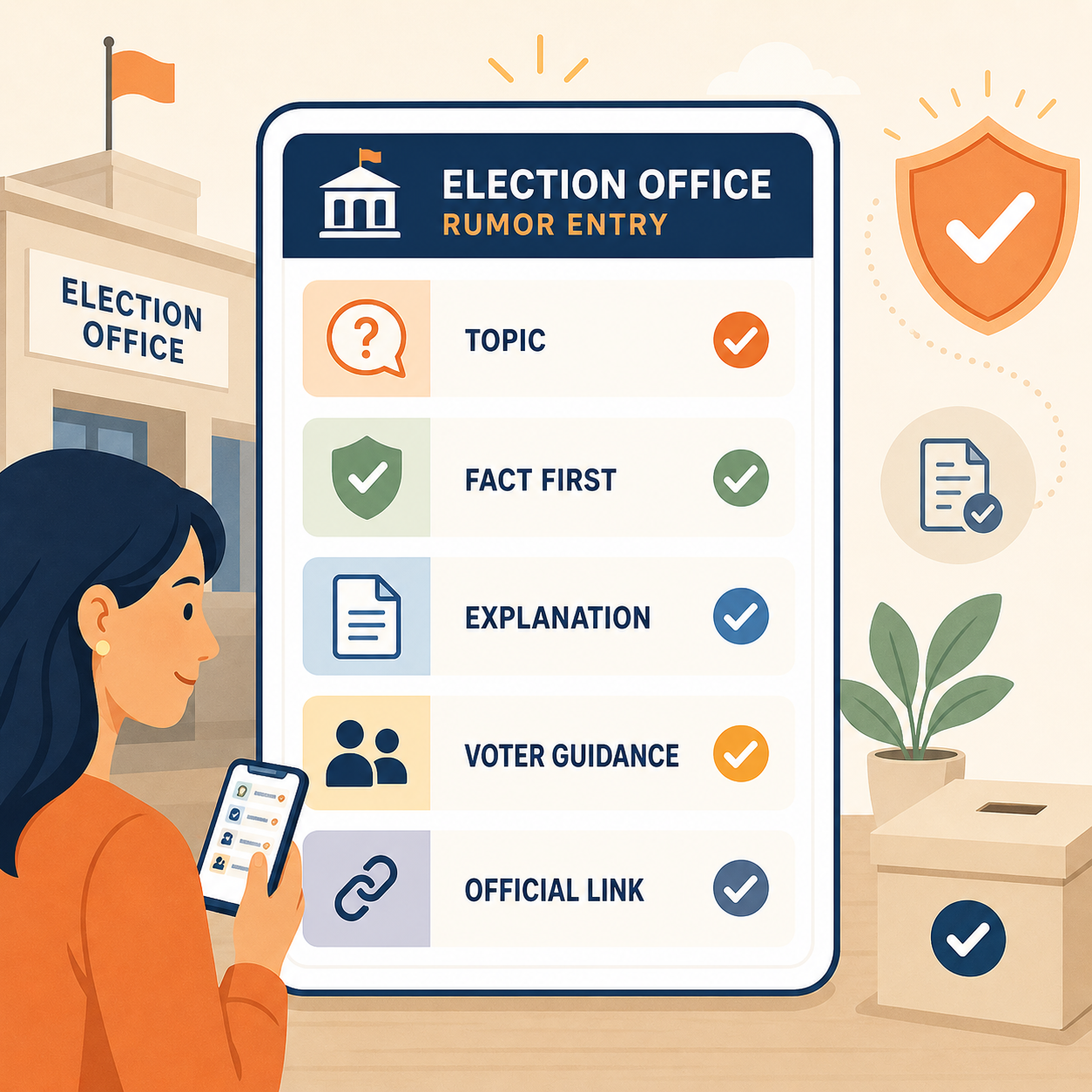
A strong entry usually includes five elements:
-
A clear claim label that tells readers what topic the entry addresses.
-
A short fact statement that says what is true or false without hedging.
-
A plain-language explanation of the relevant procedure or event.
-
A voter guidance line that explains whether any action is needed.
-
A source-of-truth link pointing to the fuller official information.
This kind of structure supports both speed and trust. It also aligns with broader election communication recommendations that call for timely, accurate, and clear information, plain language, and proactive direction to official sources.
The office should also keep each entry focused on one clarification goal. If one post tries to address three different rumors, it becomes harder to scan and easier to misinterpret. Separate entries are often better when claims are distinct, even if they relate to the same topic area. That way, voters and reporters can link to a specific correction without dragging unrelated material into the explanation.
Headlines matter as well. A headline should not repeat the most inflammatory version of the rumor unless that wording is necessary for clarity. In many cases, it is better to frame the entry around the actual topic rather than the viral claim itself. This reduces the chance that the office unintentionally amplifies a misleading phrase while still helping readers find the answer they need.
The body of the entry should also separate the true element from the false conclusion whenever necessary. Some of the most persuasive rumors contain a real image, a real polling place, a real machine issue, or a real administrative delay. The office gains credibility when it acknowledges the accurate piece and then explains why the broader claim is wrong. That approach often works better than a flat denial because it matches what readers may already have seen with their own eyes.
Entries should always tell the reader what to do with the information. Sometimes that means no action is needed. Sometimes it means checking your voter registration through the official portal, verifying your polling place on the election website, or ignoring nonofficial claims about deadlines and using the office’s posted information instead. Without that final guidance step, the entry may correct the record but still leave the voter unsure about what comes next.
Finally, each entry should show when it was posted or updated. A visible date helps the public tell whether the office is responding actively and whether the clarification is current. It also helps reporters and partners avoid circulating stale information. Official election guidance places strong value on timely and transparent public communication, and visible update cues support that goal directly.
Write Corrections to Clarify, Not to Amplify
 A rumor control page works best when each entry leads with the office’s factual conclusion rather than with the most inflammatory version of the claim. Official election communication guidance emphasizes timely, accurate, and clear information, the use of plain language, and official websites as trusted public information sources. As a practical implication of that guidance, rumor entries should be built to help readers understand the facts quickly, not to repeat a false phrase so many times that the office ends up reinforcing it.
This is especially important because many readers will not arrive at the page as committed believers in a rumor. They will arrive as uncertain voters, hurried reporters, concerned poll workers, or community partners looking for something they can trust and share. A correction that sounds like an argument with the internet is less useful than one that sounds like a calm public explanation. The office should therefore write each response in a tone that is direct, specific, and procedural. That approach is more consistent with the broader guidance that election officials are the authoritative sources of election information and should help voters access accurate information through official channels.
One of the strongest writing choices an office can make is to separate the visible fact from the false conclusion. Many rumors are persuasive because they contain one real element. A photo may be real. A polling place may actually have had a line. A machine may actually have been taken out of service. A result update may actually have been posted later than expected. What turns that observation into misinformation is the leap from the real element to the false interpretation. A good rumor control entry should name the real element when necessary, explain the actual procedure or event, and then make clear why the larger claim is inaccurate. This kind of explanation aligns with the emphasis official election resources place on helping voters distinguish rumor from reality by checking with election officials directly.
Election offices should also be disciplined about length. A rumor control entry does not need to reproduce every accusation in detail in order to correct it. In many cases, a shorter clarification is more effective because it gives the public less misleading language to remember and more accurate language to share. The office’s goal is not to document the emotional texture of the falsehood. It is to make the factual explanation easier to find, easier to quote, and easier to repeat. That is consistent with official guidance encouraging election officials to communicate in clear, simple language and to prepare accurate public-facing content on vulnerable topics in advance.
Put the Fact First and the Explanation Second
Readers should not have to work through a paragraph of rumor language before they reach the office’s answer. The clearest format is usually a short fact-first line followed by a plain-language explanation. That structure allows the voter to grasp the office’s conclusion immediately, then understand the relevant context. It also makes the entry more useful to reporters and partners who may quote only the first line. Guidance from CISA and the Election Assistance Commission specifically encourages election officials to prepare official channels that provide accurate information on common topics vulnerable to disinformation and to ensure voters know where to access that information.
A fact-first format also helps the office maintain a steadier tone. The entry does not need to sound angry in order to sound confident. It needs to sound organized. When a voter sees a clear statement of what is true, followed by a simple explanation of the relevant procedure, the office appears prepared rather than reactive. That impression matters because trust is shaped not only by the content of the answer, but also by whether the office sounds like it expected to explain the process clearly. The EAC’s voter education materials and NASS’s #TrustedInfo initiative both reinforce the idea that election officials should serve as the trusted, direct source for this kind of clarity.
Correct the Claim Without Sounding Dismissive of the Voter
Rumor control pages often fail when they sound like they are mocking the people who had questions. That tone may feel satisfying internally, but it can alienate the very reader the office most needs to reach. Official election communication guidance consistently emphasizes public trust, plain-language explanation, and proactive communication through official channels. A calmer tone is therefore not just a stylistic preference. It is part of making the office’s explanation usable to people who are uncertain but persuadable.
A useful working assumption is that some readers encountered the rumor in good faith. They may have heard it from a relative, a neighbor, a candidate supporter, or a local social media group. The office does not have to validate the rumor to respect the reader. It can simply explain the facts, name the procedure, and tell the reader where official updates will continue to appear. This is one reason official election resources place such heavy emphasis on directing the public back to election officials’ websites and materials as the credible source of record.
Build a Fast Review Path So the Page Can Move at the Speed of Confusion
A rumor control page is only effective if the office can update it quickly enough to close the information gap while the claim still matters. That does not mean sacrificing accuracy. It means preparing the review path before public attention spikes. Joint EAC and CISA guidance specifically advises election officials to identify communication team roles, assign review and approval responsibilities, maintain partner contact information, and prepare incident response communications in advance so accurate information can move quickly through official channels.
In practice, that means the office should know ahead of time who drafts a rumor entry, who verifies the facts, who approves the public language, who posts the update, and who distributes it across the office’s other channels. If that chain is unclear, the rumor control page becomes slow at exactly the moment speed matters most. By contrast, a preplanned workflow allows the office to respond with verified core facts quickly and then expand the explanation if needed. This reflects the planning model in the EAC and CISA materials, which call for defined roles, prepared communication plans, and ready official channels rather than an ad hoc response once confusion is already spreading.
This is also where templates become valuable. If the office already has a standard entry format, preapproved language for recurring procedural topics, and a consistent review path, it can publish a credible clarification much faster. The office does not need to invent tone, structure, and approvals from scratch every time. Official election communication guidance explicitly recommends identifying common election administration topics that are vulnerable to disinformation and preparing accurate web-based resources on those topics ahead of time.
Speed should also be paired with visible update discipline. Each rumor control entry should show when it was posted or updated, and the page should make it easy for readers to see that the office is responding actively. A visible timestamp helps the public, reporters, and community partners avoid circulating stale guidance and supports the broader goal of timely, transparent communication through official sources.
Finally, the office should not let perfection prevent basic clarification. If the core verified facts are already known, the page can publish a short, accurate entry and then update it as more detail is confirmed. That is often better than waiting too long while others define the story first. CISA and the Election Assistance Commission have both emphasized that election officials are the primary, authoritative sources of election information and that timely communication is a core part of reducing risk to election operations and confidence.
Promoting Long-Term Election and Voter Confidence Through Effective Rumor Control
A strong rumor control page does more than answer one false claim at a time. It helps shape how voters understand the election office over the long term. When the public sees that the office responds quickly, explains procedures clearly, and corrects misinformation in a calm and disciplined way, the office becomes a more credible source before the next rumor even appears. That matters because trust is cumulative. Voters remember whether the office was easy to understand, whether it sounded prepared, and whether it helped them separate confusion from fact without making the situation feel more chaotic.
This kind of communication discipline also reduces the burden that misinformation places on day-to-day operations. When the office has one stable page where clarifications live, it becomes easier to answer repeated questions consistently. Reporters can link to the same explanation. Community organizations can share the same correction. Poll workers and hotline staff can use the same wording. Instead of spending time reinventing the response across channels, the office can spend more time verifying facts, monitoring new confusion points, and supporting voters who need direct help.
Rumor control pages also help election offices manage the difference between public attention and actual operational risk. Some rumors create noise but little real confusion. Others create real confusion because they affect behavior, trust, or turnout. A well-run page helps the office focus public attention where it belongs. It tells voters which claims matter enough to address, what the facts are, and what the office wants the public to understand going forward. That kind of prioritization helps reduce the feeling that every rumor is equally serious, while still showing that the office takes misinformation seriously enough to answer it clearly.
Another long-term benefit is that rumor control pages help educate the public about election administration itself. Many recurring rumors succeed because the underlying process is not well understood. When the office explains how registration records are maintained, how ballots are handled, how tabulation works, what observation rules allow, or why results update in stages, it is not just correcting a falsehood. It is teaching the public how the system works. That educational function becomes more valuable over time because it gives voters a stronger framework for interpreting future claims.
This is especially important for voters who are newer to the process, less connected to local civic information, or more likely to encounter election news in fragments through social media, text threads, or word of mouth. A rumor control page that uses plain language, stable structure, and direct links to official information creates a more accessible public resource. It helps reduce the advantage that misinformation often has when it is simpler and more emotionally direct than the truth. The office does not need to match rumors with drama. It needs to match rumors with clarity that is easier to find and easier to understand.
Over time, effective rumor control also protects the office from appearing reactive or defensive. If the office only speaks when a rumor is already widespread, it can look like it is always catching up. If it maintains a visible, regularly updated page and integrates that page into broader voter education, it looks prepared instead. That preparedness matters because public confidence is shaped not only by what the office says, but by whether the office appears to have anticipated the need to explain difficult topics clearly.
In that sense, a rumor control page is not just a misinformation response tool. It is part of the office’s broader communication infrastructure. It supports trust, reduces operational friction, improves message consistency, and helps the public see election administration as a system with explainable procedures rather than a series of confusing events. Offices that invest in this kind of page are not simply correcting the record at the moment. They are building a more resilient public understanding of how elections work.
Strategic Communication Support for Election Offices and Voter-Facing Agencies
 Election offices often understand the facts behind a rumor quickly, but they do not always have a communication system that helps them publish those facts in a form the public can understand and share with confidence. A rumor control page may exist, but if it is updated inconsistently, written too defensively, or disconnected from the office’s other public channels, it will not do enough to reduce confusion. The challenge is not only knowing the truth. It is organizing the truth in a way that reaches the public before speculation hardens.
That is why agencies often choose to partner with an external resource like Stegmeier Consulting Group (SCG) to strengthen communication systems. Stegmeier Consulting Group supports election offices, boards of elections, clerks, and voter-facing public organizations by helping them build practical communication frameworks for rumor control pages, public clarifications, source-of-truth content, media response language, staff scripts, and partner-facing updates. That includes identifying the issues most likely to trigger confusion, creating plain-language response templates, building review and approval workflows for rapid updates, and aligning web content with social posts, FAQs, hotline language, and field communication.
SCG can also help offices structure rumor control pages so they are easier to scan, easier to maintain, and more useful to multiple audiences at once. A strong page should work for voters, reporters, community organizations, and internal staff without becoming cluttered or overly technical. That requires thoughtful message architecture, consistent entry formats, clear governance, and a disciplined approach to deciding which claims deserve public response and which do not. These are communication design questions as much as they are operational questions.
SCG also supports offices in moving from reactive rumor response to proactive confidence-building. That means preparing explanations for likely pressure points before confusion spikes, integrating rumor control into broader voter education efforts, and training staff and partners to reinforce the same public-facing clarifications. These practices help election offices reduce misinformation pressure, improve public understanding, and respond more quickly when false claims begin to spread.
Conclusion
Rumor control pages work when they help election offices close information gaps before confusion hardens into distrust. A strong page gives the public one clear place to verify claims, understand the relevant procedure, and find the office’s most current explanation in plain language. When the page is selective, well structured, and updated quickly, it becomes more than a rebuttal tool. It becomes part of the office’s public confidence infrastructure.
Clear rumor response depends on discipline at every stage. The office has to decide which claims create enough risk to deserve an entry. It has to write corrections that lead with the facts instead of repeating the rumor in a way that gives it more reach. It has to move quickly without sacrificing verification, and it has to connect the page to social posts, press responses, staff scripts, and community partners so the same clarification appears everywhere voters may look.
The goal is not to chase every false claim on the internet. The goal is to make accurate information easier to find, easier to understand, and easier to share than the rumor itself. Election offices that do this well reduce confusion, lower repetitive staff burden, strengthen credibility, and help voters see the office as the most reliable place to verify what is true.
SCG’s Strategic Approach to Communication Systems
Align your agency’s messaging, processes, and public engagement strategies
Election offices build confidence when every public touchpoint reinforces the same facts, the same source of truth, and the same calm explanation of how election processes work. SCG helps voter-facing organizations create coordinated communication systems by developing rumor control page frameworks, plain-language clarification templates, source-of-truth content, media response language, staff scripts, and governance workflows that support faster and more consistent public correction.
SCG also supports coordination across websites, social posts, FAQs, hotline guidance, partner messaging, and field communication so rumor response does not happen in one place while confusion continues everywhere else. Use the form below to connect with our team and explore how a strategic communication framework can elevate your agency’s impact.