
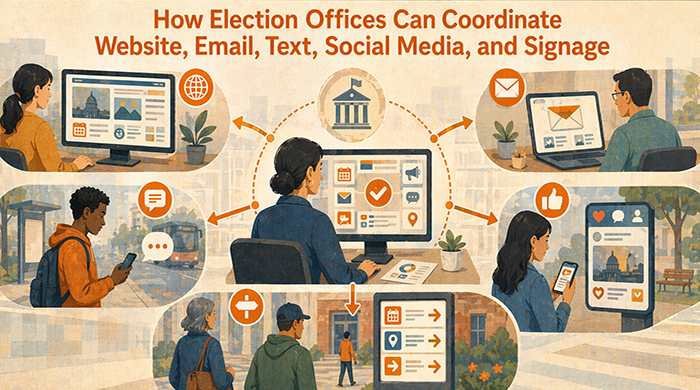
One Message, Many Channels: How Election Offices Can Coordinate Website, Email, Text, Social Media, and Signage
Election offices rarely struggle because they lack channels. More often, they struggle because each channel speaks slightly differently. The website explains one thing in full detail. A social post shortens it. A text alert strips it down further. An email adds a different context. On-site signage uses different labels again. None of these pieces may be wrong on their own, yet together they can create uncertainty at the exact moment voters need clarity. A voter who sees one message online, another in a reminder, and a third at the polling place may not experience the office as informative. The voter may experience the office as fragmented.
This is why multichannel communication in elections is not just a distribution issue. It is a trust issue. Election offices ask voters to make time-sensitive decisions under real constraints, often with little room for error. They need people to know where to go, what to bring, what has changed, what deadline applies, and what to do next if something goes wrong. When those answers stay aligned across channels, the office appears organized and prepared. When they drift, even slightly, the process can feel harder to navigate than it really is.
That risk is especially high in election environments because the same message often has to travel across very different formats and moments. A polling place change might begin as a website update, become an email reminder, turn into a text alert, appear in a social post, and then be reinforced through exterior signage and in-person guidance. A deadline message may need one version for a homepage banner, another for a brief SMS, another for an accessibility-friendly email, and another for signage at a voting location. Each version may be shaped by space limits, timing, and audience expectations. The challenge is not simply to repeat the message everywhere. The challenge is to preserve the same meaning everywhere.
This is where coordination becomes a strategic function of election communication. The office has to decide what the message actually is before deciding how to distribute it. It has to know which facts must remain identical, which terms should never change, which action the voter should take next, and what level of detail belongs in each channel. Without that discipline, every adaptation becomes an opportunity for drift. A shortened message may lose a critical condition. A sign may use a different location label than the website. A social post may imply urgency without clarifying the action. In elections, these are not small inconsistencies. They can produce missed deadlines, wrong-site arrivals, repeated phone calls, and avoidable complaints.
Election offices that coordinate channels well usually understand one central idea. The public does not experience communication by department or format. It experiences one institution. Voters do not separate the text alert from the sign at the door or the website from the poll worker’s explanation. They interpret all of it as the office’s voice. That means consistency is not merely a branding preference. It is one of the clearest signals that the office has control of the process it is asking the public to trust.
Why Multichannel Election Communication So Often Breaks Down
 Election communication usually breaks down across channels for understandable reasons. Different teams may manage different platforms. Website content may be handled by one staff member, email reminders by another, social updates by another, and polling place signage by local site leads or temporary workers. Even in smaller offices where one team handles most public information, the pressure of election timelines can push people to create channel-specific messages quickly without first locking in a shared message structure. The result is not always a contradiction. More often, it is variation that seems harmless internally but confusing externally.
One common problem is that each channel begins optimizing for its own format. Website language becomes detailed and process-heavy. Text messages become so compressed that essential context disappears. Social posts lean toward attention and urgency. Signs rely on shorthand. Emails try to do too much at once. Each adaptation may feel reasonable in isolation, but the public is not reading them in isolation. A voter who moves across channels is trying to determine whether all of those messages point to the same conclusion. If they do not, the office may seem less reliable than it actually is.
Another problem is timing. In elections, information changes quickly, but not every channel updates at the same pace. A website may reflect the latest change while a previously scheduled email still contains older wording. Social posts may continue circulating after a new update goes live. Printed signs may still use an earlier label or direction. These timing gaps can be especially damaging during polling place changes, weather disruptions, deadline periods, and election-night reporting. The issue is not simply that one channel is late. The issue is that the office now appears to have multiple versions of the truth.
Message breakdown also happens when offices rely too heavily on channel habits instead of voter needs. Internally, it may make sense to think of the website as the place for full information, text as the urgent alert tool, social as the public-facing announcement stream, and signage as arrival support. But unless those roles are coordinated deliberately, each channel can begin answering a different question. The voter then has to stitch together meaning from fragments. That is exactly the burden strong election communication is supposed to remove.
Beyond the Ballot: Election Office Communication Strategies for County Clerks, Secretaries of State, and Boards of Election
This article is part of our series on strategic communication for Election Offices, Election Administration Agencies, and Boards of Elections. To learn more and to see the parent article, which links to other content just like this, click the button below.
The Need for a Core Message Before Channel Adaptation
Election offices often move too quickly to channel execution before defining the message that must stay stable across all formats. That sequence creates avoidable problems because adaptation starts before alignment. A team begins drafting a banner, a text alert, a social post, and a printed sign without first agreeing on the exact action the voter should take, the exact terms that should remain consistent, and the exact scope of the change being communicated. Once that happens, even small wording differences can create larger interpretation problems.
The stronger approach is to establish a core message first. That core message should identify what changed, who is affected, what the voter should do now, where they can confirm details, and what timing matters most. Not every channel needs to present all five elements at full length, but every channel should preserve the same underlying logic. The website may carry the full explanation. A text message may carry only the action and the confirmation path. A sign may focus on arrival guidance. The wording can change in length, but the meaning should not change in direction.
This matters because election communication often fails when channels start inventing their own versions of the message. A website says one entrance. A sign says another. An email uses one polling place name while social shortens it into something less recognizable. A text alert says voting has moved but does not clarify whether all voters are affected or only some. None of these problems require bad intent or poor staff performance. They usually come from skipping the discipline of message centralization before distribution begins.
When offices define the message first, channels become easier to coordinate. Teams know which language is fixed, which details can be shortened, and which context must never disappear. That makes the whole communication system more resilient, especially during fast-moving periods when the pressure to publish quickly is highest.
Giving Each Channel a Clear Job
Election offices coordinate channels more effectively when each one has a defined role in the voter journey. Problems often arise when every channel tries to do everything at once. A website page becomes overloaded with alerts, an email tries to replace a detailed FAQ, a text message attempts to carry too much explanation, and a sign ends up doing work that should have happened before the voter arrived. The result is not stronger communication. It is message clutter.
A more reliable approach is to decide what each channel is supposed to do best. The website usually serves as the full source of truth. It holds the complete explanation, the stable details, and the most current update. Email often works well for reinforcing context, deadlines, and next steps in a format that allows a little more explanation. Text alerts are strongest when they are short, urgent, and tied to a clear action or confirmation path. Social media can extend reach and reinforce visibility, but should still point back to the office’s central explanation rather than becoming the only place where meaning lives. Signage works best as arrival support. It confirms, directs, and resolves the final moments of uncertainty once a voter is already on site.
This role clarity matters because voters move through channels in sequence, not in isolation. They may first hear about a change in a text alert, then check the website, then see a social reminder, then arrive and rely on signage. If those channels are doing their jobs well, each one reduces uncertainty at the right moment. If their roles are blurred, the voter may end up searching repeatedly for the same answer in different places and still feel unsure.
Consistency in Labels, Names, and Actions
One of the easiest ways for multichannel communication to break down is through small differences in naming. Election offices may think two phrases mean the same thing, but voters often rely on exact wording to confirm they are in the right place or following the right instruction. A polling place called one thing on the website, shortened differently in an email, and labeled another way on a sign can create avoidable uncertainty. The same problem appears with deadlines, ballot return options, entrance directions, and status updates.
This is why offices need a stable label set before messages start moving across channels. The location name, entrance label, deadline language, and next-step instruction should remain as consistent as possible. The wording can be shortened carefully when space requires it, but the office should not casually swap terms that change recognition or clarity. The public reads these variations as possible differences in meaning, even when the office intended none.
Action language needs the same discipline. A voter should not be told to “check your status” in one place, “confirm your registration” in another, and “verify your voter record” in a third if all three instructions point to the same task. That kind of variation may sound natural internally, but it increases the amount of interpretation the public has to do. The clearer approach is to choose the strongest phrase and carry it across channels so the voter keeps hearing one action, not several similar ones.
Coordinating Short-Form and Long-Form Communication
Election offices often assume that shorter channels can simply be trimmed-down versions of longer content. In practice, short-form communication requires more discipline than that. A text message, social post, or sign cannot carry every detail, so the office has to decide which part of the message is essential and which part must be picked up by another channel. Without that discipline, short-form communication may lose the very context that prevents confusion.
The most effective short-form messages usually do one thing clearly. They tell the voter what changed, what to do now, or where to confirm details. They do not try to replicate the full website explanation. Instead, they preserve the core meaning and point the voter toward the fuller source of truth when needed. This keeps short-form communication useful without turning it into an incomplete substitute for the full message.
Long-form content has a different responsibility. It needs to hold the complete explanation in a way that still feels usable. A webpage or email should not simply expand into procedural overload. It should organize the fuller message clearly so voters can find the action, timing, and conditions that matter most. When short-form and long-form communication are coordinated well, the system feels coherent. The short message gets attention and directs action. The longer message confirms details and reduces ambiguity.
That relationship is one of the most important parts of multichannel coordination. Short channels should not create a second version of the process. They should guide the voter into the same process the office has already defined in full elsewhere. When that happens, the office sounds more organized, the voter does less interpretive work, and trust is easier to sustain.
Timing Is Part of the Message
Election offices often focus on whether each channel contains the right information, but timing matters just as much as wording. A correct message released in the wrong sequence can still create confusion. If a text alert goes out before the website is updated, voters may click through to incomplete information. If social media announces a change before staff at phone lines or polling locations have been briefed, the office may create a short but damaging window where the public knows more than frontline personnel. In election communication, that kind of mismatch can quickly make the office appear less coordinated than it really is.
This is why channel coordination has to include release order, not just message consistency. The office should know which channel becomes the source of truth first, which channels amplify it next, and which channels must be updated before the public starts acting on the message. In many cases, the website should be updated first or at the same moment as outward alerts so that every shorter message has somewhere stable to point. Staff-facing guidance should also be aligned early enough that anyone answering questions is working from the same information the public is receiving.
Timing becomes even more important during deadline periods and late-stage election updates. A reminder sent too early may be ignored. A reminder sent too late may increase panic rather than prevent it. Strong multichannel timing reflects the voter’s actual decision window. Early messages can build awareness. Mid-period messages can reinforce action. Final-stage messages should become more direct about what remains possible and what path is now safest. When channels move in that sequence together, the office helps voters act before pressure peaks.
Managing Changes and Disruptions Without Channel Drift
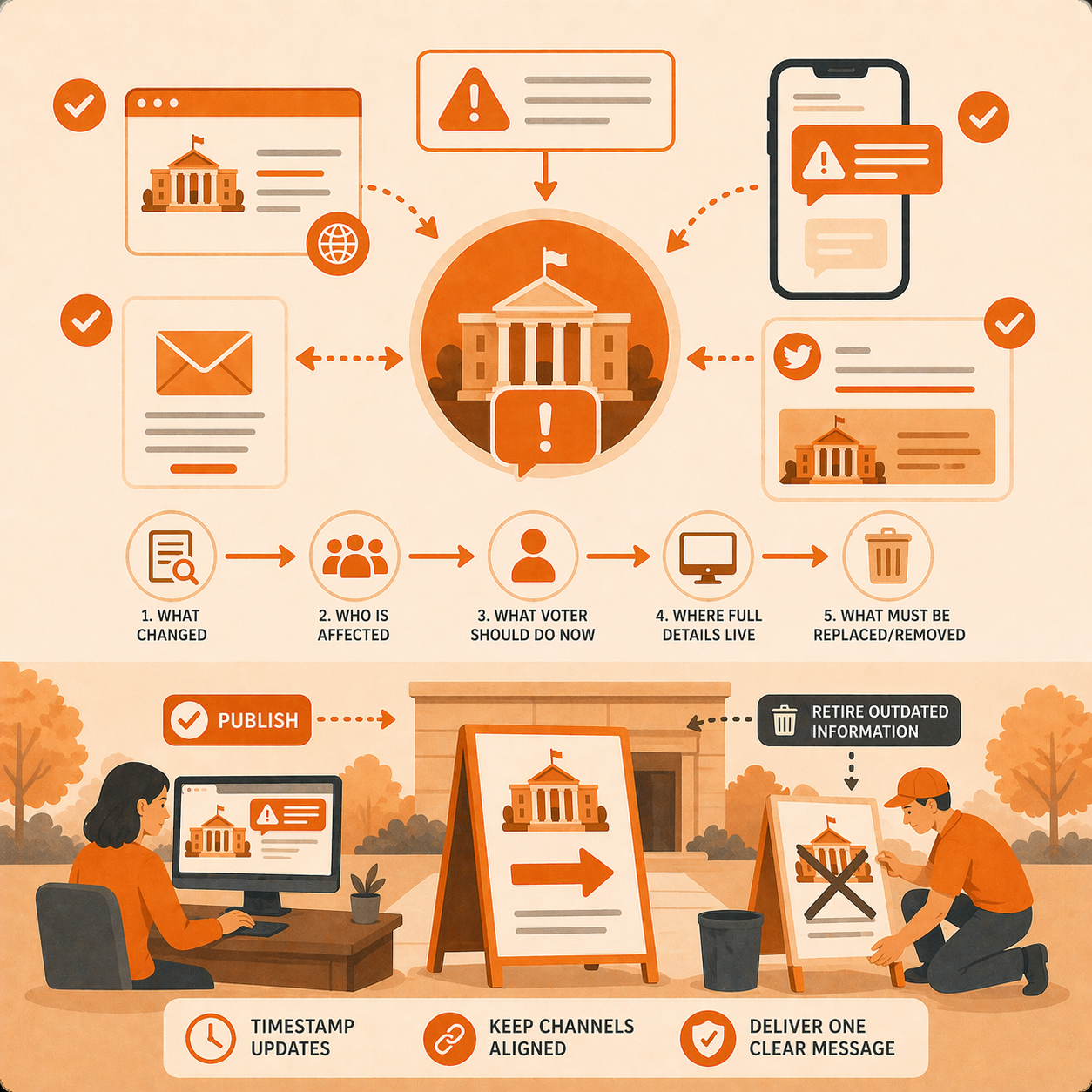 Channel drift becomes most visible when something changes quickly. A polling place shift, weather disruption, equipment issue, deadline clarification, or access update can expose every weakness in a communication system. In routine moments, small wording differences may go unnoticed. In a disruption, those same differences can become the whole story. A voter who sees one entrance listed online, another mentioned in a text, and different signage on site may not experience the change as a communication problem. The voter may experience it as evidence that the office does not fully control the situation.
This is why election offices need a disruption model for multichannel communication, not just a routine model. When something changes, the first task is to lock the core message before individual channels begin adapting it. The office should define exactly what changed, who is affected, what action the voter should take now, where the full details live, and what older information must be replaced or removed. That last point matters. A coordinated message can still fail if outdated content remains live in parallel and continues circulating after the update.
A strong disruption response also depends on retirement as much as publication. Offices sometimes think of coordination only as sending the new message. Just as important is taking down or revising the old one. Old homepage notices, scheduled posts, outdated PDFs, prior email language, and earlier signage can all continue shaping voter understanding after the official update has changed. The office should treat removal, replacement, and timestamping as part of message coordination rather than as cleanup to be handled later.
This is where signage becomes especially important. Digital channels may announce a change, but signage often becomes the final confirmation at the moment the voter arrives. If the website and alerts have been updated but the signs still reflect an earlier instruction, the office loses much of the trust benefit it gained through fast digital coordination. In change-sensitive situations, physical and digital updates have to be treated as one communication action, not separate streams.
Internal Workflow Is What Makes Multichannel Consistency Possible
Election offices often talk about public coordination as though it happens at the channel level. In reality, channel consistency usually depends on internal workflow. If teams do not know who owns the message, who approves the wording, who updates the website, who sends the alert, who changes the sign, and who informs frontline staff, then even a well-written message can break apart under pressure. The public sees the fragmentation at the channel level, but the cause usually starts inside the office.
This is why multichannel coordination needs a clear internal operating model. The office should know who is responsible for developing the core message, who has authority to approve it quickly, and how it will move from full version to short-form versions without losing meaning. It should also know who checks that each channel has actually been updated and whether older versions have been removed. Without that kind of workflow, consistency depends too much on memory and individual initiative, which becomes risky during election periods.
Internal coordination also means giving frontline staff the message early and in usable form. Call-center staff, poll workers, greeters, and temporary personnel should not have to improvise based on partial awareness of what has already gone public. They need short, stable language that reflects the same message the voter saw online. When this does not happen, the office may publish a coordinated set of public messages and still sound inconsistent in direct interaction. Voters tend to judge the office by the last explanation they hear, especially when they are already stressed.
The offices that coordinate channels best usually do one thing well behind the scenes. They make it easy for staff to sound like one institution. That does not happen by accident. It happens because message ownership, sequencing, approval, and frontline preparation have already been thought through before the next change or high-pressure moment arrives.
The Source-of-Truth Model
Election offices coordinate channels more effectively when one place is clearly treated as the source of truth. In most cases, that should be the office website or a dedicated election information page that can be updated quickly and checked easily by staff and the public. The purpose of that page is not simply to hold more detail. It is to anchor every other channel in one stable explanation so that texts, emails, social posts, and signage are all reinforcing the same underlying message.
This matters because shorter channels cannot carry every condition, timing note, or procedural detail. A text alert may tell voters what changed. A social post may increase visibility. A sign may guide arrival. But each of those channels works better when it points back to a central place where the full meaning is already organized clearly. Without that source-of-truth model, every channel is forced to carry more interpretive burden on its own, which increases the chance of drift.
A strong source-of-truth page should make the action clear, use the same labels that appear elsewhere, and show when information was last updated. It should also be easy for staff to reference directly when answering questions. The office gains trust when the public sees that shorter messages are not scattered fragments, but entry points into one coherent explanation.
Why the Source of Truth Must Be Easy to Find and Easy to Trust
A source-of-truth page only works if voters and staff can find it quickly and recognize it as the office’s most reliable reference point. If the page is buried in navigation, difficult to scan on a phone, or inconsistent with what appears in other channels, it will not reduce confusion as intended. The office should make this page highly visible during active election periods and ensure that shorter messages consistently direct people back to it.
Trust also depends on how the page is maintained. A source-of-truth page should use clear headings, stable labels, and visible update timing so people know they are looking at current information. It should not read like a storage place for every detail the office has ever published. It should feel like the central place where voters can quickly confirm what has changed, what action is needed, and what information remains current. When the page is both easy to locate and easy to understand, it strengthens the entire multichannel system around it.
Staff Scripts as Part of Channel Coordination
Multichannel consistency does not hold if the office’s spoken guidance sounds different from its written guidance. A voter may receive an email, read the website, see a sign, and then ask a question in person or by phone. If the answer sounds like a different process, the office’s coordination quickly weakens. This is why staff scripts should be treated as part of channel planning rather than as a separate customer-service issue.
The strongest staff scripts are short, clear, and built from the same core message architecture used elsewhere. They should reflect the same labels, the same action language, and the same explanation of what changed or what the voter should do next. Staff do not need to recite long statements. They do need dependable phrasing that helps them sound aligned with the rest of the office.
This is especially important during changes, deadline periods, and problem-solving moments. If a voter is already unsure, even a small wording difference can feel like a different rule. A coordinated office makes it easier for staff to answer in ways that confirm the public message rather than complicate it. That reduces confusion for voters and lowers strain on staff who would otherwise have to improvise under pressure.
Keeping Physical and Digital Guidance Aligned
Election offices sometimes coordinate digital channels well but lose consistency at the physical point of arrival. A website may be current, a text alert may be accurate, and an email may be clear, yet the sign at the parking lot, entrance, or check-in table may still use older wording or different labels. At that moment, the voter does not experience strong digital coordination. The voter experiences uncertainty.
This is why physical and digital guidance have to be treated as one system. A sign is not just a local add-on to online communication. It is the last confirmation step in the voter journey. It should use the same location names, entrance labels, timing language, and directional logic the voter has already seen elsewhere. When that alignment is present, the office feels organized. When it is missing, the process can feel unreliable even if the digital communication was strong.
Physical-digital alignment matters most in arrival-sensitive situations such as polling place changes, entrance routing, curbside voting, line management, or any circumstance where the voter must act immediately on what they see. The office should design these moments so the sign confirms the digital message rather than forcing the voter to reinterpret it. That is one of the clearest ways to reduce last-minute confusion.
Strategic Communication Support for Election Offices
 Multichannel election communication is often treated as a distribution problem, but in practice it is a coordination problem with direct implications for public trust. When website, email, text, social media, signage, and staff guidance stay aligned, voters are more likely to understand what changed, what to do next, and where to confirm details. When those channels drift, even slightly, the office can appear less organized than it really is.
Because of these stakes, many election offices find that multichannel coordination stretches beyond internal capacity or specialized expertise. Teams are often managing multiple operational demands at once, and may benefit from an external partner that brings focused communication planning, an objective outside perspective, and experience in reducing risk across high-visibility, time-sensitive election messages. For this reason, agencies often choose to partner with an external resource like Stegmeier Consulting Group (SCG) when they need stronger channel alignment without adding avoidable strain to internal operations.
SCG helps election offices approach channel coordination as part of a larger communication system. That includes defining the core message before channel adaptation begins, clarifying the role of each channel, aligning staff scripts with public-facing content, and strengthening the source-of-truth model that keeps digital and physical guidance working together. This helps offices reduce confusion, improve consistency, and support public confidence across the full voter journey.
This support is especially valuable because multichannel communication has to do several things at once. It must be clear, timely, adaptable, and stable under pressure. It must also hold together during deadline periods, changes, disruptions, and election-day operations. In that sense, coordinated channel communication is not separate from election readiness. It is one of the clearest ways readiness becomes visible to the public.
Future Trends in Multichannel Election Communication
Election offices are likely to place greater emphasis on channel coordination as a core part of voter communication strategy. Rather than treating website updates, alerts, social posts, signage, and frontline explanations as separate outputs, more offices will treat them as connected parts of one guidance system. That shift will matter because the public increasingly expects messages to stay consistent across every point of contact.
Another likely trend is stronger use of source-of-truth models paired with shorter, action-oriented channel adaptations. Offices will likely rely more on one central explanation page while using email, text, social media, and signage to reinforce the same meaning in different formats. This will help reduce message drift and make it easier for voters to confirm details quickly.
Physical-digital alignment is also likely to become more important. As voters move between phones, websites, alerts, and on-site signs, offices will face greater pressure to ensure that names, labels, directions, and instructions remain consistent from first notice to final arrival. The offices that do this well will be better positioned to reduce confusion and strengthen trust in high-pressure moments.
Conclusion
One message across many channels does not happen by accident. It depends on defining the core message first, assigning each channel a clear role, aligning timing and staff guidance, and treating physical and digital communication as parts of one system. When election offices do this well, voters are less likely to encounter conflicting information and more likely to move through the process with confidence.
This is why channel coordination should be treated as an operational communication priority rather than a distribution detail. Voters do not experience the office one platform at a time. They experience one institution. The more consistently that institution speaks across channels, the easier it becomes for the public to understand what to do, where to go, and what has changed.
In the end, strong multichannel coordination reduces the amount of interpretation voters have to do on their own. That helps prevent confusion, lowers avoidable strain on staff, and shows that the office is managing communication with the same discipline it brings to the election process itself.
SCG’s Strategic Approach to Communication Systems
Align your agency’s messaging, processes, and public engagement strategies
Election offices need communication systems that stay clear and coordinated across every voter touchpoint. Whether your office is improving website governance, aligning alerts with signage, strengthening staff scripts, or building a clearer source-of-truth model for time-sensitive updates, SCG can help you create a communication framework that supports consistency, clarity, and public trust.
Use the form below to connect with our team and explore how a strategic communication system can strengthen voter guidance and election readiness.