
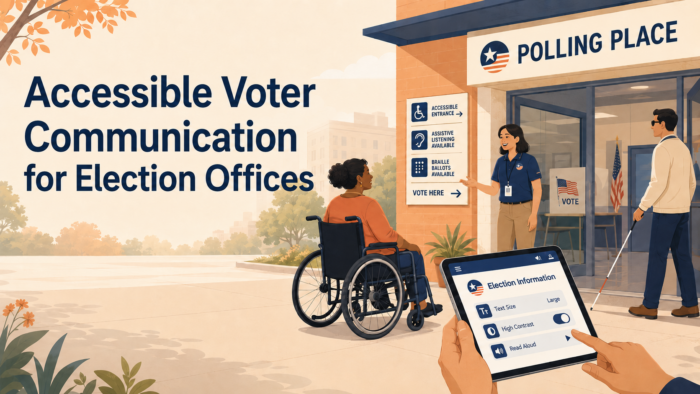
Accessible Voter Communication for Election Offices: From Signage to Screen Readers
Election accessibility is often discussed as a matter of equipment, compliance, or accommodation. In practice, it is also a matter of communication design. A voter does not experience accessibility as a statute, a checklist, or a technical specification. A voter experiences it as a sequence of messages. The parking sign is either clear or confusing. The website either works with a screen reader or creates friction. The polling place notice either reduces uncertainty or adds to it. The sample ballot, curbside instructions, audio ballot interface, email alert, and election-day update all become part of one larger system that tells a voter whether the process was built with them in mind.
That is why accessible voter communication deserves to be understood as an issue of democratic confidence, not just administrative readiness. When communication is accessible, voters can prepare privately, make decisions independently, and move through the process with dignity. They can confirm where to go, what to bring, what options exist, and what to do if something changes. When communication is inaccessible, even in small ways, the burden shifts to the voter. They must ask for extra help, piece together information from multiple places, or rely on others to interpret what should have been clear from the start. What appears to be a minor communication flaw from inside an election office can feel like exclusion from the voter’s side.
Election offices operate under unusual pressure because they must communicate clearly to a broad public, under firm deadlines, in high-stakes conditions, across multiple formats, and often with limited staff capacity. Accessibility can seem like one more requirement layered onto an already demanding operation. The deeper reality is that accessibility is not separate from effective voter communication. It is one of the clearest indicators of whether the communication system is actually working. If the message cannot be accessed, understood, navigated, or acted upon by people with different disabilities, different technologies, and different ways of processing information, then the system is not yet fully reliable.
This matters far beyond legal exposure or process integrity. It matters because communication shapes the emotional tone of participation. A voter who encounters clean, readable, well-structured, accessible information feels anticipated by the institution. A voter who encounters inaccessible PDFs, image-based instructions, low-contrast signs, unlabeled buttons, or inconsistent guidance may still manage to vote, but the experience communicates something else. It communicates that access was treated as secondary. Over time, these repeated signals affect public trust, perceived legitimacy, and the relationship between election offices and the communities they serve.
Accessible voter communication also requires election offices to think beyond the false divide between physical and digital access. The voter journey does not begin at the polling place and it does not end at the website. It moves across channels. A blind voter may begin with a mobile site read by a screen reader, continue with an emailed polling place update, arrive at a building where wayfinding signage determines confidence, and then rely on in-person verbal guidance to complete the process. A voter with low vision may depend on strong contrast in printed materials, legible signs in the parking area, and a digital lookup tool that allows zoom without breaking. A voter with a cognitive disability may need plain language, predictable structure, short instructions, and message consistency across every touchpoint. Accessibility, in other words, is not one feature. It is a continuity of communication.
Election offices that understand this tend to perform better under pressure because they design communication as a support system rather than a collection of disconnected outputs. They recognize that each message has to do more than transmit information. It must reduce uncertainty, preserve independence, and help the voter move from one stage to the next without unnecessary friction. That principle applies to building entrances, provisional ballot explanations, absentee ballot cure notices, online sample ballots, social posts about polling place changes, touchscreen instructions, and post-election public information. Accessibility is not the edge case of voter communication. It is one of the clearest ways to judge whether the office has built a communication system that people can truly use.
Accessibility as a System of Voter Confidence
 Election communication is often organized by format. Offices may have one team or staff member responsible for the website, another handling printed materials, another coordinating polling place setup, and another responding to public questions. This structure is understandable, but it can create a fragmented experience for voters. Accessibility problems frequently emerge not because any single piece is wholly unusable, but because the parts do not work together. A polling place may have an accessible entrance, but the online location lookup tool may not clearly indicate how to find it. A website may include useful voting information, but key forms may be posted as image-based PDFs that screen readers cannot interpret properly. A voter education flyer may use plain language, but the signs at the polling place may rely on dense text, poor contrast, or inconsistent labels that increase stress in the moment of arrival.
From the voter’s perspective, these are not separate issues. They are part of one experience. Confidence is built when communication remains coherent as the voter moves from channel to channel. The office website uses the same location name as the mailed notice. The curbside voting process is explained online before election day and again at the site with visible, readable signage. The accessible voting equipment is described in terms that are understandable before the voter arrives. Any last-minute change is communicated in formats that remain accessible to people using assistive technology. What looks like consistency from the office side feels like predictability and control from the voter side. That emotional effect matters because elections ask people to act under deadline, often amid public scrutiny, uncertainty, and strong civic expectations.
This is especially important for voters who have experienced past barriers. Accessibility is not evaluated in a vacuum. Voters bring memories with them. A person who previously encountered a locked side entrance, an unreadable polling place notice, or an inaccessible absentee ballot instruction will often arrive with heightened vigilance. They are already scanning for signs that the system may fail them again. In that context, accessible communication does more than inform. It is reassuring. It tells the voter that the office has anticipated real needs and taken those needs seriously. Trust begins to build before any staff interaction occurs.
That is one reason accessible communication should be treated as a strategic trust-building function inside election administration. It strengthens not only voter experience but institutional credibility. Offices that communicate access clearly tend to appear more prepared, more transparent, and more competent. They are easier for advocacy groups, family members, caregivers, and community partners to trust because the guidance is visible and usable. They also reduce the operational burden on staff because accessible information answers questions earlier and more effectively. When key instructions are written clearly, structured predictably, and available in accessible formats, fewer voters need to call, ask for clarification, or improvise in the moment.
There is also an ethical dimension here that election offices cannot afford to treat lightly. A communication system that works only for voters who can see standard print easily, navigate complex websites smoothly, hear spoken instructions clearly, or interpret bureaucratic phrasing quickly is not neutral. It privileges one kind of voter experience over another. Public trust is damaged when access depends on extra persistence, extra confidence, or extra assistance. In elections, where independence and privacy carry special civic weight, that damage is not merely inconvenient. It cuts into the legitimacy of the process itself.
Election offices therefore benefit from shifting their internal frame. Instead of asking whether each output includes an accessibility feature, they can ask whether the voter journey remains accessible from beginning to end. Instead of focusing only on whether a file technically exists in an accessible format, they can ask whether the voter can actually find, understand, and use it under normal conditions. Instead of treating signage, websites, notices, and verbal scripts as separate tasks, they can treat them as one coordinated communication environment. This shift sounds conceptual, but it has very practical consequences. It changes review habits, handoff practices, language standards, testing priorities, and staff coordination.
A well-run election office often succeeds because it reduces ambiguity before ambiguity turns into doubt. That principle applies directly to accessibility. A voter should not have to wonder which entrance is usable, whether a PDF can be read with assistive technology, whether a polling place change notice applies to them, whether curbside instructions are current, or whether an audio ballot option is actually available. Every unanswered question increases cognitive strain. Every inaccessible step forces the voter to compensate for something the system should have handled. Over time, those moments shape whether a voter experiences the office as trustworthy and prepared, or reactive and difficult to navigate.
This is why accessibility should be understood as a confidence architecture for election communication. It creates the conditions under which voters can move through the process with clarity and self-direction. It supports the public perception that the office is organized, careful, and fair. It helps ensure that access is not dependent on luck, prior knowledge, or the ability to push through friction. In an election environment, those are not cosmetic benefits. They are central to the quality of democratic participation.
Beyond the Ballot: Election Office Communication Strategies for County Clerks, Secretaries of State, and Boards of Election
This article is part of our series on strategic communication for Election Offices, Election Administration Agencies, and Boards of Elections. To learn more and to see the parent article, which links to other content just like this, click the button below.
The Accessibility Gap Between Physical and Digital Communication
Many election offices have made real progress in either physical accessibility or digital accessibility, yet the voter experience still breaks down in the space between them. This gap is one of the most common and least examined weaknesses in voter communication. An office may have compliant voting equipment, wheelchair-accessible pathways, and trained poll workers, while still publishing inaccessible online instructions that prevent voters from preparing effectively. Another office may have a well-organized website with readable pages and alt text, but fail to carry the same clarity into on-site signage, arrival cues, or in-person scripts. In both cases, the problem is not the absence of effort. It is the absence of alignment.
The consequences are larger than they first appear. When physical and digital communication diverge, voters are forced to translate the process for themselves. A screen-reader user may find a polling place address online but receive no useful description of the accessible entrance. A voter with low vision may enlarge text successfully on a mobile site, then arrive to find temporary signs printed in small type with weak contrast and inconsistent placement. A voter with a cognitive disability may understand a plain-language voter guide at home, then encounter dense legal phrasing on site that disrupts comprehension at the moment action is required. These are not narrow edge cases. They are predictable results of communication systems designed in parts rather than as a whole.
Election offices that close this gap usually do so by adopting a simple but powerful mindset. They treat every communication channel as part of one voter journey. The physical environment confirms what the digital environment promised. The digital environment prepares the voter for what the physical environment will require. Language, labels, directions, and expectations remain stable across both. That continuity reduces anxiety, preserves dignity, and improves the odds that the voter can act independently all the way through the process.
Plain Language as an Accessibility Function, Not a Style Preference
Election offices often think about accessibility first through technical compliance. They review whether a PDF is tagged, whether a website can be navigated by keyboard, whether videos include captions, or whether voting equipment meets required standards. Those steps matter, but accessibility also depends on whether voters can understand the message once they reach it. This is where plain language becomes essential. In election communication, plain language is not merely a readability choice. It is an access tool. It reduces the amount of interpretation a voter must perform before taking action, and that reduction matters especially in environments where stress, time pressure, and unfamiliar procedures can make even simple tasks feel difficult.
A voter should not have to decode the office’s language before deciding what to do next. Yet many election materials still rely on dense phrasing, legal framing, internal terminology, and layered instructions that reflect administrative process more than voter need. The result is a message that may be technically accurate but practically inaccessible. A notice might explain a ballot cure process in language that mirrors statute but leaves the voter unclear about the actual next step. A polling place update might describe a relocated site in formal terms while failing to say, in the simplest possible way, where the voter should go now. A webpage may contain complete information, but bury the action under paragraphs that require too much scanning and interpretation. These failures are often treated as writing issues. In reality, they are access issues.
This is particularly important for voters with cognitive disabilities, voters with low literacy, older voters, voters reading in a second language, and voters trying to process information quickly through assistive technologies. Screen readers, for example, do not solve confusing writing. They vocalize it. A sentence packed with subordinate clauses, legal references, or multiple embedded conditions becomes harder, not easier, when heard aloud. The same is true for voters relying on magnification, who may only see a small portion of text at one time and therefore depend on very clear sentence structure and predictable headings to understand context. Accessibility requires not only that content be reachable, but that it be understandable without unnecessary effort.
Election offices can improve this dramatically by organizing content around voter tasks rather than office processes. The message should answer the questions a voter is most likely asking in the order they are likely asking them. What changed? Who is affected? What should I do now? When do I need to act? Where do I go to confirm this? That structure reduces ambiguity and gives the voter a reliable path through the information. It also improves consistency across formats. A mailed notice, polling place sign, website update, email, or text alert can all follow the same core logic even if each uses a different level of detail.
The best plain-language election communication also respects the emotional reality of voting. A voter reading a provisional ballot explanation, a signature issue notice, or an accessibility-related instruction may already be worried that something has gone wrong. Dense or impersonal language can intensify that stress. Clear language can lower it. A sentence such as “You can still make sure your ballot is counted” does more than explain a process. It communicates direction and possibility. That does not mean election offices should sound casual or imprecise. It means they should write in a way that helps the voter act with confidence rather than freeze in uncertainty.
This is where ethical communication and operational effectiveness meet. Plain language makes the system more usable, but it also makes the office more resilient. When instructions are structured clearly and written in accessible terms, fewer voters need intervention at the last minute. Poll workers spend less time re-explaining avoidable confusion. Phone lines absorb fewer repetitive calls. Advocacy organizations and community partners can share official guidance more accurately. The office becomes easier to understand because it has done the work of understanding the voter first.
Screen Readers, Content Structure, and the Hidden Barriers of Digital Election Communication
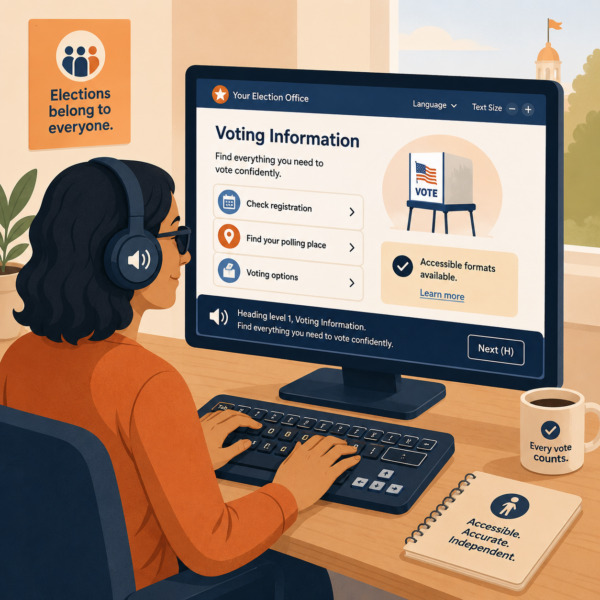
Digital election communication often fails in ways that remain invisible to staff who are reading with their own eyes. A webpage may appear clean, complete, and orderly on screen while becoming disjointed, frustrating, or functionally unusable when accessed through a screen reader. This is one of the most important reasons election offices need to think beyond visual presentation. Accessibility is not just about what content says. It is about how that content is structured, announced, and navigated by assistive technology.
Screen reader users often move through content differently from sighted users. They may jump by heading, scan lists of links, tab through interactive elements, or listen for form labels and landmarks that reveal how the page is organized. If the structure is weak, the experience becomes exhausting. A page with visual headings that are not coded as headings may sound like one uninterrupted block of text. A button labeled only “click here” provides almost no useful information when heard out of context. A polling place lookup form without clear field labels may force the voter to guess what information belongs where. An image containing critical election instructions may be fully legible to a sighted staff member and nearly meaningless to a blind voter if it lacks appropriate alternative text or if the information exists only inside the image.
These barriers matter because election communication is often time-sensitive and action-oriented. Voters are not casually browsing. They are trying to confirm a registration deadline, locate a polling place, request or track a ballot, understand identification requirements, or respond to a problem that could affect whether their vote counts. Any structural obstacle in that moment carries disproportionate weight. A poorly labeled menu is not a small inconvenience when the voter is trying to determine whether a polling place change applies to them before leaving home. An inaccessible table is not merely a formatting issue when it contains early voting hours or ballot drop box locations. A broken heading structure is not a minor web problem when it forces the user to listen through an entire page to find a single time-sensitive instruction.
The deeper issue is that many election offices still treat accessibility as a retrofit. They publish a page visually, then later ask whether accessibility can be added. A more effective model is to build digital content with structural accessibility from the start. Headings should reflect meaning, not just appearance. Links should describe their destination or function clearly. Forms should contain labeled fields, error messages that can be understood by assistive technology, and instructions that do not disappear once the user begins typing. PDFs should not be the default container for critical information when a well-structured webpage would be easier to access, navigate, and update. When documents are necessary, they should be created and tested as accessible documents rather than posted as visual replicas of print material.
Election offices also need to account for the relationship between accessibility and urgency. In election periods, updates are often made quickly. Polling place changes, deadline reminders, emergency notices, and clarifications may be posted under time pressure. That speed can increase the temptation to upload an image, post a screenshot, or paste content into a page without checking structure. Yet these are precisely the moments when accessibility matters most. A voter with a disability should not receive a less usable message simply because the office is moving fast. Speed and accessibility have to coexist in election communication because the highest-pressure moments are often the most consequential.
Usability testing is one of the clearest ways to improve this work. Election offices do not need to become accessibility laboratories, but they do need to move beyond internal assumptions. A page that looks fine in a content management system preview may reveal serious issues when reviewed by someone using assistive technology. Staff can learn a great deal by testing whether a page can be navigated by keyboard alone, whether headings form a clear outline, whether a screen reader announces controls meaningfully, and whether essential tasks can be completed without visual guesswork. These reviews are not just technical exercises. They are ways of understanding how the office’s communication system actually behaves for real voters.
The most reliable digital election communication tends to share several qualities. It uses clear headings that reflect voter tasks. It avoids vague links and image-based instructions. It presents the most important action early. It keeps structure consistent across pages so users do not have to relearn navigation each time. It is designed with the expectation that voters may arrive using different devices, different browsers, and different assistive tools. Most importantly, it treats screen reader accessibility not as a narrow accommodation for a small audience, but as part of the overall integrity of public communication.
This shift in mindset has strategic value. It helps election offices produce content that is clearer for everyone, not just for screen reader users. Strong structure improves mobile usability, scanning, maintenance, and content governance. When accessibility is built into the content architecture, the office communicates more clearly under pressure and with greater confidence across the full range of voter needs.
Polling Place Signage as Arrival Support, Not Just Directional Information
By the time a voter reaches a polling place, communication has already shaped expectations. The website, mailed notice, sample ballot, reminder email, or community outreach message has helped the voter form a mental picture of what will happen next. Polling place signage either confirms that picture or disrupts it. This is why accessible signage should be understood as arrival support rather than a narrow wayfinding task. It does more than point. It reassures, confirms, reduces doubt, and helps the voter transition from preparation into action with as little friction as possible.
This matters especially in election environments because arrival is often the moment when anxiety rises. Even voters who felt prepared at home may become uncertain once they confront parking decisions, entrances, temporary barriers, lines, weather, unfamiliar buildings, or multiple signs competing for attention. For voters with disabilities, that uncertainty can carry greater weight. A missing accessible entrance sign, a curbside voting instruction placed too far from the parking area, a directional sign with weak contrast, or a paper notice taped at an inconsistent height can turn a manageable process into a stressful one. In that moment, the problem is not only visibility. It is confidence. The voter is trying to determine whether the office anticipated their needs or left them to improvise.
Election offices often underestimate how much signage functions as emotional stabilization. A clear sign in the right place communicates that the route is known, the process has been considered, and the voter is in the correct location. This matters for all voters, but it is especially important for blind and low-vision voters, voters with mobility limitations, older voters, first-time voters, and voters who are already managing fatigue, sensory overload, or concern about making a mistake. A strong polling place signage system reduces the need for guesswork. It shortens the number of decisions a voter must make without confirmation. It also lowers the likelihood that staff will need to solve avoidable confusion at the entrance, in the parking lot, or at the wrong doorway.
Accessible signage begins with consistency. The location name used online should match the name used on signs at the site. If the office tells voters to enter through the north entrance, the on-site signs should use the same wording and should appear early enough for the voter to act on it. If curbside voting is available, the communication should not depend on a voter reaching the building first and then discovering the option through a small sign or an improvised verbal exchange. The better approach is layered confirmation. The option is described in advance online and in outreach materials, then reinforced at the site through visible, readable, well-placed signage that appears where the voter actually needs it.
Placement is as important as wording. Signs that appear only at the final point of decision often arrive too late. Voters need guidance before they have committed to the wrong turn, parked in the wrong area, or entered the wrong line. That means thinking in stages. Parking signs should help the voter understand where accessible parking or curbside service is located. Exterior directional signs should clarify which entrance to use. Entrance signage should confirm arrival and explain immediate next steps. Interior signs should continue the same logic rather than introducing a new label set or a different style of instruction. When this sequence is well designed, the physical environment feels legible. The voter can move through it with confidence because each sign answers the question that naturally arises at that moment.
Legibility matters far beyond font size alone. Contrast, clutter, wording length, placement height, lighting, and background conditions all influence whether a sign is usable. A sign with technically readable text can still fail if it is posted in glare, surrounded by visual noise, or written in a way that requires too much interpretation. Election signage often performs poorly when it is treated as a temporary afterthought. Handwritten arrows, inconsistent paper notices, and last-minute printouts may seem efficient from an administrative standpoint, but they can undermine the credibility of the entire site. Voters read the condition of signage as a signal about organizational readiness. A chaotic sign environment suggests a chaotic process, even when the underlying operations are sound.
This is one reason election offices benefit from treating signage as part of pre-election communication planning rather than day-of improvisation. A tested signage package, with standard language, predictable labels, contrast-conscious design, and clear placement guidance for poll workers, reduces variability across locations. It also creates a more equitable experience. Voters should not receive clear accessible guidance at one site and confusing improvised direction at another simply because local setup habits differ. Standardization does not eliminate flexibility, but it does create a dependable foundation that can be adapted without losing coherence.
Accessible polling place signage also has a broader trust function. It tells the public that the office understands access as part of the voting experience rather than as a side issue to be solved only when someone asks for help. That signal matters. It shapes how voters talk about the process afterward, how advocates assess the office’s preparedness, and how confidently poll workers can support the public in real time. In that sense, signage is not only a physical tool. It is a visible expression of whether the office has designed the arrival experience with care.
Verbal Guidance, Poll Worker Scripts, and the Human Side of Accessible Communication
 Even in a well-designed election environment, not every communication need can be met through print or digital materials alone. Voters ask questions, unexpected conditions arise, and some forms of access depend on human interaction. This makes verbal guidance one of the most important and least standardized elements of accessible voter communication. Election offices often spend considerable time developing printed notices and web content while giving far less attention to the spoken language voters will actually hear when they arrive, ask for help, or need clarification. Yet for many voters, especially those navigating disability-related barriers, verbal communication is the final layer that determines whether the process feels usable, respectful, and trustworthy.
The quality of verbal guidance matters because spoken instructions often occur at moments of heightened vulnerability. A voter may be trying to locate an accessible entrance, understand how curbside voting works, request use of accessible equipment, clarify whether they are in the correct precinct, or resolve a problem with registration status or ballot issuance. In those moments, the voter is not simply receiving information. They are also interpreting tone, confidence, clarity, and respect. A rushed or vague response can deepen uncertainty. A clear and calm explanation can restore it quickly.
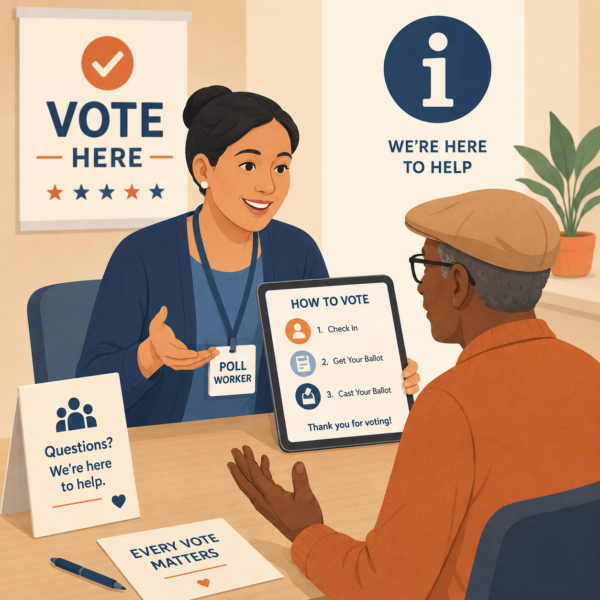
This is where poll worker scripts become strategically important. A script should not be understood as rigid phrasing that eliminates human warmth. It should be understood as a reliability tool. It helps ensure that critical explanations are short, consistent, accessible, and aligned with office policy across sites. For example, if voters ask where to find the accessible entrance, poll workers should not each invent their own explanation. They should have a shared, plain-language way to answer that question clearly and respectfully. If curbside voting is available, the explanation should be predictable enough that voters receive the same essential information no matter who happens to respond. Consistency is part of accessibility because it reduces variability in how support is delivered.
Respectful verbal communication also requires election offices to move away from assumptions. Poll workers should not assume what kind of help a voter needs, whether a voter wants assistance, or which communication method will work best. They should be trained to offer support in ways that preserve independence and dignity. That means explaining options rather than taking over, giving directions in clear sequence, and using language that is direct without becoming paternalistic. A voter with a disability should not have to navigate awkwardness, unnecessary sympathy, or uncertainty about whether asking a question will slow the process or draw unwanted attention.
There is also a significant operational benefit to improving verbal guidance. When spoken instructions are clear and standardized, poll workers can respond more effectively under pressure. They spend less time improvising and less energy trying to interpret office policy in the moment. Supervisors face fewer escalations caused by inconsistent explanations. The office also reduces the risk that inaccessible or inaccurate spoken guidance will undermine otherwise strong written materials. A website can describe accessible options correctly, but if the poll worker at the site explains them poorly or inconsistently, the voter still experiences the system as unreliable.
Verbal accessibility also includes the way election offices think about sensory load and processing time. Some voters need a slower pace, simpler sequencing, or a quieter explanation space. Others may understand spoken guidance best when it is paired with a visible cue, such as a clearly labeled sign or a printed card. Poll workers do not need to become specialists in every disability experience, but they do need enough preparation to recognize that accessible communication is not one-size-fits-all. The strongest training models emphasize clarity, patience, confirmation, and consistency. They prepare staff to communicate in ways that reduce friction rather than add to it.
This human layer is especially important because it can either repair or magnify the weaknesses of the broader communication system. If a sign is unclear, a well-prepared poll worker may still help the voter recover quickly. If the digital instructions were incomplete, a calm and accurate verbal explanation may restore confidence. But the reverse is also true. If the spoken guidance is uncertain, dismissive, or inconsistent, it can damage trust even when the office has invested heavily in accessible design elsewhere. Accessible voter communication therefore depends not only on documents, websites, and signs, but on whether the people representing the office can communicate access clearly in real time.
Election offices that do this well usually treat verbal communication as part of the same system as every other voter-facing message. The language used by poll workers reflects the language used on the website. The explanation of curbside voting matches the signage at the location. The description of accessible equipment aligns with the voter education materials shared before election day. That alignment creates a powerful effect. It tells the voter that the office is coherent, prepared, and serious about access across the full experience, not just in isolated parts.
Accessible Communication in Absentee, Mail, and Ballot Cure Processes
For many voters with disabilities, the most important accessibility decisions happen long before election day. They happen when the voter tries to request a ballot, understand deadlines, complete materials correctly, track whether the ballot was received, and respond if a problem arises. This part of the process is often treated as a separate administrative workflow, but from the voter’s perspective it is a communication journey that can either preserve independence or steadily erode it. A mail ballot process that seems orderly from inside the office can still become inaccessible if instructions are dense, deadlines are buried, cure notices are hard to understand, or online tools are difficult to navigate with assistive technology.
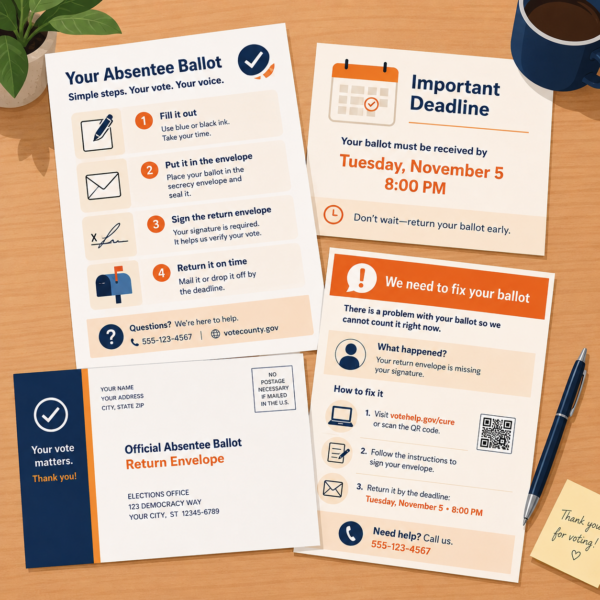
Accessible absentee and mail voting communication depends heavily on anticipation. The office has to assume that a voter may be reading instructions on a phone with magnification, listening through a screen reader, relying on plain language because the forms are unfamiliar, or trying to resolve a problem under time pressure after already believing the ballot process was complete. That means clarity cannot be reserved for the first step alone. It has to continue through each stage. The request instructions must be readable and well structured. The return guidance must explain exactly what is required. The ballot tracking language must be direct and reassuring. If the ballot is challenged or incomplete, the cure notice must make the next action unmistakably clear.
This is where many election offices unintentionally create avoidable barriers. Cure notices, in particular, are often written in language shaped more by procedure than by voter need. The notice may state that a signature discrepancy exists, that an envelope was incomplete, or that identification documentation is needed, but fail to say in the simplest possible terms what the voter must now do to protect the ballot. A voter reading that notice should not have to interpret legal phrasing, infer urgency from context, or search across multiple pages to determine the next step. The message should lead with the practical instruction. It should explain what happened, what action is needed, how to complete that action, and by when. In accessible communication, sequencing matters as much as content.
This is also one of the clearest places where tone affects public trust. Cure notices and absentee problem notices often arrive at a moment of vulnerability. The voter may feel frustrated, embarrassed, confused, or worried that their vote will not count. If the office communicates in a cold, bureaucratic, or overly formal style, the message can intensify that stress. A clearer and more voter-centered tone does not weaken the seriousness of the notice. It strengthens the likelihood that the voter will understand and act. A sentence such as “You still have time to fix this issue so your ballot can be counted” does important work because it combines urgency with direction. It tells the voter that the process is still open to them, which matters emotionally as well as practically.
Digital accessibility plays a central role here as well. Many offices now rely on online ballot request systems, ballot tracking tools, digital cure workflows, and downloadable forms. If those tools are not accessible, the voter may face barriers at the exact moment when independent action is most important. A ballot tracking page should not require visual guesswork to interpret status. A cure portal should not depend on unlabeled fields or inaccessible upload tools. A downloadable instruction sheet should not exist only as an image-based document that breaks under a screen reader. When these gaps appear in absentee voting, they can be especially damaging because the voter is often acting alone, outside the immediate support structure of a polling place.
Election offices that communicate absentee and cure processes well tend to follow a few consistent principles even when their workflows differ. They explain each step in plain language. They design instructions around the voter’s task rather than the office’s internal sequence. They repeat critical information consistently across the website, mailed materials, phone support, and follow-up notices. They make deadlines visible without burying the action under them. They also understand that accessibility includes emotional clarity. The voter should not feel punished for encountering a process issue. The communication should instead support a path back to successful participation.
This is one of the strongest reasons to view accessible election communication as a matter of continuity. A voter who cannot easily use the in-person process may depend deeply on absentee communication. A voter who can vote independently at the polls may still struggle if a mailed notice or cure instruction is inaccessible. The office cannot assume that strength in one part of the system compensates for weakness in another. Each stage has to work because each stage may be the decisive point at which participation either continues or breaks down.
Cognitive Accessibility and the Burden of Procedural Complexity
Election processes often become inaccessible not because the information is absent, but because the information is too difficult to process under real conditions. This is especially true in absentee and cure workflows, where a voter may be managing multiple documents, checking dates, interpreting status language, and trying to understand whether a problem can still be fixed. Cognitive accessibility asks a different set of questions from basic technical compliance. It asks whether the communication is organized in a way that people can follow when they are anxious, rushed, fatigued, unfamiliar with the process, or living with cognitive disabilities that make sequencing and interpretation harder.
This matters because election communication frequently assumes a level of procedural fluency that many voters do not have. Offices know what a cure affidavit is. Voters often do not. Offices understand the distinction between mailing deadlines, return deadlines, receipt deadlines, and postmark rules. Voters often do not. Offices may use terms that feel routine internally but require extra translation from the public. Cognitive accessibility does not mean oversimplifying the process into vagueness. It means reducing avoidable mental burden so voters can act correctly with less effort.
The strongest communications for cognitively accessible absentee voting usually do a few things well. They break instructions into short, sequential steps. They separate what happened from what to do next. They avoid stacking multiple conditions inside one sentence. They present dates in ways that are easy to identify and compare. They repeat the most important action in more than one place rather than assuming a voter will infer it from context. They also use formatting strategically. Short paragraphs, meaningful headings, and consistent labels all reduce cognitive load.
This is not only about serving one specific population. It improves reliability for everyone. A voter with a cognitive disability may need simple structure in order to participate independently. An older voter managing visual and memory-related changes may benefit from the same structure. A busy working voter reading a notice quickly at the end of the day may also benefit. Communication that is easier to process is often communication that performs better under the full range of real-world conditions.
Multilingual Accessibility, Message Consistency, and the Full Election Lifecycle
Accessible voter communication cannot be treated as a one-time design choice applied to a few materials. It has to remain coherent across the full election lifecycle. Registration reminders, polling place updates, vote-by-mail guidance, sample ballots, accessibility notices, election-day signage, provisional ballot explanations, cure communications, and post-election follow-up all contribute to the public’s understanding of whether the office is reliable. If accessibility appears in one stage and disappears in another, the voter still experiences the system as unstable. Consistency is therefore not just a branding principle. It is an access principle.
This is especially important when multilingual communication and disability access overlap. Election offices often separate these functions administratively, but many voters experience them together. A voter may need translated information that is also screen-reader friendly. A family member helping another voter may depend on translated plain language that explains an accessible option clearly. A voter with limited English proficiency and low vision may need digital content that remains usable under zoom and contrast adjustment. These are not rare edge cases. They are practical realities in many jurisdictions, especially in communities where language diversity, age diversity, and disability-related access needs intersect.
When multilingual election materials are developed without the same attention to accessibility as English-language materials, inequities widen quickly. A translated flyer may exist, but as a poorly scanned image. A web page may be accessible in English but direct other language users to inaccessible PDFs. A phone line may offer language support, but the mailed or digital follow-up may still use complex structure that creates additional confusion. In these situations, the office may believe it has expanded access while the actual voter experience remains fragmented.
The strongest offices usually avoid this by grounding all voter communication in a common message architecture before adapting it across languages and formats. The core information remains stable. What changed? Who is affected? What the voter should do. When action is needed. Where to confirm details. Once that structure is clear, it can be translated, reformatted, spoken, signed, posted, mailed, and announced more reliably. This is not simply a production efficiency. It is one of the clearest ways to reduce message drift. Drift creates accessibility problems because different versions of the same communication begin to place different burdens on different groups of voters.
Message consistency becomes even more important during disruptions. Polling place relocations, emergency weather changes, equipment issues, line management decisions, or court-driven procedural updates can create a rush of public communication. In those moments, accessibility is often at risk because offices move quickly and narrow their attention to speed. Yet disrupted conditions are exactly when accessible, multilingual, and cognitively clear communication matters most. A voter who already depends on accessible information cannot simply wait for the office to refine the message later. They need the change communicated in usable form at the same time everyone else receives it. Equity in election communication means access to timeliness as well as access to content.
There is also a deeper trust question here. Voters notice whether accessibility is treated as built-in or bolted on. They notice whether translated materials are current, whether accessible options are clearly described in advance, whether the same instructions appear across channels, and whether emergency updates still account for people using assistive technologies. Over time, these patterns shape institutional reputation. An office that communicates consistently across the full lifecycle appears competent and fair. An office that provides strong access only in isolated moments appears reactive. Public confidence grows when voters can predict that the office’s communication system will remain usable from start to finish.
This is why election accessibility should be understood not only as a set of accommodations, but as a discipline of message stewardship. The office is not merely distributing information. It is maintaining a public-facing communication environment in which each stage confirms the last and prepares the next. That continuity reduces confusion, supports independence, and strengthens democratic trust in a way that isolated accessibility fixes cannot.
Strategic Communication Support for Election Offices
 Accessible voter communication is often discussed as though it belongs to a narrow compliance lane, but election offices know the operational reality is broader. Accessibility touches website governance, polling place setup, print production, public messaging, staff training, vendor coordination, emergency updates, and post-election review. It affects not just whether information exists, but whether that information behaves reliably across channels and under pressure. For many offices, the challenge is not a lack of commitment. It is the difficulty of turning that commitment into a communication system that remains coherent from planning through execution.
This is where strategic support becomes especially valuable. Election offices are rarely struggling with only one isolated issue. A PDF may need remediation, but the larger problem may be a publishing process that defaults to inaccessible formats. Poll workers may need better scripts, but the deeper issue may be that verbal guidance was never integrated into the office’s broader message planning. Signage may need improvement, but the underlying cause may be that arrival support, wayfinding, and digital pre-election guidance were developed separately. When viewed in this way, accessibility is not simply a design problem or a legal concern. It is a communication systems problem.
Stegmeier Consulting Group (SCG) helps election offices approach these issues with a strategic lens. Rather than treating each output as a separate deliverable, SCG helps agencies clarify how the full voter communication environment should function. That includes examining where confusion begins, where message drift occurs, how public-facing information aligns with operational realities, and how voter trust is shaped by the consistency or inconsistency of accessible communication across the election lifecycle. This kind of support is especially important in election administration because public confidence depends not only on accuracy, but on whether accuracy is communicated in ways that people can actually use.
Strategic support can help offices create stronger internal alignment around accessibility priorities. Election communication often passes through multiple hands, including administrators, communications staff, web teams, poll worker trainers, legal reviewers, print vendors, and front-line personnel. Without a shared framework, accessibility can become diluted at each handoff. One team may focus on timing, another on legal precision, another on layout, and another on operations, with no one fully responsible for the voter’s end-to-end experience. SCG helps offices bridge those internal divides so accessible communication becomes part of how decisions are made, not simply a final review item.
This work also has a practical impact on execution. Offices that clarify their communication standards in advance are better positioned to respond under deadline. They can build message templates that hold up under screen readers. They can standardize the language used for polling place signage and accessible entrance directions. They can structure cure notices and absentee instructions so the next action is always clear. They can align digital content, print materials, and verbal guidance around the same core message logic. In election settings, where last-minute changes are often unavoidable, this kind of preparation makes accessibility more sustainable.
There is also a reputational dimension to this work. Voters, advocacy groups, caregivers, community organizations, and the broader public draw conclusions from how election offices communicate access. When the system is clear, predictable, respectful, and usable, the office appears thoughtful and prepared. When the system is fragmented, inaccessible, or inconsistent, the office may appear disorganized even if staff have worked hard behind the scenes. Strategic communication support helps close that gap between internal effort and public experience. It helps ensure that the office’s commitment to access is not just sincere, but visible.
Future Trends in Accessible Voter Communication
Accessible voter communication is likely to become more integrated, more dynamic, and more publicly scrutinized in the years ahead. One clear trend is the growing expectation that accessibility will be built into mainstream voter communication rather than treated as a specialized accommodation. Voters increasingly expect election websites, digital notices, mobile content, and polling place guidance to work across a wider range of devices, assistive technologies, and user needs from the outset. As that expectation grows, offices will face greater pressure to show that accessibility is part of normal communication practice rather than a separate layer applied later.
Another important trend is the movement toward more flexible and task-based digital design. Election offices are learning that voters do not come to digital platforms merely to read. They come to complete specific actions under time pressure. They want to check registration, find a polling place, confirm accessible options, request a ballot, track status, or solve a problem. Accessible communication will increasingly be judged by how well these tasks can be completed by people using screen readers, keyboard navigation, zoom tools, voice technology, captions, translated content, and simplified language structures. This means the future of accessibility is not only about technical standards. It is also about user flow, clarity, and message sequencing.
Artificial intelligence and automated content tools may also influence election accessibility, but their value will depend on how carefully they are governed. Tools that assist with captioning, transcription, translation support, or content review may help offices move faster, especially during high-volume election periods. At the same time, automation can introduce serious risks if it produces inaccurate instructions, weak alt text, misleading summaries, or inaccessible formatting that staff do not catch. Election communication carries too much civic weight to rely on automation without strong review practices. The likely future is not one in which technology replaces communication judgment, but one in which offices need better governance to ensure emerging tools strengthen access rather than weaken it.
More offices are also likely to connect accessibility with resilience planning. Extreme weather, polling place relocations, court rulings, public health events, cyber disruptions, and operational emergencies all place pressure on election communication. In those moments, accessible communication becomes even more essential because voters must adapt quickly. Offices that prepare accessible templates, cross-channel message structures, and plain-language emergency guidance in advance will be better positioned to respond equitably when conditions shift. This is a major strategic point. The future of accessible election communication is not limited to normal operations. It includes whether the office can maintain access when the environment becomes unstable.
There is also a growing recognition that accessibility and trust are increasingly intertwined. Communities are paying closer attention to whether public institutions communicate in ways that respect independence, reduce friction, and account for real differences in how people access information. Election offices that succeed in this environment will likely be the ones that treat accessibility as part of institutional credibility. They will understand that clear, usable, and inclusive communication does not simply help an individual voter in the moment. It shapes the public’s sense of whether the office is competent, fair, and worthy of confidence.
Conclusion
Accessible voter communication is not a peripheral concern in election administration. It is one of the clearest expressions of whether an election office has built a communication system that people can actually use. From signage and printed notices to websites, verbal guidance, ballot cure workflows, and screen reader structure, each message tells the voter something about the office’s preparedness, priorities, and respect for public participation. The question is not only whether information was provided. The deeper question is whether voters could reach it, understand it, trust it, and act on it with dignity.
This is why accessibility has to be understood as both practical and strategic. It reduces confusion, lowers operational strain, strengthens consistency, and improves the voter experience across channels. At the same time, it also shapes public trust in more lasting ways. When communication is accessible, voters are more likely to feel that the process anticipated them rather than merely accommodated them. They can prepare earlier, navigate more independently, and participate with greater confidence. That effect matters because elections are not simply transactions. They are public encounters with democratic legitimacy.
Election offices that communicate access well tend to share one important habit. They stop treating accessibility as a separate checklist attached to individual outputs and start treating it as a continuity of communication across the full voter journey. The website prepares the voter for the site. The signage confirms what the notice promised. The poll worker language reflects the same plain-language structure used online. The absentee instruction, cure message, and post-election explanation all feel like they came from the same institution with the same standards of clarity and respect. That is where trust begins to deepen. It grows when the system behaves predictably and when accessibility is evident not just in one isolated feature, but throughout the experience.
In that sense, accessible voter communication is not only about helping voters overcome barriers. It is about whether election offices are willing to design communication with enough care that fewer barriers are created in the first place. That is a higher standard, but it is also the more durable one. It strengthens service, supports fairness, and helps ensure that the communication environment surrounding the vote is as inclusive and reliable as the democratic act itself.
SCG’s Strategic Approach to Communication Systems
Align your agency’s messaging, processes, and public engagement strategies
Election offices communicate under unusually high expectations. Information must be clear, timely, accurate, and usable across multiple formats while also supporting public trust in the integrity of the process. Whether your office is refining accessible voter materials, improving polling place communication, strengthening digital content governance, or aligning internal workflows around public-facing messaging, SCG can help you build a communication system that supports consistency, accessibility, and confidence across the full voter journey. Use the form below to connect with our team and explore how a strategic communication framework can strengthen your office’s effectiveness and public trust.