
Segmenting Voter Communication in Election Offices: Reaching First-Time Voters, Older Adults, and Mail Ballot Users
Election offices are often encouraged to communicate consistently, and that principle matters. But consistency does not mean speaking to every voter as though they are starting from the same level of knowledge, confidence, and need. In practice, election communication becomes more effective when the office keeps one clear public process while recognizing that different groups encounter that process from very different starting points. A first-time voter may need reassurance and basic orientation. An older adult may need clarity about timing, physical access, or changes from past practice. A mail ballot user may need precise, step-by-step guidance about deadlines, signatures, return options, and what to do if something goes wrong. If the office speaks to all three groups in exactly the same way, it may be consistent in form while still falling short in usefulness.
This is why segmentation matters in election communication. It is not about creating separate truths for different audiences. It is about deciding where the same truth needs different framing, different emphasis, or a different level of explanation so voters can actually use it. Election offices are not simply distributing information. They are helping people make timely decisions under real constraints. Those constraints vary. Some voters need help understanding the process for the first time. Some need help adapting to changes in rules, locations, or methods after years of established voting habits. Others need help navigating a ballot path that unfolds over days or weeks rather than at a polling place in one visit. Communication that ignores those differences may still be accurate, but accuracy alone does not guarantee that the message will land.
Segmentation is also closely tied to public trust. Voters are more likely to see the election office as prepared and credible when communication feels relevant to the decisions they actually face. A first-time voter who receives only formal deadlines and process terminology may not know where to begin. An older voter who has voted at the same site for years may need more explicit notice that something has changed and what that change means in practical terms. A mail ballot voter may not need broad reminders as much as a clear explanation of sequence, timing, and what actions become riskier as the return window narrows. When the office speaks to those realities directly, it reduces avoidable confusion and shows that voter guidance has been designed with real public behavior in mind.
This is especially important because election offices often communicate under limited capacity. Staff cannot create endless versions of every message for every possible audience. That is why segmentation has to be strategic rather than excessive. The goal is not to produce a different campaign for every demographic category. The goal is to identify where differences in voter experience are most likely to affect whether people understand the process, act in time, and avoid preventable problems. When offices do that well, segmentation becomes less about marketing technique and more about democratic usability. It helps more people move through the same process with confidence.
Why Segmentation Matters in Election Communication
 Election offices often know that voters have different needs, but their public communication systems do not always reflect that knowledge. Many offices still default to broad messages designed to apply to everyone at once. Those messages can be useful at a general level, especially for high-level reminders about registration, deadlines, voting options, and election day timing. But broad communication has clear limits. The more general the message becomes, the more likely it is to leave crucial questions unanswered for the people who need the most guidance.
This is where segmentation becomes a practical communication tool. It helps the office identify which groups are most likely to need different kinds of explanation in order to act successfully. That does not mean the office is changing the rules or personalizing information in a way that risks inconsistency. It means the office is recognizing that the same election process can be encountered as new, unfamiliar, routine, stressful, or highly procedural depending on who the voter is and how they plan to vote. Those differences shape what information is most useful and what misunderstandings are most likely.
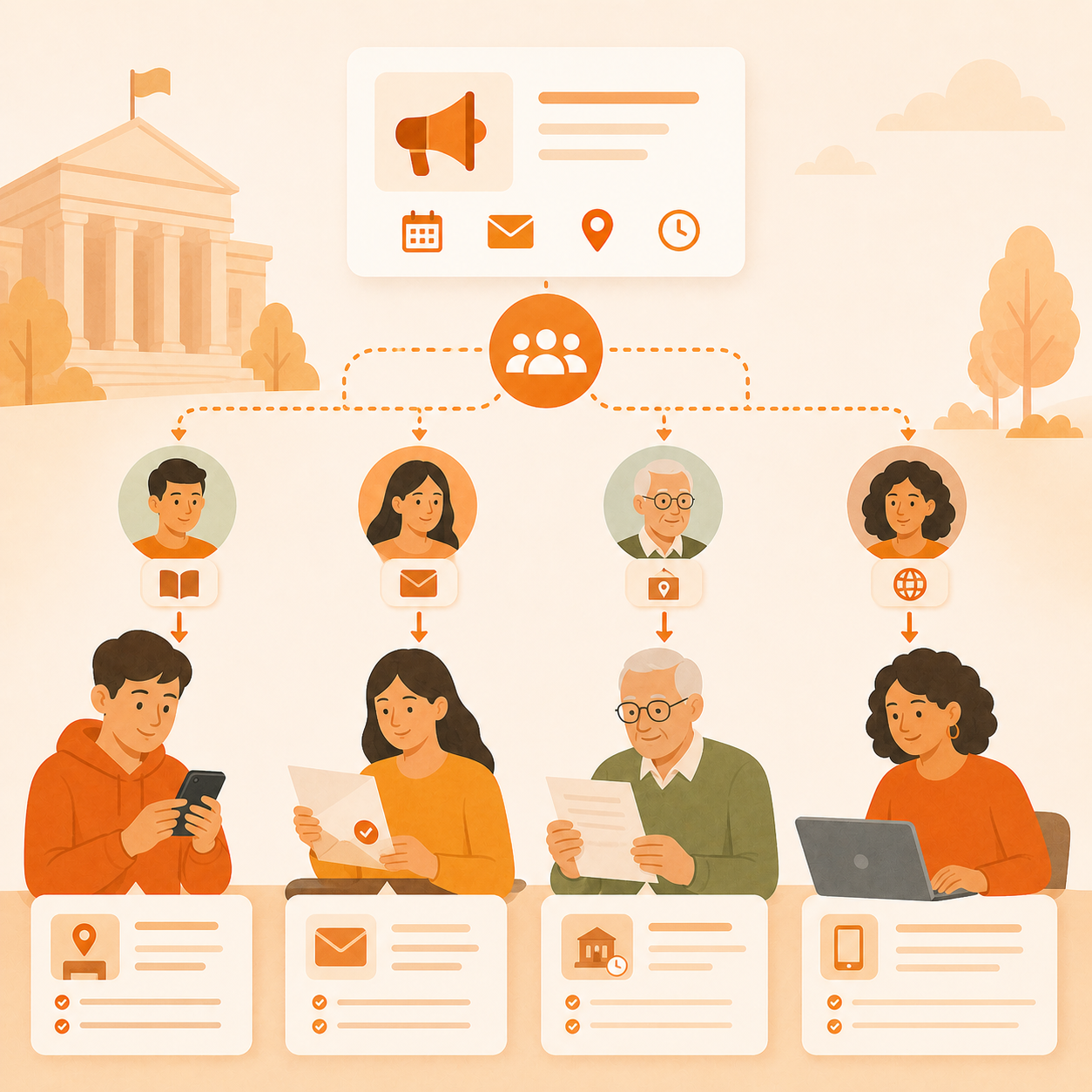
For example, a first-time voter may not need the same kind of message as a long-time voter who has recently shifted to vote by mail. The first-time voter may need orientation about where to start, what voting options exist, what to bring, and what to expect at the polling place. The mail ballot user may already understand the general process but need stronger messaging around deadlines, signatures, tracking, and return methods. An older adult may be highly experienced with voting and still need more explicit communication when long-standing habits are disrupted by polling place changes, modified hours, new procedures, or digital-first public updates. If the office sends each of these voters the same generic reminder, it may technically reach them while still leaving major decision points unclear.
Segmentation also helps offices make better use of limited communication space. A text alert, social post, postcard, or homepage banner cannot explain everything at once. Offices have to decide what is most important to emphasize in a given message. Segmentation improves those decisions because it makes clearer which barriers are most likely for which audience. That leads to stronger prioritization. Instead of assuming every voter needs the same headline, the office can decide when a message should focus on orientation, when it should focus on timing, when it should focus on access, and when it should focus on process completion.
There is also an equity dimension here. Election offices serve the whole public, but equal access to information does not always come from identical communication. Some voters need more context, more repetition, or more practical guidance in order to use the same process successfully. When offices understand segmentation this way, it stops looking like a special communications add-on and starts looking like part of fair public service. The office is not privileging some voters over others. It is reducing preventable gaps in how different voters understand and navigate the same election system.
Beyond the Ballot: Election Office Communication Strategies for County Clerks, Secretaries of State, and Boards of Election
This article is part of our series on strategic communication for Election Offices, Election Administration Agencies, and Boards of Elections. To learn more and to see the parent article, which links to other content just like this, click the button below.
Segmenting Without Fragmenting the Message
One reason some election offices hesitate to segment communication is the understandable fear that multiple versions of a message will create inconsistency. In elections, that is a serious concern. Voters need one reliable process, one set of deadlines, and one official source of truth. Segmentation should never weaken that. In fact, strong segmentation depends on protecting it. The office must first establish the core message that remains fixed across all audiences. Only then should it decide which parts of that message need different emphasis, sequencing, or explanation for different voter groups.
This is the difference between segmenting and fragmenting. Fragmented communication creates different language that drifts in meaning across channels or audiences. Segmented communication keeps the meaning stable while adjusting the frame. A first-time voter message and a mail ballot voter message may highlight different actions, but they should still point back to the same official process and the same source of truth. The office is not creating separate election systems. It is helping different groups understand how to move through the same one.
This usually works best when the office builds communication in layers. The foundational layer holds the fixed facts. Election date, registration rules, deadline timing, voting options, polling place or ballot return information, and official verification links remain the same for everyone. The second layer is audience emphasis. For first-time voters, the office may lead with what to expect and how to prepare. For older adults, it may lead with what has changed, what remains the same, and where to confirm practical details. For mail ballot users, it may lead with the timing sequence and the safest next step. The facts have not changed. The entry point has.
That layered approach makes segmentation more manageable. It prevents the office from building entirely separate communication systems for different groups, which would be difficult to sustain and risky to govern. It also helps keep website content, email reminders, text alerts, printed pieces, and frontline scripts aligned. The office knows what language is fixed, what labels should remain consistent, and where audience-specific emphasis can be added without changing the underlying meaning.
When election offices segment this way, they gain two advantages at once. They preserve consistency, which supports trust and operational discipline. They also improve usability, which helps more voters act successfully. That combination is what makes segmentation valuable. It is not a departure from clear public communication. It is one of the strongest ways to make clear public communication work for more people.
Reaching First-Time Voters With Orientation, Not Just Information
First-time voters are often approached with the assumption that they simply need more encouragement or a basic reminder to participate. In practice, what many of them need most is orientation. They may not know how registration connects to voting options, what steps happen before election day, what to bring, where to go, what the check-in process feels like, or how to tell whether a message they are seeing is official. If the election office communicates with first-time voters the same way it communicates with experienced repeat voters, it can leave too much of the process unexplained.
This is why first-time voter communication works best when it reduces uncertainty early. The office should not assume that a general election calendar or a standard reminder is enough. Many first-time voters need the process broken into a sequence they can picture and act on. Register. Confirm your information. Decide how you plan to vote. Learn what to bring or what to expect. Check your location or ballot status through the official source. That kind of structure is useful because it turns voting from an abstract civic event into a manageable set of steps.
Tone matters here as well. First-time voters often benefit from communication that sounds clear and welcoming without becoming casual or vague. The office should help them feel that the process is knowable and that they do not need prior experience in order to participate successfully. Messages that rely too heavily on legal terms, compressed deadlines, or procedural shorthand can make the system feel more intimidating than it is. By contrast, a message that explains what happens next and what a voter should do now is more likely to build confidence.
First-time voter segmentation also benefits from anticipation of common friction points. These voters may be more likely to arrive without understanding identification expectations, line procedures, polling place navigation, or mail ballot steps if they choose that option. They may also be more likely to rely on social platforms or peer-to-peer information that does not fully explain official process details. That means the office should not only provide information, but also reinforce where the official source of truth lives and how to verify practical details before voting begins.
Reaching Older Adults With Stability, Clarity, and Change Awareness
Older adults are often highly experienced voters, which can make it easy for election offices to under-communicate with them. Experience, however, does not eliminate the need for targeted guidance. In many cases, it makes clarity even more important because experienced voters often rely on established habits. They may expect the same polling place, the same entry route, the same deadlines they remember from prior elections, or the same balance between print and digital communication. When those assumptions no longer hold, confusion can follow quickly.
This is why communication for older adults often needs to do two things at once. It must confirm continuity where continuity exists, and it must highlight change where change matters. If a polling place has moved, if hours differ, if mail ballot rules have shifted, or if digital lookup tools now play a larger role in confirming details, the office should not bury those changes inside general election messaging. It should make them visible and practical. A voter who has successfully voted for decades may still run into avoidable trouble if the office assumes prior experience will fill in the gaps.
Clarity of format also matters. Older adults may be especially sensitive to weak contrast, small type, dense blocks of text, and messages that force them to search across multiple platforms for one clear answer. Election communication for this group tends to work best when it is direct, well organized, and available in formats that do not depend entirely on fast digital navigation. That does not mean older adults should be treated as a single communication type or assumed to avoid digital tools. It means the office should recognize that readability, repetition, and practical specificity remain especially important.
There is also a trust dimension here. Older adults are often among the most regular participants in the election process, which means they may notice inconsistency quickly. If one message says one thing and another says something slightly different, or if a long-standing routine has changed without strong notice, the office may appear less dependable than it intended. Segmented communication for older adults should therefore focus not only on access to information, but on preserving confidence during change. A clear message about what is different, what remains the same, and where to confirm current details can do important preventive work.
Reaching Mail Ballot Users With Sequence, Timing, and Completion Guidance
 Mail ballot users often need some of the most precise communication an election office can provide because their voting path unfolds across multiple steps rather than in one visit. A mail ballot is not just a voting option. It is a sequence. The voter must request the ballot if needed, receive it, review the instructions, complete it correctly, sign where required, return it through an accepted method, and in some cases respond if a problem is flagged later. When offices communicate with mail ballot users too generally, they often leave the most failure-prone parts of that sequence underexplained.
This is why mail ballot communication works best when it is organized around completion rather than awareness alone. A voter does not simply need to know that mail voting is available. The voter needs to know what step comes next, what deadline applies to that step, and what becomes riskier if they wait. A message that only says “return your ballot on time” is far less useful than one that explains when mailing is still safe, when drop-off becomes the better option, and where the voter can confirm official return rules. In this segment, timing and method are inseparable.
Mail ballot users also benefit from communication that makes hidden requirements visible early. Signature placement, envelope instructions, witness or identification requirements where applicable, ballot tracking tools, cure processes, and return-method differences can all create problems if they are discovered too late. These are not secondary details. They are often the points where a ballot that seemed simple becomes stressful. Strong segmentation helps the office emphasize those details more clearly for mail ballot users without overloading every other audience with process information they may not need.
Another reason this segment matters so much is that mail ballot users are especially vulnerable to false confidence. A voter may believe the main task is done once the ballot is completed, even though timing, delivery, or acceptance still depend on later steps. This makes sequence-based communication essential. The office should help the voter understand not only what to do, but how the full path works from ballot in hand to ballot successfully returned and, when possible, tracked. That kind of guidance reduces last-minute panic and makes the office’s communication feel more practically useful.
Segmenting by Voting Method Without Losing the Shared Source of Truth
Mail ballot users often need more specific guidance than in-person voters, but that does not mean they should be pulled into a separate communication system. The same core election information still needs to remain stable. Official deadlines, ballot return rules, cure instructions, and source-of-truth links must be consistent across all channels. What changes is the emphasis. For mail ballot users, the office should lead with sequence, timing, return options, and completion risk. For in-person voters, the same election may require stronger emphasis on polling place details, hours, and what to expect on arrival.
This distinction matters because segmented communication becomes risky when method-based guidance starts to drift from the office’s main process language. A mail ballot reminder should not create a second vocabulary that makes the official rules harder to recognize elsewhere. The strongest offices usually solve this by keeping method-specific guidance closely tied to the same labels, deadlines, and confirmation tools used across the wider communication system. The message is more tailored, but the official process still sounds like one process.
This is also where source-of-truth design becomes especially important. Mail ballot users often need more detail than can fit in a text alert, short social post, or brief reminder email. The office should make it easy for those voters to move from a segmented message into a fuller official explanation without feeling that they have entered a different information environment. The same deadline names, return-option labels, and ballot-status tools should appear consistently across the path. That continuity helps the office stay clear and trustworthy even while giving mail ballot users more specialized guidance.
In practical terms, this means segmentation should help the office surface the right information sooner, not create a maze of separate instructions. A mail ballot voter should feel more supported, not more redirected. When that balance is handled well, segmentation strengthens usability without weakening consistency.
Keeping Method-Specific Guidance Anchored to the Same Core Labels
Voting-method segmentation works best when the office changes emphasis without changing the language voters rely on to recognize the official process. A mail ballot message may need to focus on return timing, tracking, and completion steps, while an in-person voting message may focus more on polling place details, hours, and arrival expectations. Even so, the same key labels, deadline names, return-option terms, and verification tools should remain consistent across both. When the office uses stable wording, voters are less likely to feel that different methods come with different rules or different official guidance. That consistency helps segmented communication feel more supportive without becoming fragmented.
Using the Source of Truth to Hold Method-Specific Messages Together
Method-specific communication becomes much easier to trust when every version points back to the same official source of truth. A segmented reminder can highlight the most important next step for a mail ballot voter or an in-person voter, but the fuller explanation should still live in one central place where deadlines, procedures, and updates are maintained consistently. This matters most when timing changes, return options narrow, or confusion begins to rise. If voters move from a targeted message into a source-of-truth page that uses the same labels and confirms the same process, the office appears more organized and dependable. The segmented message helps with relevance, while the shared source of truth protects clarity and trust.
Using Segmentation to Reduce Preventable Voter Problems
One of the strongest reasons to segment voter communication is that many election-related problems are predictable before they happen. First-time voters often struggle with orientation, older adults may be disrupted by changes to long-standing routines, and mail ballot users may run into timing or completion issues that do not affect in-person voters in the same way. When election offices recognize these patterns early, they can design communication that addresses likely trouble points before they become calls, complaints, missed steps, or lost confidence.
This kind of prevention matters because confusion rarely begins at the moment of failure. It usually begins earlier, when a voter did not receive the right explanation at the right time. A first-time voter who is unsure what to bring may delay action until election day. An older adult who assumes the polling place has not changed may rely on memory instead of checking current details. A mail ballot user who does not understand return timing may wait too long and then discover that the safest option has narrowed. Segmented communication helps election offices intervene before those misunderstandings harden into practical problems.
The value here is not only operational. It is also reputational. Voters are more likely to trust the office when communication appears to anticipate real needs instead of reacting after confusion appears. A segmented approach signals that the office understands how different people experience the same process and has taken care to make the guidance more usable. That strengthens confidence because the office looks prepared, attentive, and serious about helping voters succeed.
Matching Segmented Messages to the Right Channels
Segmentation becomes more effective when election offices consider not only what each voter group needs to hear, but where that message is most likely to be noticed and used. First-time voters may be more likely to respond to mobile-friendly reminders, short step-based guidance, and messages that clearly point them to the official source of truth. Older adults may benefit from clearer print materials, strong readability, and repeated practical guidance that confirms both what has changed and what remains the same. Mail ballot users may need messages timed to the sequence of request, receipt, completion, return, and tracking rather than one broad reminder about voting options.
This does not mean each group needs a separate communication system. It means the office should think more deliberately about where relevance and usability come together. A message can be accurate and still underperform if it appears in a place or format that does not match how that group usually receives information. Strong segmentation therefore depends not only on content but on channel fit. The office is more likely to prevent confusion when it pairs the right emphasis with the right communication path.
This channel awareness also helps offices use limited capacity more effectively. Instead of multiplying messages unnecessarily, the office can adapt one stable source-of-truth process into a few targeted pathways that match how different groups actually move through the election. That makes segmentation more manageable because it is based on practical communication behavior rather than endless customization.
Using Repetition and Reinforcement to Support Different Voter Groups
Different voter groups often need not only different emphasis, but different kinds of repetition. First-time voters may need the process explained more than once in a simple sequence before it feels familiar. Older adults may need repeated confirmation when a long-standing habit, location, or timing rule has changed. Mail ballot users may need reminders that track the actual decision path, including when to stop relying on one return method and use another. In each case, repetition is not redundancy. It is part of helping the message become usable under real conditions.
This matters because many voters do not act the first time they receive information. They may notice it, set it aside, and return to it only when the election feels closer or the choice becomes more urgent. If the office repeats only a broad generic reminder, that later contact may still fail to answer the voter’s most important question. Segmented reinforcement works better because it repeats the guidance that group is most likely to need at the moment it becomes relevant. That makes the office’s communication feel more timely and more practical.
Election offices that use repetition strategically are better positioned to reduce avoidable confusion without increasing clutter. They do not simply say the same thing louder. They reinforce the same official process through audience-relevant cues, timing, and message emphasis. That approach helps different voter groups stay oriented while still preserving one consistent and trustworthy election system.
Strategic Communication Support for Election Offices
 Segmented voter communication is often treated as a content-planning exercise, but in practice it is also a public-trust issue. When election offices communicate in ways that reflect how different voters actually encounter the process, they reduce confusion and make official guidance easier to use. When communication stays too generic, some voters may receive accurate information but still miss the action, sequence, or context they need to participate successfully.
Because of these stakes, many election offices find that segmentation can stretch beyond internal capacity or specialized expertise. Teams are often balancing deadlines, accessibility, language needs, digital updates, mail ballot communication, and public questions all at once. In that environment, agencies may choose to work with an external partner because they need focused communication planning, specialized expertise, and an objective outside perspective on how to tailor messaging for key voter groups without creating inconsistency or neutrality concerns.
Stegmeier Consulting Group (SCG) helps election offices approach segmentation as part of a larger communication system. That includes identifying where different voter groups are most likely to experience confusion, building audience-specific message patterns around one shared source of truth, and aligning those messages across channels so first-time voters, older adults, and mail ballot users receive clearer guidance without hearing different versions of the process. This helps offices improve usability while preserving consistency and public confidence.
This support is especially valuable because segmented communication has to do several things at once. It must remain accurate, consistent, practical, and manageable under real election conditions. It must also help the office tailor emphasis without creating drift. In that sense, strong segmentation is not separate from election readiness. It is one of the clearest ways readiness becomes visible through more usable public communication.
Future Trends in Segmented Voter Communication
Election offices are likely to place greater emphasis on audience-based communication patterns rather than relying only on broad public reminders. As voter needs become more visible across voting methods, access needs, and information habits, offices will need clearer ways to tailor guidance for key groups while still preserving one stable source of truth.
Another likely trend is stronger use of sequence-based communication for groups facing more complex voter journeys. First-time voters will likely receive more orientation-focused messaging, while mail ballot users may receive more step-based timing guidance and older adults may receive clearer communication around continuity, change, and confirmation. This kind of segmentation will matter because the same election process does not feel the same to every voter.
Election offices may also connect segmentation more closely to channel strategy. Different groups often rely on different combinations of print, digital, reminder-based, and in-person guidance. Offices that build reusable message patterns and align them across channels will be better positioned to reduce confusion without multiplying effort. Over time, segmentation is likely to become less of a special campaign tactic and more of a standard part of election communication design.
Conclusion
Segmenting voter communication is not about creating different election processes for different people. It is about helping more voters understand how to move through the same process successfully. First-time voters may need orientation. Older adults may need stability and change awareness. Mail ballot users may need sequence and timing guidance. When election offices recognize those differences clearly, they make official information more usable without weakening consistency.
This is why segmentation should be treated as a communication design strategy rather than as optional refinement. Broad messages still matter, but broad messages alone cannot answer every practical question different voters bring to the same election. Offices that segment well are better able to reduce avoidable confusion, support timely action, and make public guidance feel more relevant and trustworthy.
In the end, strong segmented communication helps election offices do something simple but important. It helps the right information reach the right voter in a form that is easier to understand and act on. That strengthens both voter experience and confidence in the office’s preparedness.
SCG’s Strategic Approach to Communication Systems
Align your agency’s messaging, processes, and public engagement strategies
Election offices need communication systems that help different voter groups navigate the same election process with clarity and confidence. Whether your office is refining first-time voter guidance, improving communication for older adults, strengthening mail ballot messaging, or aligning segmented outreach across channels, SCG can help you create a communication framework that supports usability, consistency, and public trust. Use the form below to connect with our team and explore how a strategic communication system can strengthen voter guidance and election readiness.