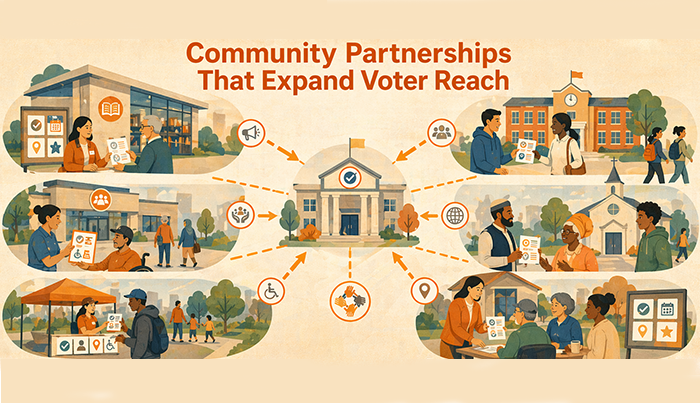
Community Partnerships That Expand Voter Reach: How Election Offices Can Build Trust Without Sacrificing Neutrality
Election offices are often told to reach more voters, but reach is not simply a matter of sending more messages. It is a matter of whether the right information reaches people through sources they already notice, use, and trust. That is what makes community partnerships so important in election communication. A school district, library, disability service provider, neighborhood association, faith-based organization, tenant group, civic nonprofit, or cultural center may already have the audience, familiarity, and local credibility that an election office cannot build overnight through official channels alone. When those relationships are structured well, they can help voters hear about deadlines, polling place changes, registration options, language access, and voting methods earlier and with greater clarity.
At the same time, community partnerships sit close to one of the most sensitive boundaries in election administration. Election offices must expand public reach without appearing to favor one constituency, one ideology, one network, or one political interest over another. That is where the work becomes more demanding than generic outreach advice usually suggests. A partnership that looks practical from inside the office can look partial from outside if the purpose, rules, and message boundaries are not clear. In elections, trust is shaped not only by who receives information, but by whether the public believes the office is engaging the community in a fair, even-handed, and nonpartisan way.
This is why community partnerships should be treated as a communication system design issue rather than as informal relationship-building alone. The office has to decide what role partners should play, what information they can help distribute, what must remain identical across channels, and how neutrality will remain visible as outreach expands. Without that structure, partnerships can become uneven, improvised, or overly dependent on personal relationships. With it, they can become one of the most effective ways to extend voter guidance into places where official communication may not travel as well on its own.
Why Community Partnerships Matter So Much for Election Offices
 Election offices usually do not struggle because they lack official communication channels. They struggle because official channels do not always reach every voter early enough, clearly enough, or in the right context. A website may hold accurate information, but many voters will not visit it until they already have a problem. A social post may be visible to some audiences and nearly invisible to others. A mailed notice may arrive, but not always with enough salience to drive action. Community partnerships matter because they help bridge the gap between official availability and real public reach.
This is especially important for voters who do not move through the election process with high confidence or high institutional familiarity. First-time voters, infrequent voters, voters with limited English proficiency, voters with disabilities, older adults, shift workers, renters, and people who rely more on neighborhood networks than on formal public messaging may all benefit from hearing election information through organizations they already interact with. In those cases, the partner is not replacing the election office. The partner is helping the office’s guidance travel farther and land more effectively.
Partnerships can also improve timing. Election offices often communicate according to the administrative calendar. Community organizations often understand when their audiences are most likely to pay attention, what formats are most usable, and what recurring misunderstandings tend to surface locally. That insight can help election offices frame outreach more practically and reduce the likelihood that key information reaches people only after their options have narrowed.
The deeper value of these partnerships is not just amplification. It is credibility through familiarity. Voters may trust the election office as the official source, but still be more likely to notice, absorb, or act on a message when it is reinforced through a known local institution. That reinforcement can be especially valuable during periods of confusion, deadline pressure, or procedural change. In those moments, partnerships help make official guidance more legible without changing who owns the information.
Beyond the Ballot: Election Office Communication Strategies for County Clerks, Secretaries of State, and Boards of Election
This article is part of our series on strategic communication for Election Offices, Election Administration Agencies, and Boards of Elections. To learn more and to see the parent article, which links to other content just like this, click the button below.
The Neutrality Challenge
The same partnerships that expand voter reach can also create risk if neutrality is not made visible. Election offices cannot approach community partnership work as though any local visibility is automatically good visibility. In a high-trust environment, a broad outreach effort may be seen as practical public service. In a lower-trust environment, the same effort may be examined for signs of favoritism, selective access, or unequal emphasis. That is why partnership strategy has to be built with neutrality in mind from the beginning rather than defended later after questions arise.
Neutrality problems usually do not begin with overt bias. More often, they begin with uneven structure. One organization receives timely materials while another does not. One partner gets a direct briefing while others rely on public updates alone. One community hears repeated reminders because it has a strong local network, while another hears very little because no equivalent relationship was built. These gaps may come from capacity limits rather than intent, but the public may still experience them as unequal treatment. In election administration, unequal communication reach can quickly become a credibility issue.
This does not mean election offices should avoid partnerships. It means they need a framework for deciding how partnerships are selected, what kinds of organizations are included, what materials can be shared, and how the office will maintain consistency across the network. A clear framework protects both the outreach effort and the office itself. It helps the public see that the office is not outsourcing neutrality to informal relationships. It is extending official information through a structured, nonpartisan, and repeatable model.
Offices that handle this well tend to make three things clear. First, the election office remains the source of official information. Second, partners are helping expand access to that information, not reinterpret it on partisan terms. Third, the partnership model is designed to serve broad public understanding rather than narrow constituencies alone. When those points remain visible, community trust and institutional neutrality are much more likely to reinforce one another instead of colliding.
Choosing the Right Partners Without Creating Perceived Favoritism
Election offices expand voter reach most effectively when they choose partners through a clear public-interest lens rather than through convenience or familiarity alone. That means looking for organizations that already connect with people who may not consistently receive or act on official election information through standard channels. Libraries, schools, disability service organizations, senior-serving institutions, neighborhood groups, immigrant and refugee support organizations, civic nonprofits, housing networks, and community resource centers can all play valuable roles when the partnership is structured around access to accurate information rather than advocacy.
This is where offices need to be especially careful. A partner may be trusted in the community and still create perception risk if the office cannot explain why that organization was included, what role it is playing, and how similar opportunities are made available more broadly. Neutrality is easier to preserve when partner selection follows consistent criteria. The office should be able to say that it is working with organizations that help reach underserved, hard-to-reach, or information-sensitive audiences through established community service functions, not through partisan or issue-based alignment.
A strong partner strategy also benefits from breadth. If partnerships cluster too narrowly around one network, one demographic lane, or one set of community relationships, the office may unintentionally create the appearance that some groups are receiving more direct institutional attention than others. Broader and more transparent inclusion helps offset that risk. It signals that the office’s goal is wide public access to official guidance, not targeted influence. That distinction matters because even well-intentioned outreach can create distrust if the structure feels selective or opaque.
Defining What Partners Should and Should Not Do
Community partnerships work best when the office is explicit about the role partners are meant to play. The safest and most effective model is usually straightforward. The election office creates the official guidance, and partners help extend its reach. That can include sharing deadlines, registration information, polling place updates, language-access resources, early voting details, accessibility guidance, and links or materials that point voters back to the office’s source of truth. What partners should not be doing is improvising official guidance, selectively reframing election procedures, or blending civic information with political persuasion.
This role clarity matters because community organizations often communicate in styles that are effective for their audiences, but not all style adaptations are harmless in an election context. A shortened explanation, an overpersonalized framing, or a well-meant summary can change the meaning of the original guidance in ways that produce confusion later. That is why election offices should decide in advance what can be adapted, what language should remain fixed, and what materials should be shared in ready-to-use form.
The clearer the office is about these boundaries, the easier it becomes to preserve neutrality and reduce message drift. Partners do not need to become extensions of the election office. They do need enough structure that the information they share remains consistent with official guidance. This protects the public, the partner, and the office. It also makes collaboration easier because expectations are visible from the start instead of being negotiated informally after problems appear.
Why Ready-to-Use Materials Matter
One of the simplest ways to protect neutrality in community partnerships is to make it easy for partners to share accurate information without rewriting it. Ready-to-use materials reduce the chance that a community partner will unintentionally change the meaning of a deadline, polling place update, ballot rule, or accessibility option while trying to make it more usable for their audience. They also reduce the burden on the partner, which makes participation more practical.
These materials can take many forms. They may include short approved blurbs, flyer text, newsletter copy, translated content, social captions, email-ready language, posters, FAQ links, or graphics with stable wording and clear directions back to the election office. The specific format matters less than the principle behind it. If the office wants many partners to help distribute official information without sacrificing consistency, it should do as much of the message design work upfront as possible.
This also helps the office maintain a stronger source-of-truth model. Partners are not being asked to act as independent interpreters of election policy. They are helping official information travel farther through trusted community channels. That keeps the relationship focused on voter access and public clarity rather than on loosely managed co-messaging.
Building Trust Through Structure, Not Informality
Many community partnerships begin informally, especially in local government environments where staff already know key organizations and leaders. Those relationships can be valuable, but election communication becomes more trustworthy when the partnership model does not depend too heavily on individual familiarity. Informality can create speed, but it can also create unevenness. One group hears about an update because a staff member knows whom to call. Another receives nothing because no equivalent relationship exists. Over time, this kind of unevenness can look less like outreach and more like selective access.
This is why structure matters. Election offices can preserve the goodwill of local relationships while still creating a more visible framework for partnership. That framework might include standard outreach lists, shared onboarding language, common message packets, transparent partner expectations, and predictable processes for distributing updates. Structure does not make partnership colder. It makes partnership fairer, more scalable, and more defensible under scrutiny.
Trust grows when the public sees that the office is not relying on ad hoc relationship patterns to decide who gets information and when. It grows when partners understand their role clearly and receive the same quality of guidance. It grows when outreach appears repeatable rather than improvised. In election administration, that kind of structure helps the office expand reach while keeping neutrality visible.
Which Messages Work Best Through Community Partnerships
 Community partnerships are most effective when election offices use them for information that is useful, practical, and broadly relevant across the voter journey. The strongest partnership messages usually help people understand what action to take, when to take it, and where to confirm details. Registration reminders, vote-by-mail guidance, early voting information, polling place lookups, accessibility resources, language support, deadline reminders, and notices about changes or disruptions all fit this model well. These are the kinds of messages that benefit from wider reach without requiring partners to interpret complicated policy on the office’s behalf.
This is different from asking partners to explain every part of election administration. Most community organizations do not need to become procedural experts. They need to be able to point people toward accurate official information at the right moment. That is an important distinction because the goal of partnership is not to transfer election administration knowledge outward in full. The goal is to help voters hear the right guidance early enough to act successfully.
Election offices should also think carefully about which messages are especially well suited to trusted local networks. Information about language access, disability access, curbside voting, first-time voter preparation, mail ballot return options, and location changes can often travel more effectively through community organizations that already serve people likely to need that guidance. In these cases, the partner helps make the message more visible and more locally relevant without changing its meaning.
Prioritizing What Goes Into the Partnership Network First
Election offices do not need to send every update through every partner. The better strategy is to decide which types of information are most likely to prevent voter confusion, reduce unequal access to information, or support groups that may not reliably encounter official messaging through standard channels alone. That kind of prioritization makes the partnership network more useful and easier to manage.
The first messages sent through partners should usually be the ones that answer high-impact voter questions early. What deadlines matter most. What options are available now. What has changed. Where should people go for the full and current answer. These messages help the office prevent common problems before they reach the point of urgency. They also fit well with the role most partners can play effectively, which is reinforcing clear official guidance rather than carrying long procedural explanations.
Prioritization should also reflect the community’s actual information gaps. In one jurisdiction, the greatest need may be around language access and registration awareness. In another, it may be mail ballot return timing, polling place changes, or accessibility options. Offices that listen to recurring community questions and known points of confusion are more likely to build a partnership network that serves real voter needs rather than generic outreach goals.
Helping Partners Extend Reach Without Overloading Them
Community partnerships become less effective when election offices ask too much of partners at once. A partner that receives long documents, frequent shifts in wording, or too many unrelated election updates may not know what matters most or what should be shared first. That kind of overload weakens the very clarity the partnership is meant to improve.
The office can reduce this risk by giving partners a simple communication structure. What is the key message? Who is most affected? What should people do now? Where should they go for the full answer. This helps community organizations share useful information quickly without having to sort through excessive detail. It also increases the odds that the partner will keep the message intact.
Partner confidence matters here as well. Organizations are more likely to share election information consistently when they know the office will provide clear materials, stable timing, and a reliable place to verify updates. If the office wants partners to reinforce public trust, it has to make the relationship manageable from the partner’s side too. The easier it is to share accurate guidance, the more likely partners are to do it well and repeatedly.
Keeping Materials Simple, Short, and Ready to Share
Community partners are more likely to participate consistently when election offices make materials easy to use. A partner should not have to sort through long explanations or decide which details matter most before sharing information. The office can reduce that burden by providing short, ready-to-share content that clearly states the action, the timing, and the source for full details. This might include newsletter copy, social captions, flyer text, translated blurbs, or brief email-ready language. Simplicity helps partners act quickly, and it helps preserve the accuracy of the original message.
Matching the Message to the Partner’s Role
Not every community partner needs the same volume or type of election information. A library, senior center, disability service provider, school, or neighborhood organization may each be positioned to reinforce different kinds of voter guidance. Election offices can make the partnership model more manageable by sending only the messages most relevant to a partner’s audience and role. This keeps outreach from becoming overwhelming and helps partners focus on the information they are best equipped to share. A more targeted approach also improves consistency because partners are less likely to improvise when the materials they receive already fit their community context.
Keeping Neutrality Visible Across the Partnership Network
Community partnerships only strengthen trust when neutrality remains visible throughout the outreach effort. It is not enough for the election office to intend nonpartisanship internally. The structure of the partnership network has to show it externally. That means using consistent criteria for partner inclusion, offering the same kinds of materials across the network, and making clear that partners are helping distribute official voter information rather than shaping election messaging on their own terms.
This visibility matters because partnership outreach can attract scrutiny even when it is well intentioned. If the office appears to work closely with some organizations while others are left outside the process, questions about favoritism can surface quickly. The office is better protected when it can point to a clear framework. Partnerships are based on public access needs, not political alignment. Materials are standardized. The office remains the source of official information. That kind of structure helps outreach look fair because it is fair in design as well as intent.
Neutrality also depends on message discipline. Partners should be sharing the same core information, using the same key labels, and pointing people back to the same source of truth. The office should not allow one part of the network to drift into looser interpretation while another stays tightly aligned. Even small variations can create the impression that some audiences are hearing different guidance. In election communication, that impression can be damaging even when the differences were unintentional.
Staff Coordination Behind the Partnership Strategy
Community partnerships may look outward-facing, but their success depends heavily on internal coordination. If outreach staff, communications staff, election administrators, and frontline personnel are not aligned, the partnership network can become uneven very quickly. One team may send strong materials while another is unaware of what has gone out. A partner may ask a follow-up question and receive a different answer from the one already shared publicly. These gaps weaken both clarity and neutrality.
This is why election offices need a simple internal model for partnership communication. Staff should know who manages the partner list, who develops the materials, who approves the language, who updates the source-of-truth page, and who answers partner questions when timing is sensitive. The office should also make sure frontline staff understand the role of the partnership effort so they can speak consistently if community organizations reference the materials or direct voters back to the office.
Internal coordination also helps the office respond more calmly when scrutiny arises. If a question comes in about why certain groups received materials, how a message was distributed, or whether a partner changed the office’s wording, the office is in a much stronger position if the outreach system is already documented and aligned. That preparation makes partnership communication easier to defend because it reflects a repeatable structure rather than an informal collection of relationships.
Responding to Scrutiny Without Undermining the Partnership Model
Election offices should expect that visible partnership efforts may sometimes draw criticism, especially in politically sensitive environments. The office does not need to retreat from partnership outreach because of that possibility. It does need to be ready to explain the purpose and structure of the model clearly. A strong response usually centers on public access, consistency, and neutrality. The office is working with community organizations to extend the reach of official voter information, not to target persuasion or delegate election authority.
This kind of response works best when it stays calm and procedural. The office should be able to explain that partnerships are used to help more voters receive accurate information, that the office provides the official messaging, and that the model is designed to operate on a nonpartisan basis across a broad range of community-serving organizations. That explanation is much more persuasive when it sounds like a normal part of election communication planning rather than a hurried defense.
It also helps to remind the public that partnerships do not replace official channels. They reinforce them. The election office still owns the guidance, the deadlines, the process rules, and the source of truth. Community organizations help that guidance travel farther. When offices explain the model this way, they make it easier for the public to see partnerships as a fairness tool rather than as a neutrality risk.
Strategic Communication Support for Election Offices
 Community partnership outreach is often treated as a local outreach task, but in practice it is also a public-trust issue. When partnerships are structured clearly, they help election offices extend accurate voter information into places where official messages may not travel as far or as early on their own. When they are informal, uneven, or loosely managed, the same effort can raise questions about neutrality, consistency, and fairness.
Because of these stakes, many election offices find that partnership-based voter communication can stretch beyond internal capacity or specialized expertise. Teams are often balancing operational deadlines, public information needs, language access, accessibility, and stakeholder coordination at the same time. In that environment, agencies may choose to work with an external partner because they need focused communication planning, specialized expertise, and an objective outside perspective on how to expand reach without increasing neutrality risk.
Stegmeier Consulting Group (SCG) helps election offices approach community partnerships as part of a larger communication system. That includes defining partner roles clearly, identifying which messages belong in the partnership network first, creating ready-to-use materials that preserve message consistency, and building outreach structures that remain fair, nonpartisan, and easy to explain under scrutiny. This helps offices strengthen voter reach while keeping the source of official information clear.
This support is especially valuable because partnership communication has to do several things at once. It must expand access, preserve neutrality, reduce message drift, and remain manageable for both the office and its community partners. In that sense, strong partnership communication is not separate from election readiness. It is one of the clearest ways readiness becomes visible through public trust and operational discipline.
Future Trends in Community Partnership Communication
Election offices are likely to place greater emphasis on structured partnership models rather than informal outreach alone. As public expectations rise, offices will need clearer criteria for partner selection, more repeatable outreach processes, and stronger message controls that help partnerships expand reach without creating unequal communication patterns.
Another likely trend is the increased use of ready-to-share materials designed for different community settings. Offices will likely rely more on short approved blurbs, translated content, accessibility-friendly materials, and clear source-of-truth links that allow partners to distribute official guidance without having to reinterpret it. That shift will help reduce message drift while making partnerships easier to sustain.
Election offices may also connect partnership strategies more closely to equity, accessibility, and trust-building goals. Rather than treating partnerships as an extra layer of outreach, more offices will likely treat them as a standard part of how voter information reaches people who may not rely on official channels alone. The offices that do this well will be better positioned to improve reach while keeping neutrality visible.
Conclusion
Community partnerships can help election offices reach voters more effectively, but only when those partnerships are designed with the same care the office brings to the rest of its public communication. Reach by itself is not enough. The office has to make sure official information stays accurate, consistent, and clearly nonpartisan as it moves through community networks.
This is why partnership outreach should be treated as a communication systems issue rather than an informal relationship effort. Election offices need a clear model for who partners are, what role they play, what information they should share, and how that work remains visibly fair. When that structure is in place, partnerships can strengthen both voter access and public trust.
In the end, the strongest community partnership strategies do not ask the public to choose between local trust and institutional neutrality. They show that both can work together. When election offices extend official guidance through well-structured community networks, they make voter information easier to reach, easier to use, and easier to trust.
SCG’s Strategic Approach to Communication Systems
Align your agency’s messaging, processes, and public engagement strategies
Election offices need communication systems that expand reach without weakening clarity, consistency, or neutrality. Whether your office is building a community partnership framework, refining ready-to-use outreach materials, aligning partner communications with official guidance, or strengthening how voter information moves through trusted local networks, SCG can help you create a communication framework that supports broader access and stronger public trust.
Use the form below to connect with our team and explore how a strategic communication system can strengthen voter outreach and election readiness.