
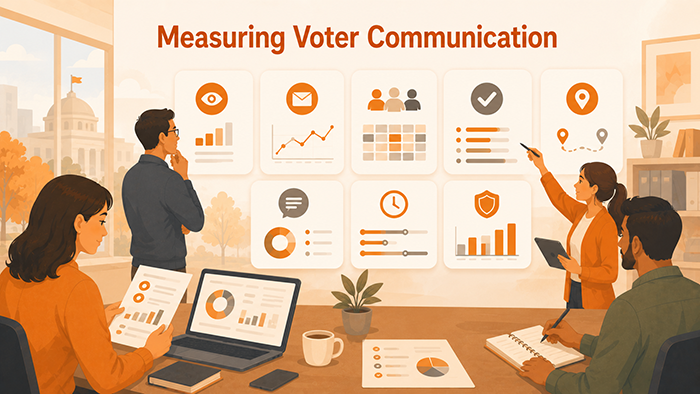
Measuring Voter Communication: Which Metrics Actually Matter for Election Offices
Election offices are often told to measure communication more carefully, but measurement in public-sector election work is not as simple as pulling website traffic, email open rates, or social media impressions into a report. Those numbers can be useful, yet they do not automatically show whether voters actually understood what they needed to know, acted in time, found the right place, trusted the information, or avoided preventable problems. In election communication, the real question is not whether a message was seen. It is whether the message helped the public move through the process more clearly and with less friction.
That distinction matters because election offices do not communicate for general awareness alone. They communicate so people can take the right action at the right time under real constraints. A registration reminder is meant to prompt timely action. A polling place change notice is meant to prevent wrong-site arrivals. A mail ballot message is meant to reduce sequence mistakes, deadline confusion, and return problems. An election-night results explanation is meant to help the public interpret incomplete reporting without assuming disorder. When offices measure only reach or engagement, they may miss whether communication actually changed those outcomes in the ways that matter most.
This is where communication measurement in election administration becomes more demanding than standard digital reporting. A high click rate may look strong and still tell the office very little about whether voters understood the process. A well-performing social post may travel widely and still fail to reduce the most common phone questions. A heavily visited webpage may signal interest, confusion, or both. On the other hand, a channel with modest engagement might still be highly valuable if it helps reduce recurring errors among a key group of voters. The office therefore has to ask a more strategic question. Which measures actually tell us whether communication made the election easier to navigate, easier to trust, and less likely to produce preventable strain.
This is especially important because election offices often work with limited time and limited staff capacity. If the office measures too many things, it can end up tracking activity without learning much. If it measures too little, it may rely on instinct and anecdote alone. The strongest approach is not to measure everything. It is to identify the metrics that best connect communication to practical voter outcomes and operational realities. That means looking beyond raw visibility and asking where communication success should show up in behavior, clarity, timing, and problem reduction.
Why Election Communication Metrics Often Miss the Point
 Election communication metrics often miss the point because they are borrowed from environments with different goals. In commercial communication, success may center on attention, conversion, or engagement. Election offices do need attention, but their deeper objective is different. They need people to understand official guidance, act successfully within lawful timelines, navigate process changes, and trust the office enough to rely on its information when it matters. A message that performs well by marketing standards may still underperform by election-administration standards if it does not reduce confusion or improve action.
One common problem is overreliance on surface metrics. Website visits, open rates, social impressions, and video views can all signal that something reached the public. They do not necessarily show that the public interpreted the message correctly. A polling place page may get heavy traffic because the notice was effective, or because people are confused and searching repeatedly. A deadline reminder may generate strong email opens while still failing to reduce last-minute panic. A high-performing post may be widely shared because it is useful, or because it is being debated or misunderstood. These numbers are not meaningless, but they need interpretation that reflects election goals rather than digital habits alone.
Another problem is that offices sometimes measure what is easiest to extract rather than what is most useful to know. Digital dashboards make it easy to collect channel activity, but voter understanding often reveals itself somewhere else. It may show up in reduced call volume on a specific issue, fewer wrong-location arrivals, smoother mail ballot completion, fewer repeated clarification questions, or more even traffic to source-of-truth pages before the deadline crunch. Those indicators can be harder to organize, but they often tell the office far more about whether communication worked in practical terms.
Election offices also face a timing challenge. Some communication outcomes are visible immediately, while others only become clear across the full election cycle. A same-day spike in page visits may not tell much by itself. But when paired with lower confusion at polling places, fewer preventable deadline issues, or steadier interpretation of election-night reporting, it begins to mean something. Strong measurement therefore depends on connecting communication activity to the points where communication is supposed to relieve strain or support successful voter action.
Beyond the Ballot: Election Office Communication Strategies for County Clerks, Secretaries of State, and Boards of Election
This article is part of our series on strategic communication for Election Offices, Election Administration Agencies, and Boards of Elections. To learn more and to see the parent article, which links to other content just like this, click the button below.
Start With the Voter Action, Not the Channel
Election offices measure communication more effectively when they begin with the voter action they are trying to support rather than with the channel they are using. This shift changes the whole logic of measurement. Instead of asking whether the email performed well or whether the website got traffic, the office asks whether voters registered in time, found the right polling place, returned ballots correctly, understood deadline timing, or interpreted post-election processes more clearly. Once that goal is defined, channel metrics become more useful because they can be evaluated in relation to a real public outcome.
This approach matters because election communication usually exists to solve a specific problem or support a specific action. A first-time voter page is not successful simply because people visited it. It is successful if it helps more voters understand how to begin. A mail ballot reminder is not successful because it opens. It is successful if it reduces sequence mistakes or encourages earlier return behavior. A source-of-truth page for a polling place change is not successful because it had pageviews. It is successful if fewer voters arrived at the wrong location or called asking where to go. When the office starts with the action, the metrics become more grounded in public usefulness.
This also helps offices prioritize better. Not every communication effort needs the same kind of measurement. Some messages are mainly about awareness. Others are about behavior change, problem reduction, or trust support. If the office knows which kind of outcome it is seeking, it becomes much easier to decide what evidence would actually indicate success. That keeps the measurement effort tighter and more meaningful.
In practice, this means election offices should frame communication questions more directly. Did this message help people act earlier? Did it reduce avoidable confusion? Did it improve navigation of the process? Did it reduce strain on staff by answering the most common question before the public had to ask it? Those are stronger starting points than asking whether one channel outperformed another in isolation. Channels matter, but they matter most as tools for helping the public do something successfully.
The Difference Between Reach Metrics and Outcome Metrics
Election offices often begin with rich metrics because they are easy to collect and easy to compare. Website visits, email opens, text delivery rates, social impressions, and video views can all help show whether information traveled. That has value, but reach only tells part of the story. A message can travel widely and still fail to improve understanding or reduce preventable problems. This is why election offices should distinguish clearly between reach metrics and outcome metrics.
Reach metrics show whether communication was encountered. Outcome metrics show whether communication helped the public do something more successfully. That distinction is especially important in election work because the office is not trying to build attention for its own sake. It is trying to help voters register on time, find the right place, return ballots correctly, interpret election-night results responsibly, and navigate the process with less confusion. If measurement stops at exposure, the office may overestimate success simply because the message appeared in front of people.
That does not mean reach metrics are unimportant. They often serve as early indicators. If a critical deadline page received little traffic, or if a message failed to reach a known voter segment, the office may need to rethink distribution. But reach should usually be treated as an input measure, not the final proof that communication worked. The more useful question is what happened after the message was seen. Did calls on the issue decrease. Did fewer voters show up at the wrong location? Did mail ballot return patterns improve earlier in the cycle? Did repeated confusion drop once the communication was updated? Those are the kinds of outcomes that bring measurement closer to public usefulness.
This matters because election offices can easily end up optimizing for visibility while missing whether visibility changed behavior. A source-of-truth page with high traffic may actually be a sign that earlier messaging was unclear. A social post with strong engagement may be widely shared because people are debating it rather than understanding it. A text alert may produce fewer clicks than expected and still be highly effective if it pushes people toward the right action immediately. Strong measurement does not dismiss reach. It places reach in a broader framework where voter action and problem reduction matter more than surface volume alone.
Operational Metrics That Reveal Whether Communication Worked
Some of the most valuable election communication metrics are not traditional communication metrics at all. They are operational signals that show whether the public understood the process well enough to act with fewer errors and less last-minute confusion. This is often where election offices gain their clearest insight into communication effectiveness. If the communication was supposed to reduce a known problem, the office should look for evidence that the problem actually became less common.
This might include fewer wrong-location arrivals after a polling place change campaign, lower call volume on a deadline that was explained more clearly, fewer repeated questions at check-in, stronger early return patterns for mail ballots after sequence-based reminders, or lower rates of preventable ballot cure issues after better instruction design. These indicators often matter more than engagement dashboards because they connect communication directly to the strain points the office was trying to reduce.
Operational metrics are especially useful because they reflect the real environment where election communication succeeds or fails. Voter confusion eventually reaches the office somewhere. It appears in phone queues, site-level questions, returned mail ballots, line management issues, website search behavior, or repeated staff escalations. When those patterns change after communication is adjusted, the office has more meaningful evidence than impressions or click counts alone could provide.
This kind of measurement also helps offices prioritize future improvements. If one communication effort drove a great deal of traffic but did little to reduce confusion, the office learns that clarity may need work. If another effort had modest digital engagement but clearly reduced field problems, the office learns that the communication was more effective than surface metrics suggested. That is one of the most important advantages of using operational signals. They help the office evaluate communication based on what it is actually trying to improve.
Which Metrics Matter Most by Communication Goal
Election offices communicate for different reasons, and the right metrics depend on the goal of the message. A broad voter-awareness campaign should not be measured in exactly the same way as a deadline message, a polling place change notice, or an election-night explanation. Offices make better measurement decisions when they first define the communication goal and then choose the smallest set of metrics that best reflect whether that goal was achieved.
If the goal is awareness, reach and visibility metrics may matter more. The office may want to know whether a message reached the intended audiences through website traffic, distribution counts, text delivery, or social impressions. If the goal is action, then timing and behavior metrics become more important. Did people register earlier? Did they request ballots in time? Did they return ballots through lower-risk methods as the deadline approached? If the goal is confusion reduction, then support metrics and field signals become more useful. Did call-center volume on that issue fall? Did frontline staff report fewer repeated questions. Did site-level problems decrease? If the goal is trust support, as with election-night dashboards or post-election explanations, the office may need to look at a mix of engagement patterns, media interpretation, repeated question types, and whether public misunderstanding became more or less pronounced after clarification.
This is why election offices should resist building one generic communication scorecard for everything. A stronger approach is to use a goal-based measurement model. Start with what the office wanted the communication to help people do or understand. Then choose the metrics most likely to show whether that happened. That keeps the measurement effort leaner and far more relevant to election operations.
Measuring Understanding Through Questions, Not Just Clicks
Election offices often learn the most about communication effectiveness by listening to the questions voters continue to ask after a message has gone out. Repeated questions are not just support activity. They are measurement signals. If voters keep asking the same thing after a deadline notice, polling place update, or mail ballot instruction has been published, the office has evidence that the message may have reached people without fully orienting them.
This is why question patterns matter so much. A drop in repeated calls or in-person questions can suggest that communication is becoming clearer. A spike in one narrow question can show exactly where interpretation is breaking down. For example, if a polling place change page gets strong traffic but staff still hear constant questions about whether the change applies to a specific voter group, the issue may not be reached. It may be missing scope language. If a mail ballot message is widely opened but staff keep hearing confusion about whether a ballot should be mailed or dropped off, the issue may be sequence clarity rather than distribution.
Election offices can use this information without building a complicated research program. They can track the most common questions by topic, compare those patterns before and after major communications, and note where confusion remains concentrated. This kind of measurement is especially useful because it points directly to what should be revised. It helps the office improve wording, sequence, and emphasis based on real public behavior rather than on assumptions about what people must have understood.
What Search Behavior and Navigation Patterns Can Reveal
 Website and search behavior can also provide stronger insight when interpreted carefully. A high pageview count alone may not mean much, but navigation patterns often reveal where voters are struggling to find or confirm information. If users repeatedly search for the same term, bounce quickly between related pages, or return to the homepage before locating the needed answer, the office may be seeing signs of communication friction rather than simple interest.
This is particularly useful for source-of-truth pages, polling place lookup tools, deadline pages, and vote-by-mail guidance. If voters are landing on a page and then immediately searching again for a closely related question, the page may not be answering the right thing first. If the office sees heavy traffic to a page but also sees continued confusion in support channels, the issue may be that the content is technically present but not structured in the way voters need. These patterns help the office move beyond counting visits and start evaluating usability.
Search terms are especially valuable because they reflect voter language, not office language. If people consistently search for words the office is not using in headings or message labels, that mismatch may be limiting findability and comprehension. In that sense, search behavior is not just a digital metric. It is a signal about how the public is trying to make sense of the process.
Search Terms as a Window Into Voter Language
Search behavior can help election offices see the process from the voter’s point of view rather than from the office’s internal terminology. When people repeatedly search for the same words or phrases, they are revealing how they naturally describe the task they are trying to complete. That can be extremely valuable. If the office is using formal labels like “vote-by-mail” while large numbers of users are searching “absentee ballot status” or “where do I drop off my ballot,” that mismatch may be making official information harder to find than it needs to be. Search terms therefore do more than show interest. They reveal where the office’s language and the public’s language are not fully aligned.
This kind of insight can improve both usability and message design. Election offices can use recurring search patterns to revise page headings, FAQ language, navigation labels, and reminder messages so that official content becomes easier to locate under real-world conditions. In that sense, search terms are not just a web metric. They are one of the clearest signals of how voters are trying to interpret the election process in their own words.
Navigation Friction as a Sign of Message Weakness
Navigation patterns can also reveal whether voters are finding the answer they need quickly or being forced to work too hard to piece it together. If users move repeatedly between related pages, return to the homepage, or click through several layers before reaching a key deadline, polling place, or ballot-return instruction, the office may be seeing communication friction rather than normal browsing. These patterns often suggest that the information is technically present but not organized in the way voters need it most.
This matters because election communication is often time-sensitive. A voter who cannot quickly locate a polling place update, return deadline, or cure instruction may not simply feel annoyed. They may act too late, call the office for help, or leave with the wrong assumption. When navigation friction appears around high-priority tasks, it is often a sign that the office should revise page structure, ordering, headings, or source-of-truth design so the most important answer appears sooner. In that way, navigation behavior becomes a practical measure of whether communication is helping voters move through the process clearly or forcing them to search for clarity on their own.
What Bounce Rate and Repeat Visits May Be Signaling
Bounce rate and repeat visits can be useful, but only when election offices interpret them carefully. A high bounce rate is not always a sign of failure. If a voter lands on a page, finds the answer immediately, and leaves, that may actually indicate that the content was efficient and clear. But if high bounce rates appear on pages where voters likely need multiple steps, such as mail ballot guidance, polling place changes, or deadline instructions, the office should look more closely. The page may not be giving people enough context, action guidance, or next-step direction to move forward confidently.
Repeat visits can be similarly revealing. In some cases, repeated return to a page may reflect healthy behavior, especially if voters are checking for updated election-night results, polling place confirmations, or time-sensitive deadline information. In other cases, repeat visits may suggest unresolved confusion. If people keep returning to the same page before calling the office, searching again, or navigating elsewhere, the office may be seeing a sign that the information is not landing clearly the first time. That pattern is especially important on source-of-truth pages, where the goal is not just attention, but usable clarity.
Taken together, bounce rate and repeat visits are most helpful when read alongside the purpose of the page and the voter action the page is supposed to support. They should not be treated as stand-alone success or failure indicators. Instead, they can help election offices ask a more useful question: did the voter get what they needed quickly and clearly, or did they leave or return because the message still left too much uncertainty?
Staff Feedback as a Communication Metric
Frontline staff often see communication problems before dashboards do. Poll workers, call-center staff, front desk personnel, and field supervisors hear where people hesitate, what they misunderstand, and which explanations have to be repeated again and again. That makes staff feedback one of the most practical metrics an election office can use, especially when the goal is confusion reduction.
This kind of feedback does not need to be anecdotal and unstructured. Offices can ask staff to note the most common questions, the most frequent points of hesitation, and the moments where voters seem to arrive with incorrect assumptions. Over time, those patterns can show whether communication is improving. If the same confusion points keep appearing after multiple message updates, the office has evidence that the issue is not just public inattention. It may be a design problem in the communication itself.
Staff feedback is also useful because it often captures what digital metrics miss. A voter may never click a link, but may arrive at the polling place with the wrong expectation. A website may look successful from a traffic perspective, but still leave staff answering preventable questions all day. When offices combine staff observations with channel data, they get a fuller picture of whether communication is helping the public act more confidently and correctly.
Building a Practical Measurement System
Election offices do not need a massive reporting framework to measure communication well. In most cases, they need a practical system that connects a small number of communication metrics to the specific voter outcomes and operational pressures they care about most. The strongest systems are usually simple enough to repeat across election cycles and focused enough to produce decisions rather than data overload.
A useful starting point is to identify a few recurring communication goals. Did the office want more voters to act earlier? Did it want to reduce confusion on a deadline, polling place change, or vote-by-mail process? Did it want to improve interpretation of election-night reporting? Once the goal is clear, the office can decide which measures best reflect that outcome. This might include page traffic to a key source-of-truth page, repeated question volume on the issue, call-center trends, search behavior, staff feedback, or a specific operational outcome such as fewer wrong-site arrivals or fewer preventable cure issues.
This kind of system works better than a large generic dashboard because it keeps communication measurement tied to actual election needs. It also makes reporting more usable internally. Staff can look at a small set of indicators and ask whether communication helped reduce friction, improve timing, or support clearer public understanding. That is much more valuable than collecting dozens of disconnected metrics that never lead to a real communication decision.
Avoiding the Trap of Over-Measuring
Election offices can easily end up measuring too much and learning too little. Digital platforms offer endless numbers, but more data does not automatically produce better insight. If the office is tracking every available metric without a clear decision purpose, the measurement process can become a distraction rather than a support tool. In election communication, the goal is not to build the most detailed analytics report. It is to understand enough to improve public guidance where it matters most.
This is why restraint matters. Offices should focus on the measures that are most likely to reveal whether communication changed understanding, timing, or confusion in useful ways. If a metric does not help explain whether voters acted more successfully or whether preventable strain was reduced, it may not deserve ongoing attention. That does not mean it has no value. It means it may not need to sit at the center of the office’s communication measurement effort.
Over-measuring can also blur priorities. A team may see small wins in reach or engagement and assume communication is performing well even while frontline confusion remains high. Or it may chase channel performance improvements that have little connection to the public outcome that actually matters. A tighter measurement system helps avoid this by keeping the office anchored in a few metrics that reflect real election communication goals rather than digital activity alone.
Turning Measurement Into Better Communication
Measurement only becomes useful when it leads to better communication choices. Election offices should not treat metrics as a final report card. They should treat them as signals that help refine the next round of messaging, timing, channel use, or content structure. If the office learns that voters kept asking the same question after a message was published, that suggests the explanation needs clearer sequencing or scope. If traffic was high but field confusion remained high as well, the office may need stronger action language rather than broader reach. If one reminder reduces last-minute pressure more effectively than another, the office has learned something about timing and channel role that can be used again.
This is where a practical review loop becomes valuable. After a major deadline, polling place change, election-night reporting cycle, or mail ballot effort, the office can review what happened, what metrics were strongest, what confusion points remained, and what should be revised next time. That review does not need to be overly formal to be useful. What matters is that communication findings are captured while they are still fresh and translated into future message improvements.
When election offices work this way, measurement becomes part of communication design rather than something separate from it. The office is not just proving that it communicated. It is learning how to help voters understand and act more successfully in the next cycle. That is where communication measurement becomes genuinely valuable in election administration.
Strategic Communication Support for Election Offices
 Measuring voter communication is often treated as a reporting exercise, but in practice it is also a public-trust issue. When election offices know which communication efforts are actually reducing confusion, improving timing, and helping voters act more successfully, they are in a much stronger position to make future guidance clearer and more reliable. When measurement stays limited to surface engagement alone, the office may miss whether communication is truly working where it matters most.
Because of these stakes, many election offices find that communication measurement can stretch beyond internal capacity or specialized expertise. Teams are often balancing deadlines, public information demands, operational questions, digital reporting, and frontline support all at once. In that environment, agencies may choose to work with an external partner because they need focused communication planning, specialized expertise, an objective outside perspective, and support in identifying which metrics actually connect to voter understanding and operational outcomes.
Stegmeier Consulting Group (SCG) helps election offices approach communication measurement as part of a larger communication system. That includes identifying the outcomes a message is supposed to support, distinguishing between reach and usefulness, connecting communication to operational indicators, and building practical review loops that turn findings into better future messaging. This helps offices move beyond activity tracking and toward measurement that supports clearer public guidance and stronger election readiness.
This support is especially valuable because election communication measurement has to do several things at once. It must remain practical, focused, and tied to real voter and staff outcomes. It must also help the office learn without creating unnecessary reporting burden. In that sense, strong communication measurement is not separate from election readiness. It is one of the clearest ways readiness improves from one cycle to the next.
Future Trends in Measuring Election Communication
Election offices are likely to place greater emphasis on outcome-based communication measurement rather than relying mainly on digital reach metrics. As expectations rise around clarity, trust, and voter usability, offices will need stronger ways to connect communication efforts to real-world outcomes such as earlier action, fewer repeated questions, and lower preventable confusion.
Another likely trend is greater use of combined measurement models. Offices will increasingly benefit from looking at channel data alongside operational signals such as call patterns, staff feedback, source-of-truth page behavior, wrong-site arrivals, or mail ballot problem trends. This kind of blended view will make it easier to judge whether communication actually improved the voter experience rather than simply generated attention.
Election offices may also build more regular post-cycle communication reviews into their planning process. Instead of treating communication metrics as an end-of-cycle summary, more offices will likely use them as a planning tool for refining timing, wording, and channel roles in the next election. That shift will matter because the strongest communication systems are usually the ones that learn visibly over time.
Conclusion
Measuring voter communication well is not about collecting the most data. It is about collecting the right data. Election offices need measures that show whether communication helped people understand the process, act at the right time, and avoid preventable confusion. Reach and engagement can be useful, but they are only part of the story.
This is why communication measurement should start with the voter action or problem the office is trying to influence. From there, the office can choose the smallest set of metrics most likely to reveal whether communication worked in practice. That approach keeps measurement grounded in public service rather than channel activity alone.
In the end, the most useful communication metrics are the ones that help election offices improve. They show where public understanding is still weak, where message timing can be stronger, and where future communication can reduce friction more effectively. That is what makes measurement valuable in election administration.
SCG’s Strategic Approach to Communication Systems
Align your agency’s messaging, processes, and public engagement strategies
Election offices need communication systems that can be measured in ways that support real improvement, not just surface reporting. Whether your office is refining communication metrics, connecting public messaging to operational outcomes, improving post-cycle review, or building a stronger framework for evaluating voter guidance, SCG can help you create a communication system that supports clarity, consistency, and public trust. Use the form below to connect with our team and explore how a strategic communication system can strengthen election readiness and continuous improvement.