QPR Training as a Community Communication Strategy: How Veterans Services Agencies Can Build Suicide Prevention Into Everyday Outreach
Question. Persuade. Refer. Three words, one to two hours of training, and a set of skills that research consistently shows can make a meaningful difference in whether a person who is struggling survives to reach help. QPR, the suicide prevention training model that teaches ordinary people to ask a direct question about suicide, to make a compassionate case for staying alive, and to connect someone in distress with appropriate support, has been deployed in communities across the country for decades as a gatekeeper training program. Its evidence base at the individual intervention level is well established. Trained individuals do ask the question more often. Trained individuals do feel more confident intervening. And direct questions, contrary to the cultural myth that asking about suicide plants the idea, do give people in distress relief rather than additional harm.
What has been less systematically explored is what happens when QPR training is deployed not as an individual skill-building exercise but as a community communication strategy, deliberately designed to change not just individual behavior but the ambient communication culture of a community. This distinction, between individual training and community communication strategy, is the central insight this article develops. QPR training that reaches five percent of a community’s social networks produces more capable individual gatekeepers. QPR training that reaches thirty percent of a community’s social networks begins to produce something qualitatively different: a community in which the conversation about psychological struggle and help-seeking has been normalized across the fabric of everyday social interaction, in which the stigma barrier to these conversations is structurally lower, and in which a veteran who is struggling is more likely to encounter, within their existing relationships, someone who knows what to look for and knows what to do.
Veterans services agencies that recognize this community communication dimension of QPR training, and that design QPR deployment accordingly, are using one of the most cost-effective and culturally resonant community prevention tools available. QPR is not an expensive intervention. It does not require clinical expertise to deliver. It does not require veterans to identify themselves as patients or to engage with a healthcare system they may distrust. What it requires is community reach, consistent deployment, and the strategic framing that positions QPR within the cultural frameworks veterans already hold rather than within the clinical mental health framework that many veterans actively resist.
This article examines how veterans services agencies can deploy QPR training as a community communication strategy rather than a clinical program add-on. It covers the theoretical foundation for community-level prevention communication, the strategic reframing of QPR for veteran audiences, the specific community settings and partner organizations that amplify QPR’s community penetration, the measurement frameworks that track community-level impact, the sustainability practices that maintain community QPR programs over time, and the emerging developments in community-based prevention communication that will shape how agencies approach this work in the coming years.
The population-level evidence on suicide prevention is clear on one point that has direct implications for how agencies should approach this communication challenge: individual-level interventions, however effective at the individual level, are insufficient to produce measurable population-level changes in suicide rates without accompanying changes in the community communication environment. QPR training, deployed strategically as a community communication investment, is one of the most accessible mechanisms for producing those community communication changes in veteran populations. The evidence and the urgency of the prevention mission together make the case for treating QPR as a strategic communication priority rather than a marginal program activity.
The Evidence Base for QPR as a Community Prevention Tool
 Any strategic investment in QPR as a community communication tool should be grounded in a clear-eyed assessment of what the evidence actually supports and what remains to be demonstrated. The evidence base for QPR is substantial at the individual level and more limited but emerging at the community level, and agencies should understand both the strength of the available evidence and its current limits when making the case for community QPR investment.
At the individual level, QPR training has been evaluated across numerous studies using a range of methods, and the consistent finding is that training increases gatekeeper knowledge about suicide and warning signs, increases self-efficacy for intervening with someone who may be at risk, and decreases anxiety about asking directly about suicidal thoughts. These individual-level effects are well documented in both general population and veteran population research, and they are the direct mechanisms through which community-level effects are hypothesized to operate. If more individuals in a community are trained, more individuals have the knowledge and confidence to intervene, and the aggregate of more individual interventions is a community that is more capable of recognizing and responding to members in crisis.
The specific effects of QPR in veteran populations carry additional significance because of the specific barriers that veteran culture creates for direct conversation about psychological struggle. Veterans who have been trained in QPR are not only more capable of asking the direct question. They have had, through the training process itself, a structured and supported conversation about suicide, warning signs, and help-seeking in a group context. For many veterans, this is a genuinely novel experience. Military culture creates extensive norms against this kind of direct conversation about psychological vulnerability, and the QPR training context provides a structured exception to those norms that demonstrates, through direct experience, that the conversation can happen without the feared consequences.
At the community level, the evidence for QPR’s impact is less directly measurable but conceptually coherent with the population-level prevention literature. The Together With Veterans program, developed for rural veteran communities in New England and subsequently expanded to other regions, provides the most relevant model for community-based prevention in veteran populations. This program, which incorporates QPR training as one element of a broader community engagement strategy including veteran-to-veteran outreach, community coalition building, and resource connection, has produced measurable changes in community norms around mental health discussion and help-seeking in participating communities. While attributing specific suicide rate changes to QPR training alone is methodologically complex, the program’s overall evidence base supports the community communication model that this article advocates.
The theoretical framework connecting individual QPR training to community-level communication effects draws on social network theory and community-level stigma research. Stigma, as research consistently demonstrates, is a property of communities rather than only of individuals. It is embedded in the shared norms, language patterns, and behavioral expectations of a community, and it is maintained or reduced through the communicative practices of community members with each other. When a significant proportion of a community’s members have had the specific experience of QPR training, having explicitly discussed suicide, having had the permission to ask directly, and having practiced the intervention conversation in a safe context, the community’s aggregate comfort with these conversations shifts. This shift is the mechanism through which community QPR penetration produces community communication change.
What QPR Training Produces at the Individual Level
The specific individual-level changes that QPR training produces are worth examining in detail because understanding these changes illuminates why the training is particularly valuable for veteran audiences and why its community communication effects are plausible. The training is not simply an information transfer. It is a cognitive and attitudinal intervention that specifically targets the beliefs and anxieties that prevent intervention, and it does so in ways that are particularly relevant to the specific barriers that veteran culture creates.
The first individual-level change is knowledge about warning signs. QPR training teaches participants to recognize specific behavioral, verbal, and situational warning signs that a person may be at elevated risk of suicide. This knowledge is genuinely useful because many of the most significant warning signs are subtle and would not be recognized by an untrained observer as risk indicators. Veterans who are trained in recognizing these warning signs are more capable of identifying when a fellow veteran may be in trouble than veterans who have not received this training, and this increased recognition capability is the first step in the intervention chain.
The second individual-level change is myth correction. QPR training directly addresses the myths that prevent people from intervening, the most consequential of which is the belief that asking about suicide will put the idea in someone’s head who was not already thinking about it. Research consistently and clearly demonstrates that asking about suicide does not increase suicidal ideation and that direct questions about suicide are more likely to provide relief to someone who is struggling than to cause harm. Veterans who have internalized the cultural norm against raising difficult topics directly are particularly susceptible to this myth, and training that addresses it explicitly and provides the research evidence gives trained individuals the cognitive permission to ask the question that their cultural instincts might otherwise prevent.
The third individual-level change is increased self-efficacy for intervention. Many people who witness signs of struggle in someone they care about do not intervene because they are uncertain whether intervention would help, afraid of making the situation worse, or simply do not know what to do. QPR training directly addresses this self-efficacy barrier by providing a specific, simple protocol that trained individuals can follow and by allowing them to practice the protocol in the safe context of the training before they are called upon to apply it in a real situation. The combination of a clear protocol and practice experience significantly increases participants’ confidence that they can intervene effectively.
The Community-Level Communication Effect
The translation from individual training effects to community-level communication effects requires understanding how the individual changes produced by QPR training interact with the social and cultural dynamics of the veteran community to produce aggregate changes in the community’s communication environment. This translation is not automatic, and it does not happen simply because more individuals have been trained. It requires that training be distributed across the social network in ways that create overlapping coverage, that trained individuals apply their training in ways that are visible within the community, and that the agency actively supports the community norms changes that make QPR application more normalized over time.
The social network dimension of community QPR penetration is particularly important. Not all community members occupy equivalent positions in the social network of the veteran community. Post commanders, VSO chaplains, prominent community members, and individuals with many existing social connections in the veteran community have disproportionate influence on community norms and communication culture relative to community members with fewer connections. QPR training that reaches these highly connected community members first, and that then spreads through their networks to additional community members, is more effective at producing community communication change than training that is randomly distributed across the community without attention to social network position.
The visibility of QPR application within the community is the second mechanism through which individual training effects aggregate into community-level communication change. When a trained community member uses their QPR skills and the intervention becomes known within the community, either through the trained person’s own account or through the account of the person who was supported, the community learns that the QPR conversation happens, that it is survivable, and that it can have positive outcomes. This learning, transmitted through the peer network, is itself a prevention communication act that normalizes the intervention for community members who have not themselves been trained.
The community norms change that is the ultimate target of the community QPR communication strategy is not simply a change in individual behavior but a change in the implicit shared understanding of what is and is not appropriate to discuss, ask, and acknowledge within the veteran community. When a community has reached the point where a veteran who is struggling can realistically expect that someone in their social network will notice, will ask directly, and will help them connect with support, without requiring the veteran to proactively seek help themselves, the community has reached the prevention communication environment that the community QPR strategy is designed to create.
Serving Those Who Served: Communication Strategies for Veterans Agencies
This article is part of our series on strategic communication for Veterans Services Agencies, County Veterans Services Offices, State Departments of Veterans Affairs, and community-based veteran support organizations. To learn more and to see the parent article, which links to other content just like this, click the button below.
Reframing QPR for Veteran Audiences
The conventional presentation of QPR training uses mental health framing that positions the training as a mental health skill-building experience, a way to help people in mental health crisis. This framing is accurate but is problematic for veteran audiences for the same reasons that clinical mental health language generally creates resistance in veteran communities. Veterans who do not identify as people who need mental health training, who are skeptical of clinical mental health framing, or who are resistant to any communication that positions them as engaged with the mental health service ecosystem will resist QPR training that is presented in these terms regardless of how valuable the training actually is.
Reframing QPR for veteran audiences requires genuinely repositioning the training within value frameworks that veterans have already internalized and that they experience as authentic to their identity. The most effective reframe for veteran audiences is not a softening of the clinical framing but a replacement of it with a framework that is equally honest about what the training does and why, but that describes those things in language that resonates with veteran culture rather than clinical culture.
The tactical assistance reframe is the most consistently effective approach for veteran QPR recruitment. This reframe describes QPR as a training in how to provide tactical assistance to a fellow veteran who is in trouble, drawing explicitly on the military value of never leaving a fellow servicemember behind and the operational principle of calling for backup when a situation exceeds what one person can manage alone. In this frame, the trained QPR participant is not a mental health intervener. They are a member of the veteran community who has acquired a specific skill set that allows them to recognize when a fellow veteran needs support, to be the person who asks the direct question rather than looking away, and to connect their fellow veteran with the backup resources that the situation requires.
This reframe is not a deception or a manipulation. It is an honest description of exactly what QPR training enables, stated in terms that are authentic to the veteran’s cultural framework rather than the clinical framework that many veterans reject. The skills the training produces are the same regardless of which framework is used to describe them. What changes is whether the description resonates with the veteran’s self-concept enough to motivate participation in the training and application of the skills after training.
Communication materials used to recruit veterans for QPR training should reflect the tactical assistance reframe consistently and specifically. A training announcement that says ‘Learn to recognize when a fellow veteran is struggling and know what to do about it’ is substantively identical in what it is offering but fundamentally different in its framing from one that says ‘Suicide prevention mental health gatekeeper training.’ The first description invites veterans who identify with the responsibility to look out for their own. The second description categorizes the training in a way that many veterans will file as not for them before they have assessed whether it actually is. The choice between these framings is not a minor communication preference. It directly determines who participates.
Adapting QPR Content for Veteran Cultural Contexts
Beyond the framing of training recruitment communications, the content of QPR training for veteran audiences benefits from specific adaptations that make the training examples, scenarios, and cultural references resonate with the specific experience of the veteran population. Standard QPR training content is designed for general audiences and uses examples and scenarios that are relatable across populations. For veteran audiences, replacing or supplementing these with examples drawn from veteran experience produces training that is more immediately engaging, that generates stronger identification with the scenarios, and that leaves participants feeling that the training was designed for them rather than adapted for them as an afterthought.
Veteran-specific QPR training adaptations should include scenarios drawn from specific veteran life situations: the veteran who has recently separated from service and is struggling with the transition to civilian life, the veteran who is waiting for a disability rating decision after months of uncertainty, the veteran who is dealing with employment difficulties related to service-connected conditions, the veteran who has lost connection with the unit community that provided their primary social support during service. These scenarios generate immediate recognition among veteran training participants and make the application of QPR skills feel concrete and relevant rather than abstract and hypothetical.
The cultural competence of QPR trainers working with veteran audiences is as important as the content of the training itself. A trainer who does not understand the specific cultural dynamics of veteran communities, including the norms around direct communication about psychological difficulty, the specific language patterns that signal insider status, and the history of how mental health has been treated in military institutional contexts, will deliver less effective training than a trainer who understands these dynamics and can navigate them skillfully. Training of trainers for veteran community QPR programs should specifically address veteran cultural competence alongside standard QPR training curriculum.
Building QPR Into the Fabric of Veteran Community Programming
The strategic deployment of QPR as a community communication tool requires moving QPR training from a standalone mental health program to an integrated component of the full range of veteran community programming that veterans services agencies and their community partners conduct. When QPR is offered only as a separate mental health training event, it reaches primarily the veterans who are already engaged with mental health programming and who are most open to mental health framing. When QPR is integrated into programming that veterans attend for other reasons, it reaches a much broader cross-section of the veteran community, including veterans who would not attend a standalone mental health training but who are present at VSO meetings, benefits events, employment workshops, and community service activities.
The integration principle is not simply about adding QPR to existing events as an additional agenda item. It requires thinking about how QPR training can be delivered in formats that fit naturally within the time, tone, and purpose of the programming it is being integrated into. A two-hour standalone QPR training is not appropriate to drop into a VSO post monthly meeting that runs ninety minutes on other topics. A thirty-minute abbreviated QPR awareness session that teaches the key concepts, addresses the most important myths, and provides the basic intervention protocol, with an invitation to a full training session for those who want to go deeper, is a more appropriate integration for a VSO post meeting context.
VSO posts deserve extended attention as QPR integration sites because of their unique position in the veteran community. VSO posts are among the most consistent gathering points for veterans in many communities, they operate within a strong culture of member care and mutual responsibility, and they have leadership structures that can champion and sustain cultural change in ways that individual member-level efforts cannot. A VSO post whose commander has received QPR training, who has integrated QPR awareness into post culture, and who has created explicit norms around member wellbeing and direct checking-in, is performing a community prevention communication function that extends to every member of the post and through them to the members’ social networks in the broader veteran community.
Building VSO post integration requires sustained relationship investment by the veterans services agency with post leadership. This means regular briefings for post commanders, provision of updated QPR materials and resources for posts to distribute to their members, designation of agency staff as specific points of contact for post leadership who want to discuss member wellbeing concerns or referral options, and recognition of posts that have made member wellbeing a demonstrated community priority. The relationship investment required is modest in individual interactions but significant in its cumulative effect on post culture and community prevention capacity.
Beyond VSO posts, the range of community programming contexts into which QPR training can be meaningfully integrated includes employer wellness programs in veteran-dense industries, community college orientation programs for veteran students, faith community leadership training, agricultural extension programs that serve rural veteran farmers, and any other community programming context where veterans are present in meaningful numbers for purposes other than mental health services. Each of these integration contexts requires specific adaptation of QPR content and delivery to fit the time, audience, and cultural norms of the programming context, and agencies that develop this adaptation capacity across multiple integration contexts build community QPR penetration through multiple simultaneous channels.
Healthcare Provider Integration
Healthcare providers who serve significant veteran patient populations represent one of the highest-leverage integration contexts for QPR training, because the healthcare encounter provides a trusted relationship context and a natural opportunity for the kind of direct checking-in that QPR encourages. A primary care provider who has been trained in QPR and who routinely asks veteran patients direct questions about how they are doing beyond the physical dimension of their healthcare is applying community prevention principles within the institutional healthcare relationship that many veterans maintain even when they have disengaged from other veterans services.
Integrating QPR into healthcare provider training for providers who serve veteran populations is an investment that reaches veterans through one of the most trusted channels available. The primary care relationship, when it exists and is functional, is built on sustained personal trust that is not easily replicated by other services. A question about psychological wellbeing from a trusted primary care provider carries a weight that the same question from an agency representative or a community member does not, because the clinical relationship provides a specific context in which personal questions are expected and in which the provider’s concern for the patient’s full wellbeing is understood as part of their professional role.
Agencies that develop formal training partnerships with healthcare systems serving veteran populations, ensuring that clinical staff at those organizations receive QPR training and are equipped with referral information for veteran-specific resources, are building prevention infrastructure in a healthcare setting that complements and extends the community prevention work happening through VSO posts and other community channels. The combination of healthcare-based and community-based prevention communication creates overlapping coverage that reaches veterans through multiple trusted relationship channels simultaneously.
Designing a Sustainable Community QPR Training Program
 A community QPR training program that is designed for community penetration at the scale required to produce population-level effects requires organizational planning and infrastructure that goes well beyond scheduling a series of training events. Sustainable community penetration requires a trained cadre of QPR trainers who can deliver training consistently over time across multiple community settings, administrative infrastructure that supports scheduling, documentation, and quality maintenance, partner relationships that distribute training across the full range of relevant community contexts, and measurement systems that track community penetration and provide the evidence base for sustained organizational investment.
Building a trained cadre of community QPR trainers is the foundational infrastructure investment for a community penetration strategy. The QPR Institute offers trainer certification that prepares individuals to deliver standard QPR training curriculum, and building a cadre of veteran-specific QPR trainers within the community is a more sustainable and more culturally effective model than relying on a small number of agency staff to deliver all training. When peer support specialists, VSO post commanders, healthcare providers, and other community members are certified as QPR trainers, the training capacity is distributed across the community in ways that reach different community segments through different trusted relationships and that continue to function even when agency staff capacity is limited.
Trainer support and quality maintenance are as important as trainer certification. A certified trainer who delivers one training in their first year and nothing subsequently is not a community training resource. They are past training participants. Supporting trained trainers in remaining active includes regular refresher training that updates their content knowledge and reinforces their training skills, recognition by the agency of their training contribution as a valued community investment, and logistical support for scheduling training events including venue identification, material preparation, and participant recruitment. Agencies that provide this ongoing support maintain an active trainer cadre. Agencies that certify trainers and then leave them to manage their training function entirely independently will see trainer activity decline rapidly.
The administrative infrastructure for tracking community penetration requires systems for recording QPR training delivery, documenting the number of participants trained, tracking the community settings where training has been delivered, and calculating cumulative community penetration estimates. This documentation serves both the program evaluation function and the program management function, since it identifies the community settings and population segments that have been well covered and those that remain underserved by current training deployment. Agencies that have this documentation infrastructure make strategic decisions about training deployment based on evidence rather than assumption.
Partner agreements that formalize the commitment of community organizations to host QPR training for their members or employees provide the structural framework for sustained multi-channel training deployment. A formal agreement between the veterans services agency and the VSO posts in its service area, committing posts to hosting QPR training for their members on a regular schedule, is more sustainable than informal arrangements that depend on the initiative of individual post commanders who may change over time. Similarly, formal agreements with healthcare systems, educational institutions, and major employers that include QPR training as a component of their veteran-related programming create structural commitments that survive personnel changes and program cycle variations.
Tracking Community Penetration as a Communication Metric
The shift from thinking about QPR training as a clinical program activity to thinking about it as a community communication investment requires a corresponding shift in how its success is measured. Clinical program metrics, such as the number of training events held, the number of individuals certified, and the number of documented interventions, capture the activity dimension of the program but not the community communication impact that is the ultimate target of the strategic deployment. Community penetration metrics, which track the proportion of the veteran community that has received QPR training and map the distribution of training across community social networks, capture the community communication impact dimension that clinical metrics miss.
Estimating community penetration requires knowing the approximate size of the veteran population in the agency’s service area, which is available through VA population data, Census Bureau veteran population estimates, and local veterans services records. With this denominator established, the cumulative count of QPR training participants drawn from the local veteran community becomes the numerator for a penetration percentage calculation. Tracking this percentage over time, and setting targets for penetration levels based on the community prevention literature, converts QPR training activity from a count of events into a measure of community communication investment.
The distribution of training across community social networks is as important as the aggregate penetration level, because concentrated training in a small number of community settings reaches fewer of the social networks through which prevention benefits propagate than training distributed across diverse settings and community contexts. An agency that has trained every veteran who attends a specific VSO post may have high penetration within that post community but no penetration in other veteran community segments. Tracking which community settings and population segments have been reached, and which remain underserved, provides the intelligence needed to direct future training deployment toward the gaps.
Community norms measurement, using brief surveys or structured focus group conversations with veteran community members at regular intervals, supplements penetration metrics with evidence about whether the community communication change that QPR training is intended to produce is actually occurring. Survey items that assess veteran comfort with discussing psychological struggle with peers, willingness to ask a direct question of a fellow veteran who seems to be in trouble, and awareness of available support resources, measured before a community QPR program and at regular intervals after it, provide a direct measure of community communication change that penetration percentages alone cannot capture.
Partnership Structures for Community QPR Deployment
No single veterans services agency has the community reach, the trusted relationships across all veteran community segments, or the organizational resources to achieve meaningful community QPR penetration solely through its own training delivery. Community QPR programs that reach the penetration levels associated with community communication change are built on partnership structures that distribute the training function across multiple organizations and community contexts, each of which reaches different segments of the veteran community through different trusted relationships.
The partnership ecosystem for a comprehensive community QPR deployment strategy encompasses several distinct partner categories, each with different roles and different relationship requirements. VSO posts have already been discussed extensively as the most natural and important community partner for QPR integration. Beyond posts, the partnership ecosystem should include healthcare partners who reach veterans through clinical relationships, educational institutions that serve veteran students, employer organizations with significant veteran workforces, faith communities with meaningful veteran membership, and community service organizations that serve veterans in non-clinical contexts.
Healthcare partnership for community QPR deployment requires engagement with the specific healthcare systems and clinical settings that serve the largest concentrations of veteran patients in the agency’s service area. For many communities, this includes both VA-affiliated community care providers and community health centers that serve significant veteran populations. Formal training partnerships with these organizations, including provision of QPR training for clinical staff and integration of QPR-aligned veteran wellbeing screening into standard clinical protocols, extend community prevention into the healthcare relationship context in ways that significantly expand the community network of trained gatekeepers.
Educational institutions, particularly community colleges with significant veteran student populations and universities with veteran resource centers, offer QPR integration opportunities that reach veterans in a specific and often underserved life transition context. Veterans transitioning from military service to higher education are navigating one of the most challenging transitions of their post-service lives, and they are doing so in an institutional context that may have limited capacity to recognize and respond to the specific stressors of that transition. QPR training for academic advisors, student affairs staff, faculty with significant veteran student contact, and veteran student organization leaders builds campus-based gatekeeper capacity for a population that research identifies as having elevated prevention needs.
Faith community partnership for QPR deployment operates through a different trust structure than healthcare or educational partnerships. Faith leaders derive their authority and their relationship capital from a combination of religious standing, pastoral relationship, and community longevity, and their willingness to engage with prevention topics is shaped by their theological frameworks and their community’s specific norms around discussing struggle and seeking help. Effective faith community partnership begins with relationship building that takes these factors seriously, that engages with faith leaders on their own terms rather than positioning QPR as a secular mental health program, and that finds the resonances between QPR’s core values of concern, direct engagement, and connection to help and the pastoral values that faith leaders already hold.
The formalization of partner relationships through memoranda of understanding, service agreements, or other formal commitment mechanisms provides the structural stability that sustains community QPR programs through personnel changes, budget cycles, and program priority shifts. Informal relationships that depend on the enthusiasm of specific individuals on both sides are vulnerable to dissolution when those individuals move on. Formal agreements that embed QPR training into the institutional programming commitments of partner organizations create structural commitments that survive at least some of the changes that inevitably affect informal relationships over time.
Communicating QPR’s Availability to the Veteran Community
A community QPR training program that is well designed, well resourced, and delivered through strong partner relationships will still underperform its potential if the veteran community it is intended to serve does not know the training is available or does not understand why it is relevant to them. Communicating QPR training availability effectively across the veteran community requires the same intentional communication strategy that the agency applies to any other significant community program, with specific attention to the framing challenges and channel considerations that are particular to QPR in the veteran context.
The tactical assistance reframe described earlier in this article should be the organizing frame for all QPR availability communication in veteran contexts. Training announcements, social media posts, VSO post briefings, employer communications, and any other channel through which QPR training availability is communicated should consistently describe the training in terms of the tactical assistance it enables rather than the mental health skill-building it involves. This consistency across channels is not simply a marketing decision. It is a communication strategy decision that shapes whether the training reaches the veterans who are resistant to clinical mental health framing or only the veterans who are already open to it.
Peer voice is as important in QPR recruitment communication as in any other veteran-facing communication context. A veteran who has completed QPR training and who can speak to its value in terms drawn from their own experience is a more effective recruiter than any institutional communication, for all the reasons the peer voice discussions throughout this series have addressed. QPR alumni testimonials, organized around the tactical assistance value of the training rather than its mental health framing, and delivered through the social media channels, VSO post relationships, and community event appearances where peer voice is most effective, create recruitment communication that operates through the most trusted channels available.
The channels through which QPR availability is communicated should be as diverse as the veteran community’s information ecosystem. Benefits newsletters and agency communications reach veterans who are engaged with the formal veterans services system. VSO post announcements reach veterans who attend post gatherings. Employer communications reach veterans in the workplace. Social media posts reach veterans in digital spaces. Faith community bulletins reach veterans who are connected to faith organizations. The geographic distribution of training events, across community locations rather than concentrated at the agency’s central facilities, ensures that geographic distance is not a barrier to participation for veterans in different parts of the service area.
Strategic Communication Support for Veterans Services Agencies
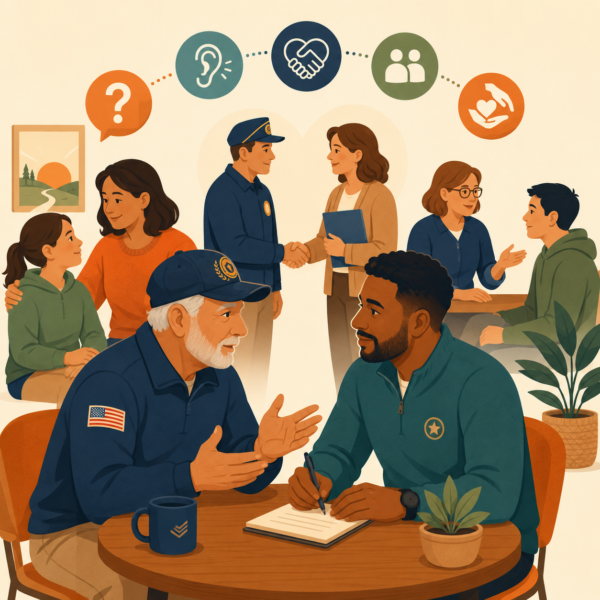 The long-term impact of QPR training is determined not only by how many people complete the training, but by how effectively an agency integrates it into its broader communication strategy for veteran suicide prevention. Agencies that achieve lasting community impact typically treat QPR as more than a standalone educational program. They position it as part of a coordinated effort to strengthen community awareness, expand trusted support networks, and encourage earlier conversations about mental health and help-seeking across the veteran community.
Making that transition requires a communication framework that extends well beyond the training curriculum itself. Community-wide deployment depends on clear communication objectives, sustained partnerships with local organizations, structured support for trainer development, consistent messaging across communication channels, and evaluation systems that measure changes in community awareness and engagement over time. These elements work together to transform individual training events into a long-term communication strategy capable of influencing community norms and strengthening prevention efforts.
Many veterans services agencies choose to partner with external communication specialists such as Stegmeier Consulting Group (SCG) because designing and sustaining community-wide communication initiatives requires specialized expertise in communication strategy, community engagement, partnership development, implementation planning, and long-term performance measurement. These capabilities complement the agency’s expertise in suicide prevention and behavioral health while helping build communication systems that can be sustained and expanded over time.
SCG works with veterans services agencies to develop community QPR deployment strategies that emphasize population-level communication impact rather than program-level activity. Support may include positioning QPR within the broader veteran communication environment, strengthening community partner engagement, developing trainer cadre strategies and support structures, creating community penetration tracking systems, and establishing evaluation frameworks that measure how communication efforts influence awareness, conversations about mental health, and help-seeking behaviors across the community.
The value of this approach extends beyond increasing the number of QPR participants. SCG helps agencies build communication frameworks that integrate QPR into their broader prevention strategy, creating consistent messaging, stronger community partnerships, and sustainable implementation practices that reinforce prevention efforts across multiple organizations and communication channels.
The goal is to create a community communication environment in which more veterans, families, friends, employers, and community partners recognize warning signs, feel confident initiating conversations about suicide risk, and understand how to connect someone with appropriate support. By embedding QPR within a comprehensive communication strategy, agencies are better positioned to strengthen community resilience and improve long-term suicide prevention outcomes.
Future Trends in Community-Based Prevention Communication
The landscape of community-based suicide prevention communication is evolving rapidly in response to research advances, technological change, and growing evidence about the conditions under which community-level interventions produce measurable population-level effects. Several trends deserve specific attention from agencies planning their community QPR strategies over the coming years.
The evidence base for community-based prevention is becoming more specific about the intervention conditions that produce population-level effects, including the community penetration levels that are associated with measurable community norms change, the social network positions that, when occupied by trained individuals, produce the greatest network diffusion effects, and the combination of community-level and individual-level interventions that produces the strongest synergistic effects. Agencies that stay current with this research and adjust their community QPR deployment strategies as the evidence evolves are more effective over time than agencies whose community prevention approach is set at program inception and not systematically updated.
Digital community platforms are emerging as important sites for community-based prevention communication among younger veteran populations who form significant portions of their social networks online. The principles of community prevention, including peer voice, direct asking, and normalized discussion of struggle, can be applied in digital community environments as well as in-person ones, and the development of digital community QPR awareness programs that operate through the social media platforms and online forums where younger veterans are most active represents an important frontier for community prevention communication. Agencies that develop digital community prevention communication capacity are extending the community communication environment into the spaces where a significant and growing portion of veteran social life occurs.
The Zero Suicide framework, which provides a system-level approach to suicide prevention that encompasses clinical care systems, community organizations, and the interface between them, is becoming an increasingly common organizing framework for comprehensive prevention strategies in communities with significant veteran populations. As more communities adopt Zero Suicide frameworks, QPR community deployment will increasingly be situated within a larger prevention system architecture that creates formal connections between trained community gatekeepers and the clinical and peer support resources they are intended to connect people to. Agencies that build these connections into their community QPR programs from the beginning are positioning their community prevention work within the comprehensive prevention infrastructure that the most effective prevention systems require.
The growing formalization of community health worker and peer support specialist roles in public health systems is creating new possibilities for community QPR program infrastructure that goes beyond what volunteer gatekeeper training alone can sustain. Community health workers and peer support specialists who are formally embedded in community organizations and who carry QPR among their skills are providing a professional infrastructure for community prevention communication that has greater sustainability and consistency than programs that depend on volunteer gatekeeper activity alone. Agencies that think about community QPR deployment in the context of this emerging professional community health workforce are building community prevention capacity that integrates effectively with the growing professional infrastructure for community-based health promotion.
Conclusion
The veteran community is a social network before it is a service population, and the most powerful prevention interventions are those that operate at the level of the social network, changing the ambient conditions under which veterans make decisions about acknowledging struggle, seeking support, and staying connected to the people and purposes that give life meaning. QPR training, deployed as a community communication strategy rather than a clinical program activity, is an intervention that operates at this network level. It builds the community of people who are watching, who are willing to ask, and who know how to help. And the larger that community grows, relative to the size of the veteran community it serves, the more likely it is that any veteran in crisis will encounter, within their existing relationships, someone who can make a difference.
That is the prevention outcome that strategic community QPR investment is designed to produce, and it is the outcome that the evidence suggests is achievable with sustained, well-designed community deployment. Veterans services agencies that commit to this investment are not running a training program. They are building the community that makes prevention possible, one conversation, one training session, and one relationship at a time. Use the form below to connect with our team.
SCG’s Strategic Approach to Communication Systems
Stegmeier Consulting Group’s communication systems work with veterans services agencies is grounded in the understanding that the most important communication outcomes are not those that happen in agency publications or on agency social media feeds. They are the outcomes that happen in real conversations between people who trust each other, in community spaces where veterans gather and talk and pay attention to how each other is doing. QPR community deployment is the clearest available investment in building those community-level communication conditions, and SCG’s approach to supporting it reflects the strategic seriousness that the prevention mission requires.
SCG helps agencies develop community QPR strategies that are grounded in population-level prevention evidence, adapted to the specific cultural dynamics of the veteran communities they serve, and designed with the long-term penetration targets and sustainability infrastructure that produce community communication change rather than episodic training activity. The partnership frameworks, trainer development systems, penetration tracking metrics, and community norms measurement approaches that SCG brings to this work give agencies the strategic tools they need to treat QPR community deployment as the population-level communication investment it is, and to demonstrate the community-level impact of that investment in terms that justify continued organizational commitment over the multiple years required to produce the community penetration levels associated with meaningful prevention effects.
Use the form below to connect with our team and explore how strategic QPR community deployment can help your agency expand community preparedness, strengthen peer support, and build a more effective suicide prevention network.