
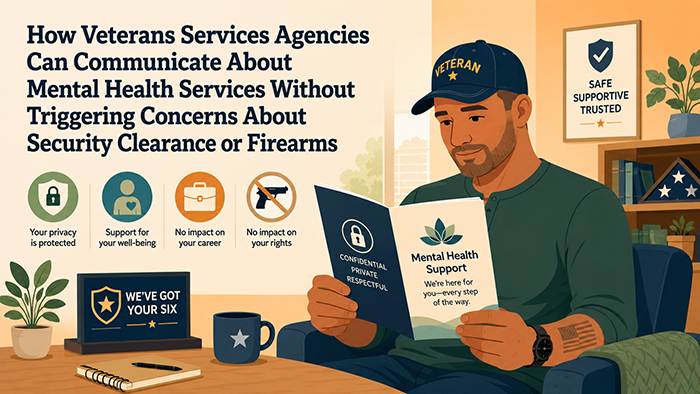
How Veterans Services Agencies Can Communicate About Mental Health Services Without Triggering Concerns About Security Clearance or Firearms
There is a moment in many conversations between a veterans services professional and a veteran that has no visible external sign. It is the moment when a veteran who has been asked about their mental health, or who has begun to consider whether to mention that they are struggling, performs a rapid internal calculation. On one side of the calculation is the potential value of support. On the other side are specific fears: the fear that acknowledging a mental health struggle will trigger a review of their security clearance and put their career at risk, and the fear that engaging with mental health services will result in some formal determination that leads to the loss of their firearms. These fears are not fantasies conjured from nothing. They have real roots in actual law and policy, real amplification through veteran peer networks, and real behavioral consequences in the form of veterans who choose silence over support.
The silence that results from this calculation is not a trivial communication failure. It is a failure with potentially fatal consequences, because the veterans most likely to perform this calculation and choose silence are often veterans whose psychological situations are genuinely serious and whose decision not to seek support leaves them without resources that could make a significant difference. When a veteran’s fear of losing their clearance or their firearms prevents them from accessing mental health services, the institutional systems that both govern clearance and regulate firearms rights have, regardless of their actual content, produced a chilling effect that costs veteran lives.
The most direct and most durable solution to this problem is communication that gives veterans accurate, specific, and honest information about what the relevant laws and policies actually say, information that allows veterans to make genuinely informed decisions about mental health help-seeking rather than decisions shaped by misconceptions that accurate information could correct. This communication is not about persuading veterans that their concerns are irrational. In some specific circumstances, those concerns reflect real considerations that deserve real attention. The communication is about distinguishing the circumstances where genuine caution is warranted from the large majority of circumstances where fear is preventing help-seeking without any basis in actual policy or law.
Veterans services agencies are positioned to deliver this communication consistently and credibly across every interaction they have with veterans. They are not positioned to change the law, to guarantee specific outcomes for specific veterans, or to provide the individualized legal advice that complex clearance situations sometimes require. But they are positioned to ensure that no veteran leaves an interaction with their agency holding a misconception about the consequences of mental health help-seeking that accurate communication from the agency could have been corrected. That is the communication obligation this article addresses, and it is one of the most consequential communication functions any veterans services agency can perform.
This article provides a comprehensive framework for that communication, covering the factual landscape of security clearance adjudication and federal firearms law, the specific forms the most consequential misconceptions take, the design principles for accurate and effective communication about these topics, the staff training and organizational infrastructure required for consistent delivery, the particular situations that require individualized guidance beyond what agency-level communication can provide, and the emerging trends that will shape this communication landscape over the coming years.
The Security Clearance Policy Landscape and What It Actually Says
 Security clearance adjudication is governed by the Adjudicative Guidelines issued by the Director of National Intelligence, which define the criteria that adjudicators apply across thirteen factors when evaluating initial or continuing clearance eligibility. Guideline I, titled Psychological Conditions, is the specific guideline relevant to mental health considerations in the clearance process. Understanding what this guideline actually says, in its specific language rather than in the summary form in which it is often transmitted through veteran peer networks, is the essential foundation for any agency communication on this topic.
The guideline does not bar individuals who have sought mental health treatment from holding clearances. Its concern is with psychological conditions that could affect an individual’s reliability, judgment, trustworthiness, and ability to protect classified information. The presence of such a condition, as assessed by the adjudicative criteria, can be a concern in the clearance process. The guideline also identifies specific mitigating factors that adjudicators must consider when a psychological condition concern is present, and among the most significant of these mitigating factors is the individual’s willingness to seek diagnosis and treatment. The guideline explicitly identifies voluntary treatment-seeking as a positive indicator rather than a negative one in the adjudicative framework.
This is the specific policy reality that most veterans in clearance-sensitive positions do not know. The cultural narrative in clearance-holding communities is often the reverse of what the policy says: that mental health disclosure endangers clearances, that treatment-seeking creates records that become liabilities in the adjudicative process, and that the safest strategy is to avoid any mental health engagement that creates documentation. This narrative is not only inaccurate as a general matter but is specifically and consequentially wrong about the direction of the adjudicative guidance, which positions treatment-seeking as a mitigating factor, not an aggravating one.
The Department of Defense has explicitly recognized the gap between veteran perception and policy reality on this issue, and has issued public guidance on multiple occasions stating directly that seeking mental health treatment does not in most cases disqualify an individual from security clearance eligibility, and that the DoD encourages service members and veterans to seek mental health support without fear of clearance consequences. This official messaging provides veterans services agencies with authoritative backup for the accurate information they are communicating, and agencies should be familiar with these official statements and able to reference them when veterans ask for confirmation that the agency’s communication is accurate.
The circumstances where genuine clearance concerns are warranted are narrow and specific. A psychological condition that significantly impairs judgment, reliability, or functioning in ways that are not responsive to treatment, or that involves specific risk factors identified in the adjudicative guidelines, can legitimately affect clearance eligibility. Veterans in these specific circumstances deserve honest information that acknowledges genuine consideration rather than blanket reassurance that would be misleading. But these circumstances are genuinely narrow, and the large majority of veterans avoiding mental health services because of clearance fear are avoiding services for which, were they to seek them, their clearance eligibility would not be materially affected.
How the Adjudicative Process Actually Works
Beyond the substance of the adjudicative guidelines, veterans often have misconceptions about the process through which mental health information enters the clearance process, misconceptions that shape their fears in ways that accurate procedural information can address. The most common procedural misconception is that VA mental health records are automatically reported to clearance adjudicators or shared with employing agencies in the clearance investigation process. This misconception is factually incorrect. Mental health records, including VA mental health records, are among the most protected categories of health information under federal law, and they are not automatically disclosed to security clearance investigators.
The primary mechanism through which mental health information enters the clearance process is self-disclosure by the applicant on the standard form SF-86, the Questionnaire for National Security Positions. The SF-86 asks about mental health consultations with a mental health professional within the preceding seven years, with specific exceptions for marriage and family counseling that did not involve treatment of a diagnosable condition, and for treatment sought in connection with service in the military or as a result of a traumatic event. Veterans who understand the actual scope of what the SF-86 asks and what is excluded from the reporting requirement are in a position to provide accurate and complete information without the anxiety that comes from believing that any mental health encounter becomes part of the clearance record.
Security investigation processes can also involve interviews and record checks that might surface mental health information through other channels, particularly in the context of periodic reinvestigations for active clearance holders. Veterans with specific concerns about their active clearance maintenance in relation to mental health treatment should be directed to appropriate resources for individualized guidance rather than being given general assurances that cannot account for their specific circumstances. Agency-level communication can provide the general policy framework accurately. Individual guidance for specific and complex situations requires resources, including clearance attorneys and employing agency personnel security offices, that can address the specifics.
The PACT Act and Service-Connected Mental Health Claims
A specific source of clearance concern for some veterans involves the relationship between filing a VA disability claim for a mental health condition and the clearance adjudication process. Veterans who are considering filing a disability claim for PTSD, depression, anxiety, or another mental health condition sometimes fear that doing so will create a record that is accessible to clearance investigators or that the VA rating process itself constitutes the kind of formal mental health adjudication that affects clearance eligibility.
This concern reflects a misunderstanding of both the VA disability claims process and the clearance adjudicative process. A VA disability rating for a mental health condition is a determination made by the VA for the specific purpose of establishing compensation eligibility. It is not a determination that the condition impairs the veteran’s reliability, judgment, or trustworthiness in the sense that the clearance adjudicative guidelines address. The two determinations are made by different agencies, under different frameworks, for different purposes, and one does not determine the outcome of the other.
Veterans who file for and receive a VA disability rating for a mental health condition may appropriately disclose that rating on the SF-86 if the underlying consultation occurred within the reportable timeframe and is not otherwise excluded. The disclosure of a VA disability rating is not itself a negative factor in the clearance process, and the receipt of compensation for a service-connected mental health condition is not evidence of impairment of the kind the adjudicative guidelines address. Communicating this distinction clearly to veterans who are hesitant to file legitimate mental health disability claims for clearance reasons removes a barrier that costs veterans both the financial benefits they are entitled to and the mental health treatment acknowledgment that could support better care.
Serving Those Who Served: Communication Strategies for Veterans Agencies
This article is part of our series on strategic communication for Veterans Services Agencies, County Veterans Services Offices, State Departments of Veterans Affairs, and community-based veteran support organizations. To learn more and to see the parent article, which links to other content just like this, click the button below.
The Federal Firearms Law Landscape and Its Actual Scope
The federal firearms law relevant to mental health is found in the Gun Control Act of 1968 and its subsequent amendments, which establish certain categories of persons who are prohibited from possessing or purchasing firearms. The prohibition relevant to mental health involves two specific categories: persons who have been adjudicated as mentally defective, and persons who have been committed to a mental institution. These are legal terms with specific meanings that are significantly narrower than the general phrase ‘mental health history’ that circulates in veteran communities as a description of who is affected by the firearms prohibition.
The phrase ‘adjudicated as a mental defective’ is a legal term that refers to a formal determination made by a court, board, commission, or other lawful authority that a person is a danger to themselves or others, is guilty but mentally ill, or lacks the mental capacity to manage their own affairs. This determination must be made through a formal legal proceeding with adjudicative characteristics: it involves a lawful authority, it produces a formal finding, and it is not the same as a clinical diagnosis, a medical opinion, or a voluntary decision to seek mental health treatment. A person who voluntarily seeks therapy, takes psychiatric medication, receives a mental health diagnosis from a provider, or seeks and receives any form of outpatient mental health treatment has not been adjudicated as a mental defective under federal law, regardless of the severity of the condition being treated.
The phrase ‘committed to a mental institution’ refers to formal involuntary commitment through a legal process, not to voluntary inpatient psychiatric treatment. A veteran who voluntarily checks into a psychiatric unit because they recognize that they need intensive support has not been committed to a mental institution in the sense the federal firearms law addresses. The commitment the law describes is an involuntary legal process, initiated by someone other than the individual themselves, that results in a formal order of commitment. Voluntary treatment, including voluntary inpatient treatment, does not trigger the federal firearms prohibition.
These distinctions are specific and important, and they are the distinctions that are most frequently collapsed in veteran community communication about mental health and firearms. The transmission of the simplified version, that mental health history affects gun rights, is accurate in the narrow circumstances where the federal prohibition applies and wildly inaccurate as a general description of the relationship between mental health care and firearms rights. Veterans services agencies that communicate about this topic have an obligation to communicate the actual scope of the law with specificity rather than allowing the simplified version to go unchallenged.
The VA Fiduciary Reporting Issue and Its Legislative Resolution
Among the specific sources of veteran concern about the VA mental health system and firearms rights is the history of the VA’s practice of reporting certain veterans to the National Instant Criminal Background Check System, a practice that generated significant controversy and significant anxiety in the veteran community. Understanding this history and its legislative resolution is essential for agencies communicating about mental health and firearms rights, because the history is real and the concern it generated in the veteran community was legitimate, but the current policy landscape has been significantly modified from the practice that gave rise to the concern.
The VA practice that generated this concern involved reporting veterans to NICS when the VA determined that they were unable to manage their own financial affairs and appointed a fiduciary to manage their VA benefits. This determination was made in some cases on the basis of a mental health condition, and veterans who received a VA-appointed fiduciary for benefit management purposes were reported to NICS as adjudicated mental defectives under the VA’s interpretation of that term. The result was that some veterans who had never been through any legal adjudicative process lost their firearms rights as a consequence of a VA administrative determination made primarily for benefit management purposes.
Veteran advocacy organizations and Congress recognized this practice as problematic, and legislative action addressed it through provisions establishing due process rights for veterans facing this kind of report. Veterans who receive notice that the VA intends to make a NICS report based on a fiduciary determination now have the right to contest that determination through a hearing process before the report is made. Veterans who were reported under the prior practice have pathways for seeking relief from the NICS prohibition that resulted from those reports.
Agencies communicating about this issue should acknowledge both the legitimate basis of the concern and the legislative response to it. Veterans who know this history are not being irrational when they cite it as a reason for concern about VA mental health engagement. The concern had a real basis. What has changed is the policy framework governing the specific practice that gave rise to it, and accurate communication about both the history and the current framework is more trust-building than either dismissing the concern or treating the prior practice as still applicable.
State Law Variation and Its Communication Implications
The federal framework governing the relationship between mental health and firearms rights is the floor, not the ceiling, of the legal landscape in this area. State laws governing the intersection of mental health and firearms rights vary significantly across jurisdictions, with some states having broader mandatory reporting requirements, lower thresholds for mental health-related firearms prohibitions, or different procedural frameworks for restoration of firearms rights than the federal minimum. Veterans who live in states with more expansive firearms restriction frameworks face a different legal landscape than veterans in states where only the federal prohibition applies.
Veterans services agencies cannot provide accurate and complete communication about mental health and firearms rights without accounting for the state-specific legal framework in their jurisdiction. A national-level communication that accurately describes the federal framework may be significantly incomplete or actively misleading in states where state law creates additional restrictions or procedural requirements. Agencies must ensure that their communications about this topic are reviewed for accuracy in the context of their specific state’s legal framework and updated when state law changes.
Where state law creates genuine additional restrictions beyond the federal baseline, honest communication requires acknowledging those restrictions rather than simply reassuring veterans that seeking mental health treatment does not affect their firearms rights. In states with mandatory reporting requirements for certain mental health treatment episodes, or with lower thresholds for the mental health-related firearms prohibitions, accurate communication must reflect the actual legal landscape. Veterans in these states with specific concerns about the implications of mental health help-seeking for their firearms rights deserve to be directed to appropriate legal resources for individualized guidance rather than receiving general assurances that do not account for the specific legal environment in which they live.
The Communication Principles for Addressing These Concerns
The principles that govern effective communication about mental health, security clearance, and firearms are, in their essential form, the same principles that govern effective communication about any consequential and complex topic for a skeptical audience: honesty, specificity, proactivity, and appropriate acknowledgment of limits. But the application of these principles in this specific context has distinctive features that deserve careful attention because the stakes of getting the application wrong are so high.
Honesty in this context means both factual accuracy and transparency about the limits of what agency-level communication can address. Factual accuracy means providing the specific information about what the adjudicative guidelines actually say, what the federal firearms prohibition actually covers, and what the state-specific legal framework requires, rather than the simplified or colloquial versions of these matters that circulate in veteran communities. Transparency about limits means acknowledging that some questions in this space require individualized legal guidance that agency communication cannot provide, and ensuring that veterans with those questions are directed to appropriate resources rather than given false confidence that a general agency communication has answered their specific situation.
Specificity means providing the concrete details that allow veterans to assess their own situation accurately rather than providing general statements that are technically true but not operationally useful. A general statement that mental health treatment does not typically affect clearance eligibility is technically accurate but does not give a veteran with a specific clearance level, a specific treatment history, and a specific employing agency the information they need to make an informed decision. Specific information about what the SF-86 asks, what the mitigating factors in the adjudicative guidelines include, what the federal firearms prohibition specifically covers, and what the state-specific legal framework requires, gives veterans a genuine informational basis for decision-making.
Proactivity means raising these concerns directly in every relevant communication context rather than waiting for veterans to articulate them. The veterans most shaped by these concerns are often the least likely to raise them in an agency interaction, because raising them feels like revealing that they are considering something they believe is off-limits. A CVSO representative who says at the beginning of a conversation about mental health services ‘I want to address something that comes up a lot, which is concerns about clearance and firearms, because there are some important things about what the policies actually say that are different from what veterans often believe’ is giving every veteran in the conversation the information they may be acting on without knowing they have the opportunity to verify it.
Accuracy Above All Else
The most important specific principle governing agency communication about mental health, clearance, and firearms is the principle of accuracy, and it deserves extended treatment because the specific ways in which this communication can be inaccurate have different consequences that need to be understood. There are two directions in which inaccuracy can run: overstating the risk in ways that reinforce fears and prevent help-seeking, and understating the risk in ways that provide false assurance that damages trust when veterans discover the limitations.
Both forms of inaccuracy cause harm, though they cause different harms. Overstating the risk reinforces the misconceptions that are already preventing help-seeking and gives institutional authority to fears that accurate communication would correct. When an agency representative, out of excessive caution or insufficient knowledge, says something that confirms a veteran’s fear that mental health treatment will cost them their clearance, they are causing the same harm that the fear was already causing, with the added injury of institutional confirmation. Understating the risk, by providing blanket reassurances that do not account for the circumstances where genuine caution is warranted, causes a different harm: it damages trust when veterans who relied on those reassurances subsequently discover that their specific situation involved considerations the blanket reassurance did not account for.
Accurate communication navigates between these two failure modes by being specific enough to be useful without overpromising more certainty than the relevant policies actually provide. The accurate formulation is not that mental health treatment never affects clearances, but that in the vast majority of cases, seeking mental health treatment does not result in clearance denial or revocation, and that the adjudicative guidelines specifically identify treatment-seeking as a mitigating factor. The accurate formulation for firearms is not that mental health treatment never affects firearms rights, but that voluntary treatment does not trigger the federal firearms prohibition, which applies specifically to formal legal adjudication and involuntary commitment, and that state law may create additional considerations depending on the veteran’s jurisdiction.
Achieving this level of accuracy requires that agency staff be genuinely and deeply knowledgeable about the relevant policies, not at the level of general familiarity but at the level of specific, current, and nuanced understanding. This knowledge requires training investment that goes beyond a brief overview, because the relevant policies have specific technical language, specific exceptions, and specific interactions with state law that require genuine familiarity to communicate accurately. Agencies that provide this training investment are building the staff knowledge base that makes accurate communication possible. Agencies that assume staff will figure it out are building the conditions for the inaccurate communication that damages veterans and damages agency trust.
Proactive Rather Than Reactive Communication
The structural difference between proactive and reactive communication about clearance and firearms concerns is not simply a matter of timing. It is a matter of which veterans get accurate information and which do not. Reactive communication, in which the agency addresses clearance and firearms concerns only when a veteran raises them, reaches the veterans who are willing to articulate these concerns in an agency context. It does not reach the larger population of veterans who hold the same concerns but are unwilling to raise them, either because doing so would feel like admitting that they are considering something they think is prohibited, or because they have resolved to remain silent on the topic and are acting on their misconceptions without disclosure.
Proactive communication, in which the agency raises clearance and firearms concerns directly in every relevant context and addresses them before veterans are asked to disclose them, reaches the silent population that reactive communication misses. The mechanism is simple: if the agency routinely says ‘I want to address clearance and firearms concerns because we know these come up a lot and there are some important things to understand about what the policies actually say,’ every veteran in the conversation receives that information, not only the veterans who were willing to raise the concern themselves.
The proactive approach also performs a second communication function beyond information transmission. It normalizes the concern itself, signaling to veterans that having these concerns is not unusual, not suspicious, and not a reason for shame. When the agency representative raises the concern without being prompted, they are communicating implicitly that this is a legitimate topic about which the agency has thought carefully and has useful information. That implicit communication is itself a trust-building act that prepares veterans to receive the substantive information the agency is providing.
Implementing proactive communication about clearance and firearms concerns across all relevant agency interactions requires that it be built into standard interaction protocols rather than left to individual staff judgment. Staff who naturally think to raise these concerns will do so. Staff who do not will not, and the veterans they serve will continue acting on misconceptions that a proactive protocol would correct. A standard protocol that includes clearance and firearms concerns in every intake conversation about mental health services, in every outreach event presentation that discusses mental health resources, and in every printed mental health communication material, ensures that the proactive communication is consistent rather than dependent on individual staff initiative.
Designing Communication Materials That Address These Concerns
 The design of specific communication materials for addressing clearance and firearms concerns in the context of mental health outreach represents one of the most concrete communication investments available to veterans services agencies. While the principles described in the previous sections apply across all communication channels and contexts, materials that are specifically designed to address these concerns provide a durable reference point that veterans can consult and share, that staff can use in conversations, and that partners can distribute through the channels they control.
The most effective format for this communication is a well-structured FAQ document that names the specific concerns veterans have, states each concern as a direct question in the veteran’s own language, and provides specific, accurate, and appropriately nuanced answers. The FAQ format is appropriate because the concerns veterans have are categorical and specific rather than diffuse, and because FAQ format signals that the document was designed to answer real questions rather than to promote a program. Veterans who are skeptical of institutional communications respond more positively to a document that begins with their questions than to a document that begins with the agency’s program descriptions.
The specific questions that an effective FAQ for this purpose should address include: Will seeking mental health services affect my security clearance. What does the SF-86 ask about mental health? Will seeking mental health services mean I lose my guns? What is the VA fiduciary reporting issue and does it still apply? Are mental health records shared with my employer or with clearance investigators? Are there any circumstances where mental health treatment can affect my clearance or firearms rights? If I have specific concerns about my clearance situation, where can I get guidance?
The answers to these questions should be specific enough to be operationally useful while honest about the limits of what agency-level communication can definitively address. They should be written in plain language that is accessible without specialized knowledge of clearance or legal frameworks. They should be legally reviewed before distribution to ensure accuracy. They should include a date stamp and a commitment to regular review, because the policy landscape in this area can change. And they should be consistent in message with the talking points used by all agency staff, so that veterans who receive the written document and subsequently discuss the topic with an agency representative receive consistent information from both sources.
The FAQ document should be distributed through every channel the agency controls: available at intake appointments, included in outreach event materials, accessible on the agency website, and referenced in every agency communication that addresses mental health services. Its universal distribution ensures that the information it contains reaches veterans across the full range of the agency’s community rather than only the veterans who specifically seek it out.
Incorporating Assurances Into Standard Mental Health Outreach
Beyond the dedicated FAQ document, the systematic integration of accurate clearance and firearms information into all standard mental health outreach communications is the organizational practice that converts the communication of this information from a special topic to a standard feature of the agency’s mental health communication environment. When every mental health brochure includes a brief, accurate callout about clearance and firearms policies, when every mental health outreach event includes a standard segment addressing these concerns, and when every social media mental health post includes a brief note with a reference to the full FAQ, the information environment around mental health services is comprehensively different from an environment where this information appears only in a dedicated document that veterans must specifically seek out.
The integrated approach matters because it reaches veterans at every point in their information-seeking process rather than only at the specific point where they have already committed to seeking information about mental health services. A veteran who is passively absorbing information about veterans services without actively considering mental health services may encounter the clearance and firearms information in a benefits newsletter and carry it as background knowledge for months or years before it becomes relevant to a decision they need to make. The ambient presence of accurate information in the communication environment means that when that decision point arrives, the information is available in memory rather than requiring an active search.
The design of integrated clearance and firearms communication within standard mental health outreach materials requires attention to brevity and placement. The information needs to be specific enough to be useful without overwhelming the primary content of the mental health communication it is integrated into. A callout box or sidebar that provides the essential accurate information, with a reference to the full FAQ for veterans who want more detail, accomplishes this function without subordinating the primary communication purpose of the mental health outreach material to the clearance and firearms communication.
Staff Training for Accurate and Sensitive Communication
The quality of communication about mental health, clearance, and firearms at the individual interaction level depends entirely on the knowledge and communication skill of the agency staff who are conducting those interactions. The best-designed communication materials in the world produce no value when the staff member who is sitting across from a veteran either does not know the relevant policy information, or knows it but communicates it in a way that is technically accurate but emotionally tone-deaf to the specific nature of the veteran’s concern. Investing in staff training that addresses both the substantive knowledge and the communication skill dimensions of this challenge is a non-negotiable component of an effective communication system for this topic.
The substantive knowledge component of staff training should cover the adjudicative guidelines on psychological conditions in sufficient detail that staff understand not only the general principle but the specific mitigating factors, the SF-86 reporting scope, and the difference between the formal adjudication and treatment-seeking. It should cover the federal firearms prohibition in sufficient detail that staff understand what adjudication as a mental defective specifically means, what committed to a mental institution specifically means, and what voluntary treatment does and does not involve. It should cover the state-specific legal framework in the agency’s jurisdiction in sufficient detail that staff can provide state-accurate information rather than generic federal information that may be incomplete or misleading in the local context.
The training should also cover the history of the VA fiduciary reporting issue and its legislative resolution, because veterans who raise this specific concern deserve an informed response that acknowledges the legitimate basis of the concern while providing accurate information about the current policy framework. Staff who are unaware of this history will either dismiss the concern as a misconception or be unable to engage with it substantively, both of which undermine the trust-building function of the communication.
The communication skill component of training should address how to raise clearance and firearms concerns proactively in veteran interactions, how to respond to specific veteran questions with appropriate accuracy and nuance, how to acknowledge the limits of agency-level information and make specific referrals to appropriate resources for individualized guidance, and how to maintain the empathetic tone that ensures veterans feel respected rather than lectured when these topics are raised. Role-playing exercises that simulate common veteran questions and concerns are particularly valuable for developing the real-time communication skill that reading policy documents cannot produce on its own.
Confidentiality Protections and What Veterans Need to Know
A related but distinct dimension of the clearance and firearms communication challenge involves the scope of confidentiality protections for mental health records. Many veterans who fear that mental health help-seeking will create accessible records that affect their clearance or firearms eligibility have a distorted picture of how broadly mental health records are actually shared. Understanding the real scope of confidentiality protections, and communicating about them accurately, is an important component of the comprehensive communication framework for this topic.
Mental health records are among the most stringently protected categories of health information under federal law. The Health Insurance Portability and Accountability Act establishes robust confidentiality protections for medical records, including mental health records, with limited and specific exceptions for situations involving imminent danger, mandatory reporting of abuse, certain judicial proceedings, and limited administrative purposes. Substance use disorder treatment records receive even stronger protection under 42 CFR Part 2, which restricts their disclosure more severely than HIPAA in most circumstances. These protections apply to VA mental health records as well as to records created in community mental health settings.
The specific circumstances under which mental health records can be disclosed without patient consent are narrow and do not include disclosure to employers for employment purposes, disclosure to clearance investigators through routine clearance investigation processes, or disclosure to law enforcement for general purposes. Veterans who understand the actual scope of confidentiality protections are in a better position to recognize that the broad sharing of their mental health records with the entities whose attention they fear is not legally authorized through ordinary channels, and that the fear of broad disclosure is based on a misunderstanding of what the law actually permits.
Communication about confidentiality should be honest about its limits as well as its scope. The exceptions to confidentiality protections are real, and in circumstances involving imminent danger, mandatory reporting requirements, or formal legal proceedings, mental health information can be disclosed without patient consent. Veterans who are told that their mental health records are completely private and can never be shared under any circumstances are receiving information that is not accurate. Honest communication about both the protection and its exceptions builds more durable trust than assurances that overstate the scope of protection.
For veterans pursuing disability compensation for mental health conditions through the VA, there are specific considerations about how the claims process relates to their medical records that deserve explicit communication. When a veteran files a disability claim that includes a mental health condition, they are inviting the VA to review relevant medical records in connection with that claim, and they may be asked to attend a Compensation and Pension exam at which their mental health condition will be assessed. The use of those records in the claims process is a specific, limited use for a specific purpose and is different from the broad disclosure to third parties that veterans may fear. Veterans who understand this distinction can pursue disability claims for legitimate mental health conditions without the fear that doing so creates a broadly accessible record of their mental health history.
Building a Comprehensive Communication Infrastructure
Addressing clearance and firearms concerns consistently and accurately across all mental health outreach requires building these topics into the communication infrastructure of the agency in ways that are systematic, sustainable, and continuously maintained rather than episodic and reactive. The communication infrastructure for this purpose has several interconnected components that together create an environment in which veterans consistently receive accurate information about these concerns regardless of how or when they encounter the agency.
The foundational component is the accurate, regularly reviewed, legally vetted FAQ document described earlier. This document serves as the authoritative reference for all agency communications on this topic. When the FAQ is accurate and current, staff talking points, brochure content, social media posts, and intake protocols derived from it can also be accurate. When the FAQ is outdated, inaccuracy propagates through every communication channel that draws on it. Maintaining the FAQ’s accuracy requires a systematic review process tied to relevant policy and legal changes, with a designated staff member responsible for monitoring the relevant landscape and triggering reviews when changes occur.
The second component is the integration of clearance and firearms information into all standard mental health outreach communications, as described throughout this article. Implementation of this integration requires a systematic review of all existing mental health communication materials to identify where the integration is absent and to add the appropriate content. It also requires a standard for new communications development that includes clearance and firearms information in every mental health outreach material as a standard element rather than an optional addition.
The third component is staff training that is deep enough to support accurate real-time communication, delivered at orientation and refreshed regularly as policies evolve. The refresh schedule should be tied to the same monitoring process that triggers FAQ reviews, so that staff knowledge is updated whenever the policy landscape changes. The training should include practical exercises that develop real-time communication skills alongside substantive policy knowledge.
The fourth component is a clear referral pathway for veterans whose questions exceed what agency-level communication can accurately address. This pathway should identify specific resources by category: clearance attorneys who specialize in security clearance matters and who can provide individualized guidance for veterans with active clearance concerns, employing agency personnel security offices where veterans with clearance maintenance questions can get agency-specific guidance, state-specific legal resources where veterans with state firearms law questions can get accurate state-level information, and VA-specific resources where veterans with questions about the interaction between disability claims and clearance or firearms considerations can get accurate guidance. Having these referral resources documented and readily available for staff use ensures that when a veteran’s question exceeds the scope of agency-level communication, the response is a specific and useful referral rather than a vague acknowledgment of uncertainty.
Strategic Communication Support for Veterans Services Agencies
 Helping veterans make informed decisions about mental health care requires more than providing accurate information. Veterans must also trust that the information they receive about security clearances, firearms, and related concerns is current, consistent, and communicated with appropriate context. Achieving that level of confidence requires communication systems that extend beyond individual conversations, ensuring the same accurate guidance is reinforced through staff interactions, outreach materials, digital resources, referral processes, and ongoing training.
Developing this type of communication capability depends on a coordinated approach. Agencies benefit from maintaining accurate policy guidance, establishing clear communication protocols, integrating consistent messaging across mental health outreach materials, providing regular staff training, and implementing structured review processes that keep information aligned with evolving laws, regulations, and agency guidance. When these elements are managed as a unified communication system, agencies are better equipped to address misconceptions before they discourage veterans from seeking care.
Many veterans services agencies choose to partner with external communication specialists such as Stegmeier Consulting Group (SCG) because building communication systems around complex and evolving policy topics requires specialized expertise in communication strategy, policy translation, message development, governance, and content management. This allows agencies to combine their expertise in veterans’ services and behavioral health with dedicated communication capabilities that support long-term consistency, accuracy, and public trust.
SCG works alongside veterans services agencies to develop communication frameworks that help veterans better understand how mental health care relates to security clearances, firearms concerns, and other sensitive policy issues. Support may include assessing existing communication materials, identifying areas where misunderstandings are most likely to occur, developing legally reviewed frequently asked questions and staff guidance, integrating consistent messaging across outreach channels, creating staff training resources, and establishing review processes that keep communication current as policies evolve.
Effective communication on these topics is not measured solely by the number of materials produced or training sessions delivered. SCG helps agencies build communication systems that support informed decision-making over time by embedding governance practices, regular content reviews, and consistent messaging throughout the organization. This enables agencies to maintain public confidence while adapting communication as policies, regulations, and veteran concerns continue to change.
The goal is to create a communication environment where veterans can make decisions about seeking mental health care based on accurate information rather than misconceptions or uncertainty. By reducing communication barriers before they influence behavior, agencies are better positioned to encourage timely access to care and support better long-term outcomes for veterans and their families.
Future Trends in This Communication Landscape
The policy landscape governing the intersection of mental health treatment, security clearance, and firearms rights is subject to ongoing evolution driven by legislative activity, administrative policy development, research advances, and the growing recognition across federal systems that clearance-related barriers to mental health care are a workforce health and national security concern in their own right. Several trends deserve specific attention from agencies maintaining communication systems on these topics.
The federal government’s explicit and public acknowledgment that clearance concerns are a significant barrier to mental health help-seeking among the national security workforce, including military personnel and veterans, represents a significant shift in the institutional communication environment that veterans services agencies can leverage in their own communication. When the Department of Defense, the Office of Personnel Management, and intelligence community leadership are publicly stating that mental health treatment is encouraged and does not typically affect clearance eligibility, veterans services agencies communicating the same message have authoritative institutional backup that increases the credibility of their communication. Staying current with official federal messaging on this topic and incorporating references to it in agency communication is a credibility-building strategy available at no additional cost.
Ongoing legislative attention to the intersection of mental health and firearms rights, at both the federal and state level, means the policy landscape in this area will continue to evolve. Agencies with systematic monitoring and review processes will maintain communication accuracy through those changes. Agencies without such processes will face growing accuracy gaps that become communication liabilities over time. The investment in systematic review is therefore not a one-time cost but an ongoing operational necessity for agencies that are serious about accurate communication on this topic.
The expansion of confidential mental health service options, including telehealth platforms operating outside VA systems, employee assistance programs, and other service channels that generate records outside the VA administrative environment, is creating new options for veterans with specific clearance concerns that deserve communication attention. As these options expand, accurate communication about how different service channels relate to clearance investigation processes, and about the specific confidentiality frameworks that govern records created in different service environments, will become increasingly important for helping veterans navigate the landscape of available support options with accurate information about the implications of each.
Conclusion
The veteran who is sitting across from a CVSO representative or reading an agency’s mental health outreach material and holding the fear that seeking support will cost them their career or their firearms rights is not being irrational. They are making a calculation based on the information available to them, and the information available to them is, in the large majority of cases, wrong in ways that accurate communication could correct. The policy reality for most veterans in most circumstances is far less threatening than the cultural narrative suggests, and the distance between that reality and the narrative is a communication gap that veterans services agencies have both the opportunity and the obligation to close.
Closing that gap requires communication that is honest, specific, proactive, consistently delivered, and continuously maintained. It requires staff who know what they are talking about in sufficient depth to communicate accurately in real time. It requires materials that are accurate, accessible, and present in every communication channel the agency controls. And it requires the organizational discipline to build these elements into standard operating procedures rather than treating them as special topics to be addressed on request. Veterans deserve this communication. Their lives may depend on it.
SCG’s Strategic Approach to Communication Systems
Stegmeier Consulting Group’s approach to communication system development for veterans services agencies includes specific expertise in the high-stakes communication challenges that create barriers to mental health help-seeking. The security clearance and firearms concern is among the most consequential of these barriers, and SCG’s work with agencies on this topic reflects the same commitment to accuracy, cultural sensitivity, and systematic implementation that characterizes all of SCG’s communication work with public agencies serving complex populations.
SCG brings a structured and methodical process to every component of the communication infrastructure described in this article: from initial accuracy assessment of existing materials through legal review of new content, staff training curriculum development, integration protocol design, and systematic review process establishment. The result is a communication system that gives veterans accurate information about the consequences of mental health help-seeking, removes misconception-based barriers for the large majority of veterans for whom those barriers rest on inaccurate beliefs, and provides honest and appropriate guidance for the smaller number of veterans whose circumstances involve genuine considerations that warrant individualized guidance. That outcome is what effective communication about this topic looks like, and it is the standard SCG helps agencies achieve.
Use the form below to connect with our team and explore how strategic mental health communication can help your agency address common misconceptions, reduce barriers to care, and encourage more veterans to seek support when they need it.