
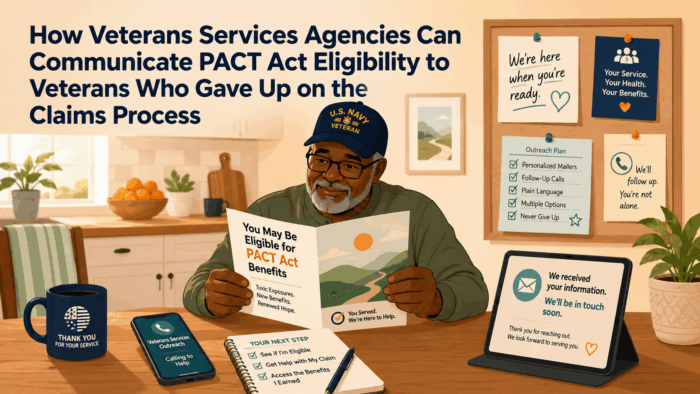
How Veterans Services Agencies Can Communicate PACT Act Eligibility to Veterans Who Gave Up on the Claims Process
There is a particular kind of silence in veteran outreach data that most communication strategies are not built to detect. It is not the silence of veterans who have never heard of VA disability compensation, and it is not the silence of veterans who are actively working through an open claim. It is the silence of a veteran who filed once, years or even decades ago, received a denial letter that felt final and often felt personal, and quietly closed that chapter of their relationship with the VA. That veteran is not unreachable in the way a veteran who has never engaged with the system is unreachable. They are reachable but resistant, informed but distrustful, and in many cases sitting on a toxic exposure condition that the 2022 Promise to Address Comprehensive Toxics Act, commonly known as the PACT Act, would now recognize as service-connected, if only they could be persuaded to try again.
This population, veterans who previously filed and were denied, alongside veterans who were exposed to burn pits, Agent Orange, or other toxic substances during service and never filed at all because they understood, correctly at the time, that the VA would not have recognized their condition as connected to that exposure, represents one of the most consequential and most difficult communication challenges facing veterans services agencies since the PACT Act’s passage. The law itself is not the hard part. Explaining what changed, in plain terms, is a communication task any competent agency can accomplish. The hard part is reaching veterans who have already decided, based on real prior experience, that the system does not work for them, and persuading enough of them to reconsider that decision that the law’s intended reach is actually realized rather than left as unclaimed benefit sitting behind a wall of justified skepticism.
This article examines how veterans services agencies, including state veterans affairs departments, county veterans service offices, and the organizations that support them, can build a communication strategy specifically designed to reach and re-engage veterans who disengaged from the claims process before the PACT Act existed. It addresses why disengagement happens, what distinguishes the population that needs re-engagement from the population that simply needs first-time outreach, what messaging approaches actually rebuild trust rather than triggering renewed skepticism, and what channels, partnerships, and internal practices make re-engagement outreach effective rather than another well-intentioned effort that never reaches the veterans it was designed for.
Understanding Why Veterans Disengage From the Claims Process
 Disengagement from the VA claims process is rarely a single decision made in a single moment. It is more often the endpoint of an accumulated set of experiences, each of which on its own might not have been sufficient to cause a veteran to give up entirely, but which compound over the course of a claim into a conclusion that further effort is not worth the emotional and administrative cost. Understanding this accumulation matters because a communication strategy aimed at re-engagement that treats disengagement as a single event, addressable through a single reassuring message, will consistently underperform against a strategy that recognizes disengagement as a conclusion built from multiple layers of frustration and disappointment.
The most immediate cause of disengagement is, unsurprisingly, denial itself. A veteran who files a claim believing in good faith that a condition is connected to their service, and who receives a denial letter written in dense regulatory language that explains the decision in terms of insufficient evidence of nexus or insufficient evidence of an in-service event, experiences that denial not as a technical administrative outcome but as a rejection of their own account of what happened to them during their service. This is a distinction that matters enormously for communication strategy. The VA’s denial letter is, from the agency’s internal perspective, a procedural document explaining why the evidentiary standard was not met. From the veteran’s perspective, it is frequently experienced as the government telling them that what they know happened to them, what they watched happen to the men and women who served beside them, did not happen, or did not matter. That gap between the institutional intent of a denial and its lived emotional impact is the seed from which most long-term disengagement grows.
Beyond the denial itself, veterans frequently describe the claims process leading up to that denial as opaque and exhausting in ways that erode their willingness to engage with the system even before an outcome is reached. Compensation and Pension examinations that feel rushed or dismissive, documentation requests that arrive without clear explanation of why a particular record is needed or how to obtain it, and long processing delays that leave a veteran without any sense of where their claim stands or when a decision might arrive, all contribute to an experience that feels less like navigating a benefit application and more like enduring an adversarial process designed to wear down the claimant. A veteran who experiences this kind of process, regardless of the eventual outcome, is more likely to disengage from future interaction with the system even if a later denial is not the primary driver, because the process itself has already taught them what to expect.
The Compounding Effect of a Prior Denial on Future Willingness to Reapply
A prior denial does not simply end at the point the denial letter is received. It becomes a reference point the veteran carries forward into every subsequent decision about whether the VA claims process is worth engaging with again, and this compounding effect is precisely what makes PACT Act re-engagement outreach more difficult than first-time outreach to veterans who have never filed at all. A veteran who has never filed a claim approaches the idea of doing so with uncertainty but without a specific negative experience to draw on. A veteran who filed and was denied approaches the same idea with a concrete, personally lived data point that strongly suggests the effort will not succeed, and that data point is considerably more persuasive to that individual than any general statement in outreach material asserting that the law has changed.
This compounding effect is amplified when the veteran’s denial occurred for a condition that the PACT Act now explicitly recognizes as presumptively service-connected due to toxic exposure. A veteran who was told, correctly under the regulations in effect at the time, that their respiratory condition could not be connected to their service without individualized evidence of exposure and causation, and who now learns years later that the same condition is presumptively connected for anyone who served in a qualifying location during a qualifying period, experiences this less as good news and more as confirmation that the system failed them the first time through no fault of their own, a realization that can generate as much frustration and distrust as it generates hope. Communication that fails to directly acknowledge this dynamic, and instead simply announces the PACT Act’s expanded eligibility in celebratory terms without acknowledging what the veteran previously went through, risks being read by the very population it is trying to reach as tone deaf to their actual experience, further reinforcing rather than reducing their skepticism.
The practical implication for outreach strategy is that re-engagement communication aimed at previously denied veterans needs to do more than announce new eligibility. It needs to explicitly validate that the prior denial was a product of the regulations in effect at that time rather than any failure of the veteran’s claim or credibility, and it needs to clearly and specifically explain that the legal basis for that denial has changed in a way that directly addresses the reason the earlier claim failed. A generic message announcing that the PACT Act expanded eligibility for toxic exposure conditions does less to move a previously denied veteran toward reapplication than a message that names the veteran’s likely prior denial reason directly and explains specifically why that reason no longer applies under current law.
Serving Those Who Served: Communication Strategies for Veterans Agencies
This article is part of our series on strategic communication for Veterans Services Agencies, County Veterans Services Offices, State Departments of Veterans Affairs, and community-based veteran support organizations. To learn more and to see the parent article, which links to other content just like this, click the button below.
What the PACT Act Actually Changed and Why Past Denials May No Longer Apply
The PACT Act’s core mechanism, and the piece of the law that matters most for communication with previously denied veterans, is its expansion of presumptive service connection for a substantial list of conditions linked to toxic exposure, removing the individualized burden of proof that previously required a veteran to establish, often through the difficult and sometimes impossible task of locating decades-old exposure records, that a specific exposure event caused their specific condition. Before the PACT Act, a veteran seeking compensation for a respiratory illness, certain cancers, or other conditions linked to burn pit smoke, Agent Orange, or other environmental hazards encountered during service generally had to demonstrate an individualized connection between their specific exposure and their specific diagnosis, a standard that in practice denied a very large number of claims where the exposure was real and the condition was real, but where the individualized evidentiary link required by the regulations in effect at the time could not be adequately documented.
The PACT Act restructured this by establishing presumptive service connection for a defined list of conditions when the veteran served in specific locations during specific time periods associated with known toxic exposure, meaning the veteran no longer needs to individually prove the causal link that the prior regulatory framework required. This is a fundamentally different evidentiary standard, not merely an expanded list of covered conditions, and communicating this distinction accurately matters considerably for veterans who were denied under the old standard, because it means their prior denial was very likely a direct product of an evidentiary burden that no longer exists for their situation, rather than any deficiency in their claim, their credibility, or the severity of their condition.
The law also expanded the list of locations and exposure circumstances that qualify a veteran for consideration under this 400″>The law also expanded the list of locations and exposure circumstances that qualify a veteran for consideration under this presumptive framework, extending well beyond the exposure circumstances most closely associated with the post-9/11 conflicts to include additional Gulf War era locations and additional Agent Orange exposure locations that were not previously covered under presumptive frameworks established in earlier legislation. This expansion matters for communication purposes because it means a meaningful portion of the veteran population that needs to hear about PACT Act eligibility is not limited to the most recent generation of veterans, and outreach that implicitly or explicitly frames the PACT Act as primarily relevant to post-9/11 veterans risks missing a substantial population of Vietnam-era and Gulf War-era veterans whose exposure circumstances now also qualify under the expanded presumptive list.
Equally significant for a veteran considering whether to reapply is the PACT Act’s establishment of a process allowing veterans with certain previously denied claims to have those claims reconsidered under the new presumptive standard without needing to restart the process from an entirely blank slate, and without needing to independently reconstruct the evidentiary record that the old standard would have required. Communicating the existence and mechanics of this reconsideration pathway clearly, including what a veteran needs to do to request it and what documentation, if any, is still required, removes one of the most significant practical barriers that might otherwise discourage a previously denied veteran from attempting reapplication, since the alternative fear, that reapplying means repeating an exhausting and ultimately unsuccessful process from the beginning, is precisely the fear that drives continued disengagement.
Identifying the Population of Veterans Who Disengaged From the Claims Process
Effective re-engagement outreach depends on the agency’s ability to identify, with reasonable specificity, which veterans in its service population are likely candidates for PACT Act reconsideration, rather than relying solely on broad public messaging and hoping the relevant veterans encounter it. This identification task is more achievable than it might initially appear, because state and county veterans services agencies frequently maintain records, even if imperfectly organized for this purpose, of veterans who have previously engaged with their office for claims assistance, including veterans whose claims were ultimately denied.
Reviewing historical case files for veterans whose claims were denied for conditions now covered under the PACT Act’s presumptive list, and whose service dates and locations align with the newly covered exposure circumstances, allows an agency to build a targeted outreach list of veterans who are strong candidates for reconsideration, rather than relying entirely on those veterans independently learning about the law change and taking the initiative to inquire. This kind of case file review requires dedicating staff time to a task that does not produce an immediate visible outcome in the way that processing a new claim does, which is part of why many agencies have been slower to invest in it than the potential impact would justify, but the return on this investment, measured in successful reconsiderations for veterans who would otherwise never have reapplied, is substantial precisely because this population is the the potential impact would justify, but the return on this investment, measured in successful hardest to reach through general public messaging alone.
Veterans who never filed a claim at all, because they understood at the time that their condition would not have qualified under the pre-PACT Act standard, present a different identification challenge, since there is no case file record of their exposure or their condition for the agency to review. Identifying this population requires working backward from service era and location data, where available through military records access or veteran registration systems, to flag veterans whose service dates and duty locations align with qualifying exposure circumstances, even in the absence of any prior claim indicating they experienced a related health condition. This population also frequently intersects with veterans who are connected to community health systems, veteran employment programs, or veteran housing services rather than the formal disability claims system, because a veteran who never filed a claim in the first place may have had considerably less ongoing contact with veterans services agencies generally, making partnership with these adjacent service systems an important complement to case file review alone.
Distinguishing Never-Filed Veterans From Previously Denied Veterans in Messaging Approach
Although both never-filed veterans and previously denied veterans are targets of PACT Act re-engagement outreach, the messaging that effectively reaches each group differs in important ways that a single undifferentiated communication approach will not adequately address. A veteran who never filed a claim because they reasonably believed their condition would not qualify needs primarily factual, informational messaging that clearly explains the new presumptive framework and invites them to consider filing for the first time, an outreach task that resembles standard benefit awareness communication more than trust rebuilding, since this veteran has no negative prior experience with the claims system specifically related to this condition, even if they may hold general skepticism about government processes based on other experiences.
A previously denied veteran, by contrast, requires messaging that does the trust rebuilding work described earlier, directly acknowledging the prior denial, explaining specifically why the legal standard that produced that denial has changed, and providing a clear, low-friction pathway to reconsideration that does not feel like starting over. Sending previously denied veterans the same general informational messaging used for never-filed veterans risks failing to address the specific skepticism this population carries, while sending never-filed veterans the more elaborate trust-rebuilding messaging designed for previously denied veterans risks feeling unnecessarily heavy or presumptuous for a veteran who has no prior negative experience to be reassured about. An agency that segments its outreach lists to reflect this distinction, sending each population a version of the message calibrated to their actual prior relationship with the claims system, will generate meaningfully higher engagement than an agency that treats PACT Act outreach as a single undifferentiated campaign.
Messaging That Rebuilds Trust With Skeptical Veterans
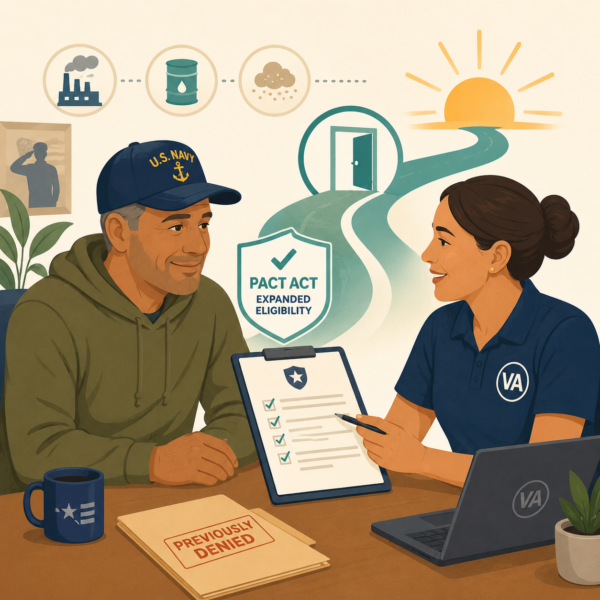
 Messaging aimed at previously denied veterans succeeds or fails largely on whether it demonstrates genuine understanding of what that veteran actually experienced, rather than treating the prior denial as an incidental detail to be mentioned briefly before moving quickly to the good news of expanded eligibility. Effective trust-rebuilding messaging begins by naming the experience specifically, acknowledging that the veteran filed previously, that their claim was denied, and that the denial likely felt like the system determining that their condition was not connected to their service, rather than skipping past this acknowledgment to focus primarily on the law itself.
Following this acknowledgment, effective messaging explains specifically and concretely what changed in the legal standard, avoiding vague or celebratory language about expanded benefits in favor of precise explanation of the evidentiary shift from individualized proof of causation to presumptive service connection based on service location and dates. A veteran who is told simply that new benefits are now available for veterans exposed to burn pits has been given information that sounds like it could be another overstated promise. A veteran who is told specifically that claims for their particular condition previously required them to prove an individual causal link that the government now presumes automatically based on where and when they served, and that this is the specific reason their earlier claim would very likely be evaluated differently today, has been given information that is concrete enough to evaluate against their own memory of why their claim was denied, which is considerably more persuasive than a general assertion that things have changed.
Messaging should also directly address the practical fear that reapplication means repeating the same exhausting process that led to the original denial, explaining clearly what streamlined reconsideration pathway exists, what the veteran actually needs to do, and what support is available to help them through it, ideally naming a specific person or office the veteran can contact directly rather than directing them to a general website or hotline that may itself feel like another layer of bureaucratic distance. Veterans services agencies that pair PACT Act outreach with an offer of direct, personalized assistance from a specific veteran service officer, framed explicitly as help navigating the reconsideration process rather than simply an invitation to reapply independently, see meaningfully higher follow-through than agencies that rely on informational messaging alone without an accompanying offer of direct human support.
Avoiding Language That Feels Like Another Bureaucratic Promise
A veteran who has already experienced one round of the claims process ending in disappointment is understandably attentive to language patterns that echo prior communication they now associate with that disappointment, and messaging that inadvertently reproduces those patterns, even while attempting to deliver genuinely good news, risks being dismissed before it is fully read. Language that emphasizes how the veteran simply needs to submit an application, provide documentation, and wait for a decision, without acknowledging that this description closely resembles the process that previously led to denial, is likely to be read by a skeptical veteran as more of the same rather than as something meaningfully different.
Messaging that instead emphasizes the specific structural change in how the claim will now be evaluated, and that offers direct human assistance rather than simply a set of instructions to follow independently, more effectively signals to the veteran that this outreach represents something genuinely different from their prior experience rather than a repackaged version of the same process. Agencies should also be attentive to tone, avoiding language that sounds celebratory or triumphant about the new law in a way that risks feeling dismissive of what the veteran previously went through, and instead adopting a tone that is direct, respectful, and grounded in acknowledgment of the veteran’s prior experience alongside clear, specific information about what has actually changed.
Channels for Reaching Veterans Who Have Disengaged From Formal Systems
Veterans who have disengaged from the claims process, whether after a denial or through a decision never to file in the first place, are by definition less likely to be actively monitoring communication from veterans services agencies through the channels those agencies typically rely on, including agency newsletters, agency websites, and veteran service organization communications aimed at actively engaged members. Reaching this population requires channels that do not depend on the veteran having maintained an active relationship with the formal veterans services system.
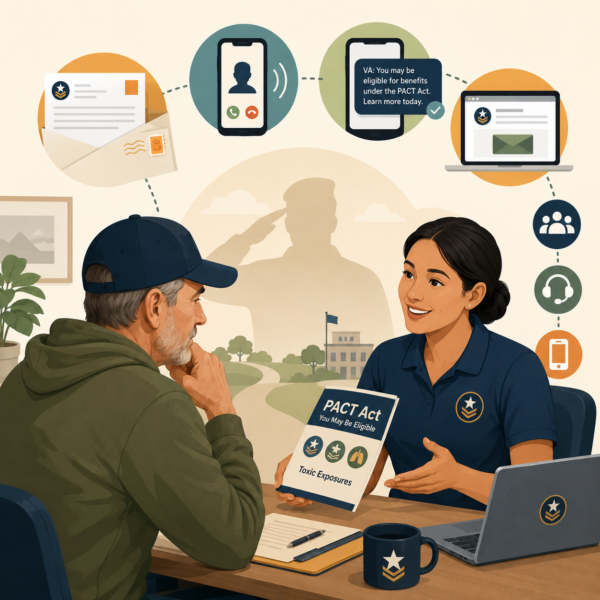
Direct mail retains meaningful value for this specific population precisely because it does not require the veteran to have opted into any digital distribution list or to be actively checking any particular communication channel, and a personalized letter, addressed to the veteran by name and referencing their specific prior claim where case file records make this possible, is more likely to be opened and read than a generic email that the veteran, having already disengaged from the system, has no particular reason to open if it arrives from an agency they no longer expect to hear meaningful news from. Agencies that have access to prior case file contact information should prioritize direct mail specifically targeted at previously denied veterans whose conditions and service dates align with PACT Act coverage, since this channel reaches veterans regardless of their current digital engagement with any veteran-specific communication system.
Community health systems represent another critical channel for reaching veterans who have disengaged from the claims process but who continue to seek medical care for the very conditions that PACT Act reconsideration might now cover. A veteran being treated for a respiratory condition or a covered cancer at a community health center or a non-VA hospital, having given up entirely on the idea that the condition might be service-connected, is unlikely to encounter PACT Act information through any veteran-specific channel, but might encounter it through their treating physician or through health system outreach if that health system has been equipped by the veterans services agency with basic screening questions and referral information to identify patients who may be veterans with PACT Act-eligible conditions.
Reaching Veterans Through Non-Veteran-Specific Community Touchpoints
Veterans who have disengaged from formal veteran systems entirely, not only from the claims process specifically but from veteran service organizations, county veterans service offices, and other veteran-specific community structures, require outreach that reaches them through touchpoints that have nothing inherently to do with veteran status but that a disproportionate share of veterans nonetheless pass through. Faith communities, particularly in rural areas where a local congregation may be one of the more consistent community structures a disengaged veteran continues to participate in, represent one such touchpoint, and providing clergy and congregation leaders with basic, accurate information about PACT Act eligibility, along with simple referral pathways, can surface veterans who would not otherwise be reached through any veteran-specific channel.
Local libraries, senior centers, and community centers serve a similar function for older veterans, particularly Vietnam-era and Gulf War-era veterans whose PACT Act eligibility may not be widely understood even among veterans themselves, since public perception of the PACT Act often skews toward its relevance to more recent burn pit exposure without equal awareness of its expanded relevance to earlier exposure circumstances. Equipping these community touchpoints with simple, accurate reference materials and a clear point of contact for referral, rather than expecting community staff to become experts in PACT Act eligibility criteria themselves, allows these non-veteran-specific channels to function as an effective extension of the agency’s own outreach without requiring specialized veteran services training at each touchpoint.
Partner Outreach and Coordination With Veteran Service Organizations
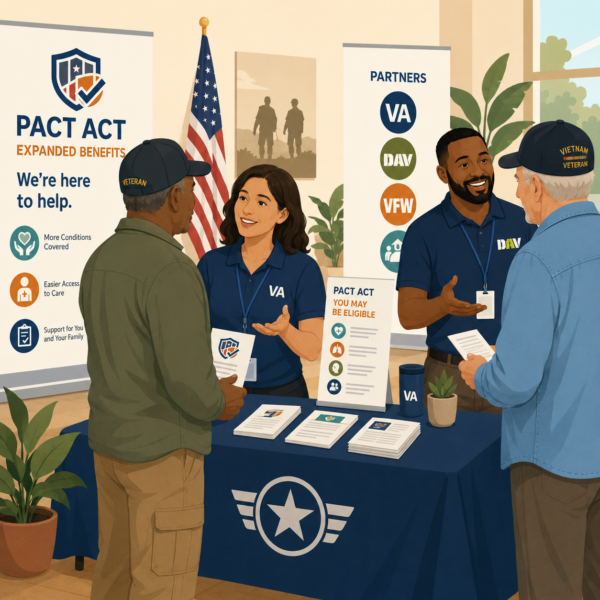
Veteran service organizations, including both large national organizations and smaller, more localized veteran groups, remain a critical partner for PACT Act re-engagement outreach despite the disengaged population’s distance from formal veteran systems, because these organizations frequently maintain long-term relationships with veterans who may have stepped back from active claims engagement but who retain some ongoing connection to organizational membership, events, or informal peer networks even after disengaging from the claims process itself. Coordinating with these organizations to ensure their own outreach to members includes accurate, current PACT Act reconsideration information extends the agency’s reach considerably beyond what its own direct communication channels achieve, particularly for veterans who trust organizational peer communication more readily than communication arriving directly from a government agency.
This coordination should go beyond simply providing organizations with printed materials to distribute, and should include training sessions for organizational service officers and peer support volunteers who interact directly with veterans, equipping them to recognize potential PACT Act reconsideration candidates during ordinary organizational interactions and to make a warm, direct referral to the agency’s veteran service officers rather than relying on the veteran to independently seek out reconsideration information after learning it exists in general terms. A veteran who hears about PACT Act reconsideration from a trusted peer at an organizational event, accompanied by a direct offer to help them connect with a service officer, is considerably more likely to follow through than a veteran who encounters the same information through a printed flyer with no accompanying personal encouragement.
Working With Toxic Exposure Advocacy Groups and Disease-Specific Organizations
Beyond general veteran service organizations, advocacy groups focused specifically on toxic exposure conditions and disease-specific organizations serving populations such as cancer patients and respiratory illness patients represent a valuable and often underused partnership channel for PACT Act outreach, because these organizations frequently serve veterans who identify primarily with their health condition rather than with veteran-specific community structures, and who may not have encountered PACT Act information through any veteran-oriented channel at all. A veteran being treated for a covered cancer who participates in a disease-specific support group or advocacy organization, but who has no ongoing connection to veteran service organizations, represents exactly the kind of previously unreachable candidate that partnership with these disease-specific organizations can surface.
Building relationships with these organizations requires the veterans services agency to provide clear, medically accurate information connecting specific covered conditions to PACT Act eligibility criteria, framed in terms these organizations and their members will find directly relevant to their existing health concerns rather than framed primarily around veteran benefits terminology that may feel less immediately relevant to an organization whose central focus is the health condition itself. Agencies that invest in this kind of disease-specific partnership development reach a population of veterans that veteran-specific outreach, no matter how well designed, is structurally unable to reach on its own.
Handling Reapplication and Reconsideration for Previously Denied Claims
The practical experience a previously denied veteran has when they actually attempt to pursue reconsideration matters as much for the success of a PACT Act re-engagement strategy as the outreach messaging that convinces them to try in the first place, and an agency that generates successful outreach engagement but then delivers a reconsideration process that feels as burdensome and confusing as the original claims process will lose much of the trust that outreach worked to rebuild. Veterans services agencies should ensure that any veteran who responds to PACT Act outreach is met with a reconsideration process that is meaningfully simpler and faster than starting a new claim from scratch, consistent with what the underlying legal reconsideration pathway actually allows, and that this simplified process is clearly and specifically explained to the veteran at the point of initial contact rather than the veteran discovering the actual scope of what is required only after they have already committed to restarting engagement with the system.
Veteran service officers handling reconsideration requests should be specifically trained on the differences between the prior evidentiary standard that produced the original denial and the current presumptive standard, so they can clearly explain to each veteran, in terms specific to that veteran’s prior denial reason, why the outcome is likely to differ this time, rather than processing the reconsideration request through the same general intake process used for entirely new claims without acknowledging the veteran’s prior history. This individualized explanation, delivered by a knowledgeable service officer at the point of reconsideration, reinforces the trust-rebuilding work that outreach messaging began and gives the veteran concrete reason for confidence going into a process they have already experienced disappointment with once before.
Agencies should also track reconsideration outcomes specifically, separate from general claims processing metrics, both to measure the actual effectiveness of PACT Act re-engagement efforts and to identify patterns in cases where reconsideration still results in denial, since a veteran who pursued reconsideration in good faith based on outreach encouragement and received a second denial deserves a clear, specific explanation of why the presumptive standard did not apply to their particular circumstances, delivered with the same care and directness that characterized the initial outreach, rather than a generic denial letter that risks confirming the veteran’s original skepticism about the entire reconsideration effort.
Training Frontline Staff to Recognize and Re-Engage Disengaged Veterans
Every point of contact a veterans services agency has with the public, not only its dedicated claims and outreach staff, represents a potential opportunity to identify and re-engage a veteran who may be a PACT Act reconsideration candidate, and agencies that train frontline staff across multiple functions to recognize this opportunity extend their effective outreach capacity considerably beyond what a dedicated outreach team can achieve on its own. Staff handling unrelated veteran services, including employment assistance, education benefit processing, and general information requests, frequently interact with veterans who mention prior claims history or health conditions in passing, without any dedicated outreach worker present to recognize the potential PACT Act relevance of that mention.
Training these staff to recognize basic indicators, such as a veteran mentioning a respiratory condition, a covered cancer diagnosis, or a prior denied claim in the course of an entirely unrelated interaction, and equipping them with a simple, low-friction way to flag that veteran for follow-up by a trained service officer, rather than expecting frontline staff outside the claims function to become PACT Act experts themselves, allows the agency to capture re-engagement opportunities that would otherwise be missed entirely. This kind of cross-functional training investment requires clear internal coordination and a straightforward referral mechanism that frontline staff can use without significant additional burden on their primary job responsibilities, but the returns, measured in re-engagement opportunities that would not otherwise have been identified, justify the modest training investment required.
Strategic Communication Support for Veterans Services Agencies
 Building a PACT Act re-engagement communication strategy capable of reaching veterans who have disengaged from the claims process, whether after a prior denial or through a decision never to file at all, requires sustained investment in case file review, message segmentation, community and organizational partnership development, and staff training. Many veterans services agencies have not yet been able to make that investment at the scale this population requires. As a result, PACT Act outreach efforts often succeed in reaching veterans who are already engaged with the claims process while leaving previously disengaged veterans substantially underserved, even though they may be among those who stand to benefit most from the law’s expanded eligibility.
A structured assessment of an agency’s current PACT Act outreach often reveals a consistent set of communication challenges. Messaging may not distinguish between veterans whose claims were previously denied and those who never filed, despite the different concerns and motivations of each audience. Agencies may have limited or no systematic process for reviewing case files to identify veterans who could benefit from reconsideration. Reapplication processes may not feel meaningfully different from the original claims experience, making it difficult to rebuild trust with veterans who have already disengaged. Partnership development may also be limited, reducing opportunities to reach veterans through community health systems, disease-specific organizations, and other trusted community touchpoints outside traditional veteran networks.
Addressing these communication challenges requires strategic planning, audience research, message development, partnership coordination, and staff engagement across multiple organizations. Many agencies recognize opportunities to strengthen these efforts but have communication teams that are already focused on day-to-day operations, constituent services, claims support, and program administration. As a result, agencies often partner with external communication specialists such as Stegmeier Consulting Group (SCG) to gain specialized public sector communication expertise, additional capacity, and an objective perspective while allowing internal staff to remain focused on serving veterans and administering critical programs.
SCG helps veterans services agencies develop PACT Act re-engagement communication strategies that reconnect with previously disengaged veterans and encourage them to reconsider benefits they may now qualify for under the expanded law. Support may include developing case file review methodologies, creating message segmentation frameworks for previously denied and never-filed populations, strengthening trust-building communication, building partnerships with community health providers and disease-specific organizations, training frontline staff, and improving the overall reconsideration experience so it aligns with the promises made through outreach.
Beyond individual outreach initiatives, SCG can also help agencies build communication frameworks that coordinate messaging across programs, partners, and communication channels. By establishing consistent communication strategies, repeatable outreach processes, and stronger collaboration with community organizations, SCG helps agencies create re-engagement programs that are easier to sustain, adapt, and expand as PACT Act implementation continues to evolve.
The goal is to build a re-engagement communication system that reaches veterans wherever they are, whether through the formal veterans services network, community health systems, disease-specific organizations, or other trusted community connections, and provides each veteran with clear, timely, and credible reasons to reconsider a claims process they may have abandoned years earlier.
Future Trends in PACT Act Outreach and Toxic Exposure Communication
The communication landscape around PACT Act eligibility and broader toxic exposure benefits is continuing to evolve as data systems improve, as the population of eligible veterans is better understood, and as agencies gain more experience with what re-engagement approaches actually work. Several developments are likely to shape this evolution in the years ahead.
Improved data matching between military service records and health system records is gradually making it more feasible for agencies to proactively identify likely PACT Act candidates based on service location and duty dates without requiring the veteran to have previously filed any claim at all, reducing reliance on the veteran’s own awareness as the sole trigger for engagement. Expanded direct mail and case file review programs targeting previously denied veterans are likely to become standard practice across more jurisdictions as agencies that have already invested in this approach demonstrate measurable reconsideration success rates, providing a model other agencies can adapt. Growing partnership between veterans services agencies and disease-specific medical organizations is likely to deepen as agencies recognize that veterans disengaged from formal veteran systems are often still engaged with the health system for the very conditions PACT Act reconsideration would address, making health system partnership one of the highest-value channels for reaching this population going forward. Finally, increased attention to the actual reconsideration experience, not only the outreach that prompts a veteran to attempt it, is likely to become a more explicit focus of agency quality measurement, reflecting growing recognition that trust rebuilt through effective outreach can be undone quickly if the reconsideration process itself does not deliver a meaningfully better experience than the one that produced the original disengagement.
Conclusion
Veterans who disengaged from the VA claims process before the PACT Act existed did not disengage out of indifference. They disengaged because a process that mattered enormously to them produced an outcome that felt, often correctly under the standards in effect at the time, unresponsive to what they had actually experienced during their service. Reaching this population now requires more than announcing that a law has changed. It requires acknowledging what these veterans went through, explaining specifically and concretely why the outcome would likely differ today, meeting them through channels that do not depend on their continued engagement with formal veteran systems, and delivering a reconsideration experience that genuinely lives up to what outreach promises.
Veterans services agencies that build this kind of deliberate, trust-rebuilding re-engagement strategy, rather than treating PACT Act outreach as a general awareness campaign indistinguishable from any other benefit announcement, are best positioned to ensure that the law’s expanded eligibility reaches the veterans it was specifically designed to help, including the population that has the most reason to doubt that any outreach effort will actually make a difference for them. Closing that gap is not simply a matter of legal compliance or program completion. It is a matter of finally delivering, for veterans who have every reason to be skeptical, on a promise the system failed to keep the first time.
SCG’s Strategic Approach to Communication Systems
Align your agency’s messaging, processes, and public engagement strategies.
Veterans services agencies need PACT Act re-engagement communication systems that reach veterans who previously filed and were denied, and veterans who never filed at all, with messaging that rebuilds trust rather than repeating the patterns that led to disengagement in the first place. That means case file review to identify likely reconsideration candidates, message segmentation that distinguishes previously denied veterans from never-filed veterans, trust-rebuilding messaging that directly acknowledges prior denials and explains specifically what has changed, partnership development with community health systems and disease-specific organizations, and a reconsideration process that delivers a genuinely different experience than the one that produced the original disengagement.
SCG helps veterans services agencies build PACT Act outreach programs that reach disengaged veterans and give them real reason to reconsider a process they may have written off. Whether your agency needs case file review methodology, message segmentation and trust-rebuilding content development, community and organizational partnership strategy, frontline staff training, or reconsideration process design, SCG can help you build a system that turns PACT Act re-engagement into a genuine second chance for the veterans your agency serves.
Use the form below to connect with our team and explore how strategic PACT Act outreach can help your agency reach previously disengaged veterans, rebuild trust damaged by prior denials, and ensure the law’s expanded eligibility reaches every veteran it was designed to serve.