
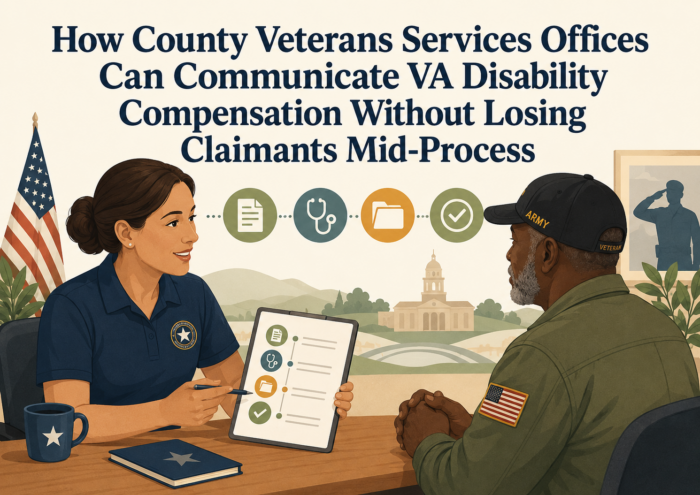
How County Veterans Services Offices Can Communicate VA Disability Compensation Without Losing Claimants Mid-Process
A veteran who has successfully navigated the federal VA disability claims process, secured a compensation rating, and enrolled in VA healthcare has, in most states, completed only part of the benefits picture available to them. Layered beneath and alongside the federal system sits a second tier of support, administered not by the U.S. Department of Veterans Affairs but by the veteran’s own state government, that can meaningfully change their financial position, their housing costs, their employment prospects, and their ability to start or sustain a small business. This second tier is where the analogy of a benefits system as a single, unified structure breaks down. It is more accurate to think of veteran benefits as two adjacent buildings that share a foundation but were designed by different architects, built on different timelines, and are rarely toured together. A veteran can walk confidently through the federal building, having been guided there by the VA itself, by veteran service organizations, or by a county veterans service officer, and never realize that the second building exists at all, or that a portion of what they qualify for sits inside it.
This is not a hypothetical gap. State departments of military and veterans affairs across the country administer education benefits, property tax exemptions, hiring preference programs, housing assistance, and business support programs that in many cases exceed the value of comparable federal offerings for the specific veteran populations they serve, and yet awareness of these programs consistently lags far behind awareness of federal VA benefits. The reasons are structural rather than accidental. Federal VA benefits are the subject of national media coverage, national veteran service organization advocacy, and a single centralized point of information. State benefits are fragmented by design, varying from state to state, often administered by an agency the veteran has never had reason to interact with, and communicated through channels that were never built with sustained public awareness in mind.
This article examines how state departments of military and veterans affairs can close that awareness gap through a deliberate, sustained communication strategy rather than the sporadic outreach efforts that characterize how many of these programs are currently promoted. It addresses what state-specific benefits actually consist of, why the awareness problem persists even where the programs themselves are well designed and genuinely valuable, and what a communication system built specifically to reach veterans with information about supplemental state programs would need to include.
Why State-Specific Veteran Benefits Remain a Persistent Awareness Gap
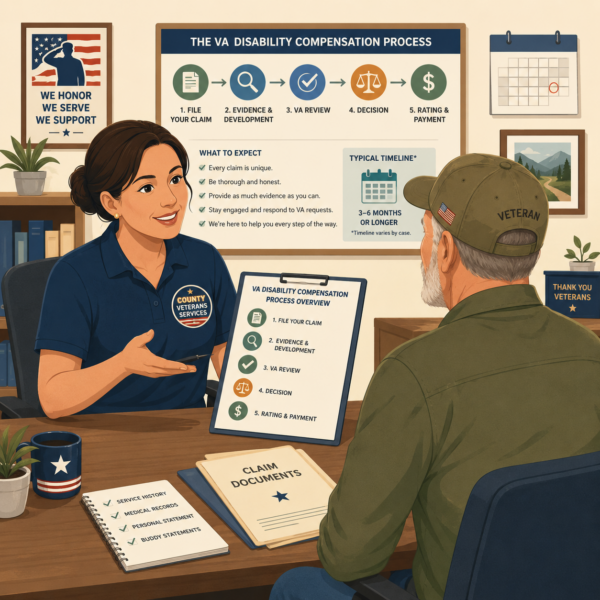 The core awareness problem facing state departments of military and veterans affairs is not that veterans are indifferent to benefits they might qualify for. It is that the architecture of the American veteran benefits system trains veterans to look toward a single source, the federal VA, as the complete and authoritative answer to the question of what they have earned through their service. Every major public information effort a veteran is likely to encounter, from VA outreach campaigns to veteran service organization literature to media coverage of veteran issues, is oriented around the federal system. State benefits, even when they are substantial, are competing for attention against an information ecosystem that was never built to feature them prominently.
This creates a structural asymmetry that no amount of program quality can overcome on its own. A state education benefit that covers tuition at public institutions for the dependents of a veteran who died or was permanently disabled in service is, in real terms, comparable in value to elements of the federal GI Bill for the families it serves. A state property tax exemption tied to a service-connected disability rating can represent thousands of dollars in annual savings for a veteran homeowner. A state hiring preference in public sector employment can be the deciding factor in a competitive hiring process. None of these programs are marginal. Yet a veteran who has never had a reason to visit their state department of military and veterans affairs website, and who has instead built their entire understanding of veteran benefits through interactions with the federal VA and national veteran service organizations, has no natural pathway to discovering that these state programs exist.
The problem compounds because state benefit programs are frequently structured around eligibility criteria that reference federal determinations, such as a disability rating percentage or classification as a Purple Heart recipient, without the state agency having any systematic way of knowing which veterans in the state actually hold those qualifying federal designations. The federal VA, for reasons of privacy law and interagency data-sharing limitations, does not automatically notify state agencies when a veteran within their state receives a disability rating that would newly qualify them for a state property tax exemption or education benefit. This means the state agency is, in many cases, structurally unable to proactively identify and directly notify the veterans who have just become eligible for a program, and must instead rely on the veteran discovering their own eligibility and taking the initiative to apply, a reversal of the outreach model that would actually close the awareness gap most effectively.
The Layered Structure of Veteran Benefits and Why It Confuses Rather Than Clarifies
Veterans encounter their benefits landscape as a layered structure without a map that clearly explains the layers. Federal disability compensation and federal healthcare enrollment operate as two distinct systems within the VA itself, a distinction that already generates significant confusion, as covered in related communication challenges facing county veterans service offices. State benefits then sit as a third and fourth layer on top of that already confusing federal structure, administered by an entirely different agency with different application processes, different documentation requirements, and different points of contact.
A veteran attempting to understand their full benefits picture must therefore mentally reconcile at least three separate systems: federal disability compensation, federal healthcare, and state supplemental benefits, each with its own eligibility logic, its own application process, and often its own terminology for describing similar concepts. A federal disability rating of fifty percent or greater might be described in federal materials in terms of monthly compensation amounts, while the same rating threshold appears in state property tax exemption materials described in terms of an assessed value reduction, using different language to describe what is functionally the same qualifying condition. This inconsistency in how the same underlying eligibility fact is described across systems adds a layer of interpretive work that many veterans, particularly those who are older, who are managing service-connected cognitive or physical conditions, or who simply have limited patience for bureaucratic navigation after already completing a lengthy federal claims process, are unlikely to complete on their own initiative.
The practical consequence is that a state department of military and veterans affairs cannot treat benefit communication as a matter of simply publishing accurate program information and making it available to anyone who seeks it out. The agency must instead treat benefit communication as an active translation and connection function, one that takes the fragmented, multi-layered reality of the veteran benefits landscape and actively bridges it for the veteran, rather than assuming the veteran will do that bridging work independently once the information is technically accessible somewhere on a state website.
Serving Those Who Served: Communication Strategies for Veterans Agencies
This article is part of our series on strategic communication for Veterans Services Agencies, County Veterans Services Offices, State Departments of Veterans Affairs, and community-based veteran support organizations. To learn more and to see the parent article, which links to other content just like this, click the button below.
The Range of State Benefits That Supplement Federal VA Programs
State-specific veteran benefit programs are considerably more varied than public perception typically credits, and the range itself is part of what makes them difficult to communicate in a single simple message. Education benefits represent one of the most valuable categories, and in many states extend coverage significantly beyond what the federal GI Bill provides. These state education programs often waive tuition entirely at public colleges and universities for the dependents of veterans who died in service, were killed by a service-connected condition, or hold a total and permanent disability rating, a benefit that can persist for the dependent’s entire undergraduate education and, in some states, extend to graduate study as well. Because eligibility is tied to the veteran’s own federal disability determination, a family may qualify the moment a parent’s rating is finalized, yet remain entirely unaware that the qualifying event has occurred and that a state education benefit has quietly opened up for their children. Property tax exemptions constitute a second major category and are frequently the single largest annual financial benefit available through a state program, often scaled to disability rating percentage and in some states providing a full exemption for veterans with a total disability rating, a reduction that compounds year over year and that many eligible homeowners simply never apply for because the application requires an affirmative filing with a local assessor’s office rather than being applied automatically once a federal rating is issued. Employment preference programs give veterans, and in many cases their spouses, additional consideration in state and local government hiring processes, sometimes through points added to civil service examination scores and sometimes through absolute preference in tie-breaking situations, a benefit that can be decisive in competitive public sector hiring but that a veteran unfamiliar with civil service systems may never think to invoke. Housing programs vary considerably by state but frequently include below-market mortgage financing through a state veterans’ home loan program, home modification grants for veterans with service-connected mobility impairments, and in some states dedicated veteran housing assistance funds that operate independently of federal VA home loan guarantees. Business support programs, though generally smaller in direct dollar value than the categories above, can be meaningful for veterans pursuing entrepreneurship, and typically include expedited or waived licensing fees for veteran-owned businesses, state contracting set-asides or preferences for certified veteran-owned or service-disabled veteran-owned businesses, and in some states dedicated low-interest loan funds intended specifically to help veterans capitalize a new business. Taken together, these programs form a substantial secondary benefits system, one whose aggregate value for an individual veteran and their family can rival or exceed what many assume is available only through federal channels, and whose central communication challenge is that no single moment in a veteran’s interaction with the state naturally surfaces all of these categories at once.
Building a Communication Strategy Organized Around Veteran Life Events
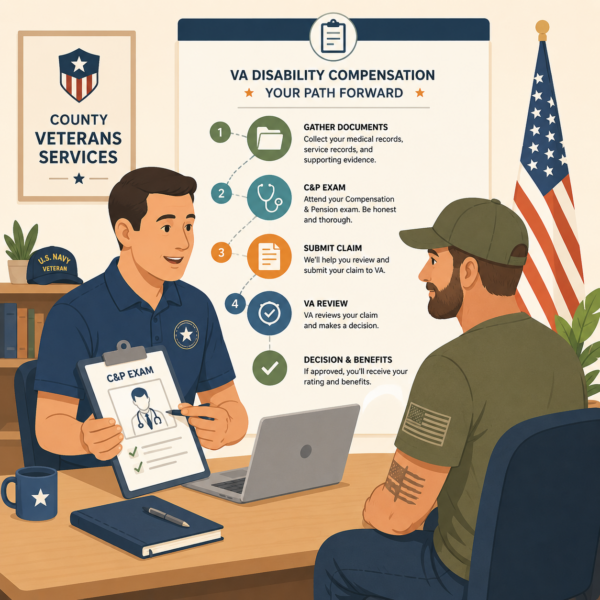 A state department of military and veterans affairs seeking to close the awareness gap around its supplemental benefit programs needs to abandon the assumption that a well-organized website and an annual outreach campaign are sufficient, and instead build a communication strategy organized around the specific life events and transition points at which a veteran becomes eligible for, or newly relevant to, a particular state program. This life-event orientation matters because state benefits are not uniformly relevant to all veterans at all times. A property tax exemption becomes relevant the moment a veteran receives a qualifying disability rating or purchases a home. An education benefit becomes relevant when a veteran has a dependent approaching college age, or at the moment a new disability rating or death in service creates dependent eligibility. An employment preference becomes relevant when a veteran applies for a public sector job. Communication that treats all veterans identically, regardless of where they sit in this timeline, wastes attention on program details that are not yet actionable for the recipient and risks the entire communication being set aside as not currently relevant, only to be forgotten by the time the veteran’s circumstances actually change.
Organizing communication around life events instead means identifying the specific moments at which a veteran’s circumstances make a particular state benefit newly relevant, and ensuring that information about that benefit reaches the veteran at or near that moment rather than only through generic, undifferentiated outreach. A veteran who has just received a new or increased federal disability rating is at a moment where state property tax exemption eligibility and, if they have dependents of college age or younger, state education benefit eligibility should both be actively communicated, since a rating change is very often the precise trigger event for both programs. A veteran approaching separation from active duty is at a moment where state employment preference programs and state business support programs both become newly relevant, since the transition to civilian employment or entrepreneurship is immediately in front of them. A veteran purchasing a first home is at a moment where both the state property tax exemption and any state veterans’ home loan program deserve direct mention, since the veteran is already engaged in exactly the kind of transaction those programs are designed to support.
Coordinating Life-Event Outreach With County Veterans Service Offices
State departments of military and veterans affairs rarely have direct, individualized knowledge of when a specific veteran’s life circumstances change, but county veterans service officers, who work directly with individual veterans on federal claims and often become aware of exactly these transition points through the course of that casework, represent an underused channel for surfacing state benefit relevance at the moment it matters most. A county veterans service officer assisting a veteran through a disability rating increase is in an ideal position to also mention, at that same appointment, that the increased rating may newly qualify the veteran for a property tax exemption or dependent education benefit, provided the officer has been equipped with current, accurate information about those state programs and has been given clear guidance that mentioning them is an expected part of the casework interaction rather than an optional add-on.
Building this coordination requires the state department of military and veterans affairs to treat county veterans service officers as an extension of its own communication function, providing them with regularly updated program summaries, straightforward eligibility checklists they can walk through with a veteran in the course of an appointment, and direct application materials or referral pathways they can hand off on the spot. Without this deliberate coordination, the state agency’s benefit information and the county office’s federal claims casework operate as two disconnected systems, even though the county officer is often the single point of contact best positioned to bridge the two at precisely the moment a veteran’s eligibility for a state program changes.
Distribution Channels for Reaching Veterans With State Benefit Information
Newsletter and email communication, while valuable for veterans already connected to the department’s distribution list, faces an inherent limitation for state benefit outreach: it depends on the veteran having opted in at some point, and many veterans, particularly those separated from service years or decades earlier and who have had no subsequent reason to interact with the state veterans affairs agency, are simply not on any such list. Expanding distribution requires the department to build active subscription pathways at every point of contact a veteran or their family might have with the state, including driver’s license renewal offices that offer veteran designation on state identification cards, professional licensing boards that ask about veteran status, and property tax assessor offices that process homestead exemption applications, each of which represents an opportunity to prompt a veteran subscription rather than a missed touchpoint.
Veteran service organizations operating within the state, including state chapters of national organizations as well as smaller, regionally focused veteran groups, maintain their own communication channels with a membership that substantially overlaps with the population the state department needs to reach, and a coordinated partnership in which the state agency supplies accurate, ready-to-use content for these organizations’ own newsletters and meetings extends reach considerably beyond what the department’s own distribution list achieves independently. Because many older veterans and veterans in rural areas of a state are more likely to encounter information through these organizational and community channels than through a state agency’s own digital communication, this partnership channel deserves attention comparable to what the department invests in its own direct outreach.
Employers, and particularly large employers with active veteran hiring or veteran employee resource programs, represent a distribution channel that is frequently overlooked despite significant potential value, since a veteran employee benefits from learning about state employment preference programs, business support programs if they are considering a transition to entrepreneurship, and property tax exemptions through a trusted workplace channel that reaches them at a point when they are already actively managing career and financial decisions.
Reaching Veterans Who Are Disconnected From Formal Veteran Networks
A meaningful portion of the veteran population, including veterans who separated from service without an honorable discharge characterization that later required correction, veterans who have had difficult or adversarial experiences with the federal claims process and have consequently disengaged from veteran services generally, and veterans who live in rural or otherwise underserved areas without convenient access to a veteran service organization post or a county veterans service office, are disconnected from the formal veteran information networks that most state outreach efforts rely on by default. Reaching this population requires the state department of military and veterans affairs to actively seek out channels beyond formal veteran networks, including partnerships with community organizations that serve veterans indirectly, such as homeless services providers, community health centers, and workforce development agencies, all of which encounter veterans who may not otherwise identify with or engage in formal veteran community structures. A department that treats this disconnected population as a secondary concern, addressed only after the formal-network population has been reached, will consistently underserve the veterans who may need state benefit programs, particularly housing and property tax relief programs, most urgently.
Reducing Confusion Through Clear, Comparative Benefit Explanations
State benefit communication succeeds or fails significantly on the clarity of how it distinguishes state programs from federal programs a veteran may already know about, and comparative framing that explicitly places a state benefit alongside its federal counterpart, rather than presenting it in isolation, does considerably more to reduce confusion than a standalone description of the state program on its own. A veteran reading about a state property tax exemption benefits from an explanation that briefly establishes this is separate from, and in addition to, any federal compensation they receive, filed with a different office, and requiring a separate application, because without that explicit contrast a veteran may reasonably assume the state benefit is simply another name for something they have already received through the federal system, or may assume that having filed federal paperwork automatically triggers the state benefit as well.
This comparative approach matters most for the education benefit category, where the existence of the federal GI Bill creates the greatest risk that a veteran or their dependent will assume the state benefit is redundant with what the federal government already provides, and will therefore never investigate further. Communication that clearly explains a state dependent education benefit can be used in combination with federal GI Bill benefits, or that it covers different costs, such as remaining tuition after federal benefits are exhausted, gives the dependent a concrete reason to pursue both rather than assuming one makes the other unnecessary.
Strategic Communication Support for State Departments of Military and Veterans Affairs
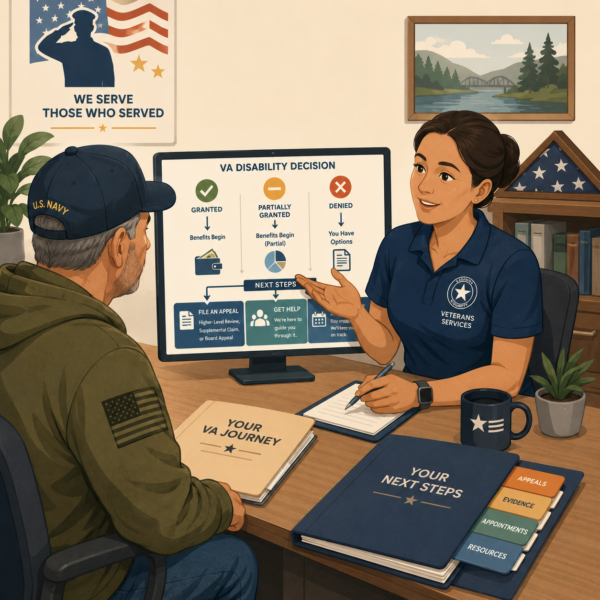 Building a communication program that closes the awareness gap between what a state offers its veterans and what veterans actually know they qualify for requires sustained investment in content development, distribution partnerships, and coordination with county veterans service offices. Many state departments have not yet been able to make that investment at the scale the opportunity warrants. As a result, valuable benefit programs often remain underutilized, not because the programs themselves are ineffective, but because the communication infrastructure needed to reach eligible veterans at the right moments has not been fully developed.
A structured assessment of a state’s benefit communication efforts often reveals a consistent set of challenges. Program information may be available on the department’s website but is not actively shared through life event-based outreach. Coordination with county veterans service officers may be limited or informal, even though they can serve as trusted frontline communication partners. Distribution efforts may primarily reach veterans who are already connected to established veteran organizations, while benefit descriptions may not clearly explain how state programs complement, rather than duplicate, federal benefits.
Addressing these communication challenges requires strategic planning, audience research, message development, and coordination across multiple organizations. Many departments recognize opportunities to strengthen these efforts but have communication teams that are already focused on day-to-day operations, constituent services, legislative priorities, and program administration. As a result, agencies often partner with external communication specialists such as Stegmeier Consulting Group (SCG) to gain specialized public sector communication expertise, additional capacity, and an objective perspective while allowing internal staff to remain focused on serving veterans and administering programs.
SCG helps state departments of military and veterans affairs strengthen veteran benefit communication programs so more eligible veterans understand the services available to them and know when and how to access them. Support may include developing life event-based outreach strategies, improving coordination with county veterans service offices, identifying partnership opportunities with veteran service organizations and employers, creating messaging that clearly distinguishes state and federal benefits, and designing distribution strategies that reach veterans who are not connected to traditional veteran networks.
Beyond individual communication initiatives, SCG can also help departments build communication frameworks that align outreach across programs, partners, and communication channels. By establishing consistent messaging, repeatable processes, and coordinated distribution strategies, SCG helps agencies create communication programs that are easier to maintain, adapt, and expand as veteran needs and state priorities evolve.
The goal is to build a communication system that reaches veterans when state programs become relevant to their circumstances, explains available benefits in a clear and actionable way, and expands awareness beyond the formal networks that many outreach efforts traditionally rely upon.
Future Trends in State Veteran Benefit Communication
The landscape of state veteran benefit communication is shifting as data systems improve, as coordination between state and federal agencies gradually expands, and as veterans themselves increasingly expect the kind of proactive, personalized notification common in other areas of government and commercial service. Several developments are likely to shape this evolution over the coming years.
Expanded data-sharing arrangements between state departments of military and veterans affairs and county-level property assessment and vital records systems are beginning to make it possible for some states to identify veterans who may newly qualify for a property tax exemption based on a home purchase or a disability rating change reported through other state processes, reducing reliance on the veteran independently discovering and applying for the benefit. Integration between state benefit systems and the federal VA’s own veteran-facing digital tools, while still limited by data-sharing constraints, is an area of growing interest, and states that build strong working relationships with their federal VA regional counterparts are better positioned to pursue integration opportunities as they become technically and legally feasible. Segmented, targeted communication based on data a state agency already holds through its veteran identification card program, professional licensing interactions, or other state touchpoints is becoming more feasible as agencies modernize their data systems, allowing a department to direct education benefit information specifically to veterans with dependents of relevant age rather than broadcasting the same message to the entire veteran population regardless of relevance. Finally, growing recognition that county veterans service officers represent an underused frontline communication channel is likely to push more states toward formal training and coordination programs that equip these officers to actively surface state benefit eligibility during the federal casework they already perform, rather than treating state benefit awareness as a separate function entirely disconnected from the county-level relationship many veterans already trust.
Conclusion
The gap between what a state offers its veterans through supplemental benefit programs and what those veterans actually know they qualify for is not a reflection of program quality. It is a communication and awareness problem, produced by a benefits landscape that trains veterans to look toward a single federal source and by state agencies that have not yet built the distribution infrastructure, life-event coordination, and comparative messaging needed to reach veterans at the moment their eligibility for a specific state program becomes real.
State departments of military and veterans affairs that invest deliberately in life-event triggered outreach, in genuine coordination with county veterans service officers, in partnerships that extend reach beyond formal veteran networks, and in clear messaging that distinguishes state programs from federal ones, are not simply improving a public information function. They are ensuring that education benefits, property tax exemptions, employment preferences, housing assistance, and business support programs actually reach the veterans and families they were designed to serve, rather than sitting underutilized because the veterans who qualify never learned the programs existed.
SCG’s Strategic Approach to Communication Systems
Align your agency’s messaging, processes, and public engagement strategies.
State departments of military and veterans affairs need benefit communication systems that reach veterans with accurate, timely, and actionable information about the state programs available to them. That means life-event triggered outreach calibrated to the moments a benefit becomes relevant, coordination with county veterans service officers who can surface eligibility during existing casework, distribution partnerships that extend beyond formal veteran networks to reach veterans who are otherwise disconnected, and comparative messaging that clearly distinguishes state programs from federal benefits veterans already know.
SCG helps state departments of military and veterans affairs build benefit communication programs that close the awareness gap and connect eligible veterans and their families with the programs designed to serve them. Whether your agency needs life-event outreach strategy, county office coordination frameworks, veteran service organization and employer partnership development, or comparative benefit messaging, SCG can help you build a system that turns state benefit awareness into a lasting source of support for the veterans your state serves.
Use the form below to connect with our team and explore how strategic veteran benefit communication can help your agency close awareness gaps, strengthen coordination with county veterans service offices, and ensure eligible veterans and their families receive the full range of support your state provides.