
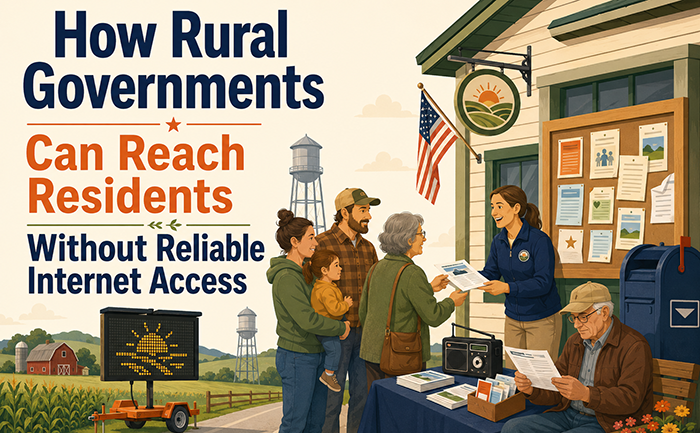
How Rural Governments Can Reach Residents Without Reliable Internet Access
The assumption that residents can access official government information online is a planning convenience that does not describe the reality of many rural communities. Broadband infrastructure gaps, weak cellular coverage, limited data plans, older populations less comfortable with digital tools, and the simple economics of connectivity in sparsely populated areas mean that a significant portion of rural residents do not reliably access the internet as part of their daily information routine. These are not residents who are choosing to ignore official communication. They are residents who cannot access it through the channels that government agencies are increasingly treating as primary.
This matters because the gap between who receives government information and who needs it is often widest precisely among the populations least likely to access it digitally. Older residents who may be most affected by changes to senior programs and transportation services. Low-income households who may most need information about utility assistance programs and rate change timelines. Agricultural producers who may be most affected by road weight restrictions and drainage project schedules. Residents with disabilities whose specific service needs may be most dependent on timely and accurate government information. When digital channels are treated as the only or primary channels for official communication, these populations are systematically excluded from information that affects them most.
This article addresses how rural local governments can reach residents who do not have reliable internet access, using channels and approaches that are both practical for small agencies with limited staff and genuinely effective at reaching the populations they need to serve. It covers telephone communication, direct mail, printed notices, libraries as community information hubs, local radio, in-person distribution through municipal facilities and community gathering places, and partnerships with organizations that have direct relationships with residents who face digital access barriers. The goal is a communication practice that serves all residents, not only those whose connectivity reflects a more urban information environment.
This article does not argue that digital communication should be abandoned or minimized. Digital channels are efficient, cost-effective, and appropriate for the substantial share of rural residents who do access information online. The argument is that digital channels alone are not sufficient for rural communities with significant connectivity gaps, and that the investment in non-digital communication channels is not a concession to the past but a necessary component of an equitable and effective rural communication strategy.
Understanding the Digital Access Gap in Rural Communities
 Before designing non-digital communication strategies, it helps to understand the nature and extent of the digital access gap in the specific community the agency serves. The digital access gap is not uniform across rural communities or across the rural population. It is shaped by geography, demographics, income, and the specific history of infrastructure investment in the area. Understanding the gap in the specific community context allows the agency to design non-digital communication strategies that match the actual needs of the population rather than responding to a generalized rural stereotype.
Broadband availability is the most commonly measured dimension of the digital access gap, but it is not the only relevant one. Broadband availability data, which reports whether service is technically available at a given location, often overstates actual access because it does not account for whether residents can afford the available service, whether the available service is reliable enough to be useful for government information access, or whether residents choose not to subscribe even when service is available and affordable. The number of residents with broadband connections is generally lower than the number for whom broadband is technically available.
Device access is a second dimension of the digital access gap that broadband availability data does not capture. A resident who has broadband service but who accesses it only through a shared family smartphone has a very different relationship with digital information than a resident who has home broadband and a personal computer or tablet. Mobile-only internet access, which is more common among lower-income and older rural residents, creates barriers to accessing document-heavy government websites, completing online forms, and reading long-form notices that are designed for desktop viewing.
Digital literacy is the third dimension of the gap and perhaps the least visible in standard connectivity data. A resident who has internet access but who is not comfortable navigating government websites, opening email attachments, or using online platforms for public comment may effectively be excluded from digital communication even when the technical infrastructure exists. Digital literacy barriers are particularly common among older residents and among residents who did not encounter computers and the internet during their education and early working life.
For small rural agencies that do not have access to detailed local connectivity data, a practical approach to estimating the local digital access gap is to review the volume of calls and walk-in visits the office receives from residents seeking information that is available on the agency’s website. A high volume of in-person and phone inquiries about information that is clearly posted online is a strong signal that a significant portion of the local population is not accessing digital channels effectively. Staff experience with which types of residents tend to access the office directly rather than through digital channels can provide additional calibration.
Engaged & Connected: Communication Strategies for Small Towns, Villages, Townships, and Rural Communities
This article is part of our series on strategic communication for Small Towns, Villages, Townships, and Rural Local Governments. To learn more and to see the parent article, which links to other content just like this, click the button below.
Telephone Communication
The telephone is the most universally accessible communication technology in rural communities, reaching residents who do not have broadband, who are not comfortable with the internet, and who may not regularly check their physical mailboxes. Even among residents who do not own smartphones, landline telephone access is nearly universal. Telephone-based communication strategies range from simple recorded message lines to direct outbound calling programs, and the appropriate strategy depends on the nature of the information being communicated and the resources available to the agency.
Recorded Information Lines
A recorded information line is a telephone number that residents can call to hear a recorded message about current agency information, project status, meeting dates, service disruptions, or other time-sensitive matters. The line can be updated as frequently as needed without requiring staff to be available for calls, and it provides residents with a consistent, reliable source of official information available at any hour.
Recorded information lines are particularly effective for information that residents may want to access on their own schedule, such as meeting dates and agendas, construction project updates, and service hours. They are also effective for emergency situations where a large number of residents may be seeking the same basic information simultaneously and where the volume of direct inquiries would overwhelm available staff. A recorded line that provides accurate current information about an ongoing utility disruption, for example, can absorb much of the call volume that would otherwise flow to staff.
The recorded line should be prominently advertised in all agency communications, including on the website, in printed materials, and on posted notices. Residents who do not have internet access should know the number and should associate it with reliable, current official information. The number should be stable, not changing from project to project or situation to situation, so that residents can commit it to memory or write it down as a standing resource.
Outbound Calling Programs
For significant notices that require direct resident action, such as boil water advisories, road closures with access implications for specific households, or program enrollment deadlines, direct outbound calling to affected households can reach residents who would not be reached through any other channel. Outbound calling is more resource-intensive than recorded lines or mass notifications, but for notices with significant public health or safety implications, the additional effort is justified.
Volunteer or staff-assisted calling programs, in which calls are made directly by staff members or trained volunteers rather than through automated systems, are particularly effective for reaching older residents who may be more receptive to a human voice than to an automated call. A brief, clear call from the agency to an elderly resident who lives alone, informing them of a boil water advisory and asking whether they need assistance obtaining safe water, is both a communication act and a community service act that no digital channel can replicate.
Automated outbound calling systems are more scalable than direct calling programs and can reach a large number of households quickly. These systems are appropriate for emergency alerts and time-sensitive notices but less appropriate for situations where the content of the notice may raise questions that require a human response. Automated systems should always provide a callback number that connects to a person who can answer follow-up questions, rather than leaving residents who have questions with no path to human assistance.
Direct Mail and Printed Notices
Direct mail reaches every household with a deliverable mailing address, regardless of internet access, digital literacy, or communication technology preferences. For rural agencies that serve areas with significant digital access gaps, direct mail is not an outdated communication technology. It is the most universally accessible distribution channel available and the only one that can reliably reach every household in the service area with a physical document they can read, share, post on their refrigerator, and reference later.
The cost of direct mail is real, and it is the primary reason that agencies may be reluctant to use it routinely. Printing, stuffing, and postage for a notice mailed to several hundred or several thousand households represents a meaningful expense for a small agency operating under budget constraints. That cost should be evaluated against the cost of failing to communicate with the portion of the population that direct mail would reach but that other channels do not. For notices with significant public health, safety, or financial implications, the cost of direct mail is typically justified by the communication benefit.
Postcards are a cost-effective direct mail format for brief, essential information. A postcard that states the notice headline on the address side and provides the key facts on the reverse can be produced and mailed at a lower cost than a full letter or a newsletter, while still reaching every household in the service area. Postcards are particularly appropriate for deadline notices, emergency follow-ups, and brief informational updates that do not require detailed explanation but that need to reach every household directly.
Utility bill inserts are an efficient form of direct mail for agencies that manage utility services, because they piggyback on a distribution that is already occurring and reaching every utility customer. A well-designed insert included with the regular billing cycle costs primarily in printing rather than in additional postage and handling, making it one of the most cost-effective channels for reaching the full customer population with a physical document. The limitation of bill inserts is the timing: they can only reach residents at the billing cycle frequency, which may be monthly or quarterly rather than immediately responsive to a developing situation.
Libraries as Community Information Hubs
Public libraries occupy a unique position in rural community communication because they are simultaneously trusted institutions, physical gathering places, digital access providers, and community information resources. A rural library that is known as the place to go for reliable local information, where current agency notices are always posted, where printed copies of official documents are available, and where staff can help residents find and understand government information, is performing a community communication function that no other institution in the rural landscape can replicate.
Establishing the local library as a community information hub for the agency requires an active partnership rather than the passive act of mailing posters to the library occasionally. The agency should make regular contact with library staff, provide current materials on a reliable schedule, brief library staff on significant local developments so they can accurately answer patron questions, and treat the library as a priority distribution partner for any notice that needs to reach residents without reliable internet access.
Libraries also provide digital access to residents who lack it at home. A rural resident who does not have home broadband can access the agency’s website, complete an online survey, or submit comments on a proposed project using library computers. The library’s role as a digital access point is most valuable to the agency when the agency has a working relationship with library staff who can assist patrons in finding and using official agency information. A library staff member who knows what information the agency posts online and who can help a patron navigate to the relevant page is an extension of the agency’s communication capacity in a way that an unmanned library computer terminal is not.
Some libraries maintain community bulletin boards, local information binders, or display areas specifically for government and community organization materials. Making full use of these existing infrastructure elements, providing well-designed, current, and clearly dated materials for display, extends the agency’s communication reach without requiring any additional physical infrastructure investment.
Local Radio
Local radio stations persist in many rural communities as a genuine community information medium, particularly in areas where commuting distances are long and where listening to local radio while driving is a common information habit. In communities that still have local news and public affairs programming, local radio can reach a significant share of the rural population with spoken information that requires no digital access, no literacy, and no device beyond a standard AM or FM receiver.
Building a relationship with local radio stations, whether commercial stations with community affairs programming or public radio stations with strong rural service missions, gives the agency a channel for reaching residents who listen to the radio regularly but who may not follow digital channels. Many local radio stations welcome brief public service announcements from local governments, particularly for emergency information, meeting notices, and other matters of direct community relevance.
For agencies in communities where local radio remains a significant medium, developing a standing relationship with the station’s news or public affairs staff is a practical communication investment. A radio journalist who knows the agency administrator by name, who receives reliable information about significant local developments, and who understands the agency’s communication needs is more likely to provide accurate and complete coverage of local government matters than one who has no established relationship with the agency.
Emergency communication through local radio is particularly valuable in areas where other communication channels may be disrupted by the same event that created the emergency. A severe weather event that knocks out internet service and cellular coverage may leave local radio as the only functioning mass communication channel in the area. Battery-powered and hand-cranked radios remain common in rural emergency preparedness kits precisely because of this reliability. Agencies that have established a standing relationship with local radio stations for non-emergency communication will find that relationship most valuable when an emergency makes it essential.
Municipal Facilities as Information Distribution Points
 Local government facilities, including township halls, village offices, utility offices, and public works buildings, are physical spaces that residents visit for various purposes and that can serve as information distribution points for residents who may not access official communication through other channels. A well-maintained bulletin board in the lobby of the township hall, displaying current project notices, meeting schedules, and service updates in large, clearly readable format, reaches every resident who visits the facility for any purpose.
The township hall bulletin board is a particularly important communication resource in communities where the hall is used for other community purposes, such as polling place functions during elections, community gatherings, or local organization meetings. Residents who visit for one purpose often pause to read posted information if it is visible, well-organized, and clearly current. A bulletin board that mixes notices from several years ago with recent ones, that has materials posted at angles that make them difficult to read, or that has been neglected and appears abandoned communicates the opposite message from the one the agency intends.
Maintaining physical bulletin boards as genuine communication tools requires the same discipline as maintaining digital channels: current information posted promptly, outdated information removed on a defined schedule, and materials that are designed to be read rather than simply displayed. A brief weekly or biweekly review of posted materials to confirm they are current and readable is a modest investment in a communication channel that reaches residents who have no other reliable access to official information.
In-Person Distribution and Community Gathering Places
The most direct form of non-digital communication is physical distribution of printed materials at locations where residents regularly gather. Post offices serve this function in many rural communities where residents collect their mail in person, making the post office a daily or frequent gathering place where posted notices and take-one displays reach a representative cross-section of the community. Hardware stores, agricultural supply businesses, diners, laundromats, and community gathering places all offer similar opportunities for reaching residents who will pick up a flyer, read a posted notice, or take a business card-sized reminder that they can keep in a pocket.
Staff or volunteer presence at community events, including fairs, markets, and local gatherings, allows the agency to reach residents who might not visit official locations but who will accept a brief conversation and a printed summary from a recognizable community member. That personal distribution approach is more labor-intensive than mailing or posting notices, but it is particularly effective for reaching residents who have low trust in official institutions or who have learned to tune out routine government communication.
Door-to-door distribution, in which staff or volunteers deliver printed materials directly to households, is appropriate for significant emergency situations or for notices with major household impact in specific geographic areas. Door-to-door distribution reaches every household including those that do not visit the post office, the library, or any community gathering place. It is resource-intensive and generally not practical for routine communication, but for situations where the stakes are high enough, it provides the most comprehensive coverage of any physical distribution approach.
Coordinating Across Channels for Full Population Coverage
The most effective approach to reaching rural residents without reliable internet access is not to rely on any single non-digital channel but to use multiple channels simultaneously so that every resident is likely to encounter the information through at least one of them. A strategy that combines a recorded telephone line, a direct mail postcard to households in the affected area, posted notices at the library and the township hall, a public service announcement on local radio, and distribution through community partner organizations reaches a far broader and more representative share of the community than any single channel can achieve.
Multi-channel distribution requires coordination to ensure that all channels carry consistent information. The same principles of source-of-truth discipline and channel update protocol that govern digital channel management apply equally to non-digital channels. A direct mail postcard that contains different dates from the posted notice at the library creates exactly the kind of confusion that the agency’s communication is supposed to prevent. Designating a responsible staff member for each non-digital channel and building channel update steps into the notice distribution workflow ensures that consistency is maintained across the full channel portfolio.
The content on each channel should be appropriate for the format and the likely audience. A radio public service announcement should be short, spoken clearly, and provide only the most essential information. A direct mail postcard should lead with the most important fact and provide a contact for residents who want more detail. A library display can carry more complete information because residents who visit the library to read the notice have made a specific decision to engage with the information. A bulletin board notice should be visually scannable because most residents who read bulletin boards are not planning to read every word of every posting.
Designing Printed Materials That Work Without Digital Support
Printed materials distributed to residents without reliable internet access must be genuinely self-contained. They cannot assume that residents will scan a QR code for more information, visit the website for full details, or watch a video explanation of a complex issue. Every piece of information a resident needs to understand what the communication is about, whether it affects them, what they should do, and who to contact with questions must be present in the printed piece itself.
Design choices for printed materials intended for non-digital audiences should prioritize readability over visual sophistication. Large, clear type that can be read without reading glasses by residents with average vision. High contrast between text and background. Adequate white space that prevents the page from appearing overwhelmingly dense. Logical reading order that moves through the information in the sequence residents need, starting with the most essential facts and ending with contact information and any call to action. These design principles are not complicated to follow, but they require deliberate attention during the production process.
Plain language is especially important for printed materials reaching populations with lower average literacy levels. Government notices often default to the formal language of official documents, which assumes a reading level and a familiarity with regulatory and procedural vocabulary that many residents do not have. A boil water advisory written at a high reading level may be technically accurate but practically inaccessible to a resident who cannot parse its language under the stress of a disruption. Plain language that communicates the essential information in direct, simple sentences is not a concession to a low-literacy audience. It is effective communication for every audience.
For communities with significant non-English-speaking populations, printed materials in the relevant languages are not optional. A notice that is distributed only in English does not reach the non-English-speaking household that receives it, any more than no notice does. Professional translation of the most critical notices, including emergency alerts, boil water advisories, and significant service change announcements, is the minimum standard for equitable communication in linguistically diverse rural communities. Machine translation is not a substitute for professional translation for official government notices where accuracy is essential.
Building and Maintaining Non-Digital Contact Lists
Effective non-digital communication requires knowing who needs to be reached through which channels. A telephone outreach program requires a telephone number list. A direct mail program requires a mailing address list. A partner distribution program requires current contact information for partner organizations and their key staff. Building and maintaining these lists is a communication infrastructure investment that pays returns on every notice and every emergency.
Property records are a foundational source for direct mail lists, because they provide a mailing address for every property owner in the service area. Most rural local governments already have access to property records through county assessor or auditor systems. Supplementing property owner mailing lists with lists derived from utility customer records, voter registration files, or other administrative databases can expand the reach to renter households and non-property-owning residents who are equally entitled to government information.
Telephone contact lists for outbound calling or recorded message programs can be developed from a combination of sources, including voluntarily provided contact information from residents who have interacted with the agency, information shared by community partner organizations, and publicly available telephone directories. The list should be updated regularly and should include a mechanism for residents to add or update their contact information. An annual reminder that residents can update their contact information with the agency, distributed through all available channels, helps maintain list accuracy over time.
Partner organization contact lists should be maintained separately from resident lists and should include the key staff contact at each organization who is responsible for receiving and distributing agency communications. These contacts change with staff turnover, and maintaining current partner contact information requires the same deliberate attention as maintaining current resident contact information. An annual verification of partner contact information, sent to each partner with a request to confirm or update the relevant staff contact, is a practical list maintenance practice that catches most changes before they create communication gaps.
Testing Non-Digital Communication Effectiveness
Non-digital communication channels are harder to measure than digital ones because they do not automatically generate analytics about who received and engaged with the information. But assessing whether non-digital channels are reaching their intended audience is as important as assessing digital channel performance, because channels that are maintained but not effective represent wasted effort and missed communication opportunities.
A simple approach to testing non-digital communication effectiveness is to monitor the volume and nature of incoming contacts after a significant non-digital distribution. A direct mail postcard that generates no calls from the target area may indicate that the mailing did not reach its intended audience, that the content was not compelling enough to generate the response the agency expected, or that the notice did not require a response even among residents who received and read it. Distinguishing between these explanations requires some analysis, but the baseline observation of response volume provides a starting point.
Periodic direct outreach to community partner organizations, asking whether they have been distributing materials and whether residents have been engaging with them, provides qualitative feedback on distribution effectiveness that quantitative metrics cannot capture. A library director who reports that residents frequently ask about information displayed on the library bulletin board is providing evidence that the channel is working. A community center coordinator who reports that materials are typically still in the take-one display untouched after a month may be signaling that the display location or the material design is not working effectively.
Resident surveys, whether distributed through non-digital channels such as utility bill inserts or through community gathering places, can ask specifically how residents receive information from the agency. Responses that identify specific non-digital channels as primary information sources confirm that those channels are working. Responses that indicate residents receive no information from the agency, or receive it only through word of mouth, identify gaps that the non-digital communication strategy is not filling. These survey results should inform adjustments to the channel portfolio and the distribution approach.
Strategic Communication Support for Small and Rural Governments
 Ensuring every resident receives important information requires more than maintaining a website or posting updates on social media. In many small and rural communities, some residents have limited internet access, unreliable cellular service, or little familiarity with digital communication platforms. Effective public communication recognizes these realities and builds strategies that reach residents through a combination of digital and non-digital channels rather than assuming online communication alone is sufficient.
Successful multi-channel communication systems are built through audience research, channel planning, community partnerships, plain-language messaging, coordinated workflows, and ongoing evaluation. Different residents rely on different sources of information, whether that is local newspapers, radio stations, community bulletin boards, direct mail, libraries, faith-based organizations, or neighborhood networks. Building communication around these trusted channels helps governments improve message reach while reducing the risk that important announcements fail to reach portions of the community.
Developing this type of communication system requires specialized expertise in communication strategy, audience analysis, channel selection, partnership development, workflow design, and communication evaluation. Many small and rural governments choose to partner with external communication specialists such as Stegmeier Consulting Group (SCG) because these capabilities complement the organization’s operational expertise while providing the strategic communication knowledge needed to build sustainable communication systems that improve information access for all residents, regardless of their access to digital technology.
Working alongside small and rural governments, SCG develops multi-channel communication strategies that strengthen both digital and non-digital outreach. Support may include assessing existing communication channels, identifying gaps in community coverage, developing direct mail and print communication strategies, strengthening relationships with local radio stations and community organizations, integrating libraries and other trusted partners into communication planning, and establishing workflows that coordinate digital and non-digital communication across routine operations and emergency situations.
As communication technologies and community needs continue to evolve, agencies benefit from communication systems that remain flexible while maintaining broad community reach. SCG helps governments establish repeatable communication processes, governance practices, and performance measurement frameworks that enable communication to remain inclusive, coordinated, and effective across every channel used to serve residents.
The objective is to create a communication environment in which every resident has a reliable way to receive important public information regardless of internet connectivity or digital access. By strengthening multi-channel communication systems, small and rural governments are better positioned to improve public awareness, promote equitable access to information, and build stronger connections with the communities they serve.
Future Trends in Rural Non-Digital Communication
The landscape for non-digital rural communication is changing, though not in the direction of those channels becoming obsolete. Broadband expansion programs at the state and federal level are extending internet access to some previously unserved rural areas, and that expansion will gradually reduce the share of rural residents who lack broadband access. But expansion is slow, uneven, and does not resolve the digital literacy, device access, and affordability dimensions of the digital access gap. Non-digital communication strategies will remain necessary and appropriate for rural agencies for the foreseeable future.
Community broadband networks, cooperative internet providers, and tribal broadband initiatives are providing internet access in some rural areas through models that are more affordable and more community-aligned than commercial providers. As these alternatives become more common, they may change the economics of digital access for some rural populations. Agencies in areas where community broadband is expanding should monitor changes in local connectivity and adjust their channel strategies as actual access patterns change, rather than either assuming the problem is solved or ignoring improvements that may reduce the need for specific non-digital investments.
The integration of digital and non-digital communication is itself an important trend. Printed materials that include QR codes linking to online resources allow residents who have mobile internet access to quickly access more detailed digital information while providing the printed materials with all essential standalone content for residents who cannot access the QR code link. Voice-based access to digital information, through telephone interfaces that allow residents to navigate official information by voice command, is becoming more accessible and may provide a bridge between non-digital communication habits and digital information resources for residents who are comfortable with telephone communication but not with web browsing.
Conclusion
Reaching residents without reliable internet access is a communication equity obligation for rural local governments, not an optional enhancement to a primarily digital communication strategy. The residents who are least likely to access official information through digital channels are often those who are most affected by the decisions, services, and emergencies that official communication describes. Meeting their communication needs requires deliberate investment in channels that reach them effectively, combined with the discipline to maintain those channels with the same consistency and quality standards applied to digital channels.
The channels and strategies described in this article are not exotic or expensive. Telephone information lines, direct mail, library partnerships, local radio relationships, and community gathering place distribution are all within the capacity of any small rural government. What they require is deliberate design, consistent maintenance, and the organizational commitment to treat non-digital communication as a professional responsibility rather than an afterthought to digital communication. Rural agencies that make that commitment will find that their overall communication is more representative, more trusted, and more effective at serving the full community they exist to serve.
Stegmeier Consulting Group’s Strategic Approach to Communication Systems
Align your agency’s communication reach with the full spectrum of residents you serve.
Small and rural governments need communication strategies that reach every resident, including those without reliable internet access, those with limited digital literacy, and those who rely on telephone, print, and in-person channels for their information. Building that reach requires deliberate investment in non-digital channels alongside digital ones, coordinated through a workflow that ensures every channel carries consistent, current information.
SCG helps rural agencies develop multi-channel communication strategies that serve every resident regardless of their technology access. Whether your agency needs to close a specific gap in reaching non-digital populations or build a comprehensive approach that integrates non-digital and digital channels, SCG can help you develop the strategy that makes your communication genuinely equitable and effective.
Use the form below to connect with our team and explore how a multi-channel approach to rural communication can help your agency reach every resident with the information they need to understand their services, make informed decisions, and stay safe when it matters most.