
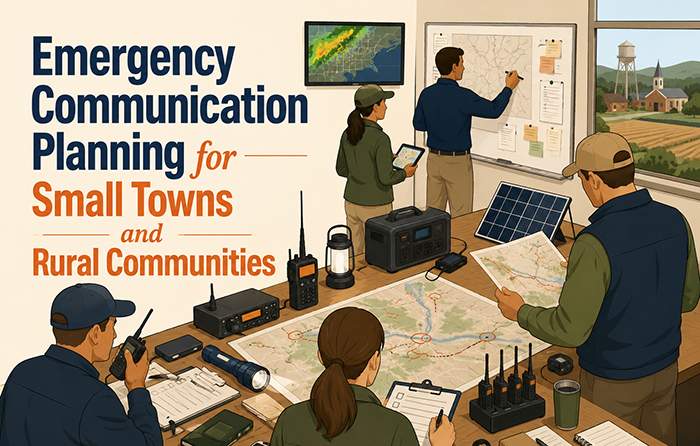
Emergency Communication Planning for Small Towns and Rural Communities
Emergency communication in small towns and rural communities is not simply a scaled-down version of what larger jurisdictions do. It operates in a fundamentally different environment: geographic dispersion that makes uniform notification difficult, infrastructure fragility that can disable multiple communication channels simultaneously, limited staff capacity that may leave one or two people responsible for both the operational response and the public communication, deep community relationships that can be either an asset or a liability depending on how communication is managed, and a resident population that may be less familiar with official emergency notification systems than residents of communities where emergencies are more common and where official systems have been established longer.
Despite these differences, the core communication requirements of an emergency are the same in a rural township as they are in a large city. Residents need to know what is happening, whether they are affected, what action they should take, where they can get more information, and when the next update will come. They need that information quickly, accurately, and through channels they actually receive. They need updates as the situation develops. And they need a clear all-clear when the emergency is resolved and normal conditions have been restored. The scale and channels differ. The communication requirements do not.
This article addresses how small towns and rural communities can build the emergency communication capacity they need before an emergency occurs. It covers how to select and establish communication channels that work under emergency conditions, how to build alert enrollment and reach the maximum share of the population, how to write message templates that can be activated quickly under pressure, how to design an update schedule that keeps residents informed throughout an extended emergency, how to coordinate with county and state emergency management partners, how to manage the all-clear and post-emergency communication, and how to review and improve emergency communication after each significant event. The goal is a communication system that functions effectively when it is needed most, not one that is assembled under pressure when the emergency is already underway.
Building Emergency Communication Capacity Before It Is Needed
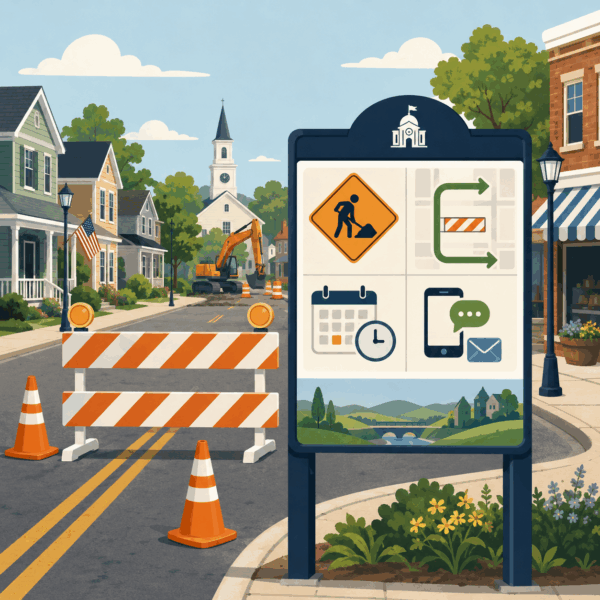 The most consequential emergency communication decisions are made during ordinary operations, not during the emergency itself. Which channels will be used? Who has authority to send an alert? What access is needed and who has it? How will residents enroll to receive notifications? What templates will be used? How will partner agencies be notified? These decisions, if made for the first time during an active emergency, will be made poorly under pressure with incomplete information. Made deliberately during ordinary operations, they produce a communication system that can be activated quickly and reliably when needed.
Emergency communication planning begins with a frank assessment of the channels that will be available and functional during the types of emergencies the community is most likely to face. A severe weather event may disrupt cellular service. A power outage may disable internet infrastructure. A flood that inundates the township hall may disable office-based communication equipment. The channels identified for emergency communication should be those that are most likely to remain functional during the specific types of emergencies the community faces, not simply those that are most convenient during normal operations.
Building redundancy into the channel portfolio is the practical response to this assessment. No single channel is reliable under all emergency conditions, which means that every channel can fail at the worst possible moment. A community that has invested in a single digital notification platform will have no emergency communication capacity if that platform goes down during the emergency. A community that has invested in digital notification, a community telephone chain, local radio relationships, physical posting at key community locations, and direct partner notification will retain multiple communication pathways even when individual channels fail.
Documenting the emergency communication plan in a format that can be used by any staff member, not just the one who built it, is essential for a system that needs to function when the usual people are not available. The documentation should cover every element of the communication system: which channels to activate, in what order, how to access each channel, what messages to send, who should approve messages before they go out or whether immediate release is authorized, how to reach partner agencies, and what information should be included in each update. That documentation, reviewed and tested annually, is the difference between an emergency communication plan that is a living operational tool and one that is a paper exercise.
Engaged & Connected: Communication Strategies for Small Towns, Villages, Townships, and Rural Communities
This article is part of our series on strategic communication for Small Towns, Villages, Townships, and Rural Local Governments. To learn more and to see the parent article, which links to other content just like this, click the button below.
Alert Enrollment and Reaching the Maximum Population
Resident notification systems that depend on resident enrollment will only reach the portion of the population that has enrolled. In many rural communities, that portion is significantly smaller than the actual population that needs emergency notifications. Building enrollment is a standing communication priority for agencies that have established a notification platform, not a one-time effort at launch.
Making Enrollment Easy and Visible
Enrollment should be as simple and frictionless as possible. A sign-up link on the agency’s home page, prominently displayed and clearly labeled. An enrollment option included in every utility bill. An enrollment booth at community events. A brief reminder in every agency newsletter. Partner organizations asked to promote enrollment to their own members and clients. Each of these touchpoints adds to the enrolled population over time, and the cumulative effect of consistent enrollment promotion is a notification list that reflects a representative share of the community.
For residents who cannot enroll digitally, telephone enrollment options should be available. A staff member who will add a phone number to the notification list based on a call-in request reaches residents who cannot navigate an online enrollment form. For residents who speak languages other than English as their primary language, enrollment information in those languages removes a barrier that otherwise excludes those residents from the notification system entirely. Non-English enrollment promotion should be distributed through partner organizations that serve the relevant language communities.
Reaching Residents Who Cannot or Will Not Enroll
No notification platform will reach every resident, regardless of how aggressively enrollment is promoted. Some residents will not enroll because they are not aware the system exists. Some will not enroll because they do not trust the system or the agency operating it. Some cannot enroll because of language barriers, digital access barriers, or cognitive or physical barriers to completing an enrollment process. And some will not receive notifications even if enrolled because their contact information changes without being updated in the system.
The emergency communication plan should explicitly address how the agency will reach residents who are not enrolled in the primary notification system. The non-digital channels described elsewhere in this series, including local radio, physical posting, partner organization networks, and telephone trees, serve this function and should be activated simultaneously with the digital notification system rather than treated as fallback options for after the digital notification has been sent. Simultaneous multi-channel activation maximizes the speed at which the emergency communication reaches the full population.
Specific outreach for vulnerable and isolated populations should be part of the emergency communication plan. Residents who live alone and whose isolation is known to neighbors or community organizations. Residents with disabilities whose ability to receive standard emergency notifications is limited. Residents who do not speak English and who may not receive notifications in their language. Agricultural workers whose housing may be remote and whose communication access may be limited. Each of these populations may need direct personal contact during an emergency, and planning for that contact before the emergency occurs is the only way to make it happen when needed.
Writing Emergency Message Templates
Emergency message templates are not polished communications. They are functional tools that allow accurate essential information to reach residents quickly under conditions where composing a message from scratch would introduce dangerous delays or errors. A template that can be filled in with the specific facts of the current situation in five minutes and sent immediately is worth far more in an emergency than a carefully crafted communication that requires thirty minutes to prepare.
Every template should address the same core questions that every emergency communication must answer: What is happening or has happened? Where is it happening, described specifically enough that residents can determine whether they are in the affected area? What should affected residents do right now? What should they avoid? Where can they get more information? When will the next update be provided? The template structure ensures that no critical element is omitted even when the person sending the alert is under significant stress.
Template Categories
Emergency communication templates should cover at least the following categories, each of which has different content requirements and different urgency levels. Severe weather warnings, including those for high winds, flooding, ice storms, and extreme heat or cold. Utility disruptions, including water main breaks, power outages affecting agency-operated facilities, and boil water advisories. Road emergencies, including sudden closures due to accidents, flooding, or structural failures. Public safety incidents that require resident action, such as evacuation orders or shelter-in-place advisories. Environmental or contamination incidents that require specific resident precautions.
Each category should have three template versions: an initial alert, an update, and a resolution or all-clear. The initial alert establishes the situation. Updates provide new information as it becomes available and confirm the next update time. The resolution closes the communication cycle and gives residents any post-emergency instructions they need. Having all three versions ready in advance prevents the common failure of communicating well during the emergency but forgetting to send the all-clear when the situation is resolved.
Template Language
Emergency template language should be plain, specific, and directive. It should tell residents what to do, not what the agency is considering doing. It should name specific geographic areas, specific roads, and specific actions rather than using general descriptions that leave residents uncertain about whether they are affected. It should avoid jargon, technical terms, and regulatory language that residents may not understand. And it should be as brief as possible while still including all of the essential information, because residents who receive an alert during an emergency will read a short, clear message more reliably than a long, comprehensive one.
The tone of emergency templates should be calm and direct rather than alarming. Language that creates panic in residents who are already under stress is counterproductive, as it can lead to dangerous decisions made in a heightened emotional state. The agency’s job in an emergency communication is to give residents the information they need to make rational decisions about their own safety, not to communicate the emotional urgency that staff are feeling internally.
Channel Selection and Activation for Emergency Communication
The channels used for emergency communication should be selected based on their reliability under emergency conditions, their reach within the community, and their accessibility to the populations most at risk. No single channel is adequate for emergency communication in rural communities with diverse populations and variable infrastructure reliability. The emergency communication plan should specify which channels will be activated for each category of emergency and in what sequence.
Mass notification platforms that can send text messages and emails simultaneously to enrolled residents are the most efficient channel for reaching a large number of people quickly. These platforms should be tested regularly to confirm that messages are being delivered reliably and that the contact list is current. Staff who have authority to send alerts should practice using the platform during non-emergency conditions so that the technical process is familiar when speed is essential.
Social media is an important supplementary channel for emergency communication because it reaches residents who follow the agency’s account, can be shared by followers to reach additional community members, and can provide ongoing updates in a format that is accessible on mobile devices. Social media emergency posts should link to the agency’s website for full information, should be short enough to read quickly on a small screen, and should be consistent in language and content with notifications sent through other channels.
The local emergency management system, typically coordinated at the county level, is both a communication channel and a coordination partner. Ensuring that the local agency’s emergency communication is integrated with the county emergency management system, that the county emergency manager is notified of significant local emergencies, and that the agency’s communication is consistent with county-level communication about the same event, requires an established relationship and a clear protocol developed before the emergency occurs.
Update Schedules During Extended Emergencies
Extended emergencies, those that last more than a few hours and that require sustained resident awareness over a period of days or longer, create communication demands that initial alert templates are not designed to sustain. A flood that requires residents to remain away from their homes for several days, a water system contamination that requires an extended boil water advisory, or a road closure that will persist for weeks all require a communication rhythm that keeps residents informed without creating alert fatigue or leaving them uncertain about the current status of the situation.
A defined update schedule, announced in the first alert and maintained throughout the emergency, gives residents the predictability they need to stay informed without constantly monitoring every available channel. An announcement that updates will be provided every morning and evening as long as the situation continues, combined with a specific channel residents can check for the latest information at any time, allows residents to manage their own information-gathering in a way that is sustainable over an extended period.
Each update in an extended emergency should include a brief restatement of the current situation for residents who may be accessing the update without having seen previous communications. The update should describe what is new or changed since the last update, confirm the current resident action instructions, and provide the time of the next scheduled update. This structure ensures that each update is self-contained enough to be useful regardless of when the resident enters the communication stream.
When the situation is stable and no significant change has occurred since the last update, the agency should still send the scheduled update rather than skipping it. An update that says the situation remains unchanged, that the previous instructions remain in effect, and that the next update will be at a specified time is more useful than silence during a period when residents may be wondering whether the situation has been resolved or whether they missed an important development.
Partner Coordination in Emergency Communication
 Emergency communication in small rural communities is almost never a solo effort by the local agency. County emergency management, neighboring jurisdictions, state agencies, utility companies, school districts, healthcare providers, and community organizations are all potential partners in emergency communication, each of whom may be communicating with the same community members through different channels and with different perspectives on the same situation.
Establishing communication coordination protocols with these partners before an emergency occurs is the only way to ensure that coordination actually happens during an emergency. A protocol that specifies which agency will serve as the primary communicator for each type of emergency, how information will be shared between agencies in real time, how to flag when partner communication is inconsistent with official information, and how corrections will be distributed across all partner channels prevents the channel inconsistency that is one of the most damaging communication failures in multi-agency emergency responses.
The county emergency management office is the most important coordination partner for most rural local government emergency communication. Building a direct relationship with the county emergency manager, participating in county-level emergency planning exercises, and ensuring that the local agency’s communication protocols are compatible with county communication systems are investments that pay dividends during actual emergencies when coordination happens automatically rather than requiring real-time negotiation.
Community organizations that serve vulnerable populations, including senior centers, food pantries, disability services providers, and housing assistance organizations, should be partners in emergency communication outreach to those populations. These organizations often have direct contact information and trusted relationships with residents who are among the most at risk during emergencies and the least likely to receive standard emergency notifications. A protocol for rapid notification to these partner organizations during emergencies allows them to activate their own outreach to the residents they serve.
The All-Clear and Post-Emergency Communication
The all-clear communication is as important as the initial alert and is more often neglected. Residents who have been managing their households according to emergency instructions, whether boiling water, avoiding a road, staying off their property, or taking any other action, need a clear, explicit communication telling them when normal conditions have been restored and what, if any, follow-up steps they need to take. Allowing an emergency to resolve quietly, without an explicit all-clear, leaves residents uncertain about whether the situation is actually resolved or whether they missed the resolution notice.
The all-clear should describe what has been restored, confirm any conditions residents should know about before returning to normal practices, and acknowledge the community’s patience during the emergency period. For extended emergencies that required significant community disruption, a brief expression of appreciation for how residents managed during the situation is appropriate and valued.
Post-emergency communication, beyond the all-clear, should include a brief description of what happened, what the agency did to address it, what was learned from the response, and what steps are being taken to prevent recurrence or to improve the response to future emergencies. This communication is not a crisis management exercise. It is an accountability and transparency communication that gives residents insight into how their local government performs during emergencies and what it is doing to improve that performance over time.
After-Action Review of Emergency Communication
Every significant emergency is an opportunity to assess how well the emergency communication system performed. The review should be conducted while the experience is still fresh, with the staff members who managed the communication, and should address specific questions: Did the initial alert go out quickly enough? Did it reach the residents who needed it? Were the updates consistent and on schedule? Were partner agencies effectively coordinated? Did the all-clear communicate everything residents needed to know? Were there residents who did not receive notification and who needed it?
The review should also consider the quality of the communication itself. Was the initial alert clear and specific? Did residents understand what action they were supposed to take? Were there questions from residents that indicated the communication was incomplete or confusing? Were there inconsistencies between what different channels or different staff members communicated? Each of these observations points to a specific improvement in the template, the workflow, the training, or the channel strategy.
Improvements identified through after-action review should be documented and implemented before the next potential emergency, not set aside for a future planning cycle. The communication system that performed adequately but imperfectly during the last emergency can be significantly improved before the next one if the lessons of the review are taken seriously and acted on promptly.
Testing and Drilling Emergency Communication Systems
A communication system that has never been tested under realistic conditions is a communication system that may fail under emergency conditions. Testing and drills are not bureaucratic exercises. They are the mechanism by which the agency confirms that its communication system will actually function when activated, identifies gaps and failures before they matter, builds staff familiarity with the process under conditions that allow for learning rather than immediate consequence, and maintains the relationships with partner agencies and community organizations that emergency communication depends on.
At minimum, an annual test of the primary notification platform should confirm that messages are being delivered to enrolled recipients, that the contact list is reasonably current, that staff with alert authority can successfully send a test message from whatever device and location they might be in during an actual emergency, and that the system behaves as expected. A test that discovers a problem, such as a platform credential that has expired, a contact list that has not been updated, or a staff member who cannot access the system from their personal device, has served its purpose even if the discovery is uncomfortable.
More comprehensive communication drills, conducted in coordination with county emergency management and partner agencies, simulate the full communication response to a specific emergency scenario. The drill should test not only the technical system but also the workflow: how quickly can the initial alert go out after the emergency is identified, how are partner agencies notified, how is the update schedule maintained, and how does the all-clear process work? After-action review of the drill produces the same kind of learning that after-action review of actual emergencies produces, but in a context where improvements can be made without having failed during an actual event.
Drills should include the non-digital communication channels as well as the primary notification platform. Confirming that local radio contacts are current and that station staff know who to contact for emergency announcements. Verifying that physical posting locations are accessible and that posting materials are available. Testing the partner notification phone tree. Confirming that the recorded information line can be updated quickly and that the phone number is still accurate in all published materials. Each of these confirmations takes only a few minutes but collectively ensures that the non-digital channels will function when needed.
Managing Spontaneous Community Communication During Emergencies
Emergencies generate spontaneous community communication that the agency cannot control and that may include misinformation, speculation, and incomplete accounts of the situation. Residents post on social media. Neighbors call each other. Community groups share updates through their own channels. Local businesses relay what they have heard. Some of this spontaneous communication will be accurate and helpful. Some will be incorrect, incomplete, or misinterpreted. Managing this communication environment is part of the emergency communication challenge that small rural agencies face.
The most effective response to spontaneous community communication is not to suppress it but to provide a clear, authoritative, regularly updated source of official information that residents can compare with what they are hearing through informal channels. A community that has a reliable source of official emergency updates is a community that can evaluate spontaneous communication against an official baseline, which significantly reduces the damage that misinformation can cause during a rapidly evolving situation.
When specific inaccurate information is circulating widely and is likely to lead residents to take harmful actions or to fail to take necessary ones, a direct and specific correction through official channels is warranted. The correction should be calm, factual, and focused on providing the accurate information rather than on criticizing the source of the inaccuracy. A statement that clarifies the correct facts, addresses the specific misconception, and directs residents to the official information source is more effective than a general appeal for residents not to share unverified information.
Community members who are actively engaged in spontaneous communication, such as local Facebook group administrators or neighborhood network coordinators, can be valuable allies if the agency has established relationships with them before an emergency. A community group administrator who knows the agency contact, who receives official updates directly, and who has agreed to share official updates through their network is a force multiplier for official emergency communication. Building those relationships during ordinary operations, before they are needed, is among the most practical investments a rural agency can make in its emergency communication capacity.
Communication Considerations for Specific Rural Emergency Types
Different types of emergencies create different communication challenges, and effective emergency communication planning should address the specific types of emergencies the community is most likely to face. Rural communities have specific emergency profiles that differ from those of urban communities, and emergency communication planning should reflect those differences.
Agricultural emergencies, including severe drought, flooding that affects crop fields, chemical spills affecting agricultural land, livestock disease outbreaks, and road damage during critical farming periods, require communication that addresses the specific operational concerns of farming households alongside the general public safety information. Agricultural emergency communication should be distributed through agricultural channels as well as general public channels, and should address the specific decisions that farming operations need to make during the emergency.
Wildfire risk communication is increasingly relevant for rural communities in regions where fire danger has historically been managed through prescribed burning but where changing conditions are creating new risks. Pre-fire season communication that tells residents how they will be notified of fire conditions, what evacuation routes exist, and what precautions they should take before fire season is more effective than information distributed only during an active fire event. Rural agencies in fire-prone areas should develop standing pre-season communication as part of their emergency communication planning.
Infrastructure failures that cascade across multiple systems, such as a flooding event that simultaneously damages roads, undermines utility infrastructure, and isolates residential areas, create compound communication challenges. The agency may need to communicate simultaneously about multiple aspects of the emergency through coordinated messages that help residents understand the full scope of the situation without creating confusion by treating each element as a separate emergency. Planning for compound emergencies, and developing communication frameworks that can address multiple simultaneous impacts, is an advanced element of emergency communication planning that small agencies can develop incrementally as their basic systems mature.
Strategic Communication Support for Small and Rural Governments
 Emergency communication planning requires the same systematic approach as any other communication system development, combined with the specific consideration of how systems will perform under the stress, the infrastructure disruptions, and the information incompleteness that characterize actual emergencies. For small agencies that have never built a formal emergency communication plan, the work can seem daunting alongside all of the other communication and operational priorities they are managing. Outside support can accelerate the process significantly.
Stegmeier Consulting Group (SCG) helps small and rural governments develop emergency communication systems that are realistic, tested, and ready to function when they are needed. That work includes channel assessment and selection, alert enrollment strategy development, message template creation, update schedule design, partner coordination protocol development, and after-action review facilitation. Whether your agency is building an emergency communication system from scratch or improving a system that has been tested by experience and found wanting, SCG can help you develop the capacity that your community deserves.
Future Trends in Rural Emergency Communication
The landscape for rural emergency communication is changing in ways that create both new capabilities and new challenges for small agencies. Several trends are worth noting for agencies building or improving their emergency communication capacity.
Wireless emergency alerts, sent by government agencies through the wireless carriers to mobile devices in a defined geographic area, are becoming more accessible to local governments at the county and sub-county level. These alerts reach every enabled mobile device in the targeted area without requiring prior enrollment, which addresses one of the most significant limitations of standard notification platforms. As the threshold for local government access to wireless emergency alerts continues to evolve, rural agencies should stay informed about what access is available and how to use it appropriately.
Interoperability between local, county, and state emergency notification systems is improving in many areas, allowing a single activation at the county level to trigger notifications through multiple local systems simultaneously. Rural local governments that invest in notification platforms compatible with county and state systems gain access to a larger and better-resourced communication infrastructure than any local agency can maintain independently. Understanding the interoperability options available through county emergency management is an important part of rural emergency communication planning.
Community resilience networks, in which residents with specific communication or technical capabilities volunteer to assist with emergency communication in their neighborhoods, are being developed in some rural communities as a supplement to official notification systems. These networks can reach isolated residents, provide informal verification of emergency conditions, and extend the agency’s communication reach into areas that official channels do not cover effectively. Building relationships with community members who might serve in this capacity is a proactive step that some rural agencies are beginning to incorporate into their emergency preparedness planning.
Conclusion
Emergency communication for small towns and rural communities is built during ordinary times, not assembled under pressure when an emergency is underway. The channels, the templates, the partner relationships, the enrollment campaigns, and the trained staff that make emergency communication effective are all investments made before the emergency that pay returns when the emergency occurs. Agencies that make those investments will communicate more effectively, reach more residents, and maintain more community trust during emergencies than those that try to build the system while managing the event.
Residents in small towns and rural communities deserve emergency communication that is as fast, as accurate, and as complete as what residents anywhere receive. The challenges of rural emergency communication are real, but they are not insurmountable. A small agency that has built the right system, tested it regularly, and maintained the relationships and access that make it functional can communicate as effectively during an emergency as any larger, better-resourced jurisdiction. That outcome requires planning, practice, and commitment, but it is within the reach of every rural local government that takes its emergency communication responsibility seriously.
Stegmeier Consulting Group’s Strategic Approach to Communication Systems
Align your agency’s emergency communication with the planning and capacity your community needs to be safe.
Small and rural governments need emergency communication systems that are built before they are needed, tested regularly, and maintained with the same discipline as operational emergency response capacity. Building those systems requires channel selection, alert enrollment, template development, partner coordination, and the after-action review habits that make each emergency a learning experience for the next.
SCG helps public agencies develop emergency communication capacity that is realistic, functional, and ready when it matters most. Whether your agency is building its emergency communication system for the first time or strengthening an existing system that has been tested by experience, SCG can help you develop the approach that keeps your community informed and safe during the events that test local government most.
Use the form below to connect with our team and explore how a prepared emergency communication system can help your agency serve residents effectively when they need their local government most.