
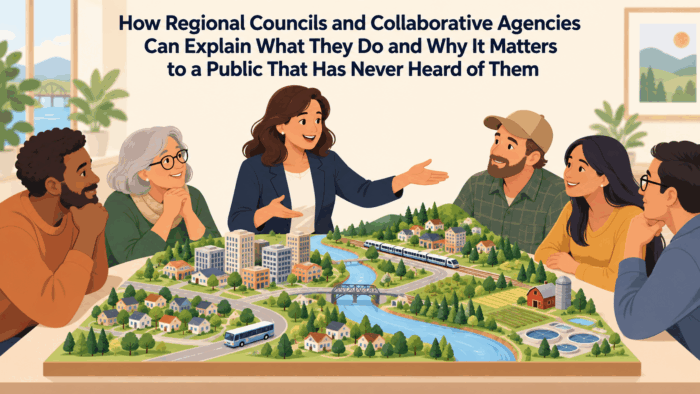
How Regional Councils and Collaborative Agencies Can Explain What They Do and Why It Matters to a Public That Has Never Heard of Them
There is a category of public agency that shapes daily life in ways that most residents cannot name, cannot locate on an organizational chart, and cannot hold accountable through the electoral mechanisms they understand. Metropolitan planning organizations determine which roads get built and which transit investments get funded across multi-county regions. Councils of governments coordinate the services and policies that no single municipality can manage alone. Regional transportation authorities move people across jurisdictions that were not designed to cooperate. Conservation districts deliver federal conservation programs to agricultural landowners through institutional structures that most farmers have never been formally introduced to. These agencies are doing consequential public work, and most of the public they serve has never heard of them.
The anonymity of regional collaborative agencies is not an accident of history that better marketing could correct. It is a structural feature of how these agencies are constituted. They derive their authority from member governments rather than from direct democratic election. Their decisions affect residents through layers of local government action that absorb whatever regional mandate was behind them. The transportation plan that shaped the highway corridor that shapes the commute that shapes the neighborhood is traceable to a regional planning process that most residents who experience those consequences have never had occasion to think about. The invisibility is the product of institutional design, and communicating through it requires a different strategy than the straightforward identity communication that a city or county can produce.
Most regional collaborative agencies respond to this invisibility problem in one of two ways, and both are inadequate. The first response is the comprehensive institutional overview: a website about page that explains the agency’s full mandate, its governance structure, its federal authorization basis, and its program portfolio in a form that a policy analyst might find useful and a curious resident would abandon after the second paragraph. The second response is program-specific communication that describes individual services without ever explaining the agency that delivers them, leaving residents with fragments of program knowledge that do not add up to institutional understanding. Neither response builds the public legitimacy that regional agencies need to maintain political support, attract funding, and exercise the coordination function that their mandates assign them.
Building public understanding of what a regional collaborative agency does and why it matters is a communication challenge that must be solved at the level of the rationale rather than the institutional description. Residents do not need to understand the agency’s governance structure to understand why regional coordination matters. They need to understand the specific problems that the agency exists to address, why those problems cannot be solved by any single local government acting alone, and what the agency’s specific contribution to solving them is. That rationale, communicated in terms that connect to residents’ actual experience of regional conditions, is the institutional explanation that builds public understanding more durably than any organizational chart.
The Structural Anonymity Problem
 Regional collaborative agencies are anonymous by design in a way that most public institutions are not. A city has a mayor whose name appears on election ballots, whose face appears in local news, and whose decisions generate the constituent contacts that make city government feel personally accountable to residents. A county has commissioners or supervisors who run for office, attend community events, and field calls from constituents who know where to go when something goes wrong. A regional collaborative agency has a board of appointed or elected officials from member governments who are primarily accountable to those governments, staff who are experienced planners and coordinators but not publicly known figures, and a governance structure that most residents, if asked, could not describe in general terms.
This structural anonymity creates a specific communication vulnerability: when a regional agency makes a decision that affects a community, the community’s response is directed at the local officials and local agencies they recognize, not at the regional body that may have driven the decision. The member city council member who voted for a transportation improvement program project gets the credit when that project is delivered. The regional planning organization whose technical analysis identified the project as a regional priority, whose federal program allocated the funding, and whose staff coordinated the intergovernmental process that made the project possible, is invisible in the story. The anonymity that insulates regional agencies from direct political accountability also deprives them of the credit-claiming opportunities that build public legitimacy over time.
The anonymity problem is compounded by the complexity of what regional agencies do. The work of coordinating transportation planning across a dozen municipalities, of developing the regional data products that inform local planning decisions, of managing federal program requirements that span multiple jurisdictions, is work whose value is realized through the local decisions it enables rather than through any visible regional product. A long-range transportation plan is not a road. A regional competitiveness strategy is not a business. A watershed management plan is not a restored riparian buffer. The planning and coordination products that regional agencies produce are inputs to the local and federal decisions that produce the visible outcomes that residents experience, which makes the regional contribution systematically harder to communicate than the local contribution that residents can observe directly.
Acknowledging this structural anonymity directly in communication planning is the first step toward addressing it strategically. An agency that understands that its institutional invisibility is a design feature of its governance model rather than a communication failure will approach the communication challenge differently than one that treats anonymity as a problem that more institutional promotion could solve. The goal is not to make the agency as well-known as the city hall that sits at the center of local civic life. It is to build the specific understanding of what the agency does and why it matters among the specific audiences whose support and engagement the agency most needs.
From Fragmentation to Coordination: Communication Strategies for Councils of Governments, Metropolitan Planning Organizations, and Regional Planning Agencies
This article is part of our series on strategic communication for Councils of Governments, Metropolitan Planning Organizations, and Regional Planning Agencies. To learn more and to see the parent article, which links to other content just like this, click the button below.
Starting With Problems, Not Programs
The Rationale-First Communication Framework
The most effective public explanation of what a regional collaborative agency does begins not with what the agency is, but with what problem it exists to address. A metropolitan planning organization is most easily explained not through its federal authorization basis or its governance structure but through the observable consequences of uncoordinated transportation investment: the congestion that builds when highway capacity is added without transit investment, the access gaps that emerge when land use decisions in one municipality make transportation demands that neighboring municipalities’ networks were not designed to absorb, the air quality consequences of vehicle miles traveled that no single municipality can reduce on its own. These problem descriptions connect to what residents experience, and they provide the rationale for why a regional coordination body exists that institutional description cannot supply.
Problem-first communication requires agencies to resist the institutional instinct toward self-description and instead anchor their public explanation in the regional conditions that their work is designed to improve. This means leading public communications not with who the agency is but with what is not working in the region and why. It means connecting specific program offerings to the specific problems they address rather than describing program eligibility and application processes without the problem context that makes those programs meaningful. And it means framing the agency’s value in terms of what would be different, or worse, in the region if the agency did not exist, which is a more compelling rationale than any organizational description can provide.
The problem-first framework is not a marketing strategy. It is an honesty strategy. Regional collaborative agencies address real problems that are genuinely difficult to solve without regional coordination, and those problems are the most honest and the most compelling explanation for why these agencies exist and why they deserve public support. An agency that leads with its mission statement rather than with the problems its mission addresses is substituting institutional self-description for the substantive public value explanation that genuine transparency requires.
Making the Regional Scale Visible
One of the most persistent challenges in explaining regional collaborative agencies is making the regional scale of the problems they address tangible to residents whose daily experience is organized at the neighborhood and municipal level. A resident who commutes across county lines experiences the regional transportation network as a personal daily reality, but they may not have connected that personal experience to the regional planning process that shapes it. A farmer who participates in a conservation cost-share program experiences it as a transaction with the conservation district, but may not have connected it to the federal conservation program framework that the district administers. Making the regional scale visible in communication means specifically connecting the local experience that residents have to the regional conditions that produce it.
Regional data communication is one of the most effective tools for making the regional scale visible. A map that shows commute flows across municipal boundaries, demonstrating that the workforce of a major employer is distributed across a dozen municipalities none of which can address transportation access on their own, makes the regional transportation planning rationale tangible in a way that verbal description cannot. A chart that shows the relationship between regional land use patterns and regional vehicle miles traveled, demonstrating that sprawling development in one part of the region produces traffic congestion that residents of a different part of the region experience, makes the regional land use connection concrete in a way that abstract planning principles do not. Regional data that connects local experience to regional causes is the communication bridge between the neighborhood scale where residents live and the regional scale where the problems they experience are most usefully addressed.
The regional scale can also be made visible through the counterfactual: what would the region look like if the coordination function did not exist. An MPO that did not allocate federal transportation funding according to a regional plan would allocate it through a political competition among member governments in which the largest and most politically powerful municipalities would consistently prevail. A council of governments that did not coordinate regional services would leave each municipality to provide those services independently, at higher cost and lower quality than coordinated provision allows. A conservation district that did not deliver federal cost-share programs would leave agricultural landowners to navigate the USDA’s program bureaucracy without local technical assistance, resulting in lower program uptake and less conservation achieved per federal dollar spent. These counterfactuals are not hypothetical exercises. They are the realistic alternatives to regional coordination that help residents understand why regional agencies exist and what they provide.
Audience-Specific Explanation Strategies
The public understanding challenge for regional collaborative agencies is complicated by the diversity of audiences that need to understand what the agency does and why it matters, each for different reasons and through different communication contexts. The general public needs enough understanding to support public funding for regional programs and to engage with regional planning processes when given the opportunity. Elected officials at member governments need enough understanding to represent regional coordination as a genuine value to their constituents rather than as a bureaucratic obligation. The business community needs enough understanding to recognize the connection between regional planning decisions and their own operational interests. Media need enough understanding to cover regional issues accurately and to recognize when local stories have regional dimensions.
Public explanation for general audiences should prioritize the problems-and-outcomes frame over the institutional-description frame, using the regional data and local experience connections that make the regional scale tangible. Public explanation for elected officials should additionally address the governance accountability dimensions of regional coordination, making clear how member government representation works, how member government interests are represented in regional decisions, and how the regional coordination function serves the long-term interests of each member community. Public explanation for the business community should connect regional planning to the business environment factors that matter to business decision-making: workforce access, infrastructure reliability, regulatory consistency, and the regional market conditions that determine business competitiveness.
Media explanation for regional agencies deserves specific investment that most regional agencies do not make. A reporter covering local government in a multi-county metropolitan area is covering a beat that includes regional stories whose connection to the local communities they affect is not always immediately apparent. An agency that has invested in background briefings for local reporters, that maintains accessible media contact infrastructure, and that proactively identifies local stories with regional dimensions and connects reporters to the regional context, is building the media understanding that produces more accurate and more contextually complete coverage of regional issues than agencies that respond only to media inquiries.
Building Explanation Into Every Communication
Agencies that communicate effectively about what they do and why it matters do not confine that explanation to their institutional overview page or their annual report. They build the rationale-first explanation into every communication context: program outreach that explains why the specific program exists alongside how to apply for it, meeting agendas that explain why regional coordination on the agenda topic is necessary alongside what the meeting will decide, public hearing materials that explain why public input matters to the regional decision being made alongside the process for providing it. This integration of explanation into routine communication is more effective than episodic institutional promotion because it reaches audiences at the moment when they are most engaged with the specific program or process the explanation is connected to.
Website communication for regional collaborative agencies should be designed around the explanation-first principle rather than around the organizational structure of the agency. A website organized by department, program office, or committee structure is organized for the convenience of the staff who maintain it rather than for the residents or local officials who visit it to understand what the agency does and what it offers. A website organized around the problems the agency addresses, the communities it serves, and the outcomes it produces, is organized for the public who need to understand the agency’s rationale before they can navigate its programs or participate in its processes.
Regular communication rhythms that provide updated regional context for what the agency is doing, and why it matters, maintain the public understanding that episodic communication cannot sustain. A monthly regional update that explains not only what the agency did in the previous month but why those activities matter for the regional conditions the agency is trying to improve, is a communication investment that builds cumulative public understanding over time. An annual report that explains not only the agency’s program outputs but the regional outcomes those programs are designed to produce, is an accountability document that serves the public understanding function alongside the fiscal transparency function that annual reports conventionally provide.
Explaining Regional Authority Honestly
One of the most important elements of honest public explanation for regional collaborative agencies is the accurate communication of what the agency can and cannot do. Regional agencies frequently operate with less authority than residents assume, relying on the voluntary cooperation of member governments rather than on the direct regulatory or enforcement authority that state and local agencies have. An MPO that does not fund transportation projects directly but allocates federal funding that is spent by member governments is an agency whose authority is real but indirect, and communicating about that authority accurately prevents the misunderstanding that the agency has direct control over project delivery when it does not.
Honest authority communication also requires explaining what happens when regional coordination fails or when member governments do not cooperate with regional decisions. Most regional collaborative agencies have limited formal mechanisms for compelling member government compliance with regional plans or policies, and the limits of those mechanisms deserve honest communication. A regional long-range transportation plan that identifies a specific corridor as a regional priority does not guarantee that the local governments responsible for land use along that corridor will make the zoning decisions that the plan’s transportation assumptions require. A regional council of governments resolution does not bind member municipalities to the policy direction it articulates. Communicating these limits honestly is not an institutional confession of weakness. It is the accurate description of how regional coordination works that allows residents and local officials to understand both the value and the limits of regional collaboration.
How Institutional Explanation Compares With Other Public Agency Communication
The institutional explanation challenge for regional collaborative agencies has no direct parallel in the communication programs of cities, counties, or state agencies, all of which have direct electoral relationships with their constituents that provide a basic level of institutional recognition that regional agencies cannot assume. A city does not need to explain what a city is before it can communicate about city services. A state environmental agency does not need to explain the concept of environmental regulation before it can communicate about permit requirements. Regional collaborative agencies must do both simultaneously: explain what kind of institution they are and why it exists, at the same time they are communicating about the specific programs and decisions that they need residents and officials to engage with.
The comparison with special districts, which are single-purpose governmental units that also lack the electoral visibility of general-purpose governments, is instructive. A water district or a school district has a single well-understood function that most residents can identify even if they cannot describe the governance structure. Regional collaborative agencies typically perform multiple functions across multiple program areas, which makes the single-function recognition shortcut unavailable and the institutional explanation challenge correspondingly more complex.
Communicating Legitimacy Without Electoral Mandate
Regional collaborative agencies face a legitimacy challenge that no communication strategy can fully resolve but that communication can substantially mitigate: the absence of a direct electoral relationship with the residents and communities whose lives regional decisions affect. A city derives its legitimacy from the voters who elect its council and mayor. A state agency derives its legitimacy from the governor and legislature elected by state voters. A regional collaborative agency derives its legitimacy from the intergovernmental agreement of the member governments whose representatives sit on its governing body, and from the federal mandate that may require its existence, neither of which is a source of legitimacy that most residents understand or feel connected to.
Communicating institutional legitimacy in the absence of an electoral mandate requires regional agencies to ground their legitimacy claims in functional performance rather than in democratic authorization. An agency that cannot point to a ballot box as its source of authority can point instead to the specific results its work has produced for the communities it serves, the specific problems it has helped solve that no single local government could have solved alone, and the specific accountability mechanisms, including member government representation, public comment requirements, and federal oversight, that ensure the agency’s decisions are subject to meaningful review. Functional legitimacy is buildable through consistent, honest, and demonstrably effective performance over time, and communicating that performance is the primary legitimacy communication available to regional collaborative agencies.
Public participation in regional planning processes is both a federal requirement for many regional agencies and a legitimacy-building communication investment that extends the agency’s democratic connection beyond the intergovernmental representation of its governing body. When residents participate in long-range transportation plan development, in regional comprehensive planning processes, or in conservation district program design, they are engaging with the regional planning process in ways that build the direct democratic connection that regional agencies cannot achieve through governance structure alone. Communication that actively seeks this participation, that makes participation accessible to the full range of community members whose lives regional decisions affect, and that demonstrates how participation shaped the decisions that followed, is legitimacy communication of the most genuine kind.
Transparency as a legitimacy mechanism deserves explicit communication investment. Regional agencies that publish their meeting agendas and minutes accessibly, that make their technical analyses and program performance data available to the public, that communicate honestly about the trade-offs in regional decisions rather than presenting all regional decisions as straightforwardly positive, and that report specifically on how public and member government input affected planning and program decisions, are demonstrating the accountability that builds legitimacy in the absence of a direct electoral relationship. This transparency is not simply good governance practice. It is the primary legitimacy communication available to agencies that cannot rely on electoral accountability as a legitimacy foundation.
The Role of Staff in Public-Facing Explanation
 Regional collaborative agency staff are the primary human face of the institution for most of the audiences the agency serves, and their capacity and confidence in explaining what the agency does and why it matters is a critical communication resource that most agencies do not invest in systematically. A planner who can clearly and compellingly explain the regional transportation planning process to a community member at a public meeting is providing institutional explanation communication more effectively than any website or brochure can, because the personal interaction carries the authenticity and responsiveness that printed or digital materials cannot match. Investing in staff communication capacity is investing in the institution’s most effective explanation vehicle.
Staff development for public-facing explanation requires training in both the substance of what the agency does and the communication of why it matters in terms that non-specialists can understand. Regional planners, program coordinators, and technical staff are often expert in the substance of their work but less practiced in explaining that work to audiences who do not share their technical background. Developing the plain-language explanation capacity that public-facing explanation requires is a communication training investment that pays dividends across every public interaction that staff members have, from public meetings to media inquiries to informal community conversations.
Consistent explanation across staff is as important as individual staff explanation capacity. When different staff members describe the agency’s purpose and programs in inconsistent terms, audiences who interact with multiple staff members receive a fragmented institutional picture that reinforces rather than reduces the confusion that structural anonymity produces. Shared explanation frameworks, consistent terminology, and regular communication alignment among staff who interact with external audiences are organizational communication investments that ensure the quality of individual staff explanation is amplified rather than diluted by institutional inconsistency.
Staff diversity that reflects the demographic diversity of the communities the agency serves is also a staff communication investment with specific explanation implications. Agency staff who share cultural backgrounds, language preferences, and community identities with the specific communities the agency serves are more credible explanation communicators in those communities than staff who do not. Investing in staff diversity is not only an equity imperative. It is a communication effectiveness investment that extends the agency’s explanation reach into communities where institutional communication from unfamiliar faces and institutional voices has historically been less effective.
Evaluation and Feedback in Explanation Programs
Explanation programs that are not evaluated against the understanding outcomes they are designed to produce will not improve systematically over time. The most useful measure of an institutional explanation program’s effectiveness is not how many people the agency communicated with but how many of those people came away with an accurate understanding of what the agency does and why it matters. This is a harder measure to collect than reach metrics, but it is the measure that is actually informative about whether the explanation program is working.
Survey research that measures what specific audience segments understand about the regional agency before and after specific explanation interventions provides the evidence base for explanation program improvement that output metrics cannot supply. A pre- and post-survey of participants in a regional planning public meeting, measuring what they understood about the agency’s role before the meeting and what they understand after it, tells the agency whether the meeting successfully built the understanding it was designed to produce. A survey of member government staff measuring their understanding of specific regional programs and their communication capacity for explaining those programs to local constituents, reveals the gaps in intergovernmental explanation that targeted communication support could address.
Feedback mechanisms that allow audiences to report what was confusing, what questions they had that the agency’s explanation did not answer, and what formats and channels they found most and least useful, provide the qualitative intelligence that quantitative understanding surveys cannot fully capture. A feedback channel embedded in public meeting processes, in website communication, and in intergovernmental briefing materials, that makes it easy for audiences to report explanation gaps, gives the agency a continuous source of explanation improvement intelligence that periodic surveys alone cannot provide.
Building Explanation Into Budget and Advocacy Communication
Budget season is among the most important explanation communication moments for regional collaborative agencies because it is when member governments, funders, and federal partners evaluate whether the regional agency’s programs justify continued investment. An agency that communicates its budget request primarily in financial and programmatic terms, without explaining why the regional coordination mission that the budget funds is necessary and valuable, is missing the explanation opportunity that budget season provides. Budget communications that lead with the specific problems regional programs address, that connect program investments to specific regional outcomes, and that make the case for regional coordination as a more effective use of public resources than the alternatives, are explanation communications as well as funding communications.
Federal grant applications and compliance reports are another explanation opportunity that most regional agencies treat as purely administrative communications. A federal transportation planning grant application that explains not only what activities the grant will fund but why regional transportation planning produces outcomes that local planning cannot, is making the explanation case for regional coordination to a federal audience that controls significant resources and whose understanding of the regional agency’s value influences those resource decisions. Embedding explanation into every communication that reaches audiences with decision-making authority over the agency’s resources is the strategy that makes explanation communication most consequential.
Advocacy communication for regional agency funding, which makes the case to state legislatures, congressional representatives, and federal agencies for the funding that regional coordination programs require, is the explanation communication with the highest financial stakes. Regional agencies that communicate their advocacy messages primarily in terms of program funding needs rather than in terms of the specific outcomes that funding produces, and the specific consequences for communities and regions if that funding is reduced, are leaving the most powerful explanation arguments unused. Advocacy communication that explains specifically what regional coordination has accomplished with current funding, what it will accomplish with requested funding, and what will not happen if funding is reduced, is explanation communication that serves the agency’s resource interests as well as its legitimacy interests.
Explanation Across Program Cycles
Regional collaborative agencies operate on planning cycles, federal reporting requirements, and program delivery schedules that create predictable rhythms of public communication that most agencies manage as compliance obligations rather than as strategic explanation opportunities. A long-range transportation plan update that occurs every four years is a quadrennial explanation opportunity that most MPOs treat as a planning process requiring public participation, rather than as the most significant occasion in the planning cycle for building public understanding of what the regional transportation planning function is and why it matters. A conservation district that reports annually to the state on cost-share program enrollment is producing a compliance document, not an explanation communication, unless the reporting is designed with the public explanation function in mind.
Embedding explanation investment into the compliance-driven communication calendar that most regional agencies operate on requires the communication discipline to see compliance communications as explanation opportunities and to design them accordingly. An annual report that satisfies its financial transparency obligation while also explaining specifically what regional coordination accomplished in the past year and why that accomplishment required regional rather than local action, is serving both functions simultaneously. A federal comment period notice that satisfies the regulatory notification requirement while also providing the accessible, plain-language explanation of what is being planned and why public input matters, is turning a compliance communication into an explanation communication at modest additional cost.
The planning and reporting calendar also creates predictable moments when specific audiences are most likely to be paying attention to regional agency communication, and those moments deserve the most intensive explanation investment. When a regional transportation authority is presenting its capital budget for governing board approval, the business community and elected officials who will vote on that budget are more attentive to regional transportation communication than at any other time in the year. When a conservation district is conducting its spring outreach for cost-share program applications, agricultural landowners are more receptive to conservation communication than in the winter when planning season has not yet arrived. Aligning explanation investment with these attention peaks produces more explanation return per communication investment than uniform explanation across the calendar year.
Building Explanation Partnerships With Member Governments
The most efficient explanation communication available to regional collaborative agencies is the explanation that member governments provide to their own residents and constituents about regional programs and regional decisions. A city that includes a clear, accurate explanation of the regional MPO’s role in a transportation project announcement, that attributes a successful grant award to the regional economic development council’s application support, or that communicates the conservation cost-share program to agricultural constituents through the county’s own outreach channels, is providing regional explanation communication through the most credible local channel available. Member governments are the most trusted institutional voice for regional programs in their own communities, and their explanation of regional programs carries the local institutional credibility that regional agency communication alone cannot provide.
Building member government explanation partnerships requires the regional agency to provide member governments with the explanation materials, the talking points, and the technical support they need to communicate accurately about regional programs and decisions to their own residents. This is not simply about providing press release templates that member governments can distribute unchanged. It is about providing the locally adapted explanation materials, the community-specific data, and the program impact information that member government staff and officials need to make regional programs intelligible to their own constituents. The explanation partnership works when the regional agency provides the explanation resources and member governments provide the local credibility and distribution channels.
Recognizing and celebrating member government communication of regional programs, when member governments actively explain regional programs to their constituents and support regional planning processes in their communities, reinforces the explanation partnership behavior that the regional agency is trying to encourage. A regional agency that publicly acknowledges a member municipality’s strong community outreach on a regional transportation plan public engagement process, that highlights a county’s effective communication of a conservation program to agricultural landowners, or that recognizes a city’s creative explanation of regional housing data to local residents, is rewarding the behavior it wants to see more of in a way that most agencies do not invest in.
How Explanation Builds Over Time
The public understanding that regional collaborative agencies most need is not built through any single explanation communication but through the cumulative effect of consistent, rationale-first explanation across many communication contexts and over many years. A regional agency that has been consistently explaining what it does and why it matters for a decade, through annual reports that explain outcomes rather than outputs, through public meeting materials that explain process rationale rather than just agenda logistics, through program communications that explain the problems they address rather than just the applications they accept, has built a fundamentally different public understanding of its institutional purpose than one that has relied on its about page and occasional press releases to carry the institutional explanation load.
The cumulative nature of explanation communication has an important implication for how regional agencies should evaluate their explanation investment. A single explanation investment, however well-designed, will not produce the durable public understanding that regional agencies need. The return on explanation investment is long-term and cumulative, and it is most visible not in the response to any single communication but in the quality of public understanding that is present before any specific communication challenge arises. The regional agency whose public already understands what it does and why it matters is the agency that faces the next funding controversy, the next intergovernmental conflict, or the next major planning decision in a fundamentally more favorable communication environment than the agency that must build that understanding from scratch each time a communication challenge arises.
Tracking the cumulative state of public understanding over time, through annual surveys that measure specific understanding dimensions among specific audience segments, is the measurement investment that allows regional agencies to assess whether their explanation communication is producing the cumulative understanding improvement it is designed to produce. An agency that has measured public understanding of its institutional role annually for five years, and that can show consistent improvement in the specific dimensions of understanding that its explanation program targets, has the evidence that its explanation investment is working and the measurement baseline that allows it to assess which explanation approaches are most effective for which audience segments.
Explanation and Institutional Continuity
The institutional explanation challenge for regional collaborative agencies does not reset with each new communication campaign. It accumulates over the institutional life of the agency, built or eroded by each communication decision, each public meeting, each annual report, and each interaction between agency staff and the public they serve. Agencies that treat institutional explanation as a continuous organizational responsibility, rather than as a periodic marketing effort, build the cumulative public understanding that makes individual communication campaigns more effective and more resonant than those that must do all the explanation work themselves.
Organizational routines that embed explanation into every external communication, from the agenda format of public meetings to the structure of program application materials to the content of routine email correspondence, ensure that explanation is happening continuously rather than only when a specific communication investment is made. An agency whose routine program application instructions explain not only what the applicant needs to submit but why the program exists and what regional problem it addresses, is building institutional understanding through a touchpoint that every program participant encounters. An agency whose public meeting agendas explain not only what will be discussed but why the specific topic is on the regional planning agenda, is building understanding through a communication vehicle that every meeting participant receives.
Leadership communication about institutional purpose, including executive director public statements, board chair communications, and senior staff presentations, is the most visible institutional explanation communication and the most influential in establishing whether explanation is a genuine organizational priority or a peripheral public relations function. An executive director who consistently explains what the agency does and why it matters in every public presentation, who references the regional problems the agency exists to address rather than the institutional programs it operates, and who models the rationale-first explanation discipline in their own communication, establishes the organizational culture that makes explanation a continuous institutional practice rather than an occasional communication supplement.
Tying It All Together
Explaining what a regional collaborative agency does and why it matters is the most foundational communication challenge these agencies face, because every other communication program, from transportation plan engagement to cost-share outreach to intergovernmental relationship management, depends on a base level of public and official understanding that the agency exists for a legitimate purpose and performs a valuable function. Without that foundation, program-specific communication is received without context, and the institutional credibility that program communication draws on is absent.
The explanation strategy that works for regional collaborative agencies is not institutional promotion but rationale-first communication that anchors the institutional explanation in the specific problems the agency exists to address, connects the regional scale of those problems to the local experience of residents and officials, and acknowledges the real limits of regional authority alongside its genuine value. This strategy requires organizational commitment to integrating institutional explanation into every communication context rather than confining it to the about page and the annual report, and it requires the sustained communication investment that building cumulative public understanding demands.
Agencies that invest in this explanation strategy find that public understanding of what they do and why it matters is buildable, that it builds through consistent, rationale-first communication across many contexts and over time, and that it produces the institutional credibility that makes every other communication program more effective. Agencies that do not invest in it find that their program communications are received without context, their public engagement processes attract limited participation, and their relationship with member governments is defined by what individual programs deliver rather than by the broader coordination mission that justifies the agency’s existence.
Strategic Communication Support for Regional Agency Explanation
 Developing the rationale-first explanation frameworks, audience-specific communication strategies, website architectures, and media engagement programs that effective regional agency public explanation requires is work that most regional collaborative agency communication teams have not been staffed or resourced to accomplish alongside their program communication responsibilities. The structural complexity of the explanation challenge, combined with the diversity of audiences that each require different explanation approaches, makes external communication expertise a productive investment for agencies seeking to build genuine public understanding of their institutional purpose.
Stegmeier Consulting Group (SCG) works with regional collaborative agencies to develop public explanation communication programs that are grounded in the specific problems each agency exists to address, the specific regional context in which it operates, and the specific audiences whose understanding most matters to its governance and program effectiveness. This includes developing the rationale-first message frameworks that anchor institutional explanation in regional problems rather than institutional description, designing the audience-specific explanation strategies that serve general public, elected official, business community, and media audiences differently, and building the website architectures and communication rhythms that integrate institutional explanation into every communication context. The objective is a public understanding of the agency’s purpose and value that makes every other communication program more effective.
Future Trends in Regional Agency Explanation Communication
The communication environment for regional collaborative agencies is being transformed by digital information access that makes regional data more available and more interpretable to general audiences than it has ever been. Interactive regional data platforms that allow residents to explore commute patterns, land use trends, housing availability, and environmental conditions across the full metropolitan area are making the regional scale of the problems that regional agencies address directly experiential for residents who use them. Agencies that invest in these digital tools and that design them around the problems-and-outcomes frame rather than the institutional-description frame are making the regional rationale for coordination visible in ways that no amount of narrative communication can achieve.
Social media and digital content distribution are also changing how regional agency explanation reaches general audiences. Short-form video content that explains a regional transportation planning concept in two minutes, animated data visualizations that show the regional consequences of local land use decisions, and social media posts that connect current regional news stories to the agency’s coordination function, are explanation formats that reach audiences who would never read an institutional overview page but who do encounter and engage with well-designed short-form regional content in their social media feeds.
The growing recognition of regional equity as a planning and governance priority is also reshaping what explanation regional agencies need to provide about why their work matters. An agency that can explain not only what its programs accomplish in aggregate but how those programs address the specific needs of communities that have been underserved by regional planning processes, is communicating a dimension of regional value that equity-focused audiences and equity-oriented funders increasingly need to hear.
Conclusion
Regional collaborative agencies face the most difficult institutional explanation challenge in public governance because their work is consequential, their authority is indirect, their governance is complex, and their public is largely unaware they exist. Meeting that challenge requires not simply more communication but fundamentally different communication: explanation that begins with regional problems rather than institutional descriptions, that connects the regional scale to the local experience that residents and officials actually have, and that integrates the rationale for regional coordination into every communication context rather than confining it to institutional overview documents.
The agencies that build genuine public understanding of what they do and why it matters are the ones that have decided that institutional explanation is a strategic communication investment rather than a public relations supplement, and that have built the organizational commitment, the communication disciplines, and the sustained investment that making that explanation cumulative and credible requires. That understanding is the foundation on which every other regional communication program depends, and it is the most important communication investment that regional collaborative agencies can make.
Stegmeier Consulting Group’s Strategic Approach to Communication Systems
Build regional agency explanation around the rationale for coordination, not institutional description, connecting regional problems to local experience in ways that every audience can evaluate.
Regional collaborative agencies that explain what they do and why it matters by anchoring the institutional rationale in specific regional problems, connecting those problems to local experience, and building that explanation into every communication context, develop the public understanding that makes every other communication program more effective. Stegmeier Consulting Group (SCG) helps regional agencies develop the rationale-first explanation frameworks, audience-specific strategies, and integrated communication programs that transform institutional explanation from an organizational afterthought into a genuine public trust investment.
Use the form below to connect with our team and explore how strategic communication support can strengthen your agency’s public explanation program.