
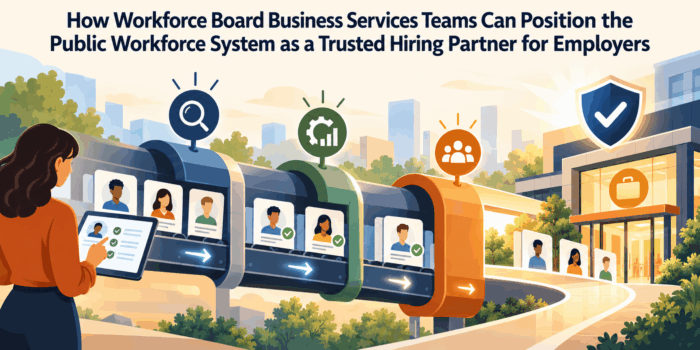
How Workforce Board Business Services Teams Can Position the Public Workforce System as a Trusted Hiring Partner for Employers
Consider the week of a human resources manager at a mid-sized regional manufacturer. She receives calls from three staffing agencies, two job board sales representatives, a recruiter offering a specialized search, a community college asking about an advisory committee, a chamber of commerce event invitation, and, somewhere in the mix, a business services representative from the local workforce board offering free help with hiring. The last call may be the most valuable of the week. It may also be the one she is least likely to return. To her, it sounds like one more organization wanting her time, and she may associate it with the government, with paperwork, or with a memory of candidates referred years ago who were not ready for the job. The word free, which should be an advantage, may even make her suspicious, because in her experience free help rarely delivers what it promises.
This is the position from which many workforce board business services teams begin. The public workforce system offers employers genuine value: candidate recruitment and screening, hiring events, labor market information, on-the-job training and incumbent worker training funds, layoff support, help building apprenticeship and training programs, and connections to a pool of jobseekers that includes skilled, motivated workers. Yet many employers do not know these services exist, do not understand them, or have formed impressions that keep them from using them. The workforce system’s dual customer design, serving both jobseekers and employers, depends on employers who trust the system enough to hire through it, partner with it, and invest their time in it.
Trust, for an employer, is earned differently than it is for a jobseeker. Employers judge service providers by reliability, responsiveness, understanding of their business, quality of results, and respect for their time. A business services team that calls when it needs placements, refers candidates who are poorly matched, takes weeks to follow up, or explains its services in program jargon will not earn that trust, regardless of the value of what it offers. A team that understands the employer’s needs, delivers what it promises, communicates in business terms, and stays in touch when it has nothing to sell will gradually become a partner the employer relies on.
This article examines how workforce board business services teams can position the public workforce system as a trusted hiring partner for employers. Its central argument is that trust is built through the cumulative experience of working with business services, not through promotion, and that communication succeeds when it is grounded in genuine understanding of employer needs, honest about what the system can and cannot provide, coordinated so employers experience one partner rather than many, and backed by consistent follow-through. It examines why employers hesitate, what trust means to them, how to define and communicate a clear value proposition, how to coordinate outreach, how to listen before offering, how to make candidate referrals credible, and how to sustain relationships through responsiveness, feedback, and fair dealing with both employers and jobseekers.
Why Employers Hesitate to Use the Public Workforce System
 Understanding why employers hesitate is the foundation for building trust. Employer hesitation rarely stems from a considered judgment that the public workforce system has nothing to offer. More often, it stems from unfamiliarity, inaccurate perceptions, past experiences, and the practical realities of busy businesses. Each of these can be addressed, but only if business services teams recognize them.
The first reason is unfamiliarity. Many employers, particularly small and mid-sized businesses, have never heard of the local workforce board or the business services it offers. They may know the American Job Center as a place for unemployed people, if they know it at all, but not as a resource for employers. Without awareness, there is no opportunity for trust to develop.
The second reason is perception of candidate quality. Some employers assume that jobseekers using public employment services are those who could not find work elsewhere, and therefore less qualified or less motivated than candidates found through other channels. This perception is inaccurate, since the public system serves a wide range of jobseekers, including experienced workers who lost jobs through layoffs, recent graduates, career changers, and workers who completed training in high-demand fields. But the perception persists, and it may be reinforced by past experiences with referrals that were poorly matched.
The third reason is concern about bureaucracy. Employers associate government programs with paperwork, rules, and slow processes. They may assume that using workforce services, particularly programs like on-the-job training, will require extensive documentation, compliance obligations, and delays. Some have had experiences that confirm this. Busy employers, especially those without dedicated human resources staff, are reluctant to take on administrative burden.
The fourth reason is uncoordinated contact. As discussed in other contexts, employers may be contacted by multiple organizations within the workforce system, including the board’s business services team, providers, Wagner-Peyser staff, vocational rehabilitation, community colleges, and others, each describing itself as offering workforce help. This fragmentation makes the system seem disorganized and consumes employers’ time.
The fifth reason is the perception that free means low value. In the private sector, recruitment and training services are paid, and employers may associate quality with cost. A free service may seem less serious or less likely to deliver results. Some employers may also suspect that free services come with hidden obligations.
The sixth reason is mismatched timing and responsiveness. Employers often need to fill positions quickly. If the business services team cannot respond on the employer’s timeline, or if it takes days to return calls, employers will turn to faster alternatives. Over time, they may stop considering the public system at all.
The seventh reason is past disappointment. An employer who used the public system once and received unsuitable referrals, experienced slow follow-up, or encountered confusing paperwork may have concluded that the system is not worth the effort. These experiences are shared among employers, affecting the system’s reputation in business networks.
Each of these reasons points to a communication and service response: awareness-building, accurate information about the jobseeker pool, streamlined processes and honest explanation of requirements, coordinated outreach, clear articulation of value, responsiveness, and consistent quality that gradually overcomes past disappointment. The sections that follow address these responses.
Skilled & Connected: Communication Strategies for Workforce Development Agencies, Career Centers, and Local Employment Services
This article is part of our series on strategic communication for Workforce Development Agencies, Career Centers, and Local Employment Services. To learn more and to see the parent article, which links to other content just like this, click the button below.
What Trust Means to an Employer
Trust is a word workforce agencies use often, but its meaning for employers is specific. Employers trust service providers that consistently deliver value with minimal friction. Understanding the components of employer trust allows business services teams to focus their communication and service on what actually matters to employers.
The first component is reliability. Employers trust partners who do what they say they will do. If a business services representative promises to send candidates by Friday, the candidates arrive by Friday. If she promises to follow up on an on-the-job training agreement, the follow-up happens. Reliability is built through small commitments kept consistently over time, and it is lost quickly when commitments are broken. For this reason, business services teams should promise only what they can deliver and should deliver what they promise.
The second component is understanding of the business. Employers trust partners who understand their industry, their operations, their workforce challenges, and their constraints. A representative who knows that a manufacturer needs workers who can pass a drug test, operate certain equipment, and work rotating shifts is far more useful than one who sends generic candidates. Understanding requires asking good questions, listening, visiting worksites, and learning about the industry.
The third component is quality of results. Employers ultimately judge the workforce system by the candidates it refers and the outcomes of services they use. Candidates who are well matched, prepared, and reliable build trust. Candidates who are poorly matched erode it. Training programs that produce skilled workers build trust. Programs that do not erode it. Quality matters more than quantity: a few well-matched candidates build more trust than many poorly matched ones.
The fourth component is respect for time. Employers are busy, and they value partners who make their lives easier rather than harder. Communication that is concise, relevant, and timely respects their time. Processes that minimize paperwork and administrative burden respect their time. Partners who take up employers’ time with unnecessary meetings, repetitive requests, or irrelevant offers lose trust.
The fifth component is responsiveness. Employers trust partners who respond quickly to their needs and questions. A representative who returns calls the same day, responds to urgent hiring needs promptly, and solves problems efficiently earns trust. One who is slow or hard to reach does not.
The sixth component is honesty. Employers trust partners who tell them the truth, including when the answer is not what they want to hear. A representative who says honestly that the system does not currently have candidates with the skills an employer needs, but can help build a training pipeline, earns more trust than one who sends unqualified candidates to avoid disappointing the employer. Honesty about what the system can and cannot do, and about the requirements of programs, prevents disappointment.
The seventh component is continuity. Employers trust relationships, not institutions. A consistent contact who knows the employer’s history and needs builds trust over time. Frequent changes in contacts, or uncoordinated contact from multiple people, prevent relationships from forming.
These components are not separate from communication; they are expressed through it. Every interaction, from the first call to the follow-up after a hire, either reinforces or undermines them. Business services teams that design their communication and service around these components, and measure their performance against them, build the trust that makes the public workforce system a hiring partner employers rely on.
Defining the Business Services Value Proposition
Employers need to understand quickly what the public workforce system can do for them and why it is worth their attention. Many business services teams describe their offerings as a list of programs, such as on-the-job training, incumbent worker training, Rapid Response, and recruitment assistance, without explaining what problems these programs solve or how they compare with alternatives. A clear value proposition, stated in terms of employer needs and supported by specific services, gives employers a reason to engage.
What the System Can Offer
The public workforce system can help employers in several ways. It can help them find candidates, by posting job openings, screening and referring jobseekers, and organizing hiring events, often at no cost to the employer. It can help them train workers, through on-the-job training that reimburses part of a new hire’s wages during training, incumbent worker training that upgrades current employees’ skills, customized training designed for their needs, and support for apprenticeship programs, subject to eligibility, local policy, and funding. It can help them understand the labor market, by providing information about wages, the availability of workers with particular skills, and trends in their industry. It can help them during layoffs, through Rapid Response services that support affected workers and, in some cases, layoff aversion strategies. And it can connect them with other resources, such as economic development incentives, community colleges, and partner programs. Each of these should be described accurately, including the conditions that apply.
Framing Value Around Employer Problems
The value proposition is most compelling when framed around problems employers recognize. Rather than leading with program names, business services teams can lead with problems: difficulty finding qualified candidates, high turnover, skills gaps among current workers, the cost of training new hires, uncertainty about wages and labor supply, or the need to reduce staff responsibly. For each problem, the team can describe how the system can help. An employer struggling to find entry-level manufacturing workers hears that the system can recruit and screen candidates, connect them with short-term training aligned to the employer’s needs, and help offset the cost of training new hires through on-the-job training. This framing makes the value concrete.
What the System Does Not Offer
A credible value proposition is clear about limits. The public workforce system is not a staffing agency that provides temporary workers or guarantees placements. It cannot always provide candidates with highly specialized skills on short notice. Training funds are limited and subject to eligibility and policy. On-the-job training involves agreements and documentation. Being honest about these limits prevents disappointment and builds credibility. Employers who understand what the system can realistically provide are more likely to use it effectively.
Differentiating From Alternatives
Employers compare the public system with alternatives such as staffing agencies, job boards, and recruiters. The value proposition should explain what is distinctive about the public system: services at no cost to the employer, access to jobseekers who may not appear on commercial platforms, training funds that private services do not offer, knowledge of the local labor market, and a public mission that includes long-term workforce development rather than only filling immediate openings. It should not disparage alternatives, which employers may also use and value, but should clarify how the public system complements them.
Consistency Across the System
The value proposition should be shared by everyone who communicates with employers on behalf of the workforce system, including board business services staff, providers, Wagner-Peyser staff, and partners. A consistent description of what the system offers, used across all employer contacts, reinforces the message and reduces confusion. Developing the value proposition jointly with these partners, and training them to use it, ensures consistency.
One Point of Contact and Coordinated Employer Outreach
Few things undermine employer trust more quickly than uncoordinated contact. An employer who hears from the workforce board’s business services representative on Monday, a training provider’s job developer on Tuesday, a vocational rehabilitation business relations specialist on Wednesday, a veterans’ employment representative on Thursday, and a community college workforce coordinator on Friday, each offering overlapping help and each unaware of the others, concludes that the public workforce system is disorganized. The employer’s time is consumed, the messages are inconsistent, and the system appears to compete with itself. Coordinated outreach, ideally with a single primary point of contact for each employer, addresses this problem directly.
The principle of a single point of contact is simple: each employer, or at least each significant employer, should have one person in the workforce system who serves as its primary contact, understands its needs, coordinates services on its behalf, and brings in other partners as needed. The employer does not need to know which program funds which service or which organization employs which staff member. The employer needs one trusted contact who can connect it with whatever the system offers.
Achieving this requires coordination among the organizations that serve employers. Many local areas form integrated business services teams that bring together employer-facing staff from the board, providers, Wagner-Peyser, vocational rehabilitation, veterans’ services, adult education, and other partners. These teams share information about employer contacts, coordinate outreach plans, assign account leads, and present a unified set of services. Even where a formal integrated team is not feasible, regular coordination meetings and a shared record of employer contacts can achieve much of the same benefit.
A shared employer contact record is central to coordination. When every partner records its employer contacts, including who was contacted, when, about what, and with what result, partners can see whether an employer is already being served and by whom. Before reaching out to an employer, a staff member can check the record and, if another partner is the account lead, coordinate with that person rather than contacting the employer independently. Shared records require agreement on what information is recorded and how it is protected, and they work only if partners use them consistently.
Account assignments should be clear. Large employers and employers with ongoing relationships may have a designated account lead. Smaller employers may be assigned by geography, industry, or the partner with the strongest existing relationship. Clear assignments prevent both duplication and gaps.
Coordination also involves messaging. Partners should describe the system’s services to employers consistently, using the shared value proposition. When one partner’s representative meets an employer whose needs another partner can address, she should be able to describe that service accurately and connect the employer with the right person through a warm handoff.
Coordination with organizations outside the workforce system matters too. Economic development organizations, chambers of commerce, industry associations, and community colleges also engage employers. Coordinating with these organizations, sharing information about employer needs where appropriate, and aligning outreach reduces the burden on employers and presents the region’s support for business coherently.
Finally, employers should know who their contact is. A business services representative who introduces herself as the employer’s primary contact for the workforce system, explains how she can help, and provides her direct contact information gives the employer a clear path. Business cards, follow-up emails, and periodic check-ins reinforce the relationship. When the contact changes, the employer should be introduced to the new contact promptly, with continuity of information.
Listening Before Offering: Understanding Employer Needs
Many business services interactions begin with an offer: a description of the system’s services, delivered before the representative knows much about the employer. This approach treats the employer as an audience for a presentation rather than a partner with specific needs. Employers notice the difference. Representatives who begin by asking questions, listening carefully, and demonstrating understanding of the employer’s business earn credibility that no presentation can provide. Listening before offering is both a communication technique and a signal of respect.
Needs discovery begins with preparation. Before meeting an employer, a representative can learn about the company, its industry, its products or services, its size and locations, and any public information about its hiring or growth. Labor market information about the industry, including wages, demand, and common skill gaps, provides context. This preparation allows the representative to ask informed questions and demonstrates seriousness.
The conversation itself should focus on the employer’s situation. Questions about the employer’s business goals, current workforce challenges, hiring plans, positions that are hard to fill, turnover patterns, skill gaps among current workers, training practices, and experiences with recruitment invite the employer to describe its reality. Questions should be open-ended and genuinely curious. The representative’s role at this stage is to understand, not to sell.
Listening requires attention to what employers say and do not say. An employer who mentions difficulty retaining new hires may be describing a problem with onboarding, wages, schedules, or job fit. An employer who says it cannot find workers with a particular skill may benefit from training rather than recruitment. Follow-up questions that explore underlying causes help the representative understand the real need, which may differ from the employer’s initial framing.
Worksite visits deepen understanding. Seeing the workplace, the work, the equipment, and the conditions helps representatives understand what employers need in candidates and what candidates should expect. Representatives who have seen the production floor, the warehouse, or the clinic can describe jobs accurately to jobseekers and can identify candidates who will fit.
After listening, the representative can reflect back what she has heard, confirming understanding and showing the employer that she has paid attention. Only then should she describe how the system might help, focusing on the services most relevant to the needs the employer described. A tailored response, such as explaining that the system can recruit candidates for the employer’s hard-to-fill technician roles and help offset training costs through on-the-job training, is far more compelling than a comprehensive list of programs.
Sometimes listening reveals that the system cannot help with a particular need, or that the employer’s needs are better met by another resource. Saying so honestly, and connecting the employer with the appropriate resource, builds trust. Employers remember partners who were straightforward with them.
Needs discovery is not a one-time event. Employer needs change with business conditions, seasons, growth, and contraction. Periodic check-ins, even when the employer has no immediate needs, maintain the relationship and allow the representative to learn about changes. Representatives who contact employers only when they have candidates to place or programs to promote are perceived as transactional. Those who check in regularly to understand how the business is doing are perceived as partners.
Finally, what representatives learn should be recorded and shared, with appropriate discretion, so that the system can respond to employer needs effectively. Information about employer needs can inform training decisions, sector strategies, and the preparation of jobseekers.
Candidate Referrals That Build Credibility
For many employers, the public workforce system’s value is measured by the candidates it refers. Referrals are the most visible test of whether the system understands the employer’s needs and can deliver. Well-matched referrals build trust quickly; poorly matched referrals destroy it. Communication around referrals, both with employers and with jobseekers, determines whether referrals strengthen or weaken the employer relationship.
The first principle is fit over volume. Business services teams sometimes feel pressure to send many candidates to demonstrate responsiveness or to meet placement goals. But an employer who receives ten candidates, of whom only one is suitable, has spent time screening nine candidates who should not have been sent. That experience suggests the system does not understand the employer’s needs. An employer who receives three well-matched candidates, of whom two are strong, experiences the system as a valuable screening resource. Quality of matches matters more than quantity.
Good matches depend on good information. Representatives need a clear understanding of each position’s requirements, including skills, experience, credentials, physical demands, schedule, location, pay, and any screening requirements such as background checks or drug tests. They also need to understand the employer’s culture and preferences. On the jobseeker side, career advisors need accurate information about candidates’ skills, experience, interests, and readiness. Communication between business services staff and career advisors, sharing job requirements and candidate profiles, enables better matching.
Preparing candidates is part of the referral. Candidates who understand the job, the employer, and the hiring process, who have prepared their resumes and practiced interviewing, and who know what to expect are more likely to make a good impression. Career advisors can brief candidates on the specific position and employer before referral, and can help them decide whether the job fits their goals. Candidates who are referred to jobs they do not want, or for which they are unprepared, are unlikely to succeed and may damage the employer relationship.
Honesty with employers about candidates is essential. Representatives should describe candidates accurately, without overstating their qualifications. If a candidate has strong potential but lacks a particular skill, the representative should say so and, if relevant, explain how training could address the gap. If the system does not currently have candidates who meet the employer’s needs, the representative should say so rather than sending unsuitable candidates. This honesty may disappoint the employer in the short term but builds trust over time.
Honesty with jobseekers matters too. Candidates should understand what the job involves, including pay, schedule, conditions, and requirements, so they can decide whether to pursue it. They should know that a referral is not a guarantee of hire. They should receive feedback, where available, if they are not selected.
Follow-up closes the loop. After referring candidates, representatives should follow up with the employer to learn which candidates were interviewed and hired, and why others were not. This feedback improves future matching and demonstrates the system’s commitment to the employer’s needs. Representatives should also follow up with candidates to share outcomes and, where possible, feedback that helps them improve.
Referrals must respect privacy and nondiscrimination. Candidates’ personal information should be shared with employers only with consent and only to the extent relevant to the position. Referrals should be based on qualifications and fit, not on characteristics protected under nondiscrimination law. Business services teams should not honor employer requests that would involve discrimination, and should be prepared to explain why.
Over time, a track record of well-matched referrals becomes the system’s most persuasive message to employers. An employer who has hired several strong candidates through the system needs no convincing that it is worth using.
Responsiveness and Follow-Through
Employers operate on business timelines. When a position opens, they want to fill it quickly. When a question arises about an on-the-job training agreement, they want an answer promptly. When they face a layoff, they need help immediately. Business services teams that cannot match these timelines lose employers to faster alternatives, regardless of the quality of their services. Responsiveness and follow-through are therefore central to building trust, and they depend on both communication practices and operational capacity.
The first element is prompt response to contact. Employers who call or email a business services representative should receive a response within a business day at most, and ideally the same day. A response does not always require a complete answer, but it should acknowledge the request, indicate when a full answer will come, and then deliver on that timeline. Out-of-office messages should direct employers to a backup contact. Shared inboxes or phone lines can ensure that employer inquiries are not lost when individual staff are unavailable.
The second element is speed in core services. When an employer needs candidates, the business services team should be able to post the opening, identify potential candidates, and begin referrals quickly. This requires efficient internal processes: a way to communicate job openings to career advisors rapidly, a pool of job-ready candidates, and coordination across partners. Where the system cannot meet an employer’s timeline, the representative should say so honestly and offer what is possible.
The third element is streamlined administrative processes. Services such as on-the-job training and incumbent worker training involve agreements, documentation, and reimbursement procedures. Slow processing of agreements or reimbursements frustrates employers and discourages future use. Business services teams can work with their boards and fiscal staff to streamline these processes, set clear timelines, and communicate them to employers. Representatives who guide employers through paperwork, rather than sending forms and waiting, make the experience manageable.
The fourth element is follow-through on commitments. Every promise a representative makes, such as sending information, scheduling a meeting, arranging a hiring event, or checking on a reimbursement, creates an expectation. Keeping a simple record of commitments and their deadlines, and following through consistently, builds the reliability employers value. When a commitment cannot be met, the representative should inform the employer promptly, explain why, and offer an alternative.
The fifth element is proactive communication. Responsiveness is not only about reacting to employer requests. Representatives who anticipate employer needs, such as sharing labor market information relevant to the employer’s industry, alerting the employer to upcoming hiring events or training programs, or checking in after a hire to see how the new employee is doing, demonstrate attentiveness. Proactive communication should be relevant and not excessive, since employers value partners who respect their time.
The sixth element is consistency during staff transitions. Staff turnover can disrupt employer relationships, particularly when commitments are in progress. Documenting employer relationships, commitments, and history in a shared record allows a new representative to continue seamlessly. Introducing the new representative to the employer promptly, with a summary of ongoing work, maintains continuity.
The seventh element is capacity. Responsiveness depends on having enough staff to serve employers. Business services teams spread too thin cannot respond quickly or follow through consistently. Boards should consider whether business services staffing is adequate for the employer relationships they aim to sustain, and should prioritize relationships where the system can add the most value.
When responsiveness and follow-through are consistent, employers come to see the workforce system as dependable. When they are inconsistent, no amount of promotion can compensate.
Speaking the Language of Business
 Public workforce programs have their own vocabulary: WIOA, Title I, individualized career services, eligible training provider list, on-the-job training contracts, incumbent worker training, performance measures, priority of service, and many acronyms. This vocabulary is necessary for administration but alienating to employers. An employer who hears that a candidate is a Title I dislocated worker eligible for an OJT under the local area’s ITA policy hears noise. An employer who hears that the candidate lost her job in a plant closure, has strong mechanical skills, and could be hired with part of her wages reimbursed during her first months of training hears something useful. Speaking the language of business means translating workforce programs into terms employers use and care about.
The first principle is to describe services by what they do for the employer. On-the-job training can be described as a way to hire someone who needs some training and receive reimbursement for part of her wages while she learns. Incumbent worker training can be described as help paying to upgrade the skills of current employees. Rapid Response can be described as support for employees and the company during a layoff. Labor market information can be described as data on wages and worker availability in the employer’s industry. These descriptions focus on employer benefits rather than program structures.
The second principle is to use business metrics. Employers think in terms of cost, time, productivity, turnover, and return on investment. Business services communication can frame value in these terms where accurate information is available: how on-the-job training can offset training costs, how a well-matched hire reduces turnover costs, how incumbent worker training can improve productivity or support promotions. Claims should be grounded in reasonable evidence and not overstated, but framing value in business terms helps employers evaluate the system as they would any business service.
The third principle is to avoid acronyms and jargon. Representatives should become fluent in explaining services without program terminology, using acronyms only when the employer already knows them or when they are explained. Written materials for employers should be reviewed for jargon. Where program terms are necessary, such as on-the-job training, they should be explained plainly.
The fourth principle is to be concise. Employers have limited time and attention. Communication should be brief, focused on the employer’s needs, and clear about next steps. A one-page summary of services relevant to a particular employer is more useful than a comprehensive brochure. A short email following up on a conversation, summarizing what was discussed and what happens next, is more useful than a long report.
The fifth principle is to understand industry context. Each industry has its own vocabulary, practices, and concerns. A representative working with healthcare employers should understand clinical roles, licensing, and staffing patterns. One working with manufacturers should understand production processes, safety requirements, and shift structures. One working with technology employers should understand the skills and credentials that matter in that field. Industry fluency, built through experience, study, and conversations with employers, makes representatives credible.
The sixth principle is professionalism. Employers judge partners by the quality of their communication, including timeliness, accuracy, appearance of materials, and professional conduct. Business services teams that present themselves professionally, with clear materials, organized meetings, and reliable follow-up, signal that they are serious partners.
Speaking the language of business does not mean abandoning the public mission. Business services teams serve employers in order to create opportunities for jobseekers, and they should be clear about that mission. But they can pursue it more effectively by communicating in ways employers understand and value.
Reaching Small and Mid-Sized Employers
Large employers often receive the most attention from business services teams, because they hire in volume, are visible, and have human resources staff who can engage with programs. But small and mid-sized employers make up the majority of businesses in most communities and employ a large share of workers. They often have the greatest difficulty with recruitment and training, because they lack dedicated human resources staff, have limited budgets, and cannot easily absorb the cost of bad hires. Yet they are often the least aware of the public workforce system and the least likely to use it. Reaching them requires communication adapted to their circumstances.
Small business owners and managers typically wear many hats. The person responsible for hiring may also be responsible for operations, sales, finance, and customer service. They have little time for meetings, paperwork, or learning about programs. Communication with them must be especially concise, practical, and focused on immediate value. A representative who can explain in a few minutes how the system can help find a reliable employee, and who can handle most of the process on the employer’s behalf, is far more likely to engage a small business than one who requires extended meetings and forms.
Small employers are often reached most effectively through intermediaries they already trust. Chambers of commerce, small business development centers, industry associations, local business networks, economic development organizations, and community banks have relationships with small businesses and can introduce workforce services. Business services teams can partner with these organizations to present at their events, contribute to their newsletters, and receive referrals. Endorsement by a trusted intermediary lends credibility that cold outreach lacks.
Peer examples are persuasive for small employers. A local small business owner who describes how the workforce system helped her find employees or train workers speaks directly to the concerns of other small business owners. Business services teams can gather such examples, with permission, and share them through business networks and events.
Administrative burden is a particular concern for small employers. Programs such as on-the-job training involve agreements, documentation, and reimbursement processes that small employers may find daunting. Business services teams can reduce this burden by simplifying processes where policy allows, providing clear guidance, completing as much paperwork as possible on the employer’s behalf, and being available to answer questions. Communication should be honest about what is required while emphasizing the support available.
Small employers may also benefit from services they do not realize they need. Labor market information can help them set competitive wages. Guidance on hiring practices, such as writing effective job descriptions or interviewing, can improve their recruitment. Connections to training providers can help them upskill workers. Business services teams that offer this kind of practical support, beyond candidate referrals, become valued advisors.
Geographic and industry targeting can make small business outreach manageable. Rather than attempting to reach every small business, teams can focus on industries with high demand, sectors aligned with regional strategies, or neighborhoods with particular needs. Sector partnerships can bring together small employers in an industry to address shared workforce challenges, reducing the effort required for each.
Finally, reaching small employers requires patience. Trust develops through repeated, positive interactions, and small employers may engage with the system tentatively at first. A small business that has a good experience hiring one employee through the system may return when it needs to hire again, and may tell other business owners about its experience. Over time, word of mouth among small businesses can become one of the system’s strongest channels.
Building Employer Feedback Into Service
Trust grows when employers see that their input shapes the services they receive. Business services teams that ask employers for feedback, listen to it, and visibly act on it demonstrate that they value employers as partners rather than treating them as recipients of programs. Feedback also provides information essential to improving services: which referrals worked and which did not, which processes frustrate employers, which skills are lacking among candidates, and which services employers value most.
The first form of feedback is informal and continuous. In every interaction, representatives can ask how things are going, whether services are meeting the employer’s needs, and what could be better. Follow-up after referrals, hiring events, and training agreements provides natural opportunities. Representatives should record this feedback, along with the employer’s needs, so that it can be reviewed and acted on.
The second form is structured surveys. Periodic employer satisfaction surveys, brief and focused, can gather systematic information about employer experience. Questions might address responsiveness, quality of referrals, ease of processes, understanding of the employer’s needs, and likelihood of recommending the system to other employers. Surveys should be short, since employers have little time, and should be sent at appropriate moments, such as after a hire or the completion of a training agreement. Results should be analyzed and shared with business services staff and leadership.
The third form is employer advisory groups and sector partnerships. Bringing employers together to discuss workforce challenges and services generates feedback and builds relationships. Sector partnerships, which convene employers in an industry around shared workforce needs, provide structured opportunities for employers to shape training programs, recruitment strategies, and services. Employers who help design services are more invested in using them.
The fourth form is board engagement. Local workforce boards have a majority of business members, who bring employer perspectives to governance. Board members can provide feedback on business services, share their own experiences, and help connect the system with other employers. Business services teams can report to the board on employer engagement and satisfaction, inviting board input.
Feedback is only valuable if it is acted on. When employers report problems, such as slow reimbursements, poorly matched referrals, or confusing paperwork, business services teams should investigate and address them. When employers identify skill gaps, the information should inform training investments and career advising. When employers praise particular services, those services should be strengthened.
Closing the loop with employers is essential. Telling employers what changed as a result of their feedback, such as faster reimbursement processing, new training programs aligned with their needs, or improved screening, demonstrates that their input matters. An employer who sees that a complaint led to a change is more likely to trust the system and provide feedback in the future. An employer whose feedback disappears without response is less likely to engage.
Feedback should also be shared with partners. Information about employer needs and experiences is relevant to career advisors, training providers, community colleges, and other partners. Sharing it, with appropriate discretion, helps the whole system respond to employer needs.
Finally, feedback should be balanced with the system’s broader mission. Employers’ preferences sometimes conflict with jobseekers’ interests or with legal requirements, such as preferences that would involve discrimination or practices that would harm workers. Business services teams should listen respectfully to all feedback but should not act on requests inconsistent with the system’s obligations. Explaining these boundaries honestly maintains trust even when the answer is no.
Ethical Commitments in Employer Services
Business services teams serve employers in order to create opportunities for jobseekers, and this dual purpose creates ethical responsibilities toward both. Building employer trust must not come at the expense of jobseekers’ interests, nondiscrimination obligations, or the public mission of the workforce system. Communication that honors these commitments strengthens trust with employers and jobseekers alike.
The first commitment is nondiscrimination. WIOA Section 188 and other federal and state laws prohibit discrimination in programs funded under WIOA. Business services teams must not honor employer requests to refer only candidates of a particular race, sex, age, national origin, religion, disability status, or other protected characteristic, and must not screen candidates on such bases. When employers make such requests, representatives should explain respectfully that the system cannot honor them and should describe the system’s commitment to referring qualified candidates. Most employers understand and accept this, and handling it professionally reinforces the system’s integrity.
The second commitment is fair treatment of jobseekers. Business services teams should not refer jobseekers to employers with known patterns of unsafe conditions, wage violations, or mistreatment of workers. Where business services staff learn of such patterns, they should consider whether continued referrals are appropriate and should consult with leadership. Jobseekers deserve accurate information about jobs, including pay, conditions, and requirements, so they can make informed decisions.
The third commitment is honesty with employers. Representatives should not overstate the system’s capabilities, candidates’ qualifications, or the benefits of programs. Overpromising may produce short-term engagement but damages trust when the reality emerges. Honest communication, including about limits, is the foundation of lasting relationships.
The fourth commitment is privacy. Jobseekers’ personal information, including disability status, criminal history, public assistance receipt, and other sensitive matters, should be shared with employers only with the jobseeker’s informed consent and only as relevant to the position. Representatives should be cautious about what they say to employers about candidates, sharing qualifications and fit rather than personal circumstances. Employer information, such as hiring plans or business difficulties shared in confidence, should also be protected.
The fifth commitment is avoiding conflicts of interest. Business services staff and board members may have relationships with particular employers. These relationships should be disclosed and managed so that they do not influence the allocation of services, such as on-the-job training funds, in ways that favor particular employers unfairly. Clear policies on how services are allocated, applied consistently, support fairness.
The sixth commitment is equitable service to employers. Business services teams may naturally focus on large employers or those with whom they have existing relationships. Equitable service means reaching small businesses, businesses owned by members of underrepresented groups, and businesses in underserved areas, and allocating services according to transparent criteria.
The seventh commitment is balancing employer and jobseeker interests. Occasionally, employer preferences conflict with jobseeker interests, such as an employer seeking to use on-the-job training for positions with low wages and no advancement, or seeking candidates willing to accept poor conditions. Boards can set policies that guide such decisions, such as requiring that on-the-job training positions meet certain wage or quality standards. Business services staff should communicate these policies clearly to employers.
These commitments may occasionally limit what business services teams can offer particular employers. But they also define what makes the public workforce system trustworthy: a partner that serves employers well while maintaining integrity, fairness, and respect for the workers it serves.
Managing Employer Relationships With Shared Data
Trust depends on continuity, coordination, and follow-through, and all three depend on information. A business services team that does not know which employers it has contacted, what those employers need, what commitments have been made, and what services have been provided cannot coordinate outreach, maintain relationships through staff changes, or follow through reliably. Managing employer relationships with shared data, often through a customer relationship management system or a shared module in the state’s case management system, is the infrastructure that makes trusted relationships possible at scale.
The core function of shared employer data is to give everyone who serves employers a common view of each employer relationship. A useful employer record typically captures a consistent set of information:
-
Basic employer information, including industry, size, locations, and key contacts.
-
The assigned account lead and other partners involved with the employer.
-
A history of contacts, including date, staff member, purpose, and outcome.
-
The employer’s stated workforce needs, hiring plans, and challenges.
-
Job openings posted and candidates referred, with outcomes.
-
Services provided, such as on-the-job training agreements, incumbent worker training, hiring events, and Rapid Response.
-
Open commitments and follow-up dates.
-
Feedback the employer has provided.
With this information, a representative preparing to contact an employer can see the full history and avoid repeating questions or duplicating outreach. A new representative inheriting an account can continue the relationship seamlessly. Supervisors can see which employers are being served and which have been neglected. And the system can analyze employer data to understand which industries and employers are engaged, which services are used, and where gaps exist.
Shared data works only if it is used consistently. Partners must agree on what to record and must actually record it, which requires training, clear expectations, and systems that are easy to use. Data entry that is burdensome or duplicative will be neglected. Integrating employer records with existing systems, minimizing required fields, and demonstrating the value of the data to staff encourages use.
Data sharing among partners requires agreement on governance. Partners need to agree on who can access employer records, how information is protected, and how it can be used. Employer information shared in confidence, such as plans for layoffs or expansion, requires particular care. Agreements among partners, often included in the one-stop memorandum of understanding or separate data-sharing agreements, establish these rules.
Jobseeker information in referral records requires protection. Records of candidates referred to employers include personal information that should be accessible only to staff who need it and should be handled in accordance with privacy requirements.
Shared data also supports measurement. Data on employer contacts, services, referrals, and hires allows business services teams to track their performance, report to the board, and identify improvements. WIOA includes effectiveness in serving employers as a primary performance indicator, measured through approaches such as employer penetration rate, repeat business customers, or retention with the same employer, depending on what states pilot or adopt. Accurate employer data supports this reporting.
Finally, data should serve relationships, not replace them. Records help representatives remember and coordinate, but trust is built through personal interaction, responsiveness, and follow-through. Data is the infrastructure; relationships are the substance.
Building a Trusted Hiring Partnership in Practice
The following hypothetical example illustrates how a business services team might build trust with an employer that had been skeptical of the public workforce system. It does not describe an actual employer or local area.
A regional logistics company operates a distribution center that employs several hundred workers. The company’s human resources manager, overwhelmed by turnover and constant hiring, has relied on staffing agencies and online job postings. She had a brief experience with the public workforce system several years earlier, when she received a handful of referrals for warehouse positions; several candidates did not show up for interviews, and those hired left within weeks. She has since ignored calls from the workforce system.
A business services representative from the local workforce board, assigned to the logistics sector, learns from labor market data and conversations with other employers that the company is hiring heavily. Rather than calling to offer services, she asks a mutual contact at the local chamber of commerce to introduce her. In her first conversation with the human resources manager, she acknowledges that the company may have had disappointing experiences in the past and asks to learn about the company’s current challenges. She listens as the manager describes high turnover in the first ninety days, difficulty finding workers for night shifts, and the cost of training new forklift operators.
The representative visits the distribution center, observes the work, and asks detailed questions about the positions, schedules, pay, physical demands, and screening requirements. She explains, briefly and in plain terms, how the system could help: recruiting and screening candidates specifically for night shift positions, preparing candidates with realistic information about the work before referral, connecting candidates with a short forklift certification course, and offsetting part of the training cost for new hires through on-the-job training, subject to eligibility and local policy. She is clear about what the system cannot do: it cannot guarantee a particular number of hires, and on-the-job training involves an agreement and documentation, which she offers to help complete.
The manager agrees to a small trial. The representative coordinates with career advisors to identify jobseekers interested in night shift warehouse work, briefs them on the job, and refers five candidates who are well matched. Three are hired. The representative follows up within a week to learn how the new hires are doing, and again at thirty and sixty days. When one new hire struggles with transportation to the night shift, the representative connects him with supportive services, and he stays.
The representative also coordinates internally. She checks the shared employer record and finds that a vocational rehabilitation business relations specialist and a community college coordinator have also been in contact with the company. She arranges a brief joint conversation so the company understands that these services are part of one system and that she will serve as the primary contact.
Over the following months, the company hires more workers through the system, enters on-the-job training agreements, and participates in a hiring event. The manager provides feedback that leads to adjustments in candidate preparation. When the representative asks whether the manager would be willing to speak at a chamber event about her experience, she agrees.
The example illustrates the core principles: acknowledging past disappointment, using a trusted introduction, listening before offering, understanding the work firsthand, being honest about limits, starting small and delivering quality, following through after hires, coordinating internally, and building on success.
Measuring Employer Trust and Satisfaction
Business services teams often measure their work through activity counts: employers contacted, job orders received, candidates referred, hiring events held. These counts indicate effort but not whether employers trust the system or find it valuable. Measuring trust and satisfaction requires indicators of employer experience and of the depth and durability of employer relationships.
The first indicator is repeat business. Employers who return to the system for additional hires, training agreements, or other services demonstrate trust through behavior. Tracking the share of employers who use services more than once, and how often, reveals whether relationships are durable. Repeat business is one of the approaches states may use in measuring effectiveness in serving employers under WIOA.
The second indicator is depth of engagement. Employers that use multiple services, such as recruitment, on-the-job training, and hiring events, are typically more engaged than those that use a single service once. Tracking the range of services each employer uses shows whether relationships are deepening.
The third indicator is referral outcomes. The share of referred candidates who are interviewed and hired, and the retention of those hires, indicates the quality of matching. High interview and hire rates suggest that referrals are well matched; low rates suggest a mismatch between employer needs and referrals. Retention of hires at thirty, ninety, and one hundred eighty days shows whether matches last.
The fourth indicator is employer satisfaction. Brief surveys can ask employers about responsiveness, quality of referrals, understanding of their needs, ease of processes, and likelihood of recommending the system to other employers. The likelihood of recommendation is a particularly useful indicator of trust, since it reflects willingness to stake one’s own reputation on the system.
The fifth indicator is responsiveness. Tracking how quickly business services staff respond to employer inquiries, how quickly candidates are referred after a job order is received, and how quickly agreements and reimbursements are processed shows whether the system operates on timelines employers find acceptable.
The sixth indicator is employer reach. Tracking the number and share of employers in the area that have used the system, by industry, size, and geography, shows whether the system is reaching beyond a small group of familiar employers. WIOA performance approaches for effectiveness in serving employers have included measures of the share of employers in an area served by the system.
The seventh indicator is employer advocacy. Employers who speak at events, refer other employers, serve on advisory groups, or provide testimonials demonstrate trust actively. Tracking these behaviors captures the strongest form of employer endorsement.
These indicators should be reviewed together. High activity with low repeat business suggests that employers try the system once and do not return. High satisfaction with low reach suggests strong relationships with a few employers but limited awareness elsewhere. Strong referral outcomes with slow responsiveness suggest quality but inadequate capacity.
Measurement should inform improvement. Results should be shared with business services staff, partners, and the board, and used to identify where communication and service need strengthening. Employer feedback gathered through surveys and conversations should be analyzed for patterns and acted on.
Finally, measurement should consider equity. Tracking which employers are served, including small businesses and businesses in underserved areas, and which jobseekers are referred and hired, across groups, ensures that business services contribute to equitable opportunity.
How Workforce Business Services Compare With Other Agency Types
Many public agencies serve businesses, and their approaches offer useful comparisons for workforce business services. Each has developed practices for building relationships with employers that workforce teams can adapt.
Economic development agencies work closely with businesses, particularly those considering expansion or relocation. Their business retention and expansion programs involve regular visits to existing businesses to understand their needs, identify problems, and connect them with resources. These programs emphasize listening, relationship building, and coordinated follow-up, practices directly applicable to workforce business services. Economic development agencies also coordinate with other organizations to present a unified offer to businesses, which parallels the integrated business services team model.
Small business development centers provide counseling and training to small business owners. Their experience shows the value of practical, concise advice tailored to small businesses’ limited time and resources, and the importance of trusted relationships. Workforce teams reaching small employers can learn from their approach and partner with them.
Community colleges engage employers through advisory committees, customized training, and work-based learning partnerships. Their experience shows that employers value opportunities to shape training programs and that sustained relationships develop through repeated collaboration. Coordination between workforce boards and colleges can strengthen both organizations’ employer relationships.
Private staffing agencies and recruiters are, in some respects, competitors to public business services, and their practices offer instructive contrasts. They emphasize speed, responsiveness, account management, and understanding of client needs, often with dedicated account managers for each client. While public business services operate under different constraints and with a different mission, the private sector’s emphasis on responsiveness and account management illustrates employer expectations.
Regulatory agencies interact with businesses in an enforcement role, which can shape businesses’ perceptions of government generally. Workforce business services, which offer help rather than oversight, must sometimes overcome perceptions formed by regulatory interactions. Communicating clearly that the workforce system is a service partner, not a regulator, helps distinguish it.
What distinguishes workforce business services is the dual customer mission: serving employers in order to create opportunities for jobseekers. This mission means that business services must balance employer needs with jobseeker interests, nondiscrimination obligations, and public accountability. It also means that business services depend on coordination with career advisors, training providers, and partners to deliver candidates and training. Workforce teams can adopt the relationship-building practices of economic development, the practical focus of small business centers, the collaborative approach of colleges, and the responsiveness of private recruiters, but they must integrate these practices within a system designed to serve both employers and workers.
Tying It All Together
Business services communication is not a side function of the public workforce system. It determines whether the employer half of the system’s dual customer design actually works. Without employers who trust the system enough to hire through it, partner with it, and invest their time in it, jobseekers’ training and career services lead nowhere. Building that trust is the central task of business services teams, and it is accomplished through the cumulative experience employers have, not through promotion alone.
Employers hesitate for understandable reasons: unfamiliarity, perceptions of candidate quality, concerns about bureaucracy, uncoordinated contact, skepticism about free services, mismatched timelines, and past disappointments. Trust, for employers, means reliability, understanding of the business, quality of results, respect for time, responsiveness, honesty, and continuity. Every interaction either reinforces or undermines these qualities.
A clear value proposition, framed around employer problems, honest about limits, distinct from alternatives, and shared across all partners, gives employers a reason to engage. A single point of contact, supported by integrated business services teams and shared employer records, gives employers a coherent experience of the system. Listening before offering demonstrates respect and produces services matched to real needs.
Candidate referrals that prioritize fit over volume, prepare candidates well, describe them honestly, and follow up on outcomes are the most visible test of the system’s value. Responsiveness and follow-through, supported by streamlined processes and adequate capacity, make the system dependable. Speaking the language of business, describing services by what they do for employers and avoiding jargon, makes the system accessible. Reaching small and mid-sized employers through intermediaries, peer examples, and reduced burden extends the system’s value to the businesses that often need it most.
Feedback built into service, acted on and acknowledged, shows employers that they are partners. Ethical commitments to nondiscrimination, fair treatment of jobseekers, honesty, privacy, conflict avoidance, equitable service, and balancing interests define the system’s integrity. Shared employer data provides the infrastructure for coordination and continuity. And measurement of repeat business, depth of engagement, referral outcomes, satisfaction, responsiveness, reach, and advocacy reveals whether trust is growing.
When these elements work together, the public workforce system becomes what it was designed to be: a trusted hiring partner that helps employers find and develop the workers they need while creating opportunities for the jobseekers it serves.
Strategic Communication Support
 Positioning the public workforce system as a trusted hiring partner requires research into employer perceptions, a clear and shared value proposition, coordination among the many partners who serve employers, staff skilled in consultative communication, streamlined processes, and measurement of employer experience. Business services teams are often stretched thin serving employers day to day and lack the capacity to step back and redesign how the system communicates with businesses. External support can help them build these foundations.
Stegmeier Consulting Group (SCG) helps public agencies communicate with business audiences in ways that build lasting relationships. For workforce boards and business services teams, that work can begin with employer research: interviews and surveys with employers who use the system, employers who used it once and stopped, and employers who have never used it, along with interviews with business services staff and partners. This research reveals how employers perceive the system, what they value, what frustrates them, and what would make them more likely to engage.
From that foundation, SCG can help develop a business services value proposition framed around employer problems, honest about limits, and shared across partners, along with plain-language descriptions of services in business terms. SCG can facilitate working sessions that bring board staff, providers, Wagner-Peyser, vocational rehabilitation, veterans’ services, community colleges, and other partners together to design integrated business services, account assignment practices, and shared employer records.
Implementation support can include training for business services staff in consultative needs discovery, business communication, honest referral practices, and handling difficult requests; employer-facing materials and templates; and processes for gathering and acting on employer feedback. Leadership toolkits can help managers monitor responsiveness, follow-through, and relationship quality.
Evaluation support helps boards track repeat business, depth of engagement, referral outcomes, employer satisfaction, responsiveness, reach, and equity, and use these indicators to strengthen business services over time. The aim is a public workforce system that employers recognize, trust, and recommend to one another.
Future Trends
Several established developments are shaping how business services teams build employer trust. Labor market conditions vary over time and by industry, and employers’ needs shift accordingly. In periods of tight labor markets, employers are more open to new recruitment sources, including the public system, and value help reaching untapped talent. In periods of slack, they may need less recruitment help but may value training and layoff aversion support. Business services teams that understand these cycles and adapt their communication to employers’ current concerns remain relevant across conditions.
Skills-based hiring, in which employers focus on demonstrated skills rather than degrees or traditional credentials, has received growing attention from employers and public agencies. Some employers and governments have removed degree requirements from certain positions. This trend can open opportunities for workforce system participants with relevant skills but without degrees, and business services teams can help employers identify and assess skills. How widely and durably employers adopt skills-based practices remains to be seen, and teams should engage with employers based on their actual practices rather than assumptions.
Digital recruitment tools continue to evolve. Employers increasingly use online platforms, applicant tracking systems, and automated screening, including tools that incorporate artificial intelligence. These tools change how candidates are found and evaluated, and they raise concerns about bias and accessibility. Business services teams may need to help candidates navigate automated systems and help employers understand how to reach candidates the tools may overlook. The use of such tools in hiring is also subject to developing legal and regulatory attention in some jurisdictions, and teams should stay informed.
The measurement of effectiveness in serving employers under WIOA has evolved since the law’s enactment, with states piloting different approaches. Business services teams should follow federal and state guidance on how employer effectiveness is measured and ensure that their data practices support accurate reporting.
Regional and sector approaches to employer engagement continue to grow. Sector partnerships that bring employers in an industry together around shared needs allow business services teams to serve many employers efficiently and to address workforce challenges collectively. Coordination with economic development organizations on regional talent strategies also continues to develop.
Finally, the structure and funding of federal workforce programs may change. Budget proposals in recent cycles have contemplated consolidating workforce funding streams, which could affect business services staffing, available programs such as on-the-job training, and performance measures. Whether and how such changes occur is uncertain. Business services teams that have built strong, trusting relationships with employers will be better positioned to sustain those relationships through any changes, because employers’ trust rests on people and performance rather than program names.
Conclusion
The business services representative’s call competes with a dozen others every week, and it will be returned only by employers who have reason to believe it will be worth their time. That reason is not created by a brochure or a campaign. It is created by a pattern of experience: a representative who listened before offering, candidates who fit, follow-up that happened when promised, paperwork that was handled rather than handed off, and honesty when the system could not meet a need. Once an employer has that experience, the public workforce system stops being one more caller and becomes a partner.
For workforce board leaders, the implications are organizational as much as communicative. Trust requires integrated business services so employers experience one system, shared employer records so relationships survive staff changes, processes streamlined enough to match business timelines, and staffing sufficient to follow through. It requires performance measures that value repeat business and referral quality over activity counts, and a clear commitment to the ethical boundaries that protect jobseekers and the system’s integrity. These are leadership decisions, and they shape what business services teams can deliver.
Boards that make them will find that employers become the system’s most persuasive advocates, telling peers that the public workforce system understood their business and delivered. That word of mouth, earned one relationship at a time, is what positions the system as the trusted hiring partner it was designed to be.
Stegmeier Consulting Group’s Strategic Approach to Communication Systems
SCG approaches business services communication as a system for building trust with employers through consistent experience. That approach starts with research into how employers actually perceive the public workforce system and why some engage while others never return a call. It continues by defining a value proposition grounded in employer problems and honest about limits, coordinating every partner who serves employers around a single point of contact and shared records, and equipping business services staff to listen first, refer for fit, speak in business terms, and follow through reliably.
For workforce boards, this means employers who experience the system as one responsive partner rather than many disconnected callers, referrals that build credibility instead of eroding it, processes that respect employers’ time, and feedback loops that show employers their input matters. It means maintaining the ethical commitments that protect jobseekers and the system’s integrity, reaching small and mid-sized employers through trusted intermediaries, and measuring trust through repeat business, referral outcomes, and employer advocacy.
Use the form below to connect with our team and explore how strategic communication support can help your business services team position the public workforce system as a trusted hiring partner for employers.