
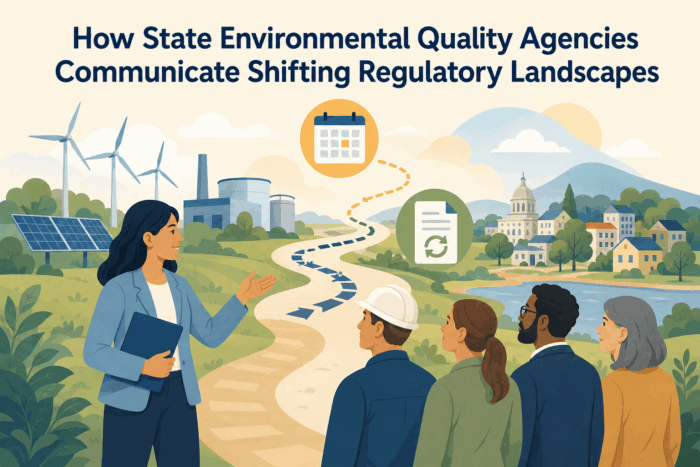
Climate Adaptation and Environmental Compliance: How State Environmental Quality Agencies Communicate Shifting Regulatory Landscapes
Climate adaptation is increasingly changing the context in which environmental compliance decisions are made. State environmental quality agencies may need to communicate new expectations related to water availability, wildfire risk, extreme heat, flooding, infrastructure resilience, air quality, habitat conditions, or changing baseline conditions while regulated entities and communities are still trying to understand how those shifts affect existing permits, programs, and compliance obligations.
The communication challenge is not only that regulatory requirements may evolve. Climate-related environmental conditions can also change the assumptions that agencies, businesses, local governments, and residents have used for years. A standard, permit condition, monitoring program, or planning framework that was developed around historical conditions may need to be interpreted differently as environmental patterns shift. Agencies must explain these changes carefully so stakeholders can distinguish between new legal requirements, updated technical guidance, revised implementation practices, and broader policy direction.
This distinction is essential because regulated entities may interpret any climate-related agency communication as an immediate compliance mandate, while communities may assume that a new adaptation strategy automatically changes enforcement or permitting standards. State environmental quality agencies should therefore communicate not only what is changing, but also what authority supports the change, when it takes effect, who is affected, and which elements remain under development.
A strong communication strategy should help stakeholders navigate regulatory evolution without creating false certainty. Agencies need to explain why environmental conditions are changing, how that affects regulatory planning, where formal requirements differ from recommendations, and what businesses, local governments, and communities should expect next. The objective is to make a shifting regulatory landscape understandable enough that stakeholders can prepare, participate, and comply without relying on speculation.
Distinguish Climate Adaptation Policy From Enforceable Compliance Requirements
 Climate adaptation strategies, resilience plans, executive directives, technical guidance, regulations, permit conditions, and enforcement standards do not carry the same legal or operational weight. State environmental quality agencies should communicate these distinctions clearly whenever climate-related requirements are introduced or discussed.
A resilience framework may influence future planning without immediately changing existing permits. Technical guidance may describe recommended practices while a regulation creates a binding requirement. A permit condition may apply only to a specific facility or program, while a statewide policy may establish broader direction. Stakeholders need to understand which category applies before they can determine what action is required.
Agencies should avoid language that makes a developing policy sound mandatory before the relevant rulemaking or permit process is complete. The opposite problem is equally important: once a requirement becomes enforceable, communication should not continue describing it merely as a future adaptation goal.
Clear classification reduces uncertainty for regulated entities and communities. It allows stakeholders to distinguish between what they must do now, what they may need to prepare for, and what remains subject to further agency or legislative action.
Explain Why Environmental Baselines May Be Changing
Environmental compliance systems often rely on baseline conditions, historical data, design assumptions, or recurring environmental patterns. Climate change can alter those conditions over time, making historical experience a less complete guide for future planning.
State environmental quality agencies should explain when changing rainfall patterns, drought conditions, wildfire behavior, sea-level conditions, heat extremes, water availability, or other environmental shifts are affecting the assumptions used in regulatory planning or technical analysis. The agency should clarify whether those changes are being incorporated into monitoring, modeling, permitting, infrastructure standards, or another process.
This communication should avoid implying that every historical benchmark has become invalid. Some standards may remain fully applicable even as surrounding conditions change. The agency should explain specifically which assumptions are being reconsidered and why.
Making baseline change visible helps stakeholders understand that regulatory evolution is not necessarily arbitrary. It connects new requirements or planning expectations to the environmental conditions the agency is responsible for managing.
Separate Observed Environmental Change From Future Scenario Planning
Agencies may use both observed data and future climate scenarios when developing adaptation strategies. These sources serve different purposes and should not be presented as though they carry the same level of certainty.
Observed trends can describe conditions that have already occurred, while scenario-based analysis helps agencies evaluate possible future conditions under defined assumptions. State environmental quality agencies should explain which type of information is informing a particular decision.
This distinction is especially important when regulated entities are being asked to make long-term investments. Stakeholders should understand whether a requirement responds to current conditions, anticipated future risk, or a combination of both.
Explain What Is Changing and What Is Staying the Same
Regulatory change is easier to understand when agencies identify continuity as well as change. State environmental quality agencies should explain which existing compliance obligations remain in effect even as climate adaptation introduces new expectations.
A facility may still need to meet the same discharge limit while also preparing for more variable water conditions. A remediation program may continue under existing cleanup standards while incorporating new flood or wildfire considerations into long-term management. A monitoring requirement may remain intact while the frequency, location, or interpretation of monitoring changes.
Communicating continuity helps prevent stakeholders from assuming that climate adaptation replaces the existing regulatory framework. In most cases, adaptation modifies how agencies plan, assess risk, or implement responsibilities rather than eliminating established environmental requirements.
This approach also improves compliance planning. Regulated entities can identify which obligations remain stable and focus their attention on the areas where new preparation, investment, or procedural changes may be necessary.
Communicate Regulatory Change Through a Clear Timeline
Climate-related environmental requirements may develop through legislation, rulemaking, guidance, permit revisions, program updates, or phased implementation. Without a clear timeline, regulated entities and communities may struggle to determine when a policy discussion becomes an operational requirement.
State environmental quality agencies should communicate major stages separately. Stakeholders should know when a proposal is being developed, when public input is being accepted, when a final policy or regulation has been adopted, when it becomes effective, and when compliance or enforcement expectations begin.
Timelines should also identify transitional periods. Some programs may provide time for regulated entities to update infrastructure, monitoring systems, emergency plans, or reporting procedures before full implementation. Those periods should be explained clearly so they are not confused with indefinite delay or immediate enforcement.
A visible timeline reduces speculation and allows stakeholders to plan. It also helps communities understand when they can participate in shaping the regulatory response rather than learning about changes only after they become final.
Explain How Climate Adaptation Affects Permitting Without Suggesting Every Permit Will Change
Climate adaptation may influence permit conditions, technical review, monitoring expectations, infrastructure design, or long-term operating assumptions. State environmental quality agencies should explain these potential effects without implying that every existing permit will automatically be reopened or rewritten.
The agency should identify where climate-related considerations enter the permitting process. They may affect new applications, permit renewals, facility modifications, site-specific risk assessments, emergency planning, or another defined stage. Stakeholders should understand whether the change applies broadly or only under particular circumstances.
Agencies should also distinguish between formal permit requirements and technical information that applicants may be asked to provide. A request for additional climate-related analysis does not necessarily mean that a particular permit condition has already been decided.
This precision helps regulated entities prepare appropriately and helps communities understand what climate adaptation can and cannot change within an individual permit proceeding.
Explain How Adaptation and Compliance Interact During Extreme Events
Climate-related events can test the boundary between routine compliance and emergency response. Wildfires, floods, extreme heat, drought, or severe storms may disrupt operations, damage pollution-control systems, alter discharge conditions, or create temporary environmental risks.
State environmental quality agencies should explain how regulated entities are expected to communicate with the agency when these conditions affect compliance. Stakeholders need to know what reporting obligations apply, what emergency procedures exist, and when temporary operational circumstances do or do not alter underlying regulatory responsibilities.
Agencies should avoid creating the impression that extreme conditions automatically excuse noncompliance. At the same time, they should explain any applicable emergency provisions, contingency processes, or case-specific regulatory mechanisms accurately and without overgeneralization.
Clear communication before an event occurs allows regulated entities to prepare operationally and gives communities a more realistic understanding of how environmental protection continues during climate-related disruptions.
How Environmental Protection Agencies Can Make Communication Central to Regulatory Effectiveness, Public Trust, and Community Health
This article is part of our series on strategic communication for Environmental Protection Agencies, Environmental Compliance Agencies, and state and local environmental departments. To learn more and to see the parent article, which links to other content just like this, click the button below.
Explain the Difference Between Adaptation Requirements and Climate Mitigation Goals
Climate policy often combines adaptation and mitigation, but the two address different problems. Adaptation focuses on managing the effects of changing environmental conditions, while mitigation generally focuses on reducing the drivers of climate change, such as greenhouse gas emissions.
State environmental quality agencies should distinguish these concepts when communicating new programs or regulatory changes. A requirement to strengthen stormwater infrastructure, plan for wildfire exposure, or account for future flood conditions may be an adaptation measure. An emissions reduction requirement may fall within a mitigation framework.
The distinction matters because the regulatory authority, affected entities, technical evidence, and compliance pathways may differ. Combining both concepts under broad climate terminology can make it difficult for stakeholders to understand why a particular requirement applies.
Clear terminology allows agencies to communicate each program on its own regulatory and technical basis while showing how the broader climate strategy fits together.
Explain How Regulatory Flexibility Differs From Regulatory Uncertainty
Climate adaptation can require agencies to account for changing environmental conditions while still applying established legal and regulatory requirements. State environmental quality agencies should distinguish between flexibility built into a regulatory program and uncertainty about how future requirements may evolve.
A permit framework may allow site-specific conditions, phased implementation, adaptive management, or contingency planning without making the underlying compliance obligation optional. Conversely, an agency may still be developing guidance or regulations for a climate-related issue, meaning some future expectations are genuinely unsettled. These are different situations and should be communicated differently.
Regulated entities need to know whether they are working within an existing flexible framework or preparing for a potential future change. Communities need the same distinction so they do not interpret agency discretion as a lack of standards or assume that a developing policy has already become enforceable.
Clear communication about flexibility helps agencies preserve credibility. It shows stakeholders where professional judgment is part of the regulatory system and where the agency is still determining how climate adaptation will be incorporated into future requirements.
Explain How Monitoring Programs May Change as Environmental Conditions Shift
Climate adaptation can affect not only regulatory standards but also the way agencies monitor environmental conditions. Changes in rainfall, temperature, drought frequency, wildfire behavior, hydrology, or seasonal patterns may alter when, where, and how environmental data need to be collected.
State environmental quality agencies should explain why monitoring strategies are changing when those changes affect compliance interpretation or public understanding. An adjustment in sampling frequency, monitoring location, seasonal timing, or reporting requirements may reflect new environmental conditions rather than a change in the agency’s underlying commitment to oversight.
Agencies should also explain whether new monitoring is intended to establish a revised baseline, identify emerging risk, evaluate infrastructure resilience, assess the effectiveness of adaptation measures, or support another defined regulatory purpose. This context helps stakeholders understand why additional data are being requested.
Monitoring changes should not be presented as proof that environmental conditions have already deteriorated. In some cases, expanded monitoring is precautionary or designed to improve future planning. Precision about purpose helps prevent unnecessary alarm while maintaining transparency.
Communicate Climate-Related Compliance Costs Without Minimizing Their Operational Impact
New adaptation requirements can create meaningful operational and financial consequences for regulated entities, local governments, utilities, and infrastructure operators. State environmental quality agencies should acknowledge these impacts when explaining regulatory change rather than presenting new requirements as administratively minor.
Communication should identify which activities may require additional planning, monitoring, engineering, reporting, maintenance, infrastructure investment, or emergency preparedness. Agencies should avoid speculating about costs they cannot reliably estimate, but they can explain which obligations are likely to require additional resources and when those obligations are expected to take effect.
This transparency is particularly important for smaller regulated entities and local governments that may have limited technical or financial capacity. If implementation assistance, phased schedules, technical resources, grants, or other support mechanisms are available, agencies should explain those options clearly without implying that support eliminates the underlying compliance responsibility.
Communities also benefit from understanding the implementation context. When regulatory changes require substantial infrastructure or operational adjustments, communication should explain why those investments are connected to environmental protection and climate resilience rather than allowing the cost discussion to become detached from the regulatory purpose.
Explain How Climate Adaptation Changes Long-Term Compliance Planning
Climate adaptation often requires regulated entities to think beyond the next permit cycle or reporting period. Infrastructure designed for decades of operation may need to account for conditions that differ from those used when the facility or system was originally planned.
State environmental quality agencies should explain when longer planning horizons are becoming relevant to compliance. A wastewater system, stormwater facility, remediation remedy, hazardous materials program, or other regulated operation may need to consider future environmental conditions because failure under those conditions could create compliance or environmental risks.
The agency should be precise about whether long-term planning is a formal requirement, an emerging expectation, or recommended preparation. Regulated entities need enough information to distinguish actions they are required to take from steps that may reduce future compliance risk.
Communicating long-term expectations early can reduce disruption. Stakeholders have more opportunity to incorporate adaptation into capital planning, operational changes, and permit preparation instead of responding only after a new requirement becomes immediate.
Connect Long-Term Planning to Near-Term Decisions
Long-range climate scenarios can feel abstract when regulated entities are focused on current permits and operating requirements. State environmental quality agencies should explain how future conditions affect decisions being made now.
A near-term infrastructure replacement, permit renewal, monitoring redesign, or remediation decision may create an opportunity to account for conditions expected over the useful life of that investment. The agency should explain that connection when it is relevant to the regulatory process.
This helps stakeholders understand why climate adaptation can influence present decisions even when the projected environmental condition may develop gradually over many years.
Explain How Climate Adaptation Interacts With Existing Infrastructure Constraints
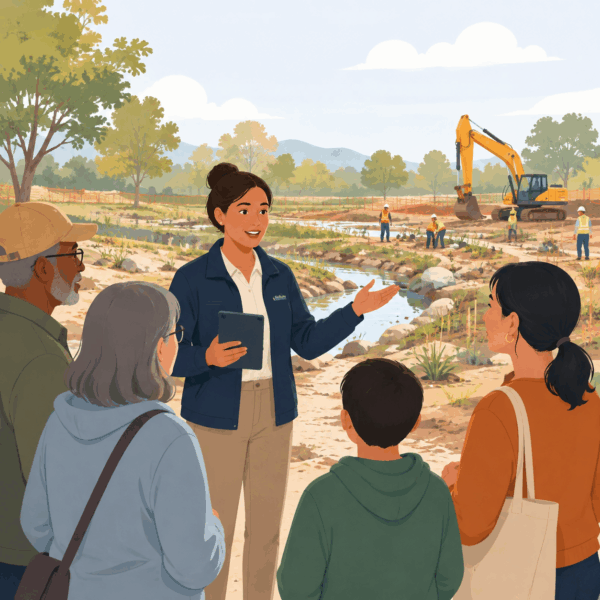 Environmental compliance requirements often apply to infrastructure that was designed under different environmental assumptions. Older drainage systems, treatment facilities, containment structures, monitoring networks, and industrial equipment may face new stresses as climate conditions shift.
State environmental quality agencies should acknowledge this legacy infrastructure challenge when communicating adaptation requirements. Regulated entities may need to understand whether the agency expects operational modifications, infrastructure upgrades, contingency planning, or additional monitoring to address changing risk.
Communication should distinguish between recognizing infrastructure limitations and excusing ongoing noncompliance. Existing design constraints may explain why adaptation requires significant investment, but they do not automatically change the environmental standards or legal obligations that apply.
A clear explanation helps stakeholders see adaptation as a transition problem rather than a sudden regulatory departure. It also gives communities a better understanding of why some compliance improvements may require phased physical changes rather than immediate replacement of entire systems.
Communicate Climate Science at the Level Needed for the Regulatory Decision
Climate adaptation communication can become ineffective when agencies either oversimplify the science or provide more technical detail than stakeholders need to understand the compliance issue. State environmental quality agencies should focus climate information on the environmental condition relevant to the regulatory decision.
If a program is addressing increased flood risk, communication should explain the data and projections relevant to flooding rather than attempting to summarize climate science broadly. If drought affects water quality or discharge conditions, the agency should focus on those relationships. This keeps the scientific explanation connected to the regulatory purpose.
Agencies should identify the source and role of climate information, including whether it comes from observed data, modeling, scenario analysis, or another technical method. Where uncertainty exists, the agency should explain how that uncertainty is incorporated into planning rather than presenting projections as precise predictions.
This focused approach helps regulated entities and communities understand why climate information matters to a specific regulatory program. The science supports the decision rather than becoming a separate communication exercise.
Coordinate Climate Adaptation Communication Across Environmental Programs
Climate-related environmental changes may affect several regulatory programs simultaneously. Drought can influence water quality, wildfire can affect air emissions and watershed conditions, flooding can affect contaminated sites, and extreme heat can alter facility operations or environmental performance.
State environmental quality agencies should coordinate communication across internal programs so stakeholders do not receive disconnected explanations of the same climate condition. Program-specific requirements may differ, but the underlying environmental context should remain consistent.
Coordination is especially important when one regulated entity is subject to several programs. A facility should not receive materially different descriptions of climate risk from permitting, enforcement, remediation, and emergency planning units without understanding why those distinctions exist.
A shared internal climate communication framework can help agencies preserve consistency while allowing each program to explain its specific regulatory responsibilities. Stakeholders gain a more coherent picture of how adaptation is influencing environmental compliance across the agency.
Create Meaningful Participation Before Climate-Related Requirements Are Finalized
Climate adaptation requirements can create significant operational, financial, and community consequences. State environmental quality agencies should provide clear participation pathways early enough that regulated entities, local governments, communities, and technical stakeholders can understand and respond to proposed changes before final implementation.
Public communication should explain what is being proposed, why the agency believes the change is necessary, what evidence supports it, which elements remain open for input, and what authority governs the process. Stakeholders should not have to interpret a technical proposal before they can understand the decision being considered.
The agency should also distinguish between participation on the policy itself and participation in later permit-specific implementation. A statewide adaptation rule may establish one set of requirements, while individual permitting decisions determine how those requirements apply to particular facilities.
Making those stages visible supports more focused participation. Stakeholders can direct comments toward the decisions that are actually open rather than raising concerns after a policy or requirement has already become final.
Organize Climate Compliance Communication Around the Decisions Stakeholders Need to Make
Climate adaptation communication becomes more useful when it is organized around practical decisions rather than around broad policy concepts. State environmental quality agencies should help regulated entities, local governments, and communities understand what action is required now, what preparation may be prudent, what remains under development, and when additional regulatory decisions will occur.
This structure is especially important when several climate-related initiatives are moving at different stages. One program may already contain enforceable requirements, another may be undergoing rulemaking, and a third may still be operating through technical guidance. Without clear separation, stakeholders may interpret the entire climate agenda as one unified mandate.
Public-facing materials should therefore distinguish current obligations, upcoming milestones, participation opportunities, and longer-term planning expectations. Agencies can then connect those decisions to the environmental conditions that make adaptation relevant, such as changing flood patterns, wildfire risk, water availability, or extreme heat.
A decision-centered approach reduces unnecessary uncertainty. Stakeholders do not need to understand every climate policy initiative at once. They need to know how the evolving regulatory landscape affects the decisions they are responsible for making.
Explain How New Climate Information Changes Existing Regulatory Assumptions
Climate adaptation often enters environmental compliance through updated technical information rather than through an entirely new regulatory program. Revised flood projections, changing hydrologic conditions, wildfire data, temperature trends, or infrastructure vulnerability assessments may affect how agencies evaluate existing requirements.
State environmental quality agencies should explain when new information changes a regulatory assumption and when it does not. A new climate projection may influence future permit review, for example, without automatically invalidating an existing permit. A revised hazard map may affect contingency planning while leaving unrelated compliance requirements unchanged.
Agencies should also identify the point at which new information becomes operationally relevant. Stakeholders need to know whether the agency is using the information for screening, planning, permit development, enforcement, infrastructure design, or another defined purpose.
Making this transition visible helps regulated entities understand why a familiar regulatory process may begin asking different questions. It also helps communities see how changing environmental evidence is being incorporated into agency decision-making.
Translate Climate Uncertainty Into Regulatory Planning Language
Climate adaptation frequently requires agencies to make decisions under uncertainty. Future rainfall, wildfire behavior, temperature extremes, sea-level conditions, and other environmental variables may be projected across ranges rather than predicted precisely.
State environmental quality agencies should explain how that uncertainty is handled within the regulatory process. Rather than presenting one future scenario as certain, agencies can describe the range of conditions being considered and explain which planning or compliance decisions are designed to remain effective across that range.
Communication should distinguish uncertainty from lack of evidence. A projection can carry uncertainty while still providing enough information to justify precautionary planning or infrastructure design. Stakeholders should understand that uncertainty is part of the analytical framework, not necessarily a reason to delay all action.
Agencies should also explain when additional monitoring or future review will be used to adjust implementation. This helps regulated entities see how adaptive management, phased requirements, or periodic reassessment may function within the compliance framework.
Explain Why a Range of Future Conditions May Be More Useful Than One Forecast
Regulated entities may prefer a single number or design assumption, but climate adaptation often requires planning across several plausible future conditions. State environmental quality agencies should explain why a range may provide a stronger basis for long-term decisions.
A treatment facility, containment system, drainage structure, or remediation remedy may need to remain functional under conditions that cannot be predicted exactly decades in advance. Evaluating several scenarios can help identify where a design or operating approach becomes vulnerable.
Explaining this reasoning helps stakeholders understand that scenario planning is not evidence of indecision. It is a method for managing uncertainty in long-lived environmental systems.
Clarify How Adaptation Expectations Apply Differently Across Regulated Entities
Climate-related environmental risks do not affect every regulated entity in the same way. A coastal facility may face flooding or sea-level concerns, an inland facility may face wildfire or extreme heat, and a water-dependent operation may be more sensitive to drought or changing hydrology.
State environmental quality agencies should avoid communicating adaptation requirements as though every entity faces identical risks or implementation needs. Where regulatory frameworks allow site-specific evaluation, agencies should explain how location, infrastructure, operational characteristics, environmental pathways, and useful life affect the analysis.
At the same time, site-specific implementation should not be confused with inconsistent standards. The agency should explain which underlying regulatory objectives apply broadly and which technical or operational measures may vary according to circumstance.
This distinction helps regulated entities understand why their compliance pathway may differ from another facility’s without assuming that regulatory expectations are arbitrary. It also helps communities understand why adaptation measures may look different across projects or regions.
Explain When Existing Permits or Plans May Need Reassessment
One of the most sensitive questions in climate adaptation is whether existing permits, approvals, remediation plans, or compliance strategies remain adequate as environmental conditions change. State environmental quality agencies should communicate the circumstances under which reassessment may occur.
The agency should identify whether review may be triggered by permit renewal, modification, new monitoring information, infrastructure change, an extreme event, a regulatory update, or another defined process. Stakeholders should not be left to assume that every climate-related development automatically reopens an existing decision.
When reassessment is required, communication should explain what part of the existing framework is being reconsidered and why. A long-term containment strategy may need updated flood assumptions, for example, while other elements of the remediation plan remain unchanged.
This targeted explanation reduces unnecessary alarm while preserving transparency. Regulated entities can prepare for the specific issues likely to be reviewed, and communities can understand how the agency responds when changing environmental conditions affect previously approved approaches.
Communicate Transitional Compliance Expectations Clearly
Regulatory transitions create risk when stakeholders cannot tell whether old requirements, new requirements, or both apply during the implementation period. Climate adaptation programs may introduce phased standards, updated planning expectations, new monitoring requirements, or revised technical guidance over time.
State environmental quality agencies should provide clear transitional communication that identifies effective dates, interim obligations, legacy provisions, and any applicable phase-in periods. Regulated entities should understand what they are expected to do during the period between adoption and full implementation.
Agencies should also explain how pending permit actions or projects already underway will be treated. Where rules differ depending on application date, renewal timing, or implementation stage, those distinctions should be communicated explicitly rather than left to individual interpretation.
Clear transition guidance supports compliance and reduces disputes. It allows stakeholders to plan around known milestones rather than guessing when the agency will begin applying a new climate-related expectation.
Connect Adaptation Requirements to Compliance Risk Management
Climate adaptation should not be communicated only as a broad environmental policy objective. For regulated entities, it is increasingly connected to practical compliance risk. Infrastructure failure, changing discharge conditions, disrupted pollution-control systems, or inadequate contingency planning can create environmental consequences that later become compliance problems.
State environmental quality agencies should explain this connection directly. Preparing for future environmental conditions can help facilities reduce the likelihood of permit exceedances, uncontrolled releases, emergency shutdowns, or other incidents that may trigger regulatory response.
This framing is most useful when it remains specific. Agencies should identify which operational vulnerabilities are relevant to the program rather than presenting adaptation as a universal solution to every compliance challenge.
Connecting adaptation to compliance risk helps regulated entities understand why planning matters before a crisis occurs. It also reinforces that adaptation is not separate from environmental protection but can become part of maintaining reliable compliance under changing conditions.
Coordinate Public Communication When Climate Adaptation Crosses Agency Boundaries
Climate-related environmental issues frequently cross jurisdictional lines. Flooding may affect contaminated sites, stormwater systems, drinking water infrastructure, transportation networks, and emergency response. Wildfire may affect air quality, hazardous materials, watershed conditions, and land management simultaneously.
State environmental quality agencies should coordinate communication with other state, regional, and local bodies when adaptation responsibilities intersect. Stakeholders need to understand which agency controls the environmental compliance requirement and which institutions are responsible for infrastructure, public health, emergency management, land use, or other related decisions.
Coordination should preserve role clarity. A state environmental quality agency can explain how climate conditions affect its regulatory programs without implying that it controls municipal infrastructure investment, emergency operations, or another agency’s permitting authority.
A coordinated public explanation reduces fragmentation. Regulated entities and communities can see how several adaptation responsibilities fit together while still understanding which agency is accountable for each decision.
Correct Climate-Related Misunderstandings Without Treating Policy Disagreement as Misinformation
Climate adaptation can generate disagreement about costs, regulatory authority, scientific assumptions, implementation timelines, and the appropriate level of precaution. State environmental quality agencies should distinguish factual inaccuracies from legitimate policy or regulatory disagreement.
When a claim misstates an effective date, permit requirement, technical finding, or agency authority, the agency should provide a clear correction supported by the relevant public record. Corrections should focus on the information rather than the motives of the person or organization making the claim.
Different views about how quickly adaptation should occur, how costs should be distributed, or which regulatory approach is preferable are not automatically misinformation. Agencies should address those concerns through the appropriate rulemaking, permitting, or public engagement process.
This distinction supports credibility in a politically and technically complex area. Agencies can protect the accuracy of the regulatory record while recognizing that stakeholders may reasonably disagree about the policy choices used to respond to changing environmental conditions.
Build Climate Adaptation Communication Into Regulatory Program Management
Climate adaptation communication is most effective when it is integrated into the same systems that govern rulemaking, permitting, monitoring, enforcement, remediation, and technical guidance. State environmental quality agencies should identify communication needs as climate-related regulatory changes are being developed rather than waiting until a new requirement is ready for implementation.
Program teams should identify which developments will require stakeholder communication, including proposed regulations, revised guidance, new monitoring expectations, changes in permit review, updated technical assumptions, or implementation deadlines. Communication staff should be involved early enough to understand why the change is occurring and how it affects existing obligations.
Agencies should also define which stakeholder groups need different levels of explanation. Regulated entities may need operational guidance, local governments may need implementation context, and communities may need a clearer explanation of how the change affects environmental protection or public participation. These audiences can receive different communication formats while relying on the same regulatory facts.
Integrating communication into program management helps climate adaptation changes feel like part of an understandable regulatory process rather than a sequence of disconnected announcements. It also reduces the risk that stakeholder confusion emerges only after implementation begins.
Create a Central Source for Climate-Related Regulatory Changes
As climate adaptation affects multiple environmental programs, stakeholders may encounter information across permitting webpages, technical guidance, rulemaking notices, monitoring programs, resilience plans, and enforcement materials. State environmental quality agencies should create a clear navigation structure that allows stakeholders to see how these changes fit together.
A central climate compliance or adaptation resource can identify current requirements, proposed changes, technical guidance, effective dates, implementation schedules, public participation opportunities, and program-specific contacts. It should distinguish clearly between final requirements and materials that remain under development.
The central source should also preserve links to formal regulatory documents and technical evidence. Public-facing summaries can help stakeholders understand the change, while the full record remains available for legal, technical, or operational review.
This structure reduces fragmentation and helps stakeholders determine whether a new climate-related initiative affects their particular permit, facility, program, or community. It also gives agency staff one authoritative source to reference when answering recurring questions.
Establish Version Control for Evolving Guidance and Requirements
Climate adaptation programs may change incrementally as new science, monitoring, policy direction, or implementation experience becomes available. Without clear version control, regulated entities can continue relying on outdated guidance or may be uncertain about which document represents the agency’s current position.
State environmental quality agencies should clearly date and label climate-related guidance, technical documents, implementation materials, and public summaries. Superseded versions should remain available where necessary for transparency, but they should not appear to be current.
When an update materially changes compliance expectations, the agency should explain what changed and why. Stakeholders should not be expected to compare lengthy technical documents line by line to determine whether a requirement, recommendation, or planning assumption has been revised.
Clear version control also helps distinguish scientific refinement from regulatory change. Updated climate data may improve technical analysis without changing an enforceable requirement, while a new rule or permit condition may create a substantive compliance obligation. Public communication should make that difference visible.
Separate Technical Updates From Formal Regulatory Changes
Climate adaptation programs may produce frequent updates to models, projections, data, or technical methodologies. These changes do not always carry the same regulatory significance as a new regulation, permit condition, or enforcement policy.
State environmental quality agencies should label technical updates according to their role. Stakeholders should understand whether the new information changes current obligations, informs future planning, or simply improves the analytical basis used by the agency.
This distinction prevents routine technical refinement from being interpreted as constant regulatory instability.
Coordinate Climate Communication Across Internal Programs
Climate adaptation can affect air quality, water quality, hazardous materials, waste management, remediation, permitting, emergency planning, and other environmental programs at the same time. State environmental quality agencies should coordinate communication across these units so stakeholders do not receive conflicting explanations of the same climate condition.
A shared internal communication framework can identify the core climate information being used, relevant terminology, major assumptions, and program-specific implications. Each program can then explain its own responsibilities without presenting fundamentally different descriptions of the environmental context.
Coordination is particularly important when one regulated entity interacts with several programs. A facility may be asked to consider flood risk in one permit, wildfire resilience in another process, and extreme weather contingency planning elsewhere. Public and regulated-entity communication should help those requirements appear connected rather than arbitrary.
Internal alignment also helps leadership and public information staff explain the agency’s broader adaptation strategy accurately. Climate adaptation becomes easier to understand when program-level changes are presented as related components of one environmental management framework.
Prepare Staff to Explain Climate-Related Regulatory Change Consistently
Climate adaptation introduces technical and regulatory concepts that may be unfamiliar even to experienced staff outside specialized programs. State environmental quality agencies should prepare permitting staff, inspectors, public information officers, community engagement teams, and leadership to explain new expectations consistently.
Staff guidance can identify what has changed, why it changed, when it takes effect, which entities are affected, what remains under development, and where additional technical or legal questions should be referred. This reduces the likelihood that stakeholders receive different answers depending on which program or employee they contact.
Training should also address uncertainty. Staff should be comfortable explaining scenario planning, changing baselines, adaptive management, and phased implementation without making unsupported predictions about future regulation or environmental conditions.
Consistent staff communication strengthens compliance because regulated entities receive clearer guidance and communities receive a more reliable explanation of the agency’s evolving role.
Coordinate Implementation Communication With Regulated Entities and Local Governments
Climate adaptation requirements may require regulated entities and local governments to change infrastructure planning, monitoring, reporting, emergency procedures, or operational practices. State environmental quality agencies should establish communication systems that support implementation after a regulation or policy is adopted.
Implementation materials should identify key dates, affected programs, required actions, reporting expectations, and available technical resources. Agencies should also provide clear contact pathways for questions that cannot be resolved through general guidance.
Where requirements are phased, communication should explain what is expected at each stage. Stakeholders should understand the difference between planning milestones, implementation deadlines, and full compliance dates.
Ongoing communication is especially important when implementation reveals practical challenges. Agencies may learn that certain guidance requires clarification or that regulated entities are interpreting a requirement inconsistently. Addressing those patterns early can reduce later compliance disputes.
Measure Whether Stakeholders Understand the Regulatory Transition
State environmental quality agencies should evaluate whether climate adaptation communication is reducing confusion rather than simply counting guidance documents, meetings, or webpage visits. The key question is whether stakeholders can identify what has changed, what they are required to do, and when the change applies.
Useful indicators may include recurring questions about effective dates, confusion between guidance and enforceable requirements, misunderstanding of permit implications, or inconsistent implementation across regulated entities. These patterns can reveal where agency communication is not sufficiently precise.
Agencies can also examine whether public comments and stakeholder questions become more focused as explanatory materials improve. Local governments, regulated entities, community organizations, and front-line agency staff can provide useful feedback about which elements of the transition remain difficult to navigate.
Measurement should lead to revision. Agencies can improve FAQs, implementation guidance, staff training, digital navigation, and timeline communication based on the areas where misunderstanding persists.
Build Institutional Infrastructure for Long-Term Climate Regulatory Communication
Climate adaptation will continue to influence environmental regulation over many years. State environmental quality agencies should build communication systems that can evolve with changing science, policy, and implementation rather than treating every new climate-related requirement as a separate outreach effort.
Institutional resources can include standard regulatory change templates, timeline frameworks, climate terminology guidance, program coordination procedures, staff training materials, stakeholder contact structures, and version-control protocols. These tools should support consistency while allowing individual programs to address their own technical and regulatory needs.
Agencies should also preserve lessons from major regulatory transitions. If one climate-related program generated confusion about authority, effective dates, technical assumptions, or implementation expectations, those lessons should inform future communication before similar problems recur.
Strong institutional infrastructure helps agencies communicate regulatory evolution with greater continuity. Stakeholders may still face a shifting environmental landscape, but they are more likely to understand how and why the agency’s expectations are changing over time.
Strategic Communication Support for Climate Adaptation and Environmental Compliance
Climate adaptation creates communication challenges because regulatory change may emerge through legislation, rulemaking, technical guidance, permit implementation, monitoring updates, or revised planning assumptions over different timelines. State environmental quality agencies may understand how those pieces fit together internally while regulated entities, local governments, and communities experience them as a shifting set of expectations. External strategic communication support can help agencies organize that complexity into a clearer public and stakeholder communication system.
Stegmeier Consulting Group (SCG) can support state environmental quality agencies by developing regulatory change communication plans, plain-language summaries, stakeholder guidance, climate adaptation explainers, implementation timelines, permit communication materials, public participation content, staff talking points, digital resource structures, FAQs, and cross-program messaging frameworks. SCG can also help agencies align communication across technical staff, permitting teams, enforcement programs, leadership, local government partners, and public-facing channels so stakeholders can distinguish current requirements, emerging expectations, technical updates, and future regulatory decisions.
External support can be especially valuable when internal communication capacity is limited, several programs are changing simultaneously, or an objective outside perspective can identify where technically accurate materials are still creating uncertainty about authority, timing, or compliance obligations. SCG’s role remains focused on communication strategy, information organization, stakeholder engagement, and public-facing systems. SCG does not develop climate science findings, determine regulatory authority, issue permits, establish compliance standards, make enforcement decisions, or provide legal determinations on behalf of the agency.
Future Trends
Climate adaptation will increasingly become embedded within routine environmental compliance rather than operating as a separate policy initiative. State environmental quality agencies will need to communicate how changing environmental conditions affect established programs such as permitting, remediation, monitoring, emergency planning, infrastructure protection, and long-term facility operations. Stakeholders will expect to understand not only new climate policies but also how climate considerations are altering familiar regulatory processes.
Regulatory communication will also need to become more dynamic as agencies rely on updated climate data, revised projections, monitoring trends, and adaptive management approaches. Static guidance documents may be supplemented by more frequently updated digital resources that distinguish current requirements from evolving technical information. Strong version control and visible explanations of what changed will become increasingly important as stakeholders navigate those updates.
Coordination across agencies and levels of government will become more significant as climate impacts cross regulatory boundaries. Flooding, drought, wildfire, heat, and changing water conditions can simultaneously affect environmental quality, public infrastructure, emergency management, public health, land use, and utility operations. State environmental quality agencies will need communication systems that clarify where their regulatory responsibilities begin and end while helping stakeholders understand how related government actions fit together.
Technology can improve climate data visualization, scenario communication, notification systems, document navigation, and stakeholder access, but it will not eliminate the need for careful interpretation. Agencies will still need to explain uncertainty, distinguish projections from observed conditions, connect long-term scenarios to present regulatory decisions, and ensure that new digital tools do not make an already complex regulatory landscape harder to understand.
Conclusion
Climate adaptation is changing the context in which environmental compliance decisions are made, but regulatory change becomes difficult to navigate when stakeholders cannot distinguish policy direction from enforceable requirements, technical updates from legal changes, or future planning from current obligations. State environmental quality agencies should make those distinctions visible throughout the regulatory process.
Effective communication should explain why environmental assumptions are changing, what evidence supports the change, which programs are affected, when new expectations take effect, and what remains stable. Regulated entities need this clarity to plan investments and maintain compliance, while communities need it to understand how changing environmental conditions influence the protections and regulatory decisions that affect them.
The strongest communication systems also recognize that climate adaptation is an ongoing process rather than a single regulatory transition. New information, changing environmental conditions, implementation experience, and future policy decisions may continue to reshape requirements over time. Agencies should therefore build durable communication infrastructure that can explain regulatory evolution without making every technical update appear to be a new mandate.
State environmental quality agencies cannot eliminate uncertainty from climate adaptation, but they can make uncertainty more navigable. When stakeholders understand what is known, what is changing, what remains under development, and what decisions they need to make, the regulatory landscape becomes easier to follow even as environmental conditions continue to shift.
Stegmeier Consulting Group’s Strategic Approach to Communication Systems
Make climate-related regulatory change easier to navigate by connecting technical change, compliance expectations, implementation timelines, and stakeholder communication in one clear system.
State environmental quality agencies need communication systems that help regulated entities, local governments, communities, and partner agencies understand how climate adaptation is affecting environmental compliance, what requirements are changing, when those changes apply, and how future regulatory decisions will unfold. Stegmeier Consulting Group (SCG) helps agencies organize complex regulatory information, develop plain-language materials, align cross-program messaging, strengthen stakeholder engagement, and build communication frameworks that make evolving climate-related expectations easier to understand and implement.
Use the form below to connect with our team and explore how strategic communication support can strengthen climate adaptation and environmental compliance communication.