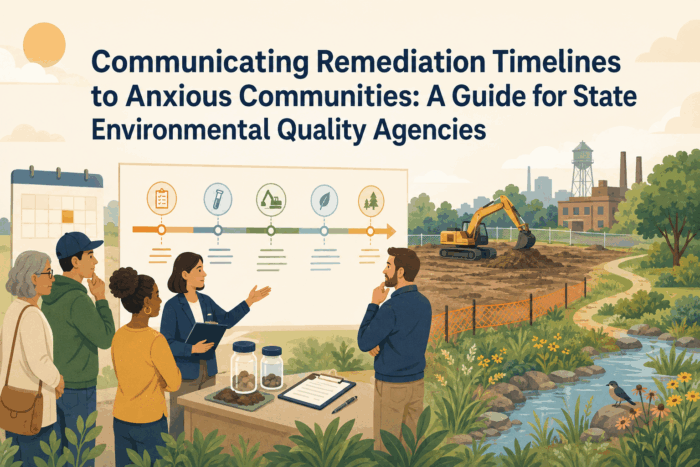
Communicating Remediation Timelines to Anxious Communities: A Guide for State Environmental Quality Agencies
Environmental remediation is rarely experienced by nearby communities as a straightforward sequence of technical tasks. Residents may first learn that contamination exists and then encounter months of sampling, technical analysis, regulatory review, remedy development, contractor preparation, field work, and monitoring before a site reaches a meaningful cleanup milestone. During that period, the project may be advancing exactly as required while the community experiences something very different: uncertainty about what is happening, how long conditions will continue, whether the schedule is changing, and what each new phase actually means.
For state environmental quality agencies, this creates a communication challenge that extends well beyond publishing estimated dates. Remediation timelines are shaped by information that becomes available progressively as a project develops. Additional sampling can change the understood extent of contamination, site conditions can affect the feasibility of a proposed remedy, and design, access, procurement, permitting, coordination, construction conditions, or monitoring requirements can influence when subsequent work occurs. A timeline communicated as a fixed commitment can therefore become inaccurate even when the underlying remediation process remains responsible, technically sound, and appropriately managed.
At the same time, excessive caution can create its own communication problem. If an agency repeatedly emphasizes that schedules are uncertain without clearly explaining what is known, what remains unresolved, and what will determine the next decision, communities may interpret that uncertainty as a lack of progress or accountability. Residents need more than technical disclaimers or broad statements about complexity. They need a clear framework for understanding how the project moves from investigation to action, why particular phases require time, and what evidence demonstrates that the remediation process is continuing to advance.
Effective remediation timeline communication therefore depends on calibrated certainty. Agencies should be specific where information is established, transparent where timing remains conditional, and consistent in showing how each milestone contributes to the larger cleanup process. The objective is not to make a complex environmental project appear simpler than it is, nor is it to eliminate uncertainty that cannot reasonably be eliminated. The objective is to make the process understandable enough that communities can distinguish legitimate project development from unexplained delay and can interpret schedule changes within the broader context of environmental decision-making.
Reframing the Remediation Timeline as a Sequence of Decisions
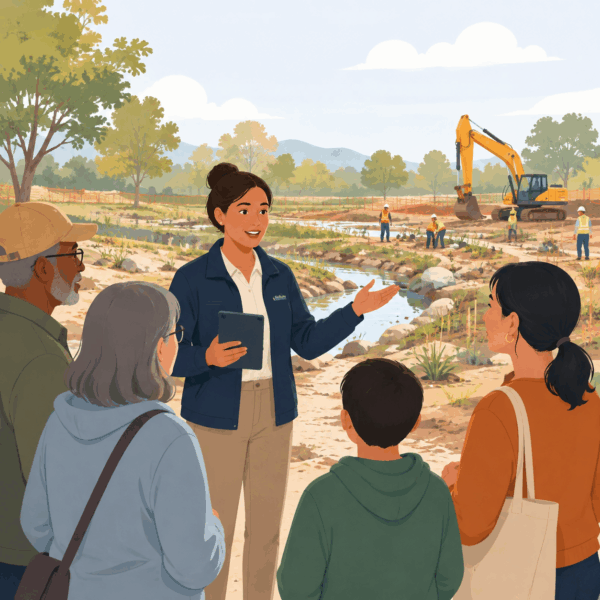 The most common weakness in public-facing remediation timelines is that they present time without adequately explaining the process. A schedule may identify months or seasons for investigation, design, construction, and monitoring, yet still leave residents uncertain about what must actually occur during those periods, what decisions are being made, and why one phase cannot simply be accelerated into the next. State environmental quality agencies can strengthen public understanding by presenting the remediation timeline as a sequence of connected technical and regulatory decisions rather than as a countdown to a single completion date.
This distinction matters because remediation projects typically develop through stages in which the outcome of one activity informs what can responsibly happen next. An investigation may need to establish where contamination is located and how it is moving before an appropriate response can be evaluated. Additional sampling may become necessary when initial findings reveal conditions outside the expected area, while remedy development may depend on the characteristics of the site, the contaminants involved, existing infrastructure, land use, and other project-specific conditions. Implementation may then require engineering, coordination, access, procurement, site preparation, and other work before visible cleanup activity begins.
The exact sequence will vary by remediation program, site, jurisdiction, and regulatory framework, and public communication should reflect the actual process governing the specific project rather than imposing a generic cleanup model. The broader communication principle, however, remains consistent. Residents should be able to understand what stage the project is in, what that stage is intended to determine or accomplish, and what milestone allows the project to advance. When those relationships are explained clearly, time becomes connected to purpose rather than appearing as an unexplained interval between visible activities.
Without that context, a six-month period between two public updates can easily look like inactivity. With the appropriate explanation, residents may understand that the same period includes additional field investigation, laboratory analysis, technical evaluation, development of a proposed response, or another substantive phase of the remediation process. This does not require agencies to overwhelm communities with procedural detail. It requires them to explain enough of the sequence that people can see how current work contributes to later decisions.
Agencies should also distinguish between activity and progress because technical activity alone does not automatically reassure a community. Reporting that samples were collected, reports were reviewed, or meetings were held provides evidence that work occurred, but it may not answer the question residents are actually trying to resolve: whether the project is meaningfully closer to addressing the environmental condition. Communication should therefore connect each major activity to its consequence for the project so that residents can understand not only what happened, but also why it matters.
If additional groundwater sampling is being conducted, for example, the public explanation should clarify what information the sampling is intended to establish and how the results will inform the next stage. If a cleanup design is under development, the communication should explain that the design translates a selected response into the specifications needed for implementation. If a technical review is taking longer than anticipated, the agency should explain what is being evaluated and why that evaluation is necessary before the project can advance. This approach makes remediation communication more substantive without requiring agencies to translate every technical document into public-facing language.
It also helps agencies avoid an important trust problem: describing the project primarily through internal process milestones that have little meaning outside the organization. Terms familiar to environmental professionals may not automatically communicate significance to residents. A phrase such as supplemental characterization, remedial design, feasibility evaluation, or long-term monitoring may be technically appropriate, but public-facing communication should explain what the activity means within the larger cleanup process. The goal is not to remove technical terminology entirely. In many cases, those terms are important because residents may encounter them in public documents, meetings, or regulatory materials. Instead, agencies can introduce technical language alongside plain-language explanations that give people the context needed to interpret it accurately.
How Environmental Protection Agencies Can Make Communication Central to Regulatory Effectiveness, Public Trust, and Community Health
This article is part of our series on strategic communication for Environmental Protection Agencies, Environmental Compliance Agencies, and state and local environmental departments. To learn more and to see the parent article, which links to other content just like this, click the button below.
Match the Precision of the Timeline to the Certainty of the Information
A credible remediation timeline does not treat every future date as equally certain. Some milestones may be firmly scheduled, while others may depend on pending sampling results, regulatory decisions, technical findings, property access, contractor mobilization, seasonal conditions, or other project-specific factors. When agencies communicate all of these dates with the same degree of confidence, they create expectations that the project itself may not be able to support and make later adjustments appear more significant than they actually are.
A stronger approach is to communicate timing according to the actual level of certainty. An activity with an established start date can be communicated as scheduled, while a phase expected to occur within a particular season or quarter can be described as anticipated within that period. A future milestone that depends on unresolved technical information can be presented as conditional, with a clear explanation of what must occur before the timing can be confirmed. This approach does not make the agency appear less confident. It makes the communication more accurate and aligns public expectations with the realities of project development.
For example, an agency may know that another round of field sampling will occur in September but may not yet know precisely when the resulting data will support a final decision about the next remediation phase. Those two milestones should not be communicated with the same level of certainty simply because they appear on the same project schedule. Distinguishing between a scheduled activity and a projected decision point helps the public understand that uncertainty is not uniformly distributed across the entire timeline.
The distinction is especially important early in remediation, when communities may be looking for a final cleanup date long before the agency has enough information to establish one responsibly. Giving residents a preliminary date that later changes repeatedly can create more frustration than explaining from the beginning why a final completion estimate is not yet reliable. At the same time, agencies should avoid using uncertainty as a reason to provide no meaningful timing information at all. Even when a final completion date cannot be established, a community can still be told when the current phase is expected to occur, what decision or activity will follow, and when the agency expects to have better information about later stages.
This creates a progressive timeline in which precision increases as the project itself becomes more defined. Rather than presenting uncertainty as a weakness in the process, the agency can show how new information gradually narrows the range of possible outcomes and allows later milestones to be scheduled with greater confidence.
Agencies should also identify the major dependencies that could materially affect the schedule before those dependencies become delays. If the next phase depends on completing additional investigation, obtaining access, finalizing a technical design, or resolving another substantive condition, that relationship should be visible in the communication. Doing so gives residents a framework for interpreting later developments and reduces the likelihood that a revised date will appear arbitrary or unexplained.
A changed date can then be understood as part of an established decision process rather than as a departure from a prior promise. That distinction is central to maintaining credibility over the life of a remediation project. Communities do not need agencies to predict every future development correctly. They do need agencies to communicate what they know responsibly, distinguish estimates from commitments, acknowledge when assumptions change, and explain how those changes affect the path forward.
Understanding Why Remediation Timelines Generate Community Anxiety
Remediation timelines become difficult to communicate because residents are rarely evaluating time as an abstract project-management variable. The duration of a cleanup process is often connected to broader concerns about environmental conditions, property use, neighborhood stability, construction impacts, institutional accountability, and uncertainty about what may happen next. A timeline that appears reasonable within a technical program can therefore feel very different to someone living near the affected site, particularly when the visible condition of the property does not seem to change for long periods.
This difference in perspective is important for state environmental quality agencies because it shapes how communities interpret both progress and delay. Technical staff may understand that several months of additional investigation are necessary to refine the understanding of site conditions, while residents may interpret the same period as evidence that the agency still does not know the extent of the problem. A project team may view an extended design period as a necessary step toward implementing an appropriate remedy, while the public may see another season passing without visible cleanup activity. These differences do not necessarily reflect misunderstanding or unreasonable expectations. They often reflect the fact that technical progress is not automatically visible or meaningful to people outside the remediation process.
Agencies therefore need to understand what the timeline represents to the people receiving the information rather than relying only on the schedule itself. For some residents, the central concern may be how long contamination will remain near their homes or businesses. Others may be focused on whether field work will disrupt traffic, parking, access, or daily routines. Property owners may be concerned about how the site will affect future use or community perceptions, while local officials may be fielding constituent questions about why the process is taking so long. Community organizations may be trying to determine whether agency actions remain consistent with earlier commitments and whether the information being provided is sufficient to understand the project’s direction.
These concerns do not mean that every remediation project will generate the same level or type of anxiety. They demonstrate why public response cannot be understood solely by looking at the technical schedule. The communication environment surrounding the timeline is influenced by what people believe the project means for their immediate circumstances, how much confidence they have in the information they are receiving, and whether the agency has provided enough context to explain how current activities relate to future decisions.
A strong communication strategy therefore begins by recognizing that schedule uncertainty and community uncertainty are related but not identical. A project schedule may contain uncertainty because technical information is incomplete, while community uncertainty can become much broader if residents do not understand why information remains incomplete, what the agency is doing to resolve it, or when greater clarity is expected. The agency’s role is not to eliminate every concern surrounding the remediation process, but it can prevent avoidable information gaps from making those concerns more difficult to manage and from allowing uncertainty about the schedule to become uncertainty about the agency’s overall competence or responsiveness.
Explain the Difference Between a Delay and a Developing Timeline
One of the most important distinctions in remediation communication is the difference between a project that has actually been delayed and a project whose schedule is becoming more defined as new information becomes available. The two situations may look similar from the outside because a projected field activity may move to a later period or a previously anticipated decision may take longer than expected. From a community perspective, any movement in the schedule can understandably be interpreted as a delay, while from a project perspective, the reason for the change may be significantly more complicated.
A true delay may occur when an established activity cannot proceed on the anticipated schedule because of an implementation problem, coordination issue, unexpected site condition, or another project-specific obstacle. In other situations, an earlier estimate may have been based on assumptions that could not be confirmed until investigation or technical review was completed. The resulting schedule change may reflect the normal development of information rather than an interruption to an otherwise fixed plan. Agencies should communicate this distinction carefully because it helps communities understand whether the project encountered an obstacle, whether the scope of work changed, or whether greater technical clarity simply altered the timing of later phases.
If a previously communicated expectation is no longer accurate, the agency should acknowledge that directly. Attempting to preserve the appearance that the timeline has not changed can weaken trust, particularly when residents have retained earlier notices or remember what was presented at public meetings. At the same time, labeling every adjustment as a delay can create an unnecessarily negative understanding of a process in which later phases legitimately depend on information generated during earlier ones. The more useful approach is to explain what changed in the project assumptions and how that change affects the next stage.
For example, an initial schedule may have assumed that investigation would confirm contamination within a defined area. If subsequent sampling indicates that additional characterization is necessary, the agency can explain that the earlier schedule was based on the information available at that time and that the new findings require additional work before the next phase can responsibly proceed. The communication should then identify how the additional work affects the current schedule, what information the additional work is expected to provide, and when another meaningful update is expected. This creates continuity between the earlier and revised timeline rather than treating them as unrelated announcements.
The same principle applies when technical evaluation changes the anticipated remedy or implementation approach. Communities should not be expected to infer why a project moved from one timeline to another, particularly when the underlying reason may be buried in technical documents or regulatory materials. The agency should explain the connection between the new information and the revised schedule in language that is understandable without oversimplifying the technical rationale. This allows residents to see that the timing changed because the project itself became better defined, rather than assuming that the agency simply failed to meet an earlier commitment.
This distinction becomes particularly important when projects have already experienced multiple revisions. Repeated schedule changes can gradually undermine confidence if each one is communicated as an isolated event with little connection to the project’s prior development. Over time, residents may begin to assume that any new date is temporary or unreliable, even when the agency has legitimate reasons for adjusting the schedule. A stronger strategy is to show how the project has evolved by distinguishing between milestones that have already been completed, assumptions that have changed, information that is still being developed, and the next decision point that will provide greater schedule certainty.
That approach reinforces an important principle of environmental communication. Accuracy should take priority over artificial certainty. A schedule that changes because an agency is responding appropriately to legitimate technical information may ultimately be more credible than a rigid timeline maintained primarily to preserve an earlier public commitment. The communication challenge is to make that distinction understandable before repeated adjustments are interpreted as evidence that the project lacks direction.
Make the Causes of Uncertainty Specific Enough to Be Useful
General statements about uncertainty can quickly lose their value when they are repeated without additional context. Residents who repeatedly hear that remediation is complex, that timelines are subject to change, or that additional work may be required are receiving technically defensible statements, but those statements may not help them understand the actual project. If uncertainty is communicated only in broad terms, it can begin to sound like a permanent disclaimer rather than meaningful information about what remains unresolved and why.
Agencies should therefore identify the specific source of uncertainty when doing so is appropriate and useful. If the timing of the next phase depends on laboratory results, the communication can explain that those results will help determine whether additional investigation is required. If the project cannot move into design until the extent of contamination is better understood, that dependency should be stated clearly. If the duration of field work will depend on conditions encountered during excavation, residents can be told in advance that the implementation schedule may be refined once work begins and more information becomes available.
Specificity makes uncertainty easier to interpret because it shows residents what is expected to resolve it. The communication should also identify what the agency expects to know next and how that information will affect the project. A statement that the timeline remains uncertain offers little sense of movement, while an explanation that the current sampling effort is expected to provide the information needed to determine the next phase gives residents a clearer understanding of how uncertainty may narrow over time.
This is particularly valuable when a project enters a period with little visible activity. The public may see a quiet site while laboratory analysis, technical review, engineering development, or regulatory evaluation continues elsewhere. Without explanation, that absence of visible work can easily be interpreted as inactivity. By identifying the current decision point, the information being evaluated, and the purpose of the work underway, the agency can help residents understand why a period that appears inactive may still be consequential to the remediation process.
Agencies should nevertheless avoid overwhelming residents with every technical dependency that exists within the project. Excessive detail can obscure the few factors that actually matter for understanding the schedule and can make public communication more difficult to navigate. The objective is not to reproduce an internal risk register or project schedule for public consumption. It is to identify the major conditions that influence when the project can move forward and to explain those conditions in terms that are relevant to public expectations.
This requires judgment about relevance and consequence. A useful public explanation focuses on dependencies that materially affect timing, public expectations, or the interpretation of progress. Minor internal scheduling issues generally do not need to be communicated unless they alter a public milestone. Major changes in investigation scope, remedy development, field implementation, or another consequential phase deserve clearer explanation because they affect how the community understands the project’s trajectory and whether previously communicated expectations remain valid.
Prevent Long Periods of Silence From Becoming Evidence of Inaction
Extended remediation projects often include periods when there is little new information suitable for a major announcement, but that does not mean communication should disappear entirely. Silence is rarely neutral in a project that has already generated public concern. When residents have been told that contamination is being investigated or addressed and then receive no meaningful updates for months, they may develop their own explanations for the absence of information. Some may conclude that the project has stalled, while others may assume that significant problems have emerged but are not being disclosed.
Even when those conclusions are inaccurate, the communication gap can make them harder to correct later. State environmental quality agencies can reduce this risk by communicating the status of the process even when the status itself has not changed dramatically. A useful update does not need to manufacture new developments. It can explain that a previously announced activity remains underway, identify what has been completed within that phase, describe what is still being evaluated, and reinforce when the next significant milestone is expected.
This is especially important when the current work occurs largely outside public view. Laboratory analysis, technical review, engineering development, and regulatory evaluation may represent meaningful progress while producing no visible change at the site. Residents who were initially told to expect cleanup activity may not naturally recognize those tasks as part of the remediation process unless the agency explains their role. Communication during these periods should therefore help residents understand why the project may appear quiet externally even though important work continues internally.
At the same time, routine communication should avoid becoming repetitive. Repeating the same general statement that the project is ongoing without adding context can eventually feel as uninformative as silence. Each update should help residents understand the current stage more clearly, even if the underlying project status has not changed substantially. An update during a technical evaluation phase, for example, can explain which earlier work has been completed, what the current analysis is intended to determine, and what decision or activity will follow once the evaluation is finished.
Maintaining that continuity becomes increasingly important for projects that span years. Community attention may rise and fall over time, and the people following the project may change as new residents, business owners, local officials, reporters, or community organizations enter the conversation without the historical context held by those who were involved earlier. A consistent record of understandable timeline updates gives those audiences a way to reconstruct the project without relying on fragmented information or institutional memory.
That record also reduces pressure on individual staff members to repeatedly explain the entire project history in response to new questions. Over time, a clear sequence of updates demonstrates not only what the agency decided, but also how the remediation process developed, why timelines changed, and what information supported each transition. This creates a more resilient form of public communication because confidence is built cumulatively through a consistent explanation of how the project is moving forward, rather than depending on each new announcement to restore understanding on its own.
Strategic Communication Approaches for Remediation Timelines
Effective remediation timeline communication requires more than periodic status updates. State environmental quality agencies need a communication structure that can remain consistent even as technical findings, schedule assumptions, and implementation conditions change. Without that structure, each new development risks becoming a standalone announcement that residents must interpret without sufficient connection to what came before. A more strategic approach gives communities a stable framework for understanding the project over time, even when the specific details of the schedule continue to evolve.
One of the strongest ways to create that continuity is to organize major updates around a consistent set of questions that reflect what communities most need to understand. Each communication should identify where the project currently stands, what has been completed since the previous update, what activity is underway now, what comes next, and whether any new information has changed the anticipated schedule. This structure creates familiarity without making the content repetitive because the framework remains stable while the underlying information changes.
Consistency becomes particularly valuable during long remediation projects, where community attention may fluctuate and project participants may change. Residents who begin following the project midway through the process should be able to understand the current status without reading years of technical documentation. Local officials, community organizations, business owners, and other interested parties should also be able to identify how the current milestone relates to the larger remediation sequence. A predictable communication structure reduces the amount of historical knowledge required to understand each new development and makes the project easier to follow over time.
This approach also strengthens institutional consistency when staffing changes occur. Remediation projects can outlast individual project managers, communication staff, consultants, contractors, or local officials. If public communication depends primarily on the style or judgment of one individual, the tone, level of detail, and interpretation of the timeline may shift when personnel change. A defined communication framework helps preserve continuity by establishing what information should be communicated, how uncertainty should be described, and how new developments should be connected to previously communicated expectations.
Communicate Schedule Changes as Developments, Not Footnotes
Material changes to a remediation schedule should be communicated intentionally rather than embedded quietly within broader project updates. Residents who have been following a project may have organized their expectations around previously communicated dates, seasons, or milestones. If those expectations change, the agency should acknowledge the change directly and explain how the project arrived at the revised schedule.
A strong schedule-change communication should establish a clear relationship between the earlier expectation and the current one. The agency can identify what had previously been anticipated, explain what new information or condition affected that expectation, and describe how the revised timing changes the next stage of the project. When uncertainty remains, the communication should also explain when the schedule is expected to become more precise or what milestone will provide the information needed to refine it further.
This approach is especially important because not all schedule changes carry the same significance. A brief adjustment to a sampling date may have little effect on the overall remediation process, while a substantial change in investigation scope or remedy design may shift the anticipated project sequence considerably. Agencies should communicate proportionately, giving more context and visibility to changes that materially affect community expectations, site activity, or the overall trajectory of the cleanup.
Internal communication protocols can support this judgment. Agencies can establish practical thresholds for determining when a schedule change requires only an update to the project webpage and when it warrants broader notification through email, direct outreach, a community meeting, coordination with local officials, or another communication channel. The purpose of these thresholds is not to create rigid rules for every project, but to ensure that significant changes receive an appropriately significant communication response.
The explanation should also focus on the cause and consequence of the change rather than merely announcing a new date. If additional characterization expands the investigation area, residents should understand how that affects the next phase. If field conditions require adjustments to the implementation approach, the communication should explain why those adjustments influence timing. If the project remains within the same overall remediation strategy but certain activities need to occur later than anticipated, that distinction should also be clear.
Providing this context helps prevent a revised schedule from being interpreted as evidence that the project has lost direction. It also reduces the risk that the agency appears to be changing dates without acknowledging prior expectations. By treating schedule changes as substantive project developments rather than administrative corrections, the agency demonstrates that it understands the importance of continuity and accountability in long-term public communication.
Use Layered Communication for Different Information Needs
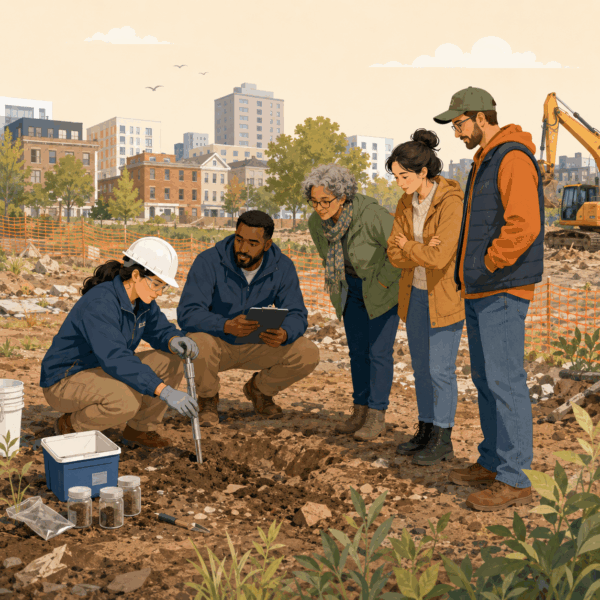 Communities affected by remediation projects do not represent a single audience with a single level of information needed. Some residents may want only a concise explanation of the current status and next milestone, while nearby property owners may need more detail about access, field activity, noise, traffic, or other practical impacts. Local officials may need enough context to respond accurately to constituent questions, and community organizations may want a fuller explanation of how technical findings are affecting the project’s direction. Other stakeholders may seek access to the underlying technical documents or regulatory materials.
A single communication product rarely serves all of these needs effectively. If every update is written at the level required by the most technically engaged audience, the information may become difficult for the broader community to navigate. If communication is reduced to short summaries without pathways to greater detail, stakeholders who want deeper information may conclude that the agency is withholding context. Layered communication allows the agency to address these different needs while maintaining one consistent project narrative.
The central public-facing update should provide the information most residents need to understand the project. That typically includes the current stage, recent progress, the next anticipated activity, any material change in timing, and a plain-language explanation of why that activity matters. Supporting materials can then provide additional technical or procedural detail for people who want to explore the project more deeply. This structure allows clarity and depth to coexist rather than forcing the agency to choose between them.
A project webpage can serve as the stable source of current information, while email updates, mailed notices, public meetings, or other channels can direct attention to major developments. Detailed reports and technical documents can remain available for stakeholders who need them, but the existence of those documents should not substitute for accessible explanation. Public communication should interpret the significance of technical information rather than expecting residents to determine the meaning of that information on their own.
Layering is also useful when a project enters a phase that affects different groups in different ways. A neighborhood-wide update may explain that field work is beginning, while residents immediately adjacent to the site may receive more specific information about traffic patterns, access, work hours, or other localized effects. Local officials may receive concise briefing information that helps them answer common questions without creating a separate or conflicting version of the project narrative.
The underlying message should remain consistent across every layer. Greater detail should expand the explanation, not alter the substance. When different audiences receive materially different descriptions of the same schedule, uncertainty can increase rather than decrease, particularly if those differences become visible through public meetings, media coverage, or community discussion.
Coordinate Messaging Across the Organizations Involved
Remediation projects frequently involve more than one organization. Depending on the site and regulatory context, public communication may involve a state environmental quality agency, property owner, responsible party, consultant, contractor, local government, or other participating entities. Each organization may have legitimate responsibilities for different aspects of the project, but the presence of multiple communicators creates a significant risk of inconsistent timeline information.
Residents generally do not distinguish easily between organizations when they receive conflicting descriptions of the same project. If one entity says field work is expected to begin in the spring while another refers to summer, the public may interpret the discrepancy as evidence of poor coordination, even if the two organizations were discussing different components of the work. Small differences in terminology can produce similar confusion when one group describes a project as being in cleanup while another describes it as still being in design or investigation.
State environmental quality agencies can reduce this risk by establishing clear communication roles early in the project. Internal teams and external participants should understand who is responsible for communicating regulatory status, who communicates construction or site logistics, how changes to public milestones are confirmed, and how major updates are coordinated before release. This does not require every organization to issue identical messages, but it does require agreement on the underlying facts and timeline.
Coordination is especially important when a schedule changes unexpectedly. If one participant communicates the change before the agency has confirmed its regulatory or technical implications, the public may receive incomplete information that later has to be corrected. Conversely, excessive coordination requirements can slow communication if every minor update requires prolonged approval among multiple organizations. Agencies should therefore distinguish between routine operational information and material developments that warrant broader alignment.
The objective is a coherent public record. Residents should be able to compare information from the agency, local government, project representatives, and other credible sources without encountering fundamentally different descriptions of where the remediation stands. Maintaining that consistency supports both clarity and accountability because it reduces the opportunity for uncertainty to grow through contradictory or incomplete messaging.
Address Community Concern Without Overstating Risk or Reassurance
Timeline communication becomes more sensitive when community concern is connected to uncertainty about environmental conditions or possible impacts. In these circumstances, agencies should avoid treating anxiety as a communication problem that can be resolved primarily through reassurance. Concern may be connected to legitimate questions about contamination, exposure pathways, property conditions, construction activity, future land use, or the amount of time required to complete the remediation process.
Public communication should remain grounded in what has actually been established. Where the agency has confirmed information about site conditions, it should explain that information clearly and consistently. Where investigation or technical evaluation remains underway, the communication should distinguish between known conditions and issues that are still being assessed. Maintaining that distinction is especially important when schedule uncertainty is connected to unresolved technical information.
Overly reassuring language can create credibility problems if later findings require the agency to revise its explanation. Broad statements intended to reduce concern may also appear dismissive when residents are seeking specific information about why additional investigation is occurring or why a project is taking longer than originally expected. At the same time, repeatedly emphasizing uncertainty without explaining how it is being addressed can make the project appear more unstable than the technical record supports.
A stronger approach is to connect uncertainty to the work designed to resolve it. Additional sampling can be explained in terms of the information gap it is intended to address. Monitoring can be described in relation to the conditions or performance being evaluated over time. A timeline extension can be connected to the need for additional technical information before the next stage proceeds. This framing allows the agency to acknowledge uncertainty without presenting it as unmanaged or indefinite.
The language used in these situations should remain disciplined. Agencies should avoid speculating about outcomes that have not been established, minimizing concerns that remain under evaluation, or promising levels of certainty that the technical process cannot yet provide. The communication should instead show how the agency is moving from uncertainty toward greater clarity and how each stage of the remediation process contributes to that progression.
This balance supports a more credible relationship with the community because it does not ask residents to choose between alarm and reassurance. It gives them a more useful basis for understanding what is known, what remains under evaluation, why the timeline may still change, and how the agency is using the remediation process to reach better-informed decisions.
Building Timeline Communication Into Remediation Operations
Effective remediation timeline communication depends on internal systems as much as public-facing language. Even a well-written update can create confusion if the information behind it has not been coordinated across technical, regulatory, operational, and communication functions. State environmental quality agencies therefore benefit from treating public communication as part of remediation project management rather than as a separate activity that occurs only after major decisions have already been made.
This integration begins with shared internal understanding. Before a timeline is communicated publicly, project managers, technical staff, communication personnel, and other relevant staff should have a common understanding of the project’s current stage, the assumptions supporting the schedule, the major dependencies that could affect future timing, and the level of certainty associated with upcoming milestones. When those elements are not aligned internally, different staff members may describe the same project in ways that are technically defensible but inconsistent from the public’s perspective.
A communication review should therefore be incorporated at meaningful project milestones. Significant investigation findings, changes in scope, remedy decisions, design developments, field mobilization, implementation changes, and other events that could alter community expectations should prompt consideration of what the public needs to understand. The purpose is not to require a formal public announcement for every technical development. It is to ensure that communication implications are evaluated at the same time project implications are being considered.
This approach can also improve the quality of the information ultimately released. Communication staff who understand the underlying project logic are better positioned to explain why a milestone matters, while technical staff can identify areas where simplification might create an inaccurate impression. Collaborative development allows agencies to produce information that is both understandable and faithful to the remediation process, reducing the likelihood that public-facing explanations will either become overly technical or lose important distinctions in an effort to simplify them.
Internal coordination becomes especially important when a project schedule changes. Before a revised timeline is communicated, the agency should establish what changed, whether the change affects only one activity or the broader project sequence, what assumptions remain valid, and what can reasonably be said about future timing. Developing this shared interpretation before public release reduces the likelihood that residents will receive one explanation from a project manager, another from a public information officer, and a third from information posted online.
The broader objective is to create a communication system that can withstand change. Remediation projects rarely remain identical to their earliest projections, so a communication process built around preserving a static schedule will become increasingly difficult to maintain. A system built around accurate status, documented assumptions, clear dependencies, and coordinated updates is more resilient because it can adapt as the project itself develops.
Establish a Predictable Communication Rhythm Without Manufacturing Updates
Communities should not have to depend entirely on major project events to determine whether remediation is continuing to move forward. For longer projects, a predictable communication rhythm can help maintain public orientation during periods when technical work continues but visible site activity is limited. The appropriate frequency will vary by project, and agencies should avoid establishing a schedule that is more frequent than the availability of meaningful information can support.
Consistency is more valuable than artificial frequency. A project involving active field work near residential areas may justify relatively frequent updates because conditions, activities, and community impacts can change quickly. A project in a lengthy technical evaluation phase may require less frequent communication, particularly if the underlying status remains stable. In both cases, residents should understand when routine information is likely to be updated and what kinds of developments would prompt additional communication.
A predictable rhythm helps prevent silence from acquiring unintended meaning. When communities know that updates are issued at reasonable intervals, a period without a special announcement is less likely to be interpreted as evidence that the project has stopped. The agency can reinforce this expectation by maintaining a current project webpage or other primary source of information that identifies the present phase and indicates when the next meaningful milestone is anticipated.
Routine updates should still contain substantive information. Repeating that work is ongoing without explaining what has been accomplished, what remains underway, or what happens next can gradually undermine the usefulness of the communication. Even when there is no major schedule change, an update can provide value by connecting recent activity to the project’s larger progression and clarifying whether previously communicated expectations remain unchanged.
This requires agencies to distinguish between maintaining contact and generating content for its own sake. Communication should not be issued simply to satisfy a calendar if it adds no meaningful context. At the same time, agencies should recognize that a lack of dramatic developments does not necessarily mean there is nothing useful to communicate. Confirming that a major phase remains on schedule, explaining what work is occurring during a quiet period, or identifying the next point at which additional information is expected can help sustain understanding without overstating the significance of routine activity.
The communication rhythm should also remain flexible enough to respond to changing circumstances. Significant new findings, major schedule revisions, visible field activity, or developments likely to affect nearby residents may warrant communication outside the normal cadence. A predictable baseline combined with the ability to communicate promptly when conditions change gives communities both consistency and responsiveness.
Coordinate Communication Around Visible Field Activity and Community Disruption
Visible field activity often changes the level of public attention surrounding a remediation project. Equipment arriving at a site, temporary fencing being installed, drilling beginning, excavation occurring, trucks moving through nearby streets, or workers using protective equipment can attract immediate interest even when the activities are routine components of the approved remediation process. If residents encounter these changes before receiving an explanation, the agency may be forced to respond to concerns that could have been reduced through advance communication.
State environmental quality agencies should therefore treat significant visible activity as a communication milestone. Before work begins, residents should receive enough information to understand what activity is planned, approximately when it will occur, how long it is expected to continue, and how it relates to the larger remediation timeline. When appropriate, communication should also explain what people may observe so that normal field conditions are not misinterpreted as evidence that an unexpected problem has occurred.
This is particularly important when remediation work affects everyday community conditions. Construction vehicles, temporary road changes, noise, dust-control measures, restricted access, altered parking, or other operational impacts may be secondary to the environmental objective from the agency’s perspective, but they can become the most immediate aspect of the project for nearby residents and businesses. Addressing these impacts directly demonstrates that the agency understands the project as both a technical undertaking and a lived community experience.
The timing of this communication matters. Information released after field work begins may still be useful, but it cannot provide the same level of preparation as advance notice. Agencies should coordinate with contractors, local governments, property owners, and other relevant participants so that public communication reflects realistic mobilization dates and operational conditions. If the schedule remains subject to change, that uncertainty should be communicated rather than presenting a tentative field date as a fixed commitment.
Visible activity can also serve as an opportunity to strengthen public understanding of progress. Residents who have followed a project through lengthy investigation or design phases may interpret mobilization as an important transition. The agency can use the moment to explain what earlier work made the field activity possible, what the current work is intended to accomplish, and what milestones will follow once implementation is complete.
Communication should continue during field work when conditions materially change. If the duration of excavation extends, work moves into a different portion of the site, or an operational issue affects neighboring properties, residents should not have to infer the significance of those changes. Timely explanations help maintain continuity between the anticipated work and what the community actually observes.
Create Clear Roles for Responding to Timeline Questions
Public communication systems are strengthened when agencies establish clear internal responsibility for responding to questions about remediation schedules. Residents may contact project managers, general agency phone lines, public information staff, local officials, or other representatives depending on how they encounter the project. Without coordinated response practices, the same question can produce different answers based on who receives it.
Agencies should identify a reliable source of current timeline information that staff can use when responding to inquiries. This may include an internally maintained project summary, a current public webpage, or another centralized resource that reflects the latest confirmed status. Staff do not need to provide identical wording in every interaction, but their explanations should be based on the same established facts, assumptions, and milestones.
Clear roles are especially important when questions concern information that has not yet been finalized. Frontline staff should understand when they can answer directly, when a question requires technical input, and when speculation should be avoided because the agency does not yet have a confirmed answer. A consistent process for escalating those questions can prevent informal estimates from becoming perceived commitments.
Local government coordination may also be important when residents direct questions to municipal or county officials rather than the state agency overseeing the remediation process. Providing local partners with concise, current information can help them respond accurately while directing more detailed technical or regulatory questions to the appropriate agency. This coordination should support a shared factual understanding without implying that local officials are responsible for technical decisions outside their authority.
Tracking recurring questions can provide additional strategic value. If residents repeatedly ask when cleanup will begin, whether a project has been delayed, or what a particular technical phase means, those questions may indicate that existing public information is not sufficiently clear. Rather than treating each inquiry as an isolated customer-service interaction, agencies can use recurring questions to identify communication gaps and improve future updates.
Evaluate Whether Timeline Communication Is Producing Understanding
The effectiveness of remediation communication should not be measured only by the number of notices, webpages, meetings, or updates produced. Those outputs demonstrate activity, but they do not necessarily show whether communities understand the project more clearly. Evaluation should focus on whether the agency’s communication is helping people interpret the timeline, recognize progress, understand changes, and know where to obtain reliable information.
Recurring community questions are one useful indicator. If residents continue asking whether any work is occurring during a period of technical review, the agency may need to explain invisible forms of progress more clearly. If questions repeatedly focus on why dates keep changing, the communication may not be adequately distinguishing between firm milestones and conditional projections. If people are uncertain about what comes after the current phase, the project timeline may need a stronger explanation of sequence and dependencies.
Agencies can also examine whether communication problems emerge at predictable points in the project. Confusion may increase when investigation expands, when a project transitions from technical analysis to field implementation, when visible activity pauses, or when long-term monitoring begins. Identifying these recurring pressure points can help agencies develop communication practices that anticipate uncertainty rather than responding only after concern becomes visible.
Evaluation should remain proportionate to the project. Not every remediation effort requires formal surveys or extensive engagement research. Staff observations, patterns in public inquiries, comments received at meetings, website usage, feedback from local partners, and other available information can help agencies understand whether their communication is addressing the questions communities actually have.
The most important measure is whether residents can form a reasonably accurate mental model of the project. They should be able to understand the current stage, recognize why that stage takes time, identify the next meaningful milestone, and distinguish between established information and projections that may still change. When those elements are consistently understood, agencies are less dependent on reassurance because the communication itself provides the context communities need to interpret developments.
This operational approach also creates long-term value beyond an individual remediation site. Agencies that document effective timeline practices, recurring public questions, common sources of misunderstanding, and successful communication approaches can gradually build more consistent systems across programs and projects. The result is not a standardized message applied to every site, but a stronger institutional capacity to communicate complex environmental timelines in ways that remain accurate, adaptable, and understandable as conditions evolve.
Strategic Communication Support for Environmental Remediation and Community Engagement
 Remediation timeline communication becomes a public-trust issue when technical uncertainty, changing schedules, and prolonged project durations begin to affect how communities interpret the agency’s competence, responsiveness, and transparency. State environmental quality agencies may have strong technical processes in place while still facing difficulty translating those processes into communication that residents can follow over months or years. The challenge is especially pronounced when project teams are managing active investigations, regulatory reviews, contractor coordination, field implementation, and community concerns simultaneously.
In these circumstances, agencies may benefit from external strategic communication support because internal capacity is often concentrated on technical, regulatory, and operational responsibilities. Communication staff may be supporting multiple programs at once, while project managers and subject-matter experts may have limited time to develop public-facing explanations, maintain consistent project narratives, or anticipate how changing timelines will be interpreted outside the agency. Remediation communication also requires specialized expertise because technical accuracy, public understanding, risk perception, stakeholder expectations, and institutional credibility must be managed together. An objective outside perspective can help identify where technically accurate information may still be difficult for a community to interpret and where communication gaps may be creating unnecessary uncertainty.
Stegmeier Consulting Group (SCG) can support state environmental quality agencies as an external partner by helping translate complex remediation processes into structured, understandable communication systems. This support can include developing message frameworks for project phases, organizing public-facing timelines, preparing update templates, strengthening project webpages, creating community notices, developing talking points for agency and local government representatives, and establishing protocols for communicating schedule changes. The purpose is not to replace the technical judgment of environmental professionals. It is to ensure that the reasoning, milestones, dependencies, and changes already present within the remediation process are communicated in ways that remain accurate and usable for nontechnical audiences.
External support can also help agencies examine the broader communication system surrounding a site rather than focusing only on individual notices. A remediation project may involve webpages, email updates, mailed notices, public meetings, stakeholder briefings, local government coordination, media inquiries, and direct responses to residents. If these elements develop independently, inconsistencies can emerge even when each individual communication is technically accurate. SCG can help agencies align these channels around a common project narrative so that updates reinforce one another and residents encounter the same underlying explanation regardless of where they obtain information.
This systems-level approach is particularly useful when projects are likely to continue through multiple phases or experience changing levels of public attention. Communication materials created early in the process can establish expectations about uncertainty, milestone sequencing, and update frequency that make later changes easier to explain. Agencies can then adapt individual messages as conditions evolve without rebuilding the communication strategy every time the schedule changes. The result is greater readiness, clearer public information, and a more durable structure for maintaining confidence throughout a complex remediation process.
Future Trends
The communication environment surrounding remediation timelines is likely to become increasingly immediate and information-intensive. Communities now have greater access to project documents, local discussion channels, online mapping tools, neighborhood networks, and other sources that can circulate information about environmental conditions quickly. While increased access can support transparency, it can also expose differences between technical documents, public summaries, contractor information, local government statements, and older project materials that remain available online.
For state environmental quality agencies, this increases the importance of maintaining a current and coherent public record. A project webpage that contains outdated schedule information can continue shaping public expectations even after a newer update has been issued elsewhere. Technical documents may include assumptions that later changed, while residents encountering those materials without context may interpret them as current commitments. Agencies will therefore need increasingly disciplined approaches to version control, archival clarity, and the relationship between detailed technical materials and current public-facing explanations.
Digital communication also increases expectations for timeliness. Residents who observe new activity at a remediation site may share photographs or descriptions before an agency has issued a formal update. Significant schedule changes can similarly become visible through contractor activity, public records, local government discussions, or community networks. Agencies that rely exclusively on slow, periodic communication cycles may find themselves responding to narratives that have already begun forming without them.
This does not mean environmental agencies should communicate immediately about every operational development. Accuracy remains essential, particularly when information is still being evaluated. The emerging challenge is to build communication systems that can move quickly enough to acknowledge meaningful developments while preserving the technical review necessary for responsible public information. Agencies that establish internal communication triggers, preapproved message structures, and clear decision responsibilities will be better positioned to respond without sacrificing accuracy.
Another important trend is the growing expectation that public information will explain process rather than merely disclose documents. Providing access to technical reports remains important, but access alone does not necessarily create understanding. Communities increasingly expect agencies to help them interpret what new findings mean, how those findings affect the project, and whether previously communicated timelines remain valid. This places greater value on plain-language explanation, visual timeline tools, milestone-based project summaries, and communication products designed specifically for public use.
Over time, agencies may also become more systematic in using communication feedback to improve remediation programs. Patterns in public inquiries, meeting comments, website behavior, and stakeholder feedback can reveal where project explanations routinely fail to answer community questions. Agencies that capture these patterns across multiple sites can develop stronger institutional practices for communicating investigation phases, uncertainty, schedule changes, field implementation, and long-term monitoring. The future of remediation communication is therefore likely to involve not simply more information, but more deliberate integration between environmental project management and public communication systems.
Conclusion
Remediation timelines are difficult to communicate because they sit at the intersection of technical process and community experience. Environmental professionals may understand a project through investigation phases, technical evaluations, regulatory decisions, design requirements, implementation activities, and monitoring obligations. Residents experience the same project through time, uncertainty, visible change, disruption, and expectations about when environmental conditions will be addressed. Effective communication must connect those two perspectives without distorting either one.
For state environmental quality agencies, the most credible approach is not to promise certainty where it does not exist. It is to communicate the degree of certainty that the project can actually support, explain the dependencies that shape future milestones, and provide enough continuity that residents can understand how the timeline develops. This requires agencies to distinguish established dates from projections, explain why schedules change, communicate during periods of limited visible activity, and connect technical milestones to their practical significance.
The quality of that communication can influence how communities interpret the entire remediation process. A long project does not automatically produce distrust, just as a detailed schedule does not automatically produce confidence. Public understanding depends on whether people can see a logical relationship between what the agency has learned, what it is doing, what must happen next, and why the timing has changed when circumstances evolve.
When timeline communication is treated as part of remediation management rather than as an administrative reporting function, it becomes more resilient. Agencies can anticipate communication needs alongside project milestones, coordinate messages across organizations, respond proportionately to schedule changes, and maintain a coherent public record over the life of the project. This allows communication to support the technical process rather than merely describe it after decisions have already been made.
Ultimately, communities do not need every variable in a remediation project to be predictable. They need the process to be understandable enough that uncertainty does not become indistinguishable from inaction. Agencies that communicate timelines with accuracy, context, continuity, and appropriate specificity are better positioned to maintain public confidence while allowing the environmental work itself to proceed according to the information and conditions that responsible remediation requires.
Stegmeier Consulting Group’s Strategic Approach to Communication Systems
Build remediation timeline communication around clear milestones, realistic expectations, and consistent public updates.
State environmental quality agencies need remediation timeline communication that helps communities understand what is happening, why schedules may change, and how each milestone contributes to the broader cleanup process. Stegmeier Consulting Group (SCG) helps agencies build communication systems that translate complex remediation activity into clear, coordinated, and credible public information across project webpages, community updates, stakeholder outreach, and other communication channels.
Use the form below to connect with our team and explore how strategic communication support can strengthen public understanding and confidence throughout the remediation process.