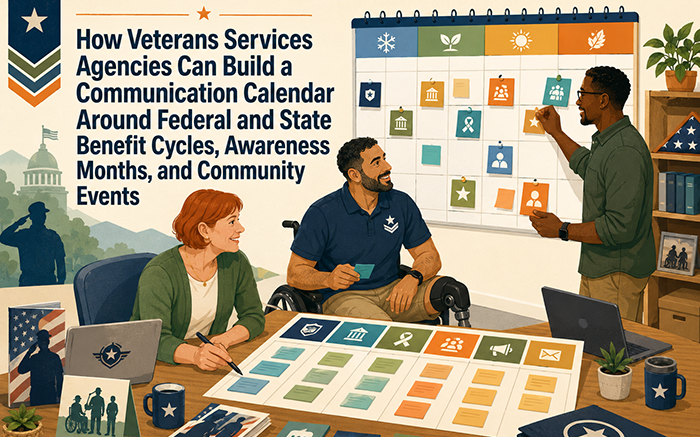
How Veterans Services Agencies Can Build a Communication Calendar Around Federal and State Benefit Cycles, Awareness Months, and Community Events
The communication calendar of most veterans services agencies is reactive by default. Something happens, a program change is announced, an awareness month arrives, a community event is scheduled, and the agency produces a communication about it, often in compressed timeframes that compromise quality, coordination, and strategic intent. The pattern is familiar enough to feel normal, but it is not inevitable, and it is not the communication pattern of agencies that are most effective at reaching and serving their veteran communities. Those agencies operate from a planned calendar that anticipates the recurring cycles, campaigns, awareness months, legislative windows, enrollment periods, and community events that structure the veterans services communication environment, and that builds communication strategy around those anticipated anchor points rather than scrambling to respond to them as they arrive.
The value of a planned communication calendar is not primarily about efficiency, though the reduction in reactive scrambling does produce real efficiency gains. The deeper value is strategic. A communication calendar that is planned three to twelve months in advance creates the conditions for coordinated, multi-channel communication that builds on itself across the calendar year rather than launching disconnected, ad hoc communications that do not accumulate into a coherent narrative about the agency and its work. It allows the agency to align specific communication investments with the specific moments in the year when veterans are most receptive to specific types of information, when partner organizations are most active in specific areas, and when the broader information environment is most supportive of specific messages. It produces communication that feels strategic and intentional rather than reactive and generic.
The federal and state benefit cycle is a rich calendar of recurring events that provide natural communication anchor points for veterans services agencies. The annual adjustments to VA disability compensation rates in October provide an annual opportunity to communicate with veterans about their compensation amounts and to encourage veterans who have not yet filed to consider doing so. The PACT Act enrollment windows, which have specific opening dates and in some cases closing dates, require communication that reaches eligible veterans before those windows close. State legislative sessions that produce new or modified state veteran benefit programs require communication updates to veterans about what has changed and what it means for them. GI Bill benefit levels that change with the academic year create annual communication opportunities for veteran students. Each of these programmatic cycles has a specific timing and a specific veteran audience, and a planned calendar that maps these cycles allows the agency to develop communication for each one with adequate preparation time rather than discovering it is approaching with insufficient time for quality preparation.
Awareness months and campaigns provide a different kind of calendar anchor point, one that is shaped by the national and cultural conversations that define specific periods of the year as particularly associated with specific topics. September is National Suicide Prevention Month, a period when the broader cultural conversation about suicide prevention creates a receptive environment for veterans suicide prevention messaging that is more difficult to create at other times of year. November is Veterans and Military Families Month, anchored by Veterans Day on November 11th, when the national attention to veterans creates maximum public receptivity to veterans services communication. June is Post-Traumatic Stress Disorder Awareness Month, a period when PTSD communication can reach veterans who might be more receptive than at other times. Each of these awareness periods provides both a communication opportunity and a distribution advantage, because media, community partners, and the general public are all attending more closely to the relevant topic during the awareness period than at other times.
This article provides a comprehensive framework for building a veterans services communication calendar that integrates federal and state benefit cycles, awareness months and national campaigns, community event cycles, VSO convention and meeting schedules, and the agency’s own program and outreach schedule into a coherent annual communication plan. It covers the planning process for calendar development, the specific content associated with each major calendar anchor point, the coordination with partner organizations that amplifies the impact of calendar-based communication, the flexibility infrastructure that allows the calendar to accommodate unexpected developments without losing its strategic structure, and the review and improvement process that makes the calendar an evolving strategic tool rather than an annual document that is produced and then set aside.
The shift from reactive to planned communication is not accomplished by producing a calendar document. It is accomplished by building the organizational practices that give the calendar operational authority: the regular review processes that keep the calendar current, the advance content development processes that produce communication assets before they are urgently needed, the partner coordination processes that build shared calendar awareness into the agency’s community relationships, and the leadership commitment that treats the communication calendar as a strategic priority whose maintenance is not displaced by the reactive demands that will inevitably compete with it throughout the year.
The Architecture of an Annual Veterans Services Communication Calendar
 An annual veterans services communication calendar is not simply a list of events and deadlines with assigned communication tasks. It is a strategic document that maps the relationship between the temporal structure of the veterans services environment and the agency’s communication objectives, identifying the specific moments in the year when specific types of communication are most likely to be effective for specific veteran audiences and building a coordinated multi-channel communication plan around those moments. This architecture requires understanding three distinct types of calendar anchor points and how they interact with each other to create the overall structure of the communication year.
Fixed regulatory and programmatic anchor points are the dates and periods that recur annually or on defined cycles as a function of federal and state law, VA regulation, and program administration. The October 1st annual compensation rate adjustment for VA disability compensation is a fixed regulatory anchor point. The opening of school year enrollment for GI Bill benefit users each fall is a fixed programmatic anchor point. Annual property tax exemption application windows in specific states are fixed programmatic anchor points. These fixed points provide the most predictable foundation for the annual communication calendar because they are known well in advance and recur with high reliability year after year, allowing the agency to build standardized communication processes around each one that can be refined over successive annual cycles.
Campaign and awareness anchor points are defined by the national and organizational calendar of awareness months, national campaigns, and designated observance periods that structure the veterans services communication environment. These anchor points are largely fixed from year to year, with some variation in the specific dates on which they fall, and they provide opportunities to align agency communication with the broader cultural conversation about specific topics in ways that amplify the reach and receptivity of the agency’s messages. The challenge of awareness month communication is making it substantive and specific rather than generic and performative: an agency that simply posts a Veterans Day acknowledgment on November 11th without connecting it to specific calls to action for veterans and specific information about available resources is not fully utilizing the communication opportunity the occasion provides.
Variable and relationship-based anchor points include community events whose dates vary from year to year, VSO post and chapter meeting schedules, local government legislative calendars, community partner events, and opportunities that emerge from the agency’s relationships with specific community organizations. These anchor points are less predictable than fixed regulatory and campaign anchor points, and the calendar must include processes for identifying and incorporating them as they are confirmed rather than planning around them with the same precision as fixed anchor points. The mechanism for incorporating variable anchor points is an ongoing calendar maintenance process that updates the calendar regularly rather than treating it as a document finalized at the beginning of the year and not revisited until the following year.
The interaction among these three types of anchor points creates the overall architecture of the communication calendar. A September suicide prevention communication plan that incorporates the fixed September awareness month anchor point, the variable community events being scheduled by local mental health organizations and VSO posts, and the relationship with healthcare provider partners who are running their own mental health awareness campaigns, is a more comprehensive and more effective communication effort than any of these elements could produce independently. Building the communication calendar requires identifying these interaction opportunities and designing communication plans that take advantage of them rather than leaving the three types of anchor points in separate planning silos.
The Twelve-Month Planning Horizon
A twelve-month planning horizon is the minimum timeframe for building a veterans services communication calendar that can support advance content development, partner coordination, and the multi-channel communication planning that produces the most effective results. Some communication investments, including video production for awareness months, printed guide revisions for annual program updates, and community event planning for major events like veterans expos, require lead times of four to six months or longer, and these investments cannot be planned effectively within a shorter planning horizon.
The twelve-month planning cycle should begin with a calendar development process that occurs in the fall of each year, mapping the known anchor points for the following year and identifying the communication objectives and investments associated with each. This calendar development process should draw on the prior year’s calendar, the lessons learned from that year’s communication efforts, and the new information about program changes, emerging veteran population needs, and partner organization plans that are available at the time of planning. The resulting calendar provides the framework for the year’s communication planning without claiming the completeness or rigidity of a finalized plan, because the variable anchor points and unexpected developments that will inevitably arise through the year will require ongoing calendar updates and adaptations.
A quarterly review of the communication calendar, scheduled as a standing agenda item in the agency’s planning rhythm, provides regular opportunities to update the calendar with newly confirmed variable anchor points, to assess whether planned communication investments are proceeding on schedule, to identify emerging communication needs that were not anticipated at the time of calendar development, and to reallocate communication resources where necessary to respond to the shifting priorities that the quarterly review reveals. These reviews are the mechanism through which the calendar maintains its relevance and its operational authority throughout the year rather than becoming an increasingly outdated planning artifact that no one consults after the first quarter.
Serving Those Who Served: Communication Strategies for Veterans Agencies
This article is part of our series on strategic communication for Veterans Services Agencies, County Veterans Services Offices, State Departments of Veterans Affairs, and community-based veteran support organizations. To learn more and to see the parent article, which links to other content just like this, click the button below.
Memorial Day and Veterans Day as Communication Anchors
Memorial Day and Veterans Day are the two most prominent public observances associated with military service and the veteran community in the United States, and they represent the two most significant awareness-based communication anchor points in the veterans services communication calendar. They are also the two anchor points that are most at risk of producing generic, performative communications that acknowledge the occasions without connecting them to substantive benefit access information or calls to action. The communication challenge of these occasions is to honor their significance while also making them do specific communication work for the veterans the agency serves.
Memorial Day, observed on the last Monday in May, is a day of national mourning and remembrance for those who died in military service. The character of the occasion as one of solemn remembrance rather than celebration of service means that it is a moment for communication that acknowledges sacrifice and loss rather than for benefit promotion. However, this does not mean that Memorial Day communication cannot serve the agency’s outreach mission. Memorial Day is a moment when national attention to military service is high and when messages connecting the sacrifices of the fallen to the obligation to care for living veterans can be particularly resonant. A Memorial Day communication that honors the fallen and then specifically names the commitment to serving living veterans by ensuring they have access to the benefits they have earned connects the memorial occasion to the agency’s mission in a way that is authentic and compelling rather than promotional.
Veterans Day, observed on November 11th, is the primary annual occasion for communication that celebrates veteran service and that invites veterans to connect with available resources. The cultural character of Veterans Day as a celebration of those who have served, rather than as a day of mourning for those who have died, makes it a more natural anchor point for benefit access communication that invites veterans to take specific actions. A Veterans Day communication that says ‘On this day when we celebrate your service, we want to make sure you know about the benefits you have earned and how to access them’ is a message that fits the occasion and that provides the specific call to action that Veterans Day’s celebratory character makes appropriate.
Both Memorial Day and Veterans Day provide natural hooks for media relations efforts that extend the agency’s communication reach beyond its direct channels. Local newspapers, radio stations, television stations, and digital media outlets are actively looking for veterans-related content during the days surrounding these observances, and agencies that proactively offer human interest stories, veteran testimonials, program information angles, and expert commentary on veteran benefit issues during these periods can secure earned media coverage that reaches audiences far beyond the agency’s own direct communication reach. A media relations strategy that is planned months in advance of each observance, with specific story pitches developed and relationships cultivated well before the days when coverage opportunities are most abundant, produces substantially better media placement outcomes than reactive outreach that happens when the media demand is already high and the available slots are already filled.
Veterans Day Communication Campaigns
A Veterans Day communication campaign, designed and implemented as a coordinated multi-channel effort in the weeks surrounding November 11th, can leverage the national attention to veterans to produce the most significant communication impact of the year for agencies that plan and execute it effectively. The campaign structure allows the agency to build awareness and interest in the period preceding Veterans Day, to deliver the primary communication content on and around the day itself, and to follow through with specific calls to action and engagement opportunities in the days and weeks following the day when the elevated community attention begins to wane.
The pre-Veterans Day period, roughly the two weeks before November 11th, is the right time for awareness-building communication that introduces the key messages of the campaign and that generates anticipation for the specific events and calls to action that will occur during and after the day itself. This communication period is when VSO post partners should be briefed on the campaign and equipped with the talking points and materials they need to carry campaign messages through their member networks, when media outreach should begin with advance story pitches, and when social media content should start building the Veterans Day narrative that the day-of content will culminate.
The Veterans Day period itself, the week of November 11th, is the peak communication moment that the preceding weeks have been building toward. This is the week for the primary benefit access calls to action, for any community events or information sessions that the campaign includes, for the peer voice content that is most emotionally resonant in the context of the national observance, and for the media engagement that delivers campaign messages through earned media coverage. The intensity of communication activity during this week should be supported by the advance planning and content development that the preceding months have enabled.
The post-Veterans Day follow-through period, the two to three weeks after November 11th, is the time for converting the awareness generated during the campaign into specific benefit access actions. Veterans who were reached during the campaign with awareness content should receive follow-up communication with specific next steps for accessing specific programs. VSO post partners who identified veterans in their networks during the campaign should receive follow-up support for connecting those veterans with CVSO services. Media coverage secured during the campaign should be amplified through the agency’s own channels to reach veterans who did not see the original coverage.
September Suicide Prevention Month Communication
 September is National Suicide Prevention Month, designated as such by national suicide prevention organizations and supported by a broad ecosystem of awareness campaigns, media coverage, and community events that create a window of elevated public attention to suicide prevention in which veterans-specific prevention messaging can reach both the veteran community and the broader public in more receptive conditions than at other times of year. The agency that plans its September prevention communication months in advance, that coordinates with healthcare partners and VSO posts and community organizations on the September calendar of prevention activities, and that produces the peer voice and culturally resonant prevention content described in the prevention communication articles earlier in this series, is positioned to use September as the most impactful month of the year for its prevention communication investment.
The specific communication investments appropriate for September Suicide Prevention Month include a series of peer voice social media content pieces that build across the month and that culminate in a call to action for veterans to connect with specific support resources, a coordinated campaign with VSO post partners that includes September-specific briefings on QPR training and crisis resource availability, a community event or series of events specifically organized around veteran mental health and suicide prevention, and media outreach that pitches veteran-specific prevention stories to local media outlets that are covering the broader suicide prevention month topic.
The Veterans Crisis Line is the most important specific resource to communicate throughout September, and the September communication strategy should include a specific plan for ensuring that Veterans Crisis Line contact information reaches the maximum possible number of veterans in the community through every available channel during the month. This includes the universal inclusion approach described in the prevention communication articles, in which Veterans Crisis Line contact information appears in every communication the agency produces during September regardless of the primary topic, and specific targeted outreach efforts that reach veterans who are not connected to the agency’s standard communication channels.
The challenge of September prevention communication is maintaining the appropriate tone and content focus across a month of sustained prevention messaging without the communication becoming either repetitive and stale or so consistently heavy in tone that it generates avoidance rather than engagement. Varying the format and the specific focus of prevention content across the month, including peer voice testimonials, information about specific resources, QPR training announcements, community event promotion, and general wellbeing content that is adjacent to prevention without being exclusively crisis-focused, maintains the audience’s engagement through the month while sustaining the overall prevention communication mission.
Coordination With National and State Prevention Campaigns
National suicide prevention organizations including the American Foundation for Suicide Prevention, the Suicide Prevention Resource Center, and the Veterans Crisis Line itself produce September awareness campaigns with specific themes, materials, and promotional resources that veterans services agencies can adopt and amplify rather than developing entirely independent campaign materials. Coordinating with these national campaigns allows agencies to benefit from the national scale of the campaign’s awareness building while adding local specificity and veteran community connection that the national campaigns cannot provide on their own.
State-level prevention campaigns and coalitions, which often include both government agencies and community organizations, provide coordination opportunities that extend the reach of September prevention communication beyond any single agency’s capacity. Veterans services agencies that are participating members of state suicide prevention coalitions have access to shared resources, coordinated media opportunities, and peer learning about what prevention communication approaches are working in similar communities, all of which improve the quality and impact of their own September prevention communication.
PACT Act Enrollment Windows and Eligibility Communication
The PACT Act’s implementation has created specific enrollment windows and claim filing deadlines that require targeted communication to ensure that eligible veterans take advantage of them before they close. These enrollment windows are among the most time-sensitive communication obligations in the veterans services calendar because missing them has real consequences for eligible veterans who are not reached before the relevant deadline passes.
Communication planning for PACT Act enrollment windows should begin well in advance of the window opening, with awareness communication that reaches veterans who may be eligible well before the enrollment period begins so that they have time to assess their eligibility, gather necessary documentation, and prepare to file when the window opens. The re-engagement outreach described in the PACT Act article earlier in this series, reaching veterans who were previously denied and who may now be eligible under expanded presumptive provisions, is particularly urgent during PACT Act enrollment windows when the specific deadline for utilizing those windows is approaching.
The communication calendar should include specific milestones for PACT Act enrollment window communication: six months before the window opens for awareness building communication; three months before for targeted outreach to specific eligible populations; one month before for urgent re-engagement communication to veterans who have been identified as likely eligible but not yet engaged; two weeks before for final call communications emphasizing the deadline; and post-window communication that documents the outcomes of the window communication campaign and identifies veterans who were reached but did not complete the enrollment process before the window closed, for follow-up on subsequent eligibility opportunities.
The specific channels for PACT Act enrollment window communication should be calibrated to the eligible veteran populations most at risk of missing the window. The veteran who is unaware that they may be eligible for expanded PACT Act benefits requires broad awareness communication through community channels. The veteran who is aware of their potential eligibility but has not yet filed requires specific motivational communication that addresses their specific barriers to filing. The veteran who has been previously denied and who is eligible for a Supplemental Claim under expanded presumptive provisions requires the specific re-engagement communication described in the PACT Act article, acknowledging their prior denial experience and providing specific information about what has changed.
State Benefit Deadline Communication
State benefit programs often have specific application deadlines or enrollment windows that are less prominently communicated than federal program windows but that are equally consequential for veterans who miss them. Property tax exemption applications in many states must be filed by a specific date in the tax year to take effect for that year’s taxes, and veterans who miss this deadline miss a full year of tax relief. State tuition benefit programs may have application deadlines tied to academic calendar enrollment periods. State veterans home application processes may have waiting list enrollment periods that require specific action within defined timeframes.
Mapping these state benefit deadlines into the annual communication calendar, with lead time for awareness communication before each deadline and specific follow-through communication after each deadline for veterans who were reached but did not act before the deadline, ensures that the agency is systematically communicating about state benefit deadlines rather than discovering them as they approach with insufficient time for effective communication. The calendar mapping for state benefit deadlines should be updated annually based on any changes to the relevant deadlines, which may change with state legislative action or administrative policy revision.
VSO Convention Schedules and Professional Development Events
VSO national and state conventions are important calendar anchor points for veterans services agency communication because they represent concentrated gatherings of VSO leadership and membership that provide outreach opportunities, relationship building occasions, and intelligence gathering functions that are not available in any other format. State VSO conventions in particular bring together post commanders from across the state in a setting where the agency can brief the full network of post leadership simultaneously, strengthening the VSO communication partnership infrastructure described in the VSO post article in this series in ways that are more efficient than individual post briefings.
The veterans services agency’s participation in VSO conventions should be strategically planned as a communication investment rather than approached as a logistical exercise in setting up a display table. The most valuable elements of convention participation include formal briefing opportunities where agency staff can present program updates and outreach needs to assembled post leadership, informal relationship building with individual post commanders and state VSO leadership that deepens the partnership relationships that drive effective year-round communication, and intelligence gathering through conversations with post leadership about what their members are asking about and what communication needs are most pressing in their communities.
Communication preparation for VSO conventions should include the development of convention-specific materials that summarize the most important program updates, the most significant eligibility changes, and the most urgent communication needs of the current period in a format appropriate for the convention setting, which typically involves more brevity and more visual engagement than the comprehensive briefing materials appropriate for in-office presentations. The post-convention follow-up communication to post commanders who participated in convention briefings provides continuity between the convention relationship building and the ongoing year-round partnership communication.
GI Bill and Education Benefit Cycles
The academic year structure creates specific communication timing opportunities for veterans services agencies communicating about GI Bill and education benefit programs. The period before the fall semester enrollment deadline is the most important annual window for GI Bill eligibility and enrollment communication, because veterans who are considering education and who learn about GI Bill benefits during this period have the most immediate opportunity to act on the information. Veterans who learn about GI Bill benefits after they have already made enrollment decisions for the current academic year may not be able to use the information until the following year.
The late spring and early summer period, roughly April through June, is the optimal window for GI Bill communication targeted at veterans who are making fall enrollment decisions. Communication during this period should include specific information about which programs a veteran qualifies for based on their service history, how to apply for GI Bill benefits, what the enrollment certification process involves, and what financial support they can expect. Veterans who receive this information while they are actively making enrollment decisions are more likely to act on it than veterans who receive it outside the enrollment decision window.
The January through March period is the optimal window for spring semester GI Bill communication and for communication about year-round programs like online education and workforce training that do not follow a traditional academic calendar. Veterans who are considering education in the spring semester or who are interested in non-traditional educational formats should receive GI Bill eligibility communication during this period, with specific information about the enrollment process and timelines relevant to the specific educational programs they are considering.
The Vocational Rehabilitation and Employment Calendar
VA Vocational Rehabilitation and Employment services, available to veterans with service-connected disabilities that create employment barriers, have specific program entry processes and timelines that align with the broader calendar of workforce development activity. Communication about VR&E should be planned to reach eligible veterans at moments when they are most likely to be thinking about employment and career development: the fall job fair season, the January new year period when many people make career development resolutions, and the period following graduation from education or training programs when veterans are transitioning to employment.
The coordination of VR&E communication with the agency’s broader employment assistance communication and with community employer networks that hire veterans creates a more comprehensive employment support communication environment than VR&E communication alone can provide. A veteran who learns about VR&E through the agency’s employment assistance communication during a community job fair, and who also receives specific information about employment preference in state government hiring, has a more complete picture of the employment support available to them than a veteran who encounters only one component of the available support landscape.
Building and Maintaining the Communication Calendar
The process of building an annual communication calendar for a veterans services agency requires specific organizational steps and organizational roles that make the calendar a functional operational tool rather than a planning document that is produced and then superseded by the reactive demands of the agency’s daily operations. The most important organizational requirement is the designation of a specific staff member or team with responsibility for calendar development, maintenance, and enforcement, because without specific ownership, the calendar will not receive the ongoing attention that sustains its relevance and its authority throughout the year.
The calendar development process should begin with an inventory of all known recurring anchor points across the three categories described earlier: fixed regulatory and programmatic anchor points, campaign and awareness anchor points, and variable relationship-based anchor points that are confirmed through the agency’s community relationships. This inventory should be organized chronologically across the twelve-month planning horizon, with each anchor point associated with the communication objectives it supports, the veteran audience it is most relevant for, the communication channels through which it will be addressed, the content development requirements for each channel, and the lead time required to develop that content before the anchor point arrives.
The content development implications of the calendar are the most operationally demanding aspect of calendar-based communication planning. Each identified anchor point generates content development requirements for one or more communication channels, and those requirements must be scheduled backward from the anchor point date to identify when content development must begin to be completed before the anchor point arrives. A September suicide prevention social media series that includes twelve individual content pieces, each of which requires peer voice content development including veteran contributor engagement, interview or statement collection, editorial review, and production, requires content development to begin no later than May to be completed by the end of August. Mapping these content development requirements onto the staff calendar, and identifying the staff capacity required to execute the content development plan, is the planning step that converts the communication calendar from a statement of intentions into an operational production plan.
Partner coordination requirements of the calendar should be identified and scheduled alongside the content development requirements. VSO post partners who need to be briefed before Veterans Day to carry the agency’s November 11th messaging through their member networks require briefings in mid-October, which in turn requires the briefing materials to be developed and the briefing meetings to be scheduled by late September, which requires the calendar planning process to identify these requirements at least four months before Veterans Day to allow adequate lead time for preparation. This cascade of requirements back from each anchor point date is what makes the twelve-month planning horizon necessary: shorter horizons do not provide sufficient lead time for the advance preparation that effective calendar-based communication requires.
Calendar Flexibility and Unexpected Developments
No annual communication calendar survives the year unchanged. Unexpected program changes, legislative developments, public health situations, or community events will arise that create communication needs not anticipated in the calendar’s initial development. A communication calendar that is too rigid to accommodate these unexpected developments will either be abandoned or will be followed at the expense of responding effectively to the unexpected. A calendar that has built-in flexibility mechanisms will be able to accommodate unexpected developments without losing its strategic structure.
The flexibility mechanisms that allow a communication calendar to accommodate unexpected developments while maintaining its strategic structure include a defined process for evaluating and prioritizing unexpected communication needs against existing calendar commitments, a contingency reserve of content development capacity that is not fully allocated at the time of calendar development, clear decision criteria for when an unexpected development warrants displacing a planned calendar activity versus when it can be accommodated through addition without displacement, and a regular calendar review process that provides a structured opportunity to update the calendar to reflect both unexpected developments and changes in agency priorities or resource availability.
The annual PACT Act-era experience of veterans services agencies provides a specific illustration of the flexibility challenge. The PACT Act’s enactment and its subsequent implementation created communication needs that were not fully anticipated in agency communication calendars that had been developed before the law’s passage. Agencies with flexible calendar processes were able to incorporate PACT Act communication as a major calendar priority without abandoning their entire existing communication plan, while agencies with more rigid planning processes struggled to accommodate the PACT Act communication obligation without significantly disrupting their other communication commitments. The lesson is that calendar flexibility is not a sign of weak planning. It is a sign of planning maturity that recognizes the inevitability of the unexpected.
Measuring Communication Calendar Effectiveness
The communication calendar is a strategic investment whose effectiveness should be measured against the communication outcomes it is designed to produce rather than against the completeness of the calendar document or the number of communications produced according to the schedule. A calendar that produces communications on schedule but that does not produce measurable improvements in veteran awareness, benefit access, or community engagement is a calendar that is being executed without being evaluated, and execution without evaluation cannot produce the continuous improvement that makes the calendar investment more valuable over successive annual cycles.
Calendar-specific communication measurement should be built into the planning process for each major anchor point, identifying in advance what metrics will indicate whether the communication around each anchor point has produced its intended effects. September suicide prevention communication should be measured against prevention-specific metrics including Veterans Crisis Line call volume from the agency’s service area during September, community awareness of specific prevention resources, and QPR training participation rates. Veterans Day communication should be measured against enrollment and contact initiation metrics. PACT Act enrollment window communication should be measured against claim filing rates from the eligible population during the enrollment period.
Year-over-year comparison of calendar communication metrics, tracking the same anchor point metrics across successive annual cycles, reveals whether calendar-based communication is improving in effectiveness over time and where specific anchor points are producing less than expected results that warrant communication strategy revision. An agency that has been executing a Veterans Day communication campaign for three years and that can compare the campaign’s reach, engagement, and access outcomes across those three years has a learning infrastructure that converts each annual cycle into an improvement investment for subsequent cycles.
Strategic Communication Support for Veterans Services Agencies
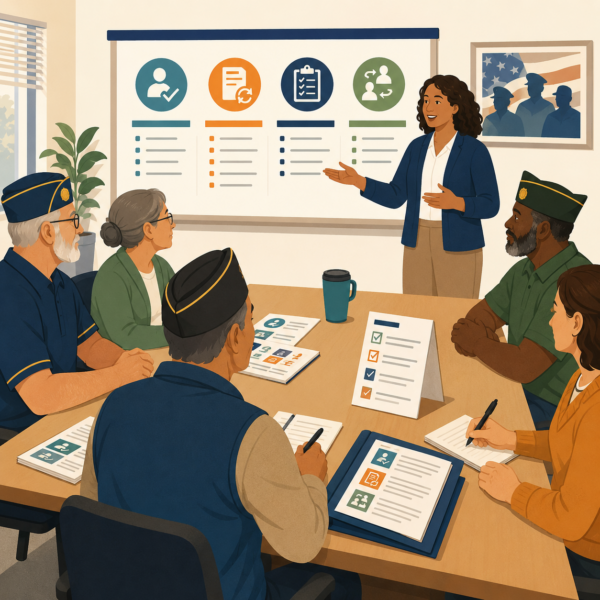 Developing an annual communication calendar requires more than scheduling social media posts or identifying dates for awareness campaigns. An effective communication calendar serves as a strategic planning framework that aligns outreach activities with veterans’ information needs, agency priorities, seasonal events, community partnerships, and recurring opportunities to increase awareness of benefits and services. When communication is planned rather than reactive, agencies are better positioned to deliver timely, coordinated, and consistent messaging throughout the year.
Successful communication calendars are built on audience insights, annual planning, content governance, partner coordination, campaign integration, and ongoing performance evaluation. Veterans seek different types of information at different times of the year, while agencies must also respond to legislative changes, community events, benefit enrollment periods, commemorative observances, and emerging communication needs. A structured calendar enables agencies to anticipate these opportunities, coordinate communication across departments and partners, and reduce the inefficiencies associated with last-minute content development.
Developing this type of communication system requires specialized expertise in communication strategy, editorial planning, audience segmentation, content governance, campaign management, and communication evaluation. Many veterans services agencies choose to partner with external communication specialists such as Stegmeier Consulting Group (SCG) because these capabilities complement the agency’s expertise in veterans programs while providing the strategic communication knowledge needed to develop communication calendars that support long-term organizational goals instead of short-term communication activity.
Working alongside veterans services agencies, SCG develops annual communication calendars tailored to each agency’s mission, programs, and community relationships. Support may include identifying strategic communication opportunities throughout the year, integrating federal, state, and local observances into communication planning, coordinating messaging with community partners, developing reusable content frameworks for recurring campaigns, establishing editorial workflows and governance practices, and implementing measurement systems that evaluate communication performance across annual planning cycles.
As agency priorities, veteran needs, and communication channels continue to evolve, communication planning must remain flexible while preserving strategic consistency. SCG helps agencies establish repeatable planning processes, governance practices, and performance measurement frameworks that enable annual communication calendars to improve with each planning cycle while maintaining alignment across departments, partners, and communication channels.
The objective is to create a communication environment in which veterans receive timely, coordinated, and relevant information throughout the year rather than only during isolated campaigns or reactive outreach efforts. By strengthening annual communication planning, agencies are better positioned to improve operational efficiency, increase engagement, and connect more veterans with the benefits and services they have earned.
Future Trends in Veterans Services Communication Calendar Planning
The veterans services communication environment is evolving in ways that will add new anchor points to the communication calendar, modify existing ones, and create new planning challenges and opportunities for agencies building annual communication strategies. Several trends deserve attention from agencies developing long-term communication calendar frameworks.
The continuing implementation of the PACT Act will generate new regulatory anchor points as additional presumptive conditions are recognized and new eligibility windows open. The communication calendar must be responsive to these new anchor points as they are established, which requires the intelligence-gathering process that tracks legislative and regulatory developments related to veteran benefits and that feeds new anchor points into the calendar planning process as they are confirmed. Agencies with established processes for this intelligence gathering will incorporate new PACT Act anchor points efficiently. Agencies without such processes will discover new enrollment windows and eligibility expansions with insufficient lead time for effective communication preparation.
The growing national emphasis on veteran mental health, including suicide prevention and PTSD awareness, is expanding the roster of awareness campaigns and national designations associated with veteran mental health topics in ways that will add anchor points to the communication calendar beyond the traditional September Suicide Prevention Month and June PTSD Awareness Month designations. Veterans Mental Health Awareness month designations at the state level, national campaigns organized by major veteran mental health advocacy organizations, and new federal prevention initiatives will all create communication opportunities that agencies with responsive calendar planning processes will capitalize on.
Digital communication planning tools are becoming more sophisticated in ways that make multi-channel communication calendar management more accessible for agencies that have previously managed their communication calendar through informal tracking systems. Content management platforms with calendar functionality, social media scheduling tools with team collaboration features, and project management tools adapted for communication production planning all provide capabilities that make planned communication calendar execution more manageable for agencies with modest communications staff capacity. Agencies that invest in the right tools for their specific planning context will be better positioned to execute ambitious communication calendars than agencies that attempt to manage complex multi-channel communication planning through spreadsheets and email.
Conclusion
The veterans services agency that operates from a planned communication calendar is not simply more organized than the agency that operates reactively. It is more effective, more equitable in its outreach, and more accountable in its communication investment. More effective because its communications are developed with adequate preparation time and coordinated across channels and partners in ways that reactive communication cannot achieve. More equitable because planned outreach is more likely to reach the full range of veteran community segments than reactive communication that tends to serve the most accessible populations first. And more accountable because planned communication with defined objectives and measurement frameworks produces evidence of outcomes rather than evidence of activity.
The veterans who are reached by a well-planned Veterans Day communication campaign, who learn about benefits they did not know they were entitled to, who contact the CVSO because a specific November 11th call to action reached them through a trusted community channel at exactly the moment when national attention to veteran service made them most receptive to the message, are veterans who would not have been reached by a reactive communication approach that produced a generic Veterans Day acknowledgment without strategic content or coordinated outreach. That difference, between the veteran who is reached and the veteran who is not, is the argument for the planned communication calendar in its simplest and most compelling form.
SCG’s Strategic Approach to Communication Systems
Stegmeier Consulting Group’s communication calendar work with veterans services agencies is grounded in the recognition that planned communication is the operational expression of a strategic communication commitment, and that a communication strategy that exists only as a document without a calendar-based execution plan is a strategy that will be overwhelmed by the reactive demands of the operational environment within weeks of its adoption. SCG helps agencies develop communication calendars that are grounded in the specific anchor points of the veterans services environment, staffed with realistic content development and partner coordination plans, and equipped with the flexibility mechanisms and measurement infrastructure that make the calendar a living strategic tool rather than a planning artifact. The result is a communication function that operates strategically and improves continuously rather than reactively and inconsistently.
Use the form below to connect with our team and explore how strategic communication planning can help your agency build a coordinated annual communication calendar that improves outreach, engagement, and veteran access to services.