
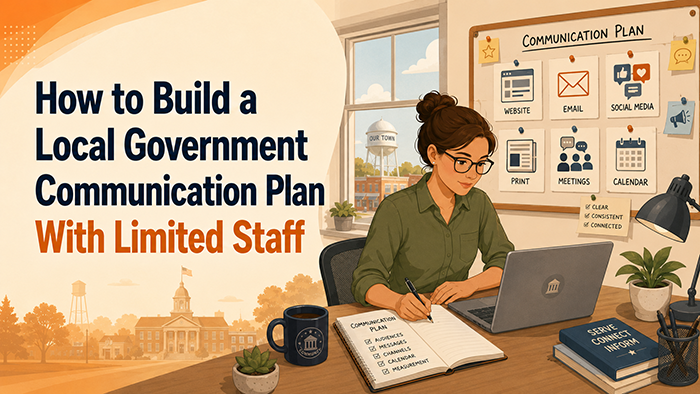
How to Build a Local Government Communication Plan With Limited Staff
Most small towns, villages, townships, and rural districts were not designed with a dedicated communications department in mind. Their institutional strength has always been operational: maintaining roads, processing permits, managing utilities, collecting taxes, and delivering essential services to households that depend on local government to function quietly and reliably in the background. Communication was assumed to happen naturally, through word of mouth, posted notices, local newspapers, or a brief mention at a town meeting. For generations, that was enough.
It is not enough anymore. Residents today move through a landscape of competing information, and local governments that do not manage their own communication are increasingly left behind. Important decisions, budget concerns, infrastructure projects, and service disruptions reach residents through rumors, social media posts, secondhand accounts, and news reports written without direct input from the agency. The result is not just misunderstanding. It is erosion of trust that is difficult to rebuild once residents begin to feel that their government is either withholding information or simply not paying attention to how it communicates.
The challenge for small and rural governments is real. Communication capacity costs money, time, and personnel. A township with two full-time employees cannot hire a public information officer. A village clerk managing permits, minutes, utility billing, and council support does not have three hours to write a newsletter. A special district that meets once a month and relies on a single administrator to handle everything from resident calls to website updates cannot be expected to build a communications strategy from scratch without guidance.
But a formal communication plan does not require a dedicated team. It requires something more modest and more achievable: a clear understanding of what information residents need, which channels will deliver it, who inside the agency will handle each task, and how often updates need to occur. A well-designed communication plan built for a small agency does not try to replicate what a large city communications department does. It sets realistic commitments, assigns responsibilities to people who already have jobs, uses simple reusable formats, and creates enough structure that communication happens consistently rather than only in response to a crisis.
This article walks through how to build that kind of plan. It covers how to identify recurring communication needs, how to select the right channels without overextending staff, how to assign responsibilities realistically, how to set a manageable publishing schedule, and how to create the kind of lightweight infrastructure that allows communication to continue even during vacancies, busy seasons, or unexpected disruptions. The goal is a plan a small government can actually use, not an aspirational document that sits in a drawer.
There is also a less obvious benefit to building a communication plan that is worth naming. The act of building the plan surfaces decisions that have never been formally made. Which channel is official? Who can publish emergency alerts? What happens when two staff members give residents different answers to the same question? When does the agency respond to a rumor versus when does it let misinformation correct itself? These are real questions that small governments encounter regularly and answer inconsistently. The communication plan is an opportunity to make those decisions deliberately rather than reactively, and to write them down so that the answers do not disappear with the next staff departure.
Understanding Why Small Governments Struggle to Communicate Consistently
 Before building a communication plan, it helps to understand why so many small governments communicate inconsistently in the first place. The answer is rarely indifference. Elected officials and staff in small agencies are often deeply invested in their communities. They attend local events, live in the neighborhoods they serve, and genuinely care whether residents are informed. The problem is structural, not motivational.
Communication in a small government is almost always a secondary responsibility. The clerk is primarily responsible for maintaining official records, supporting council meetings, managing deadlines, and handling administrative functions. The public works director is responsible for infrastructure maintenance, contractor oversight, project management, and emergency response. The administrator or manager, if there is one, coordinates operations, manages staff, responds to elected officials, and handles policy implementation. Communication sits alongside all of these duties without a clear home, and when something more urgent needs attention, communication gets delayed.
The absence of a dedicated owner creates another common problem: inconsistency. When anyone can post to the website or social media accounts, and no one is specifically responsible for keeping those channels current, updates happen in bursts. There may be three posts in one week and nothing for two months. The website may show a road closure notice from three years ago alongside a newly posted utility disruption alert. A budget presentation may be uploaded to the website but not mentioned in the newsletter. Residents who try to stay informed find that the official channels are unreliable, and they stop checking.
Small agencies also tend to communicate reactively rather than proactively. When something goes wrong, such as a water main break, a controversial rezoning decision, or a budget shortfall, staff suddenly need to communicate quickly and clearly without having built the systems to do it well. The result is uneven. Some emergencies are handled well because a motivated person steps up and figures it out. Others are handled poorly because no one knows who should send the alert, what the message should say, or which platform to use. Residents notice the inconsistency and form opinions about the agency’s competence based on it.
Another structural challenge in small governments is the absence of any feedback mechanism for communication. Large agencies can track website visits, email open rates, survey response rates, and social media engagement to understand whether their communication is reaching people and whether it is working. Small agencies rarely have those tools or the time to interpret them. Without feedback, it is difficult to know whether the monthly newsletter is being read, whether the road closure notice reached the households most affected, or whether the budget hearing notice appeared early enough to allow residents to plan. Communication that produces no visible response is easy to deprioritize, especially when staff time is limited and the operational demands of running the agency always seem more immediately urgent.
A communication plan solves the structural problem even if it cannot solve the resource problem entirely. It gives the agency a clear framework for who does what, when, and through which channels. It transforms communication from a vague shared responsibility into a set of specific, manageable tasks that are distributed across the people who already work for the agency. It does not require hiring anyone new. It requires making decisions and writing them down.
Engaged & Connected: Communication Strategies for Small Towns, Villages, Townships, and Rural Communities
This article is part of our series on strategic communication for Small Towns, Villages, Townships, and Rural Local Governments. To learn more and to see the parent article, which links to other content just like this, click the button below.
Identifying What Residents Actually Need to Know
The first substantive step in building a local government communication plan is not choosing a social media platform or designing a newsletter template. It is determining what information residents need, when they need it, and how regularly that need arises. Without that foundation, agencies build communication systems around tools and formats rather than around content, and the result is a lot of activity that does not serve residents well.
Resident information needs fall into several broad categories. Operational information covers the day-to-day business of local government: road closures, utility interruptions, office hours, service schedules, permit requirements, meeting dates, and similar matters that affect residents’ routines. Governance information covers decisions, proposals, budgets, hearings, ordinances, and votes that affect the community’s direction. Emergency information covers time-sensitive situations such as weather events, infrastructure failures, contamination notices, and public safety alerts. Background information covers explanations of how the agency works, what services it provides, how to access them, and who is responsible for different functions.
Most small governments communicate operational and emergency information reasonably well when events demand it, even if the delivery is sometimes uneven. Governance information is communicated far less reliably because the timeline is longer, the content is more complex, and residents may not notice the gap until a decision is made that affects them. Background information is communicated least often, even though it is foundational to everything else. Residents who do not understand what a township does, what the difference between a township and a county is, or how utility rates are set will struggle to interpret any of the other information the agency sends.
A useful exercise for building a communication plan is to list every recurring information need the agency has across a twelve-month calendar. What happens in January that residents need to know? Budget season. What happens in spring? Road construction. What happens in summer? Recreation programs, seasonal office closures, outdoor burning restrictions. What happens in fall? Budget hearings, election information if applicable, leaf and brush pickup. What happens year-round? Meeting dates, utility billing cycles, permit applications, emergency alerts, and ordinance enforcement notices.
Once those recurring needs are mapped, the agency can see which ones require proactive communication, which ones require reactive communication, and which ones could be handled with a standing template or a regularly updated web page. This mapping exercise is not complicated, but it is essential because it makes communication planning concrete. Instead of thinking about communication in the abstract, the agency can think about specific things it needs to communicate over the course of a year and build a plan around each of them.
The mapping exercise also helps agencies identify gaps. Many small governments communicate well about road projects but poorly about budgets. Many communicate about meetings but not about what happens at them. Many send emergency alerts but never provide an all-clear. Many post ordinances online but never explain them in plain language. Identifying the gaps is not meant to be discouraging. It is meant to give the agency a realistic picture of where the current communication falls short and where a plan could make the most difference.
A second dimension of this inventory is understanding which resident groups need different kinds of information. Property owners may have different information needs than renters. Business owners may need different permit and zoning information than residential households. Farmers in a rural township may need information about drainage, road weight limits, and agricultural burning regulations that are irrelevant to other residents. Senior residents may need information about services and programs specifically designed for them. A thorough communication plan does not treat all residents as identical, especially in communities where demographic diversity is greater than it might first appear.
Selecting Communication Channels That Match Your Capacity
One of the most common mistakes small governments make when trying to improve their communication is adopting too many channels at once. A village administrator hears that residents are on Facebook, so the agency creates a Facebook page. Then someone suggests Instagram. Then there is a push for a newsletter. Then a new clerk thinks the agency should text residents. Within a year, the agency has four communication channels, none of which are maintained consistently, and staff are spending more time feeling guilty about what has not been posted than actually communicating.
Channel selection should be based on two things: where residents actually get information, and what staff can realistically maintain. Both matter equally. A channel that residents use but that staff cannot keep current is worse than no channel at all because it creates a false impression of agency responsiveness and then disappoints residents who find outdated or missing information. A channel that staff can maintain but that few residents use is a waste of limited time and energy.
For most small and rural governments, the essential channels are a functional website, a simple email or postal mailing list, and one or two social media platforms where the local population is most active. In many rural communities, that primary social media channel is a local Facebook group or the agency’s own Facebook page. In communities with younger populations or where smartphones are prevalent, text alerts may be more effective than email. In communities where many residents are older or have limited internet access, printed notices, phone trees, or partnerships with local newspapers and radio stations may be equally or more important than any digital channel.
The website deserves particular attention because it is often treated as a digital version of a bulletin board rather than as the agency’s primary official communication hub. A good local government website should be easy to navigate, consistently updated, organized around what residents need to know rather than around how the agency is internally structured, and clearly dated so residents can tell whether the information is current. A website that residents trust and can find useful dramatically reduces the burden on every other channel because the agency can point residents there instead of trying to fit complex information into a social media post or a text alert.
Email or mailing lists are often underutilized by small governments because they seem complicated to set up or maintain. In practice, a simple email list managed through a free or low-cost platform can be one of the most efficient communication tools a small agency has. Unlike social media posts, emails are delivered directly to the recipient. Unlike printed notices, they do not require printing or postage. Unlike website updates, they push information to residents rather than requiring residents to seek it out. A monthly or biweekly email update that summarizes meeting outcomes, upcoming events, service notices, and project updates can do an enormous amount of communication work with relatively little staff time once the list is established and the template is in place.
Printed communication should not be dismissed even in communities with good internet access. Property tax notices, utility bills, and similar documents that already reach every household are opportunities to include brief communication inserts at minimal additional cost. Posting physical notices at the post office, library, community center, feed store, or other gathering places ensures that residents who are not online can still access important information. Some rural communities still have local newspapers or shoppers that accept press releases or paid notices and reach audiences that no digital channel touches.
The key principle is simplicity with discipline. A small agency that maintains two channels consistently and well will communicate more effectively than a larger agency that maintains seven channels poorly. The plan should identify the channels the agency will use, explain why each was selected, specify what kind of content belongs on each channel, and make clear that channels not included in the plan will not be maintained. Closing or deactivating unused channels is a legitimate communication decision, not a failure of ambition.
Assigning Communication Responsibilities Without Creating New Burdens
The most technically sound communication plan will fail if the responsibilities it assigns are unrealistic. A plan that tells the village clerk to write a weekly blog post while also managing accounts payable, preparing council minutes, and processing building permits is not a communication plan. It is a wish list. For a communication plan to work in a small government, the tasks it assigns must be sized appropriately for the people who already have full jobs.
Mapping Existing Staff to Communication Tasks
The first step in assigning responsibilities is identifying which staff members are already doing communication-adjacent work. The clerk is almost certainly writing some form of official notices. The public works director is probably answering questions from residents about road projects. The manager or administrator may be responding to media calls or preparing materials for elected officials. The treasurer or finance director may be preparing budget summaries. A plan can formalize and coordinate what is already happening rather than building an entirely new workflow from scratch.
Once that mapping is complete, the agency can assign specific communication tasks to specific roles based on the nature of the content. The clerk or administrator might be responsible for meeting notices, agendas, and recap summaries because those tasks are closest to existing duties. The public works director might be responsible for road closure and utility disruption notices because that department owns the information. The manager might be responsible for budget and policy communications because those require leadership context. An elected board member might be designated as the primary spokesperson for media inquiries or controversial decisions.
Assigning tasks by content ownership rather than by seniority is often more effective in small agencies. The person who knows the most about the subject is usually the best person to provide the basic information, even if someone else handles final editing or publishing. A maintenance crew supervisor who can accurately describe what went wrong with a water pump is more useful to a communication response than a manager who has to relay secondhand information. The plan should identify the content owner for each recurring communication need and specify who has final publishing authority.
Responsibility mapping should also account for what happens when the designated person is absent. In a small agency with two or three staff members, a single absence can create a significant gap in communication capacity. The plan should identify at least one backup for each critical communication task, particularly for emergency alerts and website publishing. Backup designations should be realistic: the backup publisher should actually be capable of doing the task, should have the necessary access credentials, and should have practiced the process at least once rather than learning it for the first time during a crisis.
Designating a Communication Coordinator
Every small government communication plan should identify one person as the communication coordinator, even if that title comes with no additional pay and limited additional time. The coordinator does not need to write every message. The coordinator’s job is to make sure the plan is followed, to catch gaps before they become problems, to review messages for consistency and tone, and to serve as the internal point of contact when someone is unsure whether something needs to be communicated and how.
In most small governments, the most natural home for this role is the administrator, manager, or clerk, depending on the agency’s structure and which person has the broadest awareness of what is happening across departments. The coordinator should have publishing access to the website and social media accounts, should maintain the agency’s contact lists for email and partner communication, and should know who to contact at the local newspaper and radio station if a major story needs to reach a broader audience.
The communication coordinator role also provides important continuity. When staff turn over, a designated coordinator ensures that someone is always accountable for maintaining the communication function even if the specific tasks shift. The plan should describe the coordinator role, identify who currently holds it, and explain the process for transitioning the role if that person leaves. A transition document that covers platform access, contact lists, the content calendar, and standing communication commitments should be part of every coordinator handover.
Setting Realistic Output Expectations
One of the most practical things a communication plan can do is help the agency set realistic expectations for how much it will communicate and how often. Small agencies do not need to publish daily updates. They need to publish consistently on a schedule that residents can learn to expect and that staff can actually maintain.
A baseline communication schedule for a small government might include a monthly email or newsletter summarizing the previous month’s decisions and the coming month’s meetings and events; a meeting preview posted to the website and social media a few days before each board or council meeting; a post-meeting summary shared within a few days of each meeting; operational notices sent as needed for road closures, utility disruptions, and service changes; and emergency alerts sent immediately when time-sensitive situations arise.
That baseline is achievable for most small agencies without dedicating more than a few hours per week across all staff. The meeting preview and post-meeting summary can be prepared by whoever takes meeting minutes since they already know the content. The monthly email can be assembled from notices and updates that have already been published elsewhere rather than written from scratch. Emergency alerts can be sent by a single designated person using a platform that requires only a few minutes to operate. The plan should be specific about each item in the schedule, who is responsible, and what a minimum acceptable output looks like so that the standard is clear even when the ideal is not achievable.
Building a Practical Content Calendar
 A content calendar is not a sophisticated digital marketing tool borrowed from an agency that produces content professionally. For a small local government, a content calendar is a simple planning document that shows what needs to be communicated each month, which staff member is responsible for producing or publishing each item, and which channel will carry it. It can be as simple as a spreadsheet or even a paper calendar with notes. What matters is that it exists and that it is maintained.
Building the calendar starts with the recurring items identified during the initial planning phase. Every meeting date goes on the calendar twice: once for the preview and once for the recap. Every known project milestone goes on the calendar with a note about what kind of update is needed. Every seasonal communication need, such as spring road conditions, summer program registration, fall budget hearings, or winter storm protocols, goes on the calendar at the appropriate time. Every billing cycle, permit deadline, or regulatory notice requirement goes on the calendar with the responsible staff member and the channel noted.
Non-recurring items are harder to plan but still important to account for. The calendar should include placeholder entries for emergency alerts, since those will arise unpredictably, along with the protocol for who sends them and how. It should also leave space for reactive communication around controversies, media inquiries, or unexpected developments that require the agency to respond publicly. A plan that accounts only for scheduled communication will break down the first time something unplanned happens, and in a small government, unplanned situations are a regular part of operations.
One of the most useful things a content calendar does for a small agency is make gaps visible. If the calendar shows that the agency publishes nothing between March and June, that is useful information. If the calendar shows that road project updates are planned but no budget communication appears anywhere, that is a signal that the plan needs adjustment. A visual map of what the agency plans to communicate throughout the year makes it easier to identify imbalances, add missing items, and ensure that the most important information gets scheduled before it becomes urgent.
The content calendar should be reviewed quarterly and updated to reflect changes in projects, staffing, schedules, or community priorities. An annual calendar is a starting point, not a commitment to producing exactly the same content in exactly the same way every year. The plan should specify who is responsible for updating the calendar and how often, so that it remains a living tool rather than a document that accurately describes what the agency intended to do six months ago.
Some agencies find it useful to maintain a simple log alongside the content calendar, recording not just what was planned but what was actually published, when, and through which channel. This log serves as a record of communication activity that can be reviewed during planning cycles, referenced when questions arise about what was communicated and when, and used as evidence during after-action reviews of emergency responses. It takes almost no additional time to maintain if the habit is established from the beginning.
Writing Communication Templates That Save Time and Ensure Completeness
Templates are among the most practical tools a small government communication plan can include. A template is a prewritten framework that identifies the information a specific type of message must contain, in the right order, with clear prompts for the details that change each time. When a road closure needs to be communicated, the staff member filling out the template does not need to think about what information to include. The template already knows: the location, the dates, the reason, the detour, the contact for questions, and the next update date.
Templates save time, but their more important function is ensuring completeness. Many communication failures in small governments happen not because the wrong thing was said but because something important was left out. An emergency water notice that explains there is a boil advisory but does not explain which households are affected, or a road closure notice that names the road but not the specific segment, or a meeting agenda posted without a location, leaves residents without the information they actually need. Templates prevent those omissions by making the missing information visible as an unfilled blank that must be completed before the message can be sent.
Essential Templates for Small Government Communication
Every small government communication plan should include templates for the message types that arise most often. At a minimum, those templates should cover road closures and construction notices, utility disruptions and outages, public meeting announcements, meeting recaps and summaries, emergency alerts, budget hearing notices, rate or fee change announcements, project update messages, and correction notices for previously communicated information.
Each template should be designed for the channel it will be used on. A template for a social media post should be short, direct, and include a pointer to a longer explanation on the website. A template for an email update can carry more detail and context. A template for a printed notice should include all necessary information without assuming that residents have access to a website for follow-up. Where a message will appear in multiple formats, the plan should include a primary version and a condensed version so that staff can adapt the message to each channel without rewriting it from scratch each time.
Templates should also include a review checklist. Before a message is published, the staff member responsible should confirm that all required information is included, that the message has been reviewed by a second person if the subject is sensitive, that the correct channel has been updated, and that the content calendar reflects the publication. A simple checklist attached to each template takes less than two minutes to complete and prevents many of the errors that require correction notices later.
Writing Templates in Plain Language
The value of a template depends entirely on whether residents can understand it. Local government communication is full of technical terms, acronyms, department names, regulatory references, and procedural language that staff understand and residents do not. A template written in the same language as an ordinance or a staff report will not serve residents well even if it is completely accurate.
Plain language in government communication means writing at a level that a typical resident can understand without specialized knowledge. Sentences should be direct and as short as clarity permits. Technical terms should be explained on first use. Passive voice should be avoided where it obscures who is taking an action. Abstract phrases should be replaced with concrete ones. Instead of writing that a utility improvement project will commence operations on the identified service corridor, the template should say that water main work will begin on Main Street between First and Third Avenues on Monday.
Plain language also means organizing information the way residents need it rather than the way the agency thinks about it internally. The most important information should come first. In a road closure notice, that is which road is closed and when. Everything else, including the reason, the funding source, the contractor, and the contact for questions, comes after the essential facts. Residents who are trying to plan their day or week do not need to read four paragraphs before they know whether the road they use every morning will be closed next week.
Reviewing templates for plain language should be part of the initial plan-building process and should be repeated when templates are updated. One useful practice is to have a non-staff resident read a draft template and explain back what they think it means. That exercise regularly reveals gaps in clarity that are invisible to staff who are already familiar with the subject and the agency’s standard language. The goal is not to oversimplify complex information but to present it in a way that any reasonable resident can act on without additional context.
Establishing a Source of Truth and Keeping It Current
A source of truth is the official location where residents can find the most current and accurate information about a particular topic. For a small government, the source of truth is usually the agency’s website, but many small government websites function more like electronic filing cabinets than as genuine sources of truth. Documents are uploaded but never updated. Old notices are never removed. New information is posted without removing or clearly superseding old information. Residents who try to use the website to answer a question may find three versions of the same notice and no way to tell which one is current.
A communication plan should establish the website as the official source of truth and build simple protocols for keeping it current. That means setting a policy that every published notice includes a date, that outdated notices are archived or removed on a defined schedule, that superseded information is clearly labeled as replaced, and that the home page or a prominent alerts section always reflects the most recent significant update. These are not technical requirements. They are discipline requirements that any staff member with website publishing access can follow once the expectation is established.
Source-of-truth discipline matters during ordinary times, but it matters most during disruptions. When a water main breaks, residents should be able to go to one place and find the current status. When a public meeting is rescheduled, the website should reflect the new date within hours of the change. When a road project goes longer than expected, the project page should show the revised timeline. Residents who learn to trust the website as a reliable source of current information will go there first instead of calling the office or relying on speculation from neighbors.
Maintaining the website as a source of truth is not complicated, but it requires discipline. Someone must be responsible for updating it quickly when information changes. Someone must review it periodically to identify outdated content. Someone must have publishing access from wherever they are working, including during evenings and weekends when emergencies tend to occur. The plan should specify who holds that access, who holds backup access, and what the standard turnaround time is for updating official information after it changes.
For agencies that find website maintenance difficult because of platform complexity, staff limitations, or technical barriers, it may be worth evaluating whether the current website platform serves the agency’s needs. Some local government website platforms are designed to be updated quickly by non-technical staff without relying on outside vendors for every change. If the current website requires a vendor call to update a phone number or add a meeting notice, that platform is creating a communication risk that a communication plan alone cannot solve. The plan should note that evaluation as an action item if it applies.
Coordinating Communication Across Staff and Elected Officials
In a small government, communication does not happen only through official channels. It happens whenever an elected official speaks to a neighbor, whenever a clerk answers the phone, whenever a public works employee responds to a resident question at a job site, and whenever anyone associated with the agency shares information in any setting. For communication to be consistent, the people who communicate on behalf of the agency need to be working from the same current information.
Internal alignment is not the same as message control. Elected officials in a small government have the right and the responsibility to communicate with their constituents, and residents often prefer to hear from elected officials directly. The goal is not to prevent elected officials from talking about local issues. The goal is to make sure that when they do, they are sharing accurate and current information rather than outdated details, unconfirmed rumors, or personal interpretations of a decision that has not yet been made.
A communication plan should include a simple internal alignment process. Before a significant message is published externally, the key people who might receive questions about it should be informed. Before a budget proposal is presented publicly, elected officials should know its main points. Before a road project is announced, department heads who might receive resident calls should know the basics. Before an emergency alert is sent, the person who will manage incoming calls should know what the alert says. These briefings do not need to be formal. In a small agency, a brief email or a two-minute call before a significant announcement is often sufficient.
The goal is to prevent the situation where a resident calls the office, asks about something they saw on the website, and the person who answers the phone has no idea what they are talking about. That kind of disconnect erodes credibility faster than almost anything else the agency can do. Internal alignment does not require unanimous agreement on every issue, but it does require that everyone who might speak on behalf of the agency has access to the same factual foundation.
Handling Conflicting Messages From Elected Officials
One of the more delicate communication challenges in small governments arises when elected officials disagree publicly about a decision. A board member who shares a different version of events on a personal social media account, or who contradicts official information in a conversation at a local business, creates confusion that is difficult for staff to address. Residents receive two versions of the same event and are left to decide which one to believe.
A communication plan cannot prevent elected officials from speaking their minds, nor should it try to. But it can establish a few basic norms. The plan can specify that official government channels carry official positions and decisions, that those positions reflect what was voted on or approved at public meetings, and that personal views expressed by individual officials are clearly separate from official agency positions. When those norms are clearly established in the plan and acknowledged by elected officials, residents have a clearer framework for interpreting what they hear.
Staff can also support elected officials by providing clear, factual summaries of decisions, proposals, and processes so that officials who want to communicate with their constituents have accurate information to work from. A one-page summary of a budget proposal, distributed to all board members before the public meeting, is far less likely to produce conflicting messages than sending board members into the community with only their memories of a complex staff presentation.
Planning for Emergency Communication
Emergency communication is the highest-stakes form of communication a local government produces, and it is the area where poor planning causes the most serious harm. When a water main fails, when a road washes out, when a public building must be closed unexpectedly, or when a weather event affects public safety, residents need accurate information quickly. They also need to know where to get updates as the situation develops. A communication plan that does not address emergency scenarios is genuinely incomplete, regardless of how well it addresses routine communication.
Emergency communication planning should cover three phases: the initial alert, the update cadence during the emergency, and the all-clear or resolution message. Each phase requires a different kind of message and a different communication priority. The initial alert needs to be fast, specific about the affected area, clear about the immediate resident action, and directed to the most reliable channels. Update messages need to tell residents what has changed, what is still happening, and when the next update will come. The resolution message needs to explain what has been restored and whether any follow-up action is needed from residents.
A small government communication plan should identify who has the authority to send an emergency alert, who has backup authority if that person is unavailable, which platforms the alert will be sent on, and what the minimum information a first alert must contain. It should also include a simple template for each of the three emergency communication phases so that whoever is sending the message does not have to compose it from scratch under pressure at two in the morning.
The plan should address after-hours scenarios specifically. Emergencies do not happen on a schedule, and a water main break at eleven at night requires the same communication response as one at two in the afternoon. The designated emergency publisher should have access to all communication channels from a mobile device and should know the exact steps required to send an alert outside of normal business hours. If those steps are complicated, they should be documented clearly and practiced occasionally so they work reliably under pressure.
Emergency communication should also account for the post-event period. When the immediate crisis is resolved, residents may still have questions about what caused the problem, whether it could happen again, how it was addressed, and whether any follow-up action is needed. A brief summary message published after the resolution, explaining what happened and what the agency did about it, closes the communication loop and reinforces the agency’s accountability. Agencies that communicate well during emergencies but never follow up leave residents with an incomplete picture that can generate lasting uncertainty.
Reviewing and Updating the Communication Plan
A communication plan that is written once and never revisited quickly becomes obsolete. Staff change. Platforms evolve. Community demographics shift. Projects end and new ones begin. A council that was united becomes divided. A budget that was stable becomes constrained. A plan that was accurate in January may no longer reflect how the agency actually communicates by October.
The plan should be reviewed at least once a year, ideally at the start of the budget or planning cycle when the agency is already thinking about the coming year. The review should cover whether the channels identified in the plan are still appropriate, whether the staff assignments are still accurate, whether the templates are still being used and whether they are working, whether the content calendar is being maintained, and whether the emergency communication protocols have been tested. Each of those questions should have a specific answer, not just a general sense that things are going reasonably well.
The annual review is also an opportunity to assess communication performance. How many updates did the agency publish last year? Did it communicate before major decisions or only after? Did residents have access to timely information about road projects, utility disruptions, and budget changes? Were there situations where communication was slow or inconsistent? Were there complaints that the agency shared too little information, or that what it shared was difficult to find or understand? The answers to those questions should inform what the plan needs to change.
Communication performance is difficult to measure precisely in a small government that does not have analytics tools, but some basic indicators are available. Website visit patterns can show whether residents are using official channels. Social media engagement can show whether content is reaching people. Phone calls and email volume to the office can suggest whether residents are confused about something they should be finding online. Elected official and staff feedback can reveal where internal communication is breaking down. Even informal impressions from meetings, events, and resident conversations can provide useful signals about what is working and what is not.
The communication plan should also be reviewed whenever there is significant staff turnover, a major project or initiative begins, a new technology platform is adopted, or a crisis reveals a gap in the current system. These trigger events are opportunities to refine the plan in response to real experience rather than waiting for the annual review cycle. An agency that updates its plan after each significant communication event will build a progressively stronger system over time.
Recognizing and Managing Communication Credibility
One outcome of a well-maintained communication plan that is easy to overlook is the development of institutional credibility. Credibility in local government communication is not built through sophisticated messaging or memorable branding. It is built through consistency, accuracy, and follow-through over time. Residents who receive accurate information about a road project, then an honest update when the project runs over schedule, then a clear explanation of why costs changed, and then a completion notice with information about what was accomplished, are building a relationship with their local government based on experience rather than assumption.
That kind of credibility takes time to accumulate and can be lost quickly. A single factual error that is not corrected, a budget announcement that turns out to be significantly different from the final outcome, or an emergency alert that residents learn was sent too late or contained inaccurate information can set back the trust the agency has built through months of consistent communication. The communication plan should include protocols for corrections and clarifications, specifying when a correction is warranted, how it should be framed, and how quickly it should be issued after an error is identified.
Corrections should be issued promptly and without defensiveness. When the agency publishes inaccurate information, even for understandable reasons, the fastest way to protect credibility is to acknowledge the error clearly, provide the correct information, and if appropriate, explain briefly what led to the error. Delayed corrections, corrections buried inside a longer update, or corrections framed as the original information being supplemented rather than corrected, give the impression that the agency is more interested in managing its image than in keeping residents informed.
The relationship between communication and credibility also affects how residents interpret silence. In an agency that communicates regularly and reliably, a period of silence may raise concern that something has gone wrong. In an agency that communicates inconsistently, silence is simply normal and residents have already learned not to rely on official channels. Building the habit of regular communication, even when nothing dramatic is happening, creates the baseline expectation that allows residents to notice and respond appropriately when communication becomes urgent.
Strategic Communication Support for Small and Rural Governments
 Building a local government communication plan is a meaningful undertaking for an agency that has always communicated informally. It requires stepping back from the daily demands of operations, taking stock of what residents need to know, making decisions about channels and responsibilities that have never been formalized, and creating documentation that the agency has never had before. For many small governments, that process is achievable with internal effort and enough time to think through the decisions carefully. For others, outside guidance can shorten the timeline and produce a more useful result.
The most valuable outside support for a small government communication plan is usually not someone who writes the agency’s messages. It is someone who helps the agency design the system that produces those messages. That means helping staff identify their communication needs, select appropriate channels, draft templates and schedules, assign responsibilities realistically, and build the internal alignment processes that keep everyone working from the same information. Once that system exists, the agency’s own staff can operate it without ongoing outside assistance.
Stegmeier Consulting Group (SCG) works with public agencies to develop communication strategies that are realistic, resident-centered, and sustainable within the agency’s actual capacity. For small and rural governments, that often means designing lightweight systems rather than comprehensive programs, selecting a small number of high-impact channels rather than attempting to maintain every available platform, and building templates and schedules that reduce the burden on staff who are already managing full workloads across multiple functions.
SCG also helps agencies address the internal communication challenges that communication plans often reveal. Aligning elected officials and staff on messaging, establishing clear ownership of communication tasks, designing emergency protocols that work after hours, and building the source-of-truth discipline that makes official channels trustworthy are all areas where outside perspective can accelerate progress and prevent common mistakes. A well-designed communication plan does not just tell the public what is happening. It also helps the agency function more consistently and confidently in a role it may not have previously thought of as a formal part of its work.
Future Trends in Small Government Communication
The communication environment for small and rural governments is changing in ways that make planning more important, not less. Digital channels are becoming the default expectation for public information, even in communities where internet access is still uneven. Residents increasingly expect to find meeting agendas, project updates, and emergency alerts online rather than on a bulletin board. At the same time, the spread of social media means that official information now competes in real time with rumors, screenshots, and commentary from residents who may be sharing incomplete or incorrect details.
One significant trend is the growing use of digital alert platforms that allow residents to sign up for text or email notifications from their local government. These platforms have become much more accessible and affordable for small agencies in recent years, and they offer one of the most direct ways to reach residents with time-sensitive information. A small government that has not yet explored resident notification systems may find that implementation is simpler and less expensive than anticipated, and that adoption by residents is faster than expected once the option is made available.
Another trend is the increasing importance of mobile-friendly communication. A substantial share of residents, including many in rural communities, access public information primarily through smartphones rather than desktop computers. A local government website that is difficult to navigate on a phone, or a newsletter template that does not render correctly in mobile email, is failing to reach the residents who are most likely to try to access it. Communication plans should include a basic assessment of whether the agency’s primary channels are functional on mobile devices and what steps would be needed to improve the mobile experience.
Artificial intelligence tools are beginning to appear in the local government communication context as well, primarily in the form of tools that assist with drafting notices and updates, platforms that automate routine communications such as permit reminders and meeting notifications, and simple question-answering systems that reduce routine call volume. These tools are not yet standard in small government operations, but they are becoming more accessible and require less technical expertise than they did even a few years ago. Agencies that monitor these developments may find options that reduce the staff time required for routine communication tasks without requiring new hires or major investments.
Finally, equity and accessibility considerations are becoming more prominent in expectations about local government communication. Residents with disabilities, residents with limited English proficiency, and residents with limited access to digital technology all have legitimate needs for public information that standard digital communication may not meet. A communication plan that does not address these populations is incomplete in a meaningful way. Small governments will increasingly be expected to consider how their communication reaches residents who face barriers that most staff do not personally experience, and plans built now should include at least a basic framework for accessible and equitable communication as a foundation for more comprehensive efforts over time.
Conclusion
A local government communication plan does not need to be long, complicated, or expensive to be effective. What it needs to be is honest about what the agency can realistically do, specific about who will do it, and grounded in what residents actually need to know. The small government that publishes a meeting preview every time the board meets, sends an emergency alert when service is disrupted, maintains a current website that residents trust, and communicates budget and project information before residents have to ask is doing something valuable. It is building the kind of low-level, consistent credibility that makes residents more likely to trust the agency when something difficult happens and more likely to support the agency’s work over time.
The communication plan is the tool that makes consistency possible. It converts the good intentions that exist in almost every small agency into a system that functions even when the most motivated person is out sick, a project becomes complicated, or an emergency happens in the middle of the night. It distributes communication responsibilities to the people who are already best positioned to handle them. It sets expectations that are achievable. It gives the agency a foundation to build on rather than starting from scratch every time communication becomes important.
Building that foundation takes some work, but it is work that pays back quickly and repeatedly. An agency that invests in a communication plan will spend less time managing confusion, less time correcting misunderstandings, and less time responding to frustration from residents who feel uninformed. It will be better prepared for emergencies, better positioned to explain difficult decisions, and better equipped to maintain the trust of the community it serves.
Stegmeier Consulting Group’s Strategic Approach to Communication Systems
Align your agency’s messaging, responsibilities, and community outreach.
Small and rural governments need communication systems that are practical enough to maintain with limited staff, flexible enough to handle both routine updates and unexpected situations, and structured enough to produce consistent results without depending on any single person’s initiative. Building that kind of system requires more than good intentions. It requires clear decisions about channels, responsibilities, templates, schedules, and internal alignment processes that most small agencies have never formally established.
SCG helps small and rural governments design communication plans that match their actual capacity and serve their residents well. Whether your agency is starting from nothing, trying to bring consistency to an ad hoc system that has worked informally for years, or rebuilding after a communication failure revealed significant gaps, SCG can help you identify the right priorities, build the right tools, and establish the right responsibilities to make consistent communication sustainable.
Use the form below to connect with our team and explore how a strategic communication plan can help your agency serve residents more effectively, reduce the operational burden of reactive communication, and build the kind of steady community trust that only comes from communicating well over time.