
Road Closure Communication: What Local Governments Should Tell Residents
A road closure is one of the most immediate and tangible ways a local government affects the daily lives of its residents. The household that uses that road every morning to get to work, the business that depends on deliveries through that corridor, the school bus that runs that route, the emergency services that need the fastest path to a neighborhood, the elderly resident who has no other practical way out of their neighborhood, all of them need accurate, timely information about what is happening, why it is happening, how long it will last, and what they should do instead. A road closure notice that fails to answer those questions is not a notice at all. It is a frustration generator.
The communication challenge with road closures and construction notices is not that the information is difficult to gather. The public works department almost always knows what the closure involves, where it starts and ends, how long it will last, and what the detour routes are. The challenge is getting that information from the people who have it into the hands of the people who need it, in a form that is specific enough to be actionable and distributed through channels that actually reach the affected residents before they encounter the closure.
This article addresses how local governments should communicate road closures and construction-related disruptions from the first announcement through project completion and the all-clear. It covers what information every closure notice must contain, how to handle situations where information is incomplete at the time of the first notice, how to communicate about changing conditions including delays and unexpected complications, how to serve residents who depend on specific access points, how to coordinate with businesses affected by closures, and how to close out a project with communication that completes the picture for residents who followed the disruption throughout its duration.
The framework applies to road closures of all types and scales, from a one-lane restriction during a water main repair to a multi-month full closure during a road reconstruction project. The depth and breadth of communication should scale to the scope and duration of the disruption and to the number and type of residents and users affected. A brief utility repair that affects a lightly traveled rural road for two hours requires a different level of communication than a major reconstruction that will close a primary arterial for an entire construction season. Both require communication that is timely, accurate, and specific, but the investment in that communication should be proportional to the disruption it accompanies.
Why Road Closure Communication Fails
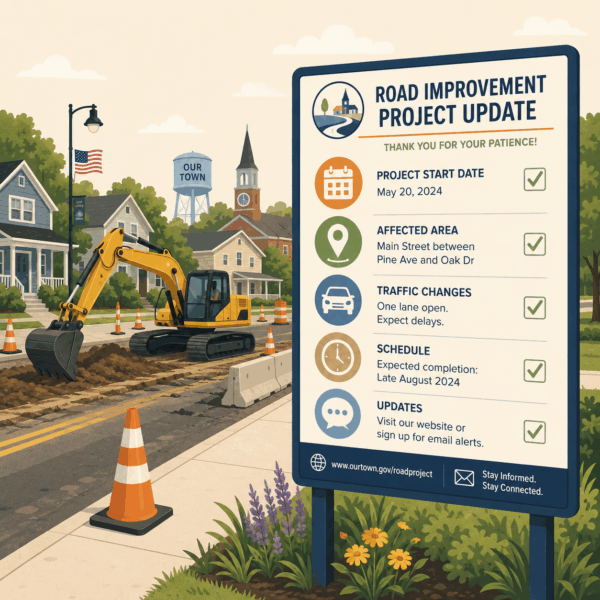 Road closure communication fails in predictable ways, and understanding those failure patterns is the first step toward addressing them. The most common failures are not the result of carelessness but of structural habits that small governments have developed over time and that continue because they have not been formally challenged or replaced with better practices.
The first and most common failure is omitting specific location information. A closure notice that says work will begin on Maple Road without specifying which segment of Maple Road is affected, or without identifying the nearest cross streets or landmarks that would allow residents to determine whether their daily route is affected, is a notice that creates more questions than it answers. Residents who live on Maple Road but whose driveways are half a mile from the work zone need to know whether they are affected. Residents who travel Maple Road as part of a commute need to know whether the work is between them and their destination. Without specific location information, every resident along that corridor is left to guess.
The second common failure is providing dates without enough specificity to be actionable. A notice that says road work will occur in April is less useful than one that says work will begin the first week of April and is expected to continue through the end of May. A notice that says work is expected to be completed by the end of the project season is less useful than one that says the current estimated completion date is a specific date, with a note that the date may change and an explanation of how residents will be informed if it does. Residents making decisions about when to schedule deliveries, plan travel, or arrange alternative transportation need dates they can put on a calendar, not general timeframes they cannot act on.
The third common failure is not describing the detour. A closure notice that does not tell residents which alternative route to use forces them to navigate a disruption without guidance, which wastes time, creates frustration, and may result in residents using routes that are not suitable for their vehicle type or that lead them through residential neighborhoods in ways the agency did not intend. A specific detour route, described in terms residents recognize rather than in terms of road numbers that may not appear on street signs, is a fundamental element of any closure notice.
The fourth common failure is not providing a contact for questions. Residents who read a closure notice and have a specific question, such as whether their driveway will be accessible during work, whether a specific business can still receive deliveries, or whether the closure will affect their trash pickup schedule, have no path to an answer if the notice does not identify who they should call or contact. A named contact with a phone number and email address, identified in every closure notice, ensures that residents with specific needs can get the specific answers they require.
The fifth common failure is not providing an update mechanism. A closure that is expected to last several weeks will change in ways residents cannot predict: the schedule will slip, the active work area will move, conditions will improve or worsen, access restrictions will be lifted for some properties and extended for others. Residents who receive one notice at the start of the closure and nothing after that are not informed about the disruption throughout its duration. They are informed about it once, at the beginning, which means that any subsequent changes they encounter without warning feel like additional surprises from an agency that is not communicating. A closure notice should always tell residents where and how often updates will appear.
Engaged & Connected: Communication Strategies for Small Towns, Villages, Townships, and Rural Communities
This article is part of our series on strategic communication for Small Towns, Villages, Townships, and Rural Local Governments. To learn more and to see the parent article, which links to other content just like this, click the button below.
The Essential Information Every Closure Notice Must Contain
A complete road closure or construction notice answers a specific set of questions that affected residents and road users will have. The questions are predictable, the answers are almost always available, and the failure to include any of them creates a gap that generates the kind of confusion and frustration that effective communication is designed to prevent.
Exact Location
The notice must identify the specific road segment that will be closed or restricted, using the most precise and resident-recognizable description available. The name of the road is necessary but rarely sufficient. The cross streets at each end of the closure zone, the distance from a named landmark, the address range affected, or any combination of these that allows a resident to determine with confidence whether their driveway, their commute route, or their access to a business or facility is within the affected area is the standard of precision the location description should meet.
For closures that involve a specific lane restriction rather than a full closure, the notice should describe which lanes will be affected, in which direction, and during which hours if the restriction is not continuous. A single-lane closure with alternating traffic control is a very different situation from a full closure with no through access, and residents need to know which one they are dealing with before they can decide whether to plan around it or simply allow extra time.
Maps are the most efficient way to communicate location information for road closures, because they convey spatial relationships that text descriptions can approximate but cannot replicate. A map showing the closure zone, the detour route, and the nearest landmarks allows most residents to immediately understand the scope of the disruption in relation to their own geography. Where maps can be provided, they should be. Where they cannot, the text description of the location should be as specific and as oriented around recognizable landmarks as possible.
Dates and Hours
Every closure notice should state the expected start date, the expected end date or completion date, and the hours during which the closure or restriction will be in effect if it is not continuous. For closures that will be active only during daytime working hours, residents need to know whether the road is accessible in the evenings and on weekends. For closures that will be continuous for an extended period, residents need to know the full expected duration so they can plan accordingly.
The expected completion date should always be qualified as an estimate if it is subject to change, and the notice should explain how residents will be informed if the date changes. An estimated completion date with a clear statement that it may change and a specific channel through which updates will be provided is more useful than a firm date that turns out to be wrong, because the qualified date sets accurate expectations while the unqualified date that changes creates the impression that the agency did not know what it was doing or was not honest about what it knew.
Reason for the Closure
Residents are significantly more tolerant of road closures and the inconveniences they cause when they understand why the closure is necessary. The reason for a closure should be stated in plain language. A water main that is being repaired is more understandable than a utility infrastructure maintenance operation. A road that is being reconstructed because the base has failed is more understandable than a pavement rehabilitation project. The reason does not need to be elaborate. It needs to be honest and specific enough that residents can connect the disruption to a real infrastructure need.
For emergency closures driven by unexpected infrastructure failures, the reason should be communicated as soon as it is known, even if the initial notice goes out before the cause has been fully determined. A notice that says the road is closed due to a water main break, with more information to follow as the situation is assessed, is better than waiting for a full assessment before issuing any notice. Residents who encounter a road closed sign with no explanation are more likely to speculate negatively than residents who receive even a brief initial notice explaining that an emergency repair is underway.
Access for Property Owners and Residents
One of the most important questions for residents who live along a closed road is whether they can access their own property during the closure. Full closures often still permit local access for property owners, and that access should be explained clearly: whether residents can reach their driveways, whether they need to notify the contractor or project manager in advance, whether there are specific times when access is not possible even for property owners, and what the best approach is for situations where access is needed during active work periods.
Businesses along a closed corridor have more complex access needs that may require individual coordination. A business that receives daily deliveries, that depends on customer access, or that has specific loading requirements may need to work directly with the project manager or contractor to establish an access plan. The notice should identify the appropriate contact for those individual coordination needs so that businesses can reach the right person rather than calling the general office for operational decisions that the project team needs to make.
Detour Route
The detour route should be described specifically enough that any road user can follow it without additional navigation assistance. The description should use road names that appear on street signs, not road numbers that may not be familiar to residents or visible on local roads. For longer detours, a step-by-step description of the route is more useful than a general reference to an alternative path. For closures affecting different types of users, such as passenger vehicles versus trucks or bicycles versus vehicles, the detour should address each category if different alternatives are recommended.
When the recommended detour passes through a residential neighborhood that was not designed for high-volume traffic, the notice should acknowledge that and explain whether temporary speed or weight restrictions have been put in place on the detour route. Residents who live along the detour route are also affected by the closure and deserve some acknowledgment of how the agency is managing the additional traffic burden on their streets.
Emergency Access
Every road closure notice should confirm explicitly that emergency vehicle access has been maintained, or explain how emergency services will access the affected area if the standard access route has been modified. Residents who live in areas served only by a closed road will be concerned about whether emergency services can reach them, and that concern is legitimate and should be addressed directly rather than left to assumption. A brief statement confirming that emergency access arrangements are in place is reassuring without requiring detailed operational explanation that might not be appropriate for public distribution.
Contact and Update Information
Every closure notice must provide a contact for residents with specific questions and identify where updates will be posted as conditions change. The contact should be a specific person or a designated project contact phone number and email, not a general agency main number that routes to whoever answers the phone on any given day. Updates should be posted on the agency’s website in a specifically identified location and announced through social media and any other channels the agency uses for time-sensitive information.
Handling Incomplete Information at the Time of First Notice
Road closures, particularly emergency closures, often require immediate public communication before all of the relevant information is available. A water main break that closes a road at ten at night cannot wait until the next morning when full information will be available. A storm event that makes a road impassable requires an immediate warning even when the duration of the closure cannot yet be estimated. The tension between the need for immediate communication and the commitment to accuracy requires a specific approach.
The right approach is to communicate what is known accurately and to identify explicitly what is not yet known. A notice that says the road is closed due to a water main break in the 200 block, that the repair is expected to take most of the day but that a more precise timeline will be available by a specific time, and that updates will be posted to the agency’s website and social media, is an accurate and honest first notice. It does not pretend to know what it does not know. It does not leave residents without any information because the full picture is not yet available. It communicates what is known, acknowledges the uncertainty, and commits to a specific update path.
Follow-up communication as additional information becomes available is the second element of this approach. When the duration estimate becomes more precise, when the detour route is confirmed, when access arrangements for affected property owners are worked out, when the repair schedule becomes clearer, each of those pieces of information should trigger an update that gives residents a progressively more complete picture. The follow-up updates should reference the original notice, so residents who see an update without having seen the first notice can understand the context of the update.
For extended closures where detailed planning is still underway when the closure begins, the agency should commit to a specific date by which comprehensive closure information will be available and should provide that information on schedule. A notice that says detailed closure information including the full project schedule, access arrangements, and detour routes will be published by a specific date gives residents a concrete expectation to hold the agency to and ensures that the information is produced on a schedule rather than as an afterthought after the project is underway.
Construction Phase Communication
Multi-day and multi-week construction projects require more than an initial closure notice and an all-clear at the end. Active construction generates changing conditions, changing access restrictions, changing schedules, and changing impacts that residents need to know about throughout the project. A construction project communication plan should specify how frequently updates will be issued, through which channels, and who is responsible for producing them.
Weekly Construction Updates
For projects lasting more than a week, a weekly construction update gives residents current information about what is happening, what has changed, and what to expect in the coming period. The update should describe what work was accomplished in the past week, what work is planned for the coming week, any changes to the access or detour situation, any changes to the estimated completion timeline, and any special conditions residents should be aware of such as significant noise or dust during specific operations.
Weekly updates do not need to be long. A brief paragraph or two that answers these questions, posted to the website and distributed through social media and any email distribution list the agency maintains, is sufficient for most construction projects. The consistency of the update cadence matters more than the length of each individual update. Residents who know they can expect a weekly update on a specific day of the week will check for it. Residents who receive updates on an unpredictable schedule will not develop the habit of looking for them.
Communicating Delays and Schedule Changes
Construction projects almost always encounter conditions that affect the schedule, and the communication about those conditions is one of the most important and most sensitive aspects of construction phase communication. A schedule change that is communicated promptly and honestly, with a specific explanation of what caused it and a revised timeline for completion, is a manageable communication challenge. A schedule change that residents discover by noticing that the project site is still active after the promised completion date, without any official communication, is a trust-damaging event.
The prompt communication of delays should not wait until a revised completion date is certain. If the agency knows that a delay has occurred and that the project will not finish on the previously communicated date, that information should be communicated immediately, even before a revised date is confirmed. A notice that says the project has encountered a delay and that the revised completion date will be communicated as soon as it is confirmed gives residents accurate information about the current situation while acknowledging the ongoing uncertainty.
Communication for Special Access Needs
 Road closures create specific access challenges for residents and users with special needs that standard closure communication does not fully address. These populations deserve explicit attention in the closure communication and in the operational planning that supports it.
Residents who depend on medical transportation or home health services that visit on a regular schedule need to know whether the closure will affect service delivery and, if so, what arrangements the service providers have made for continued access. The agency’s closure communication should note whether affected households can contact the project manager to arrange specific access windows and should provide the contact information for making those arrangements.
School bus routes that travel through a closure zone require coordination with the school district and, in most cases, parent notification about any changes to pickup and dropoff locations or times. The road closure communication should note when a school bus route is affected and should direct parents to the school district for specific information about how service will be maintained during the closure.
Agricultural users in rural communities may have specific access needs related to field operations, livestock management, or farm equipment movement that standard detour routes cannot accommodate. Large farm equipment may not be able to navigate the recommended detour, and the windows when access is needed may not align with standard work hours. The closure communication should identify a contact for agricultural access concerns and should acknowledge that individual access plans may be needed for agricultural operations along the corridor.
Residents with mobility limitations who depend on accessible routes should be considered in closure planning and in closure communication. A closure that eliminates the only accessible route between a residential area and essential services creates a genuine hardship that the agency should address specifically, whether through maintaining a specific accessible pathway through the work zone or through coordination with transportation services that can provide alternative access during the closure period. The communication should explain how accessible access is being maintained or what arrangements are available for residents who depend on it.
Coordinating With Businesses Along the Closure Corridor
Businesses that operate on or near a road closure corridor have communication and coordination needs that differ from those of residential property owners. A business that depends on customer traffic, receives regular deliveries, operates with specific loading requirements, or depends on continuous access for service vehicles may experience significant operational impacts from a closure that residential properties can accommodate more easily. The agency’s responsibility to communicate with affected businesses is distinct from its responsibility to notify residents.
Business outreach before a closure begins should be direct and should go beyond the general public notice. A meeting, a site visit, a phone call, or a personal letter to businesses along the closure corridor, before work begins, allows the agency to understand each business’s specific access needs and to work with the project team and contractor to develop individual access plans where they are needed. Businesses that have had the opportunity to discuss their access needs with the project team before the closure begins are significantly better positioned to continue operating during construction than businesses that receive only the general public notice and are left to figure out how to manage their specific situation without agency assistance.
Business communication during the closure should include specific information about any changes to loading zones, delivery access, customer parking, or signage that affects how customers and suppliers find and reach the business. Where the closure has eliminated or significantly complicated access to a business’s frontage, the agency should work with the project team and contractor to maintain the best possible access and to communicate about that access specifically to the affected business.
The All-Clear: Completing the Communication Cycle
The all-clear notice at the end of a road closure is as important as the initial closure notice, and it is far more often omitted or inadequately produced. Residents who have been following a construction project and adjusting their routines for its duration deserve a clear, complete communication when the situation has been resolved and normal access has been restored. An all-clear that simply says the road is now open fails to close the communication loop effectively.
A complete all-clear notice should confirm that the road has been reopened and identify the date of reopening. It should note any residual conditions residents may encounter, such as lane restrictions during final paving, temporary reduced speed limits, pavement markings that are not yet complete, or landscaping restoration that will occur separately from the construction completion. It should note whether the project achieved what was described in the original closure communication and whether any scope changes resulted in a different outcome than was originally described.
For longer projects, the all-clear is also an opportunity for a brief completion summary that connects the disruption to its outcome. A road that is now reconstructed and expected to serve the community well for a specific number of years represents a tangible public benefit that the all-clear communication can name. A water main that has been replaced and that will significantly reduce the frequency of emergency repairs in the area represents a service improvement that residents who endured the disruption of the replacement work deserve to know about. That kind of completion framing converts a routine closure notice into a communication that honors the public investment and the community patience that made it possible.
Building a Road Closure Communication Workflow
Effective road closure communication requires a workflow that ensures the right information is produced at the right time and distributed through the right channels without creating unmanageable additional burden on public works staff who are already managing the operational demands of the project. Building that workflow is a communication planning task that should happen before the construction season begins, not in the moment when a closure is imminent.
The workflow should identify who is responsible for producing each element of closure communication: who provides the technical information, who translates it into the plain-language notice, who reviews it before distribution, and who publishes it through the appropriate channels. For planned closures with adequate lead time, this workflow can proceed at a measured pace with appropriate review. For emergency closures, the workflow needs to accommodate rapid production and distribution, which means that the template, the channels, and the publishing access all need to be ready in advance.
A closure communication template, specific to road and construction closures, is one of the most efficient workflow tools available. The template identifies all of the information elements required, prompts for each piece of specific content, and provides a structure that ensures nothing is omitted regardless of the time pressure under which the notice is being produced. The template should have versions appropriate for different channels: a full version for the website, a condensed version for social media, a brief version for text alerts, and a notice format suitable for physical posting near the closure area.
Coordinating Closure Communication With Contractors
Most road construction and utility work is performed by contractors rather than agency employees, and that separation creates a specific communication coordination challenge. The contractor has the most detailed and current operational knowledge about what is happening on the project site, but the agency is the party responsible for resident communication and for maintaining the public trust that makes closures manageable. These two realities require a communication coordination protocol that is established in the contract and enforced during project execution.
The contract with any construction contractor should include specific communication obligations: advance notice to the agency before work begins on a new segment, timely notification of any schedule changes, provision of daily or weekly project status information that the agency can use for public updates, and cooperation with the agency’s community liaison if one has been designated. Contractors who understand these obligations before they begin work are far more likely to meet them than contractors who encounter communication expectations for the first time during construction.
The agency should designate a specific staff member as the primary contact between the project team and the communications function, responsible for translating operational information from the contractor into public notices and updates. That person should have the authority to reach the contractor’s project superintendent directly when time-sensitive communication is needed, rather than routing through formal channels that create delays the public notice schedule cannot accommodate.
When a contractor fails to provide timely operational information, causing the agency to miss a communication commitment to residents, the contract should provide a mechanism for addressing that failure. That mechanism may be a formal notification under the contract’s performance provisions, a documented discussion with the contractor’s project management, or a more formal escalation if the pattern continues. Agencies that do not hold contractors accountable for communication-related obligations will find that those obligations are consistently deprioritized by contractors whose primary focus is on completing the physical work.
Conversely, agencies should avoid creating communication obligations that contractors cannot reasonably meet, or that require contractor compliance with timelines that do not reflect the realities of construction operations. A requirement to provide written notice forty-eight hours before any change in work location is not feasible for construction operations where weather, subsurface conditions, and equipment availability create constant adjustments. Reasonable communication obligations that reflect the realities of construction management are more likely to be honored than obligations that are technically required but operationally impractical.
When Construction Affects Pavement That Was Previously in Good Condition
A specific communication challenge arises when road work temporarily damages pavement or surfaces that were in good condition before the project began. Water main repairs, underground utility installations, and other excavation work that cuts through existing pavement leave a surface condition that residents may find unacceptable even when the work has been done correctly and the final restoration is still pending. Managing resident expectations about the temporary post-work condition of the road surface is an important communication task that is often overlooked.
The pre-project closure communication should explicitly describe the expected condition of the road surface during and immediately after active construction, and it should explain when final pavement restoration will occur. Residents who know in advance that a water main repair will leave a gravel patch for a specified period before permanent pavement is placed are better prepared for what they will encounter than residents who discover the gravel patch unexpectedly and conclude that the project has been completed poorly.
The timeline for final pavement restoration should be communicated specifically, including any seasonal constraints that may affect when paving can occur. A water main repair completed in late fall may not receive permanent pavement until the following spring because paving season has ended. Residents who are not told about this timing will spend the winter driving over a gravel patch and wondering whether the agency has forgotten about it. A communication that explains the temporary pavement status and gives a specific spring target for final restoration converts that uncertainty into a managed expectation.
When the final pavement restoration does occur, the communication about it, even if brief, closes the loop for residents who have been watching and waiting. A short notice that permanent pavement has been placed in a specific location, that the work is now complete, and that any concerns about the quality of the final product should be reported to the designated contact gives residents the completion signal they need and provides a mechanism for addressing any legitimate concerns about the quality of the final restoration.
Strategic Communication Support for Small and Rural Governments
 Road closure communication is among the most frequently recurring communication challenges in small local governments, and it is an area where consistent quality makes a significant difference in resident satisfaction and trust. An agency that reliably produces complete, accurate, timely closure notices builds a reputation as a communicative organization that respects residents’ time and their need for information. An agency that produces inconsistent or incomplete closure notices, regardless of how competently it manages the underlying construction work, creates friction that affects its broader credibility.
Building a comprehensive road closure communication system requires templates, workflows, channel strategies, and the staff training to use them consistently. For agencies that manage a significant volume of construction and maintenance activity, that investment is clearly worthwhile. For agencies with fewer projects, a simpler but equally complete approach that can be executed by the staff responsible for managing the work is the right standard.
Stegmeier Consulting Group (SCG) helps small and rural governments develop road closure and construction communication systems that give residents the specific, timely information they need to navigate disruptions effectively. That work includes closure notice template development, workflow design, channel strategy, contractor communication coordination, and the training that ensures consistent application across different projects and different staff members. Whether your agency is managing a major multi-year construction program or trying to improve communication for routine maintenance closures, SCG can help you build the system that serves residents well throughout every project.
Future Trends in Road Closure Communication
The tools and expectations for road closure communication are evolving in ways that small governments should be aware of, even if full adoption of every new capability is not immediately feasible. Several trends are likely to shape how road closures are communicated in the coming years.
Integration of road closure information into digital mapping applications is becoming an important channel for reaching residents who rely on navigation tools for route planning. When a local government can submit closure information directly to navigation platforms, users of those tools receive automatic rerouting suggestions that reflect current conditions. Some platforms already support local government input, and more are likely to develop that capability. Agencies that explore these integrations may find a significant channel for reaching residents who are planning their routes before they encounter a closure, which is the most effective moment to provide that information.
Automated notification systems that allow residents to subscribe to alerts for specific roads or geographic areas, rather than following the general agency communication channels, are becoming more accessible for small governments. A resident who commutes through a specific corridor can subscribe to receive alerts only when that corridor is affected by a closure, rather than having to monitor general agency communication for information that is relevant to them specifically. These targeted notification capabilities improve the relevance of closure communication significantly and reduce the volume of information residents must process to find what applies to them.
Plain language standards for transportation communication are evolving, with growing attention to the needs of non-English speakers, residents with limited literacy, and residents who receive information primarily through audio channels rather than through written communication. Closure notices that are available in multiple languages, that are written at accessible reading levels, and that can be converted to audio formats for residents who depend on them are meeting a communication standard that is likely to become more explicitly expected as equity in public information becomes a more prominent policy priority.
Conclusion
Road closures are a moment of truth in local government communication. They test whether the agency can produce specific, timely, accurate information about a real disruption and get it to the people who need it before they encounter the problem. Agencies that pass that test consistently earn a reputation for communicating well. Agencies that fail it consistently earn a reputation for leaving residents to figure things out on their own.
The good news is that the standards for good road closure communication are achievable for any small government that is willing to build the right system. Complete notices, timely distribution, honest handling of schedule changes, specific attention to special access needs, direct business outreach, and a clear all-clear to close the communication cycle are all within the capacity of any agency. They require deliberate attention and some upfront investment in templates and workflow, but they do not require specialized expertise or large staff resources.
Residents who receive good road closure communication may not consciously notice that it is good. They will notice that they knew what was happening, that they could plan around the disruption, and that the agency kept them informed throughout. That experience builds the quiet, steady credibility that makes everything else a local government communicates more likely to be trusted and acted on.
Stegmeier Consulting Group’s Strategic Approach to Communication Systems
Align your agency’s road closure communication with the specificity and timeliness residents need.
Small and rural governments need road closure and construction communication that gives residents the specific location, dates, reason, detour, and contact information they need before they encounter a disruption, with consistent updates throughout and a clear all-clear when the work is done. Building that communication requires templates, workflows, and the channel strategy that gets information to residents through the channels they actually use.
SCG helps public agencies develop road closure communication systems that serve residents reliably across all types of construction and maintenance activity. Whether your agency needs to build a closure communication system from scratch or improve an existing approach that is not consistently reaching residents with the information they need, SCG can help you develop the practice that makes every closure notice complete, timely, and genuinely useful.
Use the form below to connect with our team and explore how a systematic approach to road closure communication can help your agency reduce resident frustration, maintain community trust, and demonstrate the operational transparency that responsible local government requires.