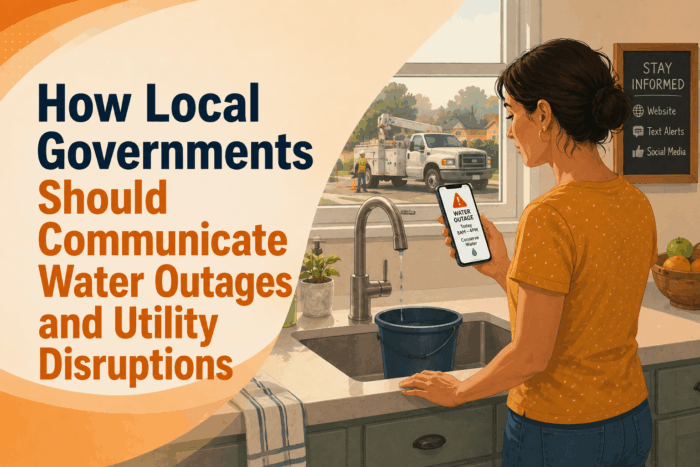
How Local Governments Should Communicate Water Outages and Utility Disruptions
A water main break at two in the morning does not wait for business hours. A sewer backup during a holiday weekend does not pause because the office is closed. A power disruption that affects a water treatment facility does not schedule itself conveniently during a workday when full staff is available to communicate about it. Utility disruptions are, by their nature, unpredictable events that require communication at moments when small local governments are least prepared to communicate: in the middle of the night, on weekends, during severe weather, or at any other time when a system that residents depend on for basic household functions has stopped working the way it should.
The stakes of utility disruption communication are higher than almost any other form of local government communication because the services being disrupted are essential. Water for drinking, cooking, and hygiene. Sewer service for waste removal. Power for lighting, heating, and the operation of medical equipment. When those services fail, residents do not just experience inconvenience. Some residents face genuine hardship, and some face health risks. The communication about the disruption is not merely informational. It is part of the service response.
This article addresses how local governments should communicate about water outages, sewer disruptions, power-related utility failures, boil water advisories, and similar utility disruptions from the moment of initial detection through the resolution of the issue and the all-clear to normal service. It covers how to produce an initial alert before all information is available, how to manage the update cadence during an active disruption, how to handle the specific communication requirements of boil water advisories, how to coordinate with other utilities and partner agencies when disruptions involve multiple systems, and how to close out the communication cycle in a way that gives residents complete information about what happened and what was done about it.
The framework applies to both planned and unplanned utility disruptions. Planned disruptions, such as scheduled maintenance that requires service interruption, have the advantage of advance notice and should be communicated well in advance of the work. Unplanned disruptions, such as main breaks or equipment failures, require immediate communication with incomplete information and a structured approach for providing updates as the situation develops. Both situations are addressed in this article, with attention to the specific communication requirements that distinguish them.
The First Minutes and Hours: Initial Alert Communication
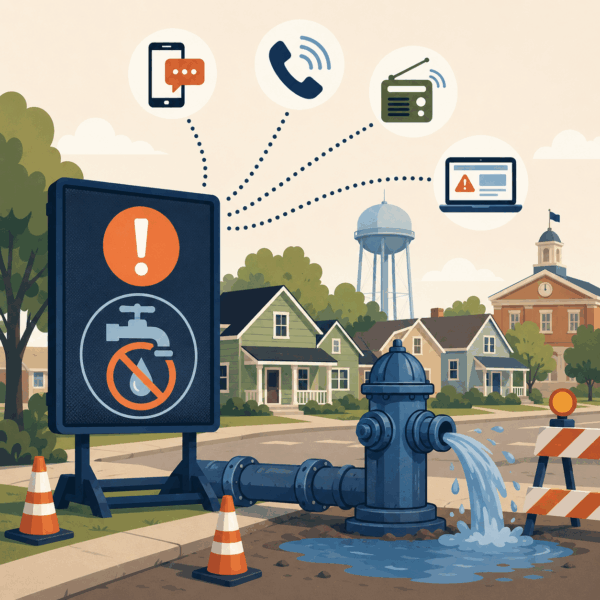 The initial alert for an unplanned utility disruption is the most time-sensitive communication a small local government produces. Residents who lose water, experience a sewer backup, or find that a utility service has been disrupted need to know immediately: what happened, which households or areas are affected, what they should do, and when more information will be available. Those four pieces of information are the minimum content of any first alert, and they should go out as quickly as possible after the disruption is confirmed, even if the full picture of the situation is not yet clear.
The first alert does not need to be comprehensive. It needs to be accurate and actionable. A notice that says water service has been disrupted in a specified area due to a main break, that residents should not use tap water until further notice, and that an update on the repair timeline will be provided by a specific time, is a complete and useful first alert. It tells residents what has happened, gives them a specific action to take, and commits to a timeline for the next update. That is all a first alert needs to do.
What a first alert should never do is wait for complete information before going out. The natural impulse to have all of the facts before communicating is understandable, but it is counterproductive in a utility disruption situation. Residents who lose water at two in the morning and do not receive any communication until the repair crew has fully assessed the situation and the repair timeline has been confirmed are residents who have been making decisions, such as whether to go buy water, whether to plan to shower at a neighbor’s house, whether to call someone for help, without the information that would have allowed them to make those decisions sensibly. An incomplete first alert that goes out quickly serves residents better than a complete alert that goes out after the window for useful advance notice has passed.
Speed and accuracy are both necessary, and both can be achieved if the initial alert is drawn from a template that prompts for the specific known information without requiring staff to compose a notice from scratch under pressure. The template should have blank fields for the affected area, the type of disruption, the immediate resident action, the next update time, and the contact for questions. Filling in those fields from the information available at the moment of first notification takes only a few minutes and produces a first alert that is both fast and complete for the information that is known.
Engaged & Connected: Communication Strategies for Small Towns, Villages, Townships, and Rural Communities
This article is part of our series on strategic communication for Small Towns, Villages, Townships, and Rural Local Governments. To learn more and to see the parent article, which links to other content just like this, click the button below.
Geographic Specificity in Utility Disruption Communication
One of the most common deficiencies in utility disruption communication is inadequate description of the affected area. A notice that says water service is disrupted in the western part of the service area is not useful to a resident who does not know whether they are in the western part of the service area. A notice that describes the affected area in terms of specific road names, address ranges, or named neighborhoods allows residents to determine immediately and with confidence whether they are affected.
Geographic specificity in utility disruption communication requires that staff have access to current utility system maps that can be consulted quickly during an emergency. A public works department that can pull up a system map, identify the location of the break or failure, and describe the downstream effect on service delivery in terms of specific roads and address ranges has the information needed to produce a specific and useful notice. A department that must estimate the affected area from memory or from an outdated map may produce a notice that over- or under-states the affected area, which creates either unnecessary alarm or false reassurance.
When the affected area is still being determined at the time of the first alert, the notice should say so explicitly and should commit to a specific update that will include more precise information. A statement that the affected area is currently believed to include a named geographic area and that more precise information will follow as the situation is assessed is more honest and more useful than a vague description that implies more precision than the agency actually has at that moment.
Maps are as useful for utility disruption communication as they are for road closure communication, and for the same reason: they convey spatial information more efficiently than text can. A map posted to the agency’s website that shows the affected service area, updated as the boundaries of the disruption become clearer, allows residents to self-identify as affected or unaffected with a level of precision that text descriptions rarely achieve. For significant disruptions affecting a large area, a map is not merely useful. It is essential.
Update Cadence During Active Disruptions
The update cadence during an active utility disruption is the element of disruption communication that most directly affects resident anxiety and information-seeking behavior. Residents who know they will receive an update at a specific time will wait for that update rather than calling the office repeatedly or relying on neighbor speculation. Residents who do not know when the next update is coming will call the office as soon as they have a question, will monitor social media continuously, and will share whatever they learn through informal channels regardless of its accuracy.
The agency should commit to a specific update schedule at the time of the first alert and should maintain that schedule even when there is nothing new to report. An update that says the repair is continuing as expected and that the next update will be provided at a specific time keeps residents oriented even when conditions have not changed. An update that says the repair has encountered an unexpected complication and that the revised timeline will be communicated as soon as it is confirmed maintains the communication cadence while being honest about the changed situation.
The update schedule should be realistic given the nature of the disruption and the agency’s communication capacity. A major water main break that may take twelve hours to repair should have updates at two to three hour intervals. A minor service interruption expected to last a few hours may need only a mid-disruption update and a resolution notice. The schedule should be stated in the first alert and honored throughout the disruption.
Updates should always include three elements: the current status of the situation, what is being done to resolve it, and when the next update will be provided. That structure ensures that each update is self-contained enough to be useful to residents who may not have seen earlier updates, and it provides the next-update commitment that maintains the communication rhythm. Omitting the next-update time from any update leaves residents uncertain about when they will next hear from the agency, which is the condition that generates the most unnecessary office contact and the most neighbor-to-neighbor speculation.
Boil Water Advisories: Specific Communication Requirements
Boil water advisories are a specific category of utility disruption communication that requires particular attention because of the public health implications and because of the specific actions residents must take to protect themselves. A boil water advisory that is communicated poorly, that does not reach all affected residents, or that is not clearly lifted when the situation is resolved can have serious consequences that go beyond the inconvenience of a standard service disruption.
Issuing the Boil Water Advisory
A boil water advisory should be issued whenever there is a confirmed or credible risk that drinking water may be contaminated, regardless of whether contamination has been confirmed. The threshold for issuing the advisory should be low because the consequence of failing to advise when advisement was warranted is far more serious than the consequence of issuing an advisory that proves unnecessary. The agency’s public health advisor, state environmental or health agency contacts, and the specific protocols for the water system should be the guide for when to issue, but when in doubt, the advisory should go out.
The advisory must identify the affected service area with the precision described in the previous section. It must tell residents specifically what precautions to take: boil water vigorously for at least one minute before using it for drinking, cooking, preparing infant formula, brushing teeth, or making ice. It must note any uses for which the water remains safe, such as flushing toilets, washing non-food-contact surfaces, or watering plants, since knowing what remains safe is as important to residents as knowing what is not. And it must explain the situation that triggered the advisory without using technical language that residents cannot interpret.
For communities where a significant portion of residents are not fluent in English, the boil water advisory must be available in the languages spoken in the affected community. A health risk communication that does not reach non-English-speaking residents because it was produced only in English is not a complete boil water advisory. The translation should be produced as part of the standard advisory distribution, not as a secondary step that may or may not happen depending on available resources.
Lifting the Advisory
The lifting of a boil water advisory requires its own specific communication that is as prominent and as widely distributed as the original advisory. Residents who are still boiling their water after the advisory has been lifted, because they did not receive the lifting notice, are experiencing an unnecessary hardship. Residents who stop boiling their water before the advisory is officially lifted, because they assume it has been resolved, may be exposing themselves to health risk.
The advisory-lifted notice should state clearly that the advisory has been lifted and that water is now safe for normal use. It should explain what testing or other verification determined that the water is safe, so residents have confidence that the lifting is based on evidence rather than administrative convenience. It should note any final steps residents should take, such as running cold water from all taps for a specified period before resuming normal use, or replacing water filters that may have captured contaminants during the advisory period.
The lifting notice should go out through the same channels as the original advisory, distributed with the same urgency and priority. A lifting notice buried in the general website updates section, without social media distribution or direct notification, is not adequate for a communication that is as public-health-consequential as the original advisory.
Planned Service Interruptions: Communicating in Advance
Planned utility service interruptions, such as those required for system maintenance, equipment replacement, meter installation, or system expansion, have the advantage of predictability that emergency disruptions do not. That advantage should be fully exploited through advance communication that gives residents maximum time to prepare.
The advance notice for a planned service interruption should go out at least 48 to 72 hours before the scheduled interruption for most residential service areas, and earlier for disruptions that will affect businesses, schools, medical facilities, or other users who need more lead time to make operational adjustments. The notice should describe what work is being performed, why it requires a service interruption, the date and time the service will be shut off, the expected duration of the interruption, when service is expected to be restored, and any special instructions for residents during the interruption period.
For planned water interruptions, residents should be advised to fill containers with water before the shutoff for drinking, cooking, and hygiene use during the interruption. For sewer interruptions, residents may need to minimize water use that generates wastewater. For any disruption that will affect a facility with special water or utility needs, such as a medical practice, a food service establishment, or a school, direct individual notice in advance of the general public notice allows those facilities to make the preparations they need without relying on the general communication timeline.
The notice should also confirm the process for notifying residents when service has been restored, so residents who have been managing through the interruption know when they can return to normal use. A restoration notice that follows immediately upon service resumption, combined with any instructions for flushing lines or other post-restoration steps, completes the planned interruption communication cycle.
Coordinating With Other Utilities and Partner Agencies
Many utility disruptions involve multiple systems or multiple agencies. A water main break may affect service provided by a separate sewer authority. A power outage may affect the operation of a water treatment facility operated by a different entity. A natural gas disruption may affect the heating systems of a facility managed by yet another agency. When disruptions involve multiple service providers, the communication must be coordinated to prevent the kind of channel inconsistency that occurs when each agency describes the same situation differently or attributes responsibility in conflicting ways.
Before a disruption occurs, agencies that share infrastructure or serve the same customer base should establish communication coordination protocols. Those protocols should specify which agency will serve as the lead communicator for joint disruptions, how information will be shared between agencies in real time during a disruption, and how each agency’s public communication will reference the other’s role without creating confusion about accountability. A protocol that assigns lead communication responsibility based on the nature of the disruption, such as the water authority leads for water system failures and the sewer authority leads for wastewater system failures, is simpler and more efficient than a protocol that requires negotiation of communication roles during the disruption itself.
Coordination with state environmental and health agencies is required for some categories of utility disruptions, including boil water advisories and spills that may affect public health or waterways. The agency should have current contacts at the relevant state agencies and should understand what notifications are required, what timelines apply, and what information the state agency needs. State agencies that receive timely, accurate notifications are more likely to be supportive partners during a disruption than those that learn about the situation from residents or media rather than from the local agency.
Local emergency management should be notified of significant utility disruptions that may affect emergency response operations, vulnerable population access to essential services, or large numbers of residents for extended periods. Emergency management partners can help coordinate access to alternative water sources, assist with outreach to vulnerable populations who may need special assistance, and ensure that emergency response operations are not affected by the disruption in ways that the utility system operator is not positioned to address independently.
Communication After the Disruption Is Resolved
The resolution communication for a utility disruption is as important as any communication that preceded it, and it requires the same attention to completeness and accuracy. Residents who experienced the disruption deserve a final communication that tells them what happened, what was done to resolve it, and what they can expect going forward. That communication closes the loop on the commitment the agency made to keep residents informed throughout the disruption.
The resolution notice should confirm that service has been fully restored, state the time of restoration, and briefly describe the repair or intervention that resolved the issue. It should note any temporary conditions residents may experience, such as discolored water following a main repair or reduced pressure during system repressurization, and explain how long those temporary conditions are expected to last. It should advise residents of any follow-up action they should take, and it should provide a contact for residents who continue to experience problems after the official resolution.
For significant disruptions that affected a large number of residents for an extended period, the resolution communication is also an opportunity for a brief after-action summary that tells the community what the agency learned from the event. An honest assessment of what happened, how the response went, what the agency is doing to prevent a recurrence, and what communication improvements will be made based on the experience gives residents confidence that the agency is taking the disruption seriously as both an operational and a communication learning opportunity.
Building Utility Disruption Communication Capacity
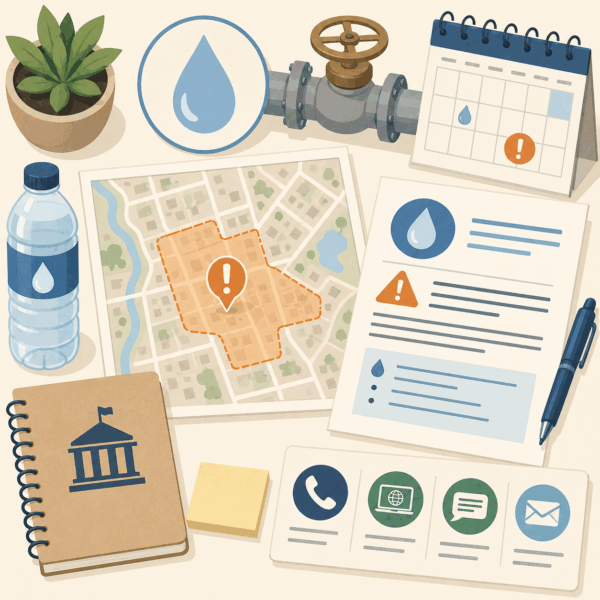 The ability to communicate effectively during a utility disruption depends on having the systems, access, and protocols in place before the disruption occurs. An agency that must figure out how to send a text alert for the first time at midnight during a water main break will not communicate as well as an agency that has tested its notification platform, confirmed its staff access, and practiced the process during normal operations.
Communication capacity building for utility disruptions includes several elements. A resident notification platform that allows the agency to send text and email alerts quickly, with confirmed enrollment of the maximum possible share of the affected service area population. Staff training on how to use the platform, including after-hours access and mobile access for staff who may need to send alerts from home or the field. A set of disruption-specific communication templates that can be filled in and sent quickly under pressure. A current and accurate utility system map that allows staff to describe the affected area with the precision residents need. A clear protocol for who has the authority to issue a notice, who serves as backup, and how the communication chain is activated when a disruption is detected.
Testing and drills are as important for communication capacity as they are for operational response capacity. An annual communication drill that simulates a significant utility disruption and exercises the full communication process, from initial alert through update cadence to resolution notice, reveals gaps in the system before those gaps create problems during an actual event. The drill should include the full range of communication channels and should involve all staff who may have a role in disruption communication.
Vulnerable Population Outreach During Utility Disruptions
Every service area includes residents whose needs during a utility disruption are greater than those of the general population. Individuals who depend on home dialysis equipment that requires a continuous clean water supply. Residents on well water who rely on electric pumps that are affected by power-related utility failures. Elderly residents who may not be monitoring digital communication channels and who may not have the physical capacity to boil water or to travel to obtain alternative water supplies. Households with infants for whom safe water for formula preparation is a critical need. These residents are disproportionately affected by utility disruptions and deserve targeted outreach that goes beyond the general public notice.
Developing a vulnerable population registry, even an informal one based on known service requests, referrals from social service agencies, and voluntary self-identification, gives the agency a basis for targeted outreach when disruptions occur. Residents on the registry can receive direct phone calls rather than relying on the general notification, can be connected with assistance resources more quickly, and can be prioritized for restoration when the disruption is being managed in stages. The registry should be maintained with appropriate privacy protections and updated regularly to reflect changes in the service area population.
For disruptions that affect vulnerable residents significantly, coordination with local emergency management, social service agencies, healthcare providers, and community organizations can extend the agency’s reach beyond what its own communication channels can achieve. A local senior center that can call its members directly, a hospital social work department that can advise patients on home medical equipment needs, or a community health worker network that can conduct door-to-door outreach in affected neighborhoods can all serve as critical communication partners when the general notification channels are not sufficient to reach those most at risk.
The communication to vulnerable residents should include not just the information provided in the general alert but also specific information about what resources are available to help them manage the disruption. Where to obtain safe water if boiling is not feasible for their situation. Who to call if they need transportation assistance. Whether the agency can arrange delivery of water to households where the occupant cannot leave to obtain it. What to do if their home medical equipment requires water or power that the disruption has affected. These specific, practical resources are what vulnerable population outreach must provide, and the general public notice alone will not provide them.
Communication During Extended or Multi-Day Disruptions
Most utility disruptions are resolved within hours. But some are not: a main break that requires specialized repair equipment not locally available, a treatment system failure that requires multiple days of work to correct, a contamination event that requires extensive testing before the all-clear can be issued. Extended disruptions create communication demands that are qualitatively different from those of shorter events, because residents must adjust their daily lives for a period long enough to require sustainable communication rather than a brief emergency response.
An extended disruption requires a sustained communication operation with a defined daily rhythm. Morning updates that report on the previous night’s progress and the day’s plan. Evening updates that report on the day’s progress and the overnight situation. Midday updates on days when significant developments are expected. Dedicated media contact opportunities for disruptions that attract press coverage. Partner briefings to keep emergency management, local elected officials, and community organizations current on the status. These communication activities require deliberate staffing and scheduling, not the improvised response that is appropriate for a short-duration disruption.
For extended disruptions, the communication should also address the practical logistics of how residents will manage during the extended period. Where can residents obtain safe water, and is that supply being maintained at a level adequate to serve the affected population? Are any community facilities such as schools, community centers, or fire stations providing water access? Are laundry and shower facilities being made available for residents who need them? What is the agency doing to accelerate the resolution, and is there any assistance the community can provide? These operational questions are as important to communicate as the technical status of the repair.
The communication should also be honest about the emotional and practical impact of an extended disruption. A community that has been without water for three days is experiencing a significant hardship, and the agency’s communication should acknowledge that directly. An acknowledgment that the situation is difficult and that the agency understands its impact on the community, expressed in the same clear and direct language the agency uses for all factual communication, is a form of community service in itself. Residents who feel that the agency is aware of and concerned about their situation are more patient and more cooperative than residents who feel that the agency is treating a major disruption as a routine operational matter.
Communication About the Cause and Prevention of Future Disruptions
After a significant utility disruption is resolved, residents often want to know what caused it, whether it could have been prevented, and what the agency is doing to prevent a recurrence. Those are legitimate questions that the agency’s communication should address honestly, even when the answers are uncomfortable or reflect infrastructure conditions that have been known but not addressed.
A water main that failed because it was at the end of its service life and had not been prioritized for replacement in the capital improvement program is a different situation from one that failed because of unexpected external damage. An equipment failure that resulted from inadequate maintenance is a different situation from one that resulted from a manufacturing defect or an unprecedented operational condition. The honest communication about cause includes acknowledging when the agency’s own decisions, whether about maintenance investment, capital replacement, or operational protocols, contributed to the disruption.
That honesty is not an admission of incompetence. It is an acknowledgment of the resource constraints and prioritization decisions that every small government faces, and it gives residents the information they need to evaluate whether the agency is managing its infrastructure responsibly. Residents who understand that a main failure resulted from deferred replacement can evaluate the governing body’s capital investment decisions with that context. Residents who are told only that the main failed, without explanation of why, cannot make that evaluation and may draw their own conclusions that are less favorable to the agency than the honest explanation would be.
The communication about what the agency is doing to prevent future disruptions should be specific and verifiable. A statement that the agency will review its inspection and maintenance protocols is less credible than a statement that the agency has scheduled a condition assessment of all mains in the affected area and will present the findings to the governing board at a specific meeting. Residents who are given a specific, verifiable next step can hold the agency accountable for following through. Residents who receive only a general commitment to improvement have no basis for that accountability.
Social Media and Short-Form Channels During Utility Disruptions
Social media is both an asset and a liability during utility disruptions. As an asset, it allows the agency to push information to residents quickly and to monitor what is being said about the disruption. As a liability, it can become a vector for misinformation, rumor, and community anxiety if the agency’s own posts are not accurate, timely, and consistent with what is being said through other channels. Managing social media effectively during a utility disruption requires a specific approach that takes both dimensions into account.
The agency’s social media posts during a disruption should be brief, specific, and consistent with the longer notices posted to the website. They should link to the website notice for residents who want more detail, and they should be posted immediately after the corresponding website update rather than later in the sequence. A social media post that goes out before the website has been updated, or that contains information different from the website, creates exactly the channel inconsistency that disruption communication is most vulnerable to.
Monitoring social media during a disruption allows the agency to identify misinformation that is circulating and to respond to it through an official post that provides the accurate information. Not every inaccurate post warrants an official response, but claims that are widely shared, that concern the safety of the water or the severity of the situation, or that mischaracterize the agency’s response efforts generally warrant a calm, factual correction. The correction should focus on providing accurate information rather than on disputing or criticizing the source of the inaccuracy.
Text alerts are among the most effective channels for utility disruption communication because they reach residents directly without requiring them to check a specific platform. For agencies that have established resident notification enrollment, text alerts for significant utility disruptions should go out at the same time as the initial website post and social media post. Residents who receive a text alert know immediately that something has happened and where to find more information. For agencies without an established notification platform, a disruption that affects a significant number of residents for an extended period may be the occasion to investigate notification platform options that would improve future response.
Strategic Communication Support for Small and Rural Governments
 Utility disruption communication is an area where the gap between current practice and the standard residents need is significant in many small governments. The combination of unpredictable timing, high stakes, incomplete information at the outset, and the need for rapid production and distribution creates a communication challenge that most small governments have not fully prepared for. Building the capacity to meet that challenge requires deliberate investment during normal operations, before the first major disruption tests the system.
Outside support is particularly valuable for utility disruption communication because it can help agencies build the systems they need before they need them, rather than in the middle of a crisis when system-building is impossible. Notification platform setup and enrollment campaigns, template development, protocol documentation, staff training, and annual drills are all investments that can be made during ordinary operations and that pay substantial dividends when disruptions occur.
Stegmeier Consulting Group (SCG) helps small and rural governments develop utility disruption communication systems that meet the standard residents need, regardless of when or how disruptions occur. That work includes notification platform guidance, template development for both planned and unplanned disruptions, boil water advisory communication protocols, partner agency coordination planning, and the training and drill design that keeps communication capacity current and tested. Whether your agency has never experienced a major disruption and wants to be prepared, or has experienced one and identified significant communication gaps, SCG can help you build the system that serves residents when they need it most.
Future Trends in Utility Disruption Communication
The tools and expectations for utility disruption communication are evolving alongside the broader trends in local government communication. Several developments are likely to shape how small governments communicate about utility disruptions in the coming years.
Automated system monitoring that triggers communication workflows when specific thresholds are crossed, such as pressure drops that indicate a main break or flow anomalies that indicate unauthorized use or system failure, is becoming more accessible for small water and sewer systems. When a pressure sensor detects a drop consistent with a main break, an automated alert to the on-call operator and a preliminary notification to affected residents could be triggered simultaneously, significantly reducing the time between problem detection and public communication. As these monitoring and notification integrations become more accessible and affordable, they will change the speed expectations for initial utility disruption alerts.
Smart meter technology, which allows utility systems to detect service anomalies at the individual customer level, is also likely to affect how disruption communication is targeted and distributed. A system that can identify which specific meters have lost service, rather than requiring staff to estimate an affected area from system map knowledge, can produce more precise affected-area descriptions and more targeted resident notifications. As this technology becomes more common in small system implementations, its communication benefits will become more significant.
The expectation of plain language and accessible communication for utility disruptions is also likely to increase. Boil water advisories and other health-related utility communications are subject to growing scrutiny about whether they reach all affected residents in accessible and understandable formats. Agencies that build multilingual communication, accessible document formats, and multiple distribution channels into their standard disruption communication practice will be ahead of requirements that are likely to become more explicitly mandated over time.
Conclusion
Utility disruptions test local government communication at its most demanding: under time pressure, with incomplete information, about services that residents depend on for basic household functions, at hours when the agency is least equipped to communicate. The agencies that communicate well under those conditions are not the ones with the largest communications staff or the most sophisticated technology. They are the ones that prepared a system in advance that can function under pressure.
The elements of that system, a rapid notification platform, disruption-specific templates, clear protocols for who communicates what and when, a structured update cadence, coordination with partner agencies, and the capacity to issue boil water advisories and resolution notices correctly, are all achievable for any small local government that is willing to make the deliberate investment during normal operations. That investment will never be wasted. Every agency will face utility disruptions. The question is whether residents will experience those disruptions with accurate, timely information or without it.
Residents who experience a utility disruption and receive prompt, accurate, specific communication from their local government may still be frustrated by the disruption itself. But they will know who is handling it, what is being done, and what to expect next. That knowledge is a form of service in itself, and providing it consistently is one of the most important things a small local government can do to maintain the trust of the community it serves.
Stegmeier Consulting Group’s Strategic Approach to Communication Systems
Align your agency’s utility disruption communication with the speed, accuracy, and completeness residents need.
Small and rural governments need utility disruption communication that goes out immediately, describes the affected area precisely, gives residents specific actions to take, commits to a regular update cadence, and closes with a complete resolution notice. Building that communication requires templates, notification platforms, staff training, and the protocols that ensure consistent execution regardless of when a disruption occurs or which staff member is available to respond.
SCG helps public agencies develop utility disruption communication systems that are ready when they are needed, covering both planned and unplanned service interruptions, boil water advisories, and the coordination requirements of multi-agency disruption responses. Whether your agency is building this capacity for the first time or strengthening an existing system, SCG can help you develop the approach that serves residents effectively in the moments that matter most.
Use the form below to connect with our team and explore how a prepared utility disruption communication system can help your agency respond to service failures with the speed, accuracy, and community care that residents deserve.