
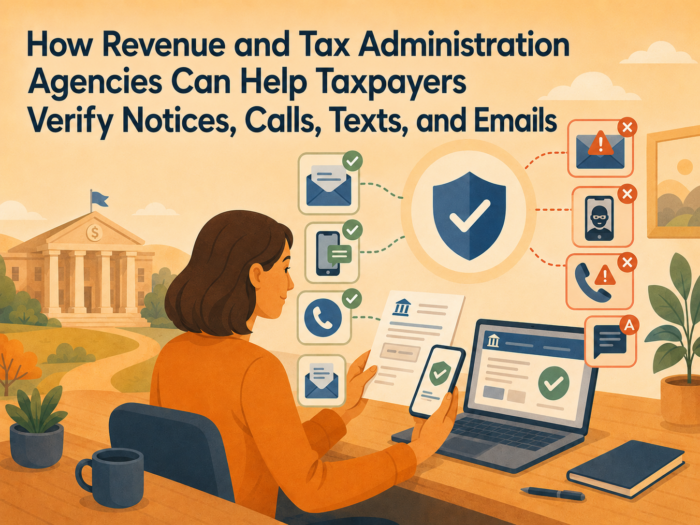
Official or Scam?: How Revenue and Tax Administration Agencies Can Help Taxpayers Verify Notices, Calls, Texts, and Emails
There is a particular kind of harm that emerges not from the absence of government communication but from its abundance. When taxpayers receive notices, calls, emails, and text messages from what appears to be their state or local revenue agency, they face a verification challenge that the government itself has inadvertently made harder to solve. The official communication channels that revenue agencies use to reach taxpayers, including mailed letters, phone outreach, email reminders, and text alerts, are the same channels that fraudulent actors use to impersonate those agencies and steal personal information. The more actively agencies communicate through these channels, the more credible those channels become as a vehicle for fraud, and the harder the verification problem becomes for the taxpayer.
Tax-related scams are among the most prevalent and financially damaging forms of fraud that individuals and small businesses encounter. Fraudulent calls claiming to be from a state revenue department, threatening immediate arrest unless payment is made. Phishing emails using government logos and official-sounding language asking taxpayers to verify their identity by clicking a link. Text messages claiming a refund is waiting but that personal information must be confirmed before it can be released. These schemes succeed not because the taxpayers who fall for them are unsophisticated but because the fraudulent communications are designed to exploit the exact expectations that legitimate agency communications create.
For state and local revenue and tax administration agencies, the challenge of helping taxpayers distinguish legitimate official communication from fraud is not someone else’s problem to solve. It is a direct consequence of the agency’s own communication practices, and it requires a direct communication response. An agency that sends letters, emails, texts, and calls to taxpayers without also teaching them how to verify those communications is creating a credibility environment that fraudulent actors can exploit. Equipping taxpayers with the knowledge to distinguish official agency contact from impersonation is not a peripheral public education function. It is a core component of the agency’s communication system.
This article examines how state and local revenue and tax administration agencies can design and deploy scam prevention communication that teaches taxpayers to recognize legitimate agency outreach, identify the signals that mark fraudulent contact, and take specific steps to verify any communication before responding. It addresses the structural, language, and channel decisions that make anti-fraud communication effective and explores the organizational responsibilities that come with building a more fraud-aware taxpayer population.
Understanding Why Tax Scams Work
 The effectiveness of tax-related scams is not primarily a function of their technical sophistication. It is a function of the psychological environment that tax administration creates. Taxpayers interact with government revenue agencies in a context defined by legal obligation, potential financial consequence, and asymmetric information. The agency knows more about the taxpayer’s account than the taxpayer does. The taxpayer knows that errors in their favor can be reclaimed and errors against them can result in penalties. A communication that implies something has gone wrong with a tax account, that action is required immediately, or that a benefit is waiting to be claimed maps directly onto the anxieties and expectations that the legitimate tax system has created.
Fraudulent actors understand this psychological environment. They design their communications to activate the same responses that legitimate agency communications produce: urgency, concern, the desire to resolve the situation quickly before it gets worse. A call that threatens arrest for unpaid taxes creates immediate fear. An email claiming a refund is available creates immediate interest. A text claiming immediate action is needed to prevent account suspension creates immediate urgency. These emotional activations suppress the critical thinking that would otherwise lead a taxpayer to question whether the communication is legitimate.
Revenue agencies that want to help taxpayers resist these schemes must address the psychological mechanism as well as the informational one. Teaching taxpayers what the agency will and will not do is essential. But equally important is helping taxpayers understand that any communication that activates intense urgency, fear, or excitement about a tax matter should be treated as a signal to slow down and verify rather than a reason to act immediately. The counter-pressure to the emotional activation of fraud is not more information. It is a habituated pause that gives the taxpayer time to apply the verification knowledge they have been given.
The Credibility Problem in Official Agency Communication
Revenue agencies face a structural credibility problem that they have in many cases not fully acknowledged. The more channels they use to communicate with taxpayers, the more legitimate-seeming fraudulent communications in those channels become. An agency that only communicates by mail creates a taxpayer population that is appropriately skeptical of emails and calls claiming to be from the agency. An agency that communicates by mail, email, text, and phone creates a taxpayer population that has learned to expect all of these as legitimate channels, which makes fraudulent communication in any of them harder to dismiss.
This does not mean agencies should reduce their use of digital channels. It means they should pair every expansion of their communication channel portfolio with a corresponding expansion of their taxpayer verification education. If the agency begins sending text messages about filing deadlines, it should simultaneously publish clear guidance about what those text messages will look like, what they will say, and what they will never ask for. If the agency begins using automated phone calls for reminder outreach, it should simultaneously educate taxpayers about the difference between the agency’s outgoing calls and fraudulent robocalls. Channel expansion without verification education is an incomplete communication strategy.
Clearer Taxpayer Communication: Strategies for State and Local Assessors, Treasurers, Revenue Departments, and Finance Offices
This article is part of our series on strategic communication for State and Local Assessors, Treasurers, Revenue Departments, and Finance Offices. Clear, timely, and accessible taxpayer communication helps government agencies improve compliance, reduce confusion, strengthen public trust, and enhance the citizen experience. To learn more and to see the parent article, which links to additional resources and best practices for taxpayer outreach and engagement, click the button below.
What Legitimate Agency Communication Will and Will Not Do
The most powerful anti-fraud tool an agency can give taxpayers is a clear, specific, widely communicated list of what legitimate agency communications do and do not include. This list should be designed around the specific tactics that fraudulent actors use most frequently, based on the fraud complaints and reports the agency receives, and should be updated as fraud patterns evolve. It should be published on the agency’s website, included in official correspondence, distributed through practitioner and partner channels, and communicated through media and community outreach during filing season when fraud is most prevalent.
Legitimate tax agency notices and communications will reference specific account information such as a tax year, a portion of the taxpayer’s identifying information, or a specific return-related matter. They will be sent from official government addresses and will direct taxpayers to official government websites and phone numbers for follow-up. They will explain the taxpayer’s options, including the option to dispute or seek clarification, rather than demanding immediate compliance. They will not create artificial time pressure designed to prevent the taxpayer from verifying the communication before responding.
What legitimate agency communications will not do is equally important to communicate. They will not demand payment through gift cards, wire transfers, cryptocurrency, or other non-standard payment methods that cannot be reversed. They will not threaten immediate arrest or law enforcement action as a consequence of unpaid taxes without prior formal notice through standard legal channels. They will not ask taxpayers to provide full Social Security numbers, bank account information, or passwords through email, text, or over the phone in response to an unsolicited contact. They will not offer to expedite a refund in exchange for a fee. And they will not send a single communication claiming that today is the last day to avoid catastrophic consequences with no prior notice.
Building the Verification Habit Through Consistent Messaging
A list of what the agency will and will not do is only useful if taxpayers encounter it before they receive a fraudulent communication and retain enough of it to apply in the moment. This requires the agency to communicate the verification framework consistently and repeatedly across multiple touchpoints rather than publishing it once on a website page that few taxpayers will find. The goal is to build a verification habit in the taxpayer population: a practiced tendency to pause and confirm before responding to any unexpected tax-related communication.
Building this habit requires consistent messaging that appears in the places taxpayers are most likely to be thinking about tax matters. The verification framework should appear on the confirmation page of the online filing system. It should appear in the body of the agency’s own mailed notices, as a brief reminder that legitimate notices can be verified through the agency’s main website or public phone number. It should be referenced in filing season media outreach and in the materials distributed through tax practitioner networks, free tax assistance programs, libraries, and community organizations. The more contexts in which a taxpayer encounters the verification framework before they receive a fraudulent communication, the more likely they are to apply it in the moment.
Designing Official Communications to Be Verifiable
An agency that wants taxpayers to be able to verify its communications must design those communications to support verification. This means including specific, accessible verification signals in every official communication that allow the taxpayer to confirm the communication’s legitimacy without relying solely on the communication’s own self-identification as official. A notice that simply says it is from the Department of Revenue is not providing a meaningful verification signal, because a fraudulent notice will say exactly the same thing.
Meaningful verification signals in official communications include the agency’s full legal name as it appears on the official government website, the official mailing address of the agency on the envelope and letterhead, a specific publicly listed phone number that the taxpayer can look up independently to confirm it belongs to the agency, a reference to the specific tax year and account type the communication concerns, and a clear directive to the agency’s official government domain for any online follow-up. These signals do not guarantee that every taxpayer can verify every communication, but they give taxpayers who are trying to verify the tools to do so reliably.
Official digital communications require additional design attention because digital channels are easier to falsify than physical mail. An official email from the agency should come from an address on the government’s verified domain, not from a commercial email service. The email should direct taxpayers to the official website by name and address rather than including embedded links that could lead to a spoofed page. If the agency uses a text messaging service, the sender identification should be consistent and should match what the agency has publicly described as its texting identity. These design decisions do not prevent all fraud, but they give taxpayers a consistent and specific set of signals to compare against any communication that claims to be official.
The Verification Pathway Every Official Notice Should Provide
Every official notice, letter, email, and digital communication that a revenue agency sends should include a brief but specific verification pathway that tells the taxpayer how to confirm the communication is genuine before they respond or provide any information. This pathway should not require the taxpayer to call a number provided in the communication itself, since a fraudulent communication will also provide a phone number that connects to a fraudster. It should direct the taxpayer to independently locate the agency’s contact information through the official government website or a prior piece of verified correspondence.
A brief verification statement might say something along these lines: if you are uncertain whether this notice is from our agency, do not call the number in this letter. Instead, look up our official phone number on our government website and call that number to confirm whether we sent this communication. That kind of instruction, placed consistently in official correspondence, teaches taxpayers a verification behavior that works regardless of how sophisticated the fraudulent communication is. Even a perfectly fabricated letter cannot survive the test of the taxpayer calling the agency’s public number and being told no such notice exists.
Common Fraud Tactics and How to Counter Them in Public Messaging
Effective scam prevention communication requires agencies to be specific about the fraud tactics their taxpayers are most likely to encounter. Generic warnings about tax scams are less useful than specific descriptions of the methods fraudulent actors use, because specificity gives taxpayers a mental model they can apply to actual situations. An agency that tells taxpayers to watch out for tax scams has communicated less than an agency that tells taxpayers that one common scam involves a caller claiming to be from the state revenue department who demands immediate payment via gift card to avoid arrest.
Phone scams involving fake agency representatives are among the most common tax fraud tactics. These calls typically claim that the taxpayer owes a balance due to an error or audit, threaten immediate legal consequences if payment is not made, refuse to provide documentation or allow time for verification, and direct the taxpayer to payment methods that cannot be reversed. Counter-messaging for this tactic should explain that legitimate agency calls about balances due will always reference prior mailed notices, will always provide time for the taxpayer to verify the communication, will always be reachable through the agency’s publicly listed main number for confirmation, and will never demand gift card or wire transfer payment.
Email phishing schemes targeting taxpayers often use official-looking logos and urgent language about refunds, required updates, or account suspensions. They typically include links to pages designed to look like the agency’s website but hosted on different domains. Counter-messaging for this tactic should explain that the agency will never ask taxpayers to click a link in an email to verify personal information, that taxpayers can hover over any link to see the actual destination URL before clicking, that the official government domain is publicly listed and verifiable, and that any email making an unusual request about a tax account should be verified by logging into the account directly through the official website rather than through the email link.
Text Message Scams and the Verification Challenge They Create
Text message scams targeting taxpayers have grown significantly in recent years as more revenue agencies have begun using text messages as a legitimate communication channel. The growth of legitimate agency texting has made fraudulent texting more credible because taxpayers have learned to accept that the agency may text them. A fraudulent text claiming that a refund is available or that action is needed on a tax account looks more legitimate in an environment where the agency uses text messaging regularly.
Counter-messaging for text scams should be specific about what the agency’s text messages will and will not include. Legitimate agency texts will identify the agency by name, will reference the general nature of the matter without requesting personal information, and will direct the taxpayer to the agency’s website or publicly listed phone number for follow-up. They will not include links asking the taxpayer to enter personal information, will not claim that a refund is waiting for immediate collection, and will not threaten consequences that require immediate action via text. Agencies should also publicize the specific sender identification their text messages use so taxpayers have a reference point for comparison.
Partner and Practitioner Roles in Anti-Fraud Education
 Tax practitioners, community organizations, free tax assistance programs, libraries, social service agencies, and other community partners play an important role in the anti-fraud education ecosystem that revenue agencies should actively engage. These partners interact with taxpayers in contexts where trust is already established and where practical guidance about recognizing and avoiding fraud can be absorbed as part of a broader service relationship. A taxpayer who receives anti-fraud guidance from their tax preparer, the community organization where they get help filing their return, or the library where they access free tax resources is more likely to retain and apply that guidance than one who encounters it only in the fine print of an agency notice.
Agencies should provide partners with ready-to-use anti-fraud education materials that are accurate, plain-language, and updated regularly to reflect current fraud tactics. These materials should describe the fraud tactics most commonly used to target the populations that partners serve, explain the specific verification steps taxpayers should take before responding to any unexpected tax communication, and identify the official channels through which taxpayers can report suspected fraud or verify the legitimacy of a communication. Partners should not be expected to become fraud investigators or legal authorities. They should be equipped to give taxpayers the basic knowledge they need to protect themselves and the contact information they need to follow up with the agency.
Media partnerships during filing season can also extend the reach of anti-fraud messaging significantly. Local news coverage of fraud schemes, public service announcements through radio and television stations, and social media content distributed through community organizations can reach taxpayers who may not visit the agency’s website or read the fine print on their official notices. These media placements should be treated as a standard component of the agency’s filing season communication plan, not as an emergency response to a specific fraud wave that has already caused harm.
Reporting Mechanisms and What Happens When Taxpayers Report
Anti-fraud education is more effective when it includes a clear, accessible pathway for taxpayers to report suspected fraud and a clear explanation of what happens when they do. A taxpayer who receives suspicious communication and has been given the agency’s anti-fraud guidance should know how to report the communication to the agency, what information to include in the report, and what the agency will do with the report. A reporting pathway that is clearly communicated and genuinely functional turns taxpayers into active participants in the agency’s fraud detection effort rather than passive recipients of educational materials.
The reporting mechanism should be easy to access through the agency’s website, should not require taxpayers to navigate multiple steps to find the right page or form, and should provide immediate confirmation that the report was received. It should ask for specific information about the fraudulent communication, including the date, the channel through which it arrived, the phone number or email address it came from if applicable, the content of the communication, and whether the taxpayer responded to it or provided any information. This specificity helps the agency identify patterns in fraudulent activity and alert other taxpayers before the same scheme causes additional harm.
Agencies should also communicate clearly about what will and will not happen as a result of a fraud report. A taxpayer who reports a suspicious call or email should know whether they will receive a follow-up from the agency, whether the report will be shared with law enforcement, and whether there is anything the agency needs from them to investigate. Providing this information respects the taxpayer’s contribution to the reporting process and increases the likelihood that taxpayers who encounter fraud will report it rather than simply ignoring it.
Helping Taxpayers Who Have Already Responded to Fraud
Not every taxpayer who receives anti-fraud education will apply it successfully before being victimized. Some will respond to fraudulent calls before realizing the communication was not legitimate. Some will provide personal information before recognizing the phishing attempt. Some will make payments through fraudulent channels before understanding what happened. These taxpayers need clear, specific guidance about what to do after they have responded to a fraud attempt, including how to report the incident, what protective steps to take for their personal information, and whether the agency can help them address any tax-related consequences of the fraud.
An agency that has a clear, published post-fraud response guidance gives victimized taxpayers a path forward that reduces additional harm. This guidance should explain that the taxpayer should not provide any additional information to the fraudulent contact, should contact their financial institution immediately if banking or payment information was shared, should place a fraud alert or credit freeze if Social Security or identity information was shared, should report the incident to the appropriate fraud reporting authorities, and should contact the agency directly through its official number to inform them that a fraudulent communication was received and responded to. Taxpayers who take these steps promptly are better protected than those who do not know what to do and delay action out of embarrassment or confusion.
Internal Alignment and Consistent Messaging Across Staff
Anti-fraud communication is only as strong as its least consistent point. A taxpayer who has read the agency’s anti-fraud guidance and then calls the agency’s main number to verify a suspicious communication should be met by a representative who can immediately and accurately confirm whether the communication was genuine and who can reinforce the verification guidance the taxpayer has already received. If the representative is uncertain, provides inconsistent information, or sends the taxpayer to a different department without resolution, the interaction undermines the taxpayer’s trust in the verification system the agency has built.
Revenue agencies should ensure that all taxpayer-facing staff, including call center representatives, front desk staff, eligibility workers, and contracted customer service teams, are trained on the agency’s current anti-fraud messaging, the specific verification signals used in official communications, and the process for responding to taxpayers who are trying to verify a suspicious communication. Staff training on anti-fraud messaging should be updated as often as the public-facing messaging is updated, which should be at least annually and more frequently when new fraud tactics emerge that require updated counter-messaging.
Internal consistency also means ensuring that the agency’s own communications do not inadvertently model the behaviors that fraudulent actors exploit. An official agency email that includes an embedded link requiring taxpayers to click to verify their information is training taxpayers to click verification links in emails, which is exactly the behavior that phishing schemes depend on. An official agency call that refuses to tell the taxpayer the agency’s publicly listed phone number so they can call back to verify is modeling the same evasion that fraudulent callers use. The agency’s own communication practices should consistently model the verification behaviors the agency is asking taxpayers to adopt.
Strategic Communication Support
 The communication challenge of helping taxpayers distinguish legitimate agency contact from fraud is one that most state and local revenue departments did not anticipate when they designed their communication systems. Notice templates were built to communicate tax information accurately and legally. Phone outreach scripts were built around compliance goals. Email and text systems were adopted to increase communication reach and efficiency. None of these systems were originally designed to function simultaneously as fraud verification tools. Retrofitting verification education into a communication system that was not built for it requires deliberate design work and a clear strategy.
Structured communication support in this area typically involves an audit of the agency’s current communications from a fraud-mimicry perspective: identifying the ways in which the agency’s own communications could be impersonated by a fraudulent actor, the signals that distinguish official communications that taxpayers can reliably verify, the gaps in the current anti-fraud education materials, and the channels through which the verification framework is most likely to reach the taxpayers who most need it. That audit produces a clear picture of where the current system is vulnerable and what specific improvements would most effectively reduce fraud victimization among the agency’s taxpayer population.
Stegmeier Consulting Group (SCG) helps state and local revenue and tax administration agencies build anti-fraud communication systems that equip taxpayers with the knowledge to verify official contacts, recognize fraudulent ones, and take protective action when they are uncertain. That support may include communication audits of current notice and outreach materials from a verification design perspective, development of plain-language anti-fraud guidance for taxpayers and partners, design of verification pathways for official correspondence, filing season anti-fraud public messaging, call center training materials, partner and practitioner outreach resources, and post-fraud response guidance for victimized taxpayers.
The goal is an agency communication system in which taxpayers have the knowledge, the tools, and the habit of verifying before they respond, and in which the agency’s own communications consistently model the verification signals they are asking taxpayers to rely on. That alignment between what the agency teaches and what the agency does is the foundation of an anti-fraud communication system that actually works.
Future Trends in Tax Scam Prevention Communication
The fraud landscape facing state and local revenue agencies is evolving faster than most agency communication systems were built to accommodate. Several developments will shape the anti-fraud communication challenge in the years ahead and require agencies to be more adaptive, more specific, and more proactive in their scam prevention messaging than they have historically needed to be.
Artificial intelligence is enabling fraudulent actors to produce more convincing impersonation content at greater scale and lower cost than was previously possible. AI-generated voice calls that sound like agency representatives, AI-written phishing emails that are free of the grammatical errors that once served as a fraud signal, and AI-created official-looking documents that replicate agency letterhead with increasing accuracy are all becoming more accessible to fraudulent actors. The implication for agency communication is that visual and linguistic credibility markers that once helped taxpayers identify fraudulent communications are becoming less reliable. Verification must increasingly depend on the specific processes the agency has established and communicated, such as the call-back verification pathway, rather than on the quality of the communication itself.
Deepfake audio and video technology is beginning to be used in sophisticated fraud schemes, including some that target individuals rather than mass audiences by creating personalized fraudulent communications that reference specific personal information obtained through data breaches or social engineering. State and local revenue agencies may not face this level of targeted fraud at scale in the near term, but the trend toward more personalized and technically sophisticated fraud underscores the importance of building verification habits that do not depend on evaluating the apparent authenticity of the communication itself.
Increased data sharing between government agencies and between government and private sector entities creates new opportunities for both legitimate personalized communication and for fraudulent actors who have access to the same data. An agency that sends a notice referencing the taxpayer’s specific employer, their filing date, and their adjusted gross income is providing a more verifiable and trustworthy communication than one that references only the taxpayer’s name. But it is also creating a template that a fraudulent actor with access to the same data could mimic convincingly. As personalization in official communications increases, the agency’s anti-fraud education must specifically address the risk of personalized fraud.
Finally, the integration of tax administration with other government services and the consolidation of taxpayer accounts into unified digital identity systems will create new fraud targets and new verification challenges. A single digital identity that gives a taxpayer access to multiple government services is a high-value target for identity theft. The communication around these unified systems, and the verification education that accompanies them, will need to be designed with the full scope of the fraud risk in mind, not just the tax administration component of it.
Conclusion
The question of whether a tax notice, call, text, or email is official or a scam is not a simple one for many taxpayers, and the difficulty of answering it correctly is not a reflection of taxpayer naivety. It is a reflection of how successfully fraudulent actors have designed their schemes to exploit the same trust, urgency, and uncertainty that the legitimate tax system creates. Revenue agencies that understand this dynamic have a responsibility that goes beyond issuing accurate official communications. They have a responsibility to equip their taxpayer population with the specific knowledge and verification habits that make the distinction between legitimate and fraudulent contact navigable.
That responsibility is met through deliberate, consistent, specific communication about what official agency contacts look like, what they include, what they will never ask for, and how they can be verified through the agency’s publicly accessible channels. It is met through official communications that include verification pathways rather than relying on taxpayers to accept the communication’s self-identification as legitimate. It is met through partner and practitioner networks that extend the verification education to populations the agency cannot reach effectively through its own channels. And it is met through internal alignment that ensures every agency staff member can reinforce the verification framework the agency has communicated publicly.
The agencies that take this responsibility seriously are not just protecting their taxpayers from financial harm. They are building a foundation of trust in official government communication that is essential to the voluntary compliance model on which tax administration depends. A taxpayer population that cannot distinguish official agency contact from fraud is a population that has reason to distrust all agency contact. That erosion of trust is a threat to the entire communication system, not just to individual taxpayers who fall victim to specific schemes.
SCG’s Strategic Approach to Communication Systems
Align your agency’s messaging, processes, and public engagement strategies.
State and local revenue and tax administration agencies need anti-fraud communication systems that equip taxpayers with the knowledge to verify official contacts, recognize fraudulent ones, and protect themselves before they respond. That means official communications designed with verifiable signals that taxpayers can independently confirm. It means consistent, specific public education about what the agency will and will not do that reaches taxpayers through multiple channels and multiple touchpoints. It means internal staff training that ensures every taxpayer interaction reinforces the same verification framework. And it means reporting and response pathways that turn the taxpayer population into an active participant in the agency’s fraud awareness effort.
SCG helps revenue agencies build anti-fraud communication systems that are specific, consistent, and designed around the actual verification challenges taxpayers face. Whether your agency needs an audit of current communications from a fraud-mimicry perspective, development of plain-language anti-fraud public guidance, design of verification pathways for official correspondence, filing season anti-fraud messaging, call center training materials, or partner outreach resources, SCG can help you build a communication system that protects taxpayers and strengthens public trust in official agency contact.
Use the form below to connect with our team and explore how a strategic approach to scam prevention communication can help your agency protect taxpayers, reduce fraud victimization, and build the kind of verification confidence that supports a trustworthy compliance relationship.