

Mail Ballot Instructions People Can Follow on the First Read: Plain Language for Election Offices
Mail ballot instruction sheets often fail for a simple reason. They are written to cover every rule, but not always written to help a voter complete the task in the right order without hesitation. A packet can be legally complete and still be hard to use if the steps are buried, the wording is dense, or the voter has to stop and interpret what matters most before sealing or returning the ballot. Federal election design guidance now explicitly treats mail voting materials as a major communication category, and the U.S. Election Assistance Commission’s design resources are built around creating clear, understandable, and accessible voter materials.
That makes mail ballot instructions a usability issue as much as an election administration issue. NIST’s guidance on writing clear voting instructions states that clear instructions are a necessary part of the voting process, and the report notes that some voters avoid absentee voting in part because they fear they will not understand what to do. When voters have to reread, guess, or hunt for the next step, the office increases the chance of preventable mistakes that have nothing to do with voter intent.
Election offices therefore need to treat the instruction sheet as an action tool, not just as an insert. The strongest instruction sets help voters move from opening the packet to marking the ballot, signing where required, sealing materials correctly, and returning the ballot on time without having to decode administrative language. The Election Assistance Commission’s voter education design toolkit is organized around making information easier to absorb through clear structure, and its broader mail voting resources are aimed at helping officials serve voters who use vote-by-mail or absentee options.
This article provides an evergreen communication framework for election offices that want mail ballot instructions people can follow on the first read. It focuses on task sequencing, plain-language wording, visible return guidance, common failure points, and the difference between a packet that contains information and a packet that actually helps voters succeed.
Most Mail Ballot Errors Begin as Instruction Problems, Not Motivation Problems
 Many mail ballot problems start long before a ballot is returned. They begin at the kitchen table when a voter opens the packet and tries to figure out what to do first, what can wait until later, and which steps are mandatory. If the instructions present all the rules at once instead of guiding the voter through the task in sequence, small moments of uncertainty quickly turn into skipped signatures, missed envelopes, incomplete certificates, or late returns. Clear instruction writing matters because it reduces those avoidable decision points.
This is why mail ballot communication should be designed around completion, not merely disclosure. NIST’s guidance emphasizes that voters need clear instructions and messages as part of the voting process itself, not as a separate extra. The Election Assistance Commission’s design materials make a similar point in practice by treating voter information materials, online materials, ballots, and mail voting materials as design tasks that must be understandable and accessible to the public.
Election offices sometimes assume that a voter will read the full instruction sheet carefully from top to bottom. In reality, many voters skim, jump to the ballot, return to the instructions only when confused, and rely on visual cues to decide what matters first. A packet that forces careful rereading at every step is more likely to produce errors than one that makes the order of actions obvious at a glance. The Election Assistance Commission’s design toolkit is built around a “bite-snack-meal” framework precisely because people often need information in layered, easy-to-absorb formats rather than one dense block.
A second problem is that many instruction sheets sound like compliance notices instead of task guidance. They explain requirements in administrative language, but they do not always tell the voter what to do in a direct, action-focused way. Plain-language guidance outside the election field has long recommended short sentences, common words, and clear headings because readers are more likely to act correctly when the message is written for use rather than for institutional completeness. That principle is especially important in mail voting, where the office is not present to correct confusion in real time.
Beyond the Ballot: Election Office Communication Strategies for County Clerks, Secretaries of State, and Boards of Election
This article is part of our series on strategic communication for Election Offices, Election Administration Agencies, and Boards of Elections. To learn more and to see the parent article, which links to other content just like this, click the button below.
Define Mail Ballot Instructions as Task Guidance, Error Prevention, and Return Support
Election offices communicate more effectively about mail ballots when they define the instruction sheet in three ways. It should function as task guidance, error prevention, and return support. Task guidance tells the voter what to do in order. Error prevention highlights the few details that most often cause ballots to fail or require follow-up. Return support tells the voter exactly how and when to get the ballot back correctly. When all three functions are present, the packet becomes much easier to use.
Task guidance means the sheet should follow the voter’s physical experience of the packet. The first step should match the first action the voter needs to take. The next step should appear immediately after that, not buried several paragraphs later. This sounds basic, but it is one of the clearest ways to reduce confusion on the first read. The Election Assistance Commission’s design resources emphasize structuring information so people can understand and use it, and NIST’s voting-instruction guidance is similarly grounded in how readers process instructions during real tasks.
Error prevention means the sheet should visibly flag the few actions that are easy to miss and important to get right. A signature requirement, an inner secrecy envelope, a witness line if applicable, and the deadline or return method should never be visually buried among lower-priority details. If every line is treated as equally important, the truly critical steps are easier to overlook. Election design guidance treats hierarchy and clarity as core communication functions because usable materials help readers distinguish what matters most.
Return support matters because the ballot is not complete until it is returned correctly and on time. A voter may mark the ballot perfectly and still fail if the return guidance is vague, fragmented, or hidden at the bottom of the sheet. The Election Assistance Commission’s mail voting resources are specifically intended to help officials manage vote-by-mail processes and serve voters using absentee and mail options, which makes return clarity a core part of the communication job rather than an afterthought.
Lead With the Action, Not With the Policy
Many instruction pages begin with background explanation, legal framing, or general statements about eligibility and procedure. That information may matter, but it should not come before the first action the voter actually needs to take. A stronger instruction set begins with a direct task statement and then moves step by step through the process in order. This matches long-standing plain-language and election-usability guidance that prioritizes task orientation and reader action over institutional framing.
Action-first writing also lowers the chance that a voter will misread the tone of the packet. When the first lines tell the voter exactly how to begin, the office sounds helpful and organized. When the first lines sound like legal disclosure, the voter may assume the process is more complicated than it really is. The Election Assistance Commission’s current design toolkit and design resource pages both reinforce the idea that election materials should be created for understanding and use, not just publication.
Write for the First Read, Not for the Third
A strong mail ballot packet should assume that the voter may only read each section once. That means the steps need to be short, visibly ordered, and easy to follow without backtracking. NIST’s guidance on clear voting instructions is especially relevant here because it treats instruction clarity as part of successful task completion, not just as a style preference. The more the office depends on rereading, the more likely it is that the voter will miss something important.
This is also where layout and wording work together. Short headings, direct verbs, and clear sequencing reduce cognitive load and help the voter keep moving. The Election Assistance Commission’s design materials emphasize understandable, accessible voter information, and that goal is especially important for mail ballot packets because the paper itself has to do the work that a poll worker or election office counter could otherwise do in person.
Sequence the Packet So the Voter Can Follow the Task in Order
Mail ballot instructions are easiest to follow when they mirror the physical order in which the voter handles the packet. The Election Assistance Commission’s design resources frame mail voting materials as a distinct information-design challenge, and NIST’s guidance on clear voting instructions emphasizes that voting instructions should support successful task completion rather than force readers to reconstruct the sequence on their own.
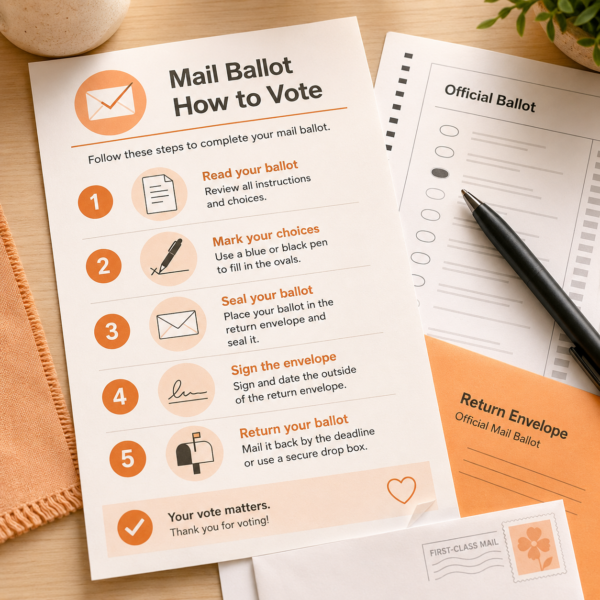
That means the instruction sheet should not begin with every rule at once. It should begin with the first action the voter needs to take, then move step by step in the same order the packet will be used. Open the ballot. Mark choices. Review the ballot. Place the ballot in the correct envelope if one is required. Sign where required. Seal the return materials. Return the ballot using the approved method. A voter should not have to jump back and forth between general paragraphs to figure out what comes next. The EAC’s Voter Education Design Toolkit promotes a “bite-snack-meal” structure for clearer communication, which reinforces the value of sequencing information in manageable layers rather than one dense block.
This kind of sequencing also helps election offices separate primary steps from supporting detail. A voter needs the core order of actions immediately. Additional information, such as special deadlines, tracking options, or contact details, can appear in clearly labeled secondary sections without interrupting the main task flow. That approach matches both the EAC’s design emphasis on understandable materials and NIST’s focus on clear instructions and messages as part of the voting process itself.
A strong packet also reduces unnecessary branching. If the voter must stop repeatedly to determine whether a rule applies, the instructions become harder to use on the first pass. Election offices should therefore keep the main steps simple and place less common exceptions in clearly marked side notes or short special-case sections. This preserves clarity for most voters without hiding important details from those who need them. The EAC’s design toolkit and NIST’s instruction-writing guidance both support this more usable structure.
Put One Action in Each Step
Instruction sheets often become harder to follow when one numbered item contains several actions at once. A step that tells the voter to mark the ballot, place it in the secrecy envelope, sign the certificate, and return the packet may technically be complete, but it is much harder to absorb quickly. NIST’s voting-instruction guidance emphasizes clear, direct instructions, and the EAC’s design framework likewise prioritizes readability and usability in voter materials.
A better approach is to give each action its own visible step. This makes the sequence easier to scan and reduces the chance that a voter will complete the first half of a sentence and miss the second half. It also helps election offices visually emphasize the tasks that are most likely to be skipped, such as signing a required envelope or certificate. Clear separation of steps is one of the simplest ways to make a packet work on the first read.
Match the Instruction Sheet to the Materials in the Packet
The wording on the instruction sheet should match the labels the voter sees on the actual ballot materials. If the packet uses “return envelope,” “secrecy envelope,” or another specific term, the instructions should use that same term every time. If the voter must sign on a specific envelope or flap, the sheet should describe it in the same language that appears on the materials themselves. The EAC’s design materials are grounded in information-design best practices for creating clear, understandable communication materials, and consistent terminology is a basic part of that clarity.
When packet language drifts, voters hesitate. They spend time trying to decide whether two different labels refer to the same envelope or whether one signature line is the right one. That hesitation creates exactly the kind of preventable error plain-language packet design is supposed to avoid. NIST’s guidance similarly treats clear instructions and messages as necessary to the voting process, not as optional refinements.
Highlight the Most Common Mistakes Without Overloading the Page
Mail ballot instructions should help voters avoid the handful of mistakes that matter most, but they should do so without making the packet feel crowded with warnings. The office’s job is not to scare the voter into caution. It is to make the critical actions impossible to overlook. The EAC’s design resources and voter education toolkit both emphasize clear hierarchy and accessible presentation, which is exactly what instruction sheets need when certain details carry far more weight than others.
This means the most important problem-prevention points should stand out visually and linguistically. If a signature is required, that instruction should be near the signing step and plainly worded. If a secrecy envelope is required, the sheet should make that action highly visible at the moment it belongs in the sequence. If the ballot must be returned by a specific deadline or method, that information should not be buried in a final paragraph after several less important notes. The EAC’s mail-voting resource page is aimed at helping election officials manage mail-voting processes and serve voters who use those options, which makes this kind of visible task support central to the communication job.
At the same time, the sheet should not read like a long list of everything that could go wrong. Too many warnings flatten the hierarchy and make the truly important steps harder to spot. NIST’s plain-language guidance supports direct, usable instructions, and the EAC’s design toolkit likewise encourages information structures that help readers understand what matters most.
A stronger approach is to identify the few actions that most directly determine whether the ballot is returned correctly and elevate only those points. Everything else should support the task without competing for attention. That kind of restraint makes the instruction sheet feel more manageable and helps the voter stay focused on completion rather than on anxiety.
Make Return Instructions Easy to Find on the First Pass
Return guidance is one of the most important parts of the packet because a correctly marked ballot still fails if it is returned the wrong way or too late. The EAC’s vote-by-mail resources are specifically intended to help election officials serve voters using mail and absentee options, and its public vote-by-mail information also emphasizes that rules vary by state and that voters should verify their state and local requirements.
Election offices should therefore make return instructions highly visible and concrete. The sheet should tell voters where to return the ballot, whether mailing is allowed, whether drop boxes or in-person return options are available if applicable, and what deadline governs return. It should also tell the voter where to check official local details if methods vary by jurisdiction. Return information should not feel like a final footnote. It is one of the core tasks in the process.
Put Deadline Language Next to Return Language
One common packet weakness is separating the deadline from the return method. A voter reads how to return the ballot in one place and discovers the timing rule later. That separation increases the risk of late action because the voter does not connect the method with the urgency. A better design places the deadline close to the return step so the voter understands both pieces together. The EAC’s editable voter education content repeatedly emphasizes relevant dates and practical voter action information, which supports pairing timing with task guidance rather than scattering it across the material.
This pairing also helps the office write more useful language. Instead of saying only “return your ballot promptly,” the office can connect the method and timing in one direct instruction. That kind of wording is easier to act on because it tells the voter what to do and why timing matters at the same time. NIST’s clear-instruction guidance strongly supports this kind of direct, action-centered wording.
Write the Sentences So the Voter Can Act Without Translating
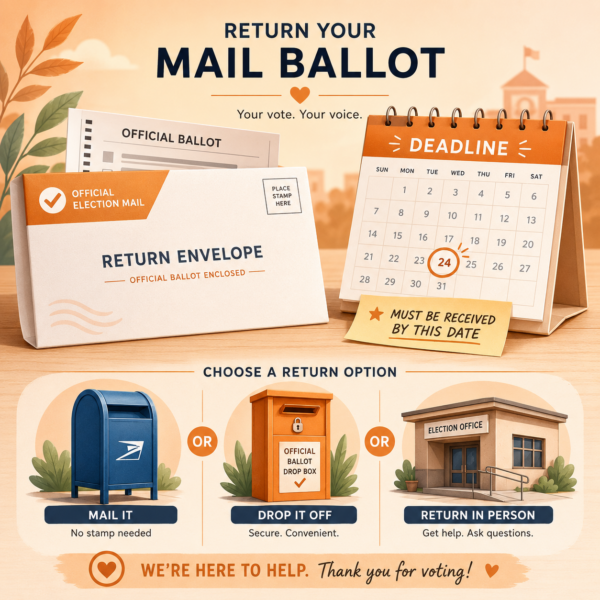 Plain-language mail ballot instructions work best when each sentence tells the voter one clear action in familiar words. NIST’s guidance on clear voting instructions says clear instructions are a necessary part of the voting process, and the Election Assistance Commission’s design resources describe election materials as communication products that should be clear, understandable, and accessible.
That means instruction sheets should rely on direct verbs and short sentences instead of administrative phrasing. “Sign the return envelope” is easier to follow than “Voters must ensure the certification on the return envelope is properly executed.” The second version may sound formal, but it forces the voter to stop and translate the task. The first version tells the voter exactly what to do. This is the difference between a packet that informs and a packet that guides.
Election offices should also avoid stacking conditions inside one sentence when the steps can be separated more clearly. If the voter must review the ballot, place it in an inner envelope, and then sign the outer envelope, those actions should appear as separate steps or separate sentences. NIST’s instruction-writing guidance is built around usability and comprehension, and the EAC’s voter education design toolkit likewise emphasizes structures that make information easier to absorb quickly.
The same principle applies to wording choices. Common words usually perform better than formal substitutes because they reduce hesitation. “Put the ballot in the secrecy envelope” is easier to process than “Insert the voted ballot into the secrecy sleeve provided.” A voter handling the packet at home should not have to decode the office’s preferred terminology before moving to the next action. The packet should sound like practical guidance, not like institutional prose.
Tone matters here as well. Instruction sheets should sound calm and useful, not stern or overloaded with warnings. A voter who senses that every step is risky may slow down, reread excessively, or become less confident in the process. The stronger approach is to state the task clearly, highlight the few details that truly matter, and keep the language focused on successful completion. That aligns with the EAC’s design framework for understandable materials and with NIST’s emphasis on clear instruction as part of successful voting.
Headings should work the same way. A heading like “Return Your Ballot” is more useful than “Ballot Return Procedures” because it tells the voter what section of the task is happening now. Instruction headings are most effective when they function like signposts in the process rather than like chapter titles in a policy document. The EAC’s design toolkit is specifically organized around helping officials build materials that readers can navigate more easily, which makes functional headings an important part of first-read usability.
Handle Special Situations Without Making the Whole Packet Harder to Use
Mail ballot packets need to account for special situations, but they should not force every voter to read through every exception before completing the basic task. The Election Assistance Commission’s design resources emphasize clarity and accessibility, and NIST’s guidance supports instruction structures that help readers focus on the actions they need most. That means the main instruction path should stay simple, while less common situations should appear in clearly separated support sections.
A useful packet usually works best when it answers the main task first and then offers short, well-labeled help for issues that arise less often. A voter who needs ordinary step-by-step guidance should be able to complete the packet without wading through material about damaged ballots, replacement requests, cure-related follow-up, or unusual return circumstances. At the same time, a voter facing one of those issues should be able to find the answer quickly without leaving the packet entirely. That balance is central to usable instruction design.
This is also where contact information becomes essential. The EAC’s editable voter education content repeatedly prompts officials to include practical office contact information, and its vote-by-mail resources are intended to support officials serving voters who use absentee and mail ballot options. When a voter runs into a less common problem, the instruction sheet should provide a direct path to help instead of forcing guesswork.
Separate Common Steps From Less Common Problems
The main instructions should describe what most voters need to do from start to finish. Special situations should appear under short labels such as “If you make a mistake on your ballot” or “If your ballot packet is missing materials.” This keeps the standard workflow clear while still helping the voter solve a problem when one appears. The EAC’s design toolkit and NIST’s writing guidance both support this kind of layered structure because it reduces overload without hiding important information.
This separation also improves first-read success because it helps the voter stay in the main task until a real issue appears. If every packet reads as though every voter is likely to face multiple complications, the overall process feels harder than it is. A packet that keeps the primary path clean and the exception path visible is more reassuring and more usable.
Make Help and Recovery Steps Easy to Find
Some voters will make a mistake, damage a ballot, miss a required line, or realize they have a question only after starting the process. In those moments, the packet should make help easy to find. The Election Assistance Commission’s voter education materials regularly direct officials to include contact information and practical next-step guidance, and its vote-by-mail page is specifically framed around helping officials manage mail voting processes for the voters who rely on them.
Recovery language should be just as plain as the main instructions. A voter should see what to do next, whom to contact, and where to look for official follow-up information. This is especially important because uncertainty after a mistake can lead to abandonment. A short, direct recovery instruction can keep the voter moving toward successful ballot return instead of giving up or making a second avoidable error. That outcome fits the broader design goals reflected in EAC and NIST guidance on clarity, usability, and accessible voter communication.
Promoting Long-Term Election and Voter Confidence Through Clear Mail Ballot Instructions
Clear mail ballot instructions improve more than one packet or one election cycle. They help voters build a stable understanding of how vote-by-mail works, which reduces repeat confusion and makes future participation feel more manageable. The U.S. Election Assistance Commission treats mail voting materials as a major voter communication category, and its design resources are specifically aimed at helping election officials create materials that are clear, understandable, and accessible.
This long-term effect matters because many mail ballot problems are recurring, not unusual. Voters can miss a signature line, misunderstand an envelope step, or overlook return timing simply because the packet asks them to infer too much from dense or poorly sequenced instructions. NIST’s guidance on voting instructions states that clear instructions are a necessary part of the voting process, and it notes that some voters avoid absentee voting in part because they fear they will not understand what to do.
Operationally, stronger mail ballot instructions also reduce unnecessary pressure on election offices. When the packet tells voters what to do in order, highlights the few critical steps that most affect ballot acceptance, and makes return guidance easy to find, offices face fewer avoidable calls, fewer repeated clarification requests, and fewer preventable ballot issues that require staff time to resolve. The EAC’s mail voting resource page is specifically designed to help election officials manage mail voting processes and serve voters who use vote-by-mail or absentee options, which reinforces that clear packet design is part of election administration, not just a writing exercise.
There is also a confidence benefit. A voter who can complete the packet without rereading every paragraph, second-guessing the envelope sequence, or searching multiple sources for return details is more likely to view vote-by-mail as trustworthy and usable. The EAC’s voter education design toolkit emphasizes making information easier to absorb through structure and hierarchy, and that kind of usability is especially important in mail voting because the packet has to guide the voter without real-time staff support.
Over time, this kind of instruction discipline can also reduce misinformation and rumor pressure around mail ballots. When the official packet is easier to follow than hearsay, social posts, or secondhand explanations, voters are less likely to rely on unofficial summaries about deadlines, signatures, envelopes, or return methods. The EAC and CISA public communications guide emphasizes that election officials strengthen confidence by conveying accurate information about how they administer elections and by preparing teams to communicate effectively, and a well-designed mail ballot packet is one of the most direct ways to do that.
Another long-term advantage is equity. Voters with less time, lower familiarity with election procedures, limited English proficiency, disabilities, or fewer opportunities to ask for help are more affected when the packet is dense, inconsistent, or visually unclear. The EAC’s design and voter education resources focus on accessibility and understandable materials for exactly this reason. Clear instruction writing does not simplify the process only for one audience. It makes the process more usable for everyone.
Strategic Communication Support for Election Offices and Voter-Facing Agencies
 Election offices often know their mail ballot rules thoroughly, but that does not always mean the voter-facing packet is doing its job. A packet can be accurate and still force too much interpretation on the voter. A return instruction can be present and still be too easy to miss. A cure or follow-up process can be available and still be too hard to find at the moment the voter needs it. The EAC’s design resources and mail voting materials make clear that these are communication and usability issues as much as they are procedural ones.
That is why agencies often choose to partner with an external resource like Stegmeier Consulting Group (SCG) to strengthen communication systems. Stegmeier Consulting Group supports election offices, boards of elections, clerks, and voter-facing public organizations by helping them build plain-language instruction frameworks, step-by-step packet sequencing, return guidance, error-prevention language, source-of-truth support content, and cross-channel message alignment so the packet, website, FAQs, and staff explanations reinforce the same actions and deadlines. These kinds of improvements are closely aligned with the EAC’s focus on clear voter materials and with NIST’s guidance on writing instructions that help people complete voting tasks correctly.
SCG can also help offices identify where voters are most likely to stop, reread, or make a preventable mistake, then redesign packet language and structure so the main path is easier to follow on the first read. That work can include clarifying envelope terminology, improving hierarchy around signatures and deadlines, strengthening return-method language, and making recovery steps easier to find when something goes wrong. These practices support the broader election communication goal reflected in federal guidance, which is to make official information more understandable, more usable, and easier for voters to act on correctly.
Conclusion
Mail ballot instructions are most effective when they help voters complete a sequence of actions correctly on the first read instead of forcing them to interpret rules, hunt for the next step, or reread the packet several times. Federal election design guidance now treats mail voting materials as a distinct communication category, and NIST’s guidance on voting instructions frames clear instructions as a necessary part of the voting process itself.
Clear instruction writing matters at every stage of the packet. Step-by-step sequencing helps voters stay oriented. Plain-language sentences reduce translation and hesitation. Visible hierarchy helps the voter notice the few details that matter most, especially signatures, envelopes, return methods, and deadlines. Return guidance becomes more useful when it appears as a core task rather than a final footnote. These principles reflect both the Election Assistance Commission’s design approach and NIST’s emphasis on instruction usability.
The goal is not simply to send a packet that contains correct information. The goal is to send a packet that voters can actually use correctly, confidently, and without unnecessary second-guessing. Election offices that treat mail ballot instructions as a usability tool, not just a compliance insert, reduce avoidable ballot errors, lower staff burden, and make voting by mail feel more manageable and trustworthy.
SCG’s Strategic Approach to Communication Systems
Align your agency’s messaging, processes, and public engagement strategies
Stegmeier Consulting Group (SCG) helps election offices build communication systems that make complex voting tasks easier to understand and easier to complete correctly. For mail ballot programs, that can include plain-language instruction frameworks, clearer step sequencing, return guidance, error-prevention messaging, cure communication support, and source-of-truth content that keeps voter materials and staff explanations aligned.
SCG also supports governance and operational coordination so instruction inserts, ballot packet materials, websites, FAQs, voter assistance channels, and follow-up notices work together as one coherent public information system. Use the form below to connect with our team and explore how a strategic communication framework can elevate your agency’s impact.