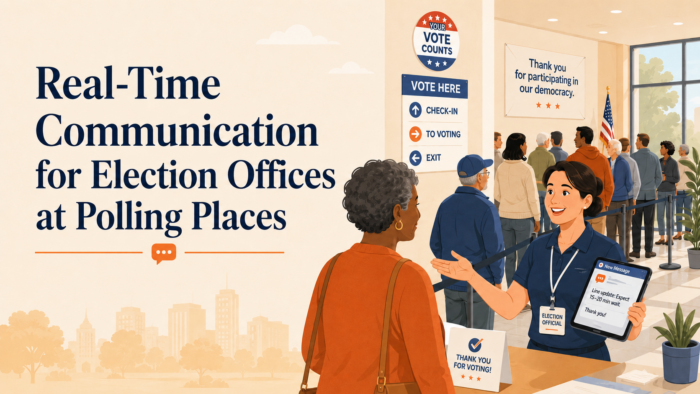
Long Lines, Short Messages: Real-Time Communication for Election Offices at Polling Places
Long lines turn a normal polling place into a real-time communication environment. The problem is not only the wait itself. The problem is what happens to voters while they are waiting. Uncertainty grows, rumors spread from one person to the next, and small gaps in information start to feel larger than they are. In that setting, a polling place does not need more words. It needs faster, clearer, and more useful words that tell voters what is happening, what to expect next, and where to go for the official answer. The U.S. Election Assistance Commission has recently emphasized fast, easy-to-digest election information through its Election Facts Label Toolkit, and its joint public communications guidance with CISA stresses that voters need access to accurate information and that poor public understanding can undermine confidence.
That makes line communication an operational issue, not just a courtesy issue. The EAC’s polling place management guidance treats adequate space for voters to wait in line, line management techniques, easy-to-follow voter instructions, and check-in staff assigned to greet and direct voters as part of successful polling place management. The same guidance also highlights adequate signage as a required element of a functioning site. In other words, real-time communication at the polling place is part of how the site works, not an optional add-on after the logistics are already in place.
Election offices should therefore think of long-line messaging as voter orientation under pressure. A useful message in this setting does not try to explain everything about election administration. It helps the voter stay confident in the process for the next ten minutes. It tells the voter where the line starts, which table to approach, what materials to have ready, whether different lines serve different purposes, and where official updates will come from if conditions change. That kind of short, practical guidance fits the EAC and CISA recommendation that election officials identify what information to share, define audience and format, and prepare their teams to communicate clearly during incidents or disruptions.
This article provides an evergreen communication framework for election offices managing long lines and active polling place conditions. It focuses on how to communicate in real time without overwhelming voters, how to use short messages to reduce confusion, and how to connect signage, staff language, and official updates into one clear polling place communication system. The EAC’s current Voting Location Resource Calculator is specifically designed to help officials estimate voter wait times and identify bottlenecks, which underscores that long lines are predictable management issues that can be paired with better real-time communication.
Long Lines Create an Information Problem Before They Create a Trust Problem
 When voters arrive at a crowded polling place, they immediately start looking for cues that tell them whether the process is organized. They read the line, the signage, the behavior of other voters, and the confidence of staff. If those cues are weak or contradictory, the wait begins to feel longer and less trustworthy even before anything has gone wrong procedurally. Election communication guidance from the EAC and CISA makes this point in broader terms by warning that a lack of public understanding can undermine confidence and by urging officials to ensure voters have access to accurate election information.
This is why long-line communication should begin with orientation, not explanation. A voter standing in a queue does not need a long narrative about staffing models or site constraints. That voter needs to know where to stand, what to have ready, whether the line is moving normally, and where to look for the next instruction. The EAC’s Election Facts Label Toolkit is built around making election facts easy to digest, and that design principle is especially useful at a polling place where people are processing information quickly under stress.
The operational value of this approach is supported by EAC research. In the EAC’s SMILE Long Lines Summary, a voter preparation strategy using an additional election worker to prepare voters in line reduced average wait times by 27.2 to 45.2 percent and reduced the longest wait by 18.1 to 33.6 percent in the simulated three-step voting process. The summary also notes that the strategy depends in part on effective communication by the election worker. That finding matters because it shows that communication in line can improve the actual experience, not just perceptions of the experience.
Election offices should also recognize that line confusion compounds quickly. If one voter is unsure where to go, several voters behind that person often slow down as well. If two lines are serving different purposes but not labeled clearly, frustration rises before staff can correct it. The EAC’s polling place management guidance specifically notes that line separation can confuse voters or result in line jumping when not managed well, while adequate signage and greeting staff are presented as core management tools.
Define Real-Time Polling Place Communication as Orientation, Preparation, and Update Discipline
Election offices communicate more effectively during long lines when they define the job in three parts. Real-time polling place messaging should provide orientation, preparation, and update discipline. Orientation tells voters where they are in the process. Preparation tells them what to have ready before reaching the next point. Update discipline tells them when conditions have changed and where official information is coming from. That structure aligns well with the EAC and CISA public communications guide, which recommends identifying the message, recognizing audience and format, assigning clear team roles, and preparing official channels voters can rely on.
Orientation is the first requirement because voters cannot act confidently if they do not know where the process begins or which line applies to them. The EAC’s polling place guidance includes check-in staff assigned to greet and direct voters, easy-to-follow voter instructions, and voter information forms as part of site management. Those elements matter because they give the voter a visible sense of order before the voter reaches the check-in table.
Preparation matters because long waits are often made worse when voters reach the front of the line and only then discover what they should have had ready. The SMILE Long Lines Summary specifically identifies voter preparation as a line-alleviation strategy in which an additional poll worker prepares voters for check-in, helping shorten waits. Real-time communication should therefore be built to prepare the next several people in line, not just to serve the person currently at the table.
Update discipline matters because polling place conditions change. A check-in station may slow down, a line may split, accessible entry guidance may need reinforcement, or voters may need to be redirected to a different queue or table. The EAC and CISA guidance recommends preparing proactive incident-response communications and ensuring voters know where to access accurate information, while the EAC’s polling place management materials stress adequate signage and line management techniques. At the polling place level, that means short, repeated, official updates are often more useful than one-time announcements.
Beyond the Ballot: Election Office Communication Strategies for County Clerks, Secretaries of State, and Boards of Election
This article is part of our series on strategic communication for Election Offices, Election Administration Agencies, and Boards of Elections. To learn more and to see the parent article, which links to other content just like this, click the button below.
Design Short Messages for the Exact Moment the Voter Needs Them
Real-time polling place messages work best when they match the voter’s immediate task instead of trying to explain the whole voting process at once. The Election Assistance Commission’s polling place management guidance treats greeting, directing, line management, signage, and easy-to-follow voter instructions as core parts of site operations, which means the message at each point should help the voter do the next thing correctly and quickly.
At the entrance, the voter needs orientation. That message should tell people where the line begins, whether there are separate lines for different services, and where to go if they need accessibility support or language assistance. In the line itself, the voter needs preparation. That message should tell people what to have ready before reaching check-in and whether different rules apply to first-time voters or voters with address updates, if those distinctions are relevant at that site. Near check-in, the message should narrow again and focus on the final preparation step so the interaction at the table moves faster. This action-by-location approach fits the EAC’s operational guidance on voter instructions and line management and also matches the SMILE long-lines findings that voter preparation in line can materially reduce wait times.
The most useful messages in this setting are usually very short. The EAC’s Election Facts Label Toolkit is built around making election facts easy to digest, and that principle is especially valuable at a polling place where voters are scanning quickly, often while distracted or frustrated. A long paragraph on a sign may be technically informative, but it is usually less effective than a short instruction with one clear action.
Short polling place messages should also be written so they can be repeated in multiple forms without changing meaning. A sign at the entrance, a staff greeting, and a brief spoken announcement should all reinforce the same core instruction. If the sign says one thing and the poll worker says another, the line slows down immediately because voters start double-checking instead of moving forward. The EAC and CISA communications guidance stresses clear talking points, defined audiences, and prepared communication roles, all of which support this kind of repetition across formats.
Election offices should also resist the temptation to over-explain every delay. During a long wait, most voters do not need a detailed operational briefing. They need to know that the line is moving, what to do while waiting, and where official updates will come from if something changes. That kind of message keeps attention on the next useful action rather than on speculation about the cause of every slowdown. CISA and the EAC specifically advise officials to ensure voters know where to access accurate information during incidents or disruptions, which makes short, source-linked polling place updates more effective than improvised commentary.
Match the Message to the Voter’s Physical Position
A voter standing outside the building needs different information than a voter who is ten people away from check-in. Polling place communication becomes stronger when each message is tied to the physical point where it will be read or heard. The EAC’s polling place management guidance emphasizes adequate signage, greeting staff, and line management techniques because those elements help voters move through the site in an orderly way.
This means entrance signs should focus on direction and line selection. Mid-line messages should focus on readiness and expectations. Check-in area messages should focus on the final preparation step. When the message changes with the voter’s position, it feels more useful and less repetitive. It also reduces the chance that people will ignore the communication because it no longer seems relevant to where they are in the process. The same operational logic appears in the SMILE long-lines research, where preparing voters before they reach the service point helps reduce overall waiting time.
Use Consistent Verbs and Stable Labels
The words used on signs and in spoken updates should stay stable throughout the site. If the entrance sign tells voters to “check in” but a staff member tells them to “report to the registration table” and another sign refers to the “poll book station,” confusion rises even when everyone is trying to describe the same place. The EAC’s design guidance for election materials emphasizes clear, understandable, and accessible communication, and stable terminology is one of the most practical ways to achieve that clarity in a crowded environment.
Simple verbs also help. “Wait here.” “Have your ID ready.” “Use this line for voter check-in.” “Ask this table for accessibility help.” These phrases are easier to process quickly than more formal alternatives. The goal is not stylistic minimalism for its own sake. The goal is to help voters act without stopping to interpret the office’s wording. That is exactly the kind of fast, clear information the Election Facts Label Toolkit is meant to support.
Coordinate Signs, Staff Language, and Short Updates as One System
Polling place communication breaks down when signs, staff greetings, and spoken updates operate like separate channels. Voters experience them as one system. If one part of that system says the line starts at the doorway, another staff member redirects people toward a side hall, and a third message announces something different about check-in, voters lose confidence in the site even if the underlying process is still functioning correctly. The EAC’s polling place management guidance makes clear that signage, greeting staff, voter instructions, and line management are interdependent operational tools, not separate add-ons.
This is why election offices should build a short shared message set for polling place conditions before Election Day. That shared set should cover the most common line-management needs, including where to stand, what to prepare, where specialty assistance is available, and how updates will be communicated if the line pattern changes. The EAC and CISA public communications guide recommends preparing teams, clarifying roles, and developing short, simple talking points in advance rather than improvising during high-pressure conditions.
Staff language matters especially because a calm spoken explanation can correct confusion before it spreads down the line. The SMILE long-lines summary found that adding an election worker to prepare voters in line reduced average and maximum wait times in simulation, and that improvement depended in part on the worker’s communication with voters. In practice, this means real-time messaging is not just about signs. It is also about whether staff can repeat the same short instructions clearly and consistently throughout the day.
Update discipline matters too. If a line is split, if one check-in point closes temporarily, or if the flow changes for accessibility or facility reasons, the update should reach voters in a simple and visible way. The Election Infrastructure Incident Response Communications Guide from CISA notes that when incidents affect election operations, communication to the public is essential to confidence in the integrity of the election process. At a polling place, that principle often means short live updates that state what changed, what voters should do now, and where to look for the official next instruction.
The strongest polling place communication systems therefore do not rely on one heroic staff member or one large sign. They work because the same message appears in several reinforcing forms. The entrance sign tells the voter where to begin. The greeter repeats the same direction. A short update explains any change. The next sign confirms the voter is still in the right place. That kind of repetition is not redundant. It is how the office keeps the line usable under stress. The EAC’s polling place management materials and Election Facts Label resources both support this emphasis on quick, understandable, task-based communication.
Communicate Changing Wait Times Without Pretending They Are Exact
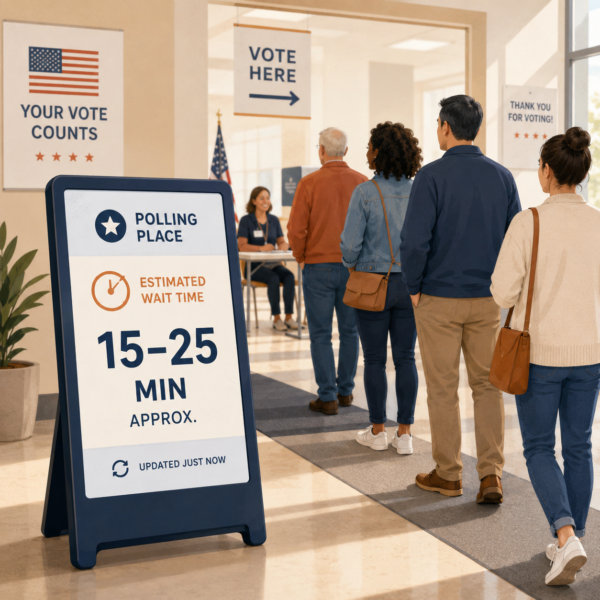 Wait times are one of the hardest things for an election office to communicate in real time because they are always moving. A line can speed up when check-in begins flowing again, then slow down a few minutes later if a bottleneck appears at a poll book station, ballot marking area, or tabulator. The U.S. Election Assistance Commission’s Voting Location Resource Calculator is designed specifically to help election officials estimate voter wait times and identify bottlenecks based on site setup, process steps, and equipment. That is a useful reminder that wait time is an operational estimate, not a static fact.
This means election offices should communicate wait times as informed ranges or current conditions rather than as precise promises. A sign or verbal update that says the current wait is about 30 to 45 minutes is often more credible than one that says 32 minutes. If conditions change quickly, the office does not want to look inaccurate or out of touch just because the line moved differently than expected. The goal is to help voters decide whether the site is functioning normally and what to expect next, not to offer stopwatch-level certainty.
The strongest real-time updates also explain the practical meaning of the wait instead of only giving a number. A voter benefits from hearing that the line is moving steadily, that check-in is the current bottleneck, or that site staff are directing voters as stations open. The EAC’s polling place management guidance emphasizes line management techniques, greeting staff, voter instructions, and adequate signage as core parts of polling place operations. Those tools work better when the office uses them to explain what the voter is experiencing right now in simple terms.
Election offices should also be careful not to over-update with tiny changes that do not help the voter act. Frequent but meaningless adjustments can make the site sound unstable. It is usually better to update when there is a meaningful change in line length, a change in where voters should go, or a new instruction that affects preparation. That approach aligns with the EAC and CISA guidance urging election officials to provide timely, clear information through trusted official channels while keeping the public oriented to what matters.
Set Expectations With Ranges, Movement, and Next-Step Cues
The most useful wait-time messages usually combine three elements. They give a rough range, they indicate whether the line is moving normally, and they tell voters what to do while waiting. For example, a voter can use a message much more easily if it says the current wait is about 30 to 45 minutes, the line is moving steadily, and voters should have identification or check-in information ready if required by that jurisdiction. That kind of update gives both orientation and preparation. It also matches the SMILE long-lines findings that voter preparation in line can reduce average and maximum wait times when an additional worker helps prepare voters before they reach the service point.
This structure helps election offices avoid one of the biggest communication mistakes in a long line. That mistake is treating the wait-time estimate as the entire message. Voters also need to know whether anything has changed and whether they should use the waiting time to prepare for the next step. A short estimate paired with a practical readiness cue is far more useful than a number standing alone. The EAC’s Election Facts Label Toolkit is built around making election facts easy to digest, which fits this kind of short, high-value message design.
Tell Voters What Changes the Estimate
Voters are more likely to accept an imperfect estimate when they understand that conditions at the site change as the voting process changes. A brief explanation that wait times may shift as check-in, ballot marking, or scanning speeds change can make the office sound transparent instead of imprecise. The EAC’s voting-location tools and process simulation resources are built around the reality that site conditions, equipment, and process flow affect wait times in dynamic ways.
This does not require a technical briefing. A short explanation that the estimate may rise or fall as stations open, lines split, or bottleneck ease is usually enough. The point is to make the estimate feel like a good-faith operational update rather than a promise the office cannot realistically keep. That kind of honesty helps preserve trust when the line changes after the voter first sees the message.
Manage Expectations With Calm Updates and Clear Alternatives
Long-line communication becomes much more effective when the office tells voters what they can count on even when it cannot eliminate the wait. Voters do not need false reassurance. They need signs that the site is being managed, that updates are official, and that the office is paying attention to the voter experience. The EAC and CISA public communications guide stresses that clear and accurate information supports confidence, while EAC polling place guidance identifies voter instructions, greeting staff, signage, and line management as core operating practices.
A strong expectation-setting message often does three things at once. It acknowledges the current condition, tells voters what the office is doing, and points them to the next official update or instruction. That structure keeps the office from sounding defensive while still giving the public something concrete. During prolonged waits, the office should sound steady and informative, not apologetic in every update and not silent until frustration hardens. The CISA incident response communications guide similarly emphasizes that communication during election-related operational incidents is essential to public confidence in the integrity of the process.
Expectation management also includes communicating any legitimate alternatives clearly. If another entrance, line, or accessible route is available, that information should be delivered in the same short, official format as the main line updates. If different lines serve different functions, those distinctions should be visible and repeated. The EAC polling place management guidance explicitly notes that line separation can confuse voters or lead to line jumping if not managed well, which makes clear role labeling and redirection a communication task as much as a logistical one.
Another important part of expectation management is dignity. Long waits can be stressful, especially for older voters, voters with disabilities, parents with children, or voters arriving under work and transportation pressure. The office should make sure real-time messages include clear help points for accessibility assistance or special routing where applicable. EAC accessibility resources emphasize the need to make voting processes usable and accessible, and polling place communication should reflect that commitment in visible, practical ways.
Finally, election offices should remember that silence during a visible slowdown creates its own message. If the line stops moving and no official update appears, voters will explain the pause to one another. That is when rumor and frustration start to fill the gap. A short official update, even one that simply says the line is still active and staff are directing voters as stations become available, is often enough to keep the public anchored to the office rather than to speculation. The EAC and CISA guidance both support the idea that official, timely, and understandable communication is essential when conditions create confusion or uncertainty.
Promoting Long-Term Election and Voter Confidence Through Clear Long-Line Communication
Clear real-time polling place communication does more than help one site get through one busy morning. It builds a pattern of trust around how the election office manages visible pressure in public. When voters see that long waits are paired with clear directions, practical preparation cues, and regular official updates, they are more likely to view the polling place as organized and responsive rather than chaotic or opaque. Federal election communication guidance emphasizes that accurate, timely, and understandable information supports confidence in election processes, especially when conditions create uncertainty.
This kind of communication also reduces repeat confusion across election cycles. Many long-line frustrations are not caused only by the wait itself. They come from uncertainty about where the line begins, whether different lines serve different functions, what voters should have ready, and where official updates will come from if conditions change. The EAC’s polling place management guidance treats line management, greeting staff, adequate signage, and easy-to-follow voter instructions as core operating practices, which means these are not one-time courtesy measures. They are repeatable system elements that can be strengthened election after election.
Operationally, stronger line communication can also improve throughput. The EAC’s SMILE long-lines summary found that adding an election worker to prepare voters in line reduced average wait times and reduced the longest wait in the simulation, in part because communication and preparation happened before voters reached the service point. That finding matters because it shows that good communication is not only about perception. It can improve the actual movement of the line when voters are better prepared at the right moment.
There is also an accessibility benefit. Voters with disabilities, older voters, parents with children, and voters under work or transportation pressure are often affected most when lines are confusing and updates are inconsistent. EAC accessibility guidance stresses that accessibility planning is part of election management, not a separate afterthought. Clear routing, visible help points, and short official updates make the polling place more usable for everyone, especially when stress is already high.
Over time, this kind of discipline helps election offices build a more resilient polling place communication system. The EAC’s Voting Location Resource Calculator is designed to help officials estimate wait times and identify bottlenecks, and the tool itself notes that results should be treated as informed estimates rather than exact predictions. That is useful for communication planning because it reinforces the idea that offices should prepare for changing conditions and pair operational modeling with realistic public messaging about wait times and flow.
Strategic Communication Support for Election Offices and Voter Services Teams
Election offices often know that long lines are possible, but they do not always have a communication system that translates changing site conditions into short, usable public messages. A polling place may have the right staff and equipment and still create confusion if the signs are inconsistent, the spoken instructions drift, or the wait-time updates feel vague or unreliable. Federal election guidance consistently points toward the value of prepared communication roles, clear official channels, practical voter-facing information, and coordinated polling place management.
That is why agencies often choose to partner with an external resource like Stegmeier Consulting Group (SCG) to strengthen communication systems. Stegmeier Consulting Group supports election offices, boards of elections, clerks, and voter services teams by helping them build practical frameworks for entrance messaging, line-management signs, wait-time update language, accessibility routing cues, staff scripts, source-of-truth content, and polling place communication workflows that stay clear under pressure. These kinds of improvements align closely with the EAC’s polling place management guidance, Election Facts Label resources, and broader election communications planning materials.
SCG can also help offices identify where confusion is most likely to build inside the line experience, connect operational planning with real-time voter messaging, and create communication systems that reduce friction without overpromising precision. Those practices help lower avoidable staff burden, improve the voter experience during long waits, and reinforce public confidence that the office can manage visible pressure in a calm and organized way.
Conclusion
Long-line communication is most effective when it helps voters stay oriented, prepared, and confident while conditions are changing around them. The strongest polling place messages do not try to explain everything at once. They tell voters where to go, what to have ready, what has changed, and where the next official instruction will come from. When election offices treat signs, staff language, and short live updates as one coordinated system, the polling place becomes easier to navigate even during the busiest periods.
Clear real-time communication matters because long waits magnify uncertainty. A voter who understands the line, the process, and the next step is far more likely to stay patient and move through the site successfully than a voter who is left to guess. Offices that manage this well reduce confusion, lower avoidable staff burden, and make visible pressure feel more organized and manageable.
The goal is not simply to shorten the line with words. The goal is to make the wait more understandable, the process more usable, and the polling place more trustworthy while the line is still forming, moving, and changing. Election offices that communicate with that level of discipline strengthen both operations and public confidence at the same time.
SCG’s Strategic Approach to Communication Systems
Align your agency’s messaging, processes, and public engagement strategies
Stegmeier Consulting Group (SCG) helps election offices build communication systems that support voters clearly during high-pressure polling place conditions. For long-line environments, that can include entrance messaging, line-routing language, wait-time update frameworks, accessibility guidance, staff scripts, and source-of-truth content that help voters understand what to do next without added confusion.
SCG also supports governance and operational coordination so signs, spoken updates, voter service language, websites, FAQs, and frontline staff messaging work together as one coherent public information system. Use the form below to connect with our team and explore how a strategic communication framework can elevate your agency’s impact.