
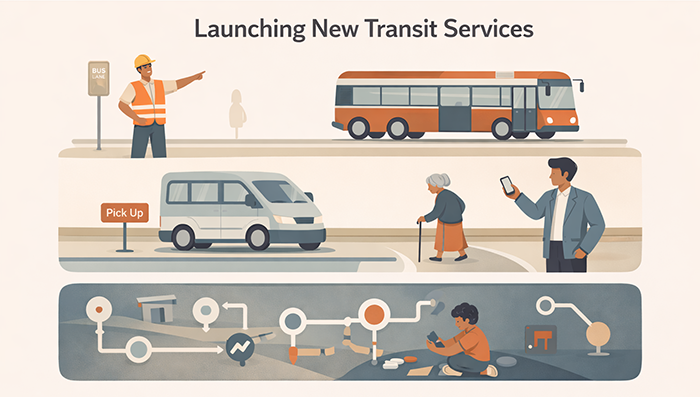
Launching New Transit Services: Microtransit, Bus Rapid Transit (BRT), and Mobility Pilots
Launching a new transit service is a trust moment. Microtransit zones, new Bus Rapid Transit corridors, first mile and last mile pilots, on-demand shuttles, and mobility experiments can expand access and modernize service. They can also create confusion if riders do not understand who the service is for, how to use it, and what to expect on day one. A launch that feels unclear or inconsistent can undermine adoption even when the service design is strong.
New services also carry a different burden than routine service changes. Riders must learn new rules, new terminology, and new habits. They need to understand eligibility, booking steps, payment rules, pickup locations, and what to do when something goes wrong. They also need to understand how the new service connects to the existing network, including transfers, fare policies, and accessibility support.
Launch communication is not a one-time announcement. It is a system that includes internal alignment, message spines, decision-point guidance, staff readiness, and predictable updates during the early weeks. The early weeks matter because small frictions, such as unclear pickup points or confusing app steps, can quickly become reputational issues that slow adoption.
This article provides an evergreen framework for launching new transit services, including microtransit, BRT, and mobility pilots. It focuses on how to communicate purpose, set expectations, drive correct first use, and build feedback loops that improve the service and strengthen trust over time.
Why New Transit Services Often Struggle at Launch
 New services struggle when the agency launches the concept but does not operationalize the user journey. Riders may understand that a service exists but not how to use it. They may not know where to board, how to book, what the fare is, or how to connect to the rest of the system. When the first attempt fails, riders often do not try again.
Launches also struggle when terms are unclear. Words like “microtransit,” “on-demand,” “pilot,” and “rapid” can mean different things to different people. Riders need plain-language definitions and stable labels that appear consistently across websites, apps, signs, and staff scripts. If the agency uses multiple names for the same service, confusion increases.
Expectation gaps also drive disappointment. Riders may assume BRT will operate like rail, or assume microtransit will pick them up anywhere. If real constraints are not communicated clearly, riders interpret the service as unreliable or as false advertising. This is a trust issue, not only a marketing issue.
Finally, launches struggle when internal teams are not aligned. If customer service does not know the rules, if field staff cannot explain pickup points, and if digital tools do not match signage, riders receive conflicting guidance. In the early weeks, those conflicts can become the dominant story.
Adoption Depends on the First Successful Trip
A rider’s first attempt is the most fragile moment. If the first trip feels confusing, slow, or unpredictable, adoption declines sharply. Launch communication should therefore be designed around the first successful trip. It should clarify steps, set realistic expectations, and provide a clear help route.
A first-trip focus also reduces customer service burden. When riders can self-navigate the first use, call volume remains manageable. When riders fail at first use, calls and complaints surge and staff become overwhelmed.
First-trip communication should also anticipate the “what if” questions. What if the pickup point is hard to find. What if the app fails. What if the vehicle is late. What if a rider needs accessible support. These questions should be answered in plain language, in stable locations, and reinforced through staff scripts.
A successful first trip becomes a trust seed. Once riders have one successful experience, they are more likely to tolerate small frictions later, and they are more likely to recommend the service to others.
New Services Must Be Explained as Part of the Network, Not as a Standalone Product
Riders evaluate new services through the lens of their existing travel patterns. They want to know how the service connects to routes they already use, whether transfers are honored, and whether the service replaces or supplements existing service. If the agency does not explain network integration clearly, riders will make assumptions that lead to missed connections and frustration.
Network integration is also an equity issue. If a pilot changes service availability in one neighborhood, riders will ask why. If the pilot requires a smartphone or a credit card, riders will ask what alternatives exist. These questions need clear, practical answers.
New service communication should therefore include simple network maps, transfer guidance, fare integration rules, and trip examples. Trip examples help riders see how the service fits into daily life and reduce confusion at launch.
Network framing also reduces backlash. When riders understand the purpose of the new service and how it connects to broader mobility goals, they are more likely to view the service as an improvement rather than as a confusing experiment.
From Detours to Understanding: Effective Communication Strategies for Transportation Agencies to Improve Safety and Drive Behavioral Change
This article is part of our series on strategic communication for Transportation Agencies, Transit Authorities, and Public Works departments. To learn more and to see the parent article, which links to other content just like this, click the button below.
Define Launch Success as Clarity, Correct Use, and Repeat Use
Launch success is not only ridership volume in the first week. It is clarity, correct use, and repeat use. Clarity means riders understand who the service is for, how to use it, and what to expect. Correct use means riders board at the right places, follow booking steps, and use the service in ways that match design intent. Repeat use means riders try the service again because the first experience was understandable and workable.
Clarity is created through consistent message spines, stable terms, and decision-point guidance. Correct use is supported by wayfinding, app usability, and staff readiness. Repeat use is supported by reliable updates, quick problem resolution, and visible improvements based on feedback.
Launch success also includes internal performance. Customer service should have scripts and decision boundaries. Field teams should have consistent talking points and escalation routes. Digital channels should match physical signage. When internal alignment is strong, external messaging stays coherent and the rider experience becomes more predictable.
Finally, launch success includes transparent learning. Pilots are experiments. Riders will accept experimentation when the agency communicates what it is testing, how feedback will be used, and when results will be shared. Transparency reduces cynicism and improves participation in the pilot’s success.
Build a Launch Message Spine That Is Consistent Across Channels
New service launches succeed when every channel communicates the same core meaning. Riders will encounter information through a website page, a social post, an app screen, a station sign, a community flyer, and a staff interaction. If each touchpoint uses different terminology or emphasizes different rules, riders will assume the service is confusing and unreliable. A launch message spine prevents this drift.
A practical launch spine begins with the purpose statement in plain language. It explains what the service is designed to do, such as provide faster corridor travel, connect neighborhoods to key hubs, or fill a first mile and last mile gap. The next element is who the service is for, including geography, eligibility, and hours. The third element is how to use it, presented as simple steps. The fourth element is what to expect, including pickup behavior, waiting expectations, and how reliability will be managed. The fifth element is fare and transfer rules, explained clearly. The sixth element is accessibility and support options. The final element is the help route and verification path, including where riders can find the most current instructions.
This spine should be reused everywhere. Short-form channels can use the purpose and the first step, then route to the full guide. Signs can focus on the correct use steps and pickup locations. Staff scripts can mirror the same sequence and emphasize what to do now.
Consistency also requires stable names. If a service is branded, use that name consistently and avoid switching between program terms and internal jargon. Stable names reduce confusion and improve word-of-mouth adoption.
Finally, the spine should be designed for translation. Plain, structured text is easier to translate accurately and easier for riders to scan. This supports multilingual access and reduces unequal understanding at launch.
Write the “How to Use It” Section as a Step-by-Step First Trip Guide
Riders adopt new services when the first trip is easy. A step-by-step guide should describe exactly what to do, from planning to boarding to payment to arrival. It should be short, and it should be visible in the places riders will look first.
For microtransit, this guide often includes how to book, where pickups occur, what pickup windows mean, how to find the vehicle, and what happens if the vehicle is late. For BRT, it includes where to board, how to pay, whether boarding is all-door, how stations work, and how signal priority or dedicated lanes affect travel time.
The guide should also include a “what if” section. What if the app fails. What if a rider does not have a smartphone? What if a rider needs assistance? What if a pickup point is hard to find? These issues appear early and can derail first use.
A first trip guide also reduces customer service contacts. Riders who can self-navigate the first attempt are less likely to call. That preserves capacity during launch week.
Finally, the guide should be reinforced through staff scripts and signage. The same steps should appear in multiple forms so riders can confirm what to do.
Make Fare and Transfer Rules Unmistakable
Fare confusion can ruin a launch. Riders will disengage quickly if they feel misled about cost or transfer eligibility. Fare rules should be stated plainly and repeated consistently across all materials.
For pilots, the agency should clearly state whether the service is free, discounted, or integrated into standard fare policies. If fares are promotional for a limited period, the end date should be clear. If transfers are honored, the conditions should be stated in plain language. If transfers are not honored, the agency should explain what to do instead and what riders should expect.
Fare rules should also be aligned with payment interfaces. If an app displays a fare differently than a flyer, riders will assume the system is unreliable. Consistency across digital and physical channels is essential.
A simple fare section should also include a help route for payment problems. Riders need to know what to do if a card fails or a ticket does not display.
Launch BRT With Corridor-Level Clarity and Station Decision Support
BRT launches often struggle when riders do not understand what makes the service different. Riders may assume it is simply a faster bus, or they may assume it operates like rail. The launch should therefore focus on corridor-level clarity and station decision support.
Corridor-level clarity means explaining how the corridor will operate, what travel time improvements are expected, and how stations change boarding and payment behavior. It also includes explaining how dedicated lanes, signal priority, and station spacing contribute to reliability and speed, without using technical jargon.
Station decision support means helping riders navigate the new boarding environment. Riders need to know where to enter, where to pay, whether to validate before boarding, and how to find the correct direction platform. If station design changes are confusing, adoption will suffer even if the buses operate well.
BRT launches should also include clear maps and line naming. Stations should be labeled consistently across maps, signage, and digital tools. If stations are renamed during launch, confusion increases. Stable naming and consistent iconography protect the rider experience.
Finally, BRT launches should anticipate the interaction with existing routes. If a local route changes or is consolidated, riders need clear guidance on the new service pattern and how to make key trips. Network integration must be explained in trip-level terms.
Explain What Is New in One Sentence, Then Reinforce With Simple Examples
BRT messaging improves when the agency can describe the key difference in one sentence. For example, “This service is designed to be faster and more reliable because it uses dedicated lanes and fewer stops.” That sentence should be repeated across channels, then reinforced with simple examples.
Examples can show typical trips and how travel time changes. They can also show how boarding works and what riders should do at a station. Examples translate abstract features into rider decisions, which increases correct use.
Examples should also include accessibility guidance. Riders should know where accessible boarding occurs and what support is available. This should be integrated into the main story, not hidden.
Simple examples also reduce misinformation. When riders can describe the service accurately, they share it more reliably with others.
Use On-Site Wayfinding as the Launch Story, Not an Afterthought
BRT stations and corridors should communicate the launch story through the environment. Clear signs, consistent labels, and visible instructions reduce reliance on long explanations. Riders often decide whether to try a new service based on whether they feel confident navigating the station.
Wayfinding should include clear platform direction cues, clear payment instructions, and clear transfer guidance. It should also include confirmation signs that reassure riders they are in the right place.
On-site wayfinding should match digital guidance. If the app uses a station name or entrance label, the physical environment should use the same label. Alignment reduces confusion and improves trust.
A strong wayfinding approach also supports crowd management. Clear movement cues reduce clustering and keep stations functional during early curiosity surges.
Launch Microtransit With Clear Boundaries and Reliable Pickup Guidance
Microtransit adoption depends on clarity about boundaries. Riders must understand the service zone, the hours, booking rules, and what “on-demand” actually means in practice. If riders believe microtransit works like a private ride-hail service, they will be disappointed and may abandon the service after a single attempt. Clear boundaries protect trust.
A strong microtransit launch defines the service zone with simple maps and plain-language rules. It clarifies where pickups occur, whether curbside pickup is available, and how virtual stops work. It also explains pickup windows, estimated arrival times, and what happens when demand is high. Riders need realistic expectations so they can plan.
Pickup guidance must be practical. Riders need to know how to find the pickup point, how to identify the vehicle, and what to do if they cannot locate the pickup. If pickup points are hard to find, the service will generate rapid frustration and customer service contacts. Clear wayfinding and consistent pickup labeling are essential.
Microtransit launches should also explain network integration. Riders should know how microtransit connects to fixed routes, whether transfers are honored, and which hubs are designed as connection points. Trip examples are particularly important here because many riders will use microtransit as part of a trip chain.
Finally, microtransit launches should include support for riders who cannot or do not want to use an app. If phone booking or alternative access exists, it should be visible. If it does not exist, the agency should communicate that clearly and explain what other options remain.
Explain Pickup Windows and “On-Demand” Terms in Plain Language
Many microtransit terms are unfamiliar. Riders may not understand pickup windows, virtual stops, or dynamic routing. Launch communication should define these terms using plain language and simple examples.
Pickup windows should be explained as planning guidance. Riders should know whether the service aims for a specific arrival time or provides a window. They should know whether they will be notified when the vehicle is approaching and how long they should wait at the pickup point.
Dynamic routing should also be explained without jargon. Riders should understand that the vehicle may make other pickups along the way and that routes can adjust. Framing this as a shared ride service with flexible routing helps set realistic expectations.
Clear definitions reduce repeat contacts because riders are less likely to call to ask whether a delay is normal. They also reduce complaints because riders feel informed rather than misled.
Make Pickup Wayfinding and Vehicle Identification Part of the Core Launch
Microtransit fails quickly when riders cannot find the pickup. Launch materials should include simple pickup guidance that matches what riders see on the ground. If pickup points are marked, the marking should be consistent. If pickup points use nearby landmarks or cross streets, that information should be stable across app instructions and physical signage.
Vehicle identification should also be clear. Riders should know what the vehicle looks like, what signage to look for, and what they should do when the vehicle arrives. If multiple services operate in the same area, clear identification prevents boarding confusion.
Launch communication should also include a “what to do if you cannot find the pickup” path. This can include contacting customer service, using an in-app help function, or following a posted sign to a nearby information point. Clear fallback routes reduce escalation.
This pickup focus improves the first trip. A first trip that feels simple and supported is the best driver of repeat use.
Pilots Need Transparent Learning Communication to Maintain Credibility
 Mobility pilots are experiments. Riders will accept experimentation when the agency communicates clearly about what it is testing, what success looks like, and how feedback will be used. Pilots lose credibility when riders feel they are being tested without consent or when the agency uses pilot language to avoid accountability.
A transparent pilot story should include the purpose, the hypothesis, and the evaluation plan in plain language. It should describe what the agency is trying to learn, such as whether a service improves access to jobs, reduces first mile and last mile barriers, increases late-night mobility, or improves corridor reliability. It should also explain what measures will be tracked and when results will be shared.
Pilots should also communicate boundaries and duration clearly. Riders need to know when the pilot starts, how long it will run, and what could happen after. If continuation depends on funding, ridership, or operational feasibility, that should be stated transparently. False certainty undermines trust later.
Feedback loops are essential for pilots. Agencies should make it easy for riders to share feedback at the moment of use through in-app prompts, QR codes, and short surveys. More importantly, agencies should close the loop by publishing what was learned and what adjustments were made.
Finally, pilots should include equity safeguards. If pilots require digital tools or are limited to certain neighborhoods, the agency should explain why and how equity was considered. The agency should also provide clear alternatives for riders not served by the pilot.
Publish “What We Are Testing” and “How We Will Decide What Happens Next”
A pilot launch should include a clear statement of what the agency is testing. This statement should be plain and specific. It should avoid vague language about innovation and instead describe the rider outcome being tested.
The agency should also explain how it will decide what happens next. This can include ridership targets, on-time performance thresholds, cost efficiency measures, and equity indicators. The agency should be realistic and avoid implying that the pilot is guaranteed to become permanent.
This transparency improves trust because riders see that the pilot has a real evaluation plan. It also reduces confusion because riders understand the purpose and the decision pathway.
Clear decision pathways also support partners. Community organizations and local leaders will ask about permanence and expansion. Providing an honest framework helps partners communicate responsibly.
Close the Loop Early With Small Adjustments That Riders Can See
Pilot trust grows when riders see that feedback leads to improvements. Early adjustments can include clearer pickup signage, revised app instructions, improved station wayfinding, adjusted hours, or revised transfer guidance.
These adjustments should be communicated in a simple “you said, we changed” format. Riders should see what changed and how it affects their next trip. Time stamps and clear verification paths help maintain credibility.
Closing the loop early also reduces escalation. Riders are less likely to vent publicly when they see responsiveness. Customer service contacts also decline when known confusion points are corrected.
Early loop closure sets the tone for the pilot. It signals that the agency is actively learning and managing the service, not simply launching and walking away.
Internal Alignment and Staff Readiness Determine Launch Quality
New services fail publicly when they fail internally first. Riders will ask operators, station staff, customer service agents, and community partners for guidance. If these groups provide different answers, riders conclude the service is not ready. Internal alignment is therefore a launch requirement, not a back-office task.
Staff readiness begins with a message pack that uses the same launch spine across every channel. The pack should include a one-page overview, a step-by-step “first trip” guide, fare and transfer rules, accessibility guidance, and a list of approved terms. It should also include short scripts for common rider questions, including what to do when something goes wrong.
Customer service needs special preparation. Launch week often produces a surge of questions about eligibility, booking, pickup points, and payment. Representatives should have verified answers, clear escalation boundaries, and consistent troubleshooting scripts. If customer service has to improvise, repeat contacts will rise and early adoption will suffer.
Field staff also need clarity. BRT station staff and bus operators need simple language for boarding and payment steps. Microtransit partners or drivers need consistent pickup guidance and rider support phrasing. Staff should also know where to route riders for the most current information, especially during early adjustments.
Partner readiness matters as well. Municipal agencies, airports, major employers, schools, and community organizations often share launch information. Providing copy-ready blocks and consistent maps reduces meaning drift and improves public understanding.
Use a Launch Readiness Checklist Before Day One
A readiness checklist helps prevent predictable failures. The checklist should confirm that all public materials use the same service name and labels. It should confirm that the website, app, printed materials, signage, and staff scripts match in meaning. It should confirm that fare and transfer rules are consistent across payment interfaces and public guidance.
The checklist should also confirm that pickup or station wayfinding is installed and easy to interpret. If a service requires specific boarding locations, those locations should be visible and labeled consistently. The checklist should include accessibility checks, such as whether accessible boarding routes are clear and whether help routes are available.
Customer service readiness should also be confirmed. Scripts, escalation routing, and troubleshooting guides should be in place. Staff should know what they can promise and what they must route to an owner.
A checklist is also a coordination tool. It forces cross-team alignment before public exposure. This reduces launch-day surprises and protects credibility.
Treat Staff Scripts as Public-Facing Launch Assets
Riders often learn new services through conversation. If staff scripts are unclear, the service will feel confusing even if the website is perfect. Scripts should mirror the launch spine and emphasize the first trip steps.
Scripts should also be tone-safe. Riders may be skeptical or frustrated during early use. Staff should have calm language that acknowledges confusion and provides the next step without blame. This protects staff and supports adoption.
Scripts should include quick routing language. Staff should be able to direct riders to the source of truth, such as a launch page or in-app guide, and explain what riders should look for there.
Scripts should also be updated quickly as adjustments occur. Launch weeks often include small changes. Time-stamped script updates with “what changed” lines prevent inconsistent explanations.
Manage the First 30 Days With Predictable Updates and Visible Improvements
Launch communication does not end on day one. The first 30 days are when riders form their lasting opinion. Agencies should plan a structured first-month communication rhythm that balances transparency with clarity.
A practical approach includes an initial launch announcement, daily quick updates in the first week if needed, and then weekly “how it is going” updates. Updates should include time stamps, what changed, and what riders should do now. Updates should also route riders to the same source of truth.
Visible improvements are essential. If riders report confusion about pickup points or station signage, the agency should correct it quickly and communicate the fix. This demonstrates responsiveness and builds trust. A “you said, we changed” pattern is effective because it ties feedback to action.
The first month should also include learning transparency for pilots. Riders should be told what the agency is tracking and how feedback is influencing adjustments. This improves credibility and reduces cynicism about experimentation.
Finally, agencies should monitor for alert fatigue. Not every change needs a push alert. Significant changes that affect rider decisions should be pushed. Minor refinements can be updated on the source of truth. Threshold rules prevent over-alerting and preserve attention.
Use “What We Heard. What We Changed.” Updates to Build Early Trust
A “what we heard, what we changed” update is a trust builder because it shows responsiveness. The update should be short, specific, and time-stamped. It should focus on the practical rider impact of the change.
Examples include clarifying pickup signage, adjusting booking instructions, adding a clearer boarding map, revising fare explanations, or improving transfer guidance. These changes help riders succeed on the next trip.
This approach also increases feedback participation. Riders are more likely to provide constructive input when they believe it leads to action.
Regular loop closure also reduces customer service burden. When known friction points are addressed and communicated, fewer riders need to contact the agency repeatedly.
Publish a Simple Launch Dashboard That Reports Adoption and Reliability in Plain Language
A launch dashboard does not need to be technical. It should communicate a small set of measures that reflect rider experience and system learning. For BRT, this might include travel time reliability and ridership growth. For microtransit, this might include average pickup window performance and booking success rates. For pilots, it might include participation levels and whether access goals are being met.
The dashboard should be updated on a predictable schedule. It should include brief interpretation in plain language and avoid exaggeration. Riders will compare the dashboard to their lived experience. Honesty preserves credibility.
A dashboard also supports partners and leadership. It provides a consistent reference for how the launch is progressing and what adjustments are being made.
Publishing a dashboard also reinforces the pilot learning story. Riders see that the agency is tracking outcomes and making decisions based on evidence rather than on slogans.
Promoting Long-Term Transportation Outcomes Through Communication
New transit services succeed over the long term when riders can understand them, use them correctly, and trust them enough to return. Launch communication strengthens adoption by reducing first-trip friction, clarifying boundaries, and setting expectations that match real operations. When riders can plan confidently and find clear help routes when something goes wrong, repeat use increases and word-of-mouth becomes more accurate and supportive.
Trust improves when agencies use a consistent launch message spine across every channel. Stable service names, plain-language definitions, and step-by-step first-trip guidance reduce confusion. Time-stamped updates and “what changed” lines protect credibility as adjustments occur. A predictable first-month communication rhythm prevents rumor cycles and reduces the perception that pilots are unmanaged experiments.
Equity outcomes improve when agencies design launch communication with realistic access pathways. Clear multilingual guidance, accessible formats, and visible assistance options reduce unequal barriers to adoption. Network integration messaging, including transfer and fare clarity, helps riders who depend on transit most understand how the new service fits into daily life. When agencies communicate boundaries and alternatives transparently, riders are less likely to feel excluded or misled.
Operational outcomes improve as well. Clear pickup guidance and station wayfinding reduce misboarding, reduce customer service demand, and reduce conflict at decision points. Staff scripts and internal message packs reduce contradictory explanations and protect frontline teams from improvisation under pressure. Feedback loops and visible “what we changed” updates create a continuous improvement cycle that stabilizes the launch experience.
Finally, transparent learning communication makes pilots more credible. When riders understand what is being tested, how success is measured, and how feedback influences adjustments, participation becomes more constructive and trust becomes more durable.
Strategic Communication Support for Your Transportation Agency
 Transportation agencies often have strong service design for microtransit, BRT, and mobility pilots, but the launch can still struggle if the communication system is not built for first-use success. New services require riders to learn new steps, new terminology, new boarding habits, and sometimes new tools. When the website, app language, signage, and staff scripts do not match, the service feels confusing even when operations are sound. In the first few weeks, that confusion can become the dominant story and slow adoption.
That is why people at transportation agencies often choose to partner with an external resource like Stegmeier Consulting Group (SCG) during a launch. An outside partner can help agencies translate a service concept into a coordinated set of rider-facing instructions and internal readiness tools, while also setting up a structured first-month update rhythm that prevents rumor cycles and reduces avoidable customer service burden. A launch is a short window where clear guidance and fast refinements matter more than perfect branding.
SCG supports transportation agencies by building launch communication systems that make correct first use easier and repeat use more likely. That includes developing a consistent launch message spine, creating step-by-step first-trip guidance for microtransit and BRT, tightening fare and transfer explanations, and aligning wayfinding language so riders can match what they read to what they see in the field. It also includes staff and customer service readiness, partner copy blocks for community distribution, and “what we heard, what we changed” updates that show the agency is actively managing early frictions. Over time, these practices strengthen trust, improve adoption, and make pilots feel like purposeful learning rather than unmanaged experimentation.
Conclusion
Launching microtransit, BRT, and mobility pilots is a communication system challenge as much as a service design challenge. Agencies can improve adoption by building a consistent launch spine, prioritizing the first successful trip, and making fare, transfer, and accessibility rules unmistakable. BRT launches benefit from corridor-level clarity and strong station decision support. Microtransit launches benefit from clear boundaries, realistic pickup guidance, and plain-language explanations of on-demand terms. Pilots succeed when agencies communicate what is being tested, how decisions will be made, and when results will be shared.
Internal alignment and staff readiness are non-negotiable. Message packs, scripts, and readiness checklists prevent contradictions and reduce early friction. The first 30 days should be managed with predictable updates, visible improvements based on feedback, and a simple launch dashboard that reports progress honestly. When these practices are embedded, new services launch with stronger trust, higher correct use, and better long-term adoption.
SCG’s Strategic Approach to Communication Systems
Align your agency’s messaging, processes, and public engagement strategies
Launching a new service is one of the fastest ways to build public confidence, or to lose it. Microtransit, BRT, and mobility pilots require clear first-trip guidance, consistent terminology across channels, staff readiness, and a feedback loop that drives fast improvements during the first month. SCG helps transportation agencies build launch communication systems that reduce friction and support adoption, including message spines, templates, wayfinding and pickup guidance, staff scripts, partner toolkits, and predictable update rhythms tied to a single source of truth.
SCG supports teams in translating service design into practical rider instructions, aligning internal and external messaging, and publishing transparent learning updates that keep pilots credible.
Use the form below to connect with our team and explore how a strategic communication framework can elevate your agency’s impact.