
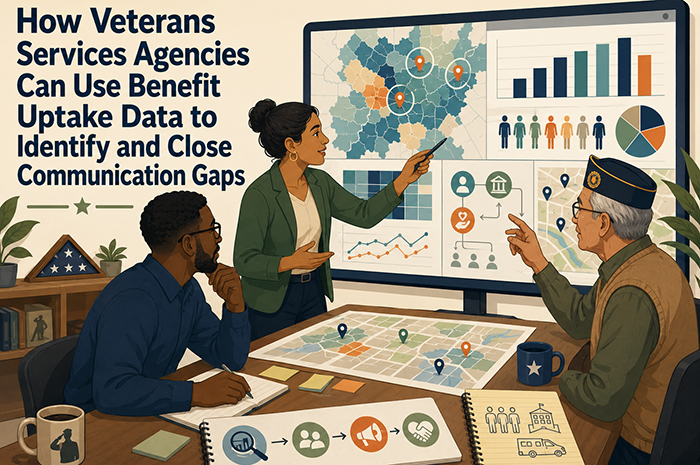
How Veterans Services Agencies Can Use Benefit Uptake Data to Identify and Close Communication Gaps
There is a significant difference between a veterans services agency that believes its outreach is reaching veterans equitably and an agency that knows whether it is. The belief is based on the intuition and the professional experience of the people doing the outreach, on the impression generated by the outreach activities themselves, and on the absence of obvious evidence of failure. The knowledge is based on data: systematic tracking of who is receiving program information, who is completing applications, who is being approved, and who is being lost at each stage of the pipeline, organized in ways that reveal whether the agency’s communication is reaching the full veteran population it is designed to serve or whether specific demographic groups, geographic areas, or service categories are being consistently underserved.
The difference between belief and knowledge matters enormously in the context of veteran benefit access because the agency’s communication investment is directed at a veteran population whose access needs are highly unequal. Veterans in rural areas face geographic communication barriers that veterans in urban areas do not. Veterans of color face historical and cultural communication barriers that affect how they receive institutional communications. Women veterans face communication environments that have historically been designed for a male majority audience. Guard and Reserve veterans face eligibility complexity barriers that active duty veterans do not. Veterans with disabilities face communication format barriers that non-disabled veterans do not encounter. These differential barriers produce differential access outcomes: veterans facing greater communication barriers are more likely to be underserved by the agency’s communication, and without data that makes this differential visible, the agency cannot know where to direct its communication improvement investments to close the gaps.
Benefit uptake data, the systematic tracking of who is engaging with and successfully accessing veteran benefit programs, is the evidence base that converts the agency’s communication equity aspiration into communication equity practice. When an agency can see that its geographic distribution of active claims is significantly skewed toward urban counties while rural counties with equivalent estimated veteran populations show much lower engagement, it has specific evidence of a geographic communication gap that requires a specific geographic communication response. When an agency can see that its women veteran enrollment rates are significantly below the estimated eligible women veteran population, it has specific evidence of a demographic communication gap that requires a demographic communication response. When an agency can see that its PACT Act claim filing rates among Guard and Reserve veterans are far below what the eligible population would suggest, it has specific evidence of a population-specific communication gap that requires targeted outreach.
This article provides a comprehensive framework for building and using a benefit uptake data strategy to identify and close communication gaps in veterans services agencies. It covers the data infrastructure required for meaningful uptake tracking, the specific metrics and analytical approaches that reveal communication gaps across demographic, geographic, and program dimensions, the analytical methods for distinguishing communication gaps from other access barriers, the communication response design that translates data-identified gaps into targeted outreach strategies, the organizational processes that ensure data analysis results in communication action rather than documentation without consequence, and the measurement approaches that assess whether targeted communication interventions are closing the gaps they were designed to address. The framework is designed to be implementable with modest technical resources and to produce actionable intelligence from data that many agencies are already collecting but not systematically analyzing for communication gap identification.
The commitment to data-driven communication equity that this article advocates is both a communication strategy commitment and an organizational values commitment. Agencies that track and analyze benefit uptake data with the intention of identifying underserved populations and targeting their communication resources toward closing access gaps are demonstrating through their data practice that they are serious about serving all veterans equitably rather than serving the veterans who are easiest to reach. That demonstration has value beyond the specific communication improvements it produces, because it establishes a culture of evidence and equity that influences every other dimension of the agency’s communication strategy and that builds the trust of veteran communities that have historically had reason to doubt whether government agencies are genuinely attentive to their specific needs.
Building the Data Infrastructure for Uptake Tracking
 Meaningful benefit uptake data analysis requires a data infrastructure that is capable of tracking veteran program engagement across the full access pipeline, from initial contact through application completion and program enrollment, and that captures sufficient demographic and geographic information about engaging veterans to allow the analysis of engagement patterns across different population segments. Most veterans services agencies collect some of this data in some form, but the data is often fragmented across multiple systems, inconsistently coded, and not organized or analyzed in ways that reveal the communication gap patterns that uptake analysis is designed to identify.
The foundational data infrastructure requirement is a case management system or intake tracking system that captures a consistent set of demographic and geographic variables for every veteran who contacts the agency, regardless of the stage of engagement at which the contact occurs. The variables most important for communication gap analysis include the veteran’s home county or zip code, which allows geographic analysis of engagement patterns; the veteran’s service era and branch, which allows analysis by the demographic characteristics most relevant to benefit eligibility; the veteran’s gender, race, and ethnicity, which allows equity analysis across demographic groups; whether the veteran is Guard or Reserve or active component, which allows analysis of engagement patterns among the population most likely to face eligibility complexity barriers; and the source of the veteran’s initial contact with the agency, which allows attribution analysis of which communication channels are producing veteran contacts from which populations.
The collection of demographic and geographic variables must be approached with sensitivity and transparency. Veterans should be told why this information is being collected, what it will be used for, and that it will be aggregated for analysis rather than used to affect individual benefit determinations. Framing demographic data collection as an equity commitment, specifically telling veterans that the agency tracks this information to ensure it is serving all veterans equitably and to identify communities it is not reaching, converts a potentially suspicious administrative request into a meaningful expression of the agency’s equity values. Collection of race and ethnicity data should follow the federal standard categories and should make clear that providing this information is voluntary.
Pipeline tracking, the ability to follow an individual veteran’s contact through the stages from initial inquiry through application submission and program enrollment, requires a system that assigns a consistent identifier to each veteran contact and that records the status of that contact at each pipeline stage. Many agencies have intake systems that track veterans through the intake and claims assistance process but that do not consistently record the outcome of each stage in ways that allow pipeline analysis. Upgrading these systems to capture consistent stage outcomes, including applications started but not completed, claims submitted and pending, claims approved and enrolled, and claims denied, is the foundational infrastructure investment for pipeline gap analysis.
Denominators and Eligible Population Estimates
Uptake data is only meaningful when interpreted against an estimate of the eligible population, because uptake rates that appear high in absolute terms may be low relative to the size of the eligible population, and uptake rates that appear low in absolute terms may represent high penetration of a small eligible population. The denominator problem, establishing a reliable estimate of the eligible veteran population in each analytical segment, is one of the most significant technical challenges in benefit uptake gap analysis.
Several data sources provide useful eligible population estimates for different analytical purposes. VA population data, published at the county and state level, provides total veteran population estimates and some demographic breakdowns that can serve as denominators for overall engagement rate calculations. American Community Survey data from the Census Bureau provides more detailed demographic breakdowns of the veteran population at various geographic levels, including age, sex, race and ethnicity, service era, and disability status, which allow more specific eligible population estimates for specific program categories. Department of Defense data on Guard and Reserve unit locations and membership can supplement VA population data for analysis of Guard and Reserve engagement rates.
The gap between veteran population estimates and eligible population estimates must be recognized in the analysis. Not all veterans in a geographic area are eligible for all programs, and uptake rates calculated against total veteran population denominators will understate the true penetration of programs with more restricted eligibility. Where possible, uptake analysis should use the most specific available eligible population estimate as the denominator, acknowledging in the analysis the uncertainty in that estimate and the implications of that uncertainty for interpretation of the resulting rate. Ranges of estimated penetration that reflect the uncertainty in eligible population estimates are more honest and more analytically useful than point estimates that imply more precision than the available data supports.
Serving Those Who Served: Communication Strategies for Veterans Agencies
This article is part of our series on strategic communication for Veterans Services Agencies, County Veterans Services Offices, State Departments of Veterans Affairs, and community-based veteran support organizations. To learn more and to see the parent article, which links to other content just like this, click the button below.
Analytical Approaches for Identifying Communication Gaps
The analytical work of identifying communication gaps from benefit uptake data requires both quantitative analysis that reveals patterns in the data and qualitative interpretation that distinguishes communication gaps from other explanations of those patterns. Low uptake rates in a specific geographic area may reflect a communication gap, a genuine lower prevalence of eligible veterans in that area, higher rates of service by alternative providers, cultural barriers beyond communication that affect engagement, or the characteristics of the specific veteran population in that area that affect their benefit needs or their prior engagement with the benefit system. Analytical rigor requires taking each of these alternative explanations seriously before attributing a low uptake rate to a communication gap and designing a communication response.
Geographic analysis maps the geographic distribution of agency engagement against the geographic distribution of the eligible veteran population, identifying areas where the ratio of engagement to estimated eligibility is significantly below the average. A county-level geographic analysis that shows a cluster of counties in the northern part of the state with significantly lower engagement rates than the state average, combined with veteran population estimates that indicate substantial eligible populations in those counties, provides initial evidence of a geographic communication gap that warrants investigation and likely intervention. The investigation should include qualitative inquiry to assess whether the geographic gap reflects a communication barrier, a geographic access barrier such as distance to CVSO offices, a cultural or trust barrier specific to the communities in those counties, or some combination of these factors.
Demographic analysis compares engagement rates across demographic groups, specifically examining whether women veterans, veterans of color, Guard and Reserve veterans, and veterans in specific service era cohorts are engaging with the agency at rates commensurate with their estimated eligible population share. These comparisons should be conducted for each major program category separately, not only for overall agency engagement, because demographic patterns may differ across programs in ways that have specific communication implications. A demographic analysis that shows women veterans are engaging with the agency at approximately their population share for benefits navigation generally but are significantly underrepresented among veterans accessing MST-specific programs has identified a program-specific communication gap rather than a general engagement gap.
Pipeline stage analysis examines where in the benefit access pipeline veterans from specific demographic or geographic groups are being lost relative to veterans from comparison groups. If veterans from rural areas are contacting the agency at rates similar to urban veterans but are completing applications at significantly lower rates, the gap is in the application support stage rather than in the initial outreach stage, and the appropriate communication response is different from the response that would be appropriate for a gap in initial contact. If women veterans are initiating contact at lower rates than men but are completing applications at similar rates once they initiate contact, the gap is in initial awareness and engagement rather than in process support, and the communication response should focus on awareness outreach rather than application support.
The Source Attribution Analysis
Source attribution analysis, which tracks how veterans who contact the agency first learned about the agency’s services or the specific program they are contacting about, provides direct evidence about which communication channels are producing contacts from which veteran populations. This analysis is particularly valuable for assessing the equity implications of different communication channel investments and for identifying which channels are most effective at reaching specific underserved populations.
Source attribution data should be collected at intake for every veteran contact, using a consistent set of source categories that correspond to the agency’s actual communication channels and community partners. Categories should include specific enough options to distinguish between, for example, social media referrals from different platforms, referrals from different types of community partners, and self-directed discovery through search engines, rather than collapsing all digital sources into a single category that does not reveal which specific digital channels are producing results.
Source attribution analysis that is cross-tabulated with demographic variables reveals whether specific communication channels are reaching some demographic groups more effectively than others and whether channels that are well-represented in the agency’s investment are producing contacts from underserved populations or primarily from already-connected populations. If source attribution data shows that VSO post referrals are producing predominantly older, male veterans while digital social media referrals are producing predominantly younger veterans, the agency has specific evidence about the demographic reach of different channels that should inform its channel investment decisions. If rural veterans are disproportionately attributed to personal referrals and face-to-face contacts while urban veterans are disproportionately attributed to digital channels, the agency has evidence that its rural digital outreach is not producing contacts and that investment in rural non-digital channels is more likely to close the geographic gap.
Distinguishing Communication Gaps From Other Access Barriers
 Not every pattern of differential uptake reflects a communication gap, and designing communication responses to non-communication access barriers is an inefficient use of communication resources that will not produce the expected uptake improvement. A rigorous data-driven communication gap identification process must include the analytical discipline to consider alternative explanations for observed uptake differentials and to test those explanations against available evidence before committing to a communication response strategy.
The most important alternative explanation for geographic uptake gaps is physical access barriers, specifically the distance between veterans and CVSO offices or other service points. Geographic areas with low uptake that are also geographically distant from CVSO offices may have low uptake primarily because of the access burden of traveling to the CVSO rather than because of communication gaps about what the CVSO offers. In this case, a communication response that improves veteran awareness of CVSO services without addressing the physical access barrier may produce increased awareness without commensurate increases in actual engagement, because aware veterans who face a three-hour round trip to the CVSO may remain non-engaged despite awareness. The appropriate response to a physical access barrier is physical access improvement, which may include mobile outreach events, telehealth-based consultations, and video claims assistance, alongside communication improvement.
Cultural and trust barriers, which were discussed at length in earlier articles in this series, may produce uptake differentials that superficially resemble communication gaps but that require different responses. A demographic group with low uptake despite high awareness of available programs, revealed through community surveys that show awareness without engagement, is experiencing a barrier that is not primarily communicative. The barrier is motivational, rooted in distrust, skepticism about program quality, or cultural factors that affect willingness to engage with government institutions. Communication responses that increase awareness further without addressing the trust and cultural barriers will not improve uptake, and the data-driven analysis must be sophisticated enough to distinguish the communication gap from the trust gap before a response is designed.
Genuine lower eligibility rates in specific populations or geographic areas may explain uptake differentials that initially appear to be communication gaps. If a rural county has a lower proportion of veterans with service-connected disabilities relative to its total veteran population, and if disability compensation is the primary program generating uptake analysis data, the county’s lower disability compensation engagement rate may reflect genuine lower eligibility rather than a communication gap. This possibility should be investigated using available demographic data about the service characteristics of the veteran population in the low-uptake area before concluding that the low uptake reflects a communication gap requiring intervention.
Community Inquiry as a Qualitative Check on Quantitative Analysis
Quantitative uptake data analysis reveals patterns but does not explain them. Qualitative inquiry with veterans in low-uptake communities and demographic groups is the essential complement to quantitative analysis that reveals the actual reasons for the observed patterns and that informs the design of appropriate responses. A focus group with rural veterans in a low-uptake county that reveals they are aware of available programs but cannot travel to the CVSO has identified a physical access barrier. A focus group with Black veterans in a low-uptake community that reveals high awareness of programs but significant distrust of the VA based on historical experiences has identified a trust barrier. A focus group with Guard and Reserve veterans that reveals they genuinely do not know that their deployment service makes them eligible for VA benefits has identified a communication gap.
The qualitative inquiry methods most useful for this purpose include focus groups with small groups of veterans from low-uptake segments, individual interviews with community members and community leaders who have specific knowledge of the barriers veterans in their community face, conversations with healthcare providers, faith leaders, and other community partners who interact with veterans in low-uptake areas, and brief intercept surveys at community events and locations frequented by veterans in the communities being investigated. Each of these methods provides evidence about the character of the access barrier that the quantitative data has identified, and together they provide a richer and more accurate picture than any single method alone.
Designing Targeted Communication Responses to Data-Identified Gaps
The translation from gap identification to communication response design requires matching the specific character of the identified gap to the specific communication approaches most likely to address it. A geographic gap caused by physical distance requires communication that addresses the distance barrier specifically, including promotion of telehealth and phone consultation options, mobile outreach event scheduling, and communication through channels that reach veterans in the specific geographic areas without requiring them to travel. A demographic gap caused by cultural barriers requires communication through trusted community channels with culturally resonant messaging, as described in the culturally competent outreach article in this series. A program-specific gap caused by lack of awareness of a specific program’s existence requires targeted awareness communication about that specific program through the channels most likely to reach the underserved population.
Communication responses to data-identified gaps should be designed as targeted interventions with specific, measurable objectives rather than as general outreach enhancements without accountability for specific outcomes. A targeted intervention that is designed to close the PACT Act claim filing gap among Guard and Reserve veterans in rural counties should have a specific target penetration objective, a specific timeline, a specific set of communication activities organized around reaching Guard and Reserve veterans in rural counties through the channels most effective for that population, and a specific plan for measuring whether the intervention has produced the expected uptake improvement. Without these specifics, the intervention cannot be evaluated and the learning from its success or failure cannot be applied to future gap-closing efforts.
The communication activities in a targeted gap-closing intervention should be selected based on their fit with the specific population and the specific gap character rather than on the agency’s general communication preferences. Agencies that are most comfortable with social media outreach should not default to social media for a gap-closing intervention targeting older rural veterans who are not active on social media. Agencies that are most experienced with VSO post briefings should not default to VSO briefings for a gap-closing intervention targeting women veterans who are underrepresented in VSO post membership. The population’s communication preferences and the channel analysis from source attribution data should drive channel selection for targeted interventions regardless of agency comfort and experience with specific channels.
Resource allocation for gap-closing interventions should reflect the magnitude and the equity priority of the identified gaps. Large gaps affecting populations that have historically been underserved by the agency should receive proportionally larger resource allocations than small gaps in populations that are already relatively well served. This resource allocation logic is the concrete expression of a communication equity commitment: it directs communication investment toward the populations whose access gaps are largest and whose communication needs are most urgent rather than toward the populations that are easiest and most comfortable to serve.
Building a Gap Tracking and Response System
A systematic approach to benefit uptake gap identification and communication response requires an organizational system that tracks gaps over time, records communication interventions designed to address those gaps, and monitors the gap metrics after interventions to assess whether the interventions are producing the expected improvements. Without this tracking system, gap identification and communication response are one-time activities that do not accumulate into the continuous improvement cycle that sustained equity progress requires.
The gap tracking system can be as simple as a spreadsheet that records each identified gap with the date of identification, the data evidence that identified it, the qualitative inquiry results that characterized it, the communication response designed and implemented, the implementation timeline, and the post-intervention uptake data that indicates whether the gap is closing. The simplicity of the system matters less than the consistency with which it is used and reviewed, because a simple system that is maintained consistently and reviewed regularly is more valuable than a sophisticated system that is implemented and then neglected.
Regular gap tracking reviews, conducted at the agency leadership level rather than only at the program staff level, ensure that identified gaps receive the organizational attention and resource allocation they require and that gap-closing communication interventions are treated as organizational priorities rather than as discretionary program activities that compete with more immediate demands for the same limited staff capacity. These reviews should be scheduled on a defined cadence, at least quarterly, and should produce specific decisions about communication resource allocation that are documented and tracked for implementation.
The Equity Reporting Function of Uptake Data Analysis
Benefit uptake data analysis serves not only a communication improvement function but an equity accountability function: it provides the evidence base for the agency to report honestly to oversight bodies, elected officials, and the public about whether the agency is serving all veterans equitably and what it is doing about the gaps it identifies. This equity reporting function is increasingly expected by the policy environment that veterans services agencies operate in, with growing emphasis on equity measurement and reporting in federal and state program accountability frameworks.
Equity reporting based on uptake data should be honest about both the gaps the analysis identifies and the communication responses the agency has designed and implemented to address those gaps. Reporting that presents only the positive uptake data and omits the gap analysis results is not honest equity reporting. Reporting that presents gap analysis results alongside specific communication responses and preliminary evidence of gap-closing progress demonstrates the organizational accountability for equity that elected officials and the public increasingly expect from government agencies serving diverse populations.
The communication design of equity reports to oversight audiences is itself an important communication challenge that is addressed in the following article in this series. For the purposes of this article, the relevant point is that uptake data analysis produces the evidence base that makes meaningful equity reporting possible and that equity reporting, in turn, creates the accountability structure that sustains organizational commitment to gap identification and gap-closing communication investment over time.
Strategic Communication Support for Veterans Services Agencies
 Improving communication begins with understanding where communication is not working. Veterans services agencies collect significant amounts of operational and program data, but identifying communication gaps requires looking beyond service delivery metrics to understand which veterans are not being reached, where misunderstandings occur, and which populations continue to experience barriers to accessing benefits and services. A data-driven communication strategy transforms this information into actionable insights that guide continuous improvement.
Successful communication gap identification systems are built through data analysis, audience research, qualitative feedback, performance measurement, communication testing, and ongoing evaluation. Quantitative data can reveal patterns in program participation and service utilization, while conversations with veterans, community partners, and frontline staff provide the context needed to understand why those patterns exist. Combining these sources enables agencies to identify communication barriers, prioritize improvement efforts, and measure whether communication changes produce better outcomes over time.
Developing this type of communication system requires specialized expertise in communication research, data analysis, audience segmentation, qualitative inquiry, performance measurement, and communication evaluation. Many veterans services agencies choose to partner with external communication specialists such as Stegmeier Consulting Group (SCG) because these capabilities complement the agency’s expertise in veterans services while providing the strategic communication knowledge needed to build evidence-based systems that identify communication gaps, guide targeted improvements, and strengthen equitable access to programs and services.
Working alongside veterans services agencies, SCG develops communication gap identification frameworks that combine operational data with communication research to support informed decision-making. Support may include assessing existing data infrastructure, developing communication performance indicators, designing methodologies for identifying communication gaps, conducting qualitative research with veterans and community partners, creating communication response strategies for identified barriers, and implementing measurement systems that monitor progress and support continuous improvement across programs and communication channels.
As veteran populations, communication technologies, and agency priorities continue to evolve, communication systems must continuously adapt to emerging needs and changing patterns of engagement. SCG helps agencies establish repeatable communication processes, governance practices, and performance measurement frameworks that enable communication decisions to remain evidence-based while supporting long-term organizational learning and continuous improvement.
The objective is to create a communication environment in which decisions are guided by evidence rather than assumptions, communication barriers are identified before they become systemic problems, and every improvement helps expand equitable access to benefits and services. By strengthening data-driven communication systems, agencies are better positioned to improve outreach, reduce disparities, and ensure more veterans receive the programs and support they have earned.
Future Trends in Uptake Data and Communication Gap Analysis
The data environment for veteran benefit uptake analysis is evolving in ways that will expand both the evidence available for gap identification and the analytical tools available for gap analysis. Administrative data sharing between federal agencies, including data sharing between the VA and the Department of Defense that makes service history data available for population-level eligibility estimation, is expanding the accuracy and specificity of eligible population denominators that are the foundation of meaningful uptake rate calculations. Better denominators produce more reliable gap identification, and the evolution toward more comprehensive administrative data sharing will improve the precision of data-driven communication gap analysis for veteran populations.
Machine learning and predictive analytics tools are being applied to veteran service data in ways that identify patterns of disengagement and risk of non-access that would not be visible in standard uptake analysis. Predictive models that identify veterans who have had contact with the agency but who are at high risk of disengaging before completing their benefit access, based on patterns in their prior engagement behavior and demographic characteristics, can inform targeted retention communication interventions that prevent pipeline losses before they occur rather than responding to them after the fact. These predictive capabilities represent a significant advance in the sophistication of data-driven communication strategy, and agencies that develop the capacity to use them will be positioned to close gaps more efficiently and more preventively than agencies that rely only on retrospective uptake analysis.
The growing standardization of equity measurement frameworks across government programs, including the adoption of demographic data collection standards and reporting requirements at federal and state levels, is creating a more consistent basis for comparing veteran service equity outcomes across agencies and jurisdictions. These standards will increasingly shape the data collection and reporting practices of veterans services agencies, and agencies that are already collecting and analyzing demographic uptake data will be well positioned to meet emerging equity reporting requirements without the significant data infrastructure development that would be required by agencies starting from scratch.
Conclusion
The agency that does not know which veterans it is failing to reach is not well positioned to do anything about those veterans’ unmet needs. The agency that does know, because it has built the data infrastructure and analytical practices to make the gaps visible, is positioned to direct its communication investment where it will do the most good for the veterans who have been most underserved. That positioning is the practical expression of a commitment to serving all veterans equitably rather than serving all veterans equally in an environment where equal treatment produces unequal outcomes. Data-driven communication gap identification and closing is the methodology through which that commitment moves from aspiration to action.
SCG’s Strategic Approach to Communication Systems
Stegmeier Consulting Group’s data strategy work with veterans services agencies is grounded in the recognition that communication equity requires evidence as much as it requires intention. The agency that wants to reach all veterans equitably but does not track whether it is doing so is relying on hope rather than on knowledge. SCG helps agencies build the data infrastructure, the analytical frameworks, and the organizational processes that convert uptake data from administrative records into strategic intelligence about where communication investment is needed and what kinds of communication will close the gaps that the data reveals. The result is a communication system that improves continuously in its equity of reach rather than one that remains calibrated to the populations it already serves well while leaving the hardest-to-reach veterans behind.
Use the form below to connect with our team and explore how strategic communication analytics can help your agency identify communication gaps, strengthen decision-making, and improve equitable access to veterans benefits and services.