How Veterans Services Agencies Can Design a Community Veterans Expo That Produces Real Access, Not Just Attendance
Every veterans services agency has hosted or attended a resource fair. The format is familiar enough to have become a default: a gymnasium or convention hall filled with tables draped in organizational banners, staffed by representatives who hand out brochures, and attended by veterans who walk the perimeter, collect pamphlets, and leave having interacted with a dozen agencies without having initiated a substantive conversation with any of them. Attendance figures are announced in follow-up press releases. The organizing agency declares the event a success. And the veterans who walked through the doors, many of whom came specifically because they needed help with something real and urgent, leave with a bag of paper and no clearer sense of what to do next than when they arrived.
The problem is not the concept of the community veterans expo. Convening veterans with service providers in a dedicated event context is a genuinely valuable access strategy, particularly for reaching veterans who are not connected to any formal service channel and who might not otherwise encounter the full range of available resources. The problem is how these events are typically designed, which is primarily around the needs and preferences of the agencies participating in them rather than around the informational needs, navigational challenges, and communication preferences of the veterans they are intended to serve. An event designed around agency participation produces agency participation. An event designed around veteran access produces veteran access. The distinction in outcomes is significant, and it is not the result of more funding, more agencies, or larger attendance. It is the result of a fundamentally different design philosophy.
Burlington County, New Jersey has developed a Veterans Expo model that treats event design as a communication strategy rather than a logistics exercise. The Burlington County model is organized around the specific question of what veterans need to do at the event and what physical, informational, and relational conditions would make it possible for them to do those things efficiently and effectively. This organizing question produces design decisions that are different from the decisions produced by the question of how to accommodate the maximum number of participating agencies in the available space, and those different decisions produce meaningfully different outcomes in the proportion of attending veterans who leave with a real service connection rather than a brochure collection.
This article provides a comprehensive planning and communication framework for designing a community veterans expo that produces real access. It covers the foundational design philosophy that distinguishes access-oriented events from attendance-oriented events, the physical layout decisions that support or undermine veteran navigation and service connection, the agency coordination strategy that converts participating organizations from table staffers into genuine service partners, the messaging and pre-event communication that brings the right veterans to the event and sets accurate expectations about what they will find there, the on-site communication systems that guide veterans through the event efficiently, and the post-event follow-up communication that extends the access window beyond the event itself and converts initial contact into sustained service engagement. The framework is applicable across jurisdictions and event sizes, and the principles it articulates are grounded in what works for veterans rather than what is convenient for organizers.
The veterans who attend a well-designed expo are veterans who have made a specific decision to invest their time in seeking information or connections that might improve their situation. That decision represents a level of motivation and engagement that is significantly higher than the passive reception of unsolicited communication, and it is a resource that event design can either leverage effectively or squander. Designing events that leverage this motivation effectively requires taking seriously the communication challenge of converting attendance into access, which is the challenge this article addresses.
The Access-Oriented Design Philosophy
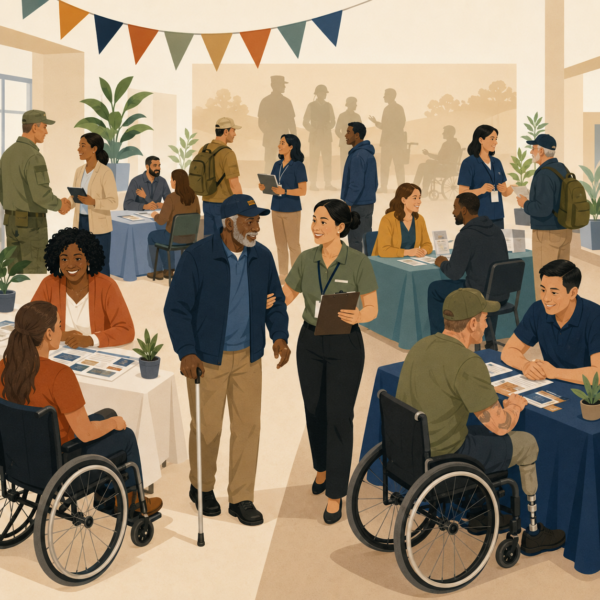 The distinction between an attendance-oriented veterans expo and an access-oriented one begins at the level of the organizing question that drives every design decision. Attendance-oriented events are organized around the question of how to bring as many veterans and as many agencies together as possible in the same space at the same time. The success metric for this approach is the attendance count, and the design decisions it produces, maximizing table space, maximizing agency participation, maximizing marketing reach to drive attendance, are all optimized around producing that count rather than around what happens to veterans once they arrive.
Access-oriented events are organized around a different question: what would it take for a veteran who walks through the door of this event to leave having made a genuine, actionable connection to a service or benefit they needed? This question immediately reveals that the conditions required for that outcome are significantly more specific than the conditions required for high attendance. Attendance is produced by marketing. Access is produced by communication design, navigational clarity, agency readiness, and follow-up infrastructure. Marketing and logistics are necessary but not sufficient for access outcomes, and events that optimize for marketing and logistics without investing equivalent attention in communication and follow-up will consistently produce high attendance and low access conversion.
The access-oriented design philosophy requires that event organizers understand, before any other design decision is made, who the attending veterans are likely to be, what specific needs they are most likely to bring to the event, and what specific barriers most commonly prevent veterans in this community from making service connections. This understanding is not produced by assumptions about what veterans need. It is produced by analysis of prior event feedback, by engagement with CVSO intake data about the most common veteran needs in the community, by consultation with VSO post commanders about what their members are most frequently asking about, and by conversations with community partners who serve veterans in non-veterans-specific settings and who have insight into the needs and concerns of veterans who are not yet connected to formal services.
The Burlington County model operationalizes the access-oriented design philosophy through a set of specific design choices that collectively create an event environment in which veterans with specific needs can navigate efficiently to the resources that address those needs, make substantive connections with agency representatives who are prepared for meaningful conversations rather than brochure distribution, and leave with clear next steps and specific follow-up contacts rather than a generic sense of the available resource landscape. Each of these design choices is described in detail in subsequent sections of this article, and each is informed by the foundational insight that producing access requires designing specifically for access rather than assuming that access will emerge from attendance.
Defining Success Metrics Before Design Begins
An access-oriented veterans expo requires access-oriented success metrics, defined before design begins, that shape every subsequent design decision. If the only metric the organizing agency intends to track is attendance, the event will be designed to maximize attendance. If the metrics include the number of veterans who made substantive service connections, the number of follow-up appointments scheduled, the number of veterans who left with a specific next-step action rather than only with materials, and the proportion of attending veterans who subsequently engaged with at least one participating service provider, those metrics will shape design decisions that produce access rather than only attendance.
Defining access metrics requires agreement among event organizers and participating agencies about what counts as a meaningful connection. The bar should be specific enough to be meaningful: a veteran who picked up a brochure is not a service connection. A veteran who had a conversation with an agency representative that identified a specific need and resulted in the veteran’s contact information being recorded with a specific follow-up action is a service connection. A veteran who scheduled an appointment before leaving the event is a stronger service connection. A veteran who was walked across the room by a volunteer navigator to meet with a specific agency whose services matched their identified need is a service connection that the event’s design produced rather than that the veteran produced through their own navigation.
Tracking these metrics requires data collection infrastructure that is built into the event design from the beginning rather than added as an afterthought. Participating agencies should be asked to record specific interactions rather than only attendance estimates. Navigator volunteers should record every veteran they assisted and the agencies they connected them to. A central registration or information station should track incoming veterans and their stated primary needs. Post-event survey data should be collected from attending veterans to assess their experience of navigating the event and their sense of whether they found what they came for. This data infrastructure is modestly demanding to design and implement, and it produces the evidence that makes meaningful event evaluation possible.
Serving Those Who Served: Communication Strategies for Veterans Agencies
This article is part of our series on strategic communication for Veterans Services Agencies, County Veterans Services Offices, State Departments of Veterans Affairs, and community-based veteran support organizations. To learn more and to see the parent article, which links to other content just like this, click the button below.
Physical Layout as a Communication System
The physical layout of a community veterans expo is a communication system before it is a logistics solution. Every layout decision communicates something to the veteran who walks through the door: about where to go, what to expect, how the event is organized, and whether the event was designed for their navigation needs or for the organizational preferences of the agencies staffing it. Layouts that are organized around agency preferences tend to produce environments in which veterans wander without clear direction, interact with agencies whose services are not relevant to their specific needs, and spend limited event time in ways that do not produce access outcomes. Layouts organized around veteran navigation needs produce directional clarity, efficient routing to relevant agencies, and the kind of spatial logic that allows veterans to move purposefully through the event rather than randomly.
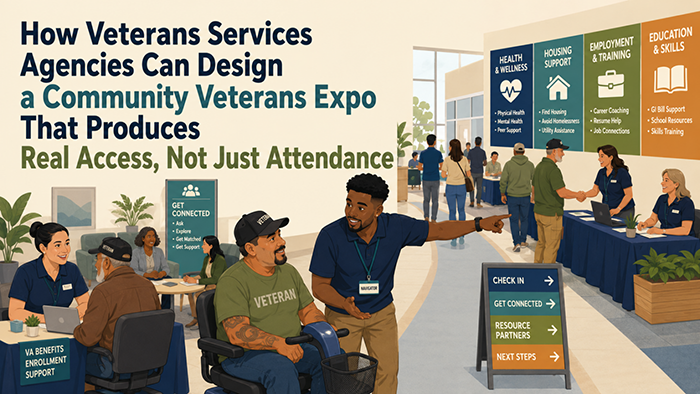
The most effective starting point for veteran-centered layout design is a categorization of participating agencies by the primary service type they offer, followed by a spatial organization of the event that clusters agencies by service type in clearly labeled zones. A financial benefits zone where disability compensation, pension, property tax exemption, and financial assistance agencies are clustered allows veterans with financial benefit questions to navigate directly to a specific area of the event rather than scanning the full table landscape to identify which of the forty participating agencies addresses their need. A healthcare zone, an employment zone, a mental health and crisis resources zone, an education and GI Bill zone, and a legal assistance zone provide similarly specific navigation targets for veterans with needs in each category.
Zone labeling must be visible and readable from the event entrance and from multiple points within the event space. Signage that requires veterans to walk the full perimeter to find the zone they need is not effective navigational signage. Signage should be at eye level or above, should use large font and high-contrast color, and should be supplemented by a printed event map available at the entrance that shows zone locations and lists the agencies in each zone. Veterans who enter the event with a map that tells them where to go are far more likely to reach the relevant agency than veterans who enter without orientation and navigate by scanning.
The placement of a central information and navigation station at or immediately inside the event entrance is one of the most impactful single layout decisions an organizing agency can make. This station, staffed by knowledgeable volunteers or agency staff, serves as the first point of contact for every attending veteran. Its function is not to provide comprehensive information about all available services but to orient veterans quickly to the event, understand their primary need in one to two questions, and direct them specifically to the zone or agency most relevant to that need. This triage and routing function converts the event entrance from a point of disorientation into a point of efficient navigation, and it means that veterans who are confused about where to start have an immediate and accessible resource rather than defaulting to random wandering.
The Navigator Volunteer System
Navigator volunteers are one of the most effective physical layout supplements available to veterans expo organizers, and their deployment is one of the clearest distinctions between events designed for access and events designed for attendance. Navigator volunteers are trained community members, ideally veterans themselves or veterans family members, who circulate through the event space looking for veterans who appear disoriented, who are walking without a clear direction, or who are hovering near the edges of the space without engaging with agencies. These volunteers initiate brief conversations, identify the veteran’s primary need, and physically walk with the veteran to the agency or zone most relevant to that need, making an introduction when possible.
The physical accompaniment dimension of the navigator function is essential and easily underestimated. A veteran who is told verbally that the VA healthcare table is in zone three does not have the same experience as a veteran who is walked to that table by a navigator who introduces them to the agency representative and mentions briefly what the veteran told them they need. The introduction converts a cold approach to a table into a warm referral, which significantly increases the likelihood that the subsequent conversation will be substantive rather than superficial. This warm referral function is what distinguishes the navigator volunteer from a simple information booth and is what produces the access outcomes that information-only orientation cannot.
Navigator volunteer training should be specific and practical. Volunteers need to know the general categories of services available at the event, the zone layout, the names of the agencies in each zone and their primary service types, and how to make a brief but effective introduction when connecting a veteran with an agency. They do not need to know the detailed eligibility requirements for specific programs. The routing and introduction function is the navigator’s job; the program-specific information function belongs to the agency representative. Keeping these roles distinct allows navigator volunteers to function effectively with relatively brief training and allows agency representatives to have substantive conversations without being pre-empted by navigators who have provided incomplete program information.
Private Conversation Spaces
One of the most significant and most commonly overlooked layout requirements for a genuine access-producing veterans expo is the provision of private or semi-private conversation spaces for veterans who need to discuss sensitive topics. Many of the most important conversations that need to happen at a veterans expo involve information that veterans are not comfortable sharing in an open room with other veterans and community members present. A veteran discussing a mental health crisis, a veteran disclosing military sexual trauma for the first time in seeking information about MST services, a veteran with questions about their specific medical conditions and disability rating, and a veteran in financial distress discussing their specific circumstances, all benefit from a conversation environment that provides a reasonable degree of privacy.
Providing private conversation spaces does not require elaborate construction or large amounts of floor space. Partitioned areas within the event space, separate meeting rooms adjacent to the main event area, or designated quiet zones with chairs arranged to face away from the main traffic flow can all provide sufficient separation for sensitive conversations without requiring full room-level privacy. The key is that veterans know these spaces are available and that agency representatives who are having conversations that warrant more privacy know to invite the veteran to use them.
Signage and staff training should both address private conversation space availability. Veterans should see signage at the event entrance and in relevant zones indicating that private conversation spaces are available for sensitive discussions. Agency representatives staffing mental health, MST, and crisis resource tables should be specifically trained to offer private conversation space proactively to veterans who approach them with topics that warrant it. This proactive offer signals that the agency understands the sensitive nature of the topic and has designed the event environment to accommodate that sensitivity, which significantly reduces the barrier to substantive disclosure for veterans who might otherwise limit their disclosure to what is comfortable in a public setting.
Agency Coordination as a Communication Strategy
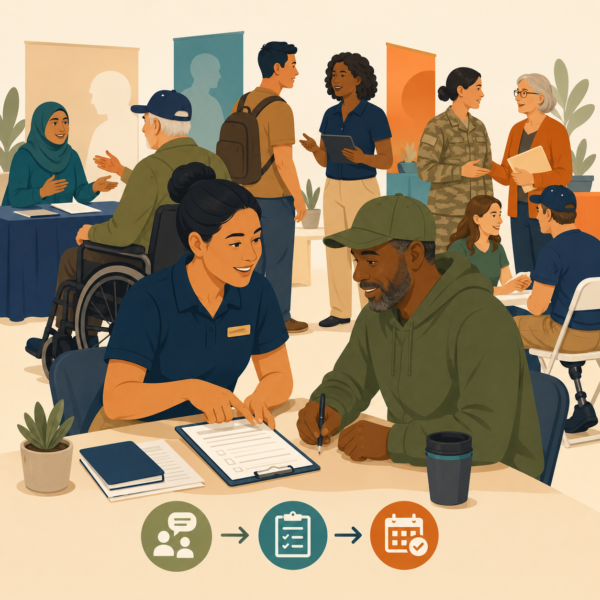 The participating agencies at a community veterans expo are the communication infrastructure through which veteran access is ultimately produced, and how those agencies are coordinated before and during the event is as important as any physical layout or marketing decision. Agencies that arrive at an event without preparation for substantive veteran conversations, without specific knowledge of the other participating agencies’ services and how they relate to their own, and without a clear understanding of what the event is trying to accomplish will staff their tables in the same way they would at any event: with brochures, a sign, and a general willingness to answer questions. This default approach produces default outcomes, and default outcomes at a veterans expo are the attendance-without-access experience that is the norm rather than the exception at poorly designed events.
Agency coordination for an access-oriented veterans expo begins with a pre-event coordination meeting that is substantively different from the logistics-only agency briefings that typically precede resource fairs. A substantive pre-event meeting covers not only the logistics of table assignments and parking but the event’s access goals, the specific success metrics the organizer intends to track, the role of navigator volunteers and how agency representatives should interact with them, the cross-referral expectations that require agency representatives to know enough about other participating agencies’ services to make specific referrals when a veteran who approaches their table has a need that another agency is better positioned to address, and the data collection that agency representatives are expected to contribute during the event.
The cross-referral expectation is the most substantively demanding coordination requirement and the one that produces the most significant access outcomes when implemented well. Veterans who approach a table with a need that does not precisely match the agency at that table should not be told to look around and find the right table. They should receive a specific referral to the agency that best addresses their need, ideally with the representative picking up a phone or walking over to make a warm introduction. This requires that representatives know what the other participating agencies do, and it requires a coordination mechanism, whether a printed agency directory with contact information for the representatives at each table or a shared communication channel among representatives during the event, that makes specific cross-referrals possible in real time.
Agency commitment to post-event follow-up is another coordination element that distinguishes access-oriented events from attendance-oriented ones. Agencies that make commitments at the pre-event meeting to follow up with every veteran whose contact information they collected, within a specific timeframe and through a specific channel, are building the post-event access infrastructure that the event itself creates the conditions for. Those commitments should be documented and their fulfillment should be reported to the event organizer as part of the event’s access outcome tracking, creating accountability for follow-up that is absent when follow-up is left to individual agency discretion.
Agency Representative Preparation
Individual agency representatives who staff tables at a veterans expo perform better when they are specifically prepared for the substantive conversations they will have, not just logistically situated at a table with promotional materials. Preparation for substantive event conversations involves several dimensions: knowledge of the agency’s specific programs and eligibility requirements at a level of detail sufficient for substantive discussion; ability to identify which veterans the agency can serve and which it cannot; knowledge of the event’s other participating agencies sufficient for specific cross-referrals; and the communication skills for the specific conversational context of a brief, high-stakes interaction with a veteran who may have limited time, limited patience for bureaucratic language, and a specific and urgent need.
Pre-event training for agency representatives, ideally conducted in the weeks before the event rather than on the morning of, covers these preparation dimensions with enough depth to produce the substantive readiness that brief event interactions require. Training on the conversational format of effective expo interactions is particularly valuable: the most productive expo conversations have a specific structure, beginning with an open question about what the veteran is looking for, moving quickly to a specific eligibility assessment, and concluding with either a specific next step or a warm referral to another agency. Representatives who have practiced this structure are more efficient and more effective in event interactions than those who conduct each conversation without a structural framework.
Representative energy and engagement are physical and emotional dimensions of agency table staffing that significantly affect the veteran experience of approaching a table. Representatives who are sitting behind their tables with their attention on their phones, who greet approaching veterans without eye contact or with visible distraction, and who respond to veteran questions with the weary efficiency of people who have answered the same question fifty times that morning, are producing a veteran interaction experience that discourages substantive disclosure and limits the depth of the conversation that follows. Representatives who are standing, who make eye contact with veterans approaching their table, who greet veterans with genuine engagement, and who communicate through their physical presence that they are fully present for the conversation, are producing a significantly different interaction experience that is more likely to result in substantive access outcomes.
Pre-Event Communication That Brings the Right Veterans
The communication that precedes a community veterans expo determines not only how many veterans attend but who attends and what they expect to find when they arrive. Events that are promoted with generic messaging, telling veterans that there will be many agencies present and encouraging attendance without specific information about what veterans will find there, tend to attract veterans who are generally curious about available resources. Events that are promoted with specific messaging, identifying the specific agencies and services that will be available and explicitly naming the conditions, questions, or situations that the event is designed to address, attract veterans with those specific conditions, questions, or situations. The second population is more likely to have genuine access needs that the event can address, and more likely to make substantive connections because they arrived with specific intentions rather than general curiosity.
Specific pre-event messaging requires that the organizing agency know in advance which agencies will be participating and what specific services they will be offering, and that this information is communicated to prospective attendees in terms specific enough to allow them to assess whether the event is relevant to their specific situation. A promotional message that says ‘get help with disability compensation claims, GI Bill questions, VA healthcare enrollment, property tax exemptions, employment assistance, and mental health resources, with representatives from twenty-two agencies available for one-on-one conversations’ is more useful to a veteran assessing whether to attend than a message that says ‘resources for veterans from across the county will be available.’
Pre-event communication should also address access logistics that are specifically relevant to veterans with disabilities, including physical accessibility of the venue, parking and transportation options, availability of quiet spaces for veterans with sensory sensitivities, and whether the event is navigable by wheelchair. Veterans whose disabilities create specific accessibility needs often do not attend events where they are uncertain about the accessibility situation, and proactive communication about accessibility accommodations removes a barrier to attendance for veterans whose access to the event depends on this information.
The channels through which pre-event communication is delivered should reflect the same community-specific channel analysis described throughout this series. VSO posts should receive direct briefings from the organizing agency well in advance of the event, with specific information they can share with their members. Healthcare providers who serve veterans should receive promotional materials to share with veteran patients. Faith communities, employer organizations, and community organizations that serve veterans should receive specific outreach with promotional materials. Social media promotion should be supplemented with direct community outreach rather than relying on social reach alone, particularly for reaching veterans who are not connected to digital information channels.
Pre-Registration and Appointment Systems
Pre-registration systems, in which veterans can indicate their primary needs before the event and receive a pre-assigned schedule of agency meetings organized around those needs, represent one of the most powerful available mechanisms for converting veteran attendance into veteran access. A veteran who arrives at an event with a pre-scheduled thirty-minute meeting with the VA healthcare enrollment team and a pre-scheduled fifteen-minute consultation with the property tax exemption specialist has a fundamentally different event experience than a veteran who arrives without pre-registration and must navigate the event independently. The pre-registration veteran enters the event with a plan, makes guaranteed substantive connections rather than incidental ones, and uses their event time efficiently.
Pre-registration systems require advance planning and coordination with participating agencies that most events do not currently undertake. They require that agencies commit to specific time slots for appointments, that a registration system collects veteran contact information and self-reported needs in advance, that the registration data is used to schedule appointments that match veteran needs with agency services, and that veterans receive their pre-scheduled appointment information before the event with enough lead time to confirm their attendance and plan their day. This infrastructure investment is significantly greater than the logistics required for a walk-in event, but it produces significantly better access outcomes that justify the investment.
Hybrid models that combine pre-registration with walk-in access accommodate both veterans who can engage with pre-registration systems and veterans who decide to attend on short notice or who prefer to navigate the event independently. In a hybrid model, a portion of each participating agency’s time is reserved for pre-registered appointments and a portion is available for walk-in interactions. This structure ensures that pre-registered veterans have guaranteed substantive conversations while also allowing the event to serve veterans who arrive without pre-registration.
On-Site Communication Systems
The communication systems that operate during the event itself determine how effectively attending veterans can navigate the resource landscape, identify the agencies most relevant to their needs, and make substantive connections within the limited time they have at the event. On-site communication systems include the wayfinding infrastructure of signage and maps, the orientation services of the central information station and navigator volunteers, the cross-referral communication among agency representatives, and the data collection systems that track veteran interactions and commitments.
Event materials given to veterans at registration or entry should serve a navigational function rather than primarily an informational function. A printed map showing zone locations and the agencies in each zone, organized around the veteran’s question sequence, specifically what types of services are available and where, is more useful at the moment of event entry than a comprehensive program booklet that requires sustained reading to navigate. The program booklet can be available for veterans who want more detail, but the primary navigational tool should be optimized for quick orientation and efficient routing.
Veteran interaction tracking during the event can be implemented through simple mechanisms that do not require technology infrastructure. Navigator volunteers who carry a brief interaction log that records each veteran they assist, the need identified, and the agency they were routed to, provide interaction data that can be used for both real-time event management and post-event evaluation. Agency representatives who record contact information for every veteran they have a substantive conversation with, using a simple paper or digital form, provide the data needed for post-event follow-up. A central check-in system at each agency table that records veteran visits can supplement these interaction records with attendance data that shows which agencies were most visited and which may need more prominent navigation support.
Real-time communication among event staff during the event enables responsive adjustments to navigation and agency staffing based on what is happening in real time. If navigator volunteers are observing that veterans are consistently having difficulty finding a specific zone, the central information station should be alerted to provide additional routing guidance to that zone. If a specific agency table has a long waiting line while other tables are underutilized, volunteer navigators should be redirected to manage the queue and manage veteran expectations about wait times. If an agency representative has been called away and their table is unstaffed, the communication system should alert the organizer so that coverage can be arranged. These real-time adjustments require a communication channel among event staff, whether a simple group text message thread or a two-way radio system, that allows rapid coordination without requiring staff to leave their positions.
Managing Veteran Expectations During the Event
Veterans who arrive at an expo with expectations that are not met by the event experience leave frustrated, and frustrated veterans are less likely to follow up on the service connections they did make and less likely to attend future events. Managing veteran expectations during the event requires that event communications be honest about what the event can and cannot provide, that agency representatives are clear in their interactions about what they can help with and what they cannot, and that the on-site communication environment provides veterans with realistic guidance about what is available and how to access it.
One of the most common sources of unmet expectations at veterans expos is the belief that veterans can receive services at the event rather than only information about services and assistance in initiating the process of accessing them. Veterans who arrive expecting to have their disability claims processed, to receive their healthcare benefits card, or to walk out with a decision on their applications will leave disappointed because expos are information and connection events, not service delivery events. Pre-event communication that is explicit about what the event provides, specifically the opportunity to meet with agency representatives, initiate processes, and schedule follow-up appointments rather than to receive services on the spot, sets accurate expectations before the event and reduces the frustration that unmet expectations produce.
During the event, agency representatives who are managing veterans whose expectations exceed what the representative can provide in an event context should communicate clearly about what the next steps are rather than leaving the veteran with a sense that nothing can happen until they contact the agency through a different channel. A veteran who leaves an event interaction with a specific appointment scheduled, a specific document to bring to that appointment, and the representative’s direct contact information has experienced a manageable gap between their expectations and the event’s actual offerings. A veteran who leaves with a brochure and a vague sense that they should call an 800 number has experienced an expectation gap that is less manageable and less likely to produce follow-through.
Post-Event Follow-Up as the Access Extension
The access window produced by a community veterans expo does not close when the event ends. It extends as long as the follow-up commitments made during the event are pursued, and it narrows with every day that passes without follow-up as the momentum of the veteran’s engagement fades and the immediate action orientation that the event context produced dissipates into the demands of ordinary daily life. Post-event follow-up is not an optional add-on to the event communication system. It is the phase of the system in which many of the access connections initiated during the event are either completed or lost.
The follow-up obligations generated by an access-oriented veterans expo are specific and significant. Every veteran who provided contact information to an agency representative with an expectation of follow-up deserves to receive that follow-up within the timeframe communicated during the event. Every veteran who scheduled a follow-up appointment deserves a confirmation of that appointment with specific instructions about what to bring and where to go. Every veteran who was referred to a specific agency by a navigator or another agency representative deserves a connecting communication from the receiving agency that confirms the referral was received and provides specific next steps.
Organizing agencies should establish a follow-up tracking system that monitors the completion of follow-up commitments across all participating agencies and that provides a mechanism for identifying and addressing gaps when commitments are not being met. This tracking does not need to be elaborate. A simple spreadsheet that records each follow-up commitment made during the event, the agency responsible for the follow-up, the deadline for the follow-up, and the completion status, creates the accountability infrastructure needed to ensure that the access connections initiated during the event are completed rather than falling through the organizational gaps that typically swallow them.
The organizing agency’s own follow-up communication to attending veterans, separate from the follow-up provided by individual participating agencies, provides a confirmation that the veteran’s attendance was meaningful and that their specific needs are being addressed. A brief follow-up communication sent to registered attendees within a week of the event, acknowledging their attendance, providing contact information for the agencies most relevant to the needs they expressed at registration or during the event, and inviting them to contact the organizing agency if they have not heard from the agencies they were referred to, performs a quality assurance function that protects the access outcomes the event produced against the organizational follow-up failures that can otherwise erode them.
Converting Expo Contacts to Long-Term Service Relationships
The ultimate measure of a community veterans expo’s access impact is not the number of connections made during the event but the proportion of those connections that develop into sustained service relationships over the months following the event. A veteran who enrolled in VA healthcare because of a conversation at the expo and who is actively using that healthcare a year later represents a more significant access outcome than a veteran who had a positive conversation at the expo but did not follow through on any of the access pathways it opened. Converting expo contacts to long-term service relationships requires follow-up that is sustained beyond the immediate post-event period and that is organized around the veteran’s full access trajectory rather than the single interaction the expo produced.
Veterans who are connected to CVSO services through expo interactions should receive the same sustained relationship investment that the CVSO provides to any client, including proactive status updates on any claims or processes initiated, regular check-in contacts during extended processing periods, and comprehensive benefit reviews that surface additional programs the veteran may be eligible for but not yet accessing. The expo is the beginning of the relationship, not the complete relationship, and agencies that treat expo contacts as a distinct category with a shorter engagement horizon than regular intake contacts are limiting the access impact of the event.
Data from expo contacts should be integrated into the CVSO’s regular caseload management systems rather than maintained as a separate event-related dataset. A veteran who is tracked in the CVSO’s case management system as a result of an expo contact, with their need identified, their referrals recorded, and their follow-up scheduled within the system, has the same continuity of care and follow-through as any other CVSO client. A veteran whose expo contact information is maintained in a separate spreadsheet that is reviewed periodically and acted on as time permits has a significantly lower probability of developing a sustained service relationship.
Measuring Expo Success Beyond Attendance
Measuring the success of a community veterans expo beyond attendance requires the access metrics and data collection infrastructure described throughout this article, applied systematically across the full event lifecycle from pre-registration through post-event follow-up. The specific metrics that most directly reflect access outcomes include the number of veterans who made substantive service connections during the event, defined as interactions that resulted in specific next steps rather than only material collection; the number of follow-up appointments scheduled during the event; the number of follow-up commitments completed within the specified timeframe; and the number of veterans who enrolled in or initiated access to at least one program within ninety days of the event.
Comparison of these access metrics across successive events allows organizers to assess whether design improvements are producing access outcome improvements over time. If the proportion of attending veterans who make substantive connections increases from one event to the next, the design changes implemented between events are working. If it remains flat or declines, additional design analysis is needed to identify what barriers to access are not being addressed by current design decisions. This iterative improvement logic requires consistent metric collection and honest evaluation of results, both of which are preconditions for the continuous design improvement that produces progressively better access outcomes.
Veteran experience feedback, collected through brief surveys distributed at the event or sent to registered attendees after the event, provides qualitative evidence about what veterans found useful, what they found confusing or frustrating, and what they wished the event had offered that it did not. This feedback is actionable design intelligence that quantitative access metrics alone cannot provide, and it should be systematically collected, analyzed, and used to inform subsequent event design rather than being filed as feedback without response.
Strategic Communication Support for Veterans Services Agencies
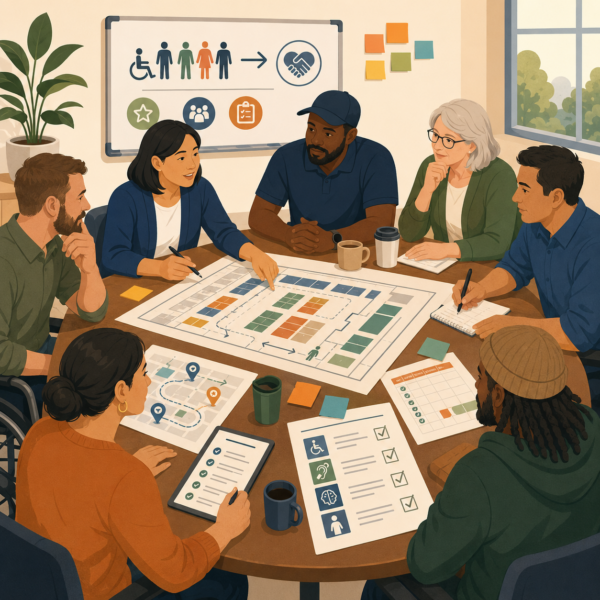 Organizing a successful community veterans expo requires more than bringing service providers together in one location. The most effective events are intentionally designed to help veterans discover relevant resources, understand available benefits, and leave with clear next steps for accessing services. Achieving these outcomes requires communication planning that begins long before the event and continues throughout the participant experience, from initial promotion and registration through post-event follow-up.
Successful veterans expos are built on audience research, strategic event design, coordinated agency participation, clear wayfinding, targeted communication, and meaningful evaluation. Veterans attend community events with different needs, questions, and levels of familiarity with available services. Designing an event that serves these diverse audiences requires communication systems that help veterans navigate resources efficiently, connect with the right organizations, and receive information that is relevant to their individual circumstances rather than overwhelming them with disconnected materials.
Developing this type of event communication strategy requires specialized expertise in audience analysis, communication planning, experience design, partner coordination, content strategy, and performance measurement. Many veterans services agencies choose to partner with external communication specialists such as Stegmeier Consulting Group (SCG) because these capabilities complement the agency’s expertise in veterans programs while providing the strategic communication knowledge needed to design community events that improve benefit access rather than simply increase attendance.
Working alongside veterans services agencies, SCG develops communication strategies that maximize the effectiveness of community veterans expos. Support may include designing participant communication journeys, coordinating messaging across participating organizations, developing event layouts that improve navigation and service discovery, creating communication materials that guide veterans to appropriate resources, establishing follow-up communication plans that reinforce next steps after the event, and implementing measurement systems that evaluate access outcomes, participant engagement, and overall event effectiveness.
As community needs, agency partnerships, and veterans services continue to evolve, event communication strategies must evolve as well. SCG helps agencies establish repeatable planning processes, governance practices, and performance measurement frameworks that enable veterans expos to improve with each event while strengthening collaboration across participating organizations and delivering increasingly meaningful outcomes for veterans.
The objective is to create a community event where veterans can efficiently connect with the benefits, services, and organizations that best meet their needs while leaving with greater confidence in how to access ongoing support. By strengthening the communication systems that shape the entire event experience, agencies are better positioned to improve benefit access, increase meaningful engagement, and maximize the long-term value of every community veterans expo.
Future Trends in Veterans Expo Design
The community veterans expo is evolving in response to several trends that are changing both how veterans access information and what conditions produce the most effective service connections. Virtual event formats, which expanded rapidly during the COVID-19 pandemic and which have demonstrated specific advantages for reaching veterans who cannot attend in-person events due to disability, geographic distance, or caregiving responsibilities, are increasingly being considered as supplements or alternatives to in-person expos. Hybrid formats that combine in-person and virtual attendance extend the geographic reach of events while preserving the relational quality of face-to-face connections for veterans who can attend in person.
Technology integration is changing both the pre-event registration experience and the on-site navigation experience for veterans who are comfortable with mobile technology. Pre-registration apps that allow veterans to schedule specific appointments and receive personalized event maps showing the agencies most relevant to their identified needs, and on-site wayfinding tools that provide real-time navigation guidance, are emerging as possibilities for events with the technical capacity to implement them. These tools are supplements rather than replacements for the human-centered navigation infrastructure of information stations and navigator volunteers, and their implementation should be evaluated against the accessibility needs of veterans who are not comfortable with mobile technology.
Data sharing across participating agencies, with appropriate privacy protections, is an emerging area of event follow-up practice that has significant potential to improve the continuity of the access pathways that expos initiate. When veterans consent to data sharing among participating agencies, the agencies that are following up on expo contacts can access a shared record of the veteran’s interactions at the event, the needs they expressed, and the commitments that were made to them, allowing each agency’s follow-up to be informed by the full context of the veteran’s event experience rather than only the single interaction with that specific agency. Developing the privacy frameworks and data sharing agreements that make this possible is a complex undertaking, but one that has significant potential to improve the coordination of post-event follow-up.
Conclusion
The community veterans expo that produces real access is not more complicated in its logistics than the event that produces only attendance. It is more deliberate in its design, more specific in its communication, more coordinated in its agency partnerships, and more systematic in its follow-up. The deliberateness, the specificity, the coordination, and the systematization are what distinguish access from attendance, and they are achievable by any agency that commits to organizing every design decision around the question of what veterans need from the event rather than the question of how to assemble the maximum number of participants in a shared space.
The veterans who attend these events have made a deliberate decision to invest their time in seeking help. The agencies that design events worthy of that investment will produce access outcomes that justify that decision. Those that settle for attendance-oriented design will continue producing the attendance figures and the brochure collections that have defined the community veterans resource fair as a format for generations, without the access outcomes that the format is capable of producing when it is designed with genuine intention.
SCG’s Strategic Approach to Communication Systems
Stegmeier Consulting Group’s event communication work with veterans services agencies is grounded in the recognition that community events are communication systems that require the same strategic design attention as any other communication investment. The physical layout, the agency coordination, the pre-event messaging, the on-site navigation infrastructure, and the post-event follow-up are all components of a communication system that either produces access or fails to, and the quality of the system’s design determines the quality of its outcomes. SCG helps agencies design event communication systems that are oriented from the beginning toward the access outcomes they are capable of producing, and that measure their success against those outcomes rather than against the attendance metrics that have historically substituted for evidence of genuine impact.
Use the form below to connect with our team and explore how strategic event communication can help your agency design community veterans expos that strengthen engagement, improve benefit access, and deliver more meaningful outcomes for veterans.