
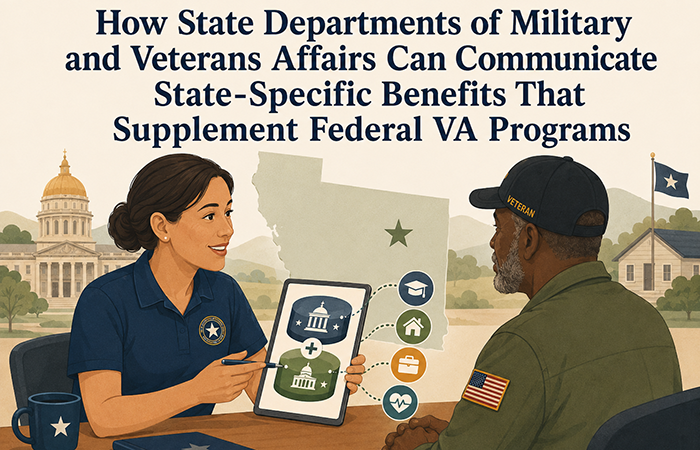
How State Departments of Military and Veterans Affairs Can Communicate State-Specific Benefits That Supplement Federal VA Programs
Federal VA programs represent the floor of veterans’ benefits, not the ceiling. Every state in the country has built additional benefit programs on top of the federal foundation, programs that range from property tax exemptions worth thousands of dollars annually to full tuition waivers at state universities, from employment preference points in state hiring processes to subsidized placement in state veterans homes, from business licensing fee waivers to state-specific disability supplements that add financial support to what the federal system provides. These programs exist everywhere. They serve real needs that federal programs do not fully address. They represent significant public investment in the wellbeing of the veterans who live in each state. And the vast majority of veterans who would benefit from them do not know they exist.
The gap between state veteran benefit availability and veteran awareness of that availability is not a political problem or a legal problem. The programs are funded, legally established, and operationally ready to serve eligible veterans. The gap is a communication problem, a structural failure of the systems designed to connect veterans with available support to actually perform that connection at the state benefit level with anything approaching the consistency that the higher-profile federal programs receive. Veterans who know, at least generally, that the VA provides healthcare and disability compensation are frequently entirely unaware that their state provides a property tax exemption that could save them several thousand dollars a year, or that the state offers tuition benefits for their children, or that state government hiring gives preference to veterans in ways that could significantly affect their career prospects.
This awareness gap is not uniform. Some state benefit categories, particularly those that veterans encounter through other institutional channels such as property tax offices and state employment agencies, have relatively higher awareness among eligible veterans. Others, particularly those that require proactive application to a state veterans services office and that veterans would not encounter through any other channel, have dramatically lower awareness and utilization rates. The communication challenge for state Departments of Military and Veterans Affairs and their county and local partners is to close the full range of these awareness gaps through communication strategies that reach veterans where they actually are rather than only through the formal veterans services channels that veterans must already be engaged with to encounter.
This article provides a comprehensive framework for how state Departments of Military and Veterans Affairs can approach the communication of state-specific veteran benefits as a strategic function rather than an administrative afterthought. It covers the inventory work that is the foundation of accurate communication, the specific communication challenges associated with different benefit categories, the channel strategy for reaching veterans who are not already connected with state veterans services, the interaction between state and federal programs and how to communicate about it honestly, the partner networks that extend communication reach into communities the agency cannot reach on its own, the measurement approaches that demonstrate communication effectiveness, and the organizational maintenance practices that keep communication current as programs change. The goal is a communication infrastructure that converts the state’s investment in veteran benefits into actual benefit access for the veterans those programs were designed to serve.
The investment a state makes in veteran benefit programs is an expression of what that state values. The communication of those programs is the completion of that investment. A benefit program that eligible veterans do not know about is a program that has not fulfilled its purpose, regardless of how well it is designed, how adequately it is funded, or how efficiently it is administered. The communication work is not supplementary to the program work. It is the final stage of the program work, and its quality determines whether the public investment in state veteran benefits actually reaches the veterans it was made for.
The Scope of State Veteran Benefits and Why Veterans Miss Them
 Before designing communication strategies for state veteran benefits, agencies need a clear and comprehensive picture of what those benefits actually include and why veterans with genuine eligibility for them are failing to access them. The scope of state veteran benefit programs is consistently broader than most veterans and even many veterans services professionals fully appreciate, and the reasons veterans miss them are specific enough to point toward communication strategies that address the actual access barriers rather than the assumed ones.
The range of state veteran benefits spans multiple major program categories. Property tax exemptions for veterans with service-connected disabilities are available in virtually every state, with significant variation in the exemption amount, the qualifying disability threshold, and the application process. These exemptions can represent several thousand dollars in annual savings for eligible veterans and represent one of the most financially significant state benefits available. Education benefits for veterans and their dependents, including tuition waivers or supplements at state universities and community colleges, exist in numerous states in forms that can cover significant educational costs that federal GI Bill benefits do not fully address. State veterans homes provide subsidized residential and nursing care options that are particularly important in states where VA facility capacity is limited and where the cost of private long-term care is beyond the reach of many veteran households.
Employment preference in state government hiring provides veterans with additional points or categorical preference in competitive hiring processes, an advantage that can be meaningful in state employment markets and that represents a concrete benefit for veterans entering or returning to the workforce. Business licensing fee waivers reduce the cost of business entry for veteran entrepreneurs, a population that research consistently shows is more likely than the general population to pursue self-employment. State-specific disability compensation supplements exist in some states to provide additional financial support to veterans whose federal disability compensation does not fully offset the economic consequences of their service-connected conditions. Hunting and fishing license fee waivers, motor vehicle registration benefits, recreational access discounts, professional licensing reciprocity for veterans whose military training qualifies them for state professional certifications, and financial assistance programs for veterans facing housing instability round out the benefit landscape with a range of programs that individually may seem modest but that collectively represent significant value for eligible veterans.
The reasons veterans miss state benefits are specific and addressable, and understanding them is the prerequisite for designing communication that actually closes the awareness gap. The first and most fundamental reason is simple lack of awareness, the absence of any prior encounter with information about the existence of state benefits. Veterans who do not know their state offers a property tax exemption for disabled veterans cannot apply for it regardless of their eligibility. The awareness gap is particularly pronounced for benefits that are administered by agencies other than the state veterans affairs agency, such as property tax exemptions administered by county assessor offices and professional licensing reciprocity administered by state licensing boards, because veterans who have had their awareness raised about state veterans services may not know to look to other agencies for other benefit categories.
The second reason veterans miss state benefits is the mental model that federal programs are the totality of what is available. The VA is the dominant institutional presence in the veterans benefits landscape, and veterans who have successfully navigated federal benefits and believe they have accessed what is available to them may have no awareness that there is an additional layer of state programs on top of the federal foundation. This mental model is particularly resilient because it has a surface plausibility: the federal government is the level of government most associated with veterans benefits administration, and the VA is visible and prominent in ways that most state veterans agencies are not. Communication that explicitly frames state benefits as supplements to federal programs, positioned as an additional layer that eligible veterans should investigate after they have engaged with federal programs, is more effective than communication that simply announces state benefit availability without acknowledging the mental model that may be blocking veteran attention to state programs.
The third reason is administrative fragmentation, the fact that state veteran benefits are distributed across multiple administering agencies without a single consolidated entry point that provides comprehensive information. A veteran who successfully navigates the state Department of Military and Veterans Affairs may access some state benefits while entirely missing benefits administered by the state Department of Revenue, the state higher education commission, various professional licensing boards, and other agencies that administer specific benefit programs for veterans but that are not primarily veterans services agencies. The absence of a single comprehensive entry point for state benefits means that even veterans who are motivated to access state benefits may fail to do so because they do not know where to look for each program.
The Awareness Gap as a Communication Failure
The awareness gap for state veteran benefits is not primarily a reflection of veteran disinterest or limited initiative. Research on veteran awareness of available benefits consistently shows that veterans who are made aware of specific programs and who understand their eligibility for those programs apply at high rates. The barrier is awareness and eligibility clarity, not motivation. This finding has direct implications for communication strategy: the primary communication investment should be in reaching veterans who do not yet know about programs with information that is specific enough about eligibility to allow them to self-assess quickly, rather than in persuading veterans who already know about programs to apply for them.
The awareness gap is deepest for programs whose benefit value is not immediately apparent from a brief description and for programs that require active engagement with an unfamiliar agency or process. A property tax exemption that requires a veteran to file an application with their county assessor’s office, providing documentation of their VA disability rating, sits behind two distinct awareness barriers: awareness that the exemption exists, and awareness of the specific process for applying. Communication that addresses both barriers simultaneously, providing both the news that the exemption exists and specific guidance about how to apply, produces higher application rates than communication that addresses only the awareness barrier without the process guidance that allows motivated veterans to follow through.
The awareness gap is also structured by the channels through which veterans receive information. Veterans who are actively engaged with CVSO offices, VSO posts, and VA healthcare facilities are more likely to encounter information about state benefits through these channels than veterans who have disengaged from formal veterans services. The veterans with the deepest awareness gaps are often the veterans who are least connected to formal services, and reaching them requires communication strategies that extend beyond the formal veterans services channels that are most accessible and most familiar to the agencies doing the communicating.
Serving Those Who Served: Communication Strategies for Veterans Agencies
This article is part of our series on strategic communication for Veterans Services Agencies, County Veterans Services Offices, State Departments of Veterans Affairs, and community-based veteran support organizations. To learn more and to see the parent article, which links to other content just like this, click the button below.
Building a Communication-Ready Benefits Inventory
Effective communication about state veteran benefits begins not with communication design but with information management: ensuring that the agency has a comprehensive, accurate, and current inventory of what benefits are available, what their specific eligibility requirements are, how veterans access them, and how they interact with federal programs. Without this inventory, communication will be either incomplete, covering only the programs the agency is most familiar with, or inaccurate, conveying outdated information about programs that have changed since the information was last verified.
A communication-ready benefits inventory goes significantly beyond a list of program names and administering agencies. For each program in the inventory, the agency needs to know and be able to communicate the eligibility requirements in plain language, the current benefit amount or value in concrete terms, the application process and required documentation, the administering agency and specific contact information, the processing timeline and what veterans can expect after applying, any interactions with federal VA programs that could affect a veteran’s decision to apply, and any geographic or other limitations on program availability that veterans need to know about before they invest effort in an application.
Building this inventory requires direct engagement with each administering agency to verify current program status and operational details, because relying on previously published information introduces the risk of communicating outdated details. State legislative sessions frequently modify benefit amounts, eligibility thresholds, and program parameters in ways that are not automatically reflected in existing agency communications or published guides. A property tax exemption that required a 50 percent disability rating last year may require only a 30 percent rating this year following a legislative change. A tuition benefit that was available only at four-year universities may have been extended to community colleges. A newly created program may not appear in any existing communications at all. Direct engagement with administering agencies at regular intervals is the only reliable mechanism for maintaining inventory accuracy.
The inventory should also document the programs that eligible veterans in the agency’s service area are least likely to know about and most likely to benefit from, since these are the programs that represent the highest-priority communication investments. This prioritization analysis should consider both the financial or practical value of the program to eligible veterans and the current awareness and utilization gap between eligible and accessing veterans. A program with high benefit value and low veteran awareness represents a high-priority communication investment. A program with modest benefit value and already-high veteran awareness represents a lower-priority communication investment, even if both are worth communicating about.
Maintaining Inventory Accuracy Over Time
The most carefully built benefits inventory degrades in accuracy over time without systematic maintenance processes, because programs change continuously through legislative action, administrative policy updates, and judicial interpretations. A benefits inventory that was accurate at the time of its development but has not been reviewed since is a liability for communication that depends on it, because veterans who receive outdated information from an authoritative agency source are more likely to make incorrect decisions based on that information than veterans who received no information at all.
Systematic inventory maintenance requires monitoring processes that are responsive to the legislative and regulatory cycles that most frequently produce program changes. State legislative sessions are the primary trigger for state benefit program changes, and agencies should have staff or relationships positioned to track legislation relevant to veteran benefit programs through the legislative cycle. This monitoring does not need to be comprehensive tracking of all legislative activity; it can be focused on the specific program areas covered by the benefits inventory and on committees with jurisdiction over veterans affairs and related topics.
Administrative policy changes at the state agency level and at other administering agencies require a different monitoring approach, since these changes may not go through a public legislative process but may nonetheless significantly affect program eligibility, benefit amounts, or application procedures. Regular communication with program administrators at each administering agency, whether through formal reporting relationships or through informal professional relationships maintained by agency staff, provides early warning of administrative changes that affect the accuracy of the benefits inventory.
A scheduled annual review of the full benefits inventory, conducted regardless of whether specific changes have been identified through the monitoring process, provides a systematic backstop for accuracy maintenance that catches changes that may have slipped through the continuous monitoring process. This annual review should involve direct verification of all eligibility requirements, benefit amounts, and application procedures with each administering agency, producing a fully verified and updated inventory at least once per year. The annual review output should trigger corresponding updates to all communication materials that are based on the inventory.
Communicating Specific Benefit Categories
Different categories of state veteran benefits require different communication approaches because they differ in how veterans encounter them, what barriers prevent their utilization, and what specific information veterans need to make the transition from awareness to application. Treating all state benefit categories as requiring the same communication approach produces generic communications that are moderately relevant to multiple programs but specifically effective for none of them. Developing category-specific communication approaches that are tailored to the specific access barriers and informational needs of each category produces communications that are more directly useful to veterans considering specific programs.
Property tax exemptions are among the most financially significant and most consistently underutilized state benefits, and their communication has several distinctive features that require specific attention. The financial significance of the benefit, potentially thousands of dollars in annual tax savings, makes awareness-building communication particularly high-value: every veteran who receives and acts on accurate information about a property tax exemption they qualify for gains a concrete annual financial benefit that compounds over time. But the communication is challenging because the exemption is administered by a county-level agency, the county assessor or tax collector, rather than by the state veterans services agency, which means that veterans services agency communication must motivate veterans to contact a different agency for the actual application.
Communicating the property tax exemption effectively requires specific information about the qualifying disability rating thresholds for the state, the mechanism by which the exemption is calculated, the application process and where to apply, and any documentation veterans will need to provide. Communication that provides this specific information rather than simply announcing that the exemption exists gives veterans everything they need to assess their eligibility and pursue the application in a single communication encounter. Communication that announces the exemption without the application specifics requires veterans to take additional steps to find the application information, and each additional step in a process is an opportunity for motivated veterans to lose momentum and fail to follow through.
Education benefits for veteran dependents represent a category where the primary communication audience is frequently not the veteran themselves but family members, particularly college-age dependents who need to know about the benefit when they are making college enrollment decisions. The timing of the communication is critical: a family that learns about a state tuition benefit for veterans’ dependents after the dependent has already enrolled at an out-of-state private university and committed to four years of significantly higher tuition costs has not benefited from the communication, regardless of how accurate and accessible it was. Communication strategies for dependent education benefits must reach families at the decision-making stage of college planning, which typically occurs in the junior and senior years of high school, and must do so through the channels where those families receive college planning information, including high school guidance counselors and college admissions processes.
Employment Preference and Workforce Benefits
State employment preference for veterans in state government hiring is a benefit that is both genuinely valuable and genuinely underutilized because the veterans most positioned to benefit from it, those who are actively seeking state government employment, often do not know it exists or do not understand how to invoke it in the application process. Communication about employment preference must be timed to reach veterans at the moment when they are actively considering or applying for state positions, because information received at other times is less likely to be retained or acted upon than information received when it is immediately actionable.
The most effective channel for employment preference communication is the state employment system itself, including the online platforms through which state government positions are advertised and applications are submitted. When veterans who are applying for state positions encounter clear, specific information about employment preference within the application platform itself, the information is delivered at exactly the moment of maximum relevance and is most likely to produce the behavior change of claiming the preference. Veterans services agency communication about employment preference should therefore focus both on stand-alone veteran outreach and on advocacy for prominent and clear preference information within state employment systems.
Professional licensing reciprocity is a related benefit category that is particularly valuable for veterans whose military training and experience qualifies them for state professional certifications. The communication challenge for licensing reciprocity is that the pathway from military occupational specialty to qualifying civilian certification is not obvious to veterans who are unfamiliar with the specific certification requirements and the reciprocity provisions that may apply to their training. Communication that maps specific military occupational specialties to relevant civilian certification categories, and that explains the specific reciprocity provisions and application procedures for each, gives veterans with relevant military training the specific information they need to pursue an accelerated certification pathway rather than the full training requirement that applies to civilians without equivalent military experience.
Agencies that have done the mapping work of identifying which military occupational specialties align with which state licensing reciprocity provisions are in a position to communicate about this benefit in terms of specific veteran experience rather than abstract program description. A veteran who served as a combat medic needs to know whether that specific background qualifies them for EMT or paramedic licensing through a reciprocity provision, not simply that licensing reciprocity programs exist. The specificity that maps military background to civilian licensing pathways is the communication investment that converts licensing reciprocity from an abstract program into a concrete opportunity that specific veterans can act on.
Business Support and Entrepreneurship Benefits
State benefits for veteran entrepreneurs, including business licensing fee waivers, preference in state procurement contracting, access to veteran-focused small business assistance programs, and in some states access to veteran entrepreneur training programs subsidized by the state, represent a benefit category whose utilization rate is particularly sensitive to awareness timing. Veterans who are planning to start a business need to know about available benefits before they incur the costs that those benefits would reduce, and veterans who have already started businesses may feel that the benefits are no longer relevant to them even when they might still qualify for ongoing benefits like procurement preference.
Communication about veteran entrepreneurship benefits should reach veterans at the transition from military service, when many veterans are making decisions about post-service career paths that may include business ownership. Transition assistance programs that include information about state entrepreneur benefits for veterans provide this early-stage awareness at the optimal decision-making moment. Ongoing communication through veteran business owner networks, chambers of commerce with significant veteran membership, and SBDC offices that serve veteran entrepreneurs provides continued awareness for veterans who are already in business and may be unaware of benefits they could still access.
The state procurement preference for veteran-owned businesses is a benefit whose communication requires specific attention to the certification and registration processes that veterans must complete to access procurement opportunities, because the preference is not automatic but must be actively invoked through a registration and verification process. Communication that explains both the existence of the preference and the specific steps required to register as a veteran-owned business for procurement purposes gives motivated veteran entrepreneurs the complete information they need to access this benefit rather than leaving them with awareness of a benefit they cannot locate the access pathway for.
Channel Strategy for Reaching Veterans Who Are Not Yet Connected
 The most significant communication challenge in state veteran benefits outreach is reaching the large population of veterans who are not already connected to state veterans services channels. Veterans who regularly interact with their CVSO office, attend VSO post meetings, receive agency newsletters, and follow agency social media accounts are relatively well positioned to receive state benefit communications through those channels. But this connected population is not the whole veteran population, and the veterans who are least connected to formal veterans services are often the veterans with the greatest unmet need for the information that state benefit communications convey.
Reaching disconnected veterans requires channel strategies that operate outside the formal veterans services communication ecosystem, in spaces where veterans are present for reasons that have nothing to do with benefits access. The principle underlying these channel strategies is simple: go where veterans are, not only where veterans who are already seeking benefits are. This principle points toward healthcare settings, workplaces, faith communities, educational institutions, and community organizations as channels that can carry state benefit communications to veterans who would not otherwise encounter them.
Healthcare settings, including community health centers, primary care practices, and emergency departments that serve veteran patients, are among the most powerful non-veterans-services channels for reaching veterans who are disengaged from formal services. A primary care provider who knows a patient is a veteran and who has brief, accurate information about state benefits to share in the course of a routine appointment is delivering benefit awareness through one of the highest-trust channels available. Equipping healthcare providers with accurate one-page summaries of the most relevant state benefits for veterans in their area, along with contact information for the state veterans services agency, enables this provider-delivered communication without requiring providers to become subject matter experts in veterans benefits.
Educational institutions, including community colleges and universities with significant veteran student populations, provide communication channels that reach veterans at a specific and often underserved life transition. Veteran student services offices at these institutions have existing communication relationships with the veteran students they serve, and integrating state benefit information into these existing relationships extends state benefit awareness to veterans who are enrolled in higher education and who may be eligible for state education supplements, employment preference, and other benefits. Campus-based communication about state benefits is particularly timely because college enrollment is a natural moment for veterans to be thinking about financial resources and career planning in ways that make benefit information immediately relevant to decisions they are actively making.
Integrating State Benefit Communication Into Federal Benefits Navigation
The highest-leverage channel for communicating state veteran benefits is the interaction a veteran has with a County Veterans Service Office when navigating federal benefits. This interaction is the most information-dense, most trusted, and most individualized contact most veterans have with any part of the veterans services ecosystem, and it is the moment at which comprehensive benefit communication, including state programs, is most likely to produce complete access rather than partial access.
CVSOs that systematically include state benefit information in every intake appointment, disability claim process, and benefits review conversation are converting the highest-value contact point in the system into a comprehensive benefit orientation rather than a federal-only navigation service. A CVSO representative who, at the conclusion of a federal benefits consultation, routinely says ‘Now let me tell you about a few things the state offers that you may not know about’ is performing a communication function that extends the value of the interaction significantly without proportionate additional time investment.
This integration requires that CVSO staff have accurate, current knowledge of state benefit programs and are equipped with communication materials that allow them to discuss state programs with the same clarity and specificity they bring to federal program discussions. State Departments of Military and Veterans Affairs have a direct responsibility for ensuring this readiness, which means providing CVSO staff with regularly updated state benefit summaries, conducting periodic training on state program changes, and maintaining a readily accessible reference resource that CVSO staff can consult when veterans ask about specific state programs during consultation appointments.
The integration should be systematic rather than dependent on individual staff initiative. A standard checklist or protocol that prompts CVSO staff to address state benefits as a regular component of comprehensive benefits consultations ensures that state benefit communication happens consistently rather than only when individual staff members think of it. This standardization is particularly important in high-volume CVSO offices where the pressure of caseload can crowd out information that is not built into standard consultation protocols.
VSO Posts and Community Organizations as Communication Partners
Veterans Service Organization posts represent a community communication partner for state benefit outreach whose value extends beyond their role in federal benefits navigation. VSO posts in many communities are the primary social gathering point for veterans who are not otherwise connected to formal veterans services, and post commanders and members carry significant credibility with their fellow veterans as trusted peers rather than government representatives. State benefit information delivered through VSO post channels reaches veterans in a trusted community context that is often more receptive than formal agency communications.
Effective VSO post partnership for state benefit communication requires that post commanders and members have accurate, current information about the benefits available and the channels through which veterans can access them. Regular briefings from state veterans services agency staff, updating post leadership on current program availability and any recent changes, maintain the post’s ability to serve as an accurate information channel. These briefings should be brief enough to fit into existing post meeting schedules and specific enough to give post members actionable information they can share with fellow veterans who may benefit.
Community organizations that serve populations with significant veteran membership, including food banks, housing assistance programs, healthcare access programs, and social service organizations, can carry state benefit awareness to veterans who are in economic difficulty and who may be eligible for state programs that could meaningfully improve their situations. Training staff at these organizations to recognize veteran clients and to provide basic information about state veteran benefits, combined with easy referral pathways to the state veterans services agency for more detailed assistance, extends state benefit communication into service settings that reach veterans who may be in the greatest need of benefit awareness.
Addressing the Federal and State Interaction Concern
Among the most consistent communication barriers to state veteran benefit access is veteran uncertainty about whether claiming a state benefit will somehow affect their federal VA benefits. This concern is understandable in the context of the complexity of the federal benefits system and the legitimate confusion that many veterans carry about how different benefit programs relate to each other. It is also, for the vast majority of state veteran benefits, a concern that is based on inaccurate beliefs rather than actual program interactions, and accurate communication that addresses the concern specifically can remove a barrier that has no basis in actual policy.
The starting point for communication about state and federal benefit interactions is an honest and comprehensive assessment of which programs do and do not interact, and in what ways. This assessment should be conducted with legal and policy input rather than relying on assumptions, because the interaction landscape is complex enough that informal assumptions about which programs interact and how are frequently wrong in ways that either unnecessarily alarm veterans or give false assurance in the limited circumstances where genuine interactions exist.
For the vast majority of state veteran benefits, the accurate answer is that they do not affect federal VA benefits. Property tax exemptions are reductions in local tax liability that have no relationship to federal disability compensation or healthcare enrollment. State education benefits for veterans or their dependents are separate state expenditures that do not affect federal GI Bill eligibility or benefit amounts. State employment preference does not affect any federal VA benefit. Hunting and fishing license fee waivers, business licensing fee waivers, and most other state veteran benefits involve state-level cost reductions or preferences that have no mechanism through which they could affect federal benefit eligibility or amounts.
Communication that makes these specific non-interactions explicit, rather than leaving veterans to infer them from the general principle that state and federal programs are separate, is more effective because it directly addresses the specific concerns that veterans have. A state benefit guide or outreach presentation that includes a specific section addressing the federal interaction concern, providing accurate non-interaction information for the specific benefits covered by the guide, gives veterans the specific reassurance they need to apply for benefits they might otherwise forgo out of unfounded concern.
The limited circumstances where genuine state and federal benefit interactions exist deserve honest and specific communication that neither dismisses the concern nor overstates the risk. VA pension, as an income-based federal benefit, does interact with certain state income-related programs and with the cost of care in some state veterans homes in ways that require individual assessment. Veterans who are considering state veterans home placement while receiving VA pension should be directed to a benefits counselor who can assess the specific interaction for their situation, with a clear explanation of why individualized assessment is needed for this specific program combination. This honest acknowledgment of the circumstances requiring individual assessment is more trust-building than blanket assurances that no interactions exist, because it demonstrates accurate knowledge of the landscape rather than superficial reassurance.
Developing a Comprehensive State Benefits Guide
A comprehensive state veteran benefits guide, developed with the plain-language principles discussed throughout this series and maintained with accurate current information, is one of the most impactful single communication investments a state Department of Military and Veterans Affairs can make. It serves simultaneously as the reference document for CVSO and VSO staff, the takeaway resource for veterans at information events, the digital resource for veterans who prefer to research independently, the foundation for more specific communications targeting particular benefit categories or veteran populations, and the training resource for community partner organizations that need accurate benefit information to serve veteran clients.
The organizational structure of a comprehensive state benefits guide should reflect veteran information needs rather than administrative agency organization. Organizing the guide by administering the agency, with all Department of Revenue programs in one section and all Department of Education programs in another, serves the agency’s organizational logic but not the veteran’s information needs. Organizing the guide by benefit category, with all financial assistance programs in one section, all education programs in another, all employment programs in a third, and all property-related programs in a fourth, allows veterans to navigate directly to the type of benefit they are looking for without needing to know which agency administers it. The administering agency information belongs in each program description as a practical detail, not as the primary organizational structure.
Within each benefit category section, individual program descriptions should follow a consistent format that covers the same elements in the same sequence for each program: what the program provides, who is eligible, how to apply, where to apply and who to contact, how long the process takes, and how this program relates to federal VA benefits the veteran may already be receiving. This consistent format allows veterans who are scanning for relevant programs to quickly assess multiple programs without needing to search within each description for the specific information they need.
The guide should be developed in multiple formats to serve veterans with different access needs and information consumption preferences. A comprehensive print guide suitable for distribution at CVSO offices, VSO posts, and community partner organizations serves veterans who prefer or require printed information. An accessible digital version serves veterans who research online. A mobile-optimized version serves veterans who access information primarily through smartphones. A brief two-to-four page summary version serves the specific purpose of creating awareness of the full range of available programs before veterans are ready to engage with the full guide. Each format should include clear direction to the other formats and to additional assistance resources for veterans who need help understanding their eligibility or navigating the application processes.
Measuring Communication Effectiveness for State Benefits
State Departments of Military and Veterans Affairs that invest in state benefit communication should also invest in measuring whether that communication is producing the access improvements it is designed to generate. Communication that is produced and distributed without measurement of its impact is communication that is assumed to be working rather than known to be working, and assumptions about communication effectiveness are regularly wrong in ways that only measurement reveals. Building measurement systems from the beginning of a communication strategy investment is more efficient than retrofitting measurement after the fact and produces better data because it captures baseline information before the communication intervention begins.
The most direct measure of state benefit communication effectiveness is benefit utilization data: how many veterans are accessing each state program, whether utilization is increasing or stable over time, and whether utilization rates reflect the estimated eligible population or suggest significant unreached segments. Benefit utilization data organized by county, by veteran demographic characteristics such as service era and disability rating status, and by the channel through which veterans learned about the program provides a nuanced picture of where the communication strategy is succeeding and where it is failing to reach eligible veterans.
Awareness survey data, collected from veterans at regular intervals through interactions with veterans services agencies, CVSO offices, and community partner organizations, provides evidence about what proportion of the veteran population knows about specific programs before they have had a specific occasion to apply. Comparing awareness survey results before and after specific communication interventions provides direct evidence of whether the interventions are producing the awareness change they are designed to produce. Tracking awareness over time without reference to specific interventions provides a trend picture of whether the ambient awareness environment is improving or remaining stagnant.
Application completion rate data, tracking the proportion of veterans who initiate the application process for specific state programs and successfully complete it versus those who begin and do not complete, provides evidence about whether communication barriers are located in the awareness stage, the decision-to-apply stage, or the application completion stage. If many veterans initiate applications but few complete them, the communication gap is in the application support dimension rather than the awareness dimension, and the communication investment should shift toward providing more specific guidance about the application process. If few veterans initiate applications despite awareness of the program, the communication gap is in the relevance or value of communication, and the investment should shift toward more compelling communication about the program’s value for eligible veterans.
Partner channel data, tracking the volume and outcomes of referrals from specific partner organizations, provides evidence about which partner channels are producing the most veteran connections to state benefits and which are underperforming relative to their potential reach. A healthcare partner that is generating significant veteran referrals for state benefits deserves continued investment in the relationship. A community organization that has been trained and equipped as a partner channel but that is generating few referrals may need additional support, different materials, or different training to perform the communication function the partnership was designed to produce.
Strategic Communication Support for State Departments of Military and Veterans Affairs
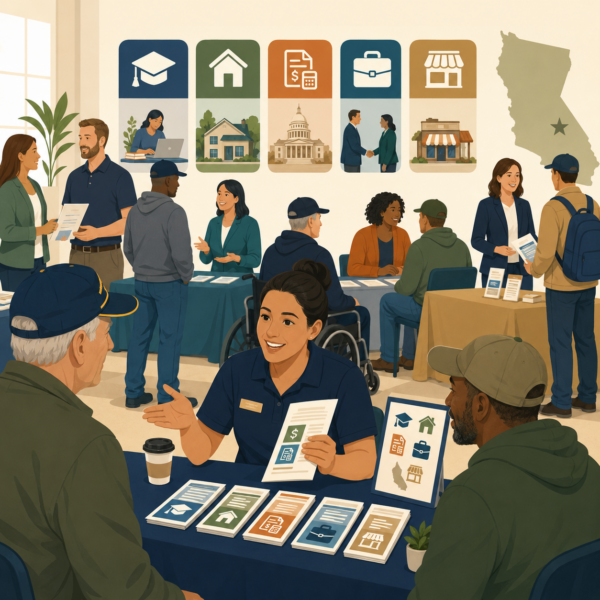 State veteran benefit programs represent a significant public investment in the wellbeing of veterans and their families. That investment delivers its greatest value only when eligible veterans know the programs exist, understand how they apply to their circumstances, and are able to access them with confidence. Communication is therefore not simply a supporting function. It is the mechanism that connects state-funded programs with the veterans they were created to serve. Without an effective communication system, even well-designed benefit programs can remain underutilized, limiting the impact of the state’s investment.
Building and sustaining that communication system requires the same level of strategic planning and operational discipline that agencies apply to program administration. Effective benefit communication depends on maintaining accurate benefit inventories, developing audience-centered messaging, coordinating communication across county veterans service offices and community partners, producing accessible guidance in multiple formats, and continuously evaluating whether communication efforts are improving benefit awareness and utilization. Agencies that approach communication as an ongoing organizational capability, rather than a series of individual outreach activities, are better positioned to maximize the public value of the benefits they administer.
Because developing and maintaining these capabilities requires specialized communication expertise, many state departments choose to partner with external communication specialists such as Stegmeier Consulting Group (SCG). External partners can provide expertise in communication strategy, audience research, plain-language content development, distribution planning, communication governance, and performance measurement while complementing the agency’s deep knowledge of veterans’ programs and services.
SCG works with state departments of military and veterans affairs to develop communication systems that are comprehensive, accurate, and designed around the veteran’s experience of seeking and accessing benefits. Support may include developing and maintaining benefits inventories, creating plain-language guides for diverse veteran audiences, designing multi-channel distribution strategies, strengthening coordination with county veterans service offices and community partners, communicating the relationship between state and federal benefits, and establishing measurement frameworks that evaluate communication effectiveness through awareness, engagement, and benefit utilization outcomes.
Beyond individual communication initiatives, SCG helps agencies establish communication standards, governance practices, and repeatable processes that strengthen consistency across programs, publications, websites, outreach campaigns, and partner networks. This systems-based approach enables agencies to adapt communication as policies evolve while maintaining a reliable and coordinated experience for veterans seeking information and services.
The goal is to build a communication system that consistently connects eligible veterans with the benefits available to them, transforms public investment into meaningful public impact, and helps ensure that state-funded programs achieve the outcomes they were created to deliver for veterans and their families.
Future Trends in State Veterans Benefit Communication
The state veteran benefits landscape is evolving in ways that will shape the communication challenges and opportunities for state Departments of Military and Veterans Affairs over the coming years. Several trends deserve sustained attention from agencies planning their long-term communication strategies and building the communication infrastructure that will need to serve veterans through the changes those trends bring.
Legislative expansion of state veteran benefits is a consistent trend across most states, driven by growing recognition of the unique challenges veterans face in the civilian transition and by increased legislative attention to veterans issues at the state level. The PACT Act’s expansion of federal disability compensation eligibility is producing downstream effects on state benefits in states where state benefit eligibility is tied to federal disability rating levels, creating new cohorts of veterans who qualify for state benefits they did not previously qualify for and requiring rapid communication updates to reach veterans whose eligibility has changed. Agencies that have built communication infrastructure capable of rapid update and distribution when program eligibility changes will be positioned to serve these new cohorts quickly. Agencies that rely on slow update cycles will fail to reach newly eligible veterans during the period when their motivation to access benefits is highest.
Demographic shifts in the veteran population are creating new communication priorities. The growing population of post-9/11 veterans, who have different service histories, different health profiles, and different benefit needs than earlier veteran cohorts, is entering peak benefit-seeking years and will increasingly dominate the eligible population for state benefit programs. The growing proportion of women veterans is creating pressure on state veteran benefit programs and communication to address women veterans’ specific circumstances and needs more directly than historical communications have done. Veterans from communities with historically limited engagement with federal and state benefit systems require communication strategies that are culturally competent and that are delivered through channels trusted in those specific communities.
Digital integration of state benefit navigation is an emerging opportunity that several states are pursuing through the development of veteran benefit portal platforms. These platforms offer veterans a single digital entry point for discovering and accessing state benefits, with eligibility screening tools that help veterans identify which programs they likely qualify for based on their service history and personal circumstances. The development of these platforms requires the accurate, comprehensive benefits inventory that this article has identified as the foundation of all effective state benefit communication, and agencies that have invested in maintaining that inventory are simultaneously building the content infrastructure that digital integration platforms require. Agencies that have not made this investment will find digital integration impossible to implement accurately regardless of the quality of the technical platform they develop.
Artificial intelligence tools are beginning to be applied to veterans benefit navigation in ways that could significantly improve the efficiency with which veterans identify and access relevant state programs. AI-powered eligibility screening tools, conversational interfaces that answer specific veteran questions about state benefits, and personalized benefit summaries generated from veteran-provided information about their service history and personal circumstances represent emerging capabilities that could substantially reduce the awareness gap for state benefits. These tools depend on accurate, current, and comprehensive benefit information, and agencies that invest in maintaining that information foundation are simultaneously preparing for the adoption of AI-assisted communication tools that will extend their communication reach in ways that are not possible with current staff-dependent communication approaches.
Conclusion
The benefits a state offers its veterans are the expression of what that state owes to the people who served from it. Each property tax exemption, each tuition benefit, each employment preference point, and each state veterans home bed represents a decision made by a state legislature to invest in the people who answered the call to service. The communication of those benefits, the work of ensuring that veterans know what their state has provided and how to access it, is the final stage of fulfilling that investment.
State Departments of Military and Veterans Affairs that build the communication infrastructure described in this article are not simply improving their public information function. They are completing the commitment the state made when it created these programs: the commitment that the benefits would not merely exist but would actually reach the veterans they were designed to serve. That commitment is a communication responsibility, and it belongs to the agencies whose mission is veterans service. The veterans who earned these benefits deserve to know about them. Providing that knowledge is the work this article has described, and it is the work that every state veterans agency with a serious commitment to its mission must be doing.
SCG’s Strategic Approach to Communication Systems
Stegmeier Consulting Group’s approach to state veteran benefit communication reflects the foundational principle that has guided all of SCG’s communication work across the veterans services landscape: effective communication is not measured by what is produced and distributed but by what reaches veterans, is understood by veterans, and is acted upon by veterans in ways that improve their access to the benefits and services they have earned. For state benefit communication, that principle translates into a communication strategy built from the ground up around how veterans seek and use benefit information, what barriers prevent them from finding and acting on state benefit information, and what specific communication investments produce the greatest improvements in benefit access across the full range of the veteran population.
SCG brings structured methodology to every element of state benefit communication system development: benefits inventory development and maintenance processes, category-specific communication design, multi-channel distribution strategy with partner network development, federal and state interaction communication frameworks, comprehensive guide development in multiple formats, and measurement systems that track utilization outcomes rather than communication activity. The practical result of this structured approach is a communication system that serves veterans effectively rather than a communication system that produces communication output without demonstrated connection to the access improvements it is supposed to produce.
State veteran benefit programs represent some of the most underutilized public investments in veteran wellbeing available anywhere in the benefits system. The utilization gap between eligible and accessing veterans reflects a communication failure of significant scale, and closing that gap through strategic communication investment is among the most direct available contributions to the mission of serving veterans that state agencies were created to fulfill. SCG’s partnership with state veterans agencies on communication system development is a partnership in completing that mission through the communication infrastructure that makes benefit access real rather than merely available.
Use the form below to connect with our team and explore how strategic state benefit communication can help your agency increase awareness, improve benefit access, and connect more eligible veterans with the programs and services your state provides.