
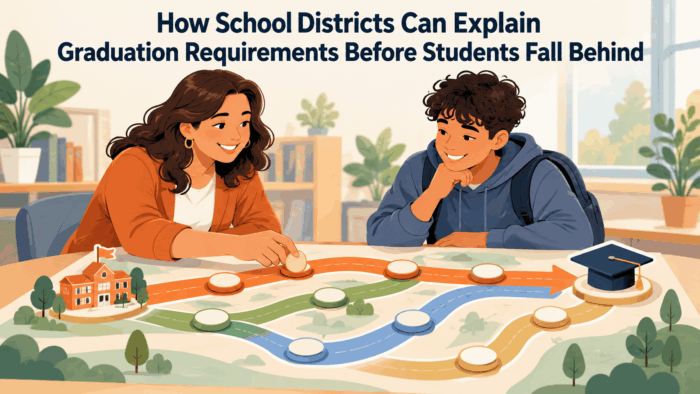
How School Districts Can Explain Graduation Requirements Before Students Fall Behind
Graduation from high school is one of the most consequential milestones in a young person’s life, and the requirements that govern it have grown more complex in many states and districts. Students may need to earn a specific number of credits distributed across subject areas, pass or participate in state assessments, complete particular courses such as a semester of financial literacy or civics, fulfill service learning or capstone requirements, demonstrate competency through alternative means, or choose among multiple diploma types and endorsements with different requirements. Some districts layer local requirements on top of state requirements, and requirements often change from one graduating class to the next as state policy evolves. For families, especially those who attended school in another state or country, navigating this landscape can be genuinely confusing, and for students, the consequences of misunderstanding it can be severe.
Too often, students and families learn that a student is off track for graduation only when it is difficult or impossible to recover. A senior discovers in the spring that a failed ninth grade course was never made up. A junior learns that a required assessment was not passed and the retake window has closed. A family assumes that a course taken at a previous school transferred, only to find that it counted as an elective rather than a core requirement. A student who planned to attend a university learns too late that the district diploma requirements and university admission requirements are not the same. Each of these situations represents a communication failure as much as an academic one, because the information that would have allowed the student to act earlier existed but did not reach the student and family in a usable form at the right time.
Clear, early, and continuous communication about graduation requirements can prevent many of these situations. When students and families understand requirements from the start of high school, or even earlier, they can plan courses intentionally, recognize problems as soon as they arise, and take advantage of recovery options while there is still time. When communication about graduation progress is regular, personalized, and easy to understand, families can partner with schools in keeping students on track. When counselors have tools and time to communicate proactively, they can catch problems early rather than spending senior year managing crises. Communication about graduation is therefore not only an informational service but a powerful prevention strategy.
This article examines how school districts can explain graduation requirements before students fall behind. It looks at why graduation communication often arrives too late, how to explain requirements in plain language, how to begin communication in middle school and at the start of high school, how to provide personalized progress information, how to communicate early warning signs and recovery options, how to support students who transfer or are new to the system, and how to connect graduation requirements to postsecondary plans. It also covers how to prepare counselors and teachers to communicate consistently and how to measure whether communication is helping more students stay on track. The goal is graduation communication that gives every student and family the information they need, early enough to make a difference.
Why Graduation Communication Often Arrives Too Late
 Most districts do communicate about graduation requirements. Requirements appear in course catalogs, student handbooks, websites, and counseling presentations, and transcripts show credits earned. Yet many students and families still feel surprised when a graduation problem surfaces. The issue is rarely the absence of information but rather its form, timing, and accessibility. Requirements are often presented as dense lists or tables written in technical language. Progress information is often buried in transcripts or online systems that families do not know how to read. Communication tends to intensify in junior and senior year, when options for recovery are narrower. Counselor caseloads frequently make proactive, individualized communication difficult. Understanding these patterns helps districts redesign communication so that it reaches families when it can still change outcomes rather than when it can only explain them. It also helps districts recognize that the families most affected by late communication are often those with the least familiarity with the system, which makes improving graduation communication an important equity strategy as well as an operational one.
Information That Exists but Is Not Usable
Graduation requirements are often published in formats that make sense to administrators but not to families. A typical requirements table might list credit totals by subject area, abbreviations for course categories, footnotes about exceptions, and references to state codes. Families who are not familiar with how high schools organize credits may not understand what a credit is, how many credits a typical course earns, or how a failed semester affects the total. Transcripts may use course codes and abbreviations that are unintelligible without explanation. Online student information systems may display graduation progress in ways that are accurate but confusing, such as percentages or color codes without explanation of what action is needed.
When information is technically available but practically unusable, families do not act on it. They may assume that the school is tracking progress and will tell them if something is wrong, which is a reasonable assumption but not always accurate in practice. Students, meanwhile, may focus on passing their current classes without understanding how those classes fit into the larger picture. Transforming existing information into formats that families can read, understand, and act on is one of the most effective improvements a district can make, and it often requires redesign rather than new information. In practice, this often means starting from the questions families actually ask, such as “Is my child on track?”, “What does my child still need?”, and “What happens if my child fails a class?”, and designing materials that answer those questions directly before presenting the full technical details.
Communication Concentrated in the Final Years
In many schools, intensive graduation communication begins in junior year, when students start thinking about college applications and counselors conduct credit checks, and intensifies in senior year, when graduation is imminent. By then, a student who failed courses in ninth or tenth grade may have limited time to recover, especially if they also need to complete current requirements. Ninth grade is widely recognized as the most important year for staying on track, since students who earn all of their credits in ninth grade are far more likely to graduate, yet communication about graduation in ninth grade is often minimal beyond an initial orientation.
Shifting the center of gravity of graduation communication earlier is therefore essential. Families of eighth and ninth grade students should receive clear explanations of requirements, an understanding of why ninth grade matters so much, and regular updates on progress. When problems arise in ninth or tenth grade, families should be informed immediately and given clear options, rather than learning about the cumulative effect years later. Earlier communication requires planning and resources, but it prevents far more costly interventions later. A student who recovers a single failed semester in the summer after ninth grade faces a far lighter burden than a senior trying to recover several courses while completing current requirements, and families who hear about problems early are far more likely to engage constructively than families who feel blindsided in the final year.
Limited Counselor Capacity
School counselors are central to graduation communication, but they often carry caseloads far above recommended levels and juggle responsibilities that include scheduling, testing coordination, college advising, social-emotional support, and crisis response. Under these conditions, individualized graduation communication tends to focus on students who are already in serious trouble or students whose families seek out the counselor. Students who are slipping quietly, and whose families are not connected to the school, may not receive attention until problems are severe.
Districts can address this challenge by building systems that support counselors rather than relying on individual effort alone. Automated but clear progress reports, early warning systems that flag students who fall behind, shared responsibility among advisors and teachers, and templates for outreach all help counselors communicate proactively with more students. When graduation communication is treated as a schoolwide system rather than the sole responsibility of counselors, more students receive timely information and support. Some schools assign every student to an advisor who meets with them regularly and serves as the first point of contact for families, with counselors focusing their time on students who need more intensive planning. This structure ensures that every student has an adult watching their progress, even when counselor caseloads are high.
Learning Together: Communication Strategies for K-12 School Districts and Public Education Agencies
This article is part of our series on strategic communication for K-12 School Districts and Public Education Agencies. To learn more and to see the parent article, which links to other content just like this, click the button below.
Explaining Requirements in Plain Language
The foundation of effective graduation communication is a clear, plain language explanation of what students must do to graduate. This explanation should be written for families with no prior knowledge of the system, including families who attended school in other countries, families who did not complete high school themselves, and families who speak languages other than English. It should explain not only what the requirements are but what they mean, why they matter, and how students typically meet them. A strong plain language explanation becomes the reference point for all other graduation communication, from orientation presentations to individual progress reports. When every material uses the same terms and the same explanations, families encounter a consistent picture of graduation across every channel, which reduces confusion and builds confidence that the information they are receiving is accurate.
Defining Credits, Courses, and Requirements
Many families are unfamiliar with the concept of credits as it applies to high school. Communication should explain what a credit is, how many credits a typical full-year or semester course earns, how many credits are needed to graduate, and how credits are distributed across subject areas such as English, mathematics, science, social studies, world languages, arts, physical education, and electives. It should explain what happens to credits if a student fails a course or a semester, and how credits are recovered. It should also explain any specific course requirements, such as particular mathematics levels or specific social studies courses, and any non-course requirements such as assessments, service hours, or capstone projects.
Using examples makes these concepts concrete. A sample four-year plan showing how a typical student meets all requirements, with notes explaining each element, helps families visualize the path. A simple explanation that failing one semester of ninth grade English means the student must recover that half credit, along with an explanation of how that is done, helps families understand the consequences of individual grades. Visual tools such as checklists, progress bars, and color-coded charts can make requirements easier to grasp than tables of numbers. Short videos explaining how credits work, recorded in the languages families speak and featuring counselors or students rather than scripted narration, can be especially helpful for families who prefer to learn by listening or who find written materials difficult. Families who understand the basic mechanics of credits are far better equipped to interpret every later progress report.
Explaining Diploma Types, Endorsements, and Assessments
In districts and states that offer multiple diploma types, endorsements, or seals, communication should explain the differences clearly, including what each requires, what benefits each offers, and how each relates to college admission and career opportunities. Families should understand that choosing a particular diploma path may affect course selection in ninth grade, and that some options require early planning. Similarly, if state assessments or alternative demonstrations of competency are part of graduation requirements, communication should explain which assessments are required, when they are taken, what scores or performance levels are needed, how many retake opportunities exist, and what alternatives are available for students who do not pass.
These explanations should acknowledge changes over time. When requirements differ by graduating class, communication should clearly identify which requirements apply to which students, since families with children in different grades may otherwise be confused. When requirements change, districts should communicate the changes promptly, explain how they affect current students, and provide updated plans. Clear communication about changes prevents families from relying on outdated information from older siblings or friends. When a change affects students already in high school, such as a new course requirement added midway through a graduating class, districts should contact affected families directly, explain exactly what is different for their child, and provide a revised plan rather than expecting families to discover the change on a website.
Starting Early: Middle School and the Ninth Grade Transition
Graduation communication should begin before students enter high school. Decisions made in middle school, such as mathematics placement and world language courses, can affect high school options, and the transition to ninth grade is one of the most critical periods for staying on track. Families who understand graduation requirements before their child enters high school can help their child plan, recognize the importance of ninth grade, and engage with counselors from the start. Early communication also builds relationships between families and high school staff that make later conversations easier. A family that has already met their child’s counselor in eighth grade is far more likely to call with a question in ninth grade, and far more receptive when the counselor calls about a concern, than a family whose first contact with the counselor comes in the middle of a problem.
Preparing Eighth Grade Families
Eighth grade families should receive a clear introduction to high school graduation requirements, ideally through a combination of written materials, a family information session, and a meeting with a counselor or advisor. This introduction should explain how credits work, what courses ninth graders typically take, how middle school courses affect high school placement, and why ninth grade is so important. It should also introduce the supports available to help students stay on track, such as tutoring, advisory programs, and mentoring.
Coordinating communication between middle and high schools ensures consistency. High school counselors can visit middle schools, middle school counselors can share accurate information about high school requirements, and joint events can bring families and students together with high school staff. Translated materials, interpretation at events, and outreach through community partners help reach families who might not otherwise engage. Districts can also provide a simple take-home checklist for eighth grade families, summarizing what to expect in ninth grade, key requirements, important dates, and who to contact, so that families have a concrete reference after the information session ends.
Emphasizing the Importance of Ninth Grade
Research consistently shows that ninth grade is a pivotal year. Students who pass all of their ninth grade courses and earn all of their credits are much more likely to graduate on time than students who fall behind. Yet many students and families treat ninth grade as a warm-up year. Communication should make the importance of ninth grade explicit, explaining that each course passed is a building block toward graduation and that falling behind early makes graduation harder. This message should be delivered in an encouraging rather than threatening tone, emphasizing that ninth grade is an opportunity to build a strong foundation.
Ongoing communication during ninth grade should keep families informed about progress, attendance, and grades, with early outreach when students begin to struggle. Ninth grade advisory programs, on-track indicators, and regular family updates can help catch problems early. When families understand that ninth grade matters, they are more likely to monitor progress and respond quickly to concerns. Some districts send ninth grade families a brief update every few weeks during the first semester, summarizing grades, attendance, and any missing work, with a clear note about whether the student is on track. This frequent, simple communication catches problems early, when a phone call and a few weeks of support can still change the outcome.
Providing Personalized Progress Information
General explanations of graduation requirements are necessary but not sufficient. Families need to know how their own child is progressing toward graduation, what requirements remain, and whether there are any problems. Personalized progress information, delivered regularly and in an understandable format, turns general requirements into actionable insight. It allows families to see exactly where their child stands and to take action if needed. Many districts have the data needed to produce personalized progress reports but do not present it in ways families can use. The challenge is often one of design rather than data. The same information that appears in an unreadable transcript can be transformed into a clear, friendly summary with modest effort, and the payoff in family understanding is substantial.
Designing Clear Progress Reports
A personalized graduation progress report should show, in simple terms, which requirements the student has met, which are in progress, and which remain. It might list each subject area with credits earned and credits needed, indicate whether required assessments have been passed, and note any non-course requirements completed. A clear summary at the top should state whether the student is on track, and if not, what needs to happen. Visual elements, such as checkmarks, progress bars, and simple color coding with explanations, make the report easy to read.
The report should also include next steps and contacts. If a student is on track, the report can encourage continued progress and highlight upcoming decisions, such as course selection. If a student is off track, the report should explain the specific issue, the options for recovery, and the name and contact information of the staff member who will help. Reports should be available in the languages families speak and delivered through multiple channels, including mail, online portals, and conferences. Before introducing a new report design districtwide, districts should test it with a small group of families, including families new to the system and families who speak languages other than English, to confirm that they can read it correctly and know what to do next.
Regular Timing and Conversations
Progress reports should be shared at regular intervals, such as at the end of each semester, and at key decision points, such as before course selection. Regularity helps families develop a habit of reviewing progress and normalizes conversations about graduation. Reports should be paired with opportunities to discuss them, such as conferences, advisory meetings, or counselor appointments. For students who are off track, a personal conversation should accompany the report, explaining the situation and developing a plan together.
Annual graduation planning meetings, in which students, families, and counselors review progress and plan the coming year, can be particularly valuable. These meetings allow families to ask questions, understand options, and participate in decisions. Even brief meetings can significantly improve families’ understanding and engagement. Planning meetings also give students practice in taking ownership of their own progress. When students explain their plan to their families and counselors, they develop a clearer understanding of what they need to do and greater commitment to doing it.
Communicating Early Warning Signs and Recovery Options
 When students begin to fall behind, timely communication can make the difference between a quick recovery and a crisis. Early warning systems that track attendance, behavior, and course performance can identify students at risk of falling off track, but these systems are only effective if they trigger communication with students and families. Communication should explain the concern clearly, present recovery options, and invite families into a plan. It should be supportive and solution-focused, emphasizing that recovery is possible. The tone of early warning communication strongly influences how families respond. Families who hear that the school has noticed a concern and wants to work together to address it are far more likely to engage than families who receive a notice that their child is at risk of not graduating, even when the underlying information is the same.
Acting on Early Warning Indicators
Early warning indicators such as course failures, low grades, chronic absence, and behavior incidents in ninth grade are strong predictors of graduation risk. When a student is flagged, schools should reach out to the family promptly, ideally through a personal call or meeting. The conversation should explain what the school has noticed, why it matters for graduation, and what support is available. It should also invite the family to share what they know about the student’s situation, since barriers outside school often contribute to academic struggles.
Communication should be coordinated among teachers, counselors, and support staff so that families receive a consistent message and a clear plan. A designated point of contact helps families know whom to call with questions. Follow-up communication should track progress and adjust the plan as needed. Documenting each contact and the agreed plan in a shared system allows any staff member to see what has been communicated, which prevents families from receiving contradictory messages and ensures continuity if a staff member changes roles or a student changes schedules.
Explaining Recovery Options Clearly
Students who have fallen behind need to understand their options for recovering credits or meeting requirements. Options may include credit recovery courses, summer school, online learning, grade replacement policies, independent study, alternative programs, and assessment retakes. Communication should explain each option in plain language, including how it works, how long it takes, whether there are costs, how it appears on the transcript, and how to enroll. Families should also understand any deadlines or limits, such as the number of credits that can be recovered through certain programs.
Recovery communication should emphasize hope and possibility. Students who are behind may feel discouraged and may consider dropping out. Messages that show a realistic path to graduation, along with support to follow it, can restore motivation. Celebrating progress during recovery reinforces effort and helps students stay engaged. Families should also know how recovered credits appear on transcripts and how they are viewed by colleges and employers, since uncertainty about these questions can make families hesitant to choose particular recovery options. Clear answers allow families to choose the option that best fits their child’s goals.
Supporting Transfer Students and Families New to the System
Students who transfer between schools, districts, states, or countries face particular risks in meeting graduation requirements. Courses taken elsewhere may not align with local requirements, credits may transfer differently than expected, and families may not understand how the new system works. Families new to the country may be unfamiliar with high school credits and diplomas altogether. Clear, proactive communication with these families is essential to preventing surprises and ensuring that students can graduate on time.
Clear Credit Evaluation and Explanation
When a student transfers, the school should evaluate prior coursework promptly and communicate the results clearly to the family. Communication should explain which courses were accepted, how they count toward requirements, which requirements remain, and how the student can complete them. If courses do not transfer as expected, the family should understand why and what options exist. For students from other countries, schools should explain how foreign transcripts are evaluated and what documentation may help.
A meeting with a counselor soon after enrollment allows the family to ask questions and develop a graduation plan. Translated materials and interpreters ensure that families fully understand the evaluation and plan. Follow-up communication should confirm progress and address any issues. Schools should also explain how families can request a review if they believe a course was evaluated incorrectly, and what documentation might support a different decision. Families who understand that they can ask questions about credit evaluation are more likely to raise concerns early, when corrections are easiest.
Orientation for Families New to the System
Families new to the country or unfamiliar with high school systems benefit from orientation that explains how high school works, including credits, grading, graduation requirements, and the role of counselors. Orientation can be offered through newcomer programs, family workshops, or individual meetings, in the languages families speak. Community partners and family liaisons can help families understand and navigate the system. Orientation should explain not only rules but also expectations that may be unfamiliar, such as the role of homework in grades, the importance of attendance for credit, how to communicate with teachers, and how families can monitor progress online or by phone.
Students who arrive late in high school may face significant challenges in meeting requirements on time. Communication should explain all available options, including extended timelines, alternative programs, and pathways for older students, so families can make informed decisions without feeling that graduation is out of reach. For older students who also need to work or support their families, flexible programs such as evening classes, independent study, or programs designed for newcomer youth may make graduation achievable, and clear communication about these options can prevent students from leaving school because they believe there is no realistic path forward.
Connecting Graduation Requirements to Postsecondary Plans
Graduation requirements are the minimum for earning a diploma, but many students have goals that require more, such as admission to a university, eligibility for certain scholarships, entry into apprenticeship programs, or enlistment in the military. Families often assume that meeting graduation requirements means a student is prepared for any postsecondary path, which is not always the case. Communication should explain the relationship between graduation requirements and postsecondary requirements so that students can plan accordingly. This is particularly important for first-generation college students, whose families may reasonably assume that a diploma is all that is needed for university admission and who may not learn otherwise until application season.
Explaining the Gap Between Diploma and Admission Requirements
Communication should clearly explain how graduation requirements compare with admission requirements for public universities, community colleges, and other postsecondary options in the state. For example, a university may require more years of mathematics, specific laboratory sciences, or world language courses than the district requires for graduation. Families should understand these differences early, ideally in eighth or ninth grade, so students can choose courses that keep their options open.
Side-by-side comparisons of graduation requirements and common admission requirements are particularly helpful. Counselors can use these comparisons in planning meetings to help students choose courses aligned with their goals. Communication should emphasize that keeping options open early is easier than catching up later. Families should also understand that admission requirements may change and that students should confirm current requirements with the institutions they are considering. Counselors can help families find and interpret this information, particularly for families who are navigating college admission for the first time.
Linking Requirements to Career Pathways
For students interested in careers that do not require a four-year degree, communication can show how graduation requirements connect to career and technical education pathways, industry credentials, apprenticeships, and community college programs. Students should understand which courses and experiences will prepare them for their chosen path, and families should understand the value of these options. Connecting graduation requirements to concrete goals helps students see the purpose of their coursework and stay motivated. Students considering military service, for example, should understand how diploma type and assessment scores may affect enlistment options, and students interested in apprenticeships should know which courses and credentials apprenticeship programs value. Concrete connections like these turn abstract requirements into steps toward a goal the student cares about.
Preparing Staff and Measuring Results
Effective graduation communication depends on staff who understand requirements thoroughly, communicate consistently, and share responsibility for keeping students on track. It also depends on measurement that shows whether communication is reaching families early and helping students stay on track. Investing in staff preparation and measurement turns graduation communication into a reliable system rather than a collection of individual efforts.
Training and Shared Responsibility
Counselors, advisors, and teachers should receive regular training on graduation requirements, especially when requirements change. Shared reference guides and templates help ensure consistent messages. Advisory programs that assign every student to a staff member who monitors progress and communicates with families can extend counselors’ reach. Teachers can reinforce graduation messages by explaining how their courses fit into requirements and by reaching out early when students struggle.
Clear protocols for communication, such as when to contact families about early warning signs and who is responsible for follow-up, ensure that no student falls through the cracks. Regular team meetings to review on-track data help staff coordinate outreach. These meetings work best when they focus on specific students and specific actions, such as who will call which family and what support will be offered, rather than general discussion of trends. Assigning follow-up responsibilities and reviewing them at the next meeting keeps communication moving.
Measuring Whether Communication Keeps Students on Track
Useful indicators include ninth grade on-track rates, the share of students who receive personalized progress reports and planning meetings, the timeliness of outreach after early warning indicators, participation in recovery options, and on-time graduation rates by student group. Family surveys can ask whether families understand graduation requirements, know their child’s progress, and feel informed early enough to act. Comparing results before and after communication changes helps identify effective practices.
Districts should share what they learn and adjust communication accordingly. Publicly reporting on-track and graduation rates, along with strategies for improvement, demonstrates accountability and invites partnership. Feedback from counselors and advisors about which tools and templates are most useful, and where families still seem confused, should also inform each year’s improvements, ensuring that the communication system evolves with the needs of students and staff.
How Graduation Communication Compares With Other Agency Types
Many public agencies communicate about requirements that must be met over time to achieve a goal. Licensing boards communicate about education, examination, and experience requirements. Benefits agencies communicate about eligibility criteria and renewal deadlines. Higher education institutions communicate about degree requirements through degree audits and advising. These organizations have learned that clear checklists, personalized progress tracking, early alerts, and proactive advising help people meet requirements and avoid costly surprises. Universities, for example, have widely adopted degree audit tools that show students exactly which requirements remain, and many have paired these tools with proactive advising for students who fall behind. School districts can adapt these practices to graduation communication. Licensing boards offer another useful model, since many now provide applicants with online dashboards showing exactly which requirements are complete and which remain, along with clear instructions for each missing item.
High school graduation communication differs in important ways. It involves adolescents and their families, whose understanding of the system varies widely. It unfolds over four or more years during a period of significant personal development. The consequences of missing requirements are particularly serious, since a high school diploma is a gateway to nearly all further education and many jobs. And schools have daily contact with students, which provides unique opportunities for early identification and support. These factors make proactive, family-centered graduation communication both essential and achievable. Schools also have the ability to intervene directly, by adjusting schedules, providing tutoring, or offering recovery courses, which means that good communication can be paired immediately with concrete help in a way that few other agencies can match.
Tying It All Together
Graduation communication is not a side function. It determines whether students and families understand what is required to earn a diploma, recognize problems early, and take action while there is still time. Without effective communication, students can fall behind quietly and discover the consequences too late. Because graduation affects nearly every opportunity that follows high school, communication about it deserves the same planning and attention that districts give to instruction, scheduling, and assessment.
Effective districts recognize why graduation communication often arrives too late: information that is technically available but not usable, communication concentrated in the final years, and limited counselor capacity. They redesign communication to address each of these barriers.
They explain requirements in plain language, defining credits, courses, diploma types, and assessments, and they communicate clearly when requirements change. They start early, preparing eighth grade families and emphasizing the importance of ninth grade.
They provide personalized progress reports at regular intervals, paired with conversations and planning meetings. They act promptly on early warning indicators and explain recovery options clearly and hopefully.
They support transfer students and families new to the system with clear credit evaluation and orientation. They connect graduation requirements to postsecondary plans, explaining the gap between diploma and admission requirements and linking requirements to career pathways.
Finally, they prepare staff to communicate consistently and measure whether communication keeps students on track. Taken together, these practices give every student and family the information they need, early enough to make a difference.
Strategic Communication Support for Graduation Communication
 Graduation depends on students understanding the requirements they must meet, recognizing potential setbacks early, and knowing where to turn when they need help. Yet credit totals, course requirements, assessment rules, and recovery options can be difficult for students and families to interpret, particularly when information is spread across reports, portals, and conversations with different school staff. Because improving graduation communication requires coordinated planning and sustained attention beyond counselors’ existing responsibilities, districts often partner with Strategic Communication Support (SCG) to make graduation expectations easier to understand and act upon. SCG helps districts build communication practices that connect academic progress information with timely guidance and practical next steps.
SCG supports districts in reviewing graduation materials and identifying where requirements, deadlines, or credit information may be unclear. This can include rewriting policy explanations in plain language, developing personalized progress reports, and organizing information so students and families can see which requirements have been completed and what remains outstanding. Clear reporting helps families recognize potential concerns before they become urgent and gives students a more concrete understanding of their path to graduation.
Communication becomes particularly important when students fall behind their expected progress. SCG helps districts establish early outreach protocols, prepare templates for credit-status notifications, and develop planning resources that guide conversations about recovery options and available support. Staff training can help counselors, teachers, and advisors explain difficult information without creating unnecessary alarm, engage families in realistic planning, and communicate consistently across schools. Additional guidance for transfer students and newcomer families can help clarify how previous coursework, credit evaluations, and local graduation requirements fit together.
When graduation policies change, districts introduce new student information systems, or on-time graduation gaps persist, families need reliable explanations of both the requirements and the steps available to students who need additional support. SCG helps districts coordinate communication across departments, align early warning messages with appropriate interventions, and prepare materials that explain changes before they affect students’ academic plans. This approach makes graduation communication a continuing part of student support rather than a series of reminders issued near the end of high school.
SCG also helps districts assess whether students and families understand graduation requirements and can use progress information to make informed decisions. Family surveys, student feedback, on-track indicators, and completion patterns across student groups can reveal where communication needs to be clearer or where additional outreach may be necessary. By translating these findings into regular updates to reporting tools, staff practices, and family guidance, districts can strengthen graduation planning and make improvements that benefit successive graduating classes.
Future Trends
Many states are revising graduation requirements to include competency-based options, career readiness indicators, and multiple pathways. Communication will need to explain these options clearly and help families understand how to choose among them. Multiple pathways can expand opportunity, but they also increase complexity, and families who do not understand the differences may make choices that limit their child’s options without realizing it.
Student information systems increasingly offer graduation tracking tools similar to university degree audits. Districts will need to ensure that these tools are designed for families, not just staff, and that families know how to use them. Short tutorials, translated interfaces, and opportunities to review the tool with a counselor during conferences can help families become comfortable using these systems to track progress on their own.
Early warning systems are becoming more sophisticated and more widely used. Communication protocols will need to keep pace so that early identification leads to early, supportive outreach. As these systems flag more students earlier, schools will need clear guidance on who contacts families, what they say, and how quickly, so that better data translates into better conversations rather than a growing list of students no one has time to call.
Attention to ninth grade success is growing, with more districts adopting ninth grade on-track initiatives. These initiatives will place communication with ninth grade families at the center of graduation strategies. Expect more districts to adopt frequent, simple progress updates for ninth grade families, ninth grade success teams that coordinate outreach, and family orientation programs that continue throughout the first year of high school rather than ending after a single summer event.
Finally, increasing numbers of students are pursuing dual enrollment, career credentials, and alternative pathways. Communication will need to show how these options fit with graduation requirements and postsecondary goals. Families will want to know, for example, whether a dual enrollment course satisfies a high school requirement, how a career credential appears on a transcript, and whether alternative pathways affect eligibility for particular colleges or programs, and districts that answer these questions clearly will help students take full advantage of new options.
Conclusion
Every student who falls behind on graduation requirements without knowing it represents a missed opportunity for communication. The information needed to prevent these situations usually exists. The challenge is delivering it in a usable form, at the right time, to every family. Meeting that challenge does not require new graduation policies. It requires a deliberate commitment to clarity, timing, and reach, so that the information districts already have becomes information families can actually use.
Districts that explain requirements plainly, start early, provide personalized progress information, act on early warning signs, support transfer and newcomer families, connect requirements to postsecondary goals, and prepare staff can help far more students stay on track.
When students and families understand the path to graduation from the beginning, graduation becomes a shared goal they can work toward with confidence rather than a deadline that arrives with surprises. That shift benefits everyone. Students feel more in control of their own futures, families feel like genuine partners, counselors spend less time managing crises, and districts see more students cross the stage on time.
Stegmeier Consulting Group’s Strategic Approach to Communication Systems
Give every student a clear path to graduation from the very first day of high school.
Stegmeier Consulting Group helps school districts explain graduation requirements clearly and early enough for students and families to act. We begin by examining how families currently learn about requirements and progress, where communication arrives too late, and where information is available but not usable.
Our team works alongside counselors, administrators, and data teams to rewrite requirements in plain language, design personalized progress reports, and develop communication protocols for early warning and recovery. We create materials for middle school families, ninth grade families, transfer students, and newcomer families, and we help districts connect graduation requirements to postsecondary plans.
We treat graduation communication as a system that spans middle school through senior year. That means aligning messages across schools, supporting counselors with tools and templates, and building measurement that shows whether communication keeps students on track.
Use the form below to connect with our team and explore how strategic graduation communication can help your district make requirements clear from the first year of high school, identify students early, and keep every student on track before they fall behind.