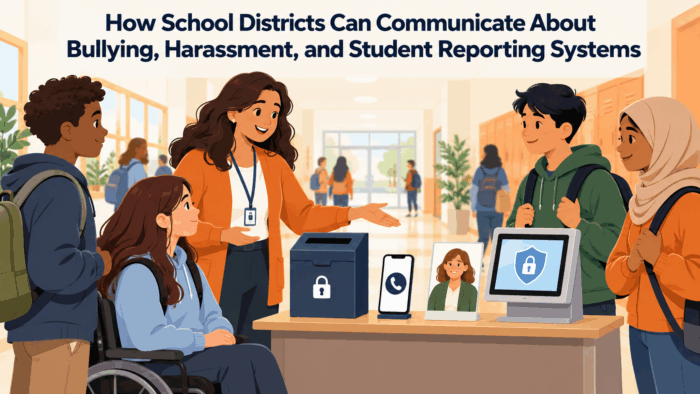
How School Districts Can Communicate About Bullying, Harassment, and Student Reporting Systems
Few school issues generate as much worry, frustration, and loss of trust as bullying and harassment. For students, being targeted by peers can affect sleep, concentration, attendance, friendships, and sense of safety, and the effects can last long after the behavior stops. For families, learning that their child has been hurt at school, or that their child has been accused of hurting someone else, is among the most stressful experiences they will have with a school system. For schools, these situations involve competing obligations: protecting students, investigating fairly, respecting the privacy of everyone involved, following legal requirements, and maintaining a positive climate for the whole school community. Every one of these obligations depends heavily on communication, and many of the conflicts that arise around bullying are, at their root, failures of communication rather than failures of intent.
Families frequently report that they reported a problem and never heard back, that they were told the school was looking into it with no further explanation, or that they could not get a straight answer about what happened or what was being done. Students often say they did not report because they did not know how, did not think anything would happen, or feared that reporting would make things worse. Staff, meanwhile, may feel constrained by privacy laws that prevent them from sharing information about other students, and they may be unsure how much they are allowed to tell a worried parent. When these perspectives collide, families can conclude that the school is indifferent or covering up problems, even when staff are working hard to address the situation behind the scenes. The resulting loss of trust can spread quickly through a community, particularly when frustrated families turn to social media.
Clear communication cannot prevent every incident, but it can change how students and families experience the process of reporting and response. When students understand what bullying and harassment are, know several easy ways to report, and trust that adults will respond, they are more likely to speak up early, before situations escalate. When families understand how reports are handled, what timelines to expect, what information can and cannot be shared, and how their child will be supported, they are better able to work with the school as partners. When the broader community sees that the district takes bullying seriously and communicates openly about prevention and climate, confidence in the school system grows. Communication is therefore not an afterthought to bullying policy. It is one of the primary ways that policy becomes real in the lives of students and families.
This article examines how school districts can communicate about bullying, harassment, and student reporting systems in ways that build trust. It looks at why bullying communication is so difficult, how to explain definitions and policies clearly, and how to design reporting systems students and families will actually use. It covers communication during investigations, communication about outcomes, support, and follow-through, and how to prepare staff to respond consistently. It also explores how to engage students, families, and the community in prevention and how to measure whether communication is working. The goal is a reporting and response system that students trust enough to use and families trust enough to support.
Why Bullying Communication Is So Difficult
 Bullying and harassment communication sits at the intersection of strong emotions, complex legal requirements, and genuine uncertainty about facts. Families who believe their child has been harmed want swift action and full information. Families whose child has been accused want fairness and protection of their child’s privacy and reputation. Students may give conflicting accounts, and some incidents occur online or off campus, where the school’s authority and knowledge are limited. Staff must follow district policy, state anti-bullying laws, and federal civil rights requirements, each with its own definitions and procedures. All of this happens under time pressure and often under public scrutiny. Recognizing these tensions is the first step toward communication that acknowledges them honestly rather than leaving families to discover them in the middle of a stressful situation.
Families Arrive Worried, Angry, or Afraid
Families rarely contact the school about bullying in a calm moment. A parent may have just learned that their child has been excluded, mocked, threatened, or physically hurt for weeks, and they may feel guilty for not noticing sooner. They may be angry that the school did not stop the behavior and afraid that their child is not safe returning the next day. Some families have had previous reports that they felt went nowhere, which intensifies their frustration. Others are reluctant to report at all, fearing retaliation against their child or doubting that the school will take them seriously. Communication that does not acknowledge these emotions, such as a brief form response or an immediate recitation of policy, can make families feel dismissed even when the school intends to act.
Families of students accused of bullying experience their own distress. They may believe the accusation is unfair, exaggerated, or one-sided, or they may be shocked to learn about their child’s behavior. They may worry about discipline, about their child’s reputation, and about whether their child is also being treated badly by others. Effective communication must take both sets of families seriously, explaining the process clearly, treating each family with respect, and avoiding language that prejudges the outcome. Schools that prepare staff for these emotional conversations, and that design communication to acknowledge feelings while providing clear information, are better able to keep families engaged as partners rather than adversaries.
Confusion About What Counts as Bullying
The word bullying is used very differently by students, families, staff, and laws. In everyday language, families may describe any unkind behavior, single conflict, or mutual argument as bullying. Most state laws and district policies define bullying more narrowly, often as repeated or severe behavior involving an imbalance of power that causes harm, while harassment based on protected characteristics such as race, national origin, sex, disability, or religion triggers additional obligations under civil rights laws. Some behavior may not meet the definition of bullying but still violates the student code of conduct, and some behavior may constitute harassment even if it happened only once. When these distinctions are not explained, families may feel that the school is minimizing their concerns when it says an incident does not meet the definition of bullying.
This confusion often becomes a source of conflict. A parent who reports bullying and is told that the behavior is a peer conflict may hear that the school does not believe their child or does not care. A school that labels every conflict as bullying may lose credibility and dilute attention from serious cases. Communication that explains definitions clearly, and that makes clear that the school will respond to hurtful behavior whether or not it meets a formal definition, helps avoid this trap. Families need to know that the label assigned to a situation affects which procedures apply, but that it does not determine whether their child’s experience matters or whether the school will help. Getting this message across is one of the most important tasks in bullying communication.
Privacy Limits That Families Do Not Expect
Federal and state privacy laws generally limit what schools can share about other students, including the details of discipline imposed on a student who harmed someone. Many families do not know this. A parent whose child was hurt naturally wants to know what consequences the other student received, and when the school says it cannot share that information, the parent may conclude that nothing happened. Staff may compound the problem by giving vague answers rather than explaining the legal reasons for the limits. In some harassment cases, civil rights rules allow or require schools to share certain information with the reporting student and family, such as outcomes that directly relate to them, which adds further complexity that staff must understand accurately.
Explaining privacy limits early, clearly, and empathetically can prevent much of the frustration that arises later. Families are far more accepting of limits when they understand that the same rules protect their own child’s information, and when the school is clear about what it can share, such as the fact that the investigation is complete, that the school took action consistent with its policy, and what steps are being taken to protect their child. Communicating these limits in writing at the start of the process, rather than only when a family asks about consequences, sets expectations and demonstrates transparency. It also helps staff respond consistently, so that families at different schools receive the same accurate explanation.
Learning Together: Communication Strategies for K-12 School Districts and Public Education Agencies
This article is part of our series on strategic communication for K-12 School Districts and Public Education Agencies. To learn more and to see the parent article, which links to other content just like this, click the button below.
Explaining Definitions, Policies, and Expectations Clearly
Students and families cannot use a reporting system well if they do not understand what behavior the school considers unacceptable, what the school will do when it learns about such behavior, and what rights and responsibilities everyone has. District anti-bullying and anti-harassment policies are usually written for legal and administrative audiences and are long, technical, and difficult to apply to real situations. Plain language summaries, examples, and age-appropriate explanations translate policy into something students and families can understand and use. This foundational communication should be shared proactively at the start of each year, reinforced throughout the year, and made easy to find at the moment a family needs it, rather than discovered only after an incident has occurred.
Plain Language Definitions With Examples
A plain language explanation of bullying and harassment should describe the key elements in simple terms and illustrate them with realistic examples. For bullying, that might mean explaining that it involves hurtful behavior that is usually repeated, that happens on purpose, and where the student doing it has more power, whether through size, popularity, numbers, or access to private information. Examples might include repeated name-calling, spreading rumors, deliberately excluding a student from a group, threats, physical aggression, or sharing embarrassing images online. For harassment, the explanation should note that unwelcome conduct based on race, color, national origin, sex, sexual orientation, gender identity, disability, religion, or other protected characteristics is prohibited, and that even a single serious incident may qualify. The explanation should also describe peer conflict, where students of similar power disagree or argue, and make clear that the school helps with conflicts too.
Age-appropriate versions are essential. Young children understand concepts like “being mean on purpose again and again” and “telling a grown-up when someone hurts you” far better than formal definitions. Middle and high school students benefit from discussion of online behavior, group dynamics, and the role of bystanders. Families benefit from a version that explains how definitions affect the process while reassuring them that the school will respond to any hurtful behavior. All versions should be translated into the languages families speak and should be consistent with one another, so that students and families share a common understanding. Including these explanations in student handbooks, classroom lessons, family orientation, and the district website ensures they reach everyone.
Summarizing the Process Before It Is Needed
Families and students should know, before any incident occurs, what happens after a report is made. A one-page process summary might explain how to report, who receives the report, how quickly the school will acknowledge it, how the school investigates, how long investigations typically take, what information families will receive and when, how students will be supported and protected during the process, what kinds of responses the school may take, and how families can appeal or raise concerns if they disagree with the outcome. A simple flowchart or timeline can make this information easy to grasp. This summary should explicitly address retaliation, explaining that retaliation against anyone who reports or participates in an investigation is prohibited and will be addressed.
Sharing this summary proactively changes the dynamic of later communication. When a family reports a concern, staff can refer to the summary and explain where the family is in the process, which reassures the family that the school is following a clear and fair procedure. Families who already understand privacy limits and typical timelines are less likely to feel that the school is stalling or hiding information. The summary should be included in start-of-year communication, posted on the district and school websites, available in school offices, and attached to every acknowledgment of a report. Updating it whenever policies change, and explaining those changes to families, keeps it accurate and credible.
Designing Reporting Systems Students and Families Will Use
A reporting system is only as effective as students’ and families’ willingness to use it. Many incidents of bullying and harassment go unreported because students do not know how to report, fear being labeled a snitch, worry about retaliation, or believe nothing will change. Families may not know who to contact, may be unsure whether their concern is serious enough, or may have had discouraging experiences in the past. Designing reporting systems with these barriers in mind, and communicating clearly about how they work, can substantially increase reporting, especially early reporting that allows schools to intervene before harm escalates. Increased reporting is a sign of trust, not a sign that a school’s climate is worsening, and districts should communicate it that way.
Multiple, Accessible Ways to Report
Students and families should be able to report in whatever way feels most comfortable to them. Options typically include telling any trusted staff member, using an online reporting form, submitting a report through a mobile app or text line, calling a dedicated phone number, or using a paper form available in school offices. Anonymous reporting options can encourage students who fear retaliation to speak up, although communication should explain honestly that anonymous reports can be harder to investigate fully and that the school will still act on what it can verify. Reporting tools should be available in multiple languages, accessible to students and families with disabilities, and usable on a phone. Every option should be explained clearly and promoted repeatedly so that students and families know exactly where to go.
Communication should make clear that any adult at school can receive a report and connect the student with the right person. Students often confide first in a teacher, coach, bus driver, cafeteria worker, or front office staff member rather than an administrator. If these staff know how to receive a report and pass it on appropriately, the student’s first attempt to reach out will be honored. Posters in hallways, bathrooms, and classrooms, cards in student planners, links in student portals, and reminders in announcements keep reporting options visible. Families should receive the same information in start-of-year materials, newsletters, and the district website, along with encouragement to report concerns even when they are unsure whether the behavior meets a formal definition.
Lowering Fear and Building Confidence
Fear of retaliation and doubt that anything will happen are among the most powerful barriers to reporting. Communication can address both directly. Messages should explain that retaliation is prohibited, that the school takes steps to protect students who report, and that students should report any retaliation immediately. Schools can describe in general terms the kinds of protective measures they use, such as adjusting schedules, increasing supervision in specific areas, or arranging check-ins with a trusted adult, so students understand that reporting can make them safer rather than more exposed. Reframing reporting as an act of courage and caring, rather than tattling, is especially important for younger students and for bystanders who witness behavior directed at someone else.
Building confidence also requires showing that reports lead to action. Schools cannot share details of individual cases, but they can share aggregate information, such as the number of reports received, the share investigated and resolved, and examples of schoolwide changes made in response to patterns, such as increased supervision in a hallway or new lessons on online behavior. Student voice can help: students who have seen positive outcomes, or student leaders who promote reporting, can encourage peers more effectively than adults. When students see that reports are taken seriously and that the climate improves as a result, they become more willing to speak up, and reporting becomes part of the culture rather than a last resort.
Acknowledging Every Report Promptly
One of the most common family complaints is that reports disappear into silence. Every report should receive a prompt acknowledgment, ideally within one school day, confirming that the report was received, identifying the staff member responsible for responding, explaining the next steps and typical timeline, and providing a way to share additional information or ask questions. Automated acknowledgments for online reports should be followed quickly by personal contact. Acknowledgments should be written in plain language, in the family’s preferred language, and should include the process summary so families know what to expect. For anonymous reports, systems that allow follow-up messages without revealing identity can help maintain communication.
Acknowledgment is also an opportunity to address immediate safety concerns. Staff should ask whether the student feels safe coming to school, whether there are specific times or places where the student feels at risk, and whether immediate steps are needed while the report is reviewed. Explaining what interim measures the school can take, and putting them in place quickly when needed, shows families that the school is acting even before an investigation is complete. A prompt, personal, and caring acknowledgment often sets the tone for the entire process and significantly reduces the frustration families feel when they believe their concerns have been ignored.
Communicating During Investigations
Investigations into bullying and harassment can take days or weeks, involving interviews with students and staff, review of video or digital evidence, and consultation with administrators or civil rights coordinators. During this period, families often hear very little, which can lead them to assume that nothing is happening. Communication during investigations should keep families informed about progress and timelines without compromising the integrity of the investigation or the privacy of other students. It should also address the needs of all students involved, including the student who was targeted, the student accused, and witnesses. Careful communication during this phase helps maintain trust and reduces the likelihood that frustrated families escalate concerns to district leadership, school boards, or social media before the process is complete.
Timelines and Regular Updates
Families should be told at the outset how long the investigation is expected to take and what factors might extend it, such as student absences, the need to review digital evidence, or the involvement of multiple schools. If the timeline changes, families should be informed promptly with an explanation. Regular updates, even brief ones, reassure families that the investigation is proceeding. An update might simply say that interviews are underway, that the school expects to complete its review by a specific date, and that the family’s contact person remains available for questions. Consistent contact from a single designated staff member helps families avoid being passed from person to person and allows a relationship of trust to develop during a difficult time.
Updates should also continue to address the student’s well-being. Staff can ask how the student is doing, whether interim safety measures are working, and whether additional support, such as counseling, would help. Families appreciate when schools proactively check in rather than waiting for families to call. Where civil rights procedures specify timelines or notifications, staff must follow them precisely and explain them clearly. Documenting all communication with families during investigations protects both the family and the school and ensures that the district can demonstrate that it responded appropriately if questions arise later.
Communicating With All Families Involved
The family of a student accused of bullying or harassment also deserves clear, respectful communication. They should be informed of the allegations to the extent appropriate, the process the school will follow, their child’s rights, and the opportunity for their child to share their perspective. Communication should avoid language that presumes guilt before the investigation is complete and should explain how the school will support their child, including addressing any underlying issues that may be contributing to the behavior. Many students who bully others are dealing with their own challenges, and engaging their families constructively can help change behavior more effectively than discipline alone.
Witnesses and their families may also need communication, particularly if students are interviewed or if they fear retaliation for participating. Schools should explain why witnesses are being interviewed, how their information will be used, and how they will be protected. In some situations, especially those involving incidents that became widely known among students, schools may need to communicate with a broader group of families about the steps being taken to maintain a safe environment, without revealing private details. Each of these communications should be coordinated so that messages are consistent and so that no family receives information that compromises another family’s privacy.
Communicating Outcomes, Support, and Follow-Through
 The end of an investigation is a critical communication moment. Families want to know what the school found, what it did, and whether their child will be safe. Privacy laws limit what can be shared about other students, but schools can still communicate meaningfully about outcomes, support, and next steps. How this communication is handled often determines whether families feel the process was fair and whether they continue to trust the school. Follow-through after the outcome, including ongoing check-ins and monitoring, is equally important, because many families report that problems resumed after a short period of improvement. Communication that extends beyond the formal conclusion of an investigation demonstrates a sustained commitment to the student’s safety and well-being.
Explaining What Families Can and Cannot Know
When an investigation concludes, the family of the student who reported should receive a clear explanation of the outcome to the extent allowed by law and policy. This might include whether the school found that bullying or harassment occurred, that the school took action consistent with its policies, and the specific steps the school is taking to protect the student and prevent recurrence. In harassment cases governed by civil rights rules, some additional information may be shareable, and staff should know precisely what is permitted. The explanation should restate why certain details, such as discipline imposed on another student, cannot be shared, and it should emphasize that the same protections apply to every student, including their own child.
Outcome communication should be delivered personally whenever possible, through a meeting or phone call followed by a written summary, rather than only by letter. A conversation allows families to ask questions, express feelings, and discuss next steps. Families should also be told how to raise concerns if they disagree with the outcome or if the behavior continues, including any appeal process or option to contact district-level staff. When families understand the outcome, the reasons for privacy limits, and their options going forward, they are more likely to accept the result even if they wish more could be shared.
Support Plans and Ongoing Check-Ins
Students who have been bullied or harassed often need support beyond the investigation itself. Communication should describe the specific support plan for the student, such as regular check-ins with a counselor or trusted adult, schedule or seating changes, increased supervision in specific areas, or access to counseling services. Families should know who is responsible for each element of the plan and how they will be informed about how it is working. Students themselves should be involved in developing the plan, so that measures feel helpful rather than isolating. A support plan that makes a targeted student feel singled out or restricted can inadvertently punish the student who was harmed, so communication should emphasize collaboration and flexibility.
Follow-up check-ins after the investigation, such as a call to the family two weeks and again six weeks later, demonstrate that the school continues to care and allow problems to be identified early if behavior resumes. Students who caused harm may also need ongoing support, such as social skills instruction, restorative conversations when appropriate and agreed to by everyone involved, or counseling, and their families should be informed about this support as well. Consistent follow-through communicates that the school’s response is not a one-time event but an ongoing commitment to a safe and respectful environment for everyone.
Preparing Staff to Respond Consistently
Students and families experience bullying response through individual staff members. A teacher who listens carefully and acts promptly builds trust. A staff member who dismisses a report, tells a student to ignore it, or gives a family inaccurate information about the process can undermine trust in the entire system. Because bullying and harassment can come to the attention of any adult in a school, all staff need basic preparation, while administrators and investigators need more detailed training on procedures, documentation, privacy, and communication with families. Consistency across schools is particularly important, since families compare experiences and quickly notice when one campus handles reports differently from another.
The First Response Matters Most
The moment a student or family first reports a concern shapes everything that follows. All staff should know how to respond: listen without interrupting or minimizing, thank the person for speaking up, avoid promising outcomes or confidentiality that cannot be guaranteed, ask whether the student feels safe right now, and explain clearly what will happen next and who will follow up. Staff should never suggest that the student is overreacting, should ignore the behavior, or should handle it on their own if the concern involves bullying or harassment. Short training sessions with realistic scenarios, such as a student disclosing online harassment or a parent arriving angry at pickup, help staff practice these responses until they become natural.
Staff also need clear guidance on how to pass reports to the appropriate person and how quickly they must do so. A simple reference card or digital guide that explains reporting steps, contacts, and timelines helps staff act correctly under pressure. When reports involve possible harassment based on protected characteristics, staff should know that additional procedures and a designated coordinator may be involved. Making these steps clear and easy to follow ensures that every report is handled properly, regardless of which staff member receives it, and that students and families experience a consistent, caring response.
Templates, Documentation, and Escalation
Administrators and investigators benefit from standardized templates for acknowledgments, updates, outcome letters, and support plans. Templates should be written in plain language, reviewed by legal counsel, translated, and designed to balance required information with a warm and respectful tone. They ensure that families across the district receive the same accurate explanations of process, privacy, and rights, and they save time for staff handling multiple cases. Templates should be used as starting points rather than rigid scripts, with staff encouraged to personalize messages to reflect each family’s situation.
Clear documentation practices protect students, families, and staff. Every report, communication, investigative step, interim measure, and outcome should be recorded consistently. Documentation allows the district to identify patterns, such as repeated reports involving the same students or locations, and to demonstrate compliance with legal requirements. Staff should also know when and how to escalate concerns to district-level staff, such as when a family is dissatisfied with the response, when a case involves serious harm or possible criminal conduct, or when incidents span multiple schools. A clear escalation pathway, communicated to families as well as staff, assures families that there is a next step if they feel their concerns have not been addressed at the school level.
Engaging Students, Families, and the Community in Prevention
Reporting and response are essential, but the most effective bullying communication also supports prevention. Students, families, and community members all influence school climate, and communication can engage each group in creating environments where bullying and harassment are less likely to occur and more likely to be addressed when they do. Prevention communication is most effective when it is ongoing rather than limited to an awareness week, when it reflects student voice, and when it gives families practical tools to support their children. Transparent communication about school climate data also helps communities understand the scope of the issue and the district’s progress, building trust that the district is addressing bullying proactively rather than only reacting to individual incidents.
Student Voice and Bystander Action
Students are often the first to see bullying and harassment, and peer norms strongly influence whether such behavior is tolerated or challenged. Prevention communication that empowers bystanders, teaching students safe ways to support peers, interrupt hurtful behavior when appropriate, and report concerns to adults, can shift those norms. Student-led campaigns, peer mentoring programs, and student advisory groups give young people ownership of the message and produce communication that resonates with peers far more than adult-produced materials. Students can help design posters, videos, announcements, and classroom discussions that reflect real situations they encounter, including online behavior that adults may not fully understand.
Student voice should also shape how schools understand climate. Anonymous climate surveys, focus groups, and conversations with student leaders can reveal where and when bullying occurs, which groups of students feel least safe, and what changes would help. Sharing what was learned with students, and explaining what the school will do in response, demonstrates that student input matters. When students see their ideas reflected in school practices, such as changes in supervision, new clubs that promote belonging, or revised lessons, they become partners in prevention rather than passive recipients of rules.
Equipping Families and Reporting Climate Data
Families play a crucial role in recognizing signs that a child is being bullied or is bullying others, talking with children about respectful behavior, and supporting children who are struggling. Family workshops, short guides, and newsletter features can help families recognize warning signs, start conversations with children, understand online risks and privacy settings, and know how to report concerns to the school. These resources should be offered in multiple languages and formats, at times families can attend, and should acknowledge that many families are unfamiliar with the platforms and apps their children use. Giving families practical tools increases the likelihood that problems are identified and reported early.
Transparent reporting of climate data builds community trust. Districts can publish annual summaries of reports received, investigations completed, types of incidents, and actions taken, along with results from student climate surveys, all in aggregate to protect privacy. Explaining what the data means, including that an increase in reports may reflect greater trust in the reporting system, helps communities interpret it accurately. Sharing the district’s prevention goals and progress, and inviting community input, demonstrates accountability. When communities see that the district is honest about challenges and committed to improvement, they are more likely to support prevention efforts and to trust the district’s response when individual incidents occur.
Measuring Whether Communication Builds Trust
Districts can evaluate bullying and harassment communication by examining whether students and families know how to report, are willing to report, receive timely and clear communication, and trust the school’s response. Measurement helps identify where reporting systems are underused, where families feel uninformed, and where staff need additional support. It also provides evidence that can guide policy and resource decisions. Because these topics involve sensitive information, measurement should rely on aggregate data and anonymous surveys and should be designed with care for student privacy and well-being.
Indicators of Awareness and Response
Useful indicators include the share of students who know how to report bullying, the share who say they would report if they experienced or witnessed it, and the share who believe adults would take action. Process indicators include the number of reports received through each channel, the time between report and acknowledgment, the time to complete investigations, and the share of families who received updates within expected timelines. These indicators should be reviewed by school, grade, and student group to identify gaps, such as groups of students who report less often or schools where acknowledgments are delayed. Tracking indicators over time shows whether communication improvements are increasing awareness, reporting, and timeliness.
Patterns in reports can also reveal communication needs. If many reports come from families rather than students, schools may need to strengthen student-facing communication. If anonymous reports increase sharply, students may fear retaliation, suggesting a need for stronger messaging about protection. If certain locations or times appear repeatedly, prevention communication can be targeted accordingly. Sharing these insights with school leaders regularly allows them to adjust practices during the year rather than waiting for annual reviews.
Family and Student Experience
Direct feedback from families and students who have used the reporting system provides essential insight. Short, optional surveys after cases are closed can ask whether families felt heard, understood the process, received timely updates, and believed the school responded appropriately. Focus groups with families and students, conducted by neutral facilitators and in families’ languages, can explore why some students do not report and what would make the process feel safer and more trustworthy. Feedback from staff can identify where procedures or templates are confusing or difficult to apply.
Districts should share what they learn and describe how they will improve. If families report that updates were too infrequent, the district can commit to regular update schedules. If students report that they did not know reporting options, the district can expand outreach. Closing the loop demonstrates accountability and reinforces trust in the system. Over time, this cycle of measurement and improvement helps reporting systems become more accessible, responsive, and trusted, which is ultimately what encourages students to speak up and families to partner with schools in creating safe environments.
How Bullying and Harassment Communication Compares With Other Agency Types
Many public agencies manage complaint and reporting systems that involve sensitive conduct, competing interests, and privacy constraints. Workplace harassment systems in public employers, civil rights offices, police oversight bodies, and inspector general offices all receive reports, investigate, and communicate outcomes while protecting the privacy of those involved. These agencies have learned that prompt acknowledgment, clear process explanations, realistic timelines, regular updates, and honest explanations of what can and cannot be shared are essential to maintaining trust. They have also learned that anonymous and multiple reporting channels increase reporting, and that public reporting of aggregate data builds accountability. School districts can adapt these lessons directly to bullying and harassment communication.
School systems face distinctive challenges that make this communication especially sensitive. The people involved are children and adolescents, whose development, vulnerability, and capacity for change call for responses that combine accountability with support and learning. Schools must communicate with multiple families whose interests may conflict, and those families often know one another and share community spaces. Incidents frequently extend into online spaces and off-campus settings, where the school’s authority is limited but the effects on school climate are real. Schools also have an ongoing relationship with every student involved, who will continue attending school together after the investigation ends. These factors require school communication to be not only fair and transparent but also deeply attentive to relationships, safety, and growth.
Tying It All Together
Bullying and harassment communication is not a side function. It determines whether students speak up, whether families trust the school’s response, and whether communities believe that their schools are safe and fair. Many conflicts around bullying are rooted in communication failures rather than lack of effort, which makes communication one of the most powerful levers districts have.
Effective districts recognize why this communication is difficult: families arrive with strong emotions, definitions are confusing, and privacy limits are unexpected. They address these challenges by explaining definitions, policies, and processes clearly, with examples and age-appropriate versions, before any incident occurs.
They design reporting systems with multiple accessible channels, including anonymous options, and they communicate directly about retaliation and the protective steps schools take. They acknowledge every report promptly and personally, addressing immediate safety concerns from the start.
They keep families informed during investigations with realistic timelines and regular updates, communicate respectfully with all families involved, and explain privacy limits honestly. They communicate outcomes personally, describe support plans clearly, and follow through with ongoing check-ins.
They prepare all staff to respond consistently, with particular attention to the first response, and they provide templates, documentation practices, and clear escalation pathways. They engage students, families, and communities in prevention and report climate data transparently.
Finally, they measure whether communication builds awareness, reporting, and trust. Taken together, these practices create reporting and response systems that students trust enough to use and families trust enough to support, which is the foundation of safer and more respectful schools.
Strategic Communication Support for Bullying and Harassment Communication
 How a district communicates about bullying and harassment can influence whether students feel safe reporting concerns and whether families trust the school’s response. Communication must explain prohibited conduct, reporting options, investigation procedures, and available support without compromising student privacy or prejudging individual cases. These responsibilities require close coordination among administrators, student services, civil rights coordinators, and legal counsel. Because developing consistent, sensitive communication across these functions can be difficult while schools are managing active cases, districts often partner with Strategic Communication Support (SCG) to strengthen their communication frameworks and prepare staff for challenging situations. SCG helps districts make reporting procedures and response expectations easier to understand while reinforcing accountability and respect for those involved.
SCG supports districts in reviewing policies, reporting forms, website content, and family notifications to identify where students and caregivers may struggle to understand their options. This includes translating policy language into accessible explanations, clarifying how and where to report concerns, and outlining what happens after a report is submitted. Age-appropriate materials can help students recognize bullying and harassment, understand the importance of reporting, and identify trusted adults who can provide assistance.
Communication following a report requires particular care. Students and families may need confirmation that their concerns have been received, an explanation of the next steps, and appropriate updates as the process moves forward. SCG helps districts develop templates for acknowledgments, progress updates, and outcome notifications that communicate clearly without disclosing confidential information or making promises that cannot be guaranteed. Shared guidance also helps staff respond consistently when families raise difficult questions or express frustration about how a concern is being handled.
Districts may need to revisit these practices when implementing new reporting platforms, responding to community concerns, updating civil rights procedures, or addressing incidents that have affected confidence in school leadership. SCG helps align communication across schools and administrative offices, establish clear responsibilities for responding to inquiries, and prepare staff to handle sensitive conversations with professionalism and empathy. These frameworks support a more predictable experience for students and families while preserving the procedural safeguards required in individual cases.
SCG also helps districts assess whether their communication practices are encouraging students and families to seek help and understand the response process. Feedback from students, caregivers, and staff, along with reporting patterns and appropriately aggregated school climate data, can highlight barriers to reporting or areas where expectations remain unclear. By reviewing these findings and refining materials and staff practices over time, districts can strengthen transparency, improve access to support, and build a school environment where concerns can be raised and addressed with greater confidence.
Future Trends
Digital reporting tools, including mobile apps and text-based systems with anonymous options, are becoming standard in many districts. These tools can increase reporting, but they require clear communication about how reports are reviewed, how quickly schools respond, and what anonymity means in practice.
Online and social media behavior continues to be a major source of bullying and harassment, often extending across school and home. Districts will need to communicate clearly about how they respond to online incidents, what their authority covers, and how families can support safe and respectful online behavior.
Federal and state requirements related to harassment continue to evolve, and districts must update procedures and communication accordingly. Clear, timely explanations of changes will be essential to maintaining trust among families who may hear conflicting information in the news.
Restorative approaches are increasingly used alongside traditional discipline, focusing on repairing harm and rebuilding relationships when all parties agree. Communication will need to explain these approaches carefully so families understand that they complement rather than replace accountability and protection.
Finally, growing attention to school climate and belonging is connecting bullying prevention with broader efforts to support student well-being. Districts that integrate bullying communication into a larger commitment to safe, inclusive schools will be better positioned to build lasting trust.
Conclusion
Bullying and harassment affect students deeply, and the way schools communicate about them shapes whether students speak up, whether families trust the response, and whether communities believe their schools are safe. Many of the conflicts that arise around bullying stem from silence, confusion, or unexplained limits rather than from a lack of care or effort by school staff.
Districts that explain definitions and processes clearly, design reporting systems students will use, acknowledge every report promptly, keep families informed during investigations, communicate outcomes honestly, and follow through with support can transform the experience of reporting and response. These improvements are practical and achievable, and they benefit every student, including those who were harmed, those who caused harm, and those who witnessed it.
When students trust that adults will listen and act, and families trust that the school will communicate honestly, bullying becomes something the whole school community works to prevent and address together. That shared trust is the foundation of schools where every student can learn safely.
Stegmeier Consulting Group’s Strategic Approach to Communication Systems
Build reporting systems students trust and responses families believe in.
Stegmeier Consulting Group helps school districts communicate about bullying, harassment, and student reporting systems in ways that build trust with students, families, and communities. We begin by reviewing policies, reporting tools, templates, and staff practices from the perspective of the people who use them, identifying where confusion, silence, inconsistency, or tone may be discouraging students from speaking up or leaving families feeling uninformed.
Our team works alongside administrators, student services, civil rights coordinators, and legal counsel to develop plain language and age-appropriate explanations, clear process summaries and timelines, and templates for acknowledgments, updates, and outcome communication. We design reporting communication that encourages early reporting, prepare staff for first responses and difficult conversations, and help districts communicate privacy limits honestly and consistently.
We approach bullying communication as a system that spans prevention, reporting, investigation, outcomes, and follow-through. That means aligning messages across schools and channels, engaging students and families in prevention, designing transparent public reporting of climate data, and building measurement that shows whether communication is increasing awareness, reporting, and trust.
Use the form below to connect with our team and explore how strategic reporting and response communication can help your district build bullying and harassment systems that students trust, that families believe in, and that show every report is taken seriously.