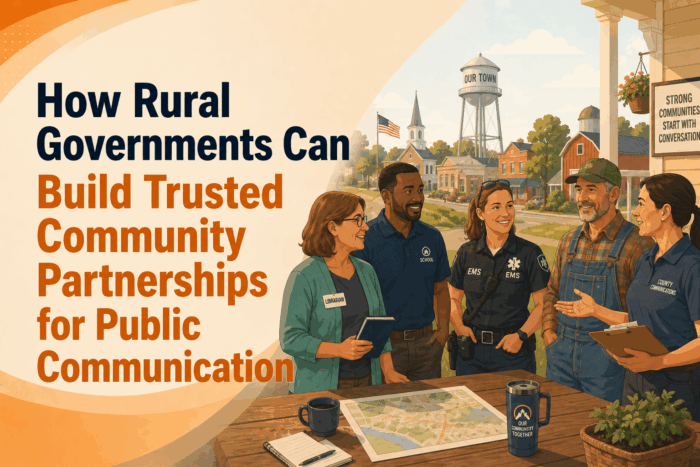
How Rural Governments Can Build Trusted Community Partnerships for Public Communication
Rural local governments operate in communication environments that are fundamentally different from those of their urban and suburban counterparts. The information landscape in a rural community is shaped by informal networks that are often more trusted and more efficient than official channels, by community institutions that predate the current governing body and that have earned deep local loyalty, and by the practical reality that many residents may not have reliable access to the digital channels on which modern government communication increasingly depends. In that environment, the ability to communicate through trusted community partners is not a supplementary strategy. It is often the most effective communication strategy available.
Community partners in rural local government communication include a broad range of organizations and institutions that have established relationships with specific community segments. Libraries, schools, and extension offices that serve educational functions and that often serve as trusted neutral spaces in the community. Volunteer fire departments, which are often among the most trusted institutions in rural communities because of their direct life-safety role. Local healthcare providers who serve as trusted sources of information for residents who look to them for guidance on a wide range of community matters. Faith communities that maintain close relationships with portions of the population that official government channels rarely reach effectively.
Agricultural organizations, electric cooperatives, local newspapers, and community radio stations occupy similarly trusted roles in many rural communities. Local businesses, particularly those that serve as informal community gathering places, can be valuable distribution partners for information that benefits their customers and neighbors. Nonprofits and human service organizations that work with specific populations, including seniors, veterans, low-income households, and individuals with disabilities, can extend communication reach to community members who are among the most likely to need official government information and the least likely to access it through standard channels.
This article addresses how rural local governments can identify, cultivate, and sustain effective community partnerships for public communication. It covers what makes a community partner genuinely useful rather than nominally involved, how to build and maintain the relationships that make partnerships function, how to prepare materials that partners can actually use, how to keep partners current when information changes, how to extend the reach of corrections and updates through partner networks, and how to sustain partnerships over time and through staff transitions. The goal is a communication approach that treats community institutions as genuine co-communicators rather than as passive distribution channels.
Why Community Partnerships Matter More in Rural Settings
 The communication advantages of community partnerships are real in any local government context, but they are particularly significant in rural communities for several reasons that reflect the specific characteristics of rural information environments. Understanding those reasons helps rural agencies build a partnership communication strategy that reflects the actual dynamics of their community rather than importing assumptions from other contexts.
Trust asymmetry is one of the most important dynamics in rural community communication. In many rural communities, local government is not among the most trusted institutions. Historical experiences, political dynamics, geographic and cultural distance from government centers, and the general skepticism of many rural communities toward outside institutions can create a trust deficit that makes official government communication less effective than in communities with stronger baseline government trust. Community partners who have earned deep local trust over decades of service can bridge that deficit by serving as trusted intermediaries who can vouch for official information and frame it in ways that resonate with community members who might be skeptical of direct government communication.
Digital access disparities make partner communication more necessary in rural settings because the assumption that digital channels will reach all residents does not hold in communities with significant broadband gaps, limited cellular service, or populations with lower rates of digital engagement. A notice posted to the agency’s website and shared on social media will simply not reach the portion of the rural population that is not online. Partners who interact with those residents through physical channels, face-to-face interactions, and print communications can reach the residents that digital channels miss.
Geographic dispersion creates its own communication challenge in rural communities where residents may be spread across a large area without the density of interaction that creates natural information diffusion. Information that spreads quickly through a dense neighborhood network may spread much more slowly through a rural community where neighbors may be miles apart. Community institutions that serve as regular gathering places, whether a volunteer fire hall, a cooperative grain elevator, or a rural church, create the density of social contact that facilitates information diffusion in ways that geographic dispersion otherwise prevents.
Local knowledge and cultural resonance are qualities that community partners can bring to government communication that official channels cannot easily replicate. A farm bureau that frames a road weight restriction in terms of its impact on spring planting operations, or a senior center that explains a Medicare assistance program in terms that resonate with its members, is doing something that a standard government notice cannot do as effectively: connecting official information to the specific circumstances and values of the community it is trying to reach.
Engaged & Connected: Communication Strategies for Small Towns, Villages, Townships, and Rural Communities
This article is part of our series on strategic communication for Small Towns, Villages, Townships, and Rural Local Governments. To learn more and to see the parent article, which links to other content just like this, click the button below.
Identifying the Right Community Partners
Not every community organization is an equally useful communication partner. Some organizations have large networks and direct channels to specific community segments. Others are respected but have limited reach. Some are well-positioned to communicate about certain topics but not others. Identifying the right partners for the right types of communication requires understanding both the organization and its relationship to the community members the agency is trying to reach.
Organizations That Serve Specific Populations
The most valuable community partners for rural government communication are often those that serve specific population segments that official channels do not reach effectively. A senior center that provides regular programming for older adults has a direct, trusted relationship with a population that is often both highly affected by local government decisions and among the least likely to access government information through digital channels. The senior center’s communication, whether through a newsletter, a bulletin board, or staff announcements at programs, can reach its members more effectively than any official government channel.
Organizations serving agricultural producers are particularly important partners in rural communities where farming operations are a significant economic and cultural presence. Agricultural extension offices, farm bureaus, commodity organizations, and cooperative organizations all have direct relationships with farmers who may be significantly affected by local government decisions about roads, drainage, zoning, and infrastructure, and who may not follow official government communication channels closely. These organizations can translate government information into terms relevant to agricultural operations and distribute it through the channels farmers actually use.
Organizations serving low-income residents, veterans, immigrants, and individuals with disabilities often have direct relationships with community members who are among the most in need of government information and the least likely to access it through standard channels. Food pantries, veteran service organizations, immigrant-serving nonprofits, and disability services providers are all potential partners for communication about services, assistance programs, and policy changes that affect their clients. These organizations typically have strong trust relationships with their clients and can vouch for the accuracy of government information in ways that official notices alone cannot achieve.
Institutions With Physical Community Presence
Institutions with regular physical presence in the community, where residents gather regularly and where information posted or distributed reaches a captive audience, are particularly valuable for rural communication. Libraries, post offices, laundromats, barbershops and beauty salons, diners, feed stores, and hardware stores all serve as natural information distribution points in rural communities. Residents who visit these locations regularly will see posted notices, pick up printed materials, and hear about local developments from staff and other patrons in ways that digital channels cannot replicate.
The volunteer fire department occupies a uniquely trusted position in most rural communities because it combines direct service delivery with deep community membership. Volunteer fire departments often include members from across the community and maintain relationships with nearly every household in their service area through annual fund drives, emergency responses, and community events. Communication distributed through the fire department, whether through their newsletters, social media, or direct member outreach, often reaches community segments that official government channels do not.
Faith communities are significant communication partners in many rural settings where they serve not only a religious function but also a social and community information function. A pastor or faith leader who mentions a local government meeting, a service deadline, or a community infrastructure project in a Sunday message or a congregational newsletter may reach a specific community segment more effectively than any official communication. Faith community partnerships require sensitivity to the appropriate boundaries between civic and religious functions, but when managed thoughtfully they can be among the most effective community communication relationships a rural agency develops.
Building Genuine Partnership Relationships
Effective communication partnerships are built on genuine relationships, not transactional information transfers. A community organization that receives requests for information distribution only when the agency needs something, without any reciprocal communication, without acknowledgment of the organization’s work, and without any relationship maintenance between requests, is not a partner. It is an unpaid distribution channel, and most community organizations will eventually stop functioning in that role.
Building genuine partnerships requires consistent, reciprocal engagement over time. The agency should support partner organizations’ communication as actively as it asks for their help distributing official information. That support might mean sharing partner events and programs on the agency’s social media, linking to partner organization websites from the agency’s website, mentioning partner programs in agency newsletters, and acknowledging partner contributions in public communications. This reciprocity signals that the partnership is a genuine mutual relationship rather than a one-directional service the partner is expected to provide to the agency.
Direct relationship maintenance between key agency staff and partner organization leaders is the foundation of partnership communication. The administrator or communication coordinator who knows the library director by name, who has a working relationship with the extension agent, who has met with the senior center director and the volunteer fire chief is in a position to ask for communication support in ways that the agency that communicates only through formal channels cannot. Those personal relationships also make it possible to provide advance notice of important communications before they go public, which partners appreciate because it allows them to prepare accurate responses to questions from their own constituents.
Annual partner meetings or check-ins are a practical way to maintain relationships with a range of community organizations simultaneously. A brief annual meeting at which the agency describes its upcoming communication priorities, invites partner input on how information is being received in the community, and expresses appreciation for past partnership support can maintain multiple relationships efficiently. These meetings also create opportunities for partners to inform the agency about issues and concerns circulating in the community that official channels have not yet surfaced.
Preparing Materials That Partners Can Actually Use
One of the most common partnership communication failures is providing partner organizations with materials that are not usable in their specific context. A dense PDF with official agency letterhead and technical language may be accurate, but it is not useful for a senior center staff member who wants to briefly explain a new program to program participants. A lengthy project description may be accurate, but it is not useful for a cooperative newsletter editor who has room for three sentences about a road weight restriction. Partners can only effectively communicate what they can explain, and they can only explain what has been translated into forms appropriate for their audience and channel.
Partner-ready materials should be specifically designed for each partner’s context and audience. Brief, plain-language summaries that can be read aloud at a community meeting. Social media posts already drafted that partners can share with their own followers. Newsletter paragraphs written at the right length and reading level for the partner’s newsletter format. Fact sheets with bullet points that a library staff member can hand to a patron who asks a question. Poster or flyer formats that can be printed and posted at a community location. Each of these formats serves a different partner context, and providing the right format for each partner reduces the effort they must invest to communicate effectively on the agency’s behalf.
Materials provided to partners should always include the agency’s contact information prominently, so that community members who have questions after receiving partner communication know who to contact directly. Partner organizations are not equipped to serve as secondary customer service representatives for the agency. Their role is to distribute and contextualize official information, not to answer detailed questions about it. Making it easy for community members to reach the agency directly after receiving partner communication reduces the burden on partners and ensures that detailed questions receive authoritative answers.
Materials should also be provided in advance of public announcements where possible, so that partners are not put in the position of being asked about something they have not yet received from the agency. A partner organization that learns about a significant local government decision from the general public, or from a news report, before receiving any information from the agency has been disrespected in a way that damages the partnership relationship. Advance partner briefing, even a day or two before the general public announcement, signals that the agency treats its partners as valued members of the communication system rather than as afterthoughts.
Distributing Corrections and Updates Through Partner Networks
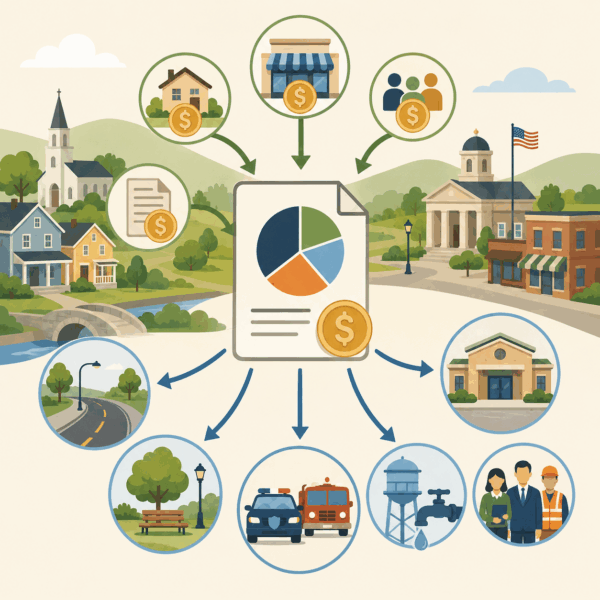 When official information changes, when a correction is needed, or when a situation is evolving and updates are being issued regularly, partner networks must be able to carry those updates as well as the original information. A partner that communicated the original version of a notice but that never received the correction may continue to distribute outdated information long after the agency has issued an update through its own channels. That lag creates exactly the channel inconsistency that the partnership is supposed to prevent.
The agency should build partner notification into its update and correction workflow as a standard step, not an afterthought. When a road closure notice is updated because the schedule has changed, the partners who distributed the original notice should receive the update at the same time the website and social media are updated. When a boil water advisory is lifted, the partners who helped distribute the advisory should receive the lifting notice immediately. When a project is delayed and the original completion date in a partner newsletter is no longer accurate, the partner editor should receive an update flag and a corrected paragraph they can use in their next issue.
For ongoing situations where multiple updates will be issued over an extended period, the agency should establish a consistent update distribution process for partners at the outset. If a major road reconstruction will involve weekly construction updates over a three-month period, partners who are helping communicate about the project should receive those weekly updates on the same schedule as the general public updates, with any additional context or partner-specific framing that makes them more useful for partner distribution.
Corrections require particular care in partner communication because they involve asking partners to correct information they already distributed. The correction notice should be specific about what was incorrect and what the accurate information is, and it should be framed in a way that is respectful of the partner rather than suggesting that the partner made an error. The partner distributed what the agency provided. If that information was incorrect, the responsibility lies with the agency. A correction notice that acknowledges the agency’s responsibility for the original error, provides the accurate information in a form the partner can easily use, and thanks the partner for their help in getting the correction out is the appropriate approach.
Sustaining Partnerships Through Staff Transitions
Community partnerships are relationship-dependent, and the departure of the staff member who built and maintained those relationships can significantly disrupt the partnership network if the relationships are not documented and transitioned appropriately. A communication coordinator who retires after ten years and who maintained personal relationships with twelve community partner contacts takes that network with them when they leave, unless those relationships have been formally documented and the transition has been managed deliberately.
Partnership documentation should be maintained as part of the communication operations records described elsewhere in this series. That documentation should include, for each partner organization, the contact name and information, the nature of the partnership, the types of information the partner regularly distributes, the communication format preferences and constraints of the partner, any standing arrangements for regular information sharing, and any history of specific partnership activities that future staff should be aware of. This documentation allows a successor to step into the partnership network with a baseline understanding of each relationship rather than starting from scratch.
Formal introduction meetings, in which the departing staff member introduces their successor to key partner contacts, are among the most effective transition practices for communication partnerships. These introductions signal continuity rather than discontinuity and give the successor a relational foundation with each partner that documentation alone cannot provide. Partners who have met the new staff member before they need to ask for something, and who have received some acknowledgment of the previous staff member’s partnership work and the agency’s appreciation for it, are more likely to extend good faith to the new relationship.
Staff transitions also create opportunities to strengthen and expand partnership networks. A new communication coordinator who approaches the transition as an opportunity to assess the existing partnership portfolio and to identify gaps may find that the previous network, however strong it was, did not maintain relationships with some important community organizations. New staff members often bring different community connections and different organizational relationships than their predecessors, and those connections can be assets for partnership development.
Managing Partner Communication During Sensitive or Controversial Issues
Community partnerships create a specific communication challenge when the information being distributed involves a sensitive decision, a politically divisive issue, or a matter on which community organizations may have their own institutional positions. A local nonprofit that advocates for environmental conservation may not be a neutral partner for communicating about a drainage project that has generated environmental concerns. A business association that has publicly opposed a proposed zoning change may not be the right partner for communicating about the zoning hearing. Selecting partners who can be genuinely neutral carriers of official information, rather than amplifiers of particular positions, is important for maintaining the integrity of the partnership communication.
At the same time, organizations that have stakeholder positions on an issue may still be valuable partners for reaching the specific community members most affected by that issue, as long as the agency is clear about what it is asking them to do. Asking a business association to distribute factual information about a public hearing on a zoning change, without asking them to endorse a specific outcome, is different from asking them to advocate for the agency position. Most community organizations can distribute factual information about a government process even when they have their own views about the underlying issue, as long as the materials they are asked to distribute are genuinely factual rather than advocacy pieces.
The agency should be transparent with partners about the nature of sensitive issues when asking for distribution assistance. A partner organization that distributes information and later discovers the issue was more politically charged than they were led to believe may feel that the agency used their credibility without fully disclosing what it was asking them to be part of. Honest briefing of partners, including acknowledgment of controversy where it exists, allows partners to make informed decisions about whether their participation is appropriate and protects the partnership relationship from the damage that deceptive or incomplete briefing can cause.
Partners who decline to participate in distributing information about a specific controversial issue should not be penalized in their relationship with the agency. A faith community that declines to distribute information about a politically divisive issue because it does not want to involve its congregation in local political disputes is making an appropriate organizational decision that the agency should respect. The partnership can continue to function for other communication purposes, and the relationship should not be damaged by a single declined request.
Evaluating Partnership Communication Effectiveness
Like any communication investment, community partnerships should be periodically evaluated to assess whether they are achieving their intended purpose. An evaluation that asks whether specific partner organizations are actually distributing information in ways that reach their intended audience, whether residents who received partner-distributed information report finding it accurate and useful, and whether the partnership is reaching community segments that official channels do not, provides the basis for adjusting the partnership strategy over time.
Evaluation can be informal, based on the observations of staff who are in contact with partners and community members, or more structured, involving brief surveys of community members who receive partner-distributed information. The evaluation should cover both the reach and the quality of partner communication: how many community members are being reached through each partner, and whether the information they receive is accurate, timely, and useful for their needs. A partnership that has a large reach but that consistently distributes outdated or inaccurate information because the agency does not update partners reliably is not functioning effectively, regardless of its nominal scale.
Evaluation should also include feedback from partners themselves about what is and is not working in the relationship. Partners who find that the materials they receive are too technical, too long, or not available in formats they can use are partners who are doing the best they can with inadequate tools. Partners who feel that the agency does not reciprocate their communication support with appropriate recognition and assistance are partners whose ongoing investment in the relationship may be declining. Regular check-ins that invite partners to provide honest feedback about the partnership are as important for relationship maintenance as they are for communication quality improvement.
The evaluation results should be used to adjust the partner communication strategy. Partners who are not effectively reaching their intended audience may need different materials or different engagement from the agency. Partners who are working well may deserve expanded roles and additional materials that extend their communication reach. Partners who have become inactive may need a relationship renewal conversation before they are provided with materials that they are unlikely to distribute. A partnership network that is actively managed and evaluated will be significantly more effective over time than one that is built once and left to function without ongoing attention.
Local Media as a Special Partnership Category
Local newspapers, community radio stations, and local television stations, where they still exist in rural communities, occupy a unique position in the partnership communication landscape because they are themselves communication organizations rather than community organizations that distribute communication. A partnership with local media is fundamentally different from a partnership with a senior center or a farm bureau, because local media has editorial independence and its own journalism standards that the agency cannot and should not try to direct.
The most effective relationship between a rural local government and local media is one built on reliable access to accurate information, prompt responsiveness to media inquiries, and consistent respect for the media outlet as an independent institution rather than as a distribution channel. A local newspaper editor who knows that the township administrator will return calls promptly, will provide accurate information on background or on the record as appropriate, and will be honest about what the agency does and does not know is more likely to treat the agency fairly and accurately in coverage than one who has experienced evasion, delay, or spin.
Press releases or media advisories distributed to local media should be written in a style that is genuinely useful to a journalist: factual, specific, well-organized, and complete enough to support a story without requiring extensive follow-up. A press release that is essentially an agency publicity piece, heavy on positive framing and light on specific information, will be edited or ignored. A press release that provides accurate, specific, newsworthy information in a form that a journalist can build on will be used and will establish the agency as a reliable and useful source for future stories.
For rural agencies in communities where local media has declined or disappeared, the communication gap left by the loss of local journalism is a significant community problem that partnerships with community organizations can partially but not fully address. The absence of a local newspaper removes one of the most important accountability mechanisms for local government and one of the most trusted information sources for community members who do not follow official government channels. Agencies that are aware of this gap can invest more in their own communication practices to fill some of what local journalism previously provided, while supporting efforts to sustain or rebuild local media capacity through community partnerships that respect the independence of the journalism function.
Relationships with county or regional media outlets that cover rural communities as part of a larger coverage area are also worth cultivating, even if those outlets provide less detailed local coverage than a dedicated local outlet would. A regional newspaper or radio station that knows the local township or village administrator by name, and that receives reliable information when a significant local development occurs, is more likely to provide accurate and complete coverage than one that has no established relationship and must work from secondhand sources when a newsworthy event occurs.
Strategic Communication Support for Small and Rural Governments
 Building and sustaining a community partnership network for rural communication is a long-term investment that requires consistent attention to relationship maintenance, material preparation, update distribution, and transition management. The agencies that do this work well are agencies that treat their community partners as genuine collaborators in the public service mission rather than as convenient distribution points to be activated when the agency has something it needs to communicate.
Outside support for rural community partnership communication can help agencies identify the most valuable potential partners in their community context, develop the partner-ready materials that make the partnership functional, build the workflow processes that ensure partners receive updates and corrections reliably, and design the transition documentation that makes partnerships durable through staff changes. For agencies building a partnership network for the first time, that support can significantly accelerate the process of developing the relationships and systems that effective rural communication requires.
Stegmeier Consulting Group (SCG) helps small and rural governments develop community partnership communication systems that extend their reach to the community members who are most difficult to reach through official channels alone. That work includes partner identification, relationship development support, partner-ready material design, update distribution workflow, transition documentation, and the training that helps staff maintain partnership relationships as an ongoing professional practice rather than an occasional special project.
Future Trends in Rural Community Partnership Communication
The role of community partnerships in rural communication is likely to remain important in the coming years, even as digital communication capabilities expand and improve. Several trends are shaping how those partnerships will develop.
The growth of community broadband infrastructure in some rural areas may over time reduce the digital access gap that makes partner communication so essential. But broadband expansion is uneven and slow, and even communities with improved connectivity will continue to have populations for whom digital communication is not the primary information channel. The shift toward broader digital access is a reason to expand the channels through which information is distributed, not to reduce investment in partner communication that reaches residents outside digital channels.
The increasing sophistication of community organizations in using their own digital channels creates new partnership opportunities. A local nonprofit with an active social media following, a volunteer fire department with a well-subscribed email list, or a library with a popular digital newsletter can now extend the reach of government information through those digital channels in ways that were not possible when most community organizations relied only on physical distribution. Partnerships that span both digital and physical distribution channels are more valuable than those that rely on either alone.
Equity and inclusion considerations are increasingly shaping how rural communication partnerships are designed. Partners who can reach populations that face barriers to official communication, including limited English proficiency, low digital literacy, disability-related communication barriers, and geographic isolation, are becoming more explicitly valued as part of equity-focused communication planning. Rural agencies that intentionally diversify their partnership networks to include organizations serving these populations will build communication systems that genuinely serve all members of their communities rather than only those who are easiest to reach.
Conclusion
Community partnerships are among the most valuable and most underutilized communication resources available to rural local governments. The organizations and institutions that have built deep trust with specific community segments over decades of service can do something that official government channels rarely achieve on their own: reach residents where they are, in contexts they trust, through voices they believe. Building those partnerships requires investment in relationships rather than only in technology, and it requires the reciprocal communication that distinguishes genuine partnerships from one-directional distribution arrangements.
Rural governments that invest in building and maintaining genuine community communication partnerships will find that their official communications reach a broader, more representative audience; that information about services, decisions, and emergencies gets to the residents who most need it; and that the trust gaps that often exist between rural communities and their local governments can be bridged through the credibility of trusted intermediaries. Those outcomes are worth the sustained relationship investment that effective partnership communication requires, and they are within the reach of every rural agency that is willing to treat its community institutions as genuine partners in the work of public service.
Stegmeier Consulting Group’s Strategic Approach to Communication Systems
Align your agency’s communication reach through trusted rural community partnerships.
Small and rural governments need community partnership communication systems that extend their reach to residents who do not access official channels, that provide trusted contextualization through institutions residents believe, and that are sustained reliably through the staff transitions and organizational changes that affect every agency over time. Building those systems requires genuine relationship investment, partner-ready materials, reliable update distribution, and the transition documentation that protects relationship continuity.
SCG helps rural agencies develop community partnership communication systems that genuinely extend their reach and deepen their community trust. Whether your agency is building its partner network for the first time or strengthening an existing network that could be more effective, SCG can help you develop the approach that reaches the residents who most need to hear from their local government.
Use the form below to connect with our team and explore how trusted community partnerships can help your agency communicate more effectively with the full range of residents in your rural community.