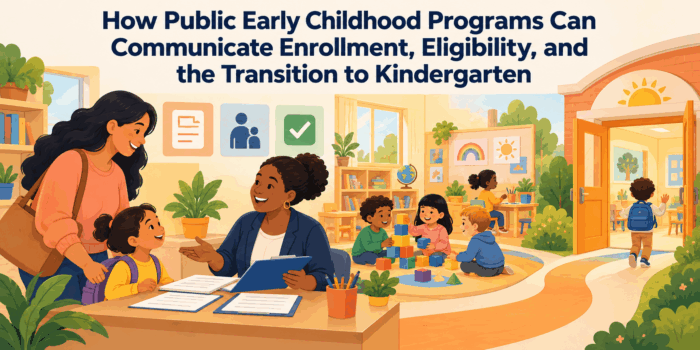
How Public Early Childhood Programs Can Communicate Enrollment, Eligibility, and the Transition to Kindergarten
Public early childhood programs give young children a strong start in learning and give families essential support during some of the most demanding years of parenting. These programs take many forms, including state-funded prekindergarten, district preschool classrooms, federally funded Head Start and Early Head Start, preschool special education services, transitional kindergarten in some states, and community-based programs that receive public funding through partnerships with school districts or state agencies. Some programs serve all children in an age group, while others are targeted to families with low incomes, children with disabilities, multilingual learners, children in foster care, or children experiencing homelessness. Many operate in partnership with child care providers, community organizations, and health and social service agencies. Together, they represent one of the most important public investments in children’s futures, with research consistently linking high-quality early learning to stronger school readiness, better long-term academic outcomes, and benefits for families and communities.
Yet the early childhood landscape is often confusing for families. A parent of a three-year-old may hear about prekindergarten, Head Start, district preschool, and subsidized child care without understanding how they differ, which ones their child qualifies for, or how to apply. Eligibility rules vary by program and may depend on the child’s age on a specific date, the family’s income, the family’s address, the child’s developmental needs, or other priority factors. Application periods, documentation requirements, waitlists, and placement processes differ from program to program and sometimes from year to year. Families who work long hours, who speak languages other than English, who are new to the community, or who have limited internet access may struggle to find and complete the right applications. Many eligible families never enroll, not because they are uninterested but because they never received clear information at the right time.
The transition from early childhood programs to kindergarten adds another layer of complexity. Families need to know when and how to register for kindergarten, what their child will experience, how information from preschool will be shared with the elementary school, and how services for children with disabilities will continue. Children need opportunities to become familiar with their new school, and teachers need information to welcome them well. This article explores how public early childhood programs can communicate enrollment, eligibility, and the transition to kindergarten clearly and warmly, so that every eligible family can find a program, every child can begin learning in a supportive environment, and every family can move into elementary school as a confident partner in their child’s education.
Why Communication Matters in Early Childhood
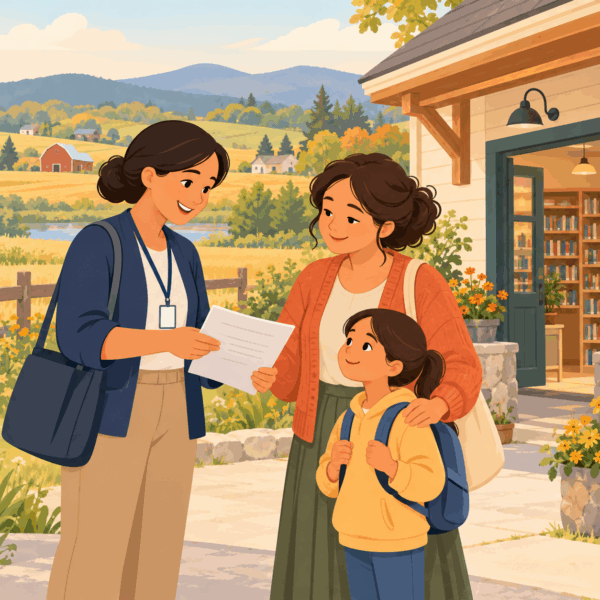 Early childhood programs are often a family’s first experience with public education. The way a program communicates during this first experience shapes families’ expectations, trust, and engagement for years to come. A parent who receives clear information, a warm welcome, and regular updates about their child’s learning begins to see schools as partners. A parent who encounters confusing forms, unanswered questions, and unexplained decisions may approach future school relationships with hesitation or distrust. Because early childhood is such a formative period for both children and families, the communication habits established in these years have lasting influence.
Communication also determines who benefits from public early childhood investments. Programs designed to serve children who would benefit most, such as children from low-income families, children with disabilities, and multilingual learners, can only fulfill that purpose if those families know about them and can enroll. Families with more time, resources, and familiarity with public systems are often the first to learn about programs and complete applications, while the families programs most aim to serve may miss deadlines or give up when processes are confusing. Clear, proactive, and accessible communication helps ensure that public early childhood programs reach the children they were created for.
The Families Early Childhood Programs Serve
Families of young children are often stretched thin. Parents may be working multiple jobs, caring for infants and toddlers, managing health appointments, navigating child care arrangements, and coping with the sleep deprivation and stress that come with raising young children. Many are young parents themselves, and some are navigating parenting while completing their own education. Families may include grandparents raising grandchildren, foster parents, single parents, and parents with disabilities. Some are new to the country and unfamiliar with American education systems. Some are experiencing homelessness or housing instability, and some are coping with family crises. Each of these circumstances shapes how families receive and respond to information.
Communication should be designed with these realities in mind. Messages should be brief, clear, and focused on concrete actions. Information should be available in multiple formats, such as text messages, phone calls, printed materials, short videos, and in-person conversations, so families can receive it in the way that works best for them. Program staff should be prepared to help families complete applications, gather documents, and understand options, rather than simply directing them to a website. Communication should also convey warmth and respect, recognizing parents as the experts on their children and as their children’s first teachers.
Many families also rely on trusted people and places for information about young children. Pediatricians, home visitors, child care providers, public health nurses, librarians, faith leaders, and other parents are often more influential than official program materials. Early childhood programs can extend their reach by equipping these trusted messengers with simple, accurate information about programs, eligibility, and how to apply. A pediatrician who mentions prekindergarten during a well-child visit, or a librarian who shares an enrollment flyer at story time, can prompt a family to take action at exactly the right moment.
A Confusing Landscape of Programs
One of the greatest communication challenges in early childhood is the fragmentation of programs. In many communities, families face several separate programs, each with its own name, funding source, eligibility rules, application process, and calendar. A family might be eligible for Head Start, state prekindergarten, district preschool, and subsidized child care, yet need to apply separately to each, provide the same documents multiple times, and wait for separate decisions. Even program staff may struggle to explain how the pieces fit together. For families, this fragmentation can feel overwhelming, and some may choose not to apply at all.
Programs can reduce confusion by explaining the landscape from the family’s perspective. A simple guide that describes the early childhood options available in the community, who each serves, what each offers, and how to apply can help families understand their choices. Visual tools, such as a chart showing age ranges, schedules, eligibility, and costs for each program, make differences easier to compare. Where possible, programs should work together to create a single point of entry, such as a coordinated application, shared enrollment hotline, or community enrollment navigator, so families do not have to figure out the system on their own.
Coordinated enrollment systems are becoming more common, allowing families to apply to multiple early childhood programs through one application. When such systems exist, communication should explain clearly how they work, how families rank choices, how placements are made, and what happens after an offer. When they do not exist, programs can still coordinate communication by referring families to one another, sharing consistent information, and helping families apply to multiple programs when appropriate. The goal is for families to experience early childhood services as one welcoming system rather than a maze of separate doors.
Enrollment navigators, sometimes called family advocates or community enrollment specialists, can make an especially large difference. A navigator can sit with a parent at a library table, explain the options in the family’s language, check eligibility on the spot, help gather documents, and submit applications to several programs at once. Navigators can also follow up with families who started an application but did not finish, a group that is often large and easy to overlook. Because navigators build personal relationships, families are more likely to call them with questions later in the process, such as when a placement offer arrives or when a child’s schedule changes. Communities that fund even a small number of navigators, placed in locations families already visit, often see meaningful increases in applications from families who had not previously enrolled.
Learning Together: Communication Strategies for K-12 School Districts and Public Education Agencies
This article is part of our series on strategic communication for K-12 School Districts and Public Education Agencies. To learn more and to see the parent article, which links to other content just like this, click the button below.
Explaining Eligibility Clearly
Eligibility rules are often the first barrier families encounter. Rules may depend on a child’s age by a specific cutoff date, the family’s income relative to federal poverty guidelines or state median income, the family’s address or school attendance zone, the child’s developmental needs, or priority factors such as homelessness, foster care, military service, or receipt of public benefits. These rules are often written in technical language and may change from year to year. Families who misunderstand eligibility may assume they do not qualify and never apply, or they may apply for programs they cannot access and become discouraged.
Clear eligibility communication helps families quickly determine which programs they can access and encourages eligible families to apply. It should emphasize inclusion, making clear which families qualify and encouraging families who are unsure to ask, rather than leading with restrictions. Programs should also explain that eligibility rules exist because of funding requirements, not because programs want to exclude families, and they should help families find alternatives when they do not qualify.
Income, Age, and Priority Criteria
Age eligibility should be explained with specific dates and examples. Instead of stating that children must be four years old by the state cutoff date, materials can say that children born between specific dates are eligible for prekindergarten in the coming school year. A simple age chart showing birth date ranges for each program and school year helps families determine eligibility at a glance. Families with children born near cutoff dates should be encouraged to contact the program to confirm eligibility, since misunderstandings about dates are common.
Income eligibility should be presented in a clear table showing household size and income limits, ideally with both monthly and annual figures. Materials should explain what counts as income, whose income is included, and whether certain families qualify automatically, such as those receiving specific public benefits or experiencing homelessness. Because many families are unsure whether they qualify, programs should encourage families to apply even if they are uncertain and should explain that staff will help determine eligibility. Some programs serve a mix of income-eligible and tuition-paying families or reserve a percentage of seats for families above income limits, and these options should be explained clearly.
Priority criteria, such as children with disabilities, children in foster care, children experiencing homelessness, multilingual learners, or children of military families, should be explained in respectful language. Families should understand how priorities affect placement and what documentation, if any, is needed. Programs should be careful to communicate priorities without stigmatizing families. For example, explaining that families experiencing housing instability may receive priority enrollment and can talk confidentially with a staff member about their situation is more respectful than requiring families to declare homelessness on a public form without explanation.
Documentation Without Discouragement
Documentation requirements can be a significant barrier. Families may be asked to provide birth certificates, proof of income, proof of address, immunization records, custody documents, and other records. Gathering these documents can be difficult for families who have moved recently, who lack stable housing, who work irregular hours, or who have records from another country. Programs should explain exactly which documents are required, which alternatives are acceptable, and how families can get help obtaining missing documents. A simple checklist, translated into families’ languages, helps families prepare before applying.
Programs should avoid creating unnecessary barriers. If a document is required for funding compliance but can be submitted after enrollment, families should know that. If alternative forms of verification are acceptable, such as a letter from an employer instead of pay stubs or a signed statement for families without a lease, materials should say so. Families experiencing homelessness are entitled under federal law to enroll without certain documents in many programs, and staff should be trained to explain these protections.
Staff who answer phones and greet families at enrollment sites shape how documentation requirements feel. A staff member who says that a family cannot apply without a birth certificate may end the conversation, while a staff member who explains that the family can begin the application today and bring the certificate later, or that the program can help request a copy, keeps the door open. Programs should give front line staff clear written guidance about acceptable documents, alternatives, deadlines for submitting missing items, and how to help families who face special circumstances. Short scripts for common situations, such as a parent who has recently moved or a grandparent caring for a grandchild without formal custody papers, help staff respond consistently and kindly. When documentation is handled with flexibility and warmth, families are far more likely to complete enrollment.
Privacy concerns may also discourage families from applying. Some families worry about sharing income information, immigration-related details, or information about family circumstances. Programs should explain clearly how information will be used, who will see it, and how it is protected. Making clear that eligibility for most public early childhood programs does not depend on a child’s or parent’s immigration status, where that is true, and that information is kept confidential can help families feel safe applying. Staff should be prepared to answer questions about privacy honestly and respectfully.
Explaining Enrollment and Placement
Once families understand eligibility, they need to understand how to enroll. Enrollment processes vary widely, from open enrollment in universal programs to competitive application processes with waitlists in programs with limited seats. Families need to know when to apply, how to submit applications, what happens after they apply, how placements are made, and how long they may wait. They also need to understand the practical details of each program, such as schedules, locations, transportation, meals, and costs, so they can choose options that work for their families.
Enrollment communication should begin well before application periods open and continue through the first weeks of the program. Families of young children often plan months in advance, especially if they need to arrange work schedules or child care. Early awareness campaigns, reminders during application periods, and follow-up after applications are submitted help families stay on track.
Applications, Deadlines, and Waitlists
Application information should state clearly when applications open and close, how to apply online, by phone, or in person, and what help is available. Programs should offer multiple ways to apply, since some families have limited internet access or are uncomfortable with online forms. Application assistance events at libraries, community centers, health clinics, and schools allow families to complete applications with staff support. Online applications should be mobile-friendly and available in multiple languages, since many families use phones rather than computers.
Deadlines should be communicated repeatedly through multiple channels. Reminders a few weeks before the deadline, a week before, and a day or two before can help busy families remember. After families apply, they should receive confirmation that their application was received, an explanation of next steps, and an estimate of when they will hear about placement. Silence after applying is one of the most common sources of family anxiety and may cause families to enroll elsewhere or give up.
Waitlists should be explained honestly. Families should know how waitlist positions are determined, whether priorities affect waitlist order, how they will be contacted if a seat opens, how long they have to respond, and whether they should consider other options in the meantime. Programs can help waitlisted families by referring them to other early childhood options, offering family resources or playgroups, and keeping in touch periodically. A family that feels remembered while waiting is more likely to accept a seat when one opens.
Schedules, Locations, and Program Types
Families need clear information about program schedules to determine whether a program fits their lives. Some programs operate a few hours a day, others operate a full school day, and some offer extended day or year-round options in partnership with child care providers. Families who work full time may not be able to use a half-day program without additional child care. Materials should describe daily schedules, calendar dates, holidays, and options for before and after care, and they should explain how families can combine programs if needed.
Location and transportation are equally important. Families should know where programs are located, whether they can choose a site, whether transportation is provided, and how drop-off and pick-up work. Many early childhood programs do not provide transportation, and families need to know this in advance. Programs located in elementary schools, community centers, Head Start centers, and child care centers may have different arrangements, and materials should describe each clearly.
Program types should be described in terms families can understand. Families may want to know about class size, teacher qualifications, curriculum approach, meals, naps, outdoor play, and how programs support children’s social, emotional, language, and early literacy development. Rather than using technical terms, materials can describe what a typical day looks like, from arrival and breakfast through circle time, learning centers, outdoor play, lunch, rest, and dismissal. Photos and short videos of classrooms help families picture their child in the program.
The first weeks of a program deserve careful communication as well. Families of young children are often nervous about separation, and children may be experiencing their first time away from home. Programs can ease this transition by sending a welcome packet before the first day, describing what to bring, how drop-off will work, what the child will eat, and how teachers will comfort children who are upset. Some programs offer gradual entry, short visits, or home visits before the year begins so that children can meet their teachers in a familiar setting. A brief message or photo from the teacher during the first days, letting parents know their child has settled in, can reassure a worried parent more than any handbook. These early gestures set the tone for a relationship built on trust and open communication.
Supporting Children With Disabilities and Multilingual Families
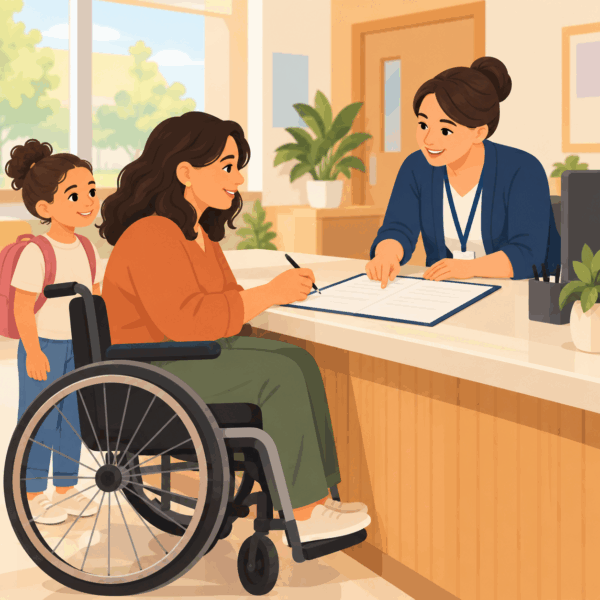 Children with disabilities and children growing up with more than one language are central to the mission of public early childhood programs. Early identification and support for developmental delays can make a profound difference in children’s outcomes, and early childhood programs that value home languages help children build strong foundations in all their languages. Communication with these families requires particular care, since families may be navigating complex systems, unfamiliar terminology, and emotions about their child’s development or their family’s place in a new community.
Programs should communicate clearly that children with disabilities and multilingual learners are welcome and that they will be supported. Families should not have to wonder whether their child belongs or whether their language and culture will be respected. Inclusive communication, from enrollment materials through daily interactions, helps families trust that the program will be a positive place for their child.
Early Intervention and Preschool Special Education
Children with developmental delays or disabilities may receive early intervention services from birth to age three and preschool special education services from ages three to five. The transition from early intervention to preschool special education is often confusing for families, since it involves different agencies, evaluations, eligibility criteria, and service plans. Families need clear information about the transition timeline, the evaluation process, their rights, and how services will be delivered. Programs should coordinate closely with early intervention providers to ensure families receive consistent information and that transitions occur smoothly, ideally with services in place by the child’s third birthday.
Families who have concerns about their child’s development should know how to request a free developmental screening or evaluation, regardless of whether their child is enrolled in a program. Child find outreach, which helps identify children who may need services, should use accessible, nonjudgmental language that encourages families to ask questions. Materials might explain that every child develops at their own pace, that some children benefit from extra support in areas such as speech, movement, or social skills, and that free screenings can help families understand their child’s development.
When children receive preschool special education services, families should understand where services will be provided, how inclusion in general early childhood classrooms works, how progress will be shared, and how families participate in planning. Individualized education program meetings should be explained in advance, with interpretation provided when needed and plain language explanations of goals and services. Families should leave meetings understanding what will happen next and whom to contact with questions.
Home Languages and Cultural Respect
Many children in public early childhood programs are growing up with more than one language. Research shows that maintaining and developing a child’s home language supports learning English and overall development. Programs should communicate this clearly to families, who may worry that speaking their home language will slow their child’s English development. Encouraging families to continue speaking, reading, and singing in their home language at home affirms their culture and supports their child’s learning.
Communication with multilingual families should be provided in their preferred languages. Enrollment materials, family handbooks, daily communications, and conferences should be available in the languages families speak, and qualified interpreters should be used for important conversations. Programs should avoid relying on older siblings or young children to interpret. Bilingual staff, family liaisons, and partnerships with community organizations can help programs build relationships with multilingual families.
Cultural respect extends beyond language. Families have different beliefs about child rearing, early learning, discipline, feeding, sleep, and family roles. Programs should approach these differences with curiosity and respect, inviting families to share their traditions and values. Communication that reflects families’ cultures, such as photos showing diverse families, celebrations of cultural traditions, and materials that respect different family structures, helps families feel welcome.
Communicating the Transition to Kindergarten
The transition to kindergarten is a major milestone for children and families. Children move into a new building, meet new teachers and classmates, adjust to new routines, and often encounter larger classes and more structured learning. Families move from the close, personal communication typical of many early childhood programs into the broader systems of elementary schools. They must register for kindergarten, understand new expectations, and build new relationships. Clear, coordinated communication can make this transition smoother and help children begin kindergarten with confidence.
Transition communication should begin well before the end of the early childhood year. Families need time to learn about kindergarten registration, visit schools, and prepare their children. Early childhood programs and elementary schools share responsibility for this communication, and their collaboration makes a significant difference in children’s experiences.
Kindergarten Registration and Readiness
Kindergarten registration information should be shared with families early, typically in the winter or early spring before the kindergarten year. Families need to know registration dates, how to register, which documents are required, which school their child will attend, and whether options such as dual language programs or school choice are available. Early childhood programs can help families by sharing registration information, hosting registration assistance events, and reminding families of deadlines. Families who register early help schools plan staffing and class sizes, and their children are more likely to participate in transition activities.
Families often have questions about kindergarten readiness. Some worry that their child is not ready because they cannot yet read or write their name, while others are unsure what kindergarten will expect. Programs should communicate that kindergarten readiness is about more than academic skills, including social skills, independence, curiosity, and the ability to follow routines, and that kindergarten teachers expect children to arrive with a wide range of skills. Practical tips, such as practicing self-care routines, reading together, talking about feelings, and visiting the new school, can help families support their children without anxiety.
Families of children with disabilities need specific information about transition. Their child’s individualized education program will be reviewed and updated for kindergarten, and families should understand how services will change, where their child will be placed, and how the early childhood and elementary teams will coordinate. Transition meetings that include families, early childhood staff, and elementary staff help ensure continuity of services and give families an opportunity to share their knowledge and hopes for their child.
Partnerships Between Early Childhood Programs and Elementary Schools
Strong partnerships between early childhood programs and elementary schools improve transitions. Programs and schools can coordinate transition activities, such as kindergarten visits, family information nights, summer transition programs, and meetings between preschool and kindergarten teachers. These activities help children become familiar with their new school and help families build relationships with kindergarten staff before the first day.
Sharing information about children, with family consent, helps kindergarten teachers welcome students well. Transition summaries prepared by early childhood teachers can describe each child’s strengths, interests, learning progress, and any supports that have helped them. Families should be involved in preparing these summaries and should understand how the information will be used. When kindergarten teachers know about a child’s love of building, their emerging reading skills, or the strategies that help them manage transitions, they can create a welcoming start.
Communication between early childhood and elementary systems should also address alignment. Early childhood and kindergarten teachers can share information about curriculum, learning standards, assessment practices, and classroom routines, helping create continuity for children. Joint professional learning and regular meetings between early childhood and elementary leaders strengthen these partnerships over time. Families benefit when they see that their child’s early childhood program and elementary school are working together.
Ongoing Family Partnership and Measuring Results
Communication in early childhood programs extends well beyond enrollment and transition. Families of young children want regular information about their child’s day, learning, and development, and they value opportunities to participate in their child’s education. Daily communication, family engagement activities, and conferences build relationships that support children’s learning and family wellbeing.
Programs should also measure whether their communication is reaching families and achieving its purposes. Enrollment data, family feedback, participation rates, and transition outcomes can reveal strengths and gaps. Using this information to improve communication helps programs serve more families more effectively.
Daily Communication and Family Engagement
Daily communication helps families feel connected to their child’s experience. Brief conversations at drop-off and pick-up, daily notes, photos of classroom activities, and messages through family communication apps can share what children learned, how they ate and rested, and any important information. Programs should consider families who do not pick up their children in person, such as those who use transportation or rely on relatives, and ensure they also receive regular updates.
Family engagement activities give families opportunities to participate in their child’s learning and connect with other families. Activities such as family literacy nights, parent workshops, classroom visits, and family events build community and support families in their role as their child’s first teachers. Programs should schedule activities at times that work for working families, provide interpretation, and offer child care or family-friendly formats. Many programs, including Head Start, have family partnership structures, such as parent committees and policy councils, that give families a voice in program decisions, and these opportunities should be explained clearly.
Conferences and progress reports should explain children’s development in accessible language. Rather than technical assessment terms, teachers can share examples of what children are doing, such as describing how a child is beginning to recognize letters in their name, take turns in play, or use new words to express feelings. Families should be invited to share their observations of their child at home, creating a two-way conversation about the child’s growth.
Programs should also prepare families for the sensitive conversations that sometimes arise in early childhood, such as concerns about a child’s development, behavior, or health. These conversations should happen privately, in the family’s preferred language, and with a focus on the child’s strengths as well as the concern. Teachers can describe what they have observed in specific, nonjudgmental terms, invite the family to share what they see at home, and explain possible next steps, such as a developmental screening or a referral to a specialist. Families should leave these conversations feeling that the program is on their side and that they have a clear plan, rather than feeling blamed or alarmed. Training teachers to hold these conversations with empathy and clarity strengthens family trust and helps children receive support early, when it can make the greatest difference.
Measuring Enrollment, Participation, and Transition Success
Programs can measure communication effectiveness by examining enrollment data. Do enrolled children reflect the diversity of eligible children in the community? Are certain neighborhoods, language groups, or family types underrepresented? Comparing enrollment to estimates of eligible children helps programs identify gaps in outreach and adjust communication strategies. Tracking where families heard about the program also shows which channels and partners are most effective.
Family feedback provides insight into the enrollment experience and ongoing communication. Surveys and conversations can ask whether families found information easy to understand, whether the application process was manageable, whether they felt welcomed, and whether they receive enough information about their child’s learning. Programs should gather feedback in families’ languages and through multiple formats, and they should share what they learned and how they are responding.
Transition outcomes are an important measure as well. Programs and elementary schools can track how many children registered for kindergarten on time, how many families participated in transition activities, whether services for children with disabilities continued without interruption, and how families and kindergarten teachers rated the transition. Follow-up surveys with families in the fall of kindergarten can reveal what helped and what could improve, guiding future transition communication.
How Early Childhood Program Communication Compares With Other Agency Types
Elementary and secondary schools communicate with families whose children are required to attend school and who are generally assigned to a school based on their address. Their enrollment processes are usually straightforward, and families can assume that a seat will be available. Public early childhood programs, by contrast, often operate with limited seats, specific eligibility rules, and voluntary participation. Families must learn about programs, determine eligibility, apply, and sometimes wait for placement. Early childhood communication must therefore do more outreach, more explanation, and more hand-holding than typical K-12 communication. It also involves families at an earlier and often more vulnerable stage of parenting, when relationships with public systems are just beginning and when families may be juggling many demands.
Public health and social service agencies offer useful comparisons. Programs such as nutrition assistance for women, infants, and children, home visiting, and child care subsidies serve many of the same families as early childhood programs, with similar eligibility rules, documentation requirements, and outreach challenges. The most effective of these agencies use trusted messengers, simple applications, coordinated enrollment, and navigators who help families access multiple services. Early childhood programs can learn from and coordinate with these agencies, sharing referral pathways and aligning communication so families experience a more connected system. Yet early childhood programs are distinctive in their focus on children’s learning and development and in their role as a bridge to the K-12 system. This means their communication must not only connect families with services but also prepare them to become engaged partners in their children’s education for years to come.
Tying It All Together
Early childhood communication is not a side function. It determines whether families of young children know that public early childhood programs exist, whether they understand which programs their children qualify for, whether they can complete applications and secure placements, and whether they move into kindergarten with confidence. Because early childhood programs are often a family’s first experience with public education, the clarity and warmth of their communication shape how families approach schools for years afterward.
Effective programs design communication around the realities of families with young children, using brief, clear messages, multiple formats, and trusted messengers such as pediatricians, home visitors, librarians, and child care providers. They explain the early childhood landscape from the family’s perspective, helping families understand the differences among programs and working toward coordinated enrollment so families do not have to navigate separate systems alone.
They explain eligibility clearly, using specific birth date ranges, clear income tables, and respectful explanations of priority criteria. They make documentation requirements manageable, offering alternatives and support, and they reassure families about privacy. They explain enrollment and placement step by step, communicating deadlines repeatedly, confirming receipt of applications, explaining waitlists honestly, and describing schedules, locations, transportation, and daily routines in concrete terms.
They welcome children with disabilities and multilingual families, explaining early intervention and preschool special education transitions, offering free developmental screenings, communicating in families’ languages, and affirming the value of home languages and cultures. They plan the transition to kindergarten carefully, sharing registration information early, explaining readiness in broad and reassuring terms, coordinating services for children with disabilities, and partnering with elementary schools on visits, information sharing, and alignment.
They maintain ongoing partnerships with families through daily communication, engagement activities, and accessible conferences, and they measure their communication through enrollment representativeness, family feedback, and transition outcomes.
Taken together, these practices ensure that public early childhood investments reach the children they were designed to serve, that families feel welcomed and informed from their first contact, and that children move into kindergarten ready to learn and supported by families who know how to partner with schools.
Strategic Communication Support for Early Childhood Communication
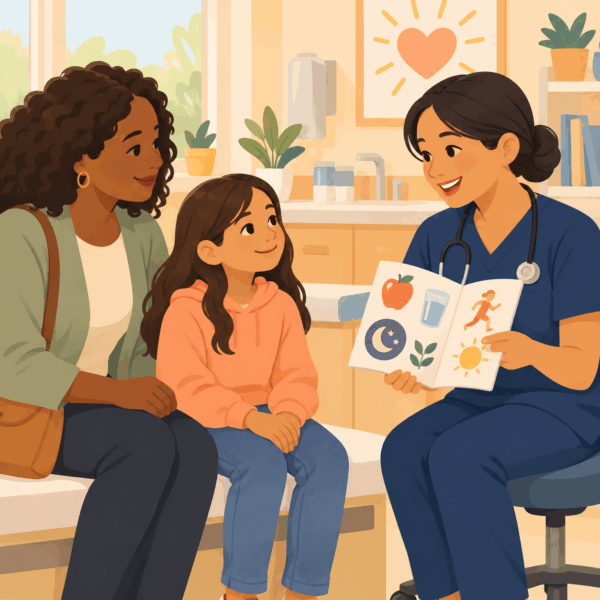 Early childhood communication determines whether families of young children know that public early childhood programs exist, understand which programs their children qualify for, can complete applications and secure placements, and move into kindergarten with confidence. When eligibility rules are technical, enrollment processes are fragmented, and transition information arrives late, many eligible families never enroll. Because effective early childhood communication requires coordination across early childhood leaders, district staff, Head Start agencies, child care providers, early intervention providers, health and social service partners, and elementary schools, early childhood programs often partner with Stegmeier Consulting Group (SCG) to build a more welcoming and coordinated approach. SCG helps programs ensure that public early learning investments reach the children they were designed to serve.
SCG supports early childhood programs in assessing how families experience the process of finding, applying to, and enrolling in programs. This can include reviewing eligibility explanations, application forms, documentation requirements, outreach channels, waitlist communication, and kindergarten transition practices, along with comparing enrollment patterns with the eligible population. These findings help programs identify barriers and underserved communities. Plain language eligibility guides, age charts, documentation checklists, and coordinated outreach plans then help families take the next step.
Sustained progress depends on the people families meet throughout the process. Enrollment staff, teachers, family advocates, and trusted messengers such as pediatricians, librarians, and home visitors all influence whether families enroll. SCG helps programs develop training for front line staff, scripts for common situations, and simple materials that trusted partners can share. Multilingual communication and guidance on early intervention and preschool special education transitions help ensure that every family understands its options.
Prekindergarten expansion, new coordinated enrollment systems, eligibility changes, and efforts to strengthen kindergarten transitions can make this work especially urgent. SCG helps programs plan communication for these moments, coordinate with elementary schools on registration and transition activities, and prepare families for the first weeks of a new program. By planning communication in advance, programs can reach more families at the right time.
SCG also helps early childhood programs evaluate whether communication is reaching families effectively. Enrollment representativeness, application completion rates, family feedback in families’ languages, participation in transition activities, and on-time kindergarten registration can reveal where gaps persist. By incorporating these findings into ongoing planning, programs can make clear, welcoming communication an ongoing practice that gives every young child a strong start.
Future Trends
Many states and communities are expanding access to public prekindergarten, moving toward universal or mixed-delivery systems that include school-based and community-based programs. These expansions will require clear communication about new options, eligibility changes, and how families can choose among providers.
Coordinated enrollment systems for early childhood programs are becoming more common, allowing families to apply to multiple programs through a single process. Programs participating in these systems will need to communicate clearly about how applications, rankings, and placements work.
Text messaging and mobile applications are increasingly used for early childhood enrollment reminders, daily communication, and family engagement. Programs that use these tools thoughtfully, with attention to language access and privacy, can strengthen family connections.
Attention to kindergarten transition is growing, with more communities developing structured transition plans, shared data systems, and joint professional learning between early childhood and elementary educators. Communication will be central to making these efforts work for families.
Finally, recognition of the value of home languages and culturally responsive practice continues to grow, encouraging programs to communicate in ways that affirm families’ languages, cultures, and roles as their children’s first teachers.
Conclusion
Public early childhood programs offer children a strong start and families essential support, but only when families know about them and can navigate enrollment. Clear communication is what turns public investment into real opportunity for children.
By designing communication around families’ realities, explaining the early childhood landscape and eligibility clearly, simplifying enrollment, welcoming children with disabilities and multilingual families, coordinating kindergarten transitions, and building ongoing partnerships, early childhood programs can reach more families and help every child begin school ready to thrive.
When families experience early childhood programs as welcoming, understandable, and supportive, they carry that trust into elementary school and beyond, building a foundation for partnership throughout their children’s education.
Stegmeier Consulting Group’s Strategic Approach to Communication Systems
Give every young child and family a clear path into learning.
Stegmeier Consulting Group helps public early childhood programs communicate enrollment, eligibility, and the transition to kindergarten. We begin by mapping how families experience your programs today, from first awareness and eligibility questions through applications, placement, daily communication, and kindergarten registration.
Our team works alongside early childhood leaders, district staff, and community partners to develop plain language eligibility guides, coordinated outreach through trusted messengers, multilingual enrollment materials, reminder sequences, special education transition resources, and kindergarten transition plans built in partnership with elementary schools.
We treat early childhood communication as a system that welcomes families into public education. That means designing communication around families of young children, reducing barriers at every step, and measuring whether programs reach the children they were created to serve.
Use the form below to connect with our team and explore how strategic early childhood communication can help your program reach more eligible families, simplify enrollment and eligibility, and help every child move confidently from early learning into kindergarten.