
How Labor Standards and Workplace Safety Agencies Benefit From a Dedicated Communication Strategy
Labor standards and workplace safety agencies operate in an unusually demanding communication environment. They enforce wage and hour laws, workplace safety requirements, labor relations rules, personnel standards, and other protections that affect both workers and employers. Their audiences often have competing interests, different levels of legal knowledge, and very different reasons for engaging with the agency. A worker may be trying to determine whether a pay practice is lawful, while an employer may be trying to understand how to comply with a new requirement. A union, industry association, attorney, community organization, or public official may be looking at the same issue from another perspective entirely.
Without a dedicated communication strategy, agencies can easily fall into a reactive pattern. One division publishes a fact sheet, another develops enforcement messaging, a third answers recurring questions through a call center, and field staff develop their own explanations based on what they encounter. Each communication may be technically accurate, but the overall system can still feel fragmented. Terminology varies, priorities compete, audiences receive different levels of detail, and residents may struggle to understand which office handles which issue.
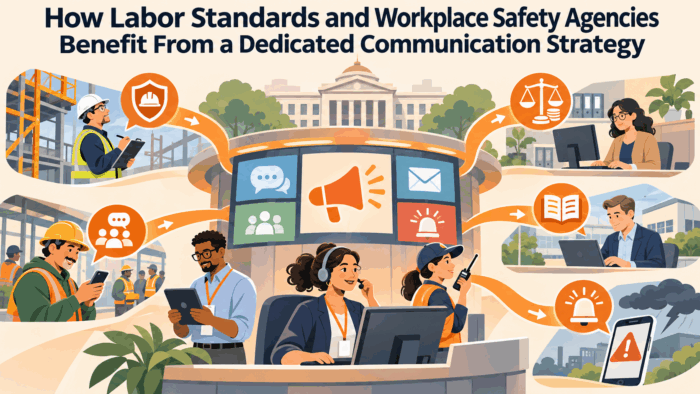
A dedicated communication strategy gives the agency a framework for deciding what needs to be communicated, to whom, through which channels, and with what level of detail. It connects enforcement communication, worker education, employer guidance, public reporting, community outreach, internal communication, and crisis response so they reinforce one another rather than operating as separate activities. It also helps agencies distinguish between communication intended to explain the law, communication intended to encourage compliance, and communication intended to report enforcement activity or agency performance.
This distinction is important because communication in labor and workplace safety settings can affect perceptions of fairness and neutrality. Workers need to believe they can seek information or report violations without the agency minimizing their concerns. Employers need to understand that the agency expects compliance but is also willing to explain requirements clearly. Stakeholders on both sides need confidence that the agency applies the same standards consistently and does not use communication to favor one constituency over another.
A strong communication strategy does not change the agency’s enforcement authority or legal responsibilities. It makes those responsibilities easier to understand and creates a more predictable experience for the people who interact with the agency. That can improve compliance, reduce avoidable confusion, strengthen public trust, and help staff communicate more consistently across programs and locations.
Move From Reactive Communication to an Agency-Wide Strategy
 Many labor standards and workplace safety agencies communicate intensively but strategically only in isolated areas. Staff may produce enforcement announcements, educational materials, employer bulletins, worker rights guides, training presentations, social media posts, call center scripts, and website updates without a single framework connecting them. The result can be substantial communication activity without a clear communication system.
An agency-wide strategy begins by identifying the major communication functions the organization needs to perform. Those may include explaining rights and responsibilities, supporting voluntary compliance, encouraging reporting, communicating inspection or investigation processes, explaining enforcement outcomes, preparing the public for regulatory changes, coordinating with community and industry partners, and providing reliable information during workplace emergencies or other high-visibility events.
The strategy should also identify which audiences need different types of information. Workers, employers, unions, worker centers, trade associations, attorneys, legislators, local governments, and members of the public may all interact with the agency, but they do not need identical messages or communication channels. A dedicated strategy helps the agency adapt information to each audience without changing the underlying policy or legal standard.
This shift from individual communication products to a coordinated strategy is one of the most important benefits of deliberate communication planning. Instead of asking only what should be published this week, the agency begins asking how each communication supports a larger public understanding of its mission, authority, services, and expectations.
Clarify What the Agency Does and Does Not Do
Labor and workplace safety systems can be difficult for the public to navigate because responsibility is often divided among several agencies, divisions, boards, commissions, or programs. Wage claims may be handled differently from workplace safety complaints, public employment disputes may belong to another body, and civil service or personnel questions may fall outside the agency entirely. Workers and employers may not understand these distinctions.
A dedicated communication strategy should make agency jurisdiction one of its foundational themes. Public-facing materials should explain which issues the agency handles, what information it can provide, what processes are available, and where people should go when a matter falls outside the agency’s authority. Clear referral information is just as important as clear descriptions of internal services.
This helps reduce one of the most common sources of frustration in government communication: people reaching the wrong office and being told only that their issue cannot be handled there. A stronger communication system explains why the issue belongs elsewhere and provides a meaningful next step whenever possible.
Jurisdictional clarity also protects the agency from unintentionally overstating its role. Public communication should not imply that the agency can resolve every workplace dispute or provide remedies that actually belong to courts, federal agencies, local governments, collective bargaining processes, or other institutions.
Build a Clear Public Map of Agency Responsibilities
Agencies can make jurisdiction easier to understand by organizing public information around the problems people are trying to solve rather than around internal organizational charts. A worker may be searching for help with unpaid wages, unsafe conditions, retaliation, discrimination, or a public employment dispute without knowing which division has authority.
A clear responsibility map can connect those common questions to the appropriate agency function and explain when the issue belongs somewhere else. The language should be plain enough that a first-time user can navigate it without already understanding administrative terminology.
This type of guidance reduces misdirected contacts while making the agency appear more helpful and coordinated.
Balance Worker Education and Employer Guidance
Labor standards agencies often serve two audiences that may view the same law very differently. Workers need to understand their rights, protections, and options for reporting concerns. Employers need to understand their responsibilities, how to comply, and what to expect during inspections, investigations, or enforcement processes.
A dedicated communication strategy should make room for both without creating false equivalence between rights and obligations. The agency’s legal responsibilities remain the same, but the explanation can be adapted to the questions each audience is most likely to have.
Worker-facing communication may focus on recognizing potential violations, understanding protections from retaliation, identifying documentation that may be useful, and knowing how to file a complaint or request assistance. Employer-facing communication may focus on compliance expectations, recordkeeping, new standards, inspection processes, available consultation services, and how to correct identified problems.
The strategy should ensure that these two streams remain consistent. Workers should not encounter strong rights language while employers receive ambiguous compliance guidance, and employers should not receive detailed explanations of procedures that workers cannot also understand. Consistency helps reinforce the agency’s role as a neutral administrator and enforcer of the law.
Make Complex Labor Rules Understandable Without Oversimplifying Them
Labor and workplace safety requirements often involve technical definitions, exceptions, thresholds, classifications, and procedural rules. Public communication must simplify these concepts enough to be usable without changing their meaning or creating misleading generalizations.
A dedicated strategy can establish plain-language standards for how legal and regulatory information is translated into public-facing content. Agencies can identify which technical terms should always be explained, how examples should be used, when formal legal language needs to appear alongside a plain-language explanation, and when staff should direct users to the controlling statute, regulation, or formal guidance.
This consistency is particularly important when different divisions communicate about related issues. A term such as employee, employer, retaliation, hazard, overtime, or covered workplace may have specific legal significance. Different programs should not casually define the same term in incompatible ways.
Plain-language communication should therefore be treated as a disciplined translation process rather than a simplification exercise. The objective is to make the law easier to understand while preserving the limits, conditions, and distinctions that matter.
Support Compliance Before Enforcement Becomes Necessary
A dedicated communication strategy can help labor and safety agencies strengthen voluntary compliance by making expectations easier to find and understand before violations occur. Enforcement remains essential, but communication can reduce the number of problems caused by misunderstanding, outdated information, or unclear implementation guidance.
Agencies can use employer bulletins, webinars, industry outreach, checklists, FAQs, digital guides, and consultation programs to explain new or commonly misunderstood requirements. Communication should focus on what employers need to do, when the requirement takes effect, what records may be necessary, and where they can obtain authoritative information.
This approach is particularly important when new standards or policy changes affect many employers at once. Waiting until inspections or complaints reveal widespread confusion is less efficient than communicating proactively during implementation.
Compliance communication should not be framed as leniency or as an alternative to enforcement. It is part of effective regulation. An agency can clearly explain expectations and still enforce them when violations occur.
Help Workers Recognize Violations Before They Need to File
Workers cannot use protections they do not understand. A dedicated communication strategy should therefore include year-round education that helps people recognize when a workplace issue may fall within the agency’s authority.
This education can address topics such as wages, hours, workplace hazards, retaliation protections, required notices, leave-related rights where applicable, and other issues within the agency’s jurisdiction. The goal is not to turn workers into legal experts. It is to give them enough information to recognize when they may need additional help.
Communication should also explain what evidence or information may be useful if the worker contacts the agency. People may benefit from knowing how to preserve pay records, schedules, correspondence, photographs, or other relevant information where appropriate.
Proactive education is especially important for workers who may not already be connected to unions, attorneys, or advocacy organizations. A dedicated strategy can help the agency reach people before a problem becomes severe enough that they have no other option but enforcement.
Build Retaliation Communication Into the Strategy
Fear of retaliation can discourage workers from contacting labor and safety agencies even when they believe a violation has occurred. Agencies should therefore treat retaliation communication as a core part of worker education rather than as a small disclaimer near the end of complaint instructions.
Public-facing materials should explain what retaliation generally means within the agency’s authority, what protections may apply, and how workers can report concerns about retaliatory conduct. The exact legal standards vary by program, so communication should remain accurate to the relevant law and avoid implying broader protections than the agency can enforce.
The agency should also prepare staff to discuss retaliation consistently. A worker who raises fear of losing a job or having hours reduced should receive a clear explanation of available protections and processes rather than being told only to complete a complaint form.
Strong retaliation communication can improve access to enforcement because it acknowledges one of the practical reasons workers may hesitate to seek help.
Coordinate Enforcement Communication Across the Agency
Enforcement announcements can shape public understanding of an agency more than almost any other type of communication. A high-profile citation, wage recovery, workplace fatality investigation, or major settlement may attract attention far beyond the people directly involved.
A dedicated communication strategy should establish how enforcement outcomes are explained, which facts are appropriate to release, how legal status is described, and how the agency connects individual cases to broader compliance expectations without sensationalizing them.
Communication should distinguish allegations, findings, settlements, citations, appeals, and final outcomes accurately. Agencies should avoid language that makes an unresolved matter sound final or that treats an enforcement announcement primarily as a publicity opportunity.
Well-designed enforcement communication can serve an educational purpose. It can explain what requirement was involved, what employers should understand, and where workers can learn more while preserving legal accuracy and procedural fairness.
Prepare Staff to Communicate Consistently Across Programs and Locations
Even the strongest public materials can be undermined if front-line staff provide different explanations depending on which office, investigator, inspector, call center employee, or program the public contacts. A dedicated communication strategy should therefore include internal guidance and staff preparation.
Staff should have access to current talking points, FAQs, referral guidance, plain-language definitions, and escalation procedures. They should understand how to explain what the agency can and cannot do and how to handle questions that cross into legal advice, another program’s jurisdiction, or an unresolved enforcement matter.
Consistency does not require employees to use identical scripts. Staff should be able to communicate naturally while relying on the same underlying facts and policy boundaries.
This internal alignment is especially important for statewide or multi-office agencies. Workers and employers should receive the same essential explanation of a law or procedure regardless of which office they contact.
Treat Communication as Part of Enforcement Effectiveness
Communication should not be viewed as separate from the agency’s regulatory mission. When workers do not understand their rights, violations may go unreported. When employers do not understand new requirements, preventable compliance problems may increase. When public instructions are inconsistent, staff spend more time resolving confusion that could have been avoided.
A dedicated communication strategy supports enforcement by improving understanding before, during, and after regulatory interactions. It helps people know when to contact the agency, what to expect from the process, and what responsibilities they have once the agency becomes involved.
Communication can also help agencies identify emerging problems. Repeated questions, search behavior, call center patterns, partner feedback, and recurring misunderstandings may reveal where a particular standard or process is not being understood.
Treating communication as part of enforcement effectiveness elevates it from a supporting function to an operational capability. The agency becomes better equipped to educate, regulate, enforce, and maintain credibility across the many audiences affected by its work.
Build Communication Around the Agency’s Core Public Responsibilities
A dedicated communication strategy should begin by identifying the responsibilities the agency most needs the public to understand. Labor standards and workplace safety agencies may oversee wage enforcement, occupational safety, retaliation protections, public employment relations, personnel systems, consultation services, complaint intake, hearings, inspections, or other functions. When those responsibilities are communicated inconsistently, the public may understand individual programs without understanding how the agency as a whole operates.
The strategy should organize communication around these core responsibilities rather than around the internal structure of the department. Workers and employers generally do not care which bureau or division owns a program until they need to contact it. Their first question is usually practical: where do I go, what does this agency handle, and what happens next.
This does not mean hiding the agency’s organizational structure. Division names and legal authorities remain important, particularly for attorneys, regulated employers, and frequent users. The communication strategy should simply make those details secondary to a clear explanation of public responsibilities.
When agencies communicate their core functions consistently, every fact sheet, webpage, event, enforcement announcement, and staff interaction reinforces the same understanding of the agency’s role.
Develop Separate Communication Paths for Workers and Employers
Workers and employers often need information about the same law for very different reasons. A worker may be trying to determine whether a paycheck is correct, whether a workplace condition is unsafe, or whether reporting a concern could result in retaliation. An employer may be trying to understand how to implement a new standard, maintain required records, or respond to an inspection.
A dedicated communication strategy should recognize these differences instead of forcing both audiences through the same content path. Worker-facing materials can emphasize rights, reporting options, protections, and what to expect when contacting the agency. Employer-facing materials can emphasize obligations, compliance steps, implementation guidance, consultation resources, and enforcement procedures.
The underlying legal standard should remain consistent across both paths. The difference lies in what context each audience needs in order to understand and act on the information. This allows the agency to provide useful communication without appearing to change the law depending on who is reading it.
Separate audience pathways can also improve website navigation, outreach planning, webinars, newsletters, and social media. People are more likely to find useful information quickly when the agency has intentionally designed content around why they are seeking help.
Create a Consistent Plain-Language Framework
Labor standards and workplace safety agencies often need to communicate rules that are legally technical but operationally practical. A dedicated strategy should establish a common plain-language approach so different programs do not explain similar concepts in radically different ways.
The framework can include standards for sentence length, definitions, examples, headings, disclaimers, references to controlling law, and explanations of exceptions. It can also identify terms that should always be defined because the public is likely to misunderstand them.
This consistency matters across channels. A term used in an enforcement announcement should not be explained differently in a worker guide or employer FAQ unless the difference is legally necessary. Staff talking points should reinforce the same language used on the website.
A plain-language framework makes communication easier to maintain because staff are not reinventing explanations independently. It also strengthens public trust because people encounter a more coherent agency voice.
Use Examples Carefully to Explain Complex Requirements
Examples can make technical requirements easier to understand, but they can also create confusion if users assume the example applies universally. Agencies should use examples that illustrate principles while making clear that actual outcomes depend on the facts and the applicable law.
Examples should avoid oversimplifying exceptions, thresholds, or jurisdictional limits. They should also be reviewed when laws or regulations change so old scenarios do not continue circulating after the underlying requirement has shifted.
Used carefully, examples can make difficult concepts much more accessible without turning general information into individualized legal advice.
Integrate Worker Rights Education Into Year-Round Communication
Worker education should not depend only on enforcement events, awareness campaigns, or moments when new laws take effect. A dedicated communication strategy should provide a year-round framework for helping workers recognize rights and understand how to seek assistance.
Recurring education can focus on wage protections, workplace safety, reporting procedures, retaliation, complaint processes, and other topics within the agency’s authority. Materials should be designed for people who may have little familiarity with labor law or government processes.
Agencies should also consider when workers are most likely to need information. Seasonal employment, high-risk industries, periods of extreme weather, or major regulatory changes may create predictable moments when targeted communication becomes more important.
Year-round education creates continuity. Workers do not encounter the agency only after a violation has already become serious.
Build Employer Compliance Education Into the Strategy
Employer communication should likewise be continuous rather than limited to enforcement notices or regulatory announcements. Agencies can use a dedicated communication strategy to help businesses understand obligations before problems occur.
Compliance education may include webinars, implementation guides, checklists, FAQs, industry-specific outreach, newsletters, consultation services, and targeted reminders about common requirements. The strategy should identify which subjects generate the most confusion and prioritize those areas for proactive communication.
Smaller employers may need different communication than large organizations with legal or compliance departments. A dedicated strategy can account for these differences and provide information in formats that are realistic for different types of businesses.
Proactive employer education can reduce preventable violations while reinforcing that compliance expectations remain firm. Clear guidance and enforcement are complementary functions, not competing ones.
Coordinate Communication Around New Laws and Standards
New labor and workplace safety requirements can create significant demand for information from workers, employers, attorneys, unions, industry associations, and community organizations. Agencies should treat major policy changes as communication initiatives rather than isolated publication tasks.
Planning should begin before the effective date whenever possible. The agency may need to prepare summaries, FAQs, employer guidance, worker education, staff talking points, webinars, partner materials, and website updates. These products should be coordinated so they present the same core explanation.
Communication should also distinguish among the date a law is enacted, the date implementing rules are issued, and the date compliance becomes required. Confusion about timing can lead workers and employers to act on requirements that are not yet effective or to overlook deadlines that have already arrived.
A coordinated rollout helps the agency manage demand while giving the public a clearer path through complex changes.
Use Partner Networks Without Losing Message Control
Labor and workplace safety agencies often rely on unions, worker centers, trade associations, chambers of commerce, legal aid organizations, community groups, and professional associations to extend their reach. These organizations can help communicate with audiences the agency may not reach effectively through its own channels.
A dedicated communication strategy should define how partners are used and what materials they receive. Providing approved toolkits, translated content, presentation materials, social copy, and links to authoritative guidance can reduce the risk that partners unintentionally modify the message.
Agencies should also preserve their neutral role. Working with worker organizations does not mean adopting those organizations’ advocacy positions, just as working with industry groups does not mean endorsing employer interests. Partner engagement should be tied to education, access, and compliance.
Clear partner protocols allow agencies to benefit from trusted networks while maintaining control over the accuracy and neutrality of official information.
Coordinate Communication During Inspections and Investigations
Inspections and investigations create moments when both workers and employers may be uncertain about what the agency is doing and what will happen next. A dedicated communication strategy can establish consistent explanations for these processes without compromising confidential or ongoing matters.
Employer communication can explain the general inspection process, what documentation may be requested, how findings are communicated, and what procedural options may follow. Worker communication can explain how concerns may be raised, what protections apply, and what the agency can and cannot disclose.
The strategy should also prepare staff to distinguish procedural information from case-specific interpretation. People involved in an active matter may ask questions that the agency cannot answer until the investigation is complete.
Clear process communication can reduce anxiety and speculation while preserving the integrity of enforcement activity.
Use Enforcement Announcements to Educate, Not Just Publicize
Enforcement communication should do more than announce that the agency took action. A dedicated strategy can turn enforcement outcomes into public education by explaining the legal or safety issue involved and connecting it to broader compliance guidance.
A strong announcement can identify the type of violation, describe the agency’s action accurately, explain the status of the matter, and direct workers or employers to resources about the underlying requirement. This helps the public understand why the case matters without sensationalizing the individuals or organizations involved.
Agencies should also be consistent about terminology. Allegations, citations, findings, settlements, orders, and final decisions should not be treated as interchangeable.
Educational enforcement communication reinforces the agency’s expectations while preserving procedural fairness and legal accuracy.
Create Internal Communication Standards for Front-Line Staff
A dedicated public communication strategy cannot succeed if internal communication remains fragmented. Inspectors, investigators, call center staff, clerks, outreach teams, and managers should have access to the same current information and understand the same communication boundaries.
Agencies can create internal guidance for common questions, referrals, legal-advice boundaries, escalation procedures, jurisdictional issues, and public explanations of new requirements. The goal is not to turn every employee into a spokesperson. It is to give staff enough shared guidance to avoid contradictory answers.
Internal updates are especially important when laws, enforcement policies, or public materials change. Staff should not learn about a new public guidance document from a caller who found it online before employees were briefed internally.
Strong internal alignment improves both public service and organizational credibility. People are more likely to trust the agency when the answer does not change depending on which office or staff member they contact.
Treat Communication Planning as an Ongoing Management Function
 A dedicated communication strategy should not be written once and then left unchanged. Labor standards and workplace safety agencies operate in environments shaped by new laws, emerging hazards, economic changes, enforcement trends, and shifting public expectations.
Leadership should review communication priorities regularly and identify where public understanding is weak. Call center questions, complaint patterns, website searches, partner feedback, enforcement activity, and staff observations can all reveal subjects that require stronger communication.
The strategy should also define how major communication decisions are made, who owns agency-wide standards, and how programs coordinate before publishing information that affects multiple divisions.
Treating communication as an ongoing management function makes the agency more adaptable. It allows communication priorities to evolve alongside the regulatory environment while preserving a consistent public understanding of the agency’s mission and responsibilities.
Use Communication to Improve Complaint Intake and Reporting
Labor standards and workplace safety agencies depend on workers, employers, unions, community organizations, and other stakeholders to identify potential violations and emerging problems. A dedicated communication strategy can improve complaint intake by making it easier for people to understand when the agency has jurisdiction, what information is useful, how to submit a concern, and what happens after a complaint is received.
Public-facing complaint information should explain the process in plain language. Workers should know whether they can submit information online, by phone, in person, or through another channel, what documentation may be helpful, and whether the agency can provide interpretation or other assistance. Employers and third parties should likewise understand how to raise questions or provide information when appropriate.
The agency should also explain what happens after intake. People may assume that submitting a complaint automatically starts a full investigation, produces immediate contact, or guarantees a particular outcome. Clear communication can distinguish intake, review, investigation, inspection, referral, and closure without exposing confidential details.
Improved complaint communication benefits enforcement as well as access. Better-informed complainants are more likely to provide useful information, while staff spend less time clarifying basic procedural questions that could have been answered before submission.
Make Retaliation Protections Visible Across the Communication System
Retaliation concerns should not be confined to a single webpage or legal notice. A dedicated communication strategy should integrate retaliation information throughout worker-facing materials, complaint instructions, outreach presentations, and enforcement education where the relevant protections apply.
Workers may hesitate to contact an agency because they fear termination, reduced hours, undesirable assignments, threats, or other consequences. If retaliation protections are not visible until after someone begins the complaint process, the agency may never hear from workers who are too concerned to take the first step.
Communication should explain the applicable protections accurately and avoid suggesting that every adverse workplace action automatically qualifies as unlawful retaliation. The agency should also explain how retaliation concerns can be reported and whether a separate process or timeline applies.
Making retaliation information prominent sends an important operational message. The agency understands that access to enforcement depends not only on whether a complaint form exists, but also on whether workers feel able to use it.
Communicate Inspection Processes Before Conflict Develops
Workplace inspections can create tension because employers may not understand what will occur, while workers may not understand what information they can provide or what the agency may disclose. A dedicated communication strategy can make the inspection process more predictable without compromising enforcement authority.
Employer-facing materials can explain the general sequence of an inspection, the role of inspectors, the kinds of records or access that may be requested, and how findings or citations are communicated. These materials should remain general enough that they do not become instructions for avoiding enforcement or predicting the agency’s investigative approach in a specific case.
Worker-facing communication can explain how employees may participate, how concerns can be raised, what confidentiality protections may apply, and what the agency can and cannot discuss during an active inspection. Workers should not assume that the agency can provide real-time updates on every investigative step.
Process transparency reduces unnecessary conflict. Employers and workers may still disagree about the facts or outcome, but they are less likely to misunderstand the agency’s basic role and procedures.
Separate Process Transparency From Case Commentary
Agencies should be transparent about how inspections and investigations generally work while remaining disciplined about active cases. Explaining the process does not require discussing evidence, witness statements, internal deliberations, or likely outcomes in a particular matter.
Staff should have clear guidance on where that boundary lies so procedural transparency does not drift into unauthorized case commentary.
This distinction allows the agency to remain accessible without compromising investigations, confidentiality, or procedural fairness.
Explain Enforcement Outcomes in Context
Enforcement results can attract significant attention, particularly when they involve large penalties, substantial wage recoveries, serious workplace injuries, or repeat violations. A dedicated communication strategy should help the agency explain these outcomes in a way that is accurate, proportionate, and educational.
Public communication should identify what the agency found or alleged, what action was taken, and the procedural status of the matter. A citation that can still be contested should not be described as though every issue is finally resolved. A settlement should not be presented as identical to a fully litigated finding if the legal posture is different.
Context is equally important. The agency can explain the broader requirement involved, why compliance matters, and where employers or workers can find additional guidance. This allows enforcement communication to support prevention and education rather than functioning only as publicity.
A consistent approach to enforcement outcomes can also strengthen perceptions of fairness. The agency appears focused on applying and explaining the law rather than selectively amplifying cases for reputational effect.
Communicate Repeat Violations Without Losing Proportionality
Repeat violations may justify stronger enforcement attention and may also be relevant to public understanding of compliance patterns. Agencies should communicate these cases carefully so the message remains factual rather than punitive in tone.
The communication should explain what makes the conduct a repeat violation under the applicable framework and how that status affects enforcement where relevant. It should avoid language that goes beyond the official findings or suggests motives the agency has not established.
Agencies can use repeat-violation communication to reinforce expectations for corrective action and sustained compliance. Employers should understand that resolving one enforcement event does not eliminate the obligation to maintain compliance going forward.
This approach supports deterrence without turning the agency’s communication function into a vehicle for public shaming.
Prepare for High-Visibility Workplace Incidents
Serious workplace injuries, fatalities, explosions, chemical releases, structural failures, or other major incidents can create immediate public and media attention. Labor standards and workplace safety agencies need a communication strategy that is prepared for these situations before they occur.
The strategy should define who speaks for the agency, what can be confirmed during the early stages, how coordination occurs with emergency responders or other agencies, and how staff avoid speculating about cause or responsibility before the investigation is complete.
Public communication should distinguish the known facts of the incident from the agency’s investigative role. Early statements may explain that an inspection or investigation has begun, what agency has jurisdiction, and when additional information may become available without implying that findings have already been made.
Prepared crisis communication allows the agency to respond quickly while protecting the integrity of the investigation. It also reduces the likelihood that inconsistent comments from multiple staff members become the public record before facts are established.
Coordinate With Other Agencies During Multi-Jurisdictional Events
Workplace incidents and labor disputes may involve several government entities at once. Local emergency services, environmental agencies, health departments, law enforcement, licensing bodies, or other regulators may each have responsibilities that overlap with the labor or workplace safety agency.
A dedicated communication strategy should establish how the agency coordinates public information when several authorities are involved. Each organization should understand which facts it owns, which questions should be referred elsewhere, and whether a joint communication structure is appropriate.
This coordination is particularly important when different agencies use different terminology or operate under different legal authorities. The public should not receive apparently contradictory explanations simply because each agency is speaking from its own narrow perspective.
Interagency communication protocols help preserve accuracy while making complex events easier for workers, employers, media, and the public to understand.
Build Multilingual Communication Into Core Operations
Labor standards and workplace safety agencies often serve workers whose primary language is not English, including people employed in industries where language barriers can directly affect awareness of rights and safety expectations. A dedicated communication strategy should integrate multilingual communication into routine operations rather than treating translation as an occasional outreach project.
Agencies should identify which materials carry the greatest consequences if they are not understood. Complaint instructions, retaliation information, safety alerts, worker rights guides, hearing notices, inspection information, and major regulatory changes may warrant priority attention.
Translation should also be coordinated with content updates. A translated page that remains online after the English version has changed can create serious inconsistency. Version control and review procedures should therefore apply across languages.
Multilingual communication can also benefit from trusted community partners, but official materials should remain clearly identifiable as authoritative agency information.
Improve Communication With Employers of Different Sizes
Large employers may have legal counsel, safety professionals, human resources teams, and dedicated compliance staff. Small businesses may rely on an owner, manager, or outside advisor who handles many responsibilities at once. A dedicated communication strategy should account for these differences.
Smaller employers may benefit from concise implementation guides, practical checklists, short webinars, and clearly organized webpages that explain what must be done without assuming specialized regulatory expertise. Larger employers may need more detailed technical guidance and direct access to formal rules or policy documents.
The legal obligation does not change based on employer size unless the law itself creates different requirements. The communication format, however, can be adapted so different audiences can understand and act on the same standard.
This audience-aware approach can improve compliance without creating the impression that the agency is applying different rules to different businesses.
Use Data to Identify Communication Gaps
Labor standards and workplace safety agencies generate substantial information that can reveal where the public is confused. Call center questions, complaint categories, website searches, frequently downloaded documents, training attendance, partner inquiries, and recurring enforcement issues can all provide insight into communication needs.
A dedicated strategy should include a process for reviewing these signals regularly. If large numbers of employers ask the same implementation question, the agency may need clearer guidance. If workers repeatedly contact the wrong division, jurisdictional communication may be inadequate. If one safety requirement appears repeatedly in enforcement activity, additional education may be warranted.
The agency should distinguish communication gaps from broader compliance problems. Not every violation occurs because the rule was unclear, and communication should not be treated as a substitute for enforcement. Data can nevertheless help identify where better explanation could prevent avoidable mistakes.
Using operational data makes communication planning more evidence-based. Resources can be directed toward topics and audiences where misunderstanding is most visible.
Measure Whether Communication Changes Understanding and Behavior
Publishing more materials does not necessarily mean the communication strategy is effective. Agencies should evaluate whether workers and employers actually understand the information and whether communication helps them take the intended next step.
Possible measures can include successful navigation to the correct complaint process, reduced misdirected calls, increased use of consultation or educational resources, improved understanding after training, or fewer recurring questions about a newly implemented requirement. Agencies can also examine whether partner organizations are accurately communicating official information.
Measurement should be connected to the purpose of each communication activity. A worker rights campaign may be intended to improve recognition and reporting, while an employer guidance initiative may be intended to reduce common compliance errors.
Outcome-focused measurement helps agency leadership determine where communication is supporting the regulatory mission and where additional changes are needed.
Use Communication as an Early Warning System
Communication channels can help agencies detect emerging issues before they become widespread enforcement problems. Repeated worker questions, unusual complaint patterns, partner reports, or sudden increases in employer inquiries may indicate that a new hazard, misunderstanding, or implementation challenge is developing.
A dedicated strategy should create a pathway for this information to reach program and enforcement leadership. Front-line communication staff should not simply answer recurring questions without reporting the pattern.
This feedback can inform new guidance, targeted outreach, staff training, or enforcement planning depending on the nature of the issue. Communication becomes a source of operational intelligence rather than only a mechanism for distributing information.
When agencies use communication this way, they become more responsive to the environments they regulate. Public questions and stakeholder feedback help the agency identify where attention may be needed before problems become more difficult to manage.
Build a Formal Communication Governance Structure
A dedicated communication strategy works best when responsibility for communication is defined at the organizational level rather than left to individual divisions or program managers. Labor standards and workplace safety agencies should establish clear governance for who sets agency-wide communication standards, who reviews high-risk content, who owns major public information channels, and how different programs coordinate before publishing information that affects shared audiences.
This governance structure should account for the range of communication functions the agency performs. Enforcement announcements, worker education, employer guidance, crisis communication, regulatory updates, public records information, outreach campaigns, multilingual materials, and staff talking points may all require different levels of review. The agency should know which products can be handled routinely and which require legal, policy, executive, or communications review before release.
Clear governance also reduces duplication. Without coordination, several divisions may create separate guidance about related topics, using different terminology or emphasizing different parts of the same requirement. A central framework can preserve program expertise while ensuring that the public encounters a coherent agency voice.
Communication governance does not need to make every message slow or centralized. The goal is to establish enough structure that staff understand the standards, approval pathways, and responsibilities before a high-profile or time-sensitive issue arises.
Create an Agency-Wide Communication Calendar
Labor and workplace safety agencies often know in advance when certain communication needs will arise. New laws may have scheduled effective dates, annual reporting cycles may create predictable public interest, seasonal hazards may recur, and planned outreach campaigns may align with known industry patterns. A communication calendar helps the agency prepare for these moments rather than responding only after questions increase.
The calendar can include regulatory implementation dates, anticipated guidance releases, training schedules, major outreach periods, recurring safety topics, legislative reporting milestones, public meetings, employer education, and worker rights campaigns. It should also leave room for enforcement events, workplace incidents, and other developments that cannot be predicted.
Planning ahead allows agencies to coordinate related communication products. A new requirement may need an employer guide, worker FAQ, webinar, staff briefing, partner toolkit, social media campaign, and website update. Building those materials as one coordinated initiative is more effective than developing each one separately after the effective date approaches.
An agency-wide calendar also helps leadership see where communication demands may overlap. Staff can allocate resources more realistically and avoid releasing several major initiatives at the same time when audiences may struggle to absorb them.
Establish Standards for High-Risk Communication
Some labor and workplace safety communication carries significantly more legal, operational, or reputational risk than routine public information. Agencies should identify these categories in advance and establish a more deliberate review process for them.
High-risk communication may include major enforcement announcements, workplace fatalities, pending investigations, controversial regulatory changes, significant penalties, repeat violations, allegations involving prominent employers, or issues attracting substantial media or political attention. These situations require particularly careful attention to legal status, confidentiality, procedural fairness, and factual precision.
A dedicated strategy should define who reviews these materials and which questions must be resolved before publication. Staff should verify whether the matter involves allegations or final findings, whether appeal rights remain, what information can legally be disclosed, and whether coordination with another agency is necessary.
This review process protects the credibility of the agency while still allowing timely communication. Speed matters, but accuracy and procedural fairness matter more.
Use a Standard Review Checklist for Sensitive Communication
A standard review checklist can help staff evaluate sensitive communication consistently before release. The checklist can address factual verification, legal posture, confidentiality, terminology, jurisdiction, partner coordination, accessibility, translation, and whether the communication clearly distinguishes established facts from unresolved issues.
The same checklist can be used across different divisions so that high-risk communication is not reviewed differently depending on which program generated it.
A structured review process reduces the likelihood that important considerations are missed during fast-moving events.
Build Internal Communication Into Every Major Public Rollout
Employees should not learn about new public guidance, regulatory changes, or enforcement messaging after it has already been published. A dedicated communication strategy should include internal preparation before major public-facing initiatives launch.
Inspectors, investigators, call center staff, regional offices, outreach teams, supervisors, and other front-line employees should receive concise internal guidance explaining what changed, what the public is being told, and how recurring questions should be handled. They should also know where to find the current materials.
Internal preparation is especially important when the agency changes terminology, launches a new complaint process, introduces a new online tool, or revises public instructions. Staff may continue relying on older explanations unless the change is communicated intentionally.
Aligning internal and external communication strengthens credibility. Workers and employers are less likely to encounter a situation where the website says one thing and staff provide another answer.
Establish Version Control Across Public Guidance
Labor standards and workplace safety guidance can remain online for years, and outdated materials may continue appearing through search engines, saved links, partner websites, or downloaded files. Agencies should establish formal version-control procedures for public-facing information.
Guides, FAQs, fact sheets, training materials, forms, and downloadable documents should include revision dates or another way to identify the current version. When a requirement changes, the agency should review related materials across the full communication system rather than updating only the most obvious page.
Archived materials should be clearly distinguished from current guidance where they need to remain publicly available. Old content should not appear alongside current information without enough context for users to understand which version applies.
Version control is particularly important in regulatory environments because people may make compliance or reporting decisions based on materials they believe are authoritative. Keeping those materials current is part of the agency’s communication responsibility.
Coordinate Translation and Accessibility With Content Updates
Multilingual and accessible communication should be updated at the same pace as the primary English-language content. Agencies should not treat translated materials or accessible versions as secondary products that can be revised later.
When a major worker rights guide, employer FAQ, or complaint instruction changes, the agency should identify which translated and accessible formats are affected. Update planning should include translation, review, captioning, document accessibility, and other necessary steps from the beginning.
Agencies should also maintain a system for determining which version controls when translated content is temporarily out of sync during an urgent change. Users should not unknowingly rely on outdated information simply because the current version has not yet been translated.
Integrating these steps into routine content management makes communication more equitable and reduces the risk that some audiences receive older or incomplete guidance.
Create a Structured Partner Communication Program
Community and industry partners can significantly extend the reach of a labor or workplace safety agency, but partner communication should be managed systematically. Agencies should identify major partner categories, what information those partners need, and how updates are distributed.
Worker centers, unions, legal aid organizations, chambers of commerce, employer associations, professional groups, community organizations, training providers, and local governments may all serve different audiences. The agency should avoid assuming that one partner email list is sufficient for every issue.
Partner toolkits can include approved language, current guidance links, translated materials, event information, FAQs, and contact points for additional questions. When a significant rule or procedure changes, partners should receive updated materials promptly and be told which older information is no longer current.
A structured partner program helps agencies benefit from trusted external networks without losing control over the accuracy of official information.
Prepare a Crisis Communication Framework Before a Workplace Emergency
Serious workplace incidents require immediate coordination, and agencies should not wait until a fatality, explosion, chemical release, structural failure, or other major event occurs to decide how communication will work.
A crisis framework should identify spokespersons, approval pathways, coordination with emergency responders and other regulators, internal notification procedures, and the type of information that can be confirmed during the earliest stages. It should also establish how updates will be provided as the investigation progresses.
Early communication should remain disciplined. Agencies can confirm their involvement, describe the general investigative role, and provide verified facts without speculating about cause, responsibility, or potential enforcement outcomes.
Preparation helps the agency respond quickly while preserving investigative integrity. It also reduces the likelihood that inconsistent comments from several staff members create confusion during a high-profile event.
Build a Media Communication Protocol
Labor standards and workplace safety agencies may receive media inquiries about enforcement actions, workplace incidents, regulatory changes, controversial cases, or broader trends. A dedicated communication strategy should define how those inquiries are handled.
Staff should know who is authorized to speak, how requests are routed, and when subject matter experts should be involved. Media responses should use the same terminology and legal distinctions reflected in official agency materials.
The protocol should also address what happens when reporters request information that cannot yet be disclosed. A clear explanation of procedural or confidentiality limits is preferable to inconsistent responses from different offices.
A structured media process helps agencies communicate quickly and accurately while protecting the integrity of active matters.
Measure Communication Performance Across the Agency
A dedicated communication strategy should include agency-wide measures that help leadership understand whether public information is actually working. Individual programs may track their own activity, but broader measures can reveal patterns that cross organizational boundaries.
Agencies can monitor misdirected inquiries, recurring call center questions, website searches that produce poor results, complaint completion problems, employer training participation, partner feedback, use of translated materials, and public response to major regulatory changes. These indicators can reveal where communication remains difficult to navigate.
Leadership should also distinguish between output and outcome measures. Publishing more fact sheets or social media posts does not necessarily mean understanding has improved. The stronger question is whether workers and employers can find the right information and act on it correctly.
Agency-wide measurement makes communication accountable to the same standards of effectiveness applied to other operational functions.
Create a Continuous Improvement Process
Communication strategy should evolve as laws, hazards, enforcement priorities, technology, and public expectations change. Agencies should establish a routine process for reviewing what is working and where communication continues to create confusion.
Program staff, investigators, inspectors, call centers, outreach teams, legal staff, and external partners can all contribute information about recurring misunderstandings. This feedback should be gathered systematically rather than relying only on occasional anecdotes.
When a problem is identified, the agency should determine whether the solution is clearer content, better navigation, staff training, stronger partner outreach, a revised form, or a broader change in process. Communication problems sometimes reveal operational problems that cannot be solved through wording alone.
Continuous improvement helps the agency avoid repeating the same communication failures and keeps the strategy aligned with changing regulatory needs.
Preserve Institutional Knowledge About Communication Systems
Effective communication practices are often developed through years of experience, major enforcement events, regulatory changes, workplace emergencies, and public feedback. Agencies should preserve those lessons so they are not lost when staff or leadership changes.
Institutional resources can include communication standards, review checklists, partner frameworks, crisis protocols, translation procedures, approval pathways, measurement methods, and records of lessons learned from previous initiatives.
Agencies should also document why major communication practices exist. Future staff may otherwise remove a review step or change a message structure without understanding what previous problem it was designed to solve.
Preserving institutional knowledge makes communication strategy durable. It allows the agency to improve over time rather than rebuilding its communication system every time personnel or leadership changes.
Strategic Communication Support for Labor Standards and Workplace Safety Agencies
 Labor standards and workplace safety agencies operate in environments where communication affects how workers understand their rights, how employers understand their obligations, how partners extend agency information, and how the public interprets enforcement activity. A dedicated communication strategy helps bring these functions together so the agency is not relying on disconnected fact sheets, isolated outreach campaigns, individual staff explanations, and one-off enforcement announcements to shape public understanding.
Stegmeier Consulting Group (SCG) can support labor standards, workplace safety, labor relations, and personnel agencies by developing agency-wide communication strategies, plain-language frameworks, worker and employer message systems, regulatory rollout plans, enforcement communication protocols, partner toolkits, internal staff guidance, multilingual communication structures, crisis communication plans, media protocols, and communication measurement systems. SCG can also help agencies identify where different divisions are communicating similar issues inconsistently and create a stronger agency-wide framework that preserves program-specific expertise while improving clarity across the organization.
External strategic communication support can be particularly valuable when agencies oversee several distinct regulatory functions, are implementing major policy changes, need to improve communication across multiple offices, or are responding to recurring public confusion about jurisdiction, enforcement, or compliance. SCG’s role remains focused on communication strategy, public information, stakeholder engagement, information organization, and communication systems. SCG does not provide legal advice, determine enforcement outcomes, interpret laws on behalf of regulated parties, replace inspectors or investigators, or make substantive regulatory decisions that belong to the responsible agency.
Future Trends
Labor standards and workplace safety communication will become more integrated with regulatory implementation. Agencies are increasingly expected not only to publish new laws or standards but also to explain what they mean, when they take effect, who is covered, what workers should understand, and what employers need to do. Communication planning will therefore need to begin earlier in the policy implementation process rather than being added after legal or operational decisions are complete.
Agencies will also face stronger expectations for audience-specific communication. Workers, small employers, large employers, unions, worker centers, industry associations, attorneys, and community partners may all need different levels of detail and different communication channels. The challenge will be adapting information to those audiences without allowing the underlying legal standard or agency message to fragment.
Digital service expectations will continue to rise as more workers and employers use online complaint systems, mobile websites, digital guidance, webinars, email alerts, and automated information tools. Agencies will need to ensure that these systems are easy to navigate, accessible, multilingual where necessary, and connected to authoritative current guidance. Technology can improve access, but it can also spread outdated or inconsistent information quickly if content governance is weak.
Communication will also become increasingly important during emerging workplace risks and rapidly changing regulatory environments. New technologies, evolving work arrangements, extreme weather, changing industry practices, and new safety concerns may require agencies to communicate before long-standing public understanding exists. Agencies with established communication governance, partner networks, rapid update procedures, and plain-language standards will be better prepared to respond without sacrificing accuracy.
Conclusion
Labor standards and workplace safety agencies benefit from a dedicated communication strategy because their work depends on public understanding. Workers need to recognize their rights and know how to seek help. Employers need clear explanations of compliance obligations. Community and industry partners need accurate materials they can share. Staff need consistent guidance so the public does not receive different answers depending on which office or program they contact.
A strong strategy connects these needs instead of treating them as separate communication projects. Worker education, employer guidance, enforcement announcements, crisis communication, public reporting, internal staff communication, partner outreach, and regulatory implementation should reinforce the same understanding of the agency’s mission, authority, and expectations.
The strongest agencies also treat communication as an operational capability. They use public questions to identify emerging confusion, measure whether information is helping people take the correct next step, maintain version control across guidance, prepare for high-risk communication, and preserve institutional knowledge so communication quality does not depend on a few experienced employees.
Dedicated communication does not weaken enforcement or make regulatory requirements less demanding. It helps agencies explain those requirements more clearly, apply them more consistently, and make their processes easier to understand. That can strengthen compliance, improve access to enforcement, reduce avoidable confusion, and support confidence that the agency is communicating fairly with both workers and employers.
Stegmeier Consulting Group’s Strategic Approach to Communication Systems
Build agency-wide communication systems that help workers understand their rights, employers understand their responsibilities, and the public understand how labor standards and workplace safety enforcement works.
Labor standards and workplace safety agencies need communication systems that connect worker education, employer compliance guidance, enforcement communication, public outreach, internal staff alignment, partner engagement, and crisis response into one coherent strategy. Stegmeier Consulting Group (SCG) helps agencies develop communication frameworks, plain-language standards, regulatory rollout plans, staff guidance, partner toolkits, multilingual content systems, enforcement messaging protocols, and measurement approaches that strengthen clarity across the entire organization.
Use the form below to connect with our team and explore how strategic communication support can strengthen public understanding, compliance communication, stakeholder engagement, and agency-wide communication systems.