
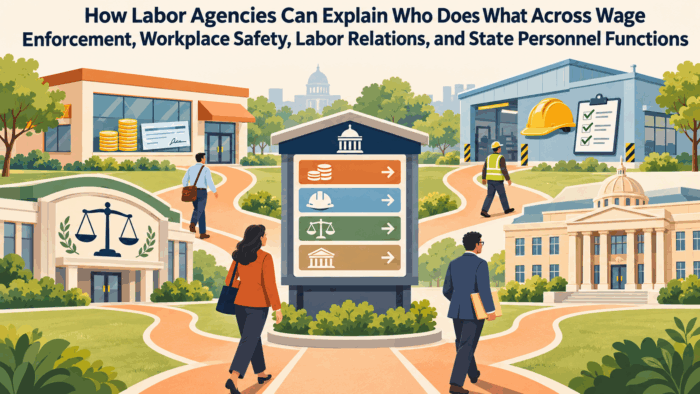
How Labor Agencies Can Explain Who Does What Across Wage Enforcement, Workplace Safety, Labor Relations, and State Personnel Functions
Labor agencies frequently oversee or operate alongside several employment-related functions that appear closely connected to the public but are legally and operationally distinct. Wage enforcement programs may investigate unpaid wages, overtime, deductions, recordkeeping, and other labor standards issues. Workplace safety programs may inspect hazards, investigate serious incidents, issue citations, and require corrective action. Labor relations boards or commissions may oversee representation elections, unfair labor practice cases, collective bargaining disputes, or mediation. State personnel agencies and central human resources offices may administer civil service systems, classifications, examinations, compensation structures, and personnel policies for the government itself. To employees working inside these institutions, the distinctions may be familiar, but to workers, employers, applicants, unions, public employees, and members of the public, they can be difficult to understand.
Most people do not begin with a clear understanding of which statutory authority or agency division governs their situation. They begin with a workplace problem. Their paycheck appears wrong, they believe a worksite is unsafe, they have a question about union representation, they disagree with a classification decision, or they are unsure whether a supervisor’s action belongs in a grievance, a labor relations proceeding, a personnel appeal, or an enforcement complaint. When government communication begins primarily with bureaus, divisions, boards, commissions, program names, and acronyms, it asks the public to solve an internal organizational puzzle before the agency has helped them understand where their issue belongs.
That confusion has practical consequences for both the public and the agency. Workers may spend days or weeks moving between offices, employers may seek guidance from programs that do not have authority to answer their questions, and public employees may mistakenly assume that a personnel agency can resolve a labor relations dispute or that a labor relations board handles every disagreement involving a unionized workplace. Call centers and front-line employees may spend substantial time redirecting inquiries, while partner organizations may unintentionally contribute to the problem by making referrals based on familiar agency names rather than the specific authority involved. Even when each individual program performs effectively, the overall system can still feel inaccessible if the boundaries among those programs are poorly explained.
Labor agencies can reduce this burden by designing communication around what people are trying to accomplish rather than expecting users to understand government structure first. The public should be able to begin with a recognizable issue and then be guided toward the correct function, authority, and process. That approach does not eliminate important legal distinctions. It translates those distinctions into a public-facing system that explains what each function handles, what it does not handle, what kind of action it can take, when more than one program may be involved, and where someone should begin when the correct pathway is unclear.
Organize Public Navigation Around Workplace Problems Rather Than Internal Structure
 One of the most important improvements labor agencies can make is to separate public navigation from the organizational chart. An organizational chart may accurately show where wage enforcement sits within a department, how a safety division is structured, where a labor relations board fits within government, or how a personnel agency relates to other administrative offices. That information is useful for transparency, but it does not necessarily help someone who wants to know why their paycheck is short, whether a workplace condition is dangerous, who handles a union representation issue, or where to challenge a civil service classification. The public usually needs a problem-solving map before it needs an administrative map.
Problem-based navigation should begin with the language people naturally use when they describe a situation. Workers may search for missing overtime, unpaid time, dangerous conditions, retaliation, or a paycheck problem. Public employees may search for a classification dispute, union election, civil service exam, grievance, or bargaining issue. Employers may search for wage compliance, inspection requirements, employee classification, or labor relations procedures. These terms may not match formal program titles, but they are the entry points people actually use. Websites, call centers, intake tools, and printed materials should recognize those entry points and translate them into the correct government pathway.
The same principle should guide intake and referral design. A person should not have to select among unfamiliar program names before explaining what happened. A general intake system, call center, or digital navigation tool can ask about the nature of the issue first and identify the relevant function second. When several functions may apply, the system can explain that the workplace problem may need to be divided into more than one regulatory or administrative process rather than forcing the user into a single category that does not fit the full situation.
This approach places more responsibility on the agency and less on the user. Government still maintains its internal structure, legal authorities, and specialized programs, but the public-facing experience absorbs some of that complexity rather than requiring workers and employers to master it before receiving assistance. When navigation begins with recognizable problems, agencies reduce misdirected inquiries, improve access, and create a more coherent entry into systems that may remain complex behind the scenes.
Explain Wage Enforcement and Workplace Safety as Different Regulatory Functions
Wage enforcement and workplace safety are often housed within the same department or broader labor agency, which can make them appear more interchangeable than they actually are. Both may receive worker complaints, interact with employers, conduct investigations, and take enforcement action. However, they generally focus on different legal requirements, collect different information, follow different procedures, and may provide different remedies. Public communication should make these distinctions clear before a worker or employer begins a formal process rather than expecting people to discover the difference only after entering the wrong program.
Wage enforcement should be explained through the compensation and labor standards issues it is designed to address. Depending on the jurisdiction, this may include minimum wage, overtime, deductions, recordkeeping, prevailing wage, paid leave, or other labor standards. Workers need to understand the kinds of pay or employment standard concerns the program may review, while employers need to understand the corresponding compliance obligations. Just as important, the agency should explain that wage enforcement is not a general forum for every employment problem. A workplace hazard, discrimination claim, workers’ compensation issue, unemployment matter, or union representation dispute may require another process even though it arises from the same employment relationship.
Workplace safety should be explained through hazards, inspections, safety standards, corrective action, and the program’s role in protecting workplace conditions. Workers may contact the agency because they believe a condition is dangerous, because a serious incident occurred, or because they believe required protections are missing. Employers may need guidance about inspections, abatement, consultation, or compliance obligations. The agency should make clear that a safety complaint is not simply another type of labor standards claim. It may involve different evidence, investigators, timelines, and enforcement authority, even when the same employer and worker are involved.
The distinction becomes particularly important when one workplace situation raises both wage and safety questions. A worker may describe unpaid time connected to a safety procedure, retaliation after raising a hazard, or an unsafe assignment that also affects compensation. From the worker’s perspective, this may feel like one workplace problem. From the agency’s perspective, it may require two or more separate regulatory pathways. Communication should acknowledge that reality directly and explain which portion belongs where, what each program can do, and whether the worker must initiate separate contacts or processes.
Explain Labor Relations and State Personnel Functions Through Their Institutional Roles
Labor relations and state personnel functions can be particularly difficult for public employees and managers to distinguish because both may involve government workplaces, supervisors, unions, classifications, compensation, and employment policies. The key communication challenge is to explain that these systems may operate in the same environment while exercising fundamentally different authority. Labor relations bodies often administer collective processes such as representation, bargaining, unfair labor practice cases, elections, or mediation, while state personnel agencies may administer civil service hiring, classification systems, exams, compensation structures, and internal government workforce policies.
Labor relations communication should help users understand that these boards or agencies are not general workplace complaint offices. A disagreement with a supervisor does not automatically create a labor relations case, and the presence of a union does not mean every employment dispute belongs before a labor relations board. Depending on the issue, a public employee may need to use a grievance process, an internal personnel procedure, a civil service appeal, or another administrative pathway. The labor relations function should be explained in terms of the collective and statutory processes it actually administers rather than through broad language that suggests it handles every dispute involving workers and employers.
State personnel functions should be explained through their role in administering government employment. Applicants may interact with these agencies through civil service exams, eligibility lists, hiring rules, and classifications. Current employees may encounter them through compensation systems, classification structures, personnel rules, or other workforce policies. These activities can overlap with subjects addressed through bargaining or employee relations, but the personnel agency may not be the authority responsible for resolving a union representation dispute or enforcing an unrelated labor standard. Clear communication should show where personnel administration ends and where another process begins.
The overlap between personnel and labor relations systems should be acknowledged rather than hidden. A classification may be established through a personnel system while compensation or working conditions are affected by collective bargaining. A public employee may have a classification appeal and a separate grievance arising from the same workplace event. Agencies should explain these intersections in terms of authority and process, helping users understand which office can take which action instead of asking them to infer jurisdiction from organization names alone.
Make Overlap and Referrals Easier to Understand
One of the greatest communication risks is oversimplifying complex workplace issues into a single destination. Some situations genuinely involve more than one program, and users should be prepared for that possibility from the beginning. A worker may have a wage concern and a safety concern. A public employee may have both a classification issue and a labor relations question. An employer may face separate compliance obligations that are administered by different parts of government. Trying to make each of these situations appear to have one simple owner may make navigation look easier initially but can create frustration later when the person discovers that several processes are actually required.
The stronger approach is to explain overlap in practical terms. Agencies can identify which part of the situation belongs to which program, whether separate intake processes are required, whether information can be shared internally, and what each process can ultimately accomplish. This helps people understand why the government is dividing what feels like one workplace problem into several institutional pathways. The explanation should emphasize that the separation reflects different legal authority rather than bureaucratic unwillingness to help.
Referrals should follow the same principle. Telling someone only that the current office does not handle the issue leaves the user with the most difficult part of the problem unresolved. A useful referral explains what the current program handles, why the issue appears to belong elsewhere, what the receiving office does, and what the person should do next. When possible, agencies can use warm handoffs, direct transfers, or coordinated referral systems so that people with complicated issues do not repeatedly begin from the beginning.
Agencies should also be transparent when programs do not automatically communicate with each other. Users may assume that contacting one office activates every related labor process, especially when programs share the same department name or website. Confidentiality requirements, separate statutory authority, or independent intake systems may make that assumption incorrect. Public communication should clearly explain when separate contact is required and when internal coordination may occur so users can make informed decisions about how to proceed.
Build One Role-Clarity System Across Every Public and Internal Channel
Role clarity should be managed as an agency-wide communication system rather than as a collection of individual program descriptions. Websites, call centers, intake forms, regional offices, partner organizations, and internal guidance should all rely on the same underlying map of responsibilities. If each program explains itself independently, even accurate descriptions can create contradictions when users compare them side by side. One program may describe an issue as a complaint, another as a claim, and another as an appeal, while staff use entirely different terminology during live interactions.
An internal responsibility matrix can serve as the foundation for this system. It can identify major issue categories, the function responsible, the type of authority exercised, common exclusions, referral destinations, general process steps, and areas where jurisdiction may overlap. The matrix can then support public webpages, call center decision trees, forms, partner toolkits, and staff training. The public does not need to see every internal detail, but every public explanation should come from the same institutional understanding.
Partner organizations should be included in this structure because worker centers, unions, employer associations, workforce organizations, and community groups often help people decide where to go. They should receive simple, current issue-to-program guidance and clear instructions for ambiguous situations. They should not be expected to make formal jurisdictional determinations, but they can help reduce common misrouting when the agency gives them accurate and usable referral tools.
The system also needs strong version control. Programs may be renamed, responsibilities may shift, or agencies may reorganize. When that happens, websites, call center tools, forms, partner materials, translated resources, and staff guidance should be updated together. Old program names should remain searchable during transition periods so users who know the previous structure are not suddenly disconnected from the services they were trying to find.
Treat Role Clarity as a Measure of Access and Service Quality
Explaining who does what is not simply an organizational communication exercise. It determines whether workers, employers, public employees, applicants, and partners can actually reach the services the government has created for them. A strong wage enforcement program is less accessible if workers cannot identify it as the correct pathway. A well-run safety program cannot serve people efficiently if basic website navigation repeatedly sends wage questions to safety staff. A personnel appeal system may be legally sound while remaining difficult to use if employees cannot distinguish it from labor relations or departmental HR.
Agencies can measure where role communication is failing by tracking misdirected calls, incorrect intake submissions, transfers, abandoned online pathways, recurring referral questions, and complaints about being sent from office to office. These patterns should be reviewed across programs rather than only within each division because the consequences of unclear communication frequently appear somewhere other than the source of the confusion. A program may believe its own description is adequate while another office is receiving hundreds of misdirected inquiries because the distinction is not clear enough to the public.
Leadership should use these patterns to improve both communication and service design. If users consistently confuse two programs, the answer may be clearer wording, different website architecture, stronger call center guidance, revised intake questions, or a better general entry point. If a particular issue repeatedly requires manual routing, a digital navigation tool or cross-program referral procedure may be appropriate. The goal should be to reduce the amount of organizational knowledge users must possess before reaching the correct service.
The broader principle is that the public should not have to understand the government as well as the government understands itself before receiving help. Labor agencies can preserve distinct legal authorities and specialized processes while presenting them through a coherent public-facing system. When people understand who does what, why those functions differ, and where to start, the labor system becomes easier to navigate, more transparent, and more accountable.
Design Clear Entry Points for Workers, Employers, and Public Employees
Different audiences enter labor systems with different assumptions, so a single generic navigation path is rarely enough. Workers may begin with a problem they believe is unfair or unlawful, employers may be looking for compliance guidance, and public employees may be trying to understand whether an issue belongs to HR, civil service, labor relations, or another process. Each audience needs an entry point that reflects how they are likely to describe the problem while still directing them toward the same underlying responsibility framework.
For workers, navigation should emphasize practical situations such as missing pay, unsafe conditions, retaliation concerns, or uncertainty about where to file. For employers, the system may need to distinguish among compliance guidance, inspections, investigations, labor relations questions, and personnel administration. Public employees may need a more explicit explanation of how departmental HR, central personnel, labor relations, union processes, and regulatory functions differ from one another.
These audience-specific pathways should not create competing explanations of jurisdiction. They should use different entry language while leading back to the same core program definitions and boundaries. The objective is to help each audience recognize the right pathway without changing what the agency actually does.
Clarify What Each Function Can Actually Do
Program names alone do not tell users what authority a function exercises. A worker may understand that wage enforcement handles pay issues but still not know whether the program can investigate records, recover wages, issue penalties, or refer the matter elsewhere. An employer may know that a workplace safety office conducts inspections but not understand what happens after hazards are identified.
Agencies should therefore describe functions in terms of actions as well as subject matter. Wage enforcement may investigate, determine compliance, pursue remedies, or take other authorized action. Workplace safety programs may inspect, cite, require correction, or provide consultation depending on the program. Labor relations bodies may conduct elections, adjudicate disputes, mediate, or administer bargaining-related processes, while personnel agencies may administer examinations, classifications, eligibility systems, or workforce rules.
Action-oriented descriptions make boundaries easier to understand because users can compare not only what a program covers but also what it is empowered to do. This can prevent unrealistic expectations, such as assuming that a personnel agency can issue a safety citation or that a labor relations board can resolve every individual employment complaint. Clear authority descriptions also help staff explain why a referral is necessary rather than making the transfer feel arbitrary.
Build Better Cross-Program Referral Practices
Referrals are often the point where otherwise accurate communication breaks down. A worker may begin with wage enforcement and be told to call workplace safety, only to discover that the safety office needs different information and follows a separate intake process. Public employees may move among HR, personnel, union representatives, and labor relations without understanding why each office is redirecting them.
Agencies should develop referral practices that explain the logic behind the handoff. Staff should be able to tell the person what the current office handles, why the issue appears to fall elsewhere, and what the receiving program is likely to do. This makes the referral educational rather than merely transactional.
Where feasible, agencies should use warm transfers or other forms of coordinated handoff for complex issues. Even a brief explanation passed to the next office can reduce the burden on users who have already described the same problem several times. The strongest referral systems make users feel that the agency is guiding them through a structure rather than pushing them away from one office at a time.
Explain When One Situation May Require Several Processes
Labor-related problems often cross institutional boundaries, and agencies should explain this possibility clearly rather than treating overlap as an exception. A worker may raise both wage and safety concerns. A public employee may have a classification issue, a grievance, and a labor relations question that arise from the same underlying event.
Communication should help users understand that one workplace situation can produce several distinct legal or administrative questions. Each question may require a different program, different evidence, and a different decision-making process. Explaining this early can reduce frustration when the person learns that one complaint or appeal will not automatically resolve every aspect of the problem.
Agencies should also make clear whether processes run independently or whether some internal coordination occurs. Users should know if they need to make separate contacts, submit separate forms, or wait for one process before another begins. This level of transparency helps people manage expectations and understand why government may divide a single workplace problem into several pathways.
Strengthen Communication for Public Employees Navigating Multiple Systems
Public employees often face the most complicated version of role confusion because several employment systems may apply simultaneously. They may interact with their employing department, central personnel, a union, a labor relations board, a workplace safety program, and other agencies depending on the issue. Without clear guidance, employees can easily assume that all of these functions are different doors into the same process.
Agencies should explain the distinct purpose of each system using practical examples. Departmental HR may administer internal policies and personnel actions. Central personnel may oversee classifications, examinations, or broader civil service rules. A union may represent employees under a collective bargaining agreement, while a labor relations body may oversee statutory disputes or representation matters. Safety and wage concerns may belong to separate regulatory programs.
This explanation should be reinforced through employee orientation, agency websites, supervisor guidance, union materials, and internal HR resources. Public employees should not have to wait until a conflict develops to discover how the systems differ. Early role clarity can reduce misdirected appeals and help employees identify the correct process before deadlines or procedural requirements become a concern.
Make Employer Navigation More Practical
Employers can also struggle with fragmented labor agency structures, particularly when one organization must comply with wage requirements, safety standards, labor relations obligations, and public personnel systems at the same time. A general directory of divisions may not tell an employer whether it needs compliance guidance, an enforcement contact, a consultation program, or a labor relations resource.
Employer-facing navigation should explain the purpose of each function in operational terms. A business may need wage guidance to understand compensation obligations, safety consultation to reduce workplace hazards, or information about an inspection process after contact from an enforcement office. Public employers may also need to distinguish between personnel administration and labor relations responsibilities.
Agencies should avoid presenting all employer resources as if they serve the same purpose. Compliance assistance, enforcement, adjudication, and personnel administration are different functions even when they concern the same workplace. Clear employer navigation helps businesses find the right resource without assuming that one program can answer every employment-related question.
Use Internal Cross-Training to Improve Public Referrals
Public role clarity depends heavily on whether agency staff understand the larger system beyond their own program. An employee may be highly knowledgeable about wage enforcement but still make poor referrals if they do not understand how workplace safety, labor relations, or personnel functions operate.
Cross-training should focus on practical boundaries and referral points rather than requiring staff to become experts in every program. Employees should know the most common issues handled elsewhere, the basic authority of related programs, and how to route ambiguous situations. This creates enough institutional literacy to help the public without encouraging staff to provide advice outside their role.
Regular refreshers are important because organizational responsibilities and program names can change. Staff who learned the structure several years earlier may unintentionally continue using outdated terminology or referral paths. Cross-training helps keep the public experience aligned even when the internal organization evolves.
Give Partners a Simple and Current Responsibility Map
Worker centers, unions, employer associations, workforce organizations, legal aid groups, and community partners often serve as informal navigators for labor systems. They can extend the agency’s reach, but they can also unintentionally misdirect people if their understanding of program roles is outdated or incomplete.
Agencies should provide partners with simple responsibility maps that identify common issue categories, the likely program, and the official entry point. The materials should also explain when a situation is too ambiguous for the partner to route confidently. In those cases, the partner should know where to send the person for general agency assistance rather than guessing.
Partner guidance should be updated whenever program responsibilities change. A clear distribution and version-control process can prevent old referral sheets from circulating long after a reorganization. This helps external organizations support access without becoming unofficial jurisdictional decision-makers.
Use a General Entry Point for Ambiguous or Overlapping Issues
Even the clearest role explanations will not resolve every situation. Some users will have complicated facts, overlapping issues, or insufficient information to determine where the problem belongs. Agencies should therefore maintain a general entry point designed specifically for uncertainty.
This entry point might be a central call line, digital navigator, general inquiry form, or triage function that allows users to describe the problem in ordinary language. Staff or systems can then identify the likely program or escalate the question when jurisdiction is unclear. The user should not be required to choose a technical category before explaining what happened.
A general entry point also serves as a safeguard against fragmented organizational design. It acknowledges that some complexity cannot be eliminated through public education alone. By giving uncertain users one reliable place to start, agencies reduce the risk that people simply give up after several unsuccessful referrals.
Use Navigation Data to Improve the System
Labor agencies should treat misrouting as useful evidence about where their communication is failing. Repeated transfers, incorrectly filed complaints, calls to the wrong division, abandoned online forms, and recurring jurisdiction questions can all show which program boundaries are difficult for the public to understand.
This data should be reviewed across programs rather than only within individual divisions. One program may receive large numbers of misdirected inquiries because another program’s public description is unclear. Looking at the system as a whole helps leadership identify the true source of navigation problems.
Agencies can then test targeted improvements, such as revised page titles, better issue-based navigation, clearer referral language, or new decision tools. If misrouting decreases after those changes, the agency gains evidence that public understanding improved. Navigation data turns role clarity from an abstract communication goal into something that can be monitored and refined over time.
Treat Role Clarity as an Ongoing Service Design Responsibility
 Explaining who does what should not be viewed as a one-time communications project. Agency structures change, new laws create new responsibilities, and public terminology evolves. A responsibility map that is clear today may become inaccurate or confusing after a reorganization or new program launch.
Leadership should therefore build role clarity into ongoing service design. Program changes should trigger updates to websites, call center tools, partner materials, forms, and internal training. New services should be evaluated not only for how they operate internally but also for how the public will distinguish them from existing functions.
When role clarity is maintained as an ongoing responsibility, labor agencies reduce the burden that organizational complexity places on the public. Workers, employers, public employees, and partners can spend less time trying to determine where they belong and more time using the process that actually applies to their situation.
Explain Jurisdiction Without Making the Public Decode Legal Structure
Jurisdiction is one of the most important concepts labor agencies need to explain, but it is also one of the easiest to communicate poorly. Workers and employers may hear that an agency “does not have jurisdiction” and interpret that statement as a refusal to help rather than a description of legal authority. Public communication should explain jurisdiction in practical terms by showing what kinds of issues a program can act on, what kinds it cannot, and why another office may need to become involved.
The explanation should also acknowledge that jurisdiction can depend on facts that are not obvious at first contact. The same workplace issue may be handled differently depending on the type of employer, the worker’s status, the location of the work, the law involved, or the nature of the alleged conduct. Front-line staff should therefore be careful not to make overly confident routing decisions when a more detailed review is required.
Agencies can make jurisdiction easier to understand by pairing the concept with next steps. Instead of stopping at “this office does not handle that issue,” the agency can explain which function appears more relevant and how the person can reach it. This preserves legal boundaries while reducing the frustration that often comes from being redirected.
Show How Related Programs Differ in Process, Not Just Subject Matter
Two programs may both deal with workplace disputes while following very different processes. Wage enforcement may rely on claims, investigations, records, and remedies, while workplace safety may involve inspections, hazard assessments, citations, and abatement. Labor relations matters may move through filings, hearings, elections, mediation, or adjudication, while personnel systems may rely on administrative review, classification processes, or civil service procedures.
Public communication should explain these process differences because users often assume that all labor-related complaints move through the same sequence. Someone may expect an immediate inspection after filing a wage issue or believe that a personnel appeal works like an enforcement investigation. These assumptions can create frustration even when the agency is following the correct process.
A short process overview can help users understand what happens after they contact a program. The explanation does not need to include every procedural detail, but it should make clear what kind of review, investigation, hearing, or administrative step is likely to occur. This helps users understand why separate functions cannot simply be merged into one general employment complaint system.
Make the Difference Between Regulatory Enforcement and Administrative Review Clear
Regulatory enforcement and administrative review are often confused because both can involve workplace disputes, formal decisions, and government authority. Wage and safety programs may regulate compliance with laws that apply to covered employers, while personnel agencies may review classifications, hiring processes, or other administrative decisions within government employment systems. The public should be able to understand that these functions are related to employment but do not exercise the same kind of authority.
The distinction is especially important for public employees. An employee may believe a classification decision was improper and also believe that a separate workplace right was violated. One concern may belong in a personnel or civil service process, while the other may require a labor standards or safety pathway.
Agencies should explain these differences through the outcome each process can produce. A regulatory program may investigate compliance and pursue corrective or enforcement action, while an administrative personnel process may review whether a classification, examination, or employment decision followed the governing system. Outcome-oriented explanations help users understand why the correct pathway matters.
Explain the Role of Departmental HR Alongside Central Personnel and Labor Relations
Public employees may interact with departmental human resources offices that are separate from central personnel agencies and labor relations bodies. These offices may administer local personnel procedures, internal policies, leave, performance processes, benefits coordination, or other employment functions within the department. Because departmental HR is often the most visible point of contact, employees may assume it has authority over every employment issue.
Communication should explain how departmental HR fits into the broader system. HR may help administer a personnel action, provide internal guidance, or direct an employee toward the correct process, but it may not have authority to decide a labor relations matter, overturn a central classification, or resolve an external regulatory complaint. The distinction should be visible before an employee becomes involved in a dispute.
This clarity also helps managers and supervisors. They should understand when an issue can be addressed through internal HR and when it needs to move into a formal personnel, labor relations, safety, or wage process. Clear role communication can prevent internal staff from unintentionally giving employees incorrect guidance.
Clarify the Difference Between a Grievance, Complaint, Claim, Appeal, and Charge
Labor systems often use formal terms that sound interchangeable to the public but may trigger entirely different procedures. A grievance may arise under a collective bargaining agreement, while a wage claim may involve enforcement of a labor standard. A personnel appeal may challenge an administrative decision, and a labor relations charge may allege conduct within a board’s statutory authority.
Agencies should avoid assuming that users know these distinctions. Public-facing materials should define the terms in plain language and explain which program uses each one. This is especially important on intake pages, where selecting the wrong process can lead to delays or rejected submissions.
Consistent terminology also helps internal staff. If call center employees, program staff, and partners all use the same basic definitions, users are less likely to receive contradictory explanations. Clear vocabulary is therefore part of role clarity, not just a matter of writing style.
Explain What Happens When a Workplace Issue Falls Outside the Agency Entirely
Not every workplace concern belongs within a labor agency, and public communication should address that possibility clearly. Workers may contact a labor department about discrimination, unemployment, workers’ compensation, licensing, contract disputes, or other issues that may be handled elsewhere. Employers may similarly seek answers that fall outside the agency’s authority.
The strongest response explains both the boundary and the likely alternative. Staff should not be expected to provide detailed advice about another agency’s program, but they should have enough referral information to help users identify a reasonable next step. This is especially important when the person’s issue is urgent or when they have already contacted several offices.
Agencies should keep external referral information current and should review recurring misdirected inquiries. If large numbers of users repeatedly contact the wrong institution, the problem may reflect a broader communication gap across government. Better cross-agency referral coordination can reduce that burden.
Build Clear Guidance for Issues That Involve Local, State, and Federal Systems
Workers and employers may face labor requirements administered at different levels of government. Local wage standards, state labor laws, federal workplace safety requirements, and other systems may overlap or apply differently depending on the situation. From the public’s perspective, those layers can be difficult to distinguish.
Agencies should explain the scope of their own authority first. They can then identify when another level of government may have a role without attempting to interpret every external law. This gives users enough information to understand why a referral is necessary while avoiding overstatement.
The same principle applies when multiple levels of government appear to regulate similar subjects. The agency should not imply that one program automatically replaces another unless that is actually true. Clear scope language helps workers and employers avoid assuming that one government contact resolves every related requirement.
Explain When Programs Coordinate and When They Remain Separate
Users may reasonably expect programs within the same department to communicate with one another, but that expectation may not match how the system operates. Separate statutory authority, confidentiality requirements, independent case systems, or procedural rules may limit the amount of coordination that occurs.
Agencies should explain when programs may share information or coordinate and when the user must make separate contact. This is particularly important when a worker raises wage, safety, and retaliation issues at the same time. The person should know whether the agency will route those concerns internally or whether separate submissions are required.
Transparency about these boundaries can reduce frustration later. Users may accept that processes are separate if they understand why and know what they need to do. The problem arises when they assume coordination is happening and later discover that an issue was never opened with the appropriate program.
Improve Communication Around Reorganizations and Program Renaming
Labor agencies sometimes reorganize programs, move responsibilities, merge offices, or change names in ways that make sense internally but create confusion externally. A familiar office may disappear from the website even though the underlying service still exists under a different name. Workers and employers who rely on older materials may then struggle to locate the new pathway.
Change communication should focus on what the reorganization means for the user. Agencies should explain which services moved, whether contact information changed, what happened to pending matters, and which new name corresponds to the old function. Old terminology should remain searchable during a transition period.
Internal staff and partners should receive the same transition guidance. If a new organizational structure is communicated only through a formal announcement, front-line employees and outside organizations may continue using outdated names for months. A coordinated transition protects access while the agency changes internally.
Use Intake and Referral Data to Identify Structural Confusion
Misdirected inquiries can reveal where the public does not understand program roles. If large numbers of wage questions reach a safety office, or personnel appeals repeatedly arrive at a labor relations board, the pattern suggests that navigation or terminology may be unclear. Agencies should treat these patterns as communication data rather than routine administrative inconvenience.
The same analysis can be applied to rejected forms, incomplete submissions, repeated transfers, and calls that begin with “I have already been sent to three offices.” These interactions show where the public-facing structure is not matching the internal structure well enough. Reviewing them across programs can reveal problems that individual divisions may not see on their own.
Agencies can then test improvements and monitor whether misrouting declines. Revised page titles, clearer responsibility maps, better referral scripts, and simpler intake questions can all be evaluated through actual user behavior. This turns role clarity into a measurable part of service quality.
Build a Shared Responsibility Framework for Long-Term Consistency
The strongest role-clarity systems are supported by one shared internal framework that explains the major functions, boundaries, processes, and referral points across the agency. This framework can serve as the source for public webpages, staff training, call center tools, partner guidance, and intake systems.
It should be reviewed whenever program responsibilities change. New laws, reorganizations, digital service changes, and shifts in administrative authority can all affect how the public should be routed. A framework that is not maintained will eventually become another source of confusion.
Shared responsibility guidance also reduces dependence on institutional memory. New staff can understand the larger labor system without relying entirely on experienced employees to explain informal boundaries. Over time, this helps the agency maintain a more stable public experience even as personnel and organizational structures change.
Build Governance Around Cross-Program Role Communication
Role clarity becomes difficult to maintain when each labor program updates its own materials independently. Wage enforcement may revise intake language, workplace safety may change inspection guidance, labor relations may reorganize a filing process, and personnel agencies may rename divisions or alter administrative procedures. If those changes are not coordinated, workers and employers can encounter conflicting descriptions even when each individual program believes its own information is correct.
Agencies should establish clear ownership for cross-program role communication. That responsibility may sit with a communications team, executive office, operations group, or another central function, but it should include participation from program, legal, and front-line staff. The purpose is to make sure that public descriptions of authority, referral points, program names, and process boundaries are reviewed together rather than in isolation.
Governance should also define how disputes about wording are resolved. One program may want a highly technical description while another favors simpler public language, and both may have legitimate concerns. A shared review structure allows the agency to preserve legal accuracy while still creating explanations the public can actually use.
Create a Central Responsibility Matrix for Staff and Communication Teams
A responsibility matrix can serve as the internal foundation for every public-facing explanation of who does what. It can identify major issue categories, the primary program involved, secondary or overlapping programs, the type of authority exercised, common exclusions, and the appropriate referral path. This gives staff one authoritative reference instead of requiring every office to create its own version of the agency’s structure.
The matrix should include practical examples because formal program names alone may not clarify the boundary. A wage issue involving missing overtime may point toward labor standards enforcement, while a dangerous workplace condition may point toward safety. A representation election may belong with labor relations, while a classification or civil service examination issue may belong with personnel administration.
This tool should remain internal and detailed enough to support staff judgment, while simpler versions can be created for the public. The same underlying structure can then support websites, call center decision trees, partner guides, training materials, and intake forms. When every channel comes from the same source, consistency becomes easier to maintain.
Standardize Public Descriptions of Each Major Function
Agencies should develop concise, approved descriptions of wage enforcement, workplace safety, labor relations, and personnel administration that can be reused across channels. Each description should explain what the function handles, what authority it has, what it generally does not handle, and what a user can expect after making contact.
These descriptions should be written in plain language rather than internal terminology. The public does not need a full statutory explanation at the entry point, but it does need enough detail to understand whether the program is likely to be relevant. More technical guidance can be linked from the initial description.
Standardized descriptions also reduce variation across regional offices and partner organizations. A worker should not hear one explanation from a call center and another from a local office. Reusing the same core language helps make the agency feel like one coordinated system.
Build Role Clarity Into Forms and Digital Intake
Intake forms are often where users discover whether they chose the correct program, which is too late if they have already spent significant time completing the wrong submission. Agencies should make role distinctions visible before the form begins. A short explanation of what the program handles, examples of common issues, and links to alternate pathways can prevent unnecessary frustration.
Digital intake can also include simple routing questions that help users recognize overlap. A worker who selects both pay and safety concerns could be told that separate processes may apply. A public employee selecting a classification issue and a union dispute could be directed toward both personnel and labor relations information.
These tools should guide rather than adjudicate. Their purpose is to improve navigation, not to determine legal jurisdiction or decide whether a claim has merit. Clear routing at the front end reduces staff workload and makes the system easier for users to understand.
Strengthen Call Center and Front-Line Referral Systems
Call centers and front-line staff often become the practical interpreters of agency structure. They need clear tools that help them identify the likely program without forcing them to become experts in every legal area. Decision trees, responsibility matrices, and standard referral language can make these interactions more consistent.
Staff should be trained to explain why a referral is being made, not simply where the person should go next. A worker is more likely to accept a transfer when they understand that the issue involves safety rather than wage enforcement or that a public employment matter belongs with personnel rather than labor relations.
The agency should also give staff a clear escalation route for ambiguous cases. Guessing can create another incorrect referral, while a quick internal verification can prevent the person from being sent through several offices. Front-line accuracy is one of the most important parts of public role clarity.
Coordinate Role Communication Across Regional Offices
Regional offices may serve different industries, languages, and local populations, but they should still explain agency roles consistently. Local examples and referral resources can vary, yet the core definition of what each program does should remain stable.
Agencies should periodically review regional practices to identify whether local offices have developed different terminology or informal referral habits. Those differences may have emerged for practical reasons, but they can also create confusion when workers or employers interact with more than one office.
Regular cross-office coordination can help preserve flexibility without allowing the agency’s structure to fragment into several local versions. The objective is consistency in authority and process, with room for regional adaptation in examples and service delivery.
Prepare Partners to Navigate the System Without Making Jurisdiction Decisions
Worker centers, unions, employer associations, legal aid organizations, workforce programs, and community groups often help people decide which labor agency function to contact. These partners should receive simple, current guidance about program roles and referral points.
Partner tools can include issue-to-program maps, common examples, links to official resources, and clear instructions for situations that do not fit neatly into one category. When the issue is ambiguous, the partner should know where to send the person for general agency routing rather than attempting to determine jurisdiction independently.
This approach allows partners to extend access without becoming unofficial interpreters of agency authority. They help people find the right starting point, while formal determinations remain with the agency.
Build Strong Version Control Around Organizational Information
Role communication can become outdated quickly when programs move, merge, change names, or assume new responsibilities. Agencies should therefore manage organizational information with the same discipline used for other important public guidance.
Each major responsibility map, program description, referral guide, and partner resource should have a clear owner and review date. When a change occurs, related materials should be updated together across websites, forms, call centers, staff tools, and partner channels.
Old terminology should not simply disappear overnight. Workers and employers may continue searching for familiar program names long after a reorganization. Redirects, transition notices, and legacy search terms can help users find the new structure without losing access.
Create a Change Communication Plan for Reorganizations
Reorganizations should be explained from the user’s perspective rather than only through internal announcements. The public needs to know which services moved, whether contact information changed, what happens to existing matters, and how the new structure relates to the old one.
Internal staff should receive transition guidance before or at the same time as the public. If call center employees and partners continue using old program names, the agency may create months of confusion even after the formal reorganization is complete.
The strongest change communication also preserves continuity in issue-based navigation. A worker looking for unpaid wages should still be able to find the correct pathway even if the responsible division has been renamed. The public should not need to relearn the agency every time government reorganizes itself.
Use Misrouting Data to Improve Role Communication
Misdirected calls, incorrect form submissions, transfers, abandoned digital pathways, and recurring jurisdiction questions all provide evidence about where the public is struggling. Agencies should track these patterns instead of treating them only as routine administrative work.
The data should be reviewed across programs. One office may receive many incorrect inquiries because another program’s public description is unclear. Looking only within individual divisions can hide the source of the problem.
Agencies can then test targeted improvements and watch whether misrouting decreases. Clearer page titles, better referral language, simpler decision tools, or revised partner guidance can all be evaluated through real user behavior. This turns role clarity into a measurable service objective.
Preserve Institutional Knowledge About Program Boundaries
Long-serving staff often understand program boundaries through years of experience, while newer employees may rely heavily on formal materials. If the agency does not document that knowledge, important distinctions can disappear when experienced staff retire or move into other roles.
Responsibility matrices, referral guides, training materials, and records of recurring jurisdiction questions can preserve that institutional understanding. Agencies should also document why certain boundaries or referral practices exist, not only what they are.
This helps future staff understand the logic behind the system and reduces dependence on informal knowledge. Over time, documented role clarity makes the public experience more stable even as personnel and organizational structures change.
Make Organizational Clarity a Leadership Responsibility
Explaining who does what should not be left entirely to communications staff or call centers. Leadership should view role clarity as part of service quality, operational efficiency, and public access.
Leaders can require regular review of responsibility maps, misrouting data, cross-program referral practices, and public-facing descriptions. They can also ensure that organizational changes trigger coordinated communication rather than isolated updates by individual divisions.
When leadership treats role clarity as an agency-wide responsibility, the system becomes easier to maintain. Workers, employers, public employees, applicants, and partners are more likely to receive consistent guidance regardless of where they enter the labor system.
Strategic Communication Support for Explaining Complex Labor Agency Structures
 Labor agencies often have strong subject-matter expertise inside individual programs but lack a single communication framework that helps the public understand how those programs fit together. Wage enforcement, workplace safety, labor relations, and personnel functions may each be well managed on their own, yet workers and employers can still struggle if websites, call centers, forms, and partner materials describe those functions differently. A coordinated communication strategy can help agencies translate internal structure into a public-facing system that is easier to navigate without weakening the legal distinctions among programs.
Stegmeier Consulting Group (SCG) can support labor agencies by developing responsibility maps, issue-based navigation systems, program comparison tools, call center decision frameworks, referral language, partner guidance, internal responsibility matrices, reorganization communication plans, and measurement systems for tracking misrouting. SCG can also review existing websites, intake processes, forms, and public materials to identify where organizational terminology, outdated program names, or unclear jurisdictional explanations are creating unnecessary barriers.
External strategic communication support can be especially valuable when an agency is reorganizing, adding new functions, consolidating intake, or dealing with recurring confusion among several programs. An outside review can help distinguish between genuine legal complexity and communication complexity that can be reduced through better design. The goal is not to oversimplify authority, but to make the path into the system clearer for workers, employers, applicants, public employees, and partners.
SCG’s role remains focused on communication strategy, public information architecture, stakeholder navigation, internal alignment, and communication systems. SCG does not determine legal jurisdiction, make case-specific decisions, interpret laws on behalf of individual parties, or replace agency counsel, investigators, hearing officers, HR professionals, or other authorized decision-makers. Strategic communication support helps the agency explain its structure more clearly while preserving the authority and independence of each function.
Future Trends
Labor agency structures are likely to become more complex as governments respond to new workplace risks, changing employment models, evolving civil service systems, and shifting regulatory responsibilities. Programs may be renamed, moved, consolidated, or assigned new duties, while the public continues to search using older terms and familiar problem descriptions. Agencies will need communication systems that can adapt quickly without forcing users to relearn the organization every time internal structure changes.
Digital navigation will become more important as more users begin with online search, guided intake tools, or mobile access rather than a central switchboard. Issue-based pathways, searchable responsibility maps, and digital routing tools can help people identify the right program before they begin a formal process. These tools should remain focused on navigation and explanation rather than making legal determinations that belong to program staff.
Cross-agency coordination will also become more important because workers and employers increasingly encounter overlapping local, state, and federal systems. People may not care which level of government created a rule if they are simply trying to find the correct place to ask a question. Agencies that maintain current referral relationships and consistent descriptions of external programs will be better positioned to reduce the frustration of being sent from one institution to another.
The broader trend will be toward treating role clarity as part of service design rather than as a communications afterthought. Agencies will be expected not only to maintain accurate program descriptions but also to demonstrate that users can find the right path with reasonable effort. Navigation, referral quality, and cross-program consistency will increasingly become part of how the public evaluates the effectiveness of the labor system as a whole.
Conclusion
Labor agencies serve the public through functions that may appear closely related while operating under very different authorities. Wage enforcement may investigate labor standards violations, workplace safety programs may inspect hazards, labor relations bodies may administer collective processes, and personnel agencies may manage government employment systems. When these distinctions are not communicated clearly, the public experiences complexity as confusion rather than as a reflection of legitimate institutional design.
The strongest communication approach begins with the problem the user is trying to solve. Workers, employers, and public employees should be able to describe the issue in ordinary language and then be guided toward the correct function. Program names, organizational charts, and statutory terminology can follow once the user understands where the issue belongs.
Clear role communication also requires agencies to explain boundaries, authority, process, and overlap. Users should understand not only what each program handles but also what it does not handle, what kind of action it can take, when another program may also be involved, and whether separate intake is necessary. This level of transparency reduces frustration and makes referrals easier to accept.
Ultimately, explaining who does what is part of public access. A labor agency can have strong individual programs and still provide a difficult user experience if people cannot determine where to start. When organizational clarity is built across websites, call centers, forms, staff guidance, partner materials, and referral systems, the labor system becomes easier to navigate, more transparent, and more accountable.
Stegmeier Consulting Group’s Strategic Approach to Communication Systems
Build labor agency navigation systems that help workers, employers, applicants, and public employees understand which function handles their issue, how the programs differ, and what happens next.
Labor agencies need communication systems that translate complex organizational structures into clear public pathways without erasing the legal and procedural differences among programs. Stegmeier Consulting Group (SCG) helps agencies develop responsibility maps, issue-based navigation, referral frameworks, internal matrices, call center tools, partner guidance, reorganization communication plans, and measurement approaches that make wage enforcement, workplace safety, labor relations, and personnel functions easier to understand and navigate. Use the form below to connect with our team and explore how strategic communication support can strengthen cross-program clarity, public access, referral systems, and agency-wide communication governance.
Use the form below to connect with our team and explore how strategic communication support can help your agency clarify program responsibilities, improve cross-program navigation, strengthen referral systems, and make complex labor and personnel functions easier for workers, employers, applicants, and public employees to understand.