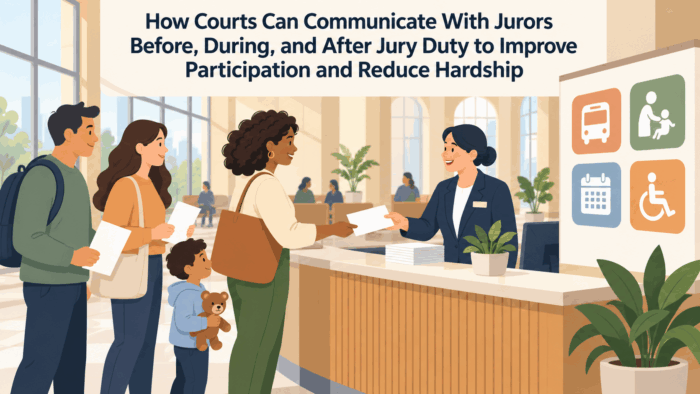
How Courts Can Communicate With Jurors Before, During, and After Jury Duty to Improve Participation and Reduce Hardship
Jury service is the most direct form of civic participation that most people will ever be asked to perform, the one moment when the machinery of the justice system reaches into ordinary life and asks a private citizen to exercise real governmental authority over the fate of another person. It is also, for most people summoned to perform it, a source of significant anxiety, practical disruption, and unresolved confusion about what is expected, how long it will last, what they will experience, and whether the obligation they are being asked to fulfill is genuinely worth the sacrifice it requires. The quality of the communication that courts provide to jurors before, during, and after jury duty determines in large part whether jurors arrive prepared, participate effectively, and leave with their confidence in the justice system strengthened or diminished.
Juror communication failures are common, well-documented, and consequential. Summons notices that provide no meaningful information about what jury duty involves, jury assembly rooms that offer nothing to help waiting jurors understand how their time will be used, voir dire processes that are not explained before jurors are asked to answer intimate questions about their lives and beliefs, trial procedures that are conducted without explanation of why each element occurs, deliberation instructions that are delivered in language that jurors cannot reliably understand, and post-service dismissals that send jurors home without acknowledging the significance of what they contributed, are all communication failures that produce the juror dissatisfaction, the participation avoidance, and the deliberation confusion that undermine jury trial quality and jury system legitimacy.
The practical consequences of inadequate juror communication extend beyond individual juror experience to the integrity of the jury trial process itself. Jurors who do not understand what they are being asked to do during voir dire are jurors whose responses may not accurately reflect their actual qualifications or biases. Jurors who cannot understand the jury instructions they are given are jurors whose deliberations may not reflect a sound application of the law to the facts. Jurors who leave jury service with negative experiences tell others, contributing to the culture of jury duty avoidance that depresses response rates and undermines the cross-sectional community representation that the jury system’s legitimacy depends on. The communication investment that prevents these failures is simultaneously an access to justice investment, a verdict quality investment, and a public confidence investment.
This article examines how courts can design and deliver juror communication programs that reduce the anxiety and the practical hardship of jury service through effective information provision before service begins, that support juror performance and juror dignity during the service period, and that honor jurors’ contributions and extend the civic education value of jury service through thoughtful post-service communication. The arc of the juror experience runs from first contact through the summons notice to final dismissal and beyond, and the communication quality at each point in that arc shapes both the individual juror’s experience and the justice system’s ability to secure the community participation that the jury trial right requires.
The Pre-Summons Communication Environment
 Juror communication begins before any specific court contact, in the ambient cultural understanding of jury duty that potential jurors carry from media representations, from the accounts of family and friends who have served, and from the general civic culture that shapes attitudes toward jury service as an obligation. This ambient environment is, for most potential jurors, not favorable: jury duty is widely represented in popular culture as an inconvenience to be avoided, a disruption to professional obligations, and an experience characterized by interminable waiting and inscrutable legal proceedings. Courts that do not actively communicate to counter this ambient cultural framing are allowing that framing to shape the expectations that potential jurors bring to their summons, their orientation, and their service.
Community education about the jury system, delivered through schools, civic organizations, court open house events, and digital media before any specific summons contact, is the pre-summons communication investment that shapes the cultural environment in which jury summons are received. Courts that participate in mock trial programs, that partner with school districts to include jury system education in civics curricula, that maintain accessible digital resources about jury service for people who want to understand the process before they are summoned, and that conduct community outreach about the importance of diverse jury pools, are investing in the civic education infrastructure that improves the quality of the juror pool and the legitimacy of the jury system before a single summons is issued.
Employer communication programs that educate major employers in the court’s jurisdiction about jury duty legal protections, the typical duration and scheduling of jury service in the court’s jurisdiction, and the specific ways that courts accommodate employer concerns about extended trial service, address the employer-side pressure that significantly influences many potential jurors’ experience of and attitude toward jury service. Many potential jurors experience jury service as a workplace problem before they experience it as a civic opportunity, because their employer’s attitude toward jury service shapes their own attitude. Courts that proactively communicate with employer human resources offices about jury service logistics, employer legal obligations, and court accommodations for scheduling concerns, are addressing a significant source of juror participation anxiety before that anxiety reaches the summons response stage.
Court Communication Strategies for State and Local Judicial Systems: Building Public Trust, Improving Access to Justice, and Explaining Court Processes
This article is part of our series on strategic communication for State and Local Courts, Judicial Systems, and Court Administration. To learn more about court communication strategies for building public trust, improving access to justice, and explaining court processes, and to see the parent article, which links to other content just like this, click the button below.
The Summons: First Formal Contact
The jury summons is the first formal communication that transforms an anonymous potential juror into a specific person with a specific legal obligation, and the quality of the summons communication determines the attitude and the preparation level that potential jurors bring to their service. Most jury summons notices are designed for legal adequacy rather than communication effectiveness: they satisfy the statutory requirements for notice of jury duty obligation while providing minimal information about what that obligation actually involves. The potential juror who receives a summons notice that identifies a reporting date and location but provides no information about what to expect, how long service typically lasts, what hardship accommodation processes are available, or how to respond if the reporting date creates a genuine conflict, is a potential juror who will arrive on the reporting date anxious, underprepared, and potentially resentful of the disruption that inadequate advance communication has not helped them manage.
Summons notice redesign that moves from legal adequacy to communication effectiveness requires adding the specific information that potential jurors most need at the first contact point. The reporting date and location that all summons notices contain should be accompanied by information about typical service duration for the court’s jurisdiction, what to bring and what to leave at home, where to park or how to reach the courthouse by public transit, what the court’s policy is for requesting postponement or hardship excuse, and where to find more detailed information about the jury service process. This additional information does not require a longer summons notice. It requires a better-designed one that uses the available space to serve the potential juror’s information needs rather than to satisfy the institutional documentation requirements that legal adequacy defines.
Online summons response systems that allow potential jurors to confirm their service, request postponement, seek hardship accommodation, or update contact information through a secure digital portal rather than through mail or telephone, reduce the friction of summons response in ways that improve response rates and reduce the administrative burden on court staff who process manual responses. The potential juror who can confirm, postpone, or seek accommodation through a mobile-accessible portal at any time rather than during business hours by telephone, is a potential juror whose response to the summons is more likely to be timely and accurate. Courts that have implemented online juror portals consistently report improved response rates and reduced no-show rates compared with mail-and-telephone systems.
Multilingual summons communication that provides summons notices in the languages most commonly spoken in the court’s jurisdiction, and that offers online resources and telephone assistance in those languages for potential jurors who need help understanding their obligations, is the language access commitment that the jury system’s representative legitimacy requires. The jury pool that includes only English-speaking community members, or that effectively excludes non-English speakers through inadequate language access in summons communication, is a jury pool that does not represent the full community whose justice the jury system is supposed to serve. Language access in jury summons communication is both a legal requirement and a legitimacy obligation that courts have historically underinvested in relative to its importance.
Pre-Service Digital Communication
The period between summons receipt and service reporting date is an underutilized communication opportunity that courts can use to convert anxious and underprepared potential jurors into informed and prepared ones. Potential jurors who have been summoned but have not yet reported are a captive audience with a specific information need and a motivation to learn what their service will involve that they will not have before receiving the summons. Courts that provide substantive pre-service digital communication during this period are investing in the juror preparation that improves service quality, reduces hardship, and increases the likelihood of full participation.
Juror orientation videos that explain what jury service involves from the potential juror’s perspective, what will happen on the first day of service, how long service typically lasts, what the court environment looks like, and what rights and accommodations jurors have during service, reduce the anxiety that inadequate information creates and prepare jurors to participate more effectively in the processes they will encounter. A ten-minute juror orientation video accessible through the court’s online juror portal, covering the typical day-one experience from parking through orientation through possible voir dire, reduces the fear of the unknown that is a significant contributor to juror anxiety and juror non-compliance.
FAQ resources that address the specific questions that potential jurors most commonly ask court staff, organized by stage of the jury service experience and accessible through the court’s online juror portal, give potential jurors the answers to their questions without requiring telephone contact with court staff. The potential juror who can find a specific answer to her question about whether she can bring her laptop, what happens if she has a scheduled medical appointment, or whether she will be asked to decide a criminal or civil case, is less anxious and better prepared than the one who could not find the answer and either called the court during busy hours or arrived with the unresolved question.
Hardship accommodation communication that specifically explains what hardship circumstances qualify for service postponement or excuse, how to document and submit a hardship request, what the review process is, and when to expect a response, enables potential jurors who have genuine hardship circumstances to navigate the accommodation process successfully rather than simply failing to appear. Many juror no-shows represent potential jurors who had genuine hardship circumstances but did not know how to seek accommodation, and who resolved their conflict by not appearing rather than by engaging the accommodation process that the court has established. Providing clear, specific hardship accommodation communication reduces no-shows by converting unanswered questions about accommodation into successful accommodation applications.
Day-One Juror Orientation Communication
The Jury Assembly Room Experience
The jury assembly room is the first physical experience of jury service for most jurors, and the communication quality in that space sets the tone for the juror’s entire service experience. Most jury assembly rooms are communication deserts: jurors arrive, sign in, and then wait with minimal information about why they are waiting, how long they will wait, what will happen when the wait ends, or how the day will be structured. This informational vacuum generates the frustration and the sense of disrespect that characterizes the negative jury duty experience that many former jurors report, and it is entirely unnecessary given the information that courts have available and the communication tools that modern court facilities can easily deploy.
Assembly room orientation presentations, delivered in person by a court officer or through video, that explain what is happening in the courthouse that day, how the jury selection process works, what the potential juror’s role in that process is, and what to expect during the waiting period, convert the assembly room wait from an informational void into a preparatory experience. Jurors who understand why they are waiting, what the selection process involves, and what will happen when their group is called to a courtroom, are jurors who experience the assembly room as a meaningful part of the judicial process rather than as an inexplicable institutional imposition.
Real-time status communication in the assembly room, whether through digital displays, periodic announcements, or a juror portal update system, that keeps jurors informed about the current status of jury selection activity in the courthouse, how many panels have been called, approximately when additional panels may be called, and what the likelihood is that remaining jurors will be dismissed for the day, respects jurors’ time and their practical needs in ways that silence does not. The juror who knows that the court is not likely to need additional panels before noon and that she probably has time to make a phone call, or that a panel is being assembled now and she should plan to be available, is a juror who can manage her time and her obligations with the information she needs.
Comfort and practical support communication that explains the assembly room amenities, the location of restrooms and food options, the court’s policy on phone and device use, and the availability of quiet work space or wifi connectivity, acknowledges jurors as adults with lives and obligations outside the courthouse rather than as institutional resources to be held available until needed. The small courtesy of providing jurors with specific information about the practical supports available during their wait, and the implicit message that the court recognizes and respects the inconvenience of jury service, contributes meaningfully to the juror experience that post-service accounts will reflect.
Courtroom Orientation for Empaneled Jurors
Jurors who are called to a courtroom for voir dire or trial have typically received no explanation of what they will experience there. The courtroom environment, the formal procedures, the roles of the various participants, the nature of the questions that may be asked in voir dire, and the process by which jurors are selected or excused, are all unfamiliar to most jurors and sources of significant anxiety that adequate courtroom orientation communication can substantially reduce. The few minutes invested in orienting empaneled jurors to the courtroom environment and process before voir dire begins is a communication investment that improves the quality of juror participation and the efficiency of the voir dire process.
Pre-voir dire orientation by the judge, including a brief explanation of the case type and the anticipated trial length, the nature of the questions that will be asked in voir dire and why those questions are legally necessary, the process by which jurors are selected and excused, and an explicit acknowledgment of the jurors’ time and service, establishes the respectful relationship between the court and the juror that the quality of juror participation requires. Judges who take five minutes before voir dire to orient jurors to what they are about to experience are judges who receive better quality information from jurors in voir dire, because jurors who understand what they are being asked and why provide more candid and more complete responses than jurors who are responding to questions they do not understand in a process whose purpose has not been explained.
Juror rights communication that specifically explains to empaneled jurors what their rights during service include, how to report concerns about juror conduct or about pressure from other jurors, how to notify the court if they have a question or concern during trial, and what accommodations are available for disability, language access, or other needs, gives jurors the institutional support information that enables them to participate fully rather than navigating uncertainty about whether their concerns are appropriate to raise. A juror who knows specifically how to notify the court if she has a question during testimony, or how to report that another juror is behaving in ways that concern her, is a juror whose participation is more fully supported than one who has not received that information.
Communication During Voir Dire
Voir dire is the stage of the jury trial process during which juror communication quality most directly affects the fairness of the resulting jury and the quality of the trial that follows. Jurors who do not understand what they are being asked in voir dire, who are embarrassed by questions that feel intrusive without explanation of their necessity, or who do not understand that honest responses even to sensitive questions are what the process requires, provide responses that are less complete and less candid than the responses that informed jurors provide. The communication investment of explaining voir dire to jurors before it begins, explaining specific lines of questioning when they arise, and creating the trust environment in which honest responses feel safe, is a voir dire quality investment as much as a juror experience investment.
Plain-language voir dire questioning that replaces legal terminology with accessible language, that explains the purpose of specific question areas before asking them, and that demonstrates through word choice and tone that the questioner understands these are unusual questions being asked of ordinary people who deserve an explanation of why they are necessary, produces more complete and more honest voir dire responses than technically accurate but unexplained questioning. A potential juror who is asked whether she has any prior knowledge of the parties or the subject matter of the case without explanation of why that question matters is a juror who may respond minimally. The same juror asked whether she has heard anything about the case or knows anything about the parties, with a brief explanation that prior knowledge can sometimes affect how we hear evidence without our realizing it, which is why we ask, is more likely to provide the complete and honest response that effective voir dire requires.
Hardship and scheduling communication during voir dire that gives potential jurors who have genuine scheduling or hardship concerns a specific and dignified process for raising those concerns, rather than requiring them to make personal disclosures in a group setting or to remain silent about conflicts that will affect their ability to serve, is juror dignity communication that also serves trial quality. The potential juror who cannot serve on a three-week trial because of a non-deferrable childcare obligation, and who has been given a private and dignified process for raising that concern, is a potential juror whose service decision reflects her actual situation. The same juror who has not been given a clear process for raising the concern may remain silent rather than making a personal disclosure in front of strangers, producing either a compromised juror or a mid-trial hardship request that disrupts the proceedings.
Communication During Trial
 The juror’s experience during trial is shaped substantially by the quality of the communication that helps jurors understand what they are observing and why. Jurors who understand the structure of a trial, what each phase is designed to accomplish, why specific evidentiary rules produce the outcomes they produce, and what their role as factfinders requires them to do and not do during the evidence-receiving phase, are jurors who can fulfill that role more effectively than jurors who observe an opaque process whose rules and structure they cannot interpret. Judicial communication during trial is not a departure from the court’s impartial role. It is the exercise of the court’s responsibility to ensure that the jury system functions as its constitutional design requires.
Trial stage explanation at each transition in the trial process, including a brief explanation of what each stage is, what the court expects of jurors during it, and how long it is expected to last, keeps jurors oriented within a process that can otherwise feel like an undifferentiated flow of legal activity whose structure and pace are determined by considerations that jurors cannot observe. Jurors who know that the court is now beginning the direct examination of the first witness, that cross-examination will follow when the examining attorney completes direct, and that the court anticipates completing testimony through the lunch break, are jurors whose experience of the trial is more coherent and less disorienting than jurors who watch the same events unfold without orientation.
Evidentiary ruling explanation that briefly explains to jurors why specific evidence has been admitted or excluded, without communicating substantive legal conclusions about the case, provides the contextual understanding that prevents jurors from drawing incorrect inferences from the court’s procedural decisions. The juror who sees the judge sustain an objection and exclude a question without explanation may infer that the excluded question contained important information that the court is hiding from the jury. The same juror who hears a brief explanation that the objection was sustained because the question asked the witness to speculate rather than report what she observed, with no significance to be drawn about the substance of the answer, has the procedural understanding that prevents misinterpretation.
Juror note-taking and question communication that specifically authorizes jurors to take notes, provides notepads and writing materials, and in jurisdictions that permit juror questions to witnesses explains the process for submitting written questions, addresses the participation gap that many jurors experience because they do not know whether note-taking is permitted or how to engage actively with the evidence they are receiving. Jurors who are told that they are encouraged to take notes, that those notes are for their own use during deliberations and will not be shared with anyone, and that they should write down anything they want to remember rather than trying to hold all the evidence in memory, are jurors whose engagement with trial evidence is more active and whose deliberations are more evidence-grounded than those of jurors who received no note-taking guidance.
Jury Instruction Communication
Jury instructions are the legal framework through which jurors apply the law to the facts they have found, and the quality of instruction communication determines whether the jury’s verdict reflects a sound application of the applicable legal standards or reflects the jurors’ own intuitions about what the outcome should be in the absence of comprehensible legal guidance. Research on jury instruction comprehension has consistently shown that standard pattern jury instructions are poorly understood by a substantial proportion of jurors, and that this comprehension failure affects deliberations and verdicts in ways that the legal system’s design intent does not anticipate or intend. Improving jury instruction communication is among the most significant juror communication investments available to courts, and it is among the least consistently made.
Plain-language instruction revision that translates legal terminology into accessible language without sacrificing the legal accuracy that appellate review requires, is the single most impactful jury instruction communication improvement available to courts. Phrases like preponderance of the evidence, reasonable doubt, and proximate cause communicate precise legal concepts to legal professionals and almost nothing useful to lay jurors who must apply those concepts to specific factual questions. Revised instructions that explain preponderance as meaning more likely than not, that explain reasonable doubt as the kind of doubt based on reason and common sense that would cause a person to hesitate to act in an important matter, and that explain proximate cause through a specific and accessible illustration, communicate the applicable legal standard in terms that jurors can actually apply.
Pre-deliberation instruction delivery timing that provides jurors with copies of the written instructions before deliberations begin, and that specifically invites jurors to refer to the instructions during deliberations, addresses the information access problem that oral instruction delivery alone creates. Jurors who receive lengthy oral instructions immediately before deliberations begin, and who are not provided with written copies to reference during deliberations, are asked to apply legal standards they heard once and cannot review to factual questions they have been accumulating for hours or days. Written instructions that jurors can read, re-read, and discuss during deliberations are instructions that are more likely to guide the verdict than to be replaced by juror intuitions about what the law probably requires.
Substantive instruction explanation by the judge before delivering the formal instruction text, which explains in plain language what the instruction is asking jurors to do and why the legal standard it articulates matters for the decision they are about to make, gives jurors the contextual understanding that makes the formal legal language more comprehensible when they encounter it. The judge who says, before reading the reasonable doubt instruction, that the instruction is going to tell you how certain you need to be before you find the defendant guilty, and that the law sets a high bar for this specifically because of the seriousness of a criminal conviction, is giving jurors the frame that makes the formal language meaningful rather than opaque.
Communication During Deliberations
The court’s communication role during deliberations is constrained by the deliberative secrecy that jury independence requires, but there is a specific and important communication function that courts must perform during deliberations: providing guidance to the jury when it has questions. Jury questions during deliberations are among the most important communication moments in the trial process, because they reveal the specific legal or factual uncertainty that the jury is grappling with and give the court the opportunity to provide the clarification that may determine whether the jury reaches a legally sound verdict. The quality of the court’s response to jury questions during deliberations is a communication quality measure that directly affects verdict integrity.
Jury question response protocols that establish a clear process for receiving, reviewing, and responding to jury questions, including the process for informing counsel of the question, the standard for determining what response is legally appropriate, and the format for delivering the response to the jury, ensure that jury questions are handled with the deliberateness and the care that their significance warrants. Courts without established protocols for jury questions risk handling these high-stakes communication moments inconsistently, creating appellate issues and verdict integrity concerns that clear protocols would prevent.
Deadlock communication that responds to reports of juror disagreement or deliberation difficulty with specific guidance about the deliberation process, including reminders about the obligation to deliberate in good faith while reaching individual verdicts based on one’s own assessment of the evidence, and specific instruction about what constitutes impermissible pressure on other jurors, addresses the deliberation quality concern that deadlock reports create. Courts whose only response to deadlock reports is pressure to continue deliberating without substantive guidance about how to deliberate effectively are courts that are not fulfilling the communication obligation that deliberation difficulty creates.
Foreperson selection and role communication that gives the jury specific guidance about the foreperson’s role in managing deliberations, what specific functions the foreperson is responsible for, and how to request communication with the court if the jury needs assistance, prevents the deliberation management confusion that inadequate foreperson guidance creates in many jury rooms. The juror who is elected foreperson without any explanation of what that role involves, who then must manage the deliberations of twelve people with no guidance about how to conduct that process, is in a position that inadequate court communication has made unnecessarily difficult.
Post-Verdict Communication
The communication that occurs after the jury returns its verdict, in the courtroom and in the immediate post-service period, shapes the juror’s lasting impression of jury service and of the justice system that the service supported. The juror who is thanked genuinely and specifically by the judge, who has the significance of what she contributed acknowledged rather than simply being dismissed, and who leaves the courthouse with the information she needs to understand what happens next in the case and what her post-service obligations are, carries a different experience of jury service than the juror who receives a perfunctory dismissal and a check and leaves without any acknowledgment of what she contributed.
Judicial post-verdict communication that thanks jurors genuinely and specifically, acknowledges the difficulty of the decision they made and the seriousness with which they approached it, and provides a brief explanation of what happens after the verdict in terms of sentencing, appeals, or case resolution, closes the juror’s engagement with the case in a way that respects what she contributed and provides the closure that many jurors want after days or weeks of intensive engagement with someone else’s legal situation. Judges who invest three minutes in post-verdict juror communication are investing in the civic education and the public confidence return that those three minutes can produce.
Post-verdict juror debriefing opportunities that allow jurors who want to discuss their experience with court staff, to ask questions about the case that they could not ask during deliberations, or to provide feedback about their service experience, give jurors the conversation that many want after the intensity of jury service and the isolation of deliberations. Some jurors leave jury service with profound questions about the case, about the law, or about the justice system that they have just experienced from the inside, and courts that provide a structured opportunity for post-verdict conversation are giving those jurors the engagement that respects the depth of what they experienced.
Media communication guidance for jurors after high-profile trials, explaining clearly what jurors are and are not permitted to discuss with media, what their privacy rights are with respect to media requests for comment, and what legal protections apply to their service, gives jurors the information they need to navigate post-verdict media attention without inadvertently creating legal problems for themselves or for the case. Many jurors in high-profile trials receive media contact immediately after the verdict and have no guidance about how to respond, placing them in an uncomfortable position that clear court communication could have prepared them for.
Post-Service Communication
The juror’s formal service obligation typically ends with dismissal from the courthouse, but the court’s communication with jurors need not end there. Post-service communication that acknowledges the juror’s contribution, provides civic education resources that extend the value of the jury service experience, and solicits feedback that helps the court improve future juror communication, converts the end of jury service from a dismissal into a closure that honors the relationship between the court and the citizen who served it.
Post-service thank-you communication that is specific rather than formulaic, that acknowledges what the juror specifically contributed and what the significance of that contribution is to the justice system, builds the civic connection that makes jury service a positive civic memory rather than a bureaucratic inconvenience. A post-service communication that says specifically that the juror served on a jury that decided a matter of significant importance to the parties involved, that the quality of juror deliberation is essential to the justice system’s ability to deliver fair outcomes, and that the court is grateful for the service she provided, is a communication that respects the juror as a civic contributor rather than a resource that has been used and returned.
Civic education follow-up resources that provide former jurors with accessible information about the justice system, the specific type of case they served on, how the verdict process works, and what happens in the case after the verdict, extend the public understanding value of jury service beyond the service period. Many former jurors have questions about the case and the system that they could not ask during service, and providing accessible resources that address the most common of those questions honors the civic engagement that jury service represents and builds the public understanding of the justice system that jury participation is uniquely positioned to support.
Juror feedback programs that invite former jurors to provide specific feedback about their service experience, including what communication was most helpful, what information they wished they had received earlier, what aspects of the service experience created unnecessary difficulty, and what the court could do to improve the experience for future jurors, give courts the specific service quality intelligence that internal assessment cannot produce. Former jurors who are asked for specific feedback and who see that feedback acknowledged and acted upon become advocates for jury service rather than critics of it, and the improvement intelligence they provide is the most specific and the most actionable source of juror communication improvement available to courts.
Hardship Reduction as Communication
The practical hardships of jury service, including lost income, disrupted childcare arrangements, transportation challenges, and workplace pressure, are the primary drivers of jury service avoidance and juror dissatisfaction. Courts cannot eliminate these hardships through communication, but they can reduce their severity substantially by providing the specific, timely, and practical information that helps jurors manage them more effectively. Hardship reduction communication is not a separate communication program; it is a communication orientation that treats the practical consequences of jury service for the juror’s life as a legitimate court communication concern rather than as a personal problem that jurors must manage on their own.
Employer accommodation communication that provides jurors with specific information about their legal rights regarding jury service, the specific letters and documentation that employers commonly request, and the court’s availability to communicate directly with employers who need clarification about jury service duration or scheduling, gives jurors the tools to manage workplace hardship more effectively. Many jurors experience workplace pressure about jury service that they could more effectively address with better information about their rights and with the court’s support, and providing that support is a hardship reduction communication investment that significantly affects juror participation rates.
Financial hardship communication that explains what juror compensation the court provides, how and when compensation is paid, what additional compensation some employers are legally required to provide, and what resources are available for jurors whose financial hardship is severe enough to warrant consideration of hardship excuse, addresses the financial anxiety that inadequate compensation information creates for many potential jurors. Courts that provide specific, clear financial information alongside their summons notices give potential jurors the financial planning information they need to prepare for service rather than discovering financial implications only when service begins.
Childcare and eldercare accommodation communication that specifically addresses the availability of any childcare resources the court provides, the process for seeking scheduling accommodation related to dependent care obligations, and the types of dependent care hardship that the court recognizes as legitimate grounds for postponement or excuse, addresses one of the most common practical barriers to jury service participation. The parent who cannot arrange childcare for a week-long trial and who does not know how to seek scheduling accommodation or whether childcare hardship qualifies for excuse, is a parent who may not appear rather than engage a process whose availability she did not know about.
Transportation and accessibility communication that provides specific information about courthouse parking, public transit options, accessible entrances and facilities for jurors with mobility limitations, and any transportation assistance the court provides or can connect jurors to, addresses the physical access barriers that prevent some potential jurors from participating. Courts that provide specific, accurate transportation and accessibility information in their pre-service communication are addressing hardship barriers that affect a significant share of potential jurors, particularly older adults, those with disabilities, and those in the income ranges where transportation costs represent a meaningful share of the jury fee paid.
How Juror Communication Compares With Other Court Communication Challenges
Juror communication occupies a unique position among court communication challenges because jurors are involuntary participants in the court’s processes whose cooperation is essential to the justice system’s functioning but whose participation cannot be fully compelled regardless of the legal obligation attached to the summons. Every other category of court user, whether litigant, attorney, or member of the public, enters the court’s communication environment voluntarily or at least with the agency to choose among alternatives. Jurors are directed to appear by legal command, asked to participate in processes whose rules and structure they did not choose, and then expected to produce outcomes whose quality depends on their understanding of what is asked of them. The communication quality that this relationship requires is higher than any other court communication challenge because the quality of the participation it produces is a direct function of the quality of the communication that supports it.
The comparison with voter communication, the other domain of civic obligation where individual participation quality directly affects collective governance outcomes, reveals a common communication challenge: institutions that depend on informed civic participation must invest in the communication that makes participation informed rather than relying on the civic obligation that motivates participation without ensuring its quality. Election administrators who have invested in voter education, multilingual ballot information, and accessible polling place communication have higher quality voter participation than those who rely on civic obligation alone. Courts that invest in juror education, plain-language instruction, and accessible service communication have higher quality juror participation than those that rely on the legal summons obligation to produce participation without the communication investment that makes participation effective.
Tying It All Together
Juror communication before, during, and after jury service is not a customer service function that courts perform for the convenience of jurors. It is a justice system quality investment that courts make in the integrity of the jury trial process, the representativeness of the jury pool, and the public confidence that the jury system’s democratic legitimacy requires. The juror who arrives prepared because pre-service communication gave her the information she needed, who participates effectively in voir dire because courtroom orientation explained what was being asked and why, who deliberates with sound understanding of the applicable legal standards because jury instructions were communicated in language she could apply, and who leaves service with a strengthened sense of the justice system’s legitimacy because post-service communication acknowledged what she contributed, is a juror who has experienced the jury system as its constitutional design intends.
The investment in the communication that produces this juror experience is modest relative to the justice quality return it produces. Plain-language summons notices, juror orientation videos, pre-voir dire judicial explanations, accessible jury instructions, and genuine post-verdict acknowledgment are all communication improvements that require more commitment and design discipline than technology or financial resources. The courts that make this commitment find that their juror participation rates, their deliberation quality, and their public confidence indicators all improve, because the communication quality that respects jurors as civic contributors rather than institutional resources produces the participation quality that the jury system’s design requires.
Strategic Communication Support for Juror Programs
 Developing the summons notice redesign, the online juror portal architecture, the pre-service orientation video program, the plain-language jury instruction revision, the post-verdict acknowledgment communication, the hardship reduction information systems, and the juror feedback programs that comprehensive juror communication improvement requires is work that most court communication and jury management offices have not been resourced or structured to accomplish while managing the operational demands of daily jury assembly and trial support.
Stegmeier Consulting Group (SCG) works with courts to develop juror communication programs that improve participation rates, reduce hardship, support deliberation quality, and build public confidence through the full arc of the juror experience from pre-summons community education through post-service feedback and civic engagement. SCG’s engagement begins with a juror communication audit that assesses the current state of communication at each stage of the juror experience, identifies the specific information gaps and communication failures that are contributing to participation challenges, hardship concerns, and deliberation quality problems, and evaluates how current juror feedback reflects the communication quality the court is currently providing.
From that audit, SCG develops the specific communication products, digital systems, judicial communication guidance, jury instruction revision frameworks, and post-service communication programs that address identified gaps. These programs are designed for the specific jurisdiction, the specific juror population characteristics, the specific technology infrastructure, and the specific judicial culture of each court rather than as generic juror communication templates, because the communication improvements that most improve participation and reduce hardship in one court context require adaptation for the different characteristics of another.
SCG also works with court leadership and jury management staff to build the organizational practices and the judicial education that sustain juror communication quality as a continuous court function rather than a one-time program improvement, including judicial communication coaching that develops the specific skills for pre-voir dire orientation, trial stage explanation, and post-verdict acknowledgment, and juror feedback analysis practices that continuously improve communication quality based on former juror experience reporting.
Future Trends in Juror Communication
Text and mobile communication technology is transforming the practical mechanics of juror communication in ways that significantly improve participation rates and reduce hardship for jurors who receive information through mobile devices rather than mail or desktop web. Courts that have implemented text message notification systems, that allow jurors to check their reporting status by text, and that use mobile-accessible portals for summons response and hardship accommodation, are reporting significant improvements in response rates, reduced no-show rates, and reduced volume of telephone calls to jury management staff. As the proportion of the potential juror population that is primarily mobile-connected continues to increase, courts that have not yet invested in mobile-first juror communication are falling behind the communication accessibility standard that their juror pools increasingly expect.
Plain-language jury instruction reform is an active area of judicial governance development in many jurisdictions, with judicial councils, law school clinics, and jury communication researchers collaborating to develop empirically tested plain-language instructions that maintain legal accuracy while significantly improving juror comprehension. Courts that have participated in plain-language instruction reform projects and that have adopted revised instructions based on comprehension testing have documented improvements in juror understanding of applicable legal standards that translate into deliberation quality improvements. The research base for plain-language instruction reform is sufficiently strong that jurisdictions that have not yet undertaken instruction revision have a documented opportunity for justice quality improvement that the available evidence supports.
Virtual jury service models that allow some or all of jury duty to be conducted through remote technology, including remote voir dire, remote trial attendance, and remote deliberations, are being explored in several jurisdictions as alternatives to or complements to traditional in-person service. The communication challenges of virtual jury service are distinct from those of in-person service, and courts that are developing virtual service models need to develop the specific communication programs that support juror participation quality in remote environments, including technical assistance for jurors who are not comfortable with the technology, clear protocols for raising concerns during remote proceedings, and deliberation support for remote deliberations that cannot rely on the physical presence and non-verbal communication that in-person deliberations involve.
Conclusion
Jury service is the constitutional foundation of the jury trial right, and the quality of jury service depends fundamentally on the quality of the communication that courts provide to the jurors who perform it. Courts that invest in the communication that prepares jurors for what they will experience, supports their participation during voir dire and trial, ensures their deliberations are guided by comprehensible legal instructions, and honors their contribution after service ends, are investing in the justice system quality that the jury trial right exists to provide. That investment is simultaneously an access to justice investment, a verdict integrity investment, and a public confidence investment whose returns extend across every dimension of court governance quality.
The juror who leaves jury service with a strengthened sense of the justice system’s fairness, competence, and respect for the citizens it depends on, is a juror who will tell others about her experience in ways that improve rather than erode the civic culture of jury service participation. That civic multiplier effect, in which quality juror communication produces quality juror experiences that produce community attitudes toward jury service that improve future participation rates and participation quality, is the long-term return on juror communication investment that makes it among the most consequential investments in court governance quality available.
Stegmeier Consulting Group’s Strategic Approach to Communication Systems
Build juror communication across the full service experience, from pre-summons education to post-service acknowledgment, transforming jury duty into a meaningful civic contribution through preparation, support, and respect.
Courts need juror communication that reduces anxiety, clarifies expectations, and supports participation at every stage of service. Stegmeier Consulting Group (SCG) helps courts develop programs tailored to their juror populations, technology infrastructure, and judicial culture. SCG assesses communication gaps and develops clearer summons notices, accessible online portals, orientation materials, plain-language instructions, judicial communication guidance, acknowledgment messages, and feedback programs. SCG also supports staff training, feedback analysis, and technology governance to keep communication accessible, consistent, and responsive to jurors’ needs.
Use the form below to connect with our team and explore how strategic communication support can strengthen your court’s juror communication program.