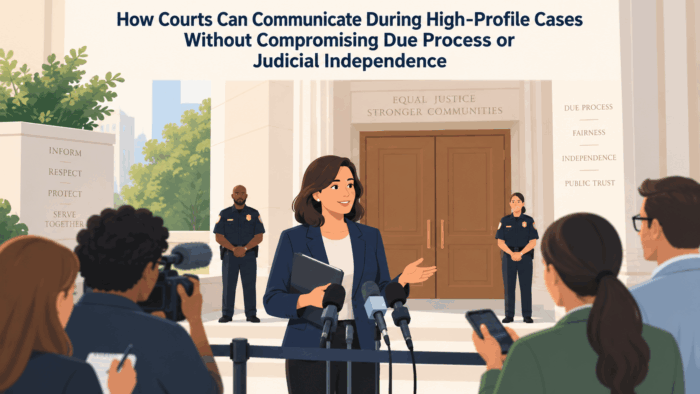
How Courts Can Communicate During High-Profile Cases Without Compromising Due Process or Judicial Independence
Courts are designed to resolve disputes out of the public spotlight in the sense that decisions are supposed to rest on evidence and law rather than on popular sentiment, and high-profile cases test that design more severely than any other circumstance. When a case draws national attention, the court suddenly faces reporters from many outlets, intense public commentary, social media speculation, advocacy campaigns, threats against participants, and political figures who offer opinions on how the matter should be decided. The institution must keep functioning, keep its calendar, protect the rights of everyone involved, and explain itself to a public that is paying attention, all without allowing the attention to influence the outcome.
The constraints that govern judicial communication create obligations that other public institutions do not share. A government agency under scrutiny can defend its decisions, argue its case, and respond to critics in kind. A court cannot. Judicial ethics codes generally prohibit judges from commenting publicly on pending cases. The rules of professional conduct restrict what lawyers may say to the press. The Constitution protects both the right of the accused to a fair trial and the public’s interest in open proceedings. These principles can pull against one another, and the court must communicate in a way that respects each. A court that responds to media pressure by saying too much risks the fairness of the trial, while a court that says nothing risks leaving the field to rumor and distortion.
The timing and tone of communication in a high-profile case are the dimensions most likely to determine public perception of the court. A decision announced without notice, a courtroom conflict that goes unexplained, a sealed document that raises suspicion, or a delay that appears unjustified can all be interpreted in the worst possible light if the court has not provided context. Conversely, a court that explains its process clearly, treats the media professionally, protects participants, and maintains steady operations can sustain confidence even when the outcome is unpopular. A court that treats high-profile case communication as an improvised response to events, rather than a function that requires planning, is leaving its most consequential communication challenge unaddressed.
This article examines how courts can communicate during high-profile cases without compromising due process or judicial independence, covering the competing values at stake, the legal and ethical framework, planning and roles, the use of orders and opinions as communication, media access and recording, decorum and extrajudicial statements, protection of the jury pool, sealing and records, communication with victims, witnesses, and defendants, social media and misinformation, security, the announcement of verdicts, responding to criticism and attacks, coordination with other institutions, and the training, evaluation, and planning practices that prepare a court before the spotlight arrives.
What Makes a Case High-Profile
 A case becomes high-profile for many reasons, and the nature of the attention affects the communication challenge. Some cases involve prominent individuals, such as elected officials, celebrities, or executives. Some involve crimes that shock a community, such as mass violence, the death of a child, or a killing involving law enforcement. Some raise contested social or political questions, such as the constitutionality of a law, the rights of a vulnerable group, or the regulation of an industry. Some involve institutions, such as a large corporation, a university, or a government agency. Some become prominent because of social media, where a video or story spreads rapidly and generates demand for a response.
High-profile status is not always evident at the outset. A case may begin as an ordinary filing and become prominent after a news report, an arrest, or a viral post. Courts should therefore develop the capacity to detect early signs of growing attention, such as an increase in media inquiries, unusual public contact, or interest from advocacy groups, and to escalate their communication posture quickly.
The level of attention also changes over time. Interest may peak at arrest or filing, drop during pretrial proceedings, and spike again at trial and verdict. Appeals and post-conviction proceedings may revive attention years later. Courts should plan for the full life of the case rather than treat the initial surge as the only moment that matters.
Not all high-profile cases are equal in intensity. A locally prominent matter may require a modest response, while a nationally watched trial may require extensive resources and coordination. Courts should have a scalable approach that allows them to calibrate their response to the level of attention, with clear thresholds for activating additional measures.
The Competing Values: Openness, Fairness, Independence, and Safety
Communication in a high-profile case requires balancing several values, each of which is legitimate and important. The first is open justice. Public access to proceedings and records allows citizens to observe how the law is applied, deters misconduct, and builds confidence that outcomes are not the product of secret arrangements. The press plays a central role in conveying what happens in court to those who cannot attend. A court that is secretive in a high-profile case invites suspicion.
The second is the right to a fair trial. Defendants are entitled to an impartial decision maker, and in jury cases to an impartial jury, free from prejudicial influence. Extensive pretrial publicity, inflammatory statements by officials or lawyers, and disclosure of inadmissible evidence can undermine this right. The court has an affirmative duty to take reasonable steps to protect the integrity of the proceedings, which may include managing communication.
The third is judicial independence. Judges must be free to decide cases on the law and facts, without fear of reprisal or hope of reward. Public pressure, political attacks, and threats are attempts, intentional or not, to influence outcomes. The court’s communication should not reflect or respond to such pressure by shifting decisions or by lobbying for public support in a way that implicates the merits.
The fourth is the safety and privacy of participants. Victims, witnesses, jurors, defendants, and court personnel may face harassment or threats. Their legitimate privacy interests must be considered when deciding what to disclose and when. Safety concerns may justify limits on the release of certain information.
No formula resolves these tensions in every case. The court’s task is to make reasoned, transparent judgments about how to give effect to each value, to explain its approach where possible, and to adjust as circumstances change. Communication is the means by which these judgments become visible and credible to the public.
Court Communication Strategies for State and Local Judicial Systems: Building Public Trust, Improving Access to Justice, and Explaining Court Processes
This article is part of our series on strategic communication for State and Local Courts, Judicial Systems, and Court Administration. To learn more about court communication strategies for building public trust, improving access to justice, and explaining court processes, and to see the parent article, which links to other content just like this, click the button below.
Understanding the Legal and Ethical Framework
The legal framework governing communication in high-profile cases is complex and varies by jurisdiction, and court leaders should rely on counsel and judicial ethics advisors for authoritative guidance. Several general categories of rules are relevant. Constitutional principles protect the right to a public trial, the right of the press and public to attend many proceedings, the freedom of the press, and the defendant’s right to an impartial jury. Court decisions over many years have addressed the tension between publicity and fair trial, emphasizing that judges must use tools short of restricting the press to protect the fairness of proceedings.
Judicial codes of conduct typically prohibit judges from making public statements that might substantially interfere with a fair trial or hearing, or that commit the judge to particular outcomes, and require judges to avoid commenting on pending or impending cases. They usually permit judges to explain court procedures to the public, and to speak about the law, the legal system, and the administration of justice in appropriate contexts. Court staff are generally expected to observe similar restraint.
Rules of professional conduct restrict extrajudicial statements by lawyers that have a substantial likelihood of materially prejudicing a proceeding. These rules typically allow certain statements, such as the claim or defense, public record information, and the scheduling or result of proceedings, while prohibiting opinions about guilt, the credibility of witnesses, or the existence of inadmissible evidence. Judges and court staff should be familiar with the rules applicable to attorneys appearing before them.
Statutes, court rules, and local policies govern access to proceedings and records, the use of cameras and electronic devices, sealing and redaction, jury selection and management, and protection of victims and witnesses. These differ widely. Court leaders should maintain an up-to-date summary of the rules that apply in their jurisdiction, accessible to staff who will need it under pressure.
Finally, the court’s own policies on media relations, public information, and social media provide the practical framework for day-to-day communication. These should be written, approved by court leadership, and reviewed by counsel. In a high-profile case, there is little time to debate basic questions, so having them settled in advance is invaluable.
Who Speaks for the Court
One of the most important decisions in high-profile case communication is who speaks. Clarity about roles prevents contradictory statements, protects the judge from inappropriate involvement, and ensures that the public receives consistent information. In general, the judge presiding over the case communicates through orders, rulings, and statements made on the record in court. Other communication is typically handled by a designated spokesperson.
The public information officer, court administrator, or other designated representative is the court’s voice in dealing with the media. This person can explain procedures, schedules, access arrangements, and public records, but does not comment on the merits of the case or on the judge’s reasoning. The spokesperson should be trained in judicial ethics, media relations, and the court’s policies, and should have a direct line to the presiding judge and to legal counsel.
Court staff, including clerks, bailiffs, interpreters, and security officers, should know that they are not authorized to speak to the media about the case. They should be given simple guidance on how to respond to inquiries, such as referring all questions to the spokesperson. They should also be reminded of confidentiality obligations and of the risks of discussing the case on social media or with friends and family.
Attorneys, parties, and witnesses are not court spokespersons and may speak for themselves, subject to applicable rules and any orders. Courts should communicate clearly to the media and the public that statements by lawyers or parties represent their own views and not those of the court. This clarity helps prevent confusion about what the court has decided.
The chief judge or presiding judge of the court may have a role in addressing institutional matters, such as security arrangements, courthouse operations, or attacks on the judiciary. Such statements should be carefully framed to avoid appearing to comment on the case itself. Coordination between the chief judge, the presiding judge, and the spokesperson is essential.
Planning Before the Spotlight Arrives
The best time to prepare for a high-profile case is before one arrives. Courts that wait until a major case is filed must develop policies, assemble teams, and train staff under extreme pressure, and mistakes made in those first days can be hard to correct. A standing protocol allows the court to move quickly and consistently.
A high-profile case protocol should define criteria for identifying cases that warrant special handling, the process for activating the protocol, and the roles and responsibilities of those involved. It should address media access, credentialing, seating, overflow space, recording and broadcasting, public information, records and docket management, security, jury management, and communication with parties, victims, and witnesses. It should name the people responsible for each function and describe how they will coordinate.
Resources should be identified in advance. This includes space for media and overflow audiences, equipment for live feeds or pool coverage, additional staff for the clerk’s office and communications, and security personnel. Agreements with neighboring courts, law enforcement agencies, and county or state authorities for emergency assistance can be worked out ahead of time. Small courts in particular may need external support.
Templates save time. Prepared forms for media orders, decorum orders, press advisories, credential applications, frequently asked questions, and statements can be adapted quickly. Pre-approved language for explaining why the court cannot comment on a pending matter, or why certain records are sealed, helps ensure consistency.
Exercises are valuable. Tabletop simulations that walk the team through a hypothetical high-profile case, including a surge of media inquiries, a leaked document, a threat, and a controversial ruling, reveal gaps and build confidence. Lessons from exercises should be incorporated into the protocol.
Developing a Case-Specific Communication Plan
Once a case is identified as high-profile, the court should prepare a plan tailored to its characteristics. The plan should begin with an assessment of the likely audiences and interests, including local, national, and international media, social media communities, advocacy groups, political figures, victims and families, jurors, and the general public. It should consider the key events in the case, such as arraignment, hearings on motions, jury selection, trial, verdict, sentencing, and appeals, and the communication needs at each.
The plan should identify risks. These may include prejudicial publicity, leaks, harassment of participants, disruptions in the courtroom, misinformation, threats, and logistical strain. For each risk, the plan should describe preventive measures and response strategies. For example, if the risk is that sensitive filings will be publicly disclosed prematurely, the plan might specify procedures for review and redaction before posting.
The plan should set out the messages that the court will communicate. These typically focus on process: how the court is ensuring a fair proceeding, how the public and media can access the case, what the schedule is, how records can be obtained, and what limits apply. Messages should be consistent, accurate, and free of commentary on the merits. A short set of core messages helps all spokespersons remain aligned.
Logistics should be planned in detail. This includes who will be allowed in the courtroom, how seats will be allocated, where overflow viewing will occur, how documents will be distributed, how media will be credentialed, and how the public will be informed of changes. A single point of contact for the media, a central web page for information, and regular briefings can reduce confusion.
The plan should be reviewed by the presiding judge, who retains authority over matters affecting the proceeding, and by counsel. It should be shared with relevant staff and partner agencies, and updated as the case progresses. Documenting decisions and rationale helps with later review and accountability.
Orders and Opinions as Communication
The primary way a judge communicates in a case is through orders and opinions, and in a high-profile case these documents have audiences far beyond the parties. The press, the public, and commentators will read, summarize, and interpret them, often quickly and sometimes selectively. Judges and their staff should write with this wider audience in mind, without altering the substance of the decision.
Clarity is the most important virtue. A well-reasoned ruling that explains the facts, the legal standard, and the basis for the decision in plain terms makes it harder to misrepresent. Judges can organize opinions with clear headings, summarize the holding at the outset, and avoid unnecessary jargon. Complex legal reasoning can be presented in a way that educated non-lawyers can follow.
Some courts provide a short, neutral summary of significant rulings, prepared by court staff and clearly stated not to be part of the opinion. These summaries help reporters who are working under deadline and reduce errors. They must be carefully drafted and approved to avoid shading the decision, and should state that the full opinion controls. Not every court uses summaries, and judges differ in their views of them, so policy should be established in advance.
Timing and distribution of rulings require planning. Releasing a decision simultaneously to all parties and the public, at a predictable time, reduces the risk of leaks and unequal access. Notice that a ruling will be issued, without disclosing its content, allows media and the public to prepare. Posting rulings promptly on the court’s website and docket ensures access.
Judges should resist the temptation to defend or elaborate on a decision outside the written ruling or the courtroom. The general principle that a judge’s opinion speaks for itself protects both the integrity of the decision and the judge’s independence. Explaining the process of how the court reached the decision, as distinct from the substance, can be done by the spokesperson in general terms.
Media Access to Proceedings and Records
Providing orderly access for the media is one of the most practical ways to serve open justice in a high-profile case. Without a clear system, reporters crowd the courtroom, disrupt proceedings, and compete for information in ways that harm both the court and the press. A well-organized process benefits everyone.
Credentialing allows the court to know who is attending and to allocate limited space. A simple application process, with clear criteria and deadlines, should be announced early. Criteria should be neutral and consistent, treating different types of media, including independent journalists and smaller outlets, fairly. Courts should avoid decisions that appear to favor particular outlets or restrict access based on viewpoint.
Seating must be planned. The court should allocate a reasonable number of seats for the media, the public, the families of the parties and victims, and others, and should explain how seats will be assigned. Overflow rooms with live audio or video allow more people to follow the proceeding without disrupting the courtroom. Pool arrangements, in which one reporter, camera, or photographer shares material with others, can reduce intrusion.
Rules of conduct for the media should be communicated in writing and enforced consistently. These may cover use of electronic devices, entry and exit during proceedings, recording and photography, interaction with jurors and witnesses, and use of certain areas of the courthouse. Violations should have defined consequences, applied fairly.
Access to documents is equally important. Journalists and the public often seek filings, exhibits, and transcripts. A designated process for requests, along with a public docket and regular posting of non-sealed filings, supports transparency. Courts should explain what is available, what is sealed and why, and how to seek access.
Cameras, Recording, and Broadcasting
Whether and how cameras are allowed in courtrooms varies widely, and the decision can be among the most visible in a high-profile case. Proponents argue that broadcasting promotes transparency and public understanding. Opponents raise concerns about the effect on witnesses, jurors, and the dignity of proceedings, as well as the risk of sensationalism. Courts must follow applicable law and policy and, where discretion exists, weigh these considerations carefully.
Whatever the policy, the court should communicate it clearly and early. The media and public should know whether cameras and audio recording are permitted, under what conditions, and who decides. If broadcasting is allowed, the court should specify technical requirements, pool arrangements, and restrictions, such as prohibitions on filming jurors, certain witnesses, or confidential communications between lawyers and clients.
Court-controlled livestreams or recordings can provide public access while limiting disruption. Some courts offer audio streams or video feeds through their own systems, reducing the need for media equipment in the courtroom. Such arrangements require technology, staff, and policies about archiving, editing, and redistribution. The court should consider whether recorded material will be made available after the proceeding and, if so, on what terms.
Judges retain authority to limit or suspend recording when needed to protect fairness or safety. Decisions to do so should be explained on the record, briefly and neutrally, so that the media and public understand the reasons. Examples include protecting a vulnerable witness, preventing the broadcast of sealed information, or responding to misconduct.
Remote participation raises additional issues. Virtual hearings can expand access but also make it easier to record or share unauthorized images. Courts should adopt clear rules about recording and distribution of remote proceedings, communicate them to participants and observers, and use technology to enforce them.
Decorum Orders and Extrajudicial Statements
Judges have inherent authority to manage proceedings and to protect the fairness of trials, and in high-profile cases this often includes issuing orders about conduct and statements. Decorum orders typically address behavior in and around the courthouse, such as restrictions on demonstrations, interviews in certain areas, and the use of devices. They can also address statements by participants to the media, though such orders must be drafted with caution.
Orders that restrict speech raise significant constitutional questions, and courts must weigh the need to protect the fairness of the trial against the rights of those whose speech would be limited. Restrictions on the press are subject to especially strict scrutiny, and courts are generally expected to consider less restrictive alternatives first. Restrictions on participants, such as attorneys and parties, are evaluated under different standards but still require careful justification. Judges should consult counsel and applicable precedent and explain their reasoning in writing.
The court’s communication about such orders is critical. The order and the reasons for it should be clear and public, unless there is a compelling reason for confidentiality. The court spokesperson should be prepared to explain what the order does and does not do, without characterizing it as a judgment on the merits. Avoiding the appearance that the court is trying to hide something is vital.
Attorney statements deserve particular attention. Rules of professional conduct provide a framework, but lawyers in high-profile cases may be tempted to try the case in the press. Judges can remind counsel of their obligations, hold conferences to discuss expectations, and, where necessary, address violations. Early, clear communication with counsel about the court’s expectations reduces the risk of problems.
Enforcement should be consistent and proportionate. Ignoring violations undermines the authority of the order and fairness to those who comply. Overreaction can generate sympathy for the violator and distract from the case. A measured response, grounded in clear rules, protects the integrity of the process.
Protecting the Jury Pool and Communicating With Jurors
Jurors are the audience whose exposure to publicity matters most to the fairness of a trial. In a high-profile case, many potential jurors will have heard about the case from news and social media, and some will have formed opinions. The court’s communication strategies must therefore be designed with the jury in mind, both before and during the trial.
Jury selection procedures can be adapted to address publicity. Extended questionnaires can explore exposure to media coverage and attitudes toward the case. Individual voir dire, conducted outside the presence of other jurors, can encourage candor and prevent contamination. The court should explain to prospective jurors the importance of impartiality, and that being aware of the case does not necessarily disqualify them but that they must be able to decide based only on the evidence presented in court.
Instructions to jurors about avoiding media, social media, and discussions about the case are essential and should be repeated regularly. Instructions should be clear and specific, explaining what is prohibited and why. Jurors should be told that violations can result in a mistrial and personal consequences. Plain-language reminders at breaks and at the end of each day reinforce the message. In some cases, courts take additional steps such as sequestration or restrictions on jurors’ devices, which should be communicated sensitively and with attention to the burdens they impose.
Juror privacy and safety are major concerns. Courts may withhold juror names and personal information from the public, restrict photography of jurors, and provide secure entrances and transportation. These measures should be explained to jurors, so they understand the court is protecting them, and to the media and public in general terms. Jurors should be told whom to contact if they feel threatened or are approached.
After the verdict, communication with jurors should be handled carefully. Jurors are free to speak or not, and courts should inform them of their rights and of any restrictions, as well as provide guidance on dealing with media. Some courts offer debriefing or counseling for jurors who experienced distressing evidence. Respecting juror choices and protecting them from harassment preserves the institution of the jury.
Sealing, Redaction, and the Public Record
Decisions about what remains confidential in a high-profile case attract intense scrutiny. The public and press generally have a strong interest in access to court records, and sealing is the exception, justified by specific interests such as privacy of minors, protection of victims, national security, trade secrets, or the integrity of ongoing investigations. In a high-profile case, any sealing will be noticed, and the court’s communication about it affects public perception.
Courts should apply consistent standards and make findings on the record when sealing documents or closing proceedings. The reasons should be stated in an order available to the public, even if the sealed material is not. Procedures for notifying the media and the public of motions to seal and for allowing them to be heard should be followed. Narrow tailoring, such as redacting specific passages rather than sealing entire documents, balances interests.
The docket is itself a communication tool. An accurate, up-to-date docket that is accessible online helps the public and media follow the case. Entries should be clear and consistent. Where certain entries are sealed, the docket can indicate that a sealed document exists without revealing contents, avoiding the impression of secret proceedings.
Clerk’s offices face heavy pressure in high-profile cases. Requests for documents may flood in, and errors in handling can lead to inadvertent disclosure. Clear procedures, training, and extra staffing help. Procedures for reviewing filings before posting, to catch confidential information such as personal identifiers or sealed content, are essential.
Leaks present a particular challenge. Premature release of sealed or confidential information, whether by staff, parties, or others, can harm fairness and trust. Courts should have policies on access controls, audit trails, and consequences for unauthorized disclosure. When leaks occur, the court should respond promptly, assess the damage, and communicate what it can about the steps being taken.
Communicating With Victims, Witnesses, and Families
In high-profile criminal cases, victims and their families are thrust into public view and face an onslaught of media attention at the moment of greatest vulnerability. Witnesses may be harassed or threatened. The court has an obligation to support these participants through communication that is respectful, timely, and protective.
Victim and witness services should be expanded and coordinated. Advocates can provide information about the process, accompany victims to hearings, arrange private waiting areas, and help manage media contact. Victims should be told what to expect, including the possibility of media attention, and should be offered options about whether and how to engage. Their preferences about notification and participation should be honored to the extent the law allows.
The court should consider the privacy of victims and witnesses when deciding what information to release. Names, addresses, and personal details may be redacted or withheld, and proceedings may be arranged to limit exposure. In cases involving minors or sexual violence, additional protections often apply. Communication to the media should reflect these protections, and the court may request that the media exercise discretion.
Families of victims often want information about case status and may be frustrated by delay or by decisions they do not understand. Regular, compassionate communication from the prosecutor’s victim services unit or the court, explaining the process and the reasons for developments, can help. Families should hear significant news before the media reports it, wherever possible.
Defendants’ families also face media pressure, and their experiences deserve consideration. While the court’s primary obligations are to the defendant and the process, humane communication about logistics, access, and conduct recognizes that families are affected.
Protecting the Defendant’s Rights in Public Communication
 The presumption of innocence is a cornerstone of due process, and court communication must not undermine it. Language used by court personnel, in press releases, on websites, and in statements can subtly convey assumptions about guilt. Referring to a defendant as the accused or the defendant rather than the perpetrator, describing charges as allegations, and avoiding characterizations of evidence are basic practices.
The court should also be careful about the physical presentation of the defendant. Restraints, clothing, and the manner of transport are matters of fairness, and images of a defendant in jail clothing or shackles can influence perceptions. Decisions about these matters are generally made by the judge, with attention to security and rights, and the court should be mindful of how they will be seen.
Defendants who represent themselves present additional challenges. The court must provide the same access to information and fairness while remaining neutral. Communication to the self-represented defendant should be clear and documented. Media attention may be intense, and judges should take care to preserve the defendant’s ability to defend without undue interference.
Communication about competence, mental health, and other sensitive matters should be handled with care. Information about a defendant’s medical or psychological condition may be confidential or prejudicial, and decisions about disclosure should reflect legal standards and fairness. The court should avoid commentary and should communicate only what is necessary and permitted.
Managing Social Media and Misinformation
Social media has transformed the environment of high-profile cases. Rumors, partial video clips, and speculation can spread within minutes, shaping public opinion before any facts have been established in court. Online communities may form around a case, produce their own theories, and target participants for harassment. The court cannot control this environment, but it can take steps to provide reliable information and to reduce harm.
Courts should consider establishing an official presence on appropriate platforms with a clear policy about what will and will not be posted. Official channels can provide scheduling information, access instructions, links to public documents, and explanations of procedure. They should avoid commentary on the merits and should not engage in debates. A consistent, factual tone builds credibility over time.
Monitoring is useful. Staff can track social media and news coverage to identify false claims that could affect the proceeding or public safety, emerging threats, or confusion about logistics. Monitoring should be conducted with attention to privacy and legal limits and should focus on information relevant to the court’s function.
Correcting misinformation requires judgment. Where false statements concern procedures, such as the schedule, access, or the nature of an order, the court can issue a clarification. Where false statements concern the merits, the court generally should not enter the debate, since doing so may compromise neutrality. In some cases, the court may explain generally why it does not comment and refer readers to the public record.
Court personnel and jurors need guidance on their own use of social media. Policies should prohibit staff from posting about the case and should apply consequences for violations. Jurors should be instructed not to post or read about the case. The court may need to remind participants periodically of these obligations.
Responding to Rumors, Errors, and Distortions
Inaccurate reporting is inevitable in fast-moving cases, and courts must decide when and how to respond. Some errors are minor and best ignored. Others, such as misreporting a ruling, misunderstanding a procedure, or publishing confidential information, can have serious consequences and warrant correction.
A good correction is prompt, specific, and factual. The court spokesperson can contact the reporter or outlet, provide the accurate information, and point to the relevant public document. A relationship of mutual respect with the press makes such corrections more likely to be welcomed. Where the error is widely circulated, a brief public clarification may be needed.
The court should resist the urge to respond to criticism of the court’s decisions with a defense of the merits. The appropriate response to disagreement about a ruling is the appellate process, not a public debate. The spokesperson can explain that parties have rights of appeal and that the court’s reasoning is contained in its written decision.
Rumors about misconduct by judges or staff should be addressed through appropriate channels, such as judicial conduct commissions or internal review, and the court should communicate about processes rather than speculate. Where allegations are credible, prompt, transparent handling reinforces integrity. Where they are baseless, calm provision of facts, within confidentiality limits, can help.
Communicating Schedules, Logistics, and Public Information
Much of what the public wants to know in a high-profile case is practical: when hearings occur, where to go, how to get in, what to bring, and how to follow proceedings. Providing this information proactively reduces inquiries, prevents disorder, and signals openness. It also shifts attention from speculation to facts.
A dedicated case page on the court’s website is a valuable tool. It can include the schedule, access and credentialing information, public filings, orders, frequently asked questions, contact information for the spokesperson, and links to livestreams if available. Updating the page promptly is crucial, since stale information breeds frustration. Social media posts can direct people to the page.
Press advisories issued in advance of key events can describe seating, security, parking, and rules. Briefings for the media before trial or major hearings allow questions about logistics. Daily or event-specific updates during trial help reporters plan. All such communication should be factual, consistent, and accessible to all media, not only favored outlets.
Changes in schedule or procedure should be communicated quickly and widely. A canceled hearing, a security delay, or a courtroom change can cause confusion and crowding. Text alerts, email lists, website notices, and signage at the courthouse can help. Staff should be prepared to answer questions at the door.
Accessibility must not be overlooked. Information should be available in multiple formats and languages where appropriate, and accommodations for people with disabilities should be arranged. The public’s right to observe depends on the ability to get in.
Security, Threats, and Communicating About Safety
High-profile cases often generate threats against judges, prosecutors, defense counsel, witnesses, jurors, and court staff. Even when threats are not carried out, they create fear and may affect behavior. Security measures and communication about them must be handled with care, balancing the need for protection with the need to maintain public access and avoid giving information that could aid an attacker.
Courts should coordinate with law enforcement and security agencies in advance to assess risks and plan measures. Communication among these agencies should be secure, timely, and clear. Threat assessment protocols, procedures for reporting incidents, and designated points of contact enable fast response.
Communication with the public about security should be general. The court can announce that enhanced security will be in place, explain what items are prohibited, and describe screening procedures, without disclosing details of tactics. Clear communication helps visitors comply and reduces conflict at entry points.
Staff and judges should be informed about threats and given guidance on personal safety, including how to report suspicious behavior, protect personal information, and manage social media exposure. Support for those who are targeted, including counseling and security assistance, is essential. Leadership should communicate that threats will be taken seriously and that those who make them will be pursued.
Public statements about threats require care. Acknowledging that threats exist can reassure the public that the court is aware and acting, but too much detail may inspire copycats or alarm unnecessarily. Statements should be coordinated with law enforcement and focus on the court’s commitment to safety and the rule of law.
Announcing Verdicts and Major Decisions
The announcement of a verdict or major ruling is the moment of greatest attention, and planning for it is critical. The reaction may be intense, whether celebratory, angry, or both, and the court must ensure safety, order, and accurate communication. Preparation begins well before the decision is reached.
The court should establish procedures for notifying parties and counsel, ensuring they are present or reachable, and preventing leaks. For jury verdicts, the court typically notifies the parties that a verdict has been reached and sets a time for its announcement, allowing for logistics and security. Notice to the public and media about the timing, without disclosing the outcome, enables preparation.
Security should be heightened. The court should consider crowd management, entry controls, and the safety of participants and the public after the announcement. Coordination with law enforcement regarding potential demonstrations is important. Plans for exits, transportation of the defendant, and protection of jurors and victims’ families should be in place.
Immediately after the announcement, the court should provide access to the written verdict or ruling. The spokesperson should be available to explain what happens next, such as sentencing dates, post-trial motions, and appeals, without commenting on the decision. Having a short statement that acknowledges the conclusion of the phase, thanks jurors for their service where appropriate, and reaffirms the court’s commitment to the process can help set the tone.
The court should anticipate reactions and avoid responding to them. Public celebration or outrage, or comments by public officials, are not matters for the court to answer. The consistent message is that the court has performed its role, that the legal system provides avenues for review, and that the court will continue to apply the law.
Unpopular Decisions, Criticism, and Attacks on Judges
High-profile cases often produce decisions that large segments of the public dislike, and the judges who make them may face severe criticism, including personal attacks, calls for impeachment, and threats. Public officials and commentators may characterize rulings as political or lawless. The court’s response must protect judicial independence without appearing defensive or partisan.
Judges generally cannot respond to criticism of their rulings, and attempting to do so could compromise their impartiality. The institution can, however, speak about the role of the judiciary and the importance of independence in general terms. Court leaders, bar associations, and judicial organizations may issue statements defending the principle that judges must be free to decide cases without intimidation, without addressing the merits of the particular case.
Such statements are most effective when they are measured, principled, and consistent. A court that reacts to every criticism will appear thin-skinned, while one that remains silent in the face of threats or serious misinformation may leave judges isolated. Distinguishing between legitimate disagreement, which can be expressed through commentary and appeal, and attacks on the legitimacy of the judiciary or threats to individuals, helps guide response.
Support for the targeted judge is vital. Court leadership should check in, provide security, offer counseling, and ensure that the judge and family are not alone. Colleagues and bar leaders can show solidarity. The court can also help the public understand how the system works by publishing explanations of appeals and the role of judges.
Education is a longer-term response. Courts that invest in civic education, explain how decisions are made, and publish accessible summaries of key rulings build a foundation of understanding that can temper reactions in moments of controversy. Trust built in ordinary times is a resource in difficult times.
Coordination With Other Institutions
High-profile cases involve many institutions, including prosecutors, defense counsel, law enforcement, corrections, victim services, local government, and sometimes federal agencies. Each has its own communication interests and obligations, and uncoordinated messaging can create confusion or prejudice the case. The court cannot control the communications of other institutions, but it can encourage coordination on matters of common concern.
Pretrial conferences with counsel can address expectations about statements and logistics. The court may convene a meeting of key agencies to coordinate security, access, and public information, clarifying which entity will communicate about which topics. Written protocols can help ensure that each agency understands its responsibilities.
Relationships with executive and legislative officials require sensitivity. Elected officials may comment on high-profile cases, call for particular outcomes, or propose legislation in response. The court’s role is to maintain independence, not to engage in political debate. Communication with these officials should focus on operational needs, such as security funding or facilities, and should be conducted through appropriate channels, avoiding any appearance of bargaining over outcomes.
Local governments often provide support such as traffic control, emergency services, and facilities. Early communication with these partners ensures that they are prepared and that the community is informed. Business owners and residents near the courthouse may be affected, and the court should provide information about disruptions and mitigation.
After the case, coordination continues. Joint debriefs help partners learn from the experience, identify gaps, and improve cooperation for future cases.
Internal Communication With Judges and Staff
High-profile cases strain court personnel. Staff may face intense workloads, public scrutiny, and in some cases harassment. Clear internal communication helps them perform their duties, comply with ethical obligations, and cope with stress.
Leadership should brief staff early, explaining the situation, the plan, and their roles. Staff should know what they can and cannot say, whom to contact with questions, and how to handle inquiries. Regular updates throughout the case maintain alignment and morale. Staff should be assured that they will be supported if they face pressure or threats.
Confidentiality obligations should be reiterated. The temptation to share inside information with friends or on social media can be strong, and breaches can cause serious harm. Staff should understand the reasons for confidentiality and the consequences of violations. Access to sensitive materials should be limited to those who need it, with appropriate controls.
Wellbeing deserves attention. Long hours, emotional content, and public criticism take a toll. Leaders can offer flexibility, rest periods, counseling services, and recognition of effort. A supportive environment improves performance and reduces turnover.
Judges, too, need support. The presiding judge may feel isolated, and colleagues can provide perspective and assistance. Opportunities to consult with ethics advisors, peers, and court leadership can help judges navigate difficult communication questions.
Public Education During High-Profile Cases
High-profile cases present teachable moments. Public interest in how the justice system works is at a peak, and the court can use this attention to explain basic concepts such as the presumption of innocence, the burden of proof, the roles of judge and jury, the rules of evidence, the appeals process, and the independence of the judiciary. This education must be neutral and avoid commenting on the case itself.
Explainers can take many forms: web pages answering common questions, short videos, infographics, and background briefings for reporters. They should use plain language and avoid legal jargon. Examples should be general and not tied to the facts of the case. For example, an explainer on how trials proceed, what a motion is, or what happens after a verdict can help the public follow developments.
Partnerships with bar associations, law schools, civic groups, and libraries can extend reach. Panels, community forums, and educational events can take place in parallel with the case, provided they do not discuss its merits. Judges may participate in general civic education within the bounds of their ethical obligations.
Educational efforts should be evaluated for neutrality. Materials should be reviewed to ensure they do not appear to favor one side or foreshadow a result. The aim is to enhance understanding of the process, so that the public can interpret events more accurately.
Digital Infrastructure and Rapid-Response Tools
Technology can support communication in a high-profile case, but it must be ready before it is needed. Websites that crash under heavy traffic, e-filing systems that cannot handle volume, or livestreams that fail at crucial moments undermine confidence. Capacity planning and testing are part of preparation.
Courts should ensure that their websites can handle surges and that high-profile case pages can be created quickly. Content management systems should allow authorized staff to publish updates without delay. Email lists and text alert systems for the media and the public can distribute notices efficiently. Secure channels for sharing sensitive information with parties and counsel are also necessary.
Records management systems should support rapid redaction, controlled access, and audit trails. Document sharing platforms for media pools or press packets can distribute materials equitably. Clear policies on retention and archiving ensure that materials remain accessible.
Technology should be backed up by manual processes. Power outages, cyber incidents, and equipment failures can occur at the worst times. Printed copies, alternative communication methods, and contingency plans allow the court to continue communicating.
Cybersecurity is especially important. High-profile cases attract hackers and those seeking to leak or manipulate information. Strong security measures, staff training, and incident response plans protect the integrity of the court’s data and communications.
Special Contexts: Political Cases, Cases Involving Public Officials, and Cases Involving the Court Itself
Some high-profile cases carry additional challenges because of the identity of the parties or the nature of the dispute. Cases involving elected officials, candidates, or political parties are especially prone to accusations of bias, and courts must be scrupulous in appearing neutral. Timing of rulings near elections can be controversial, and courts should consider and communicate the legal and procedural reasons for scheduling without reference to political calendars.
Cases involving government agencies or officials can create conflicts for the court’s relationship with the executive and legislative branches. The court should avoid even the appearance of retaliation or favor and should communicate regarding budget, security, and operations in ways that are independent of the pending matter. Recusal questions should be handled transparently, with reasons stated in writing where appropriate.
Cases involving judges, court employees, or the court as an institution raise unique concerns. A conflict of interest may require assigning the case to an outside judge, and the court should communicate clearly about why and how this was done. Transparency about the process, within legal limits, supports the legitimacy of the outcome.
Cases that touch on deeply divisive social issues generate passionate advocacy on both sides. The court should ensure equal access for all, maintain order, and avoid statements that could be construed as taking a side. Providing equal opportunities for demonstrations in designated areas, consistent with law and safety, reflects fairness.
Small Courts and Limited Resources
A high-profile case can overwhelm a small court with no dedicated communications staff, limited security, and a single courtroom. These courts may face the same media and public pressures as large urban courts but with a fraction of the resources. Planning for such situations requires creativity and cooperation.
State court administrative offices, judicial councils, and professional associations can provide support, including communication specialists, model policies, equipment, and temporary staff. Courts should know in advance whom to call. Mutual aid agreements with neighboring courts and agencies can supply space, personnel, and technology.
Simple measures can have a large effect. A one-page media guide, a designated email address, a single point of contact, and a basic web page can address many needs. Training one or two staff in media relations and judicial ethics creates local capacity. Borrowing templates and checklists from other courts saves time.
Small courts should be open about their limits. Explaining to the media and public that the court has limited space and staff, and describing the measures taken to maximize access, fosters understanding. Cooperation from the press often follows when expectations are reasonable and communicated respectfully.
After the Case: Debrief, Records, and Lessons Learned
The end of a high-profile case is not the end of communication obligations. Appeals, post-conviction proceedings, requests for records, and continuing public interest may keep the matter alive for years. At the same time, the court has an opportunity to reflect and improve.
A structured debrief should be held while memories are fresh. Participants should include judges, court administrators, communications staff, clerks, security, IT, and partner agencies. Questions to consider include what worked, what did not, what surprises arose, whether policies were adequate, and what resources were lacking. Input from the media and the public, gathered through surveys or conversations, can add perspective.
Findings should be documented and used to update protocols, templates, and training. Success stories should be recognized, and weaknesses addressed without blame. Sharing lessons with other courts, through judicial conferences and publications, contributes to the field.
Records from the case should be managed carefully. Retention schedules, archiving, and public access policies should be applied. Exhibits and evidence may need special handling. Where appropriate, the court may prepare a case history or summary for the public record.
Care for the people involved continues. Jurors, staff, and judges may need support after a stressful case. Victims and families may still need information. Communication with these groups should continue as needed and be handled compassionately.
How High-Profile Case Communication Differs From Routine and Crisis Communication
Communication in high-profile cases shares features with both routine court communication and crisis communication in other organizations, but differs from both. Routine communication is generally low-key and focused on service delivery. High-profile communication must be intensive, coordinated, and responsive to a rapidly changing environment, while remaining bound by ethical constraints.
Unlike crisis communication in many organizations, a court cannot defend itself, tell its side of the story, or seek to shape opinion about the merits. A corporation facing a scandal can issue a vigorous rebuttal, and a government agency can explain and justify its policy. The court’s primary tools are process, access, and its written decisions. This restraint is a defining feature and requires a distinct skill set.
The audience is also distinctive. In addition to the general public and media, the court’s communication affects participants whose rights are directly at stake, such as the defendant, who is entitled to a fair trial, and jurors, who must remain unaffected. Messages that would be acceptable in other contexts may be improper here.
The stakes are institutional as well as case-specific. The court’s handling of a high-profile case shapes how people view the judiciary as a whole. A well-managed case can enhance public confidence, while a poorly managed one can damage it for years. Courts must therefore consider the long-term implications of their communication choices.
Common Pitfalls and How to Avoid Them
Courts encounter recurring problems in high-profile cases. One is being unprepared, leading to improvised decisions and inconsistent messages. The remedy is standing protocols, training, and exercises.
A second is saying too much. Comments by judges or staff on the merits, however well-intentioned, can undermine fairness and impartiality. Clear rules about who speaks and what can be said, backed by training, prevent this.
A third is saying too little. Silence can create a vacuum filled by speculation. Providing timely, accurate information about process, schedules, and access builds credibility.
A fourth is unequal treatment of the media. Favoring certain outlets or providing information selectively can provoke complaints and erode trust. Consistent, transparent policies and equal access address this.
A fifth is overlooking participants. Focusing on the media and public can leave jurors, victims, witnesses, and staff without adequate information and support. They deserve direct communication and care.
A sixth is weak coordination with partners. Conflicting statements by prosecutors, defense counsel, law enforcement, and the court can create confusion. Early coordination and clear roles help.
A seventh is neglecting security and technology. Failures in either can disrupt proceedings and damage confidence. Preparation and contingency planning are essential.
An eighth is forgetting the aftermath. Failing to debrief, support staff, or follow up with participants leaves problems unresolved. Closing the loop is part of responsible communication.
Training the Court Team
Training is the foundation of effective high-profile communication. Judges, administrators, clerks, bailiffs, security staff, IT personnel, and communications staff all play roles and need to understand them. Training should be provided at onboarding and refreshed regularly.
Content should include judicial ethics rules on public comment, the court’s media policies, the legal framework for access and sealing, practices for working with the media, protocols for handling inquiries, social media policies, security procedures, and crisis response. Scenario-based exercises that simulate real situations are especially effective. Role-playing difficult interviews or press conferences builds skill and confidence.
Judges benefit from specialized training on managing high-profile cases, including trial management, jury issues, orders affecting communication, and personal safety. Learning from colleagues who have handled such cases is valuable. Judicial education organizations and court associations often provide resources.
Media training for spokespersons should cover both the technical aspects of interviews and the ethical boundaries. Practicing how to say that the court cannot comment, and how to redirect to process, in a manner that is courteous and credible, is a core skill. Spokespersons should also learn to anticipate questions and prepare concise answers.
Evaluating Performance and Learning Over Time
Courts should evaluate their handling of high-profile cases systematically. Measures might include timeliness and accuracy of information provided, media and public feedback, the number of complaints or errors, security incidents, juror experiences, and staff assessments. Qualitative reviews can examine whether the court maintained fairness, openness, and independence.
Feedback from the media is useful. Reporters can identify obstacles to access, inconsistencies, and confusing procedures. While courts need not accept every request, listening to those who cover the courts can reveal improvements. Regular meetings between court leaders and media representatives, outside the context of any particular case, can build mutual understanding.
Feedback from participants matters as well. Surveys or interviews with jurors, victims, witnesses, and staff can reveal how communication and support were experienced. Their insights help refine practices to better protect and inform people.
The results of evaluation should be used. Updating protocols, improving training, and allocating resources based on findings demonstrate accountability. Over time, a record of learning builds institutional capability.
Building a High-Profile Case Communication Plan
A written plan consolidates the principles and practices described above. It should begin with a statement of purpose and values, affirming commitments to open justice, fair trial, judicial independence, and the safety and privacy of participants. It should define what constitutes a high-profile case and how designation occurs.
The plan should set out roles and responsibilities, including the presiding judge, chief judge, court administrator, spokesperson, clerk, security chief, IT lead, jury manager, and victim and witness services. It should specify decision-making authority and escalation paths. Contact lists, including after-hours numbers, should be maintained.
Operational procedures should address media credentialing and seating, recording and broadcasting, public information, social media, records and docket management, sealing and redaction, jury management, security, and logistics. Templates and checklists should be attached. The plan should include protocols for verdicts and major rulings, threats, leaks, and technology failures.
Communication principles should be spelled out: communicate about process, not merits; provide equal access; be accurate and timely; protect privacy and safety; and coordinate with partners. Messages and sample statements should be prepared in advance.
The plan should include training, testing, and review schedules. It should be reviewed by counsel, adopted by court leadership, and shared with staff and partners. Annual updates, informed by experience and changes in law and technology, keep it relevant.
Tying It All Together
Communication in a high-profile case is not an add-on to the work of adjudication. It is part of how the court demonstrates, to a watching public, that justice is being done in a fair and orderly way. The tasks of planning, designating spokespersons, managing media access, protecting jurors, handling records, supporting participants, countering misinformation, ensuring security, and announcing decisions all serve one purpose: allowing the public to see the process while ensuring that the process remains uncorrupted by the attention it receives.
Courts that approach high-profile cases with preparation, discipline, and transparency find that credibility builds on itself. The reporter who has been treated fairly is more likely to report accurately. The juror who has been protected is more likely to serve conscientiously. The community that has seen a court explain its process, even in a contested case, is more likely to respect the outcome and the institution. Trust, earned through consistent and principled communication, is the most valuable asset a court can hold when the world is watching, and the discipline of communicating without compromising due process or independence is the primary way of earning it.
Strategic Communication Support for Courts
 Developing the high-profile case protocols, media access plans, spokesperson training, decorum and recording policies, jury communication materials, public information pages, social media guidelines, security communication procedures, verdict announcement plans, and debrief and evaluation frameworks that courts require is work that most court teams cannot complete at the level of quality and specificity that each challenge demands, particularly in advance of an actual crisis. Court administrators and judges are often managing heavy caseloads and limited staff, and planning for an uncertain future competes with daily demands. External communication expertise is a practical necessity for courts seeking to be prepared when the spotlight arrives.
Stegmeier Consulting Group (SCG) works with courts and justice system partners to develop communication programs that address the full range of challenges specific to high-profile cases, with particular attention to the ethical, constitutional, and institutional dimensions that distinguish court communication from that of other public organizations. This includes developing standing protocols and templates, training judges and staff, designing media and public information strategies, preparing for verdicts and other critical moments, and conducting after-action reviews that help courts learn and improve.
Future Trends in High-Profile Case Communication
The environment in which courts communicate is changing rapidly. Social media platforms, video sharing, and instant messaging mean that information and misinformation travel faster and farther than ever. Public expectations of access, including livestreams and online document availability, are increasing. Courts that anticipate these shifts will be better prepared to meet them.
Synthetic media and artificial intelligence introduce new risks. Fabricated images, audio, and video can be used to mislead the public about court proceedings, judges, or evidence, and automated tools can generate and spread false narratives at scale. Courts will need strategies for rapidly identifying and responding to such content, including relationships with platforms, clear channels for authoritative information, and public education about verifying sources. At the same time, courts may use AI tools for translation, transcription, and document processing, which must be adopted carefully to protect accuracy and confidentiality.
Threats against judges and court personnel have become a growing concern in many places, and online harassment and doxxing add to the danger. Courts will likely invest more in security, in protecting personal information, and in communication that supports those who are targeted. Public education about the role of judges and the consequences of intimidation may become a larger part of court communication.
Hybrid and remote proceedings are likely to remain part of court practice, with implications for access, recording, and decorum. Courts will need to refine policies, technologies, and communication to ensure that remote participation does not compromise fairness or security. Greater transparency expectations may push courts toward more routine online publication of proceedings and records, requiring careful balancing with privacy and safety.
Conclusion
Courts face communication challenges in high-profile cases that are unique in their combination of intense public attention, constitutional obligations, ethical constraints, and institutional stakes. The judge who cannot comment on a pending case, the clerk who must manage a flood of requests, the juror who must be shielded from publicity, the victim whose family is pursued by cameras, the defendant whose presumption of innocence must be preserved, and the public that wants to understand what is happening are all audiences that the same court communication program must be designed to serve.
The courts that meet these challenges most effectively are those that treat communication as a core function requiring advance planning, clear roles, and disciplined restraint. They explain process rather than merits, provide fair and orderly access, protect those whose rights and safety are at stake, correct the record where they can, support their people, and learn from each experience. That approach preserves the fairness of the proceeding, the independence of the judge, and the confidence of the public that justice has been done.
Stegmeier Consulting Group’s Strategic Approach to Communication Systems
Build high-profile case communication around the openness, fairness, and independence that public confidence in the judiciary requires.
Courts that communicate during high-profile cases with the preparation, discipline, and transparency that due process and judicial independence demand build the public confidence that sustains the rule of law. Stegmeier Consulting Group (SCG) helps courts and their partners develop the standing protocols, media and public information strategies, training programs, security and verdict communication plans, and evaluation frameworks that serve the full range of high-profile case communication challenges.
Use the form below to connect with our team and explore how strategic communication support can strengthen your court’s communication program.