

East Lansing, Michigan as a Model for Personalized Recycling Education and Contamination Reduction
 Recycling contamination is one of the most persistent public education failures in solid waste management. The gap between what recycling programs communicate and what residents actually do is not primarily a matter of resident indifference or bad intent. It is almost always a matter of communication design. Standard recycling education, broadcasting general sorting guidance to all residents through bill inserts, website content, and social media posts, reaches the residents who are already recycling correctly at roughly the same volume as the residents whose behavior actually needs to change. It produces awareness without producing behavior change, because awareness of recycling guidelines is not the same as correction of the specific sorting errors that are driving contamination in a given program.
The gap between recycling education investment and recycling contamination outcomes is visible in solid waste programs across the country. Agencies produce sorting guides, run social media campaigns, distribute bin tags, and update their websites with acceptable materials lists, yet contamination rates in residential recycling programs remain stubbornly high in many communities. This is not evidence that residents cannot learn to sort correctly. It is evidence that generic communication directed at an undifferentiated audience is a poor tool for changing specific behaviors by specific households, when those behaviors are the ones actually driving the problem.
In September 2022, the City of East Lansing launched what became the first citywide pilot program in the United States to use artificial intelligence on recycling collection vehicles to identify household-level contamination and deliver personalized education in response. The program was a partnership between the City of East Lansing, Prairie Robotics, The Recycling Partnership, and the Michigan Department of Environment, Great Lakes and Energy. It ran for 24 weeks across the city, mailed more than 5,000 personalized postcards to residents whose carts were found to contain non-recyclable materials, and was studied by Ohio State University for its statistical analysis of results. Its outcomes were significant enough that the city’s Environmental Sustainability and Resiliency Manager presented the program’s findings at the Bloomberg CityLab conference in 2024.
The program built on The Recycling Partnership’s established Feet on the Street initiative, a cart-tagging approach that sends collection crews to manually inspect curbside bins and leave educational materials at addresses where contamination is found. The East Lansing pilot was an AI-powered, citywide evolution of that model, replacing manual inspection with cameras and automated analysis to achieve household-level feedback at a scale and consistency that Feet on the Street’s manual approach could not replicate across an entire city. Understanding what the program did, why the communication design worked, and what it reveals about the limits of broadcast recycling education offers important guidance for solid waste agencies seeking more effective contamination reduction programs.
The Communication Design Problem in Residential Recycling
Why Broadcast Education Fails to Change the Behavior That Matters
Residential recycling programs depend on voluntary behavior change by a large and diverse population of households. The households in any given collection route include some that sort correctly, some that sort incorrectly despite good intentions, some that are confused about which materials are acceptable, and some that place unacceptable materials in recycling carts because it seems like the right thing to do even when they are uncertain. Each of these household types has a different communication need. Correct sorters need no behavior change communication. Confused households need specific clarification about the materials they are getting wrong. Well-intentioned households making specific sorting errors need feedback specific enough to correct those errors rather than general guidance that may or may not address what they are actually doing wrong.
Broadcast recycling education, the dominant communication approach in residential solid waste programs, is designed for the average resident who may need general guidance about sorting practices. It performs reasonably well for that audience. It performs poorly for the specific purpose of changing the behavior of the households who are actually contributing to contamination, because those households receive the same general guidance as everyone else, with no indication that their specific behavior is problematic and no particular reason to believe that the general recycling reminder is directed at them.
The invisibility of the problem to the household is itself a barrier. A resident who consistently puts contaminating materials in a recycling cart has no mechanism for knowing that their behavior is generating a problem unless the agency communicates that feedback directly to them. Without that feedback, the resident may believe they are recycling correctly and may interpret general recycling education as messages directed at less conscientious neighbors. This dynamic explains why contamination rates have proven so resistant to broadcast education investment. The communication reaches everyone, but the residents who need to change their behavior do not know the communication is directed at them.
East Lansing had an additional contextual factor that made targeted communication especially relevant: a significant student population that turns over annually. The city’s Environmental Sustainability and Resiliency Manager noted that recycling rules are hyperlocal, and that getting accurate sorting information to residents who may be new to the community every year is a challenge that general education campaigns are poorly equipped to meet. A student moving into a new apartment in East Lansing in September has no reason to assume that what was recyclable in their previous community is recyclable there. Personalized feedback at the moment of a sorting error is more effective than any amount of general guidance distributed before the error occurs.
From Fragmentation to Coordination: Communication Strategies for Councils of Governments, Metropolitan Planning Organizations, and Regional Planning Agencies
This case study is part of SCG’s series on communication for councils of governments, metropolitan planning organizations, and regional planning agencies. To learn more and to see the parent article, which links to other content just like this, click the button below.
The East Lansing Pilot Program
Prairie Robotics, AI-Powered Cameras, and Personalized Postcards at the Point of Collection
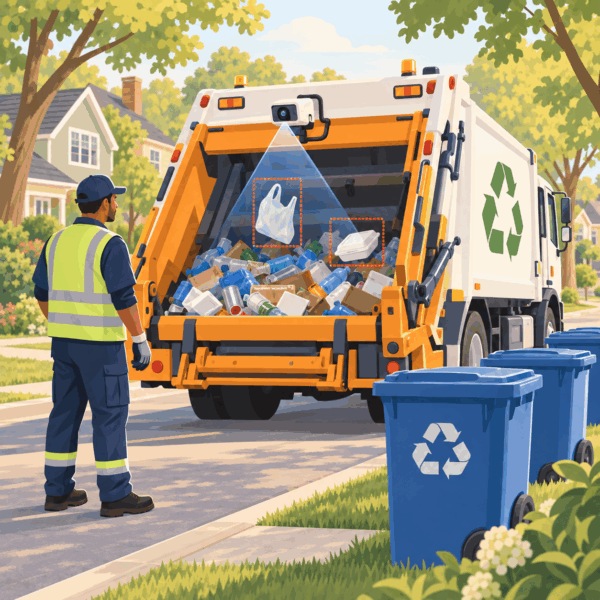
The East Lansing pilot program addressed the broadcast education problem by building a system capable of identifying contamination at the household level and communicating feedback directly to the specific addresses generating it. Prairie Robotics, a Canadian technology company that develops AI systems for waste identification, installed cameras on the city’s recycling collection vehicles. As collection trucks made their regular routes, the cameras captured images of cart contents as carts were emptied. GPS technology recorded the street address of each cart. An AI analysis system reviewed the images to identify contaminating materials, flagging households where non-recyclable items, including plastic bags, Styrofoam, general waste, and yard waste, were found in the recycling stream.
When contamination was identified at a specific address, an automatically generated personalized postcard was mailed to that residence. The postcard described the contaminating materials found, explained why those materials could not be processed in the recycling stream, and provided guidance on correct sorting practices. Postcards also included links to the city’s recycling education resources, including the Recycle Coach app, giving residents a direct path to additional guidance if they needed it. The system sent postcards incorrectly just 0.5 percent of the time, a precision rate that reflects the reliability of the AI identification system and the GPS address confirmation process.
The program tested two distinct postcard approaches. Educational postcards focused on clear, plain-language explanation of correct sorting practices and what to do differently. Emotional postcards framed recycling as a community value, acknowledged the resident’s role in the program, and connected correct sorting behavior to environmental outcomes the community cared about, without leading with rule violation. Both approaches were compared against a control group of households that received no personalized communication. Ohio State University conducted the statistical analysis of results across the intervention and control groups, providing the independent research foundation for the program’s findings.
Over the 24-week pilot period, the program mailed more than 5,000 personalized postcards to residents across the city. The most common contaminating materials identified were plastic bags, Styrofoam, and plastic film, consistent with the materials that most commonly drive contamination in curbside recycling programs nationally. The program operated alongside the city’s existing Feet on the Street manual inspection approach, allowing the partnership to directly compare the AI-automated method with the traditional cart-tagging system that The Recycling Partnership had developed for other communities.
What the Results Revealed
Contamination Reduction, Participation Gains, and the Ohio State University Findings
The results of the East Lansing pilot were significant across multiple dimensions. Overall recycling contamination in the city decreased by 22.5 percent over the course of the pilot period. This aggregate reduction reflects the combined effect of the personalized postcard interventions across both educational and emotional messaging types, compared to the control group of households that received no personalized communication.
The Ohio State University analysis found that both postcard types reduced contamination among households that received them, but with meaningfully different effects on participation. Households that received educational postcards reduced contamination compared to the control group. Households that received emotional postcards contaminated 23 percent less than before the intervention and set out their recycling carts 45 percent more often, a substantial increase in program participation alongside the contamination reduction. The emotional postcard recipients were not just sorting better. They were engaging with the recycling program more actively.
Among households that had not been setting out their recycling carts at all before the intervention, the personalized outreach made them 28 percent more likely to participate in the program. This finding is particularly significant because it demonstrates that the personalized communication approach improved both the quality and the quantity of recycling participation, reaching households that had been entirely disengaged from the program rather than only correcting the behavior of households that were already participating but sorting incorrectly.
The program’s findings were also notable for what they revealed about the durability of the behavior change produced. Personalized mailers continued to drive contamination downward for six months after the intervention period ended, suggesting that the feedback produced lasting changes in sorting behavior rather than temporary compliance that reverted when the postcards stopped arriving. This durability is a meaningful indicator of genuine behavior change rather than short-term behavioral response to the notification itself.
Why the Communication Design Worked
Specificity, Relevance, and Timeliness as the Conditions for Behavior Change
 The East Lansing results are significant not primarily because of what the technology made possible, but because of what they reveal about the communication conditions that produce behavior change in residential recycling programs. The program’s effectiveness came from three communication design principles that broadcast education consistently fails to deliver: specificity, relevance, and timeliness.
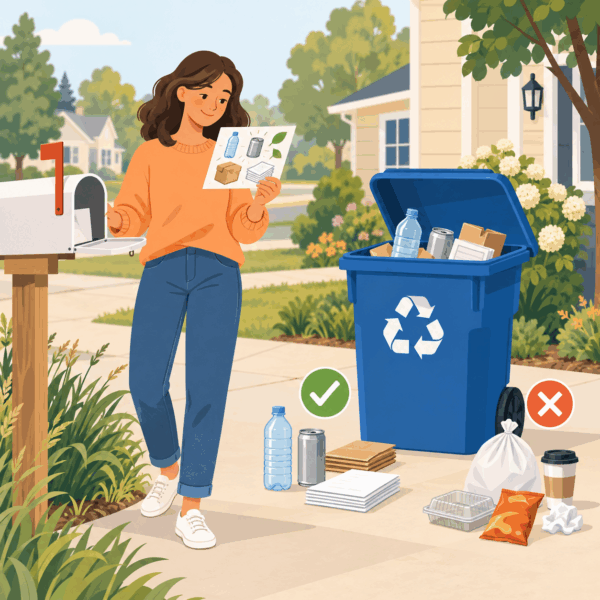
Specificity means that the postcard described the recipient’s own recycling behavior rather than a generalized description of mistakes that residents make. A household that received a personalized postcard identifying the plastic bags in their own cart received feedback that was unambiguously about their behavior. They could not interpret it as a message directed at less careful neighbors. It was directed at them, about their cart, about the specific materials that were causing a problem. That specificity is the foundation of effective behavior change communication in any context. You cannot correct a behavior you do not recognize as yours to correct.
Relevance means that the communication connected the feedback to outcomes the recipient could care about. The emotional postcard approach, which framed recycling as a community value and acknowledged the resident’s role in the program, produced stronger participation outcomes than the educational approach alone. Residents who understood that their recycling participation connected to a community environmental outcome they cared about were more likely to sustain changed behavior than residents who understood only that they had placed the wrong materials in their cart. The Recycling Partnership’s design of the emotional postcard reflected a communication insight that goes beyond recycling: behavior that feels like identity expression sustains better than behavior that feels like rule compliance.
Timeliness means that the feedback was delivered close enough to the collection event that the recipient could connect the postcard to their own recent recycling decisions. A personalized postcard arriving within a reasonable period after a contaminated collection provides feedback the recipient can contextualize. They remember what they put in the cart. They can connect the correction to a specific decision they made. General recycling reminders distributed weeks or months after the behavior that prompted them cannot produce the same specific connection between feedback and action.
The Transferable Lesson Beyond Camera-Equipped Collection Vehicles
Data-Driven Targeting as a Communication Design Principle for Any Agency
The most important lesson from the East Lansing pilot is not that every solid waste agency needs AI-powered cameras on its collection vehicles. It is that directing recycling education at the specific households and behaviors driving contamination, rather than broadcasting general guidance to the entire residential population regardless of their sorting behavior, is a fundamentally more effective communication strategy. The technology enabled that specificity at citywide scale. The communication principle it demonstrated is available through other means.
Agencies that do not have camera-equipped collection vehicles can pursue variations on the same principle through other tools. Contamination audits that identify the specific collection routes or geographic areas with the highest contamination rates provide the geographic targeting capability to concentrate education resources where contamination is actually occurring. Bin tagging programs, the manual precursor to the East Lansing AI system that The Recycling Partnership developed through Feet on the Street, allow collection crews to flag contaminated carts at the point of collection and leave educational materials at those specific addresses without requiring cameras or AI analysis. Complaint tracking systems that identify the addresses generating repeated contamination-related service requests provide the data foundation for targeted follow-up communication.
None of these approaches replicates the full precision and citywide scale of the East Lansing program. But all of them move communication toward the specific households and behaviors driving contamination and away from the undifferentiated broadcast of general sorting guidance that characterizes most recycling education programs. The East Lansing program’s manager framed the underlying challenge directly: people are trying to do the right thing, but recycling rules are hyperlocal and hard to get your hands on. The answer to that problem is not more general education. It is more specific feedback, delivered to the right household at the right moment.
The efficiency argument for targeted recycling communication is as strong as the effectiveness argument. An agency that concentrates recycling education resources on the routes, neighborhoods, or households with the highest contamination rates will produce greater contamination reduction per communication dollar than an agency that distributes those resources evenly across the service territory. The households that are already sorting correctly do not need the investment. The households that are driving contamination need it far more than even distribution delivers.
Emotional Framing and Community Identity in Recycling Communication
Why Values-Based Messaging Increased Participation Beyond Rule Correction
The finding that emotional messaging produced stronger participation outcomes than educational messaging alone deserves specific attention because it challenges the default assumption that recycling communication should focus primarily on rule clarification. The emotional postcards produced households that not only contaminated less but set out their carts significantly more often. They were not just sorting better. They were participating more actively in the recycling program.
This participation effect suggests that the emotional framing changed something more fundamental than sorting knowledge. It changed the resident’s relationship to the recycling program. A resident who understands recycling as a rule to follow will comply when they know what the rule is and have the motivation to follow it. A resident who understands recycling as participation in a community value will engage because engagement feels like an expression of identity rather than regulatory compliance. The Recycling Partnership’s emotional postcard design created the second kind of understanding.
For solid waste agencies designing recycling communication programs, this finding suggests that the communication investment should include values-based messaging alongside, or in some cases instead of, pure rule clarification. A program that tells residents what they are doing wrong and what to do differently will produce some behavior change among households that receive the feedback. A program that also tells residents why the program matters, what their participation means for community environmental outcomes, and how their individual behavior connects to results that everyone in the community benefits from will produce sustained engagement that pure compliance communication cannot replicate on its own.
The East Lansing program tested the educational and emotional approaches separately rather than in combination. A program that delivers both specific behavioral feedback and community values framing may produce outcomes that exceed either approach alone. Agencies designing personalized recycling communication programs should consider how to integrate both dimensions: the specific, timely, behaviorally targeted feedback that makes the communication undeniably relevant to the individual household, and the community identity framing that makes sustained participation feel like an expression of who the resident is.
Lessons for Solid Waste and Recycling Agencies
The East Lansing pilot, conducted by the City of East Lansing in partnership with Prairie Robotics, The Recycling Partnership, and Michigan EGLE, offers several transferable lessons for solid waste agencies seeking more effective recycling education programs.
First, broadcast recycling education is a structurally poor tool for changing the behavior that drives contamination. Sending general sorting guidance to all residents reaches households that are already sorting correctly at the same volume as households whose behavior needs to change, without giving the latter any indication that the communication is directed at them. Meaningful contamination reduction requires communication that reaches the specific households contributing to the problem and provides feedback specific enough to identify and correct the actual behavior.
Second, household-level contamination data is a communication asset. Agencies that have the data to identify which households or geographic areas are contributing most to contamination have the foundation for targeted communication programs that are significantly more efficient than broadcast education. AI-powered cameras provide one path to that data at citywide scale. The Recycling Partnership’s manual Feet on the Street cart-tagging model provides another, accessible without technology investment. Contamination audits and complaint tracking systems provide a third.
Third, emotional and values-based messaging increases program participation beyond what rule correction alone achieves. The Ohio State University analysis of the East Lansing results found that residents who received emotional postcards set out their carts 45 percent more often than before the intervention, a participation gain that educational messaging alone did not produce. Communication that connects recycling behavior to community environmental outcomes the resident cares about builds the kind of sustained engagement that drives long-term contamination reduction.
Fourth, the communication design principle matters more than the specific technology. The East Lansing program’s effectiveness came from delivering specific, relevant, timely feedback to the households whose behavior needed to change. Agencies can pursue that principle through multiple approaches, with varying levels of technology investment, by concentrating communication resources on the routes, neighborhoods, and households where contamination is actually occurring rather than distributing general education evenly across the service territory.
Fifth, participation and contamination reduction are related but distinct outcomes. The East Lansing program improved both, and the findings suggest that different communication approaches may be more effective for each outcome. Agencies that measure both, and design communication programs that address both, will achieve better results than agencies that focus exclusively on contamination rate reduction without attending to the underlying participation patterns that determine long-term program performance.
Conclusion: East Lansing as a Model for Targeted Recycling Communication
The East Lansing pilot demonstrated that the persistent gap between recycling education investment and contamination outcomes is not inevitable. It is the product of a communication design that sends the same general guidance to all residents regardless of their sorting behavior and expects that guidance to produce behavior change among the specific households that need it most. When the communication design changes, specifically when feedback is directed at the households whose behavior is generating contamination, delivered in a timeframe that allows them to connect the feedback to their own decisions, contamination rates fall and participation rates rise.
The 22.5 percent contamination reduction achieved across the 24-week pilot is a significant outcome for a program operating in a real city with a real and diverse residential population. It was achieved not by increasing the volume of recycling communication directed at all residents, but by improving the targeting and specificity of communication directed at the specific residents whose behavior needed to change. That is a communication design lesson that applies regardless of the specific technology any given agency has available.
The partnership model behind the East Lansing program is itself worth noting. By bringing together municipal operational capacity, private sector AI technology through Prairie Robotics, national recycling program expertise through The Recycling Partnership, and state environmental agency support through Michigan EGLE, the program assembled capabilities that no single partner could have provided alone. The Ohio State University research partnership ensured that the results were rigorously analyzed and publicly attributable rather than only internally reported. For solid waste agencies considering how to advance recycling education beyond broadcast campaigns, the East Lansing program offers both a specific model and a partnership approach worth examining.
SCG’s Strategic Approach to Public Utility Communication
Align your agency’s messaging, outreach programs, and ratepayer engagement strategies
 SCG helps solid waste departments, municipal energy providers, wastewater agencies, stormwater utilities, broadband authorities, and public works departments build communication systems that make program requirements, service expectations, and behavior change goals easier for residents and ratepayers to understand and act on. By aligning recycling education, service notification, community outreach, and targeted engagement programs, agencies can reduce contamination, improve program participation, and build the sustained public support that solid waste and recycling operations require.
Whether your agency is designing targeted recycling education for high-contamination routes, developing personalized feedback programs for households with persistent sorting errors, building emotional and community values messaging into recycling communication, improving the accessibility and specificity of sorting guidance for diverse resident populations, or creating a measurement framework that tracks contamination reduction and participation outcomes alongside program outputs, a strategic communication framework can help your agency achieve behavior change results that broadcast education cannot produce on its own.
Use the form below to connect with our team and explore how a strategic communication framework can strengthen your agency’s recycling education and contamination reduction outcomes.