
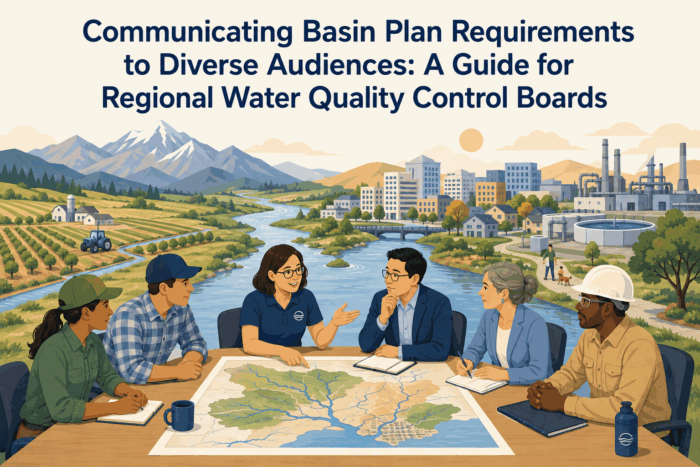
Communicating Basin Plan Requirements to Diverse Audiences: A Guide for Regional Water Quality Control Boards
Basin plans sit at the center of many regional water quality decisions, but they are often difficult for nontechnical audiences to understand. They can contain beneficial use designations, water quality objectives, implementation provisions, monitoring expectations, regulatory priorities, and other requirements that shape permitting, enforcement, restoration, and long-term watershed management. Regional Water Quality Control Boards may rely on these plans every day, while municipalities, regulated facilities, agricultural operators, community organizations, tribal governments, elected officials, and residents may encounter them only when a specific requirement begins affecting a project, permit, discharge, or local water body.
The communication challenge is therefore not simply that basin plans are technical. It is that the same plan can have very different implications for different audiences. A wastewater utility may need to understand how water quality objectives influence discharge limits. A municipality may be focused on stormwater obligations. Agricultural operators may be concerned about implementation requirements affecting land management. Community organizations may want to understand whether a water body is being protected for recreation, habitat, drinking water, cultural use, or another beneficial use. Residents may see a basin plan referenced in a permit or enforcement document without knowing what role it plays in the decision.
When boards communicate basin plan requirements only through citations, regulatory terminology, or lengthy planning documents, stakeholders may misunderstand both the purpose and the effect of the plan. Some may assume that every objective functions as an immediate source-specific limit. Others may treat a basin plan amendment as an abstract planning exercise with no operational consequences. Still others may not understand how basin plan provisions connect to permits, total maximum daily loads, monitoring programs, or other regulatory tools.
Effective basin plan communication should therefore create a bridge between the plan as a regulatory framework and the practical decisions stakeholders must make. Regional Water Quality Control Boards should explain what the basin plan does, which provisions apply to the issue at hand, how different requirements are implemented, and where other laws, permits, or agency decisions fit into the larger water quality system. The goal is not to make every audience an expert in basin planning. It is to make the framework understandable enough that people can see why a requirement exists, how it affects them, and what they need to do next.
Explain What a Basin Plan Does Before Explaining Individual Requirements
 Stakeholders are more likely to understand a basin plan requirement when they first understand the purpose of the plan itself. Regional Water Quality Control Boards should explain that basin plans establish the water quality framework for particular regions or watersheds, including the uses that water bodies are intended to support, the objectives designed to protect those uses, and the implementation approaches used to achieve those goals.
This foundation matters because basin plans are not merely technical reference documents. They can shape how permits are written, how discharges are evaluated, how impaired waters are addressed, and how regulatory priorities are implemented. Public-facing communication should explain those connections in plain language without suggesting that every basin plan provision automatically operates in the same way.
Boards should also make clear that basin plans function within a broader legal and regulatory system. Permits, enforcement actions, monitoring programs, TMDLs, statewide policies, federal requirements, and other regulatory tools may interact with basin plan provisions. Stakeholders need enough context to understand that the plan is part of the decision framework rather than a stand-alone document detached from other regulatory processes.
A clear introductory explanation reduces later confusion. When stakeholders know the role of the basin plan, individual objectives and implementation requirements become easier to interpret in relation to the specific water quality decision before them.
Explain Beneficial Uses in Terms Audiences Can Connect to Real Water Bodies
Beneficial uses are fundamental to basin planning, but the term can sound abstract or bureaucratic to audiences unfamiliar with water quality regulation. Regional Water Quality Control Boards should explain beneficial uses by connecting them to the ways people, communities, ecosystems, and economies depend on water bodies.
Depending on the applicable basin plan, beneficial uses may relate to drinking water supply, recreation, aquatic habitat, fisheries, agriculture, industrial use, groundwater recharge, wildlife, or other recognized functions. Communication should reflect the actual designations and terminology used in the relevant plan rather than presenting a generic list as though every use applies everywhere.
The most useful explanation connects the designation to regulatory purpose. If a water body is protected for recreation, for example, water quality objectives may address conditions that could interfere with safe recreational use. If aquatic habitat is a designated use, different pollutants or physical conditions may become important. This shows stakeholders why objectives exist rather than presenting them as isolated numerical requirements.
Boards should also avoid implying that beneficial uses describe only current conditions. Depending on the applicable framework, designated uses may reflect uses that are existing, potential, or otherwise recognized for protection. Public communication should explain the relevant status carefully so audiences do not assume that a degraded water body has no protected use simply because current conditions do not fully support it.
Distinguish a Beneficial Use From a Guarantee About Current Water Quality
A beneficial use designation does not necessarily mean that a water body currently meets every condition associated with that use. Regional Water Quality Control Boards should make this distinction clear when communicating about impaired or degraded waters.
The designation identifies the use the regulatory framework is intended to protect, while monitoring and assessment may show that existing conditions do not consistently support that use. This difference is important because residents may otherwise interpret the designation as evidence that the water is currently suitable for every associated activity.
Explaining the distinction helps audiences understand why regulatory action may be necessary. The beneficial use establishes the protective objective, while permits, restoration measures, TMDLs, enforcement, or other tools may be used to address conditions that interfere with it.
From Fragmentation to Coordination: Communication Strategies for Councils of Governments, Metropolitan Planning Organizations, and Regional Planning Agencies
This case study is part of SCG’s series on communication for councils of governments, metropolitan planning organizations, and regional planning agencies. To learn more and to see the parent article, which links to other content just like this, click the button below.
Translate Water Quality Objectives Without Presenting Every Number as the Same Kind of Limit
Basin plans may contain numerical and narrative water quality objectives, and those objectives can be difficult for diverse audiences to interpret. A stakeholder may see a concentration, temperature, bacterial indicator, toxicity requirement, or narrative prohibition and assume that each functions identically. Regional Water Quality Control Boards should explain what the specific objective addresses and how it is applied in the relevant regulatory context.
Some objectives may be expressed as numerical thresholds, while others describe conditions that should not occur or require interpretation through additional criteria or implementation procedures. The communication should preserve those distinctions. A narrative objective should not be converted casually into a fixed number, and a numerical objective should not be described as though it automatically becomes the same type of operational limit for every discharger.
Boards should also explain the relationship between the objective and the receiving water. The purpose is to protect designated uses and water quality conditions, but implementation may depend on the source, permit type, regulatory program, location, and applicable legal framework. Public materials should avoid suggesting that one basin plan number can be applied mechanically to every activity within the region.
Clear explanation reduces conflict because stakeholders can see that the objective is part of a regulatory process rather than an isolated benchmark. The important question becomes how the objective applies to the particular permit, discharge, or watershed issue under review.
Distinguish Basin Plan Objectives From Permit Limits and Operational Requirements
One of the most common sources of confusion is the relationship between basin plan requirements and the conditions that appear in individual permits. A regulated facility may see a water quality objective in the basin plan and assume that the same number will automatically appear as an effluent limit. A community member may assume that a permit value different from the basin plan objective means the agency weakened the requirement. These conclusions may not reflect how the applicable permitting framework operates.
Regional Water Quality Control Boards should explain that basin plan objectives help establish the water quality conditions that regulatory programs are designed to protect, while individual permit requirements are developed through the applicable permitting process. That process may consider discharge characteristics, receiving-water conditions, applicable policies, implementation procedures, and other legally relevant factors.
The communication should remain specific to the actual program. Boards should not imply that every permit limit is derived through the same method or that all dischargers are treated identically. The objective is to explain the relationship without oversimplifying the technical and legal process that converts broader water quality requirements into source-specific obligations.
This distinction is especially important when stakeholders compare a permit condition directly with a basin plan provision. A plain-language explanation can help them understand whether the values serve different functions, use different averaging periods, or reflect different parts of the regulatory analysis.
Explain Implementation Provisions as the Bridge Between Policy and Action
Basin plans often include implementation provisions that describe how water quality objectives and broader regulatory goals will be carried out. These provisions can be particularly difficult for stakeholders because they may involve schedules, control strategies, monitoring, permit requirements, source categories, or program-specific responsibilities that are spread across several sections of the plan.
Regional Water Quality Control Boards should explain implementation provisions as the operational bridge between the plan’s water quality goals and the actions expected from regulated entities or public agencies. Stakeholders need to know not only what the objective is, but how the board intends to move toward or maintain compliance with it.
For regulated audiences, this may mean explaining what implementation steps affect permitting, monitoring, reporting, operational practices, or compliance planning. For municipalities and local governments, it may involve explaining how regional requirements intersect with stormwater, wastewater, land management, or watershed programs. Community audiences may need a different explanation focused on what actions the board expects to occur and how progress will be tracked.
Implementation communication should remain precise about timing and responsibility. Boards should avoid implying that every action occurs immediately or that one regulated party is responsible for solving a watershed-wide problem when obligations are distributed across multiple sources and programs.
Explain Why Different Audiences May Have Different Responsibilities Under the Same Basin Plan
A single basin plan can affect municipalities, wastewater utilities, industrial facilities, agricultural operations, developers, public agencies, and other stakeholders in different ways. Regional Water Quality Control Boards should explain that the shared regulatory framework does not necessarily create identical obligations for every audience.
The type of activity, discharge, location, permit, source category, and applicable regulatory program can all influence how basin plan requirements are implemented. A municipality managing stormwater may encounter the plan through one set of obligations, while a wastewater treatment facility may encounter it through another. Agricultural operations may be governed through different implementation mechanisms altogether.
Audience-specific communication should therefore focus on the responsibilities relevant to each group while maintaining a consistent explanation of the underlying water quality objective. This avoids the opposite problems of making the basin plan seem universal but vague, or presenting each program as though it operates independently from the larger water quality framework.
When stakeholders can see both the common purpose and the different implementation pathways, the basin plan becomes easier to understand as a regional regulatory system. It establishes shared water quality goals while translating those goals into responsibilities that vary according to the activities and authorities involved.
Explain How Basin Plan Requirements Connect to TMDLs and Impaired Waters
Many stakeholders encounter basin plan requirements through discussions of impaired waters and Total Maximum Daily Loads, or TMDLs. These concepts can be difficult to follow because the basin plan may establish the broader water quality framework while a TMDL addresses a more specific pollutant and water body problem. Regional Water Quality Control Boards should explain how these pieces relate without assuming that audiences already understand the regulatory sequence.
Public-facing communication should begin with the water quality problem being addressed. If monitoring and assessment indicate that a water body is not meeting applicable water quality standards, stakeholders need to understand what pollutant or condition is involved, which beneficial uses are affected, and why additional regulatory attention may be necessary. The communication can then explain how a TMDL or related implementation provision fits within the basin plan framework.
Boards should also distinguish the TMDL from the individual requirements that later apply to specific sources. A TMDL may establish pollutant-loading allocations or implementation expectations, while permits and other regulatory mechanisms translate those broader requirements into source-specific obligations. Presenting the TMDL as though it is itself an individual permit limit can create unnecessary confusion.
This distinction is especially important in watersheds with multiple contributing sources. Municipal stormwater, wastewater discharges, agricultural activities, industrial sources, natural conditions, and other contributors may all be relevant depending on the pollutant and watershed. Communication should explain how responsibility is distributed without implying that one source category alone is responsible for the entire impairment.
Explain Compliance Schedules and Implementation Timelines Without Creating False Expectations
Basin plan requirements can include implementation schedules that extend over several years because water quality improvements may require infrastructure upgrades, operational changes, source controls, monitoring, regulatory amendments, or coordinated watershed action. Stakeholders may interpret a long schedule as evidence that the board is tolerating pollution indefinitely, while regulated entities may assume that future deadlines can be treated as flexible because the overall implementation period is lengthy.
Regional Water Quality Control Boards should explain what each milestone represents and which obligations apply at different stages. A long-term implementation schedule may still include near-term planning, monitoring, reporting, interim controls, or compliance actions. Public communication should make these steps visible so the timeline does not appear to consist only of a distant final deadline.
The board should also distinguish an adopted compliance schedule from uncertainty about implementation. If milestones are established through the applicable regulatory process, they should be communicated as requirements rather than aspirations. Where future actions depend on additional data, permit decisions, funding, or regulatory review, that uncertainty should be stated honestly.
Clear timeline communication helps both regulated parties and communities understand how progress will be evaluated. It prevents the regulated audience from treating long-term implementation as inactivity and prevents the public from assuming that every water quality objective can or should be achieved immediately regardless of technical or regulatory constraints.
Explain Monitoring as Evidence for Both Compliance and Adaptive Management
Monitoring plays a central role in basin plan implementation because boards need evidence about existing water quality conditions, pollutant trends, program performance, and whether regulatory actions are producing the intended results. Different audiences, however, may interpret monitoring solely as enforcement surveillance or solely as environmental research.
Regional Water Quality Control Boards should explain what the monitoring program is intended to determine. Some monitoring may support permit compliance, while other data may assess watershed trends, evaluate implementation effectiveness, identify emerging concerns, or provide information needed for future regulatory decisions. These purposes can overlap, but they should not be presented as identical.
The communication should also explain how monitoring results can affect future action. If data show that conditions are improving, implementation may continue as planned. If water quality is not responding as expected, the board may need to investigate contributing sources, revisit assumptions, modify implementation approaches, or consider other regulatory options through the appropriate process.
This helps stakeholders understand that basin planning is not necessarily a one-time exercise. Monitoring creates a feedback loop between regulatory expectations and actual environmental conditions, allowing the board to evaluate whether the adopted framework is functioning as intended.
Translate Basin Plan Amendments as Changes to the Regulatory Framework, Not Administrative Editing
Basin plans evolve over time. Regional Water Quality Control Boards may consider amendments involving beneficial uses, water quality objectives, implementation provisions, TMDLs, or other elements of the plan. To stakeholders who do not follow basin planning closely, the term “amendment” can sound like a technical document update rather than a regulatory change with practical consequences.
Boards should explain what is proposed to change and why. Public communication should identify the existing provision, the proposed revision, the water quality or implementation problem the amendment is intended to address, and which stakeholders could be affected. This gives audiences enough context to understand whether the amendment changes a standard, implementation approach, schedule, designation, or another aspect of the regulatory framework.
The board should also explain what remains unchanged. A targeted amendment should not be communicated as though the entire basin plan is being reopened. Stakeholders need to know which issues are genuinely under consideration so they can focus comments and technical review on the decision before the board.
Clear amendment communication also improves public participation. When audiences understand the practical significance of the proposed change, they are better positioned to provide information about technical feasibility, environmental conditions, implementation consequences, or other factors relevant to the board’s decision.
Show the Difference Between a Proposed Amendment and an Adopted Requirement
Public communication should distinguish clearly between ideas under consideration and requirements that have completed the applicable adoption and approval process. Stakeholders may encounter draft language, staff recommendations, hearing materials, or proposed implementation schedules and assume that the change is already in effect.
Regional Water Quality Control Boards should label procedural status consistently. A proposed amendment should be described as proposed until the required decision process is complete, and public materials should explain what additional steps remain before it becomes operative.
This distinction protects both public participation and regulated audiences. People can comment knowing that the outcome remains open, while businesses and local governments avoid changing operations prematurely based on draft requirements that may still change.
Explain How Basin Plan Requirements Interact With Permits
For many regulated audiences, the basin plan becomes most tangible when its requirements appear in a discharge permit, waste discharge requirement, stormwater permit, or another regulatory authorization. The connection between the regional planning document and the source-specific permit should therefore be communicated directly.
Regional Water Quality Control Boards should explain that permits are one of the mechanisms through which basin plan objectives and implementation requirements may be applied to individual dischargers or regulated programs. The exact translation depends on the applicable permit framework, source type, receiving water, and other regulatory factors, so communication should avoid suggesting that every basin plan provision becomes a permit condition in the same way.
When a permit introduces a new requirement tied to a basin plan amendment or TMDL, the board should explain that lineage. Regulated entities are more likely to understand the obligation when they can see how the permit condition connects to an adopted regional water quality requirement rather than viewing it as an isolated permit-writing choice.
Public audiences benefit from the same explanation. Communities following an impaired water body or pollution problem can better understand how broad basin plan goals become enforceable through individual regulatory actions.
Explain Watershed-Wide Requirements Without Making Responsibility Feel Indeterminate
Watershed-scale water quality problems can be difficult to communicate because responsibility may be distributed across many sources and programs. When everyone contributes to a problem, stakeholders may conclude that no one is individually accountable. Regional Water Quality Control Boards should explain shared responsibility without allowing it to become vague.
The board should identify the major source categories or implementation groups relevant to the water quality issue and explain how responsibilities differ among them. A municipal stormwater program, wastewater discharger, agricultural operator, and industrial facility may all contribute to the same pollutant problem but be regulated through different mechanisms.
Communication should also distinguish collective environmental outcomes from individual compliance. A watershed may remain impaired even while one regulated entity is meeting its specific requirements, and one entity’s noncompliance may not explain the entire watershed condition. These distinctions prevent both unfair attribution and overly broad claims of success.
A clear watershed framework allows stakeholders to see how individual obligations fit into a shared regional strategy. The basin plan becomes more understandable when each audience can identify its own role without losing sight of the larger water quality objective.
Communicate With Municipalities as Both Regulated Entities and Public Partners
Municipal governments can occupy several roles within basin plan implementation. They may operate wastewater systems, manage stormwater programs, own infrastructure, regulate local development, conduct monitoring, or communicate directly with residents. Regional Water Quality Control Boards should recognize this dual role when explaining basin plan requirements.
Municipal staff need technical and regulatory clarity about their own obligations, including deadlines, monitoring expectations, permit implications, and implementation responsibilities. At the same time, local governments often become the public-facing source residents turn to when basin plan requirements affect local projects or services.
Boards can support stronger local communication by providing municipalities with clear explanations that distinguish regional requirements from local implementation choices. This helps city and county staff explain why a requirement exists while remaining accurate about the areas where local agencies retain discretion.
Coordinated communication reduces the risk that residents hear one explanation from the regional board and another from their municipality. It also recognizes that successful basin plan implementation often depends on local agencies understanding both what they must do and how to explain those responsibilities to the communities they serve.
Organize Communication Around the Questions Different Audiences Need Answered
Basin plan communication becomes more effective when Regional Water Quality Control Boards recognize that different audiences approach the same requirement from different starting points. A wastewater utility may want to know how an objective affects permit limits, while a municipality may be focused on stormwater implementation, an agricultural operator may need to understand monitoring or management obligations, and a community organization may want to know how the plan protects a particular water body. One generalized explanation is unlikely to serve all of these needs equally well.
Boards should therefore organize public-facing communication around practical audience questions while maintaining a consistent regulatory foundation. The same basin plan provision can be explained at different levels of detail depending on who needs to act on it. Regulated entities may need technical implementation guidance, while residents may need a clearer explanation of the environmental purpose, affected water body, and expected outcome.
Audience-specific communication should not create different interpretations of the requirement. The underlying objective, implementation provision, or regulatory requirement should remain consistent across materials. What changes is the emphasis, terminology, and level of operational detail provided to each audience.
This approach improves both compliance and public understanding. Stakeholders are more likely to engage constructively when the board explains the requirement in terms that connect directly to the decisions, responsibilities, and concerns relevant to them.
Explain Numeric and Narrative Objectives With the Same Level of Practical Context
 Numerical water quality objectives may appear easier to communicate because they provide a specific value, while narrative objectives can seem less concrete. In practice, both can create confusion if audiences do not understand what condition is being evaluated or how the objective is applied. Regional Water Quality Control Boards should give both types of objectives sufficient interpretive context.
For numerical objectives, communication should identify the pollutant or parameter, relevant unit, averaging period or other applicable measurement context, and the water quality purpose the number serves. A single value should not be presented as though it has the same regulatory meaning in every permit or monitoring situation.
Narrative objectives require equally careful explanation. Terms addressing toxicity, nuisance conditions, objectionable materials, or other water quality characteristics may require technical interpretation within the applicable regulatory framework. Boards should explain the environmental condition the narrative objective is intended to prevent or protect against without inventing a simplified numeric equivalent where none applies.
Consistent context helps stakeholders understand that both numerical and narrative provisions are part of the same water quality framework. The distinction lies in how the objective is expressed and implemented, not in whether one is inherently more important or enforceable than the other.
Explain Water Quality Data in Relation to Basin Plan Requirements
Monitoring results become more meaningful when stakeholders understand how they relate to the basin plan. A concentration, bacterial result, temperature measurement, toxicity finding, or other water quality indicator may attract public attention, but the significance of the result depends on the applicable objective, monitoring method, location, timing, and regulatory context.
Regional Water Quality Control Boards should explain what was measured, which objective or beneficial use is relevant, and whether the result represents an isolated observation, a recurring pattern, or part of a broader assessment. One measurement should not automatically be described as proof of watershed-wide impairment unless the applicable assessment supports that conclusion.
The same caution applies in the opposite direction. One favorable result does not necessarily establish that all water quality concerns have been resolved. Seasonal variation, monitoring frequency, pollutant type, and multiple source contributions may all influence interpretation.
By connecting monitoring data to the basin plan framework, boards can help audiences understand why data collection matters and how evidence informs regulatory decisions. The public sees not only the measurement, but the role it plays in evaluating whether protected uses and water quality objectives are being supported.
Distinguish a Monitoring Result From a Formal Regulatory Determination
Stakeholders may assume that a single result above or below an objective automatically establishes compliance or noncompliance. Regional Water Quality Control Boards should explain that formal determinations may require additional evaluation depending on the applicable regulatory program, monitoring design, and legal framework.
A monitoring result can be important evidence without independently resolving every regulatory question. The board may need to consider frequency, duration, location, quality assurance, source information, or other data before reaching a formal conclusion.
This distinction helps preserve confidence in both monitoring and enforcement. The agency is not minimizing an elevated result or ignoring a favorable one. It is explaining how individual measurements become part of a larger evidentiary and regulatory process.
Make Source Responsibilities Visible Without Oversimplifying Watershed Complexity
Basin plan implementation often involves multiple source categories contributing to the same water quality problem. Residents may want to know which source is responsible, while regulated entities may question why they must take action when other contributors remain. Regional Water Quality Control Boards should explain both individual responsibilities and broader watershed complexity.
Communication should identify which source categories are subject to which regulatory mechanisms. Wastewater dischargers, municipal stormwater systems, agricultural operations, industrial facilities, and other sources may be regulated differently even when they contribute to the same pollutant problem. The board should explain those differences without implying that one category is automatically more responsible simply because its requirements are more visible.
Where source attribution is uncertain or distributed, the board should say so. A water quality impairment can result from multiple contributions, historical conditions, diffuse sources, or natural factors. The communication should distinguish evidence about individual sources from conclusions about the watershed as a whole.
This framing supports accountability without creating false precision. Each regulated audience can understand its own obligations while recognizing that basin plan implementation may require coordinated action across several sectors.
Explain Why Regulatory Requirements May Change as New Information Becomes Available
Basin plans are designed to guide water quality protection over long periods, but the information supporting implementation can evolve. Monitoring may reveal new trends, scientific understanding may improve, regulatory priorities may shift, or existing implementation approaches may prove insufficient. Regional Water Quality Control Boards should explain that changes to requirements can occur through established regulatory processes rather than appearing as arbitrary changes in agency expectations.
When new information leads to proposed amendments, revised implementation strategies, or different permit requirements, communication should identify the reason for the change. Stakeholders should understand what new evidence or regulatory development prompted reconsideration and which part of the existing framework may be affected.
Boards should also distinguish new information from immediate new obligations. Data may indicate a need for additional evaluation before a formal regulatory change occurs. Public communication should avoid implying that a new monitoring result automatically creates a new requirement unless the applicable process actually provides for that outcome.
This approach helps stakeholders understand basin planning as a structured but adaptive system. The framework can respond to changing environmental conditions and better information while still requiring defined procedures for formal regulatory changes.
Explain Technical Uncertainty Without Undermining Regulatory Expectations
Water quality regulation often requires decisions under conditions of scientific uncertainty. Data may be incomplete, sources may be difficult to separate, future environmental conditions may vary, or implementation effectiveness may take years to evaluate. Regional Water Quality Control Boards should explain uncertainty openly while remaining clear about the requirements that still apply.
A board can state that the exact contribution of one source is uncertain while also explaining that the source remains subject to a permit or implementation obligation. Similarly, the precise timeline for watershed recovery may be uncertain even when interim milestones and monitoring requirements are established.
Public communication should distinguish uncertainty about environmental response from uncertainty about regulatory responsibility. Regulated entities need to know which obligations are fixed even when long-term outcomes are difficult to predict, while communities need to understand why progress may not be immediate or perfectly measurable.
Clear uncertainty communication supports credibility because it avoids false precision. The board demonstrates that it understands the limits of available information while still explaining how the regulatory framework manages those limits.
Show How Public Participation Connects to Basin Plan Decisions
Basin plan amendments, TMDL development, implementation changes, and other major actions may involve public participation opportunities. Stakeholders need to understand what is actually open for input and how comments can influence the board’s decision.
Regional Water Quality Control Boards should explain the scope of participation in practical terms. Depending on the proceeding, stakeholders may provide technical data, information about local conditions, implementation concerns, economic or operational information where relevant, alternative approaches, or comments on proposed objectives and schedules. Guidance should reflect the specific process rather than rely on generic public-comment language.
The board should also explain which elements are constrained by law, statewide policy, federal requirements, or previously adopted decisions. Participants are more likely to engage meaningfully when they can see where the board has discretion and where the regulatory framework limits available options.
Public participation becomes more credible when stakeholders understand how their input enters the record and what happens after the comment period closes. Clear communication connects engagement to actual decision-making rather than presenting participation as a procedural formality.
Coordinate Communication Across Regional Boards, Local Agencies, and Regulated Entities
Basin plan implementation often depends on communication passing through several levels of government and regulated organizations. Regional Water Quality Control Boards may establish or administer the regional framework, while municipalities, utilities, permittees, and other entities explain operational requirements to employees, customers, residents, or property owners. Inconsistent explanations can create confusion about what the basin plan actually requires.
Boards should provide enough common language and supporting context that local agencies and regulated entities can explain the origin and purpose of major requirements accurately. This can include summaries of relevant objectives, implementation milestones, regulatory roles, and distinctions between regional requirements and local implementation choices.
Coordination should not turn local partners into extensions of the board’s public information function. Municipalities and regulated entities have their own responsibilities and communication needs. The objective is to give them an accurate foundation so that local explanations do not contradict the regional regulatory framework.
Consistent communication across these layers helps diverse audiences see basin plan implementation as a connected system. Stakeholders encounter different agencies and programs, but the core explanation of why the requirement exists and how it fits into regional water quality protection remains coherent.
Build Basin Plan Communication Into Program and Project Management
Basin plan communication is most effective when it is planned alongside regulatory implementation rather than added after a permit, amendment, TMDL, or compliance issue has already generated questions. Regional Water Quality Control Boards should identify which basin plan provisions are likely to require explanation, which audiences will be affected, and when communication should occur relative to regulatory milestones.
Planning should connect communication to permit development, basin plan amendments, monitoring results, implementation schedules, public hearings, and major compliance transitions. This helps ensure that stakeholders receive context before requirements become urgent and reduces the risk that local agencies or regulated entities learn about significant changes only through formal documents.
Boards should also define internal responsibility for keeping public-facing materials current. Program staff, technical specialists, legal teams, public information staff, and community engagement personnel may all contribute to basin plan communication. Clear ownership helps prevent conflicting explanations and outdated summaries from remaining in circulation.
Integrating communication into program management creates continuity. Stakeholders can follow how a basin plan requirement moves from policy to implementation rather than encountering isolated notices that do not explain how one stage connects to the next.
Create a Clear Information Architecture for Basin Plan Requirements
Basin plans can be lengthy and technically dense, and users may struggle to locate the specific provision that applies to their permit, watershed, or water body. Regional Water Quality Control Boards should organize public information so stakeholders can enter the framework through the question they are trying to answer rather than through the internal structure of the plan.
Digital materials can be organized by water body, pollutant, beneficial use, implementation program, or regulated audience where appropriate. A municipality looking for stormwater obligations should not need to search the entire basin plan to identify the relevant implementation provisions. A community organization should be able to locate the objectives and beneficial uses associated with a particular water body without reconstructing the document independently.
Public-facing summaries should always connect back to the authoritative basin plan language. The objective is not to replace the regulatory document, but to provide navigation that makes it easier to understand which sections matter and why.
A well-designed information structure also reduces staff workload. When stakeholders can identify the relevant objective, implementation provision, schedule, and supporting documents independently, staff can focus on substantive questions rather than repeatedly guiding users through the document.
Maintain Version Control When Basin Plans and Implementation Documents Change
Basin plans evolve through amendments, updated implementation provisions, revised TMDLs, regulatory approvals, and other changes. If older documents remain visible without clear status information, stakeholders may rely on provisions that have been superseded or assume that a proposed amendment is already in effect.
Regional Water Quality Control Boards should maintain clear version control across public webpages, downloadable documents, permit guidance, meeting materials, and supporting resources. Current requirements should be easy to identify, while historical versions should remain accessible where appropriate without appearing to govern the present process.
When a significant change occurs, the board should explain not only that a new version exists but what changed and which audiences may be affected. A short change summary can help regulated entities and local agencies determine whether they need to revise procedures, monitoring, reporting, or compliance planning.
Version control is especially important during transition periods. Stakeholders should understand when a new requirement becomes operative, whether older obligations remain in effect temporarily, and which deadlines or implementation milestones control. Clear status communication reduces avoidable compliance confusion.
Distinguish Draft, Adopted, Approved, and Effective Requirements
Basin plan actions can move through several procedural stages, and stakeholders may not understand the difference between a board-adopted amendment and a requirement that has completed all necessary approval steps. Regional Water Quality Control Boards should label these stages consistently.
Public materials should identify whether language is proposed, adopted by the board, awaiting additional approval, or effective. The exact terminology should reflect the applicable process, but the underlying communication principle is the same: stakeholders need to know whether they are reviewing a possible future requirement or a current obligation.
This distinction protects participation and compliance planning. It prevents premature implementation of draft requirements while also reducing the risk that regulated entities overlook a requirement that has already become effective.
Prepare Staff to Explain Basin Plan Requirements Consistently Across Programs
Basin plan questions can reach staff through permitting, enforcement, monitoring, TMDL implementation, stormwater programs, wastewater regulation, agricultural programs, public meetings, and community outreach. If each program explains the same basin plan provision differently, stakeholders may conclude that the board itself is uncertain about what the requirement means.
Regional Water Quality Control Boards should provide staff with a shared explanation of major objectives, beneficial uses, implementation provisions, timelines, and regulatory relationships. This does not mean reducing complex requirements to scripts. It means ensuring that staff use consistent terminology and understand where program-specific interpretation begins.
Staff should also know when a question requires additional technical or legal review. Basin plan provisions can be complex, and front-line employees should not be expected to resolve ambiguous applicability questions in real time. A clear referral process helps preserve accuracy while still giving stakeholders a useful response pathway.
Consistent staff communication improves trust because stakeholders receive the same core explanation whether they speak with a permit writer, monitoring specialist, public information officer, or program manager.
Coordinate Basin Plan Communication With Local Governments and Permit Holders
Municipalities, utilities, regulated facilities, and other permit holders often become the practical translators of basin plan requirements because they must explain how regional requirements affect local operations, customers, developers, or residents. Regional Water Quality Control Boards should support that role with clear, current, and audience-ready information.
Boards can provide concise explanations of the relevant objective, implementation provision, timeline, and regulatory purpose so local organizations do not have to reconstruct the basin plan independently. This is particularly useful when requirements affect multiple jurisdictions or when a new amendment changes established practices.
Coordination should preserve the distinction between regional requirements and local implementation choices. A municipality may have discretion in how it carries out a broader obligation, while another requirement may be more prescriptive. Public communication should make that difference visible so local decisions are not incorrectly attributed to the regional board.
This approach creates a more coherent communication chain. The board explains the regional framework, local entities explain how it applies operationally, and stakeholders receive consistent information about the source and purpose of the requirement.
Prepare Communication for Controversial Basin Plan Amendments and TMDLs
Some basin plan actions generate intense conflict because they may affect major industries, agricultural operations, municipal budgets, infrastructure investments, land management, or community expectations for water quality improvement. Regional Water Quality Control Boards should identify high-interest actions early enough to prepare communication before the formal hearing or adoption stage.
Preparation can include issue summaries, implementation timelines, audience-specific FAQs, technical explainers, public meeting materials, staff talking points, translated content, and a clear description of what the board is deciding. These tools should explain the environmental problem and regulatory framework without advocating for a predetermined outcome while the decision remains open.
Boards should also anticipate competing narratives. Regulated stakeholders may emphasize cost or technical feasibility, while communities may focus on health, recreation, habitat, or historical pollution concerns. The board’s communication should remain anchored in the record and explain how those issues enter the applicable decision framework.
A prepared communication system helps reduce escalation by making the process, evidence, and decision scope visible before controversy becomes the primary source of public understanding.
Measure Whether Basin Plan Communication Is Improving Understanding and Compliance
Regional Water Quality Control Boards should evaluate whether stakeholders understand basin plan requirements rather than measuring success only by the number of fact sheets, meetings, webpages, or notices produced. Communication effectiveness is better reflected in whether audiences can identify what requirement applies, why it exists, and what action is expected.
Useful indicators may include recurring questions about beneficial uses, confusion between objectives and permit limits, misunderstanding of implementation schedules, repeated reliance on outdated provisions, or difficulty identifying which source category is responsible for which action. These patterns can reveal where explanatory materials are insufficient.
Boards can also examine whether public comments become more focused after clearer materials are provided and whether municipalities or permit holders require fewer corrections related to basic interpretation. These measures should be used as diagnostic information rather than as proof that communication alone determines compliance.
The purpose of evaluation is continuous improvement. If the same misunderstandings appear across multiple programs or basin plan actions, the board can refine templates, staff guidance, digital navigation, and stakeholder outreach instead of addressing the same confusion repeatedly.
Build Institutional Knowledge That Survives Staff and Regulatory Turnover
Basin plans operate over long time horizons, while staff assignments, leadership, regulatory priorities, and implementation programs can change. Regional Water Quality Control Boards should preserve communication knowledge so that institutional understanding does not disappear when experienced staff leave or responsibilities shift.
Institutional resources can include approved definitions, audience-specific explanations, implementation summaries, amendment histories, staff briefing materials, referral pathways, public meeting guidance, and lessons from previous high-interest basin plan actions. These resources should be reviewed regularly so they remain aligned with current requirements.
Boards should also document recurring stakeholder concerns associated with particular watersheds, objectives, or implementation programs. That history can help new staff understand why certain provisions require additional context and where communication has previously broken down.
Strong institutional knowledge supports consistency across permit cycles, amendment processes, and changing staff teams. It helps ensure that basin plan requirements remain understandable not only in the technical record, but also in the communication systems through which diverse audiences experience them.
Strategic Communication Support for Basin Plan Implementation
 Basin plans can be difficult to communicate because they combine water quality objectives, beneficial uses, implementation provisions, monitoring expectations, permit implications, and long-term watershed priorities within one regulatory framework. Regional Water Quality Control Boards may understand these relationships internally, while municipalities, utilities, regulated facilities, agricultural operators, tribal governments, community organizations, and residents encounter only the portions that affect their immediate responsibilities. External strategic communication support can help boards organize this complexity into audience-specific explanations without changing the substance of the underlying regulatory requirements.
Stegmeier Consulting Group (SCG) can support Regional Water Quality Control Boards by developing plain-language basin plan summaries, beneficial-use explainers, implementation guides, amendment communication, TMDL materials, stakeholder FAQs, meeting presentations, staff talking points, multilingual outreach, digital information structures, and communication frameworks for controversial or technically complex basin plan actions. SCG can also help boards clarify the relationship between regional requirements and source-specific permits, distinguish draft from effective requirements, and align messaging across programs, municipalities, permit holders, and community-facing channels.
External support can be particularly valuable when internal capacity is limited, when basin plan changes affect several regulated sectors at once, or when an objective outside perspective can identify explanations that are technically accurate but difficult for nontechnical audiences to use. SCG’s role remains focused on communication strategy, information organization, public engagement, and stakeholder navigation. SCG does not establish water quality objectives, determine beneficial uses, conduct technical water quality analysis, adopt TMDLs, write regulatory findings, issue permits, or make enforcement decisions on behalf of the board.
Future Trends
Basin plan communication will increasingly need to support more complex watershed management while remaining understandable to audiences with very different levels of technical knowledge. Climate-related changes, water supply pressures, changing land use, emerging contaminants, infrastructure investment, and evolving monitoring capabilities may create new demands on regional water quality frameworks and increase the number of stakeholders trying to understand how those frameworks apply.
Digital access will also become more important. Stakeholders will increasingly expect to locate objectives, beneficial uses, implementation schedules, amendments, TMDLs, monitoring information, and permit connections through searchable and geographically intuitive tools rather than relying exclusively on lengthy regulatory documents. Interactive maps and water body-specific information may make basin plan requirements easier to navigate if they remain connected clearly to the authoritative record.
Boards may also face stronger expectations for traceability. Regulated entities and communities will increasingly want to understand how a water quality problem led to a basin plan requirement, how that requirement became an implementation action, how responsibility was assigned, and how monitoring will be used to evaluate progress. Making that sequence visible can strengthen accountability without oversimplifying the regulatory framework.
Technology can improve navigation and access, but it will not eliminate the need for careful interpretation. Regional Water Quality Control Boards will still need to explain which requirements apply, where implementation differs among source categories, how uncertainty affects decision-making, and why watershed improvement may occur over long time horizons rather than through one regulatory action.
Conclusion
Basin plans are foundational to regional water quality regulation, but their value as public and regulatory tools depends in part on whether diverse audiences can understand how the framework affects them. Beneficial uses, water quality objectives, implementation provisions, TMDLs, monitoring requirements, and permit conditions should not appear as disconnected technical concepts when they are all part of the same water quality protection system.
Regional Water Quality Control Boards can improve understanding by explaining the purpose of the basin plan first and then connecting individual requirements to practical responsibilities. Municipalities, utilities, agricultural operators, industrial facilities, community organizations, and residents may encounter different parts of the framework, but each audience should be able to identify why a requirement exists, who is responsible for implementing it, and how progress will be evaluated.
Clear communication is especially important when requirements evolve. Proposed amendments, long-term implementation schedules, changing monitoring information, and new permit obligations can create confusion if procedural status and regulatory relationships are not visible. Boards should maintain consistent explanations across technical documents, public materials, staff communication, and partner organizations.
When basin plan communication is treated as regulatory infrastructure, Regional Water Quality Control Boards are better positioned to support compliance, improve public participation, and strengthen confidence in long-term watershed management. The objective is not to simplify the framework beyond recognition, but to make it navigable enough that stakeholders can understand both their own responsibilities and the broader water quality goals those responsibilities are intended to support.
Stegmeier Consulting Group’s Strategic Approach to Communication Systems
Connect basin plan requirements to practical responsibilities so diverse audiences can understand both the regulatory framework and their role within it.
Regional Water Quality Control Boards need communication systems that help municipalities, utilities, regulated entities, community organizations, and residents understand beneficial uses, water quality objectives, implementation provisions, TMDLs, monitoring expectations, and permit connections without requiring them to interpret the entire basin plan independently. Stegmeier Consulting Group (SCG) helps boards organize complex water quality information, develop audience-specific guidance, strengthen internal and external messaging, improve digital navigation, and build communication frameworks that make basin plan requirements easier to understand while remaining aligned with the authoritative regulatory record.
Use the form below to connect with our team and explore how strategic communication support can strengthen basin plan communication and stakeholder understanding.