
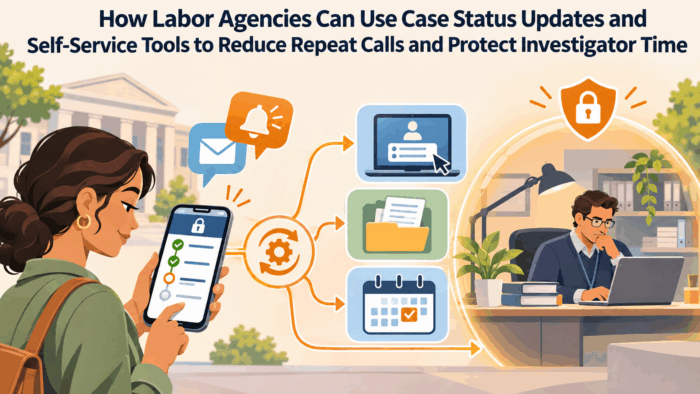
How Labor Agencies Can Use Case Status Updates and Self-Service Tools to Reduce Repeat Calls and Protect Investigator Time
Labor agencies often receive repeat calls for reasons that have little to do with the substance of a case. Workers, employers, representatives, and other parties may simply want to know whether a complaint was received, whether someone has been assigned, whether the agency is waiting for information, whether a hearing has been scheduled, or whether they are supposed to do something next. When those basic questions can be answered only by calling the agency, investigators and front-line staff become part of the status-notification system.
The operational consequences can become significant. An investigator who repeatedly stops case work to answer routine status questions has less uninterrupted time for record review, interviews, analysis, correspondence, and other substantive responsibilities. Call centers and administrative staff may experience the same pressure, particularly when they cannot see enough case information to answer questions without contacting the assigned investigator.
Self-service tools and proactive case status updates can reduce this burden, but only when they provide information people actually understand. A portal that shows “pending,” an automated message that says “your case remains open,” or an internal status code exposed to the public may technically provide information while doing little to answer the person’s real question. Effective self-service communication should explain where the case is, what that stage means, what happens next, and whether the person needs to take action.
The goal is not to eliminate human contact or make investigators inaccessible. Some questions require case-specific judgment, sensitive discussion, clarification of evidence, or direct communication with agency staff. The stronger strategy is to separate routine status needs from substantive case communication so investigators can spend more time investigating while workers and other parties receive timely, understandable information about matters that do not require investigator intervention.
Understand Why People Keep Calling About Pending Cases
 Repeat status calls are often treated as a public behavior problem, but they frequently indicate an information problem. People call because they cannot tell whether the agency received their materials, whether the case is progressing, or whether a long period without contact is normal. If the agency does not provide that information proactively, calling may be the only reasonable way for a person to reduce uncertainty.
The need for reassurance can increase as a case gets older. A worker who received an acknowledgment three months ago may begin wondering whether the complaint was lost, while an employer may be uncertain whether additional information is still expected. The longer the period of silence, the more likely people are to create their own interpretation of what the silence means.
Repeat calls can also occur because earlier answers were too vague. Telling someone that a matter is “under review” may not help if the same phrase is used during intake, investigation, supervisory review, and hearing preparation. People are less likely to call again when the status tells them something meaningful about the current stage.
Agencies should therefore analyze repeat contact before trying to reduce it. The important question is not simply how many calls are occurring, but what people are trying to learn. Those questions can reveal which status updates, portal features, FAQs, or automated notifications would remove the greatest amount of avoidable uncertainty.
Separate Routine Status Questions From Questions That Require an Investigator
Not every case-related question requires access to the investigator assigned to the matter. Questions about whether a document was received, whether a case remains open, whether a hearing has been scheduled, or whether the agency is currently waiting for information may be answerable through a portal, automated update, call center, or administrative staff. Agencies should identify these routine questions and design other channels to handle them.
Other questions genuinely require investigator involvement. A worker may need to describe new evidence, report retaliation, clarify an earlier statement, or explain a significant change in circumstances. An employer may need clarification about a substantive information request or another issue directly related to the investigation.
The communication system should help people distinguish between these categories. Self-service tools should explain what they can answer and provide a clear path for contacting staff when the issue requires case-specific attention. This prevents self-service from becoming a barrier between the public and investigators.
The same distinction helps internal staff. Call center employees and administrative teams need clear guidance about which questions they can answer, what case information they can access, and when a matter should be escalated. A well-designed tiered system protects investigator time without forcing front-line staff to guess.
Replace Generic Case Statuses With Meaningful Stages
A self-service system is only as useful as the status information it contains. Labels such as pending, open, active, processing, or under review may be technically correct while revealing almost nothing about what is happening. Agencies should create public-facing stages that correspond to meaningful points in the case lifecycle.
Depending on the program, those stages might distinguish between complaint received, initial review, awaiting assignment, assigned for investigation, waiting for information, active investigation, supervisory review, hearing preparation, decision pending, or another relevant step. The specific terminology should reflect the agency’s actual process rather than an idealized workflow that cases do not consistently follow.
Each status should include a brief explanation. “Awaiting assignment,” for example, can explain that the agency has received the case and that it is waiting for staff capacity before substantive review begins. “Waiting for information” can explain whether the agency is waiting for the worker, employer, another party, or an external source when that information can appropriately be disclosed.
Meaningful status design also requires discipline. Agencies should not create so many categories that the public needs another guide to interpret them. A limited number of understandable stages, supported by more detailed explanations where needed, can provide useful transparency without exposing internal case-management complexity.
Tell People What Happens Next
Knowing the current status is only part of what people want from a case update. They also want to know what the status means for the future. A useful update should therefore identify the next expected stage or event when the agency can reasonably do so.
For example, a case in initial review may move to assignment, while an active investigation may next involve additional information gathering or supervisory review. A matter awaiting a hearing may remain in that stage until scheduling occurs. Explaining the next general step gives people a sense of direction even when an exact date is unavailable.
The agency should avoid predicting outcomes or promising timelines that cannot be controlled. “The next step is supervisory review” is fundamentally different from “you will receive a decision within two weeks.” The first provides process orientation, while the second creates an expectation that may not be supportable.
Next-step information can be particularly valuable during stages that involve long waits. People may tolerate waiting more easily when they understand what event will move the case forward. Self-service tools can provide that explanation without requiring a staff member to repeat it individually to every caller.
Make “No Action Required” a Visible Case Status Message
Many repeat calls occur because people are worried that they are missing something. They may wonder whether the agency sent a notice they never received, whether they should submit more records, or whether silence means they were expected to follow up. A clear statement that no action is currently required can eliminate much of that uncertainty.
This message should appear within case portals, milestone emails, text notifications where used, and other status communications. It can be paired with the current case stage and an explanation of what the agency is doing next. People then know that waiting is the appropriate action rather than a sign that they have neglected the case.
Agencies should also identify the situations in which action is required. If additional information, a response, an appearance, or confirmation is needed, the status should make that obligation prominent. Clear differentiation between “we are working on the next step” and “we need something from you” improves both communication and case administration.
Making action requirements visible can also reduce avoidable delays. People are less likely to overlook genuine requests when routine updates consistently tell them whether anything is required. This makes status communication useful not only for reducing calls but also for moving cases forward.
Use Milestone Notifications Before People Feel the Need to Call
Self-service does not have to mean requiring people to repeatedly check a portal. Agencies can send proactive notifications when a case reaches an important milestone. A short message can tell the person that the case was received, assigned, moved to another stage, scheduled for a hearing, or advanced to decision review.
These notifications can reduce the period of uncertainty that often triggers repeat contact. Instead of wondering whether anything changed, the person knows the agency will notify them when a meaningful milestone occurs. This allows the public to rely more on the system and less on repeated status checking.
Notifications should remain concise and direct people to the appropriate source for additional information. A message might identify the new stage, state whether action is required, and provide a link or instruction for viewing more detail. This keeps the notification useful without trying to reproduce the entire case record.
Agencies should also explain the limits of notifications. Not every investigative activity will generate an update, and some stages may last for extended periods. Setting that expectation helps prevent people from interpreting an absence of new messages as evidence that work has stopped.
Explain the Last Update Date Without Creating False Impressions
Showing when a case status was last updated can increase confidence that the information is current. However, a date alone can also create confusion if users interpret it as the last time anyone worked on the case. Agencies should distinguish between the date the public-facing status changed and the underlying activity that may continue without a new status.
A case may remain in active investigation for several months while staff review records, conduct interviews, or wait for information. The visible status may not change during that period even though substantive work is occurring. A short explanation can prevent people from assuming the case has been untouched since the displayed date.
Agencies may also consider periodic confirmation that a long-running status remains current. A message such as “Your case remains in active review. No action is currently required” can provide reassurance even when there is no milestone to report. This is particularly useful in programs with long investigative periods.
The frequency of these confirmations should reflect agency capacity. An unsustainable promise of frequent updates can create more administrative burden than it removes. A realistic communication rhythm is better than a highly ambitious schedule the agency cannot consistently maintain.
Design Self-Service Around the Questions People Actually Ask
A case portal can contain many features and still fail to reduce calls if it does not answer the questions driving those calls. Agencies should review call logs, emails, front-desk questions, investigator inquiries, and customer service notes to identify the most common reasons people seek status information.
Those questions may include whether a complaint was received, whether an investigator has been assigned, whether uploaded documents arrived, whether the agency is waiting for the person to respond, when the next hearing will occur, or whether the case remains active. Each recurring question represents a potential self-service opportunity.
The agency should prioritize information based on public need and operational value rather than simply on what the case-management system can easily display. Internal systems may contain dozens of data fields that are irrelevant to users while omitting the one explanation that would prevent a call. Self-service design should begin with user questions, not database architecture.
This approach can also identify where technology is unnecessary. Some recurring questions may be resolved through clearer confirmation emails, FAQs, or milestone notices rather than a sophisticated portal feature. The goal is to reduce uncertainty with the simplest reliable communication tool available.
Confirm Receipt of Documents and Information
People frequently contact investigators simply to ask whether documents, photographs, records, responses, or other materials were received. This is a routine administrative question that should not require substantive investigator time whenever the agency’s technology can confirm receipt another way.
Online submission systems can provide immediate confirmation when files are successfully uploaded. Email or portal notifications can acknowledge that additional information was received without suggesting that it has already been reviewed or accepted as evidence. That distinction is important because receipt and substantive evaluation are separate events.
Confirmation should identify enough information for the person to understand what was received. Where practical, the system can show the date of submission, file name, or general category of material. This reduces the need for people to call simply to verify that a document did not disappear.
If certain types of submissions cannot be automatically confirmed, the agency should explain that limitation. Clear expectations are better than leaving people uncertain about whether the system worked. Receipt confirmation is a small communication feature that can eliminate a substantial amount of low-value follow-up.
Protect Investigator Time Without Making the Agency Feel Inaccessible
Reducing repeat calls should not become a strategy for preventing people from reaching investigators when direct communication is genuinely necessary. Workers and other parties may need to discuss sensitive facts, clarify evidence, report new developments, or respond to a substantive request. A self-service system should preserve those pathways.
The distinction should be visible to users. Routine questions can be directed toward the portal, automated system, call center, or administrative support, while substantive case matters can have an appropriate route to the assigned staff member. This makes the communication model feel intentional rather than restrictive.
Agencies should also avoid framing repeat callers as the problem. People often call because the communication system gives them no other reliable way to know what is happening. When better status information reduces those calls, the improvement comes from meeting the information need more efficiently.
Protecting investigator time ultimately supports the public as well. Fewer routine interruptions can create more uninterrupted time for interviews, evidence review, analysis, decisions, and other work that actually moves cases forward. Self-service communication is therefore most effective when it is understood as a case-processing strategy as well as a customer service strategy.
Measure Whether Self-Service Is Actually Reducing Repeat Contact
Launching a case portal or automated notification system does not automatically mean people will stop calling. Agencies should measure whether the tools answer the questions users actually have and whether repeat status inquiries decline after implementation. Without that analysis, the agency may maintain an expensive tool that adds another channel without reducing workload.
Useful measures can include status-related call volume, repeat contacts per case, portal usage, document-confirmation inquiries, common search behavior, and the percentage of questions resolved without investigator involvement. Staff feedback can reveal whether people are still calling because the portal language is unclear or because important information is missing.
Agencies should also monitor whether self-service shifts rather than reduces workload. A portal may decrease phone calls but generate large numbers of emails if users cannot understand the displayed status. The objective is not to move the same uncertainty from one channel to another.
Measurement should lead to continuous improvement. If one status generates repeated questions, its explanation may need to change. If users frequently contact staff immediately after receiving a particular notification, the message may be creating uncertainty rather than resolving it.
Treat Case Status Communication as Part of Case Management
Case status updates are often treated as customer service layered on top of enforcement operations. A stronger model treats them as part of the case-management process itself. Each major operational stage should have a corresponding public explanation, action requirement, and communication trigger where appropriate.
This alignment helps prevent communication from drifting away from actual case operations. When a case moves from assignment to investigation, the public-facing status can change with it. When the agency begins waiting for information, the system can identify whether the party needs to respond or whether no action is required.
Integrating communication with case management also improves internal consistency. Investigators, administrative staff, call centers, and digital tools can rely on the same status framework rather than developing separate explanations. The public receives a more coherent experience regardless of how they seek information.
The long-term objective is not simply fewer phone calls. It is a system in which routine case information is available without consuming investigative capacity, while meaningful human communication remains available when the substance of the case requires it. When agencies achieve that balance, self-service tools can improve public transparency and protect the staff time needed to move cases toward resolution.
Build Case Status Updates Around the Information People Need Most
Case status communication should begin with the questions people repeatedly ask rather than with the information that happens to be easiest for the agency to publish. Workers and employers may want to know whether a complaint was received, whether someone has been assigned, whether the agency is waiting for information, whether a hearing has been scheduled, or whether the case is still active. Those questions should shape the structure of the status system.
Agencies can use call logs, email inquiries, front-desk questions, portal searches, and investigator feedback to identify the most common information gaps. If a large percentage of calls ask whether documents were received, confirmation should become a standard feature. If people repeatedly ask whether they need to do anything, every status update should answer that question directly.
This approach keeps self-service focused on practical value rather than technology for its own sake. A sophisticated portal that does not answer the questions people actually have will not meaningfully reduce repeat contact. The strongest tools solve the specific uncertainty that would otherwise send someone to the phone.
Create Public-Facing Statuses That Reflect Real Case Milestones
Internal case systems may contain dozens of workflow codes that are useful to staff but meaningless to the public. Agencies should translate those codes into a smaller set of public-facing stages that reflect meaningful changes in the case. The public does not need every internal step, but it does need enough information to understand progress.
A useful framework might distinguish between received, initial review, awaiting assignment, assigned, investigation underway, waiting for information, hearing preparation, decision review, and closed. The exact stages should be tailored to the program and should reflect how cases actually move through the system. Publishing stages that do not match real operations will eventually create confusion.
Each stage should include a short plain-language explanation. “Investigation underway” should tell the user what that generally means, while “waiting for information” should explain whether the agency or another party is responsible for the next step. This turns the status from a label into useful guidance.
Some agencies may also benefit from showing the date the current stage began. That can help users understand how long the case has been in the present phase without implying a guaranteed completion date. The date should be accompanied by context so users do not assume that no work has occurred since the last visible status change.
Make Action Requirements Impossible to Miss
One of the most valuable functions of a status system is telling people whether they need to do something. A person who does not know whether the agency is waiting for them may call repeatedly just to make sure they have not missed a deadline. Clear action language can remove that uncertainty.
Every major status should indicate one of a few simple conditions: no action required, agency needs information, response due, appearance scheduled, or another clearly defined obligation. The wording should be prominent enough that users do not have to search through several paragraphs to find it.
When action is required, the system should explain what the person needs to provide, how to provide it, and when it is due. If the deadline varies by case, the specific date should be displayed rather than relying only on general instructions. This reduces avoidable delays and the number of clarification calls staff receive.
When no action is required, the system should say that directly. A simple statement such as “No action is needed from you at this time” can provide more reassurance than a much longer status description. That kind of clarity helps people understand that waiting is part of the process rather than a sign that they have forgotten something.
Use Automated Notifications to Reduce the Need for Manual Status Checking
Self-service tools are most effective when users do not have to remember to check them constantly. Agencies can send automated notifications when a case reaches a meaningful milestone, when new information is requested, or when a hearing or other event is scheduled. This creates a more proactive communication experience.
Notifications should be brief and direct users to a secure source for more detailed information. A text or email might say that the case has moved to investigation, that additional information is needed, or that no action is currently required. Sensitive case details should remain within appropriate secure channels.
Agencies should avoid sending notifications for every minor internal activity. Excessive alerts can create confusion and may cause users to stop paying attention. The best triggers are events that materially change what the person needs to know or do.
Notification systems should also allow users to update contact preferences where appropriate. A worker who changes a phone number or email address should have a clear way to keep communication current. Reliable delivery is an important part of making proactive status communication work.
Provide Document Receipt Confirmation Without Suggesting Review Is Complete
Workers and employers frequently contact investigators to confirm that records, photographs, statements, or other materials were received. This is a routine administrative need that should be handled automatically whenever the agency’s systems allow. Immediate confirmation can eliminate a significant category of low-value follow-up.
The confirmation should clearly distinguish between receipt and review. A message can say that the agency received the material on a particular date without implying that an investigator has evaluated it. This protects against unrealistic expectations while still giving the user confidence that the submission was successful.
Where possible, users should be able to see previously submitted materials or a basic submission history. This makes it easier to verify what has already been provided and can reduce duplicate submissions. The system does not need to expose internal evidence assessments to provide this level of transparency.
Agencies should also explain what users should do if an upload fails. Clear error messages, alternate submission methods, and technical support information can prevent people from calling investigators about a technology problem that should be handled elsewhere.
Use Self-Service Tools to Explain Why a Case Has Not Changed Status
A case may remain in the same stage for a long period even when the status is accurate. If users see the same label for months without explanation, they may assume the system is outdated or the case has stopped moving. Self-service tools should provide enough context to explain why a stage can last.
For example, an active investigation may involve record review, interviews, additional information requests, or coordination with another unit. A case awaiting hearing may remain in that stage until a date becomes available. A decision under review may require supervisory or legal review before issuance.
The system does not need to reveal confidential details. It can explain the general work associated with that stage and confirm that the case remains open. This helps users distinguish between a long stage and a forgotten case.
For especially long periods, agencies may also send periodic confirmation that the status remains current. A short update stating that the case is still in the same stage and that no action is required can reduce repeated checking. This is particularly useful when a stage routinely lasts several months.
Give Call Center and Administrative Staff Enough Information to Resolve Routine Questions
A case portal alone will not eliminate phone calls. Some people will prefer to speak with someone, have limited digital access, or need assistance understanding what they see online. Agencies should ensure that front-line staff can answer routine status questions without automatically transferring callers to investigators.
Call center and administrative staff should have access to the same public-facing status information and relevant action requirements. They should be able to confirm whether the case is open, whether information was received, whether action is required, and what the current stage means. This creates a second layer of service between self-service and investigator contact.
Staff should also know the limits of their role. They should not speculate about evidence, predict outcomes, or interpret substantive investigative decisions. Clear escalation criteria can help them identify when the caller genuinely needs investigator involvement.
This tiered model protects investigator time while preserving human assistance. People who cannot use self-service still receive useful information, and investigators are reserved for matters that require their judgment or direct case knowledge.
Design Escalation Rules So Important Issues Still Reach Investigators
Reducing repeat calls should never prevent workers or employers from communicating important new information. A person may need to report retaliation, continuing harm, a new witness, a business closure, a significant change in circumstances, or another development that could affect the case. Self-service and call-center systems should make these escalation pathways clear.
Agencies should define which categories of contact require investigator review. This can include substantive evidence, urgent safety concerns, significant factual corrections, time-sensitive developments, or questions tied directly to an investigator’s request. The exact categories will vary by enforcement program.
The process should make it easy for front-line staff to route these issues correctly. A caller should not have to repeatedly explain the same development to several employees before reaching the appropriate person. Strong internal routing protects both investigator time and public access.
Users should also know that escalation is not a way to accelerate routine processing. The distinction between urgent substantive information and a general request for a faster decision should be communicated clearly. This helps preserve fairness across cases.
Make Status Updates Work Across Phone, Web, Email, and Other Channels
People may move among several communication channels during the life of a case. They might file online, receive an email confirmation, call for clarification, and later use a portal to check status. The information should remain consistent across each of these interactions.
Agencies should maintain one authoritative status framework that feeds all channels. The portal, call center, automated notifications, mailed notices, and investigator explanations should use the same basic stage names and action language. This reduces the risk that users hear one explanation online and another from staff.
Consistency is especially important when a status changes. If the portal says a case is awaiting assignment while a notification says it is under investigation, users will immediately question which source is accurate. Synchronized updates help preserve confidence in the entire system.
Cross-channel alignment also makes staff training easier. Employees can rely on the same core definitions rather than learning a different explanation for every communication method. This creates a more coherent service experience for the public.
Build Accessibility and Language Access Into Self-Service From the Beginning
A self-service strategy will not reduce calls equitably if the tools are difficult for some users to access. Workers with limited English proficiency, disabilities, limited digital familiarity, or unreliable internet access may still depend heavily on phone support. Agencies should design self-service with these users in mind from the beginning.
Case status explanations, action requirements, error messages, and notification content should be available in relevant languages where feasible. Translation should preserve the meaning of procedural terms while using plain language that workers can understand. A translated label alone is not enough if the explanation remains overly technical.
Accessibility should also include readable layouts, screen-reader compatibility, keyboard navigation, mobile usability, and clear visual hierarchy. Users should be able to locate the current status and required action without relying on complex navigation. These features benefit the entire public, not only people with identified accessibility needs.
Agencies should still maintain alternative access pathways. Self-service should expand options rather than become the only way to obtain status information. A balanced system protects investigator time while ensuring that people who cannot use the digital channel are not excluded.
Use Repeat Contact Data to Improve the Status System
Repeat calls should become a source of design intelligence. If people continue calling after self-service tools are introduced, agencies should examine what those calls are still trying to resolve. The answer may reveal that the portal lacks information, the status terminology is unclear, or users do not trust that the displayed information is current.
Call reasons can be categorized and reviewed alongside portal usage, email inquiries, and staff feedback. If one status generates unusually high contact volume, the explanation associated with that stage may need improvement. If users repeatedly ask whether their documents were received, confirmation features may need to become more visible.
The agency should also look for differences across user groups. Some communities may continue relying on phone contact because the digital system is not accessible in their language or is difficult to use on mobile devices. Those patterns should inform future improvements.
Continuous review keeps self-service aligned with actual public needs. The objective is not to force more people online, but to make routine information available through the most efficient and understandable channel for each user.
Measure Investigator Time Saved, Not Just Calls Deflected
A decline in call volume is useful, but the more important operational question is whether investigators are spending less time on routine status communication. Agencies should measure whether self-service and front-line support are actually creating more uninterrupted time for substantive case work.
Useful measures may include status inquiries reaching investigators, average time spent responding to routine communications, repeat contacts per case, and the share of inquiries resolved by self-service or administrative staff. These indicators can help leadership understand whether the communication strategy is producing operational value.
Agencies should also monitor whether reduced contact has any unintended consequences. If workers stop calling because the system is harder to navigate rather than because their questions were answered, the apparent efficiency gain would be misleading. Quality and access should be evaluated alongside time savings.
The strongest outcome is a balanced system in which users receive timely, understandable information while investigators regain time for the work that moves cases forward. When agencies measure both sides of that equation, case status communication becomes a meaningful part of workload management rather than merely a customer service feature.
Explain Long Periods Without Visible Status Changes
Some stages of a labor enforcement case can last much longer than the public expects. Investigation, supervisory review, legal review, hearing preparation, or collection activity may all involve substantial work without producing a visible change in status. If a portal shows the same message for weeks or months, users may assume the system is stale or the case has been forgotten.
Agencies should explain that a status can remain unchanged while meaningful work continues. A short description can identify the types of activity commonly associated with the stage without revealing confidential case details. This gives the user a reason to trust the status instead of treating it as an empty label.
For especially long stages, periodic confirmation can help. A brief message that the case remains active, that no action is currently required, and that the agency will provide another update when the next milestone occurs can reduce repeat contact. These confirmations are particularly useful when the underlying process does not generate frequent outward-facing events.
The communication schedule should remain realistic. Agencies should not promise monthly updates if staff cannot sustain them. A dependable quarterly confirmation or milestone-based system is more useful than a more ambitious schedule that is inconsistently maintained.
Use Self-Service Tools to Explain Why Timing Varies From Case to Case
Workers and employers often compare their experience with other cases and wonder why one matter moved faster. Self-service tools can provide a general explanation of the factors that affect timing, including case complexity, evidence, number of parties, waiting periods, hearing availability, legal review, or the need for additional information. This can reduce the assumption that different timing reflects unequal treatment.
The explanation should remain general and should not attempt to justify every individual delay. Users need enough information to understand why timelines vary without receiving confidential information about other cases. A simple list of common timing factors can provide useful context.
Agencies should also explain that a longer case is not necessarily stronger or weaker than a shorter one. Duration may reflect process complexity rather than merit. This distinction can help users avoid drawing conclusions from timing alone.
Build Clear Communication for Cases Waiting on Someone Else
Many cases remain in one stage because the agency is waiting for information from an employer, worker, witness, representative, another agency, or another source. From the outside, this can look like inactivity. Where appropriate, self-service tools should explain that the next step depends on receiving information.
The status should also make clear whether the user is the person expected to respond. If the agency is waiting on the user, the required action and deadline should be prominent. If the agency is waiting on someone else, the user should be told that no action is currently required.
This distinction can reduce unnecessary contact because users no longer have to call simply to determine who is responsible for the next step. It also reduces the risk of missed deadlines when the user is expected to act.
Some cases may involve information that cannot be described publicly. In those situations, the agency can still explain that the matter is waiting on a required external step without disclosing the source or content. Even limited context is more useful than a generic pending status.
Communicate When a Case Is Reassigned
 Cases may be reassigned because of staff turnover, workload balancing, specialization, leave, or organizational changes. Users can become concerned when a new investigator suddenly appears or when communication temporarily slows during the transition. Agencies should provide a clear status message when reassignment materially affects the case.
The update should explain whether the case remains active and whether the user needs to take any action. In most situations, previously submitted information should remain part of the record, and users should not be asked to recreate the entire history unless something specific is missing. Making this clear can prevent duplicate submissions and repeat calls.
If reassignment is likely to create a delay, the agency should acknowledge that possibility. A new investigator may need time to review the file before taking the next substantive step. Honest communication is better than allowing the user to assume the case returned to the beginning.
Use Self-Service to Support Hearing Preparation and Scheduling
Cases that move toward a hearing often generate a new wave of questions. Users may want to know whether a hearing has been scheduled, where it will occur, whether it is remote or in person, what documents they should prepare, and whether interpretation or accessibility support is available. Many of these questions can be answered through self-service.
A hearing status page can display the scheduled date and format, relevant instructions, required actions, and links to approved preparation guidance. It should also explain what happens if the hearing has not yet been scheduled. Users should be able to distinguish between a case awaiting hearing and a case with a confirmed hearing date.
The tool should not attempt to coach users on how to argue the case. Its role is procedural. It can explain logistics, deadlines, document submission, and available support while leaving substantive strategy and legal advice outside the agency’s neutral communication function.
A well-designed hearing status system can reduce both investigator and administrative workload. Users receive the information they need without relying on staff for routine scheduling and logistics questions.
Explain Decision and Review Status Without Predicting Outcomes
Once a case reaches decision review, users may contact the agency frequently because they believe the end is close. A self-service tool can explain that the record is under review, that additional supervisory or legal review may occur, and that no outcome should be assumed until the formal decision is issued.
The system should avoid suggesting that a decision is imminent unless the agency can support that expectation. Phrases such as “decision pending” can be paired with an explanation that the timing may vary depending on the review required. This provides context without making an unsupported promise.
When a decision is issued, the status tool can explain the next procedural step. Depending on the program, that may involve payment, compliance, review rights, appeal, collection, or closure. Users should not have to call the investigator simply to understand that the case has moved into a new phase.
Create Better Self-Service for Collection and Compliance Stages
Repeat calls do not necessarily end when an investigation or hearing concludes. Workers may continue contacting the agency to ask whether wages have been paid, whether an employer complied, whether a penalty has been collected, or whether another enforcement step is underway. Self-service should extend into these later stages where the agency has relevant information to share.
The status should distinguish between a decision establishing an obligation and actual compliance or payment. A worker should understand that a favorable decision may be followed by another stage before money is received. Employers should likewise understand what obligations remain outstanding.
Collection or compliance statuses should explain what the agency is doing and whether the user needs to act. If responsibility shifts to another process or institution, the transition should be clearly communicated. This prevents the public from assuming that the agency simply stopped providing information after the decision.
Give Users a Clear Way to Report Significant New Developments
Self-service should reduce routine calls, but it should also make it easy to communicate information that could materially affect the case. A worker may experience retaliation, an employer may close, a witness may become available, or new records may surface. These developments should have a clear reporting pathway.
The system can provide a dedicated option for submitting significant updates rather than encouraging users to send repeated general messages. Instructions should explain what kinds of changes warrant new contact and what kinds of routine information do not need to be resubmitted. This improves signal quality for investigators.
The agency should also confirm receipt of important updates. Users should know that the new information reached the case record even if staff have not yet reviewed it. This can prevent multiple follow-up calls about the same submission.
Use Self-Service to Reduce Duplicate Evidence and Repeated Submissions
When users cannot see what they have already submitted, they may send the same documents several times. Duplicate records create additional administrative work and can complicate case files. A basic submission history can reduce this problem.
Where feasible, users should be able to see that a document or information package was received on a certain date. The system does not need to reveal how staff evaluated it. Receipt visibility alone can reassure users that the information is already in the record.
Agencies should also explain when additional evidence is useful and when it is unnecessary. Repeatedly sending the same pay records, screenshots, or written statements does not necessarily move the case faster. Clear guidance can help users contribute meaningful updates without increasing administrative burden.
Design Self-Service for People Who Do Not Trust Digital Status Alone
Some users will still call even when a portal provides accurate information. They may distrust automated systems, worry that the displayed status is outdated, or want confirmation from a person. Agencies should anticipate this rather than assuming self-service will eliminate all human contact.
Call center or administrative staff can use the same status framework to confirm what the user sees online. This creates a human verification layer without requiring investigator involvement. The caller receives reassurance while the substantive case team remains protected from routine interruption.
Over time, consistent alignment between the portal and staff responses can increase trust in the self-service tool. Users are more likely to rely on digital information when they repeatedly discover that it matches what agency staff say. Trust in self-service is built through reliability, not through forcing adoption.
Use Status Communication to Reduce Unnecessary Escalations
When people cannot get a clear answer about status, they may escalate to supervisors, elected officials, agency leadership, or external complaint channels. Some escalations reflect legitimate concerns about delay, but others arise because basic information was unavailable. Better self-service can reduce avoidable escalation while preserving pathways for genuinely exceptional cases.
The status system should explain when a matter has exceeded normal processing expectations and whether an escalation pathway exists. Users should not need political or executive intervention simply to learn whether a case is still active. At the same time, unusually old or stalled cases should not be hidden behind routine status language.
Agencies can establish clear thresholds for internal review of long-pending cases. When those thresholds are reached, the system can trigger supervisory attention rather than relying on repeated external pressure. This connects self-service communication with operational accountability.
Use Case Status Data to Identify Where Investigator Time Is Being Lost
Status communication can generate valuable management information. If investigators continue receiving many calls during one specific case stage, the problem may be that the status explanation for that stage is incomplete. If calls spike after a particular notice, the notice may be generating confusion.
Agencies should track which status-related inquiries reach investigators and why. These patterns can reveal where self-service is failing to answer routine questions. They can also identify stages where the public genuinely needs more direct communication because the issue is too complex for automation.
This information should feed back into system design. A revised status description, better document confirmation, stronger hearing guidance, or clearer next-step message may eliminate a recurring category of interruption. Small communication changes can produce meaningful operational benefits when applied to high-volume questions.
Treat Investigator Time as a Resource That Communication Can Protect
Investigator capacity is limited, and every avoidable interruption has an opportunity cost. Time spent confirming document receipt or explaining a routine status is time not spent reviewing evidence, conducting interviews, writing findings, or moving another case forward. Communication design can therefore become part of workload management.
The objective should not be to isolate investigators from the public. Their expertise remains necessary for substantive questions, evidence clarification, and case-specific communication. The goal is to reserve that expertise for interactions that truly require it.
A mature self-service system gives users timely, understandable information while creating clear escalation pathways for matters that need human judgment. When routine status needs are handled through portals, notifications, administrative staff, and consistent public guidance, investigators can focus more of their time on the work that advances cases toward resolution.
Build Governance Around Case Status Communication
Case status communication should be governed as part of the agency’s case-management system rather than treated as a collection of separate messages. Portals, automated notifications, call center scripts, investigator updates, mailed notices, and administrative support should all rely on the same underlying status framework. Without that coordination, the public may receive conflicting information depending on which channel they use.
Agencies should establish clear ownership for status definitions, public descriptions, notification triggers, escalation rules, and update schedules. Program staff may define the operational meaning of each stage, while communications staff can help translate those stages into language the public can understand. Technology, legal, and customer service teams may also need to participate so the system is accurate, usable, and aligned with agency requirements.
Governance should also define how status communication changes when operations change. If a new intake process, staffing model, hearing workflow, or case-management system alters how cases move, the public-facing framework should be reviewed at the same time. This prevents outdated explanations from remaining in circulation after the underlying process has changed.
A formal governance structure also reduces dependence on individual staff knowledge. Investigators and call center employees should not have to invent their own explanations of what “pending review” or “awaiting assignment” means. Shared definitions create consistency and reduce the risk that routine status questions escalate because different employees provide different answers.
Create a Public-Facing Status Architecture That Is Simple but Accurate
A strong case status system should provide enough detail to be useful without exposing every internal workflow code. Agencies should identify the major stages that matter to workers, employers, representatives, and other parties and translate those stages into a limited set of plain-language labels. The goal is to reflect real operational progress without recreating the complexity of the internal case-management system.
Each public status should answer three questions. What stage is the case in, what does that stage generally mean, and does the person need to do anything? This simple structure can turn a technical label into actionable information.
Agencies should also define when a status should change. If staff update statuses inconsistently, the portal may become unreliable even if the descriptions themselves are clear. Operational triggers should be specific enough that different staff apply the same stage in similar circumstances.
The agency should periodically test whether users interpret the labels as intended. A term that seems obvious internally may still confuse the public. User feedback, repeat calls, and portal behavior can reveal which labels need refinement.
Establish Rules for Automated Notifications
Automated notifications can reduce repeat contact only if they are triggered at meaningful points. Agencies should define which events deserve an email, text, portal alert, or other notification and which internal activities should remain invisible. Too few notifications create uncertainty, while too many can overwhelm users.
Useful triggers may include case receipt, assignment, requests for information, scheduling of a hearing, movement into decision review, issuance of a decision, or entry into a collection or compliance stage. The notification should explain the new status and whether action is required. It should also direct the user to the appropriate source for more detail.
Agencies should distinguish between informational notices and required-action notices. A message that says “your case moved to investigation” should look and read differently from one that says “we need documents from you by a specific date.” This makes important obligations easier to recognize.
Notification rules should also account for delivery failures. If an email bounces or a text cannot be delivered, the system should have a process for handling critical communications. Automation should support reliable communication rather than create another layer of uncertainty.
Build Escalation Paths That Protect Investigator Time
Self-service and front-line support will not resolve every question. Agencies should define clear escalation rules so substantive issues reach investigators while routine status requests remain at the appropriate level. This prevents both over-escalation and under-escalation.
Routine questions about status, document receipt, hearing dates, or whether action is required may often be handled through the portal, administrative staff, or call center. Substantive evidence questions, significant new developments, urgent safety issues, retaliation, or case-specific clarification may require investigator involvement. The distinction should be documented and trained consistently.
Escalation pathways should also account for unusually old or stalled cases. A worker should not need to repeatedly call an investigator to get attention on a case that has exceeded normal processing expectations. Internal thresholds can trigger supervisory review when a matter remains in one stage too long.
This structure protects investigator time while preserving accountability. The public still has a pathway for meaningful concerns, but routine questions do not automatically interrupt substantive case work.
Give Administrative and Call Center Staff the Tools to Resolve Routine Questions
A self-service strategy is stronger when human support can reinforce it. Many users will still prefer to call, may have limited digital access, or may need help interpreting a status. Agencies should ensure that front-line staff can answer routine questions without relying on investigators.
Staff should have access to the same public-facing status information, action requirements, document receipt history, and scheduling information that users can see. They should also receive plain-language explanations of what each stage means. This allows them to provide consistent answers quickly.
Agencies should establish boundaries around what front-line staff can say. They should not speculate about evidence, predict decisions, or offer legal interpretation. Their role is to explain process, confirm routine information, and route substantive questions appropriately.
Staff feedback should also feed into system improvement. If call center employees repeatedly encounter confusion about one status or notification, that pattern should be reviewed. Front-line experience can identify design problems before they become large-scale sources of repeat contact.
Align Status Communication With Investigator Workflow
Case status tools work best when they are integrated into the actual workflow investigators already use. If public updates require investigators to perform separate manual communication tasks, the system may add workload instead of reducing it. Agencies should design status changes and notifications to occur as naturally as possible within case management.
For example, moving a case into an assigned status could automatically update the portal and trigger a notification. Entering a request for information could create a corresponding action-required message. The more closely communication is tied to existing operational events, the less additional effort is required.
Investigators should also know which case activities are visible to the public. This helps them understand why users may call after a status change and prevents confusion about what information has already been communicated. Clear visibility rules support consistency.
Agencies should avoid requiring investigators to become customer service staff for the portal. Technical questions, password issues, or routine navigation should be handled elsewhere. Investigator involvement should remain focused on the substance of the case.
Use Version Control Across Status Language and Support Materials
Status terminology can drift over time if portals, scripts, FAQs, notifications, and training materials are updated separately. Agencies should maintain one authoritative source for public-facing status definitions and related guidance. Each channel should draw from that source.
When a status is renamed or its meaning changes, related materials should be updated together. A portal that says “decision review” while call center scripts still use an older term can create confusion. Coordinated version control reduces these inconsistencies.
Translated materials should also be included in the same update process. If multilingual users see older status language or different action instructions, self-service becomes less reliable. Equal access depends on synchronized communication across languages.
Agencies should also document the effective date of major changes. This helps staff understand which framework applies to current cases and can support transition when older cases remain in the system.
Establish Service Standards for Portal Accuracy and Refresh
A case portal should not simply exist. It should be accurate enough that users can rely on it instead of calling. Agencies should establish standards for how quickly status changes appear after the underlying case activity occurs.
If a case is assigned but the portal still shows “awaiting assignment” for several days, users may begin to distrust the tool. The same problem occurs when documents are received but confirmation does not appear. Accuracy and timeliness are fundamental to self-service credibility.
Service standards can define acceptable refresh times for status updates, document receipts, hearing schedules, and other routine information. They can also identify which updates require manual verification before publication. This helps balance speed with accuracy.
Agencies should monitor failures against these standards. If certain stages routinely update late, the issue may be technical or procedural. Portal performance should be managed as part of service quality.
Protect Privacy While Expanding Self-Service
Case status transparency must be balanced with privacy, confidentiality, and security. Agencies should determine which information can appropriately be displayed and which details should remain restricted. More information is not automatically better if it exposes sensitive facts.
Self-service systems should use secure authentication where needed and should limit the amount of case detail shown through less secure channels such as email or text. Notifications can indicate that a status changed without including sensitive allegations or evidence. Users can then access the secure portal for more detail.
Agencies should also consider shared devices, changing phone numbers, and other real-world access issues. Workers may not always have private or stable contact information. Communication design should account for those risks rather than assuming every user has a secure personal device.
Privacy safeguards should be explained in plain language. Users should know what information will be displayed, how notifications work, and how to update their communication preferences. Clear expectations support trust in the system.
Build Language Access and Accessibility Into Governance
Language access and accessibility should be treated as core requirements of the status system rather than later enhancements. If users cannot understand or navigate self-service tools, they will continue relying on phone contact. That undermines both access and the operational goal of reducing routine calls.
Agencies should review status descriptions, action messages, error notices, and notifications for plain-language usability across relevant languages. Translation should preserve meaning without reproducing unnecessary technical complexity. User testing with multilingual audiences can help identify where translated terminology remains unclear.
Accessibility should include screen-reader compatibility, mobile use, keyboard navigation, readable layouts, and clear visual hierarchy. Users should be able to locate the current status and required action quickly. Accessible design often improves usability for everyone.
Alternative access channels should remain available. Self-service should reduce unnecessary dependence on investigators, not create barriers for people who need another way to obtain information.
Use Performance Data to Refine the Self-Service System
Agencies should monitor whether the system is actually reducing routine contact and protecting investigator time. Useful measures can include status calls per case, repeat contacts, portal usage, notification open rates, document receipt inquiries, and the share of routine questions resolved without investigator involvement.
The analysis should also identify where users continue to seek help. A high volume of calls during one stage may indicate that the corresponding status message is too vague. Frequent emails after a particular notification may show that the message creates more questions than it answers.
Operational measures should be considered alongside user experience. A drop in calls is not automatically positive if users are abandoning the system or cannot find help. The strongest outcome is fewer unnecessary contacts combined with better understanding and preserved access.
Performance review should lead to regular refinement. Status definitions, notification timing, help content, and escalation rules may all need adjustment as user behavior changes. Self-service should be managed as a living service rather than a one-time technology project.
Make Case Status Communication a Long-Term Workload Management Strategy
Case status communication should be viewed as part of how labor agencies manage scarce investigative capacity. Every routine question that can be answered accurately through self-service, front-line staff, or automated notification represents time that investigators can redirect toward substantive case work. Over a large caseload, those savings can become significant.
Leadership should therefore include communication performance in workload planning. Call volume, investigator interruption, portal use, and repeat inquiry patterns can all provide insight into where communication design affects operational capacity. This creates a direct link between public information and case-processing performance.
The agency should continue protecting meaningful human contact. Investigators remain essential when the substance of the case requires their expertise, and no portal should become a barrier to reporting important developments. The goal is to reserve that expertise for the interactions where it adds the most value.
A mature system gives users predictable, understandable information while reducing avoidable interruptions. When case status updates, self-service tools, front-line support, and investigator workflows are designed together, labor agencies can improve transparency and preserve more time for the work that actually moves cases toward resolution.
Strategic Communication Support for Case Status Updates and Self-Service Tools
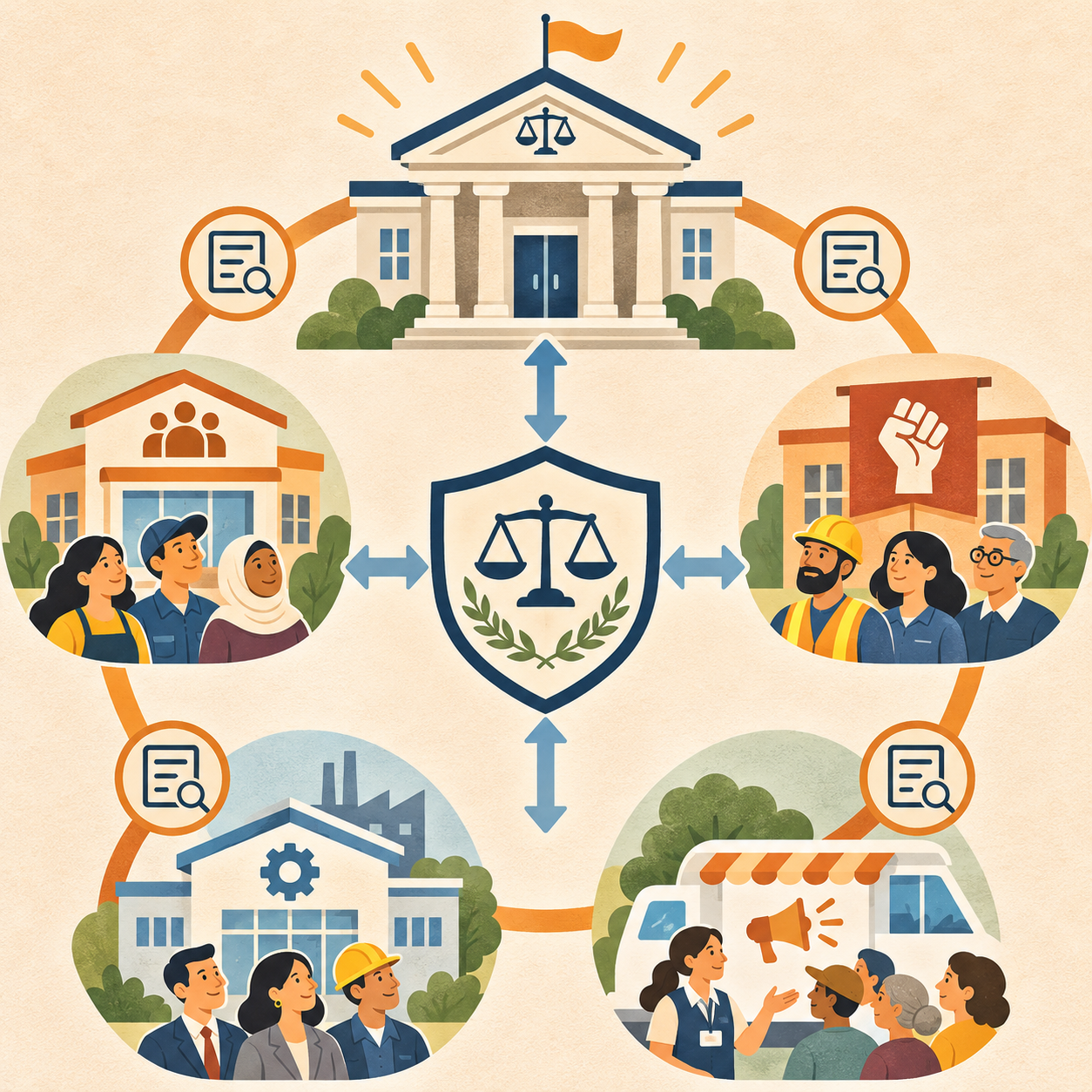 Labor agencies can reduce routine case inquiries only when self-service tools provide information people actually trust and understand. A portal, automated email, or status page may technically make information available, but it will not protect investigator time if users still need to call for clarification. Effective case status communication requires a coordinated system that connects public-facing terminology, milestone updates, document confirmations, action requirements, escalation pathways, front-line staff guidance, and the agency’s underlying case-management workflow.
Stegmeier Consulting Group (SCG) can support labor agencies by developing case status communication frameworks, public-facing status definitions, milestone notification strategies, portal language, self-service content, call center scripts, escalation guidance, document receipt messaging, and communication standards for long-pending cases. SCG can also review existing status tools and inquiry patterns to identify where users continue contacting investigators because the available information is too vague, inconsistent, outdated, or difficult to interpret.
External strategic communication support can be particularly valuable when an agency already has a case portal or automated notification system but continues experiencing high repeat-contact volume. A structured review can connect user questions with specific communication gaps and help the agency determine whether clearer status language, more proactive notifications, better front-line guidance, or stronger escalation rules could resolve those questions without investigator involvement. This approach can improve public transparency while allowing substantive staff to devote more uninterrupted time to investigations, evidence review, analysis, hearings, and case resolution.
SCG’s role remains focused on communication strategy, public information, self-service communication, internal alignment, stakeholder experience, language access, and measurement. SCG does not determine case status, make enforcement decisions, conduct investigations, assess evidence, adjudicate disputes, establish legal deadlines, or replace investigators, agency counsel, hearing officers, technology teams, or other authorized professionals. Strategic communication support helps agencies make existing case information more understandable and accessible while preserving the agency’s responsibility for case management, legal determinations, and enforcement activity.
Future Trends
Labor agencies are likely to expand digital case tracking as workers and employers increasingly expect to see basic information about pending matters without contacting staff. Portals may provide more detailed stage descriptions, document receipt histories, hearing information, action requirements, and milestone notifications. The challenge will be ensuring that increased visibility produces genuine understanding rather than exposing internal workflow terminology that creates new questions.
More agencies may also move toward event-triggered communication instead of relying primarily on users to check status manually. Automated messages can notify users when a case is assigned, when information is required, when a hearing is scheduled, or when a decision enters review. This approach can make communication feel more proactive while reducing the uncertainty that drives repeated status calls.
AI-assisted and automated tools may eventually play a larger role in helping users interpret case status, locate procedural information, or determine whether a question can be answered through self-service. These tools will require careful governance because they should explain process without predicting outcomes, interpreting evidence, or providing case-specific legal conclusions. Agencies will need clear boundaries between automated navigation and substantive investigator communication.
The broader trend will be toward integrating communication performance with workload management. Agencies may increasingly measure not only portal adoption and call volume but also how much investigator time is consumed by routine inquiries, which case stages generate the most repeat contact, and whether better communication actually creates more capacity for substantive work. Self-service will become more valuable when it is evaluated as an operational tool rather than only as a digital customer service feature.
Conclusion
Repeat case status calls often reflect uncertainty rather than unreasonable public expectations. Workers, employers, representatives, and other parties want to know whether information was received, where the case stands, what happens next, and whether they need to do anything. When the agency does not provide those answers clearly, investigators and other staff become the default source of routine status information.
Effective self-service changes that dynamic by separating routine process information from questions that require substantive expertise. Clear public-facing stages, document receipt confirmations, milestone notifications, visible action requirements, and accessible status explanations can resolve many common questions without investigator involvement. Call center and administrative staff can provide another layer of support for people who need human assistance without automatically transferring every inquiry to the case team.
The goal should not be to eliminate communication between investigators and the public. Investigators still need to receive important evidence, clarify facts, discuss significant developments, and communicate about matters that require their professional judgment. A strong self-service system protects those interactions by reducing the volume of routine questions surrounding them.
When case status communication is integrated with case management, agencies can improve both transparency and productivity. People receive more timely and understandable information, front-line staff have clearer tools, and investigators regain time for the work that actually advances cases. The result is not simply fewer calls, but a more deliberate communication system that supports both public access and enforcement performance.
Stegmeier Consulting Group’s Strategic Approach to Communication Systems
Build case status and self-service systems that answer routine questions clearly while preserving investigator access for matters that require substantive case expertise.
Labor agencies need communication systems that connect public-facing case statuses, milestone updates, document confirmations, action requirements, portal content, call center guidance, escalation pathways, language access, and investigator workflows into one consistent experience. Stegmeier Consulting Group (SCG) helps agencies develop self-service communication frameworks, plain-language status systems, notification strategies, staff tools, governance models, and measurement approaches that reduce avoidable repeat contact while protecting meaningful access to investigators when case-specific judgment is required.
Use the form below to connect with our team and explore how strategic communication support can strengthen case status updates, self-service tools, public transparency, and investigator capacity across labor agency enforcement programs.