
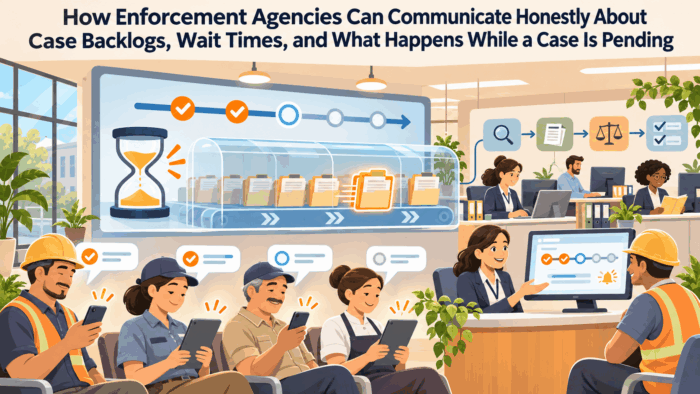
How Enforcement Agencies Can Communicate Honestly About Case Backlogs, Wait Times, and What Happens While a Case Is Pending
Enforcement agencies often communicate with people at a point when patience is already limited. A worker, consumer, business, complainant, respondent, or other affected party may have submitted information months earlier and still be waiting for a decision, investigation, inspection, hearing, or other action. When the agency provides little explanation during that period, people may assume that the case has been forgotten, that staff are not working on it, or that the agency does not consider the issue important.
Backlogs make this challenge harder because agencies may be reluctant to discuss delays publicly. Leaders may worry that acknowledging a large caseload will undermine confidence, create political scrutiny, or generate additional status inquiries from people who are already waiting. Yet silence can create a different kind of credibility problem because people are left to interpret delay without knowing what is actually happening inside the process.
Honest communication does not require agencies to promise dates they cannot meet or disclose information that must remain confidential. It requires a clear explanation of what the agency can say about workload, how cases generally move through the system, what factors affect timing, and what happens while a matter is pending. People are more likely to tolerate an extended process when they understand why it takes time and what stage the agency has reached.
The strongest approach treats backlog communication as part of case management rather than as a crisis response. Agencies should establish realistic expectations early, provide meaningful milestone updates, distinguish between inactivity and work that is not visible to the public, and explain when the person needs to act. This creates a more transparent experience even when the underlying wait cannot be shortened immediately.
Acknowledge Backlogs Without Sounding Defensive or Dismissive
 Agencies should be willing to acknowledge when caseloads, staffing constraints, investigative complexity, hearing availability, or other operational conditions are affecting timelines. Avoiding the subject can make people feel that the agency is hiding a problem they can already see through their own experience. A direct explanation is often more credible than vague language about delays.
The tone matters. Agencies should not frame the public as unreasonable for wanting answers or imply that delays are simply something people must accept. Communication should recognize that waiting can affect finances, business decisions, safety concerns, employment, benefits, compliance obligations, or other important interests depending on the enforcement system.
At the same time, agencies should avoid language that sounds like an excuse. A backlog explanation should focus on what the agency is managing, what actions are being taken, and how the process works under current conditions. This gives the public context without shifting responsibility away from the agency.
Where possible, agencies can also explain what is being done to improve performance. Hiring, process redesign, triage changes, technology improvements, temporary teams, or workload redistribution may all be relevant if they are accurate and already underway. The communication should distinguish between concrete actions and aspirational plans so people can tell what is actually changing.
Explain What a Pending Case Actually Means
The term “pending” can be frustrating because it often tells the public almost nothing. A pending case may be waiting for initial review, assigned to staff, awaiting documents, under investigation, scheduled for a hearing, pending a legal review, or waiting for another procedural step. Agencies should avoid using one broad label when more meaningful stage information can be provided.
People need to understand that a case can remain active even when they are not receiving frequent communication. Staff may be reviewing records, interviewing witnesses, waiting for responses, coordinating with another unit, preparing findings, or completing internal review. Explaining these activities can reduce the assumption that silence means no work is occurring.
Agencies should also clarify when a case is genuinely waiting rather than actively being worked. There may be periods when the next step depends on hearing availability, receipt of records, another party’s response, or completion of a required review. Honest communication should distinguish these situations instead of presenting every delay as active investigation.
A simple stage-based framework can make this easier. People may understand categories such as received, initial review, assigned, investigation underway, waiting for information, hearing preparation, decision review, or closed more easily than internal case codes. The exact stages will differ by agency, but the principle is the same: status should help people understand where the case is.
Set Realistic Timing Expectations at the Beginning
Expectations are hardest to repair after people believe the agency has missed a promise. Agencies should therefore communicate realistic timing as early as possible, ideally when a complaint, claim, referral, or other case is first received. If the process is likely to take months, the public should not be left with the impression that action will occur within weeks.
This does not mean agencies must give an exact completion date. In many enforcement settings, timing depends on complexity, evidence, legal issues, staffing, hearing schedules, cooperation from parties, and other factors that cannot be predicted at intake. A range, typical sequence, or explanation of what affects timing may be more useful and more accurate.
Agencies should also distinguish between different time concepts. Time to initial review, time to assignment, time to investigation, time to hearing, and time to final decision may all be different. Combining them into one general estimate can create confusion if the public assumes that the first milestone is the final outcome.
Timing guidance should be updated when conditions change significantly. If the agency’s published estimate no longer reflects actual performance, leaving it in place damages trust. People may be more understanding of a longer current estimate than of an optimistic estimate that repeatedly proves wrong.
Avoid Promising Specific Dates the Agency Cannot Control
Pressure for certainty can lead staff to provide dates that sound helpful but are not operationally reliable. A worker may be told that a case should be reviewed “next month,” or a business may hear that a decision is expected “within a few weeks.” If those statements are not supported by the actual queue or case status, they can create more frustration than a cautious explanation would have.
Agencies should establish guidance for what staff can say about timing. Staff may be able to provide an estimated range, explain the current stage, or identify the next expected milestone without committing to a completion date. This gives people useful information while protecting against unnecessary promises.
If the agency does provide dates for certain steps, it should distinguish between scheduled events and estimates. A hearing date may be firm unless changed, while an anticipated investigation completion date may remain uncertain. Clear wording helps people understand the difference.
When an estimate changes, the agency should communicate that change rather than allowing the original expectation to quietly expire. A brief explanation that additional evidence, staffing conditions, scheduling, or another procedural issue affected timing can preserve credibility. People are less likely to feel misled when the agency acknowledges that the estimate changed.
Explain Why Some Cases Move Faster Than Others
People often compare their case with another person’s experience and assume that different timing reflects favoritism, neglect, or inconsistency. In reality, enforcement cases may differ significantly in complexity, urgency, evidence, jurisdiction, number of parties, hearing needs, or statutory requirements. Agencies should explain these differences in general terms without discussing confidential case details.
Some cases may also receive priority because of immediate harm, safety risk, statutory deadlines, vulnerable populations, ongoing violations, or other criteria established by the agency. If prioritization exists, the general principles should be communicated transparently. People may disagree with the priority system, but they should not have to guess whether one exists.
Agencies should avoid suggesting that a longer case is necessarily more serious or less serious. Duration can reflect procedural complexity rather than substantive merit. A simple case may move quickly because the facts are clear, while a significant matter may require extensive records or legal review.
This explanation also helps reduce pressure on staff to provide case-specific comparisons. Instead of telling one person why another case moved faster, staff can rely on a consistent public explanation of the factors that influence timing. That protects confidentiality while improving understanding.
Tell People Whether They Need to Do Anything While They Wait
One of the most common problems during a long case is uncertainty about whether the person should be taking action. They may wonder whether they need to send more records, call periodically, update contact information, respond to the other party, preserve documents, or simply wait. Agencies should make this clear at each stage.
Status communication can include a simple statement such as whether no action is currently required, whether additional information is needed, or whether the person should monitor for a notice. This small addition can significantly reduce anxiety because the person knows they are not missing an obligation.
Agencies should also explain how to report important changes while the case is pending. New evidence, retaliation, changed contact information, business closure, continuing hazards, or other developments may affect the case. People should know which changes should be reported and how to submit them.
The communication should avoid encouraging unnecessary repeated submissions. If the agency does not need routine duplicate documents or monthly status requests, it can say so politely. Clear instructions help people remain engaged without creating additional workload that slows the system further.
Build Meaningful Status Updates Instead of Repeating “Still Pending”
Repeatedly telling someone that a matter is still pending does little to improve understanding. Agencies should identify a small number of meaningful milestones that can be communicated when the case changes stage. Even when the final outcome remains far away, stage movement shows that the process is progressing.
A useful update should answer three questions: what has happened, what happens next, and whether the person needs to do anything. For example, the agency may explain that initial review is complete, the matter has been assigned, and no action is required unless staff request additional information. This is far more useful than a generic “your case remains open.”
Agencies do not need to provide detailed investigative information to make updates meaningful. They can preserve confidentiality while still explaining the procedural stage. The goal is orientation, not disclosure of evidence or internal deliberations.
Milestone communication can also reduce status calls. People are more likely to wait when they understand where the case stands and know when they can expect another update. A predictable communication rhythm can therefore improve both public experience and staff capacity.
Explain When Silence Is Part of the Process
There may be periods when the agency cannot provide substantive updates because evidence is being reviewed, another party has been given time to respond, legal analysis is underway, or confidentiality limits what can be disclosed. These periods can feel like inactivity unless the agency explains them.
Agencies should tell people when there may be limited visible communication for a period of time. A simple explanation that the next stage involves internal review or waiting for required information can prevent repeated assumptions that the case has stalled. The agency does not need to disclose sensitive details to explain why communication may be limited.
It is also important to set expectations about when the person should follow up. If no action is required and the agency expects to contact them when the next milestone occurs, that should be stated clearly. If the agency encourages follow-up after a certain period, that guidance should also be specific.
Explaining silence is particularly important in long investigations. People may accept a lack of frequent updates if they know it is normal for that stage. What undermines confidence is silence with no explanation of whether the case is still active.
Communicate About Delays That Exceed the Agency’s Own Expectations
Even a well-designed case process will sometimes take longer than expected. Complex evidence, staffing changes, hearing delays, legal questions, emergencies, or other operational issues can extend timelines. Agencies should have a communication approach for cases that exceed the expected range rather than simply continuing to display the original estimate.
The update should acknowledge the delay directly and provide whatever explanation can appropriately be shared. It may not be possible to identify a precise completion date, but the agency can confirm that the matter remains active and explain the current procedural stage. This is more credible than allowing an outdated estimate to remain unaddressed.
Where possible, agencies should also explain whether the person needs to take any action because of the delay. In many cases, they may simply need to continue waiting. In others, updated records, contact information, or other information may be useful.
A consistent overdue-case communication standard can help staff manage these conversations fairly. People should not receive a detailed explanation only if they repeatedly call or escalate to leadership. Proactive communication can make transparency more equitable.
Make Backlog Communication Part of Public Accountability
Backlogs affect individual cases, but they can also become an agency-wide performance issue. When delays are significant, leadership should consider communicating aggregate information about workload, processing trends, and improvement efforts. This can provide context that individual case updates cannot.
Public reporting should focus on measures that help people understand system performance. Caseload volume, approximate processing ranges, age of pending matters, major bottlenecks, or progress on backlog reduction may be useful depending on the agency. The agency should avoid presenting metrics without enough explanation for the public to interpret them correctly.
Transparency also requires acknowledging when performance has not improved as quickly as expected. Agencies should not communicate only positive trends while ignoring persistent problems. Credibility grows when leadership can explain both progress and remaining constraints.
Aggregate reporting does not replace individual communication. A person waiting on a case still needs to know what is happening with that matter. The strongest approach combines system-level transparency with clear case-level status information.
Treat Honest Wait-Time Communication as Part of Procedural Fairness
People may disagree with an enforcement decision and still believe the process was handled fairly if they understood what happened and had a meaningful opportunity to participate. Long unexplained delays, however, can make even a legitimate process feel arbitrary. Communication therefore influences how people experience procedural fairness before any final decision is made.
Honest wait-time communication gives people realistic expectations about the agency’s capacity and responsibilities. It does not eliminate the frustration of waiting, but it reduces avoidable uncertainty. People know whether the matter remains active, what stage it has reached, and when they are expected to participate.
Clear communication also protects staff. Front-line employees do not have to invent explanations or make unsupported promises when the agency has established standard language for backlogs, timing, and status. Consistency helps the public receive similar information regardless of which employee answers the question.
A backlog may ultimately require operational solutions that communication alone cannot provide. Yet while those solutions are being developed, agencies still have a responsibility to explain the process honestly. Transparent communication cannot shorten every wait, but it can prevent the wait itself from becoming an additional source of confusion and distrust.
Explain the Difference Between Queue Time and Active Case Work
People waiting on an enforcement matter often see one long period of delay, but agencies may experience that same period as several different stages. A case may spend time waiting for assignment, undergoing active review, waiting for another party to respond, pending legal review, or queued for a hearing or decision. If those distinctions are invisible, people may assume the case has been sitting untouched for the entire period.
Agencies should explain the difference between time spent in a queue and time spent in active case work. A matter waiting for assignment is not in the same stage as a matter under investigation, even if both are technically pending. Clearer stage descriptions help people understand whether the delay reflects workload, procedural requirements, or substantive case activity.
This distinction can also improve accountability. Agencies can identify whether the primary delay is occurring before assignment, during investigation, at hearing, or during final review. That makes backlog communication more useful internally as well as externally.
Use Time Ranges Carefully and Explain What They Represent
Published wait times can create useful expectations, but they can also become misleading if the agency does not explain what the number actually measures. A statement that cases take “six months” may refer to time to initial review, average time to closure, or only one type of case. People may interpret the number as a promise about their own matter.
Agencies should identify what each time estimate covers and what it does not. If the agency publishes a typical range, it should explain whether that range reflects recent cases, current pending cases, or historical performance. It should also make clear that individual timing may vary based on complexity and procedural factors.
Ranges are often more honest than a single average because they show that experience varies. A range can help people understand that some matters resolve more quickly while others require much longer. The agency should still avoid presenting broad ranges so loosely that they become meaningless.
Some Main Sections should go further and explain how these estimates are updated. If current performance changes significantly, the agency should revise public guidance rather than leaving old numbers in place. A wait-time estimate only builds trust when it reflects the system people are actually entering.
Explain Why Average Processing Time Can Be Misleading
Average processing time may be useful for internal management, but it can be difficult for the public to interpret. A small number of very old cases may increase the average, while a large number of quick closures may make the system appear faster than the experience of people with complex matters. Agencies should be cautious about using one average as the primary explanation of delay.
Median time, ranges, age bands, or stage-specific measures may provide a more complete picture depending on the program. The agency does not need to overwhelm the public with statistics, but it should choose measures that reflect how people actually experience the system. A simple explanation of what the number means can prevent false expectations.
Communication should also distinguish between cases that close quickly for administrative reasons and cases that proceed through full investigation or adjudication. Combining all case types into one processing figure can obscure meaningful differences. The public benefits when the agency explains which cases are included in the metric.
Tell People What Can Cause a Case to Take Longer Than Expected
Even well-managed cases can take longer because of factors that emerge after filing. Additional witnesses may need to be interviewed, records may be incomplete, legal issues may require review, another party may request more time, or a hearing may need to be scheduled. Agencies should explain these possibilities before they become a source of frustration.
This communication should focus on categories rather than case-specific excuses. People do not need every internal detail, but they do benefit from understanding why some matters require more steps than others. This helps them interpret delay as part of process complexity rather than automatic evidence of neglect.
Agencies should also distinguish between delays the agency controls and delays created by external dependencies. That distinction should not become a way to shift blame, but it can provide important context. Honest communication shows where the process is constrained without pretending that every delay is unavoidable.
Build a Clear Communication Standard for Cases Waiting on Another Party
Cases often pause because the agency is waiting for information from an employer, respondent, witness, regulated entity, legal representative, or another outside party. From the complainant’s perspective, this can look like unexplained inactivity. Agencies should identify when they can appropriately say that a required response is outstanding.
The update does not need to disclose sensitive details. It can simply explain that the agency is waiting for information needed before the next stage can begin. This gives the person a reason for the current delay without compromising the investigation.
Agencies should also explain whether there is a deadline for the outstanding response and what generally happens if it is not received. If the agency cannot discuss that information in a particular case, it can still explain the standard process. People are more likely to understand the wait when they know that the agency has a procedure for moving forward.
Explain What Internal Review Means
A case may appear to stop moving after investigation because it enters supervisory, legal, technical, or quality review. People may assume the investigative work is complete and wonder why a decision has not been issued. Agencies should explain that internal review can be a substantive part of the process rather than an administrative delay added at the end.
Internal review may help ensure that evidence has been considered, legal standards have been applied consistently, calculations are correct, or proposed actions are supported by the record. The exact purpose will vary by agency, but the public can understand the general principle. Review is often one of the ways agencies protect accuracy and fairness.
At the same time, agencies should monitor whether internal review itself becomes a major bottleneck. Communication should not be used to normalize avoidable delay. If review times become excessive, leadership should address the operational problem while continuing to explain the current stage honestly.
Communicate Clearly When a Case Has Not Yet Been Assigned
Waiting for assignment is one of the most difficult backlog stages to explain because little case-specific activity may be occurring. Agencies may be reluctant to acknowledge this directly, but vague language can create more frustration. If a matter is in an assignment queue, the public should receive an accurate description of that status where possible.
The agency can explain that the case has been received, preserved in the system, and is waiting for staff capacity or the next available assignment. It can also explain whether urgent matters are screened separately and whether the person needs to provide anything while waiting. This reassures the public that the case has not disappeared.
Where assignment delays are significant, agencies should be especially careful about initial expectations. A person should not be told that an investigation is underway if the matter is actually waiting for an investigator. Accurate stage language is essential to maintaining trust.
Explain Prioritization Without Making Lower-Priority Cases Feel Unimportant
Enforcement agencies may prioritize certain cases because of immediate danger, statutory deadlines, continuing harm, vulnerable populations, large numbers of affected people, or other established criteria. When some cases move faster than others, the public may interpret that difference as favoritism unless the agency explains the general basis for prioritization.
Communication should make clear that prioritization does not necessarily reflect the ultimate merit of a case. A matter can be important and still wait longer because another matter requires more immediate action. This distinction helps people understand urgency without assuming that their own concerns have been dismissed.
The criteria should be described at a level that supports transparency without creating a formula parties can manipulate. Agencies do not need to reveal every internal triage factor. They do need to explain that different timing can result from structured priorities rather than arbitrary treatment.
Create Better Communication for Very Old Pending Cases
Cases that remain open substantially longer than normal require a different communication approach. People waiting on these matters may have already heard several general explanations and may no longer find routine status messages credible. Agencies should recognize when a case has crossed into an unusually long pending period.
A stronger update should acknowledge that the matter has exceeded the usual or expected timeframe if that is accurate. The agency can explain the current stage, what is contributing to continued delay, and whether any specific next step is identifiable. It should not simply recycle a standard “still pending” message.
Older cases may also warrant internal escalation. If a matter has remained in one stage far longer than comparable cases, the communication problem may be evidence of an operational problem. Agencies should connect long-pending case communication with backlog management and supervisory review.
Give Staff Clear Language for Difficult Status Conversations
Front-line employees often face the hardest backlog conversations. They may speak with people who are angry, financially strained, worried about safety, or convinced the agency has ignored them. Staff need language that acknowledges the frustration without making commitments they cannot keep.
Scripts and guidance should help staff explain the current stage, what the agency can and cannot say, and whether any action is required. Employees should also know how to escalate unusual cases or complaints about excessive delay. This prevents staff from improvising different explanations under pressure.
The strongest guidance should not sound mechanical. Staff should have enough flexibility to respond respectfully while staying within approved boundaries. Consistency matters, but credibility also depends on acknowledging the person’s actual concern rather than repeating a generic script.
Use Self-Service Status Tools to Reduce Unnecessary Uncertainty
Online case portals and automated status tools can reduce the need for repeated calls if they provide information people can actually understand. A status label such as “under review” is more useful when paired with a short explanation of what that stage means and whether the person needs to act.
The tool can also show the date of the most recent status change, the next expected milestone where appropriate, and how to report important new information. This gives people a clearer sense that the case remains active. Even limited information can be reassuring when it is current and specific.
Agencies should avoid building portals that merely expose internal codes or produce the same generic status for months. Self-service tools should be designed as communication systems, not just database windows. Their value comes from reducing uncertainty, not simply reducing staff contact.
Explain When a Person Should Contact the Agency Again
People waiting on a case may not know whether regular follow-up is useful or whether repeated calls simply consume staff time without changing the case. Agencies should provide clear guidance about when follow-up is appropriate. This can help reduce both unnecessary contact and the fear that silence will cause the case to be forgotten.
The agency may tell people that it will contact them at the next milestone unless additional information is needed. In other situations, it may advise follow-up after a defined period if no update has been received. The appropriate model will depend on the program and available resources.
People should also know when they should contact the agency immediately. Changes in contact information, new retaliation, continuing harm, business closure, urgent safety issues, or other significant developments may warrant prompt communication. Distinguishing routine status checking from important case updates makes the process easier for everyone to manage.
Treat Backlog Communication as a System That Must Be Maintained
 Backlog communication should evolve as workload and performance change. An agency may improve assignment times while hearing delays increase, or a temporary staffing shortage may affect one program more than another. Public guidance should reflect the current system rather than a snapshot from the previous year.
Agencies should regularly review published wait times, case status language, portal messages, scripts, FAQs, and milestone notifications. Staff feedback and public questions can identify where the current explanations are no longer working. A communication system that is not maintained will eventually become inaccurate.
Leadership should also connect communication review with operational performance review. If the public repeatedly asks the same timing question, the answer may need to be clearer. If cases remain in one stage far longer than the published estimate, the operational issue may need attention as well.
Honest backlog communication works best when it is treated as part of case management, not as a separate public relations function. The goal is to ensure that people understand what is happening while the agency continues working to improve the underlying process.
Explain How Case Complexity Affects Timing Without Making the Process Sound Arbitrary
People waiting on enforcement matters often hear that a case is taking longer because it is “complex,” but that word can feel vague or dismissive unless the agency explains what complexity actually means. A matter may involve multiple parties, conflicting records, extensive documentation, legal questions, technical analysis, or several events that occurred over a long period. These factors can require more review even when the agency is working consistently on the case.
Agencies should explain complexity in categories rather than trying to justify every individual delay. A case involving several employers or respondents may require more outreach, while a matter involving disputed facts may require additional records or interviews. The goal is to help people understand why one case may reasonably take longer than another without suggesting that longer cases are automatically more important.
Communication should also make clear that complexity can emerge after filing. A matter that initially appears straightforward may become more involved when new evidence is submitted or additional parties are identified. This helps people understand why an early estimate may change as the agency learns more.
Where appropriate, the agency can explain that complexity affects sequencing as well as total duration. Some cases may move quickly through intake but require extensive investigation, while others may wait longer for assignment and move faster once staff begin substantive work. This creates a more realistic picture of how enforcement timelines develop.
Explain What Happens When New Information Arrives While a Case Is Pending
Pending cases may change when complainants, respondents, witnesses, or other parties submit new information. A worker may provide additional records, a regulated entity may submit a response, or an investigator may learn about facts that were not included in the original filing. Agencies should explain that new information can affect both the scope and timing of review.
People should understand that additional evidence may need to be evaluated before the case moves to the next stage. This can result in follow-up questions, requests for clarification, or another round of review. The delay may be necessary to ensure that the agency considers the record fairly rather than rushing toward a decision.
Agencies should also communicate when parties should stop sending duplicate information. Repeated submissions of the same records can create additional administrative work without advancing the case. Clear instructions about what kinds of updates are useful can help preserve staff capacity.
Explain Why Some Investigations Require Long Periods Without Visible Activity
Enforcement work is often less visible than the public expects. An investigator may spend significant time reviewing records, comparing data, preparing interview questions, consulting technical staff, or analyzing whether evidence supports a particular conclusion. From outside the agency, these activities may look like silence.
Agencies can improve understanding by explaining that not every investigative step generates a public update. A case may remain in the same visible status while substantial internal work occurs. This distinction helps people avoid assuming that lack of communication means lack of activity.
At the same time, agencies should not use invisible work as a universal explanation for every delay. If a matter has actually been waiting for staff capacity or another procedural event, the status should reflect that accurately. Credibility depends on distinguishing active review from passive waiting.
Communicate Carefully When Another Agency or External Process Affects Timing
Some enforcement matters depend on information, decisions, or proceedings outside the agency’s direct control. Another regulator may be reviewing a related issue, a court proceeding may affect the case, or the agency may need records from another government entity. These dependencies can extend the timeline even when the case remains active.
Public communication should explain that an external dependency exists without disclosing information that must remain confidential. The agency can describe the general reason for the delay and whether it is waiting for another process to conclude or for information to become available. This gives the public context without shifting blame.
Agencies should also explain what happens once the external dependency is resolved. If the case returns to investigation, legal review, or hearing preparation, that next stage should be identified when possible. People are more likely to tolerate an external delay when they understand how the case will resume afterward.
Explain When Legal Review Is Affecting the Timeline
Cases may require legal review before an enforcement action, decision, settlement, or other significant step can move forward. To the public, this can appear to be an unexplained pause after the factual work seems complete. Agencies should explain that legal review can be part of ensuring that proposed actions are supported by the applicable authority and evidence.
The communication does not need to describe privileged discussions or internal legal conclusions. It can simply explain that the matter is undergoing required review before the agency proceeds. This gives people a more accurate picture of what is happening without compromising internal deliberations.
Agencies should also monitor whether legal review becomes a persistent bottleneck. If cases routinely remain in that stage far longer than expected, leadership should address the operational issue rather than relying solely on communication to explain it. Transparency and process improvement should reinforce each other.
Prepare Communication for Cases That Are Reassigned
Cases may be reassigned because an investigator leaves, workloads change, specialized expertise is needed, or the agency reorganizes staff responsibilities. Reassignment can create anxiety if the affected person suddenly hears from someone new or experiences another period of delay. Agencies should explain the transition clearly when it materially affects the case.
The update should identify whether the reassignment changes the worker’s or respondent’s responsibilities. In many cases, no action may be required, and the person simply needs to know that a new staff member has assumed responsibility. If prior information remains in the file, the agency should reassure the person that they do not need to recreate the entire case unless requested.
Where reassignment is likely to affect timing, that should be acknowledged. A short period may be needed for the new staff member to review the record. Honest communication can prevent people from assuming that the case has returned to the beginning.
Explain What Happens When a Case Is Reopened or Returned for Additional Work
An enforcement matter may sometimes return to an earlier stage after internal review, a hearing, an appeal, or discovery of new information. Workers and respondents may find this confusing because they believed the matter had already advanced beyond that point. Agencies should explain why additional work is required and what stage now applies.
The communication should avoid suggesting that returning a case for more review means the earlier work was wasted. Additional investigation or analysis may be necessary to address a specific issue, clarify the record, or comply with a procedural requirement. The agency can explain this without offering case-specific legal advice.
People should also know whether the change affects previously provided estimates. If returning the case for additional work is likely to extend the timeline significantly, the agency should reset expectations rather than leaving the original timeframe in place.
Build Communication for Cases With Long Periods Between Major Milestones
Some enforcement processes naturally contain long intervals between visible events. A matter may wait months between investigation and hearing, hearing and decision, or decision and final review. Agencies should plan communication for these intervals rather than relying only on event-triggered notices.
A periodic status confirmation can reassure people that the matter remains active and identify the current stage. The communication does not need to introduce new substantive information every time. Its purpose may simply be to confirm that the agency has not lost track of the case and that no action is currently required.
The frequency should be realistic for agency capacity. An agency that cannot sustain monthly updates should not promise them. A predictable quarterly or milestone-based communication may be more credible than a more frequent schedule that staff cannot maintain.
Explain the Difference Between a Case Being Open and a Case Being Actively Investigated
An open case is not always an actively investigated case. It may be awaiting assignment, paused for an external dependency, waiting for a hearing, or undergoing another administrative step. People may interpret the word “open” as evidence that an investigator is currently working on it every day.
Agencies should make this distinction visible in public communication where possible. A case can remain officially open while residing in a specific queue or stage. Clear stage labels help people understand the difference between legal status and current operational activity.
This distinction can also help agencies communicate workload more honestly. Leadership can acknowledge that many cases are open while explaining how many are actively assigned or awaiting a particular next step. More precise language creates a more accurate picture of both individual and system-wide performance.
Explain What Happens When the Agency Cannot Provide a Detailed Update
There will be situations where confidentiality, investigative integrity, legal restrictions, or procedural fairness limit what the agency can say. A complainant may ask what the other party said, whether an investigator believes them, or what enforcement action is likely. Agencies should have a clear way to explain these limits without sounding evasive.
Staff can state that the matter remains active and identify the procedural stage even when substantive details cannot be disclosed. They can also explain the general reason information is limited, such as protecting an ongoing investigation or preserving fairness to all parties. This gives people more context than simply saying the agency cannot comment.
The agency should use the same basic explanation across staff and channels. Inconsistent disclosure practices can create perceptions of unfairness and encourage repeated attempts to obtain information from different employees. Clear boundaries support both transparency and integrity.
Use Escalation Standards for Cases That Exceed Normal Timeframes
Agencies should not rely solely on routine status communication when a case has exceeded normal processing expectations by a significant margin. Long-pending matters should trigger internal review so leadership can determine whether the delay reflects legitimate complexity, a bottleneck, an administrative error, or a case that has simply fallen outside normal workflow.
An escalation standard can identify age thresholds or other conditions that warrant supervisory attention. The goal is not to guarantee immediate resolution but to make sure unusually old cases receive deliberate review. This connects communication with operational accountability.
People waiting on these cases should receive a more specific update when possible. The agency can acknowledge that the matter has exceeded the typical timeframe and explain the current status. That level of candor is more credible than continuing to send the same routine message indefinitely.
Use Case-Level Communication to Inform Backlog Reduction
Individual status inquiries can reveal broader system problems. If large numbers of people are asking why cases remain unassigned, the underlying issue may be assignment capacity rather than poor public understanding. If callers repeatedly ask what “legal review” means, the communication may need improvement even if the process itself is functioning normally.
Agencies should aggregate these patterns and use them in backlog management discussions. Call center questions, escalation requests, portal activity, complaints about delay, and staff feedback can show where the public experience is breaking down. These signals provide context that raw case counts may not reveal.
Communication data can therefore help leadership prioritize operational improvements. A persistent spike in questions at one stage may indicate both a messaging issue and a workflow bottleneck. Treating these signals as management information helps connect public experience with internal performance.
Treat Pending-Case Communication as a Continuing Relationship
A person waiting on an enforcement matter may interact with the agency for months or even years. During that period, every status message, unanswered question, delay notice, and handoff affects how the person perceives the agency. Pending-case communication should therefore be managed as an ongoing relationship rather than a series of isolated notices.
The agency should maintain continuity even when staff assignments or procedural stages change. People should not have to reconstruct the history of the case every time they speak with someone new. Clear records, consistent terminology, and reliable status communication can preserve that continuity.
A strong pending-case communication system does not eliminate frustration with long waits. It gives people a clearer understanding of what the agency is doing, what it is waiting for, what happens next, and when they need to participate. That transparency can preserve trust while the agency continues addressing the operational causes of the backlog.
Build Governance Around Backlog and Wait-Time Communication
Backlog communication should not be left entirely to front-line staff, individual investigators, or separate program teams. When different units use different descriptions of timing, status, assignment, or delay, people can receive conflicting information about the same process. Enforcement agencies should establish shared governance for how pending cases, wait times, backlog conditions, and major sources of delay are communicated.
That governance should identify who is responsible for approving public wait-time language, status definitions, portal descriptions, call center scripts, overdue-case notices, and aggregate backlog reporting. Program leaders, operations staff, legal staff, communications teams, and customer service functions may all need to contribute. The objective is to ensure that public explanations reflect actual operational conditions and remain consistent across channels.
Agencies should also define how communication changes when performance changes. If assignment times increase, hearing schedules improve, or a new bottleneck emerges, public guidance should be reviewed promptly rather than waiting for an annual update. Backlog communication loses credibility when published information describes a system that no longer exists.
Create Standard Definitions for Case Status and Timing
Workers, complainants, respondents, businesses, and other parties should not have to decode internal case-management terminology. Agencies should define a limited set of public-facing status terms that clearly distinguish received, awaiting assignment, active review, waiting for information, hearing preparation, decision review, and other major stages. These terms should reflect how the process actually works.
Each status should include a short explanation of what it means and whether the person needs to do anything. A status such as “awaiting assignment” should not sound identical to “under investigation,” because the underlying activity is different. Precise language helps people understand both progress and delay.
Timing terms also need standard definitions. If the agency publishes average processing time, typical range, time to assignment, or time to decision, each measure should be clearly described. Consistent definitions reduce the risk that staff, leadership, and the public are using the same words to mean different things.
Build a Formal Review Process for Published Wait Times
Published processing estimates should be treated as operational information that requires regular review. Agencies should compare public estimates with current performance and identify when the published range has become inaccurate. Leaving optimistic numbers in place may reduce short-term discomfort, but it creates greater frustration when people discover that actual waits are much longer.
A review process should identify which metrics are most useful for each program. Some agencies may need stage-specific ranges, while others may benefit from age bands or separate estimates for routine and complex matters. The goal is to provide information that reflects actual experience rather than one simplified number.
Agencies should also determine how often the information will be refreshed. High-volume programs may need more frequent updates than programs with relatively stable workloads. Whatever schedule is chosen, the public should be able to understand when the information was last updated.
When estimates change materially, communication should explain the change. A longer range may reflect increased filings, staffing shortages, hearing availability, or a procedural change. A short explanation can prevent people from assuming that the agency quietly moved the goalposts.
Create Communication Standards for Long-Pending Cases
Cases that exceed typical processing times should trigger more than routine status language. Agencies should establish a separate communication standard for matters that have remained pending well beyond the normal range. These cases require more specific acknowledgment because generic updates become less credible over time.
The communication should explain that the case has exceeded the usual timeframe if that is accurate. It should identify the current stage, confirm whether the matter remains active, and explain whether any action is required from the person. Where possible, the agency should also identify the factor contributing to continued delay.
Long-pending cases should also receive internal attention. A communication standard is most useful when connected to supervisory review, escalation, or backlog management. The agency should know whether the case is old because of legitimate complexity, a systemic bottleneck, or an administrative problem.
Align Case Portals With Actual Operational Status
Case portals should not display broad labels that remain unchanged for months if staff have more precise information available. A portal that shows “pending” from filing through decision provides little value beyond confirming that the case exists. Agencies should align public status labels with meaningful operational stages.
The portal should explain what the current stage means in plain language. It can also indicate whether the agency is waiting for information, whether the person needs to act, and when the status was last updated. These features can reduce uncertainty without revealing confidential details.
Agencies should also ensure that portal language matches notices, call center scripts, and staff explanations. A person who sees “active investigation” online and hears that the case is still waiting for assignment will immediately lose confidence in the system. Cross-channel consistency is essential.
Build a Consistent Communication Approach for Staffing-Related Delays
Staffing shortages, turnover, vacancies, training periods, or reassignments can contribute significantly to backlogs. Agencies may be reluctant to discuss these issues publicly, but vague explanations can create the impression that the agency is avoiding responsibility. When staffing is materially affecting timelines, the agency should determine how to explain that honestly.
The communication should focus on operational impact rather than internal personnel details. For example, the agency may explain that staffing capacity is affecting assignment times or that cases are being redistributed while vacancies are filled. This gives the public context without discussing individual employees.
Agencies should also explain what steps are being taken if concrete actions are underway. Hiring, temporary reassignment, cross-training, overtime, contractor support, or process redesign may all be relevant. The communication should distinguish between measures already in place and plans that have not yet produced results.
Where staffing conditions improve, agencies should update the public accordingly. Backlog communication should not become permanently tied to an old problem. Current information is more useful than a static explanation.
Coordinate Communications With Operational Backlog Reduction Efforts
Communication cannot solve a backlog, but it should be closely connected to the work being done to reduce one. If leadership is changing triage, hiring staff, redesigning workflows, adding hearing capacity, or introducing new technology, communications teams should understand those efforts well enough to explain them accurately. This helps the public see that the agency is not simply normalizing delay.
Operational teams should also understand what the public is hearing. A new process may improve throughput but create confusion if people do not understand how case sequencing has changed. Communication should be part of implementation rather than added after the operational change is complete.
Agencies should avoid announcing improvements before there is evidence that they are working. Overstating the expected effect of a reform can create another credibility problem if wait times remain high. Clear updates should distinguish between actions taken and measurable results achieved.
Establish Internal Escalation Rules for Status and Delay Questions
Front-line staff should know when a routine status inquiry becomes an escalation issue. A case may have exceeded the published timeframe, remained in one status unusually long, or generated repeated unanswered inquiries. Without clear escalation rules, staff may continue giving the same generic response even when the situation warrants review.
Agencies can define thresholds for supervisory review or specialized follow-up. These thresholds might involve case age, duration in one stage, repeated missed internal milestones, or unusual hardship. The exact criteria will vary by program, but the principle is to ensure that exceptional delays are visible internally.
Escalation does not guarantee faster resolution. It does ensure that the agency consciously reviews the situation rather than allowing the case to remain outside normal workflow indefinitely. That distinction is important for both accountability and communication.
Train Staff to Communicate Empathy Without Making Promises
People contacting the agency about delays may be frustrated, angry, or anxious. Staff should be able to acknowledge that frustration without promising that the case will be resolved by a date they cannot control. Training should help employees balance empathy with accuracy.
Useful language can recognize that the wait is longer than the person expected and explain what the agency currently knows. Staff can then identify the stage, next step, and whether any action is required. This provides substance rather than relying on apology alone.
Employees should also know which phrases to avoid. Statements such as “it should be done soon” or “you are next” can create commitments that the staff member may not be able to support. Standard guidance can reduce the temptation to offer reassurance through speculation.
Create a Public Backlog Reporting Framework
Where backlogs are significant, agencies should consider publishing aggregate performance information. A public backlog framework can show how many matters are pending, how old they are, where major bottlenecks exist, and whether performance is improving. This can provide context for individuals who are waiting on their own cases.
The data should be selected carefully. Raw case counts may increase simply because filings increased, while a falling average may hide a persistent group of very old cases. Agencies should pair metrics with explanations that help the public understand what the numbers do and do not show.
Trends are often more useful than isolated figures. Showing changes in assignment time, case age, hearing availability, or backlog volume over several reporting periods can demonstrate whether improvement efforts are having an effect. Where performance remains poor, the agency should say so rather than presenting only favorable indicators.
Public reporting should also be designed for accessibility. Simple charts, clear definitions, and plain-language summaries can make complex workload data easier to interpret. Transparency is most effective when people can understand the information being provided.
Use Complaints About Delay as Management Information
Repeated complaints about wait times should not be treated only as a customer service problem. They can provide useful evidence about where backlog communication and case operations are failing. Agencies should categorize and review these complaints alongside other performance data.
If many people say they do not know whether their case is assigned, the status system may be unclear. If complaints concentrate around the hearing stage, the issue may be scheduling capacity or poor explanation of the queue. Patterns in public frustration can help leadership identify where operational and communication improvements are most needed.
Agencies should also compare complaint patterns with actual case data. This can reveal whether perceptions are aligned with performance or whether certain stages feel more frustrating than their duration alone would suggest. Understanding both dimensions creates a fuller picture of service quality.
Make Backlog Communication a Long-Term Leadership Responsibility
Backlog communication should remain part of leadership oversight even after performance improves. Case volumes, staffing, statutory requirements, economic conditions, and enforcement priorities can all change quickly. An agency that stops monitoring communication once a crisis passes may recreate the same problems later.
Leadership should regularly review wait-time estimates, status definitions, public reporting, overdue-case communication, staff guidance, and common public questions. These reviews should occur alongside operational performance discussions rather than as a separate communications exercise. This keeps public information aligned with actual system capacity.
The strongest agencies do not treat honest backlog communication as an admission of failure. They treat it as part of procedural transparency and public service. Clear communication cannot eliminate every delay, but it can ensure that people are not left to interpret that delay without context.
A mature system connects communication, case management, performance measurement, and backlog reduction. People waiting on cases receive more accurate information, staff have clearer guidance, and leadership gains better insight into where delays are affecting public trust. That integration makes transparency part of how the agency manages performance rather than something added only when complaints become difficult to ignore.
Strategic Communication Support for Backlog, Wait-Time, and Pending-Case Communication
 Enforcement agencies facing case backlogs need more than a public statement acknowledging that delays exist. They need a communication system that explains what different case statuses mean, how wait times are calculated, what factors can affect timing, what happens during periods of limited visible activity, and when the public should expect to hear from the agency again. Without that structure, even accurate information can feel inconsistent or incomplete when people receive different explanations from websites, portals, call centers, investigators, and leadership.
Stegmeier Consulting Group (SCG) can support enforcement agencies by developing plain-language backlog communication frameworks, case status definitions, wait-time messaging, overdue-case notices, public reporting structures, call center scripts, milestone communication, portal language, staff guidance, and measurement approaches. SCG can also review existing public materials and internal communication practices to identify where estimates are unclear, where status labels are too vague, or where communication is not aligned with actual case operations.
External strategic communication support can be especially valuable when agencies are actively trying to reduce a backlog while also maintaining public confidence. Operational changes such as new triage models, staffing adjustments, technology improvements, or hearing-capacity changes may affect the public experience before results are immediately visible. A coordinated communication approach can help agencies explain what is changing, what has actually improved, and where significant delays remain without overstating progress.
SCG’s role remains focused on communication strategy, public information, internal alignment, stakeholder communication, service transparency, and measurement. SCG does not determine enforcement outcomes, conduct investigations, establish case priorities, make legal determinations, adjudicate disputes, set official processing requirements, or replace agency counsel, investigators, hearing officers, or other authorized professionals. Strategic communication support helps agencies explain workload and process conditions more clearly while preserving the agency’s substantive authority and responsibility for case management.
Future Trends
Public expectations for case visibility are likely to continue increasing. People are becoming accustomed to tracking transactions, applications, deliveries, and service requests in real time, and those expectations increasingly carry over into government enforcement systems. Agencies may not be able to provide the same level of detail because of confidentiality and procedural constraints, but they will face growing pressure to provide more meaningful status information than a generic “pending” label.
Digital case portals are also likely to become more sophisticated. Agencies may provide stage-based status descriptions, automated milestone notifications, estimated ranges, requests for additional information, and explanations of what happens next. The challenge will be making those tools informative without implying certainty that the underlying process cannot support.
Agencies may also use more operational data to communicate system performance. Rather than relying on one average processing time, public reporting may increasingly show case age bands, time to assignment, time spent in major stages, or changes in backlog volume over time. These measures can improve transparency if they are paired with clear definitions and explanations.
The broader trend will be toward treating backlog communication as part of performance management rather than as a separate public relations function. Leadership will increasingly need to connect workload data, public reporting, status communication, case escalation, and improvement initiatives. Agencies that do this well will be better positioned to maintain credibility even when they cannot immediately eliminate every delay.
Conclusion
Case backlogs are not only operational problems. They are communication problems when workers, complainants, respondents, businesses, and other affected parties do not understand where their case stands or why it is taking so long. Long waits become more damaging when they are accompanied by vague status labels, outdated estimates, inconsistent explanations, or long periods of silence.
Honest communication does not require agencies to promise completion dates they cannot control. It requires realistic expectations, meaningful stage information, clear explanations of what happens while a case is pending, and direct acknowledgment when a matter has exceeded the normal timeframe. People are more likely to tolerate delay when they understand the process and know whether any action is required from them.
The strongest systems combine case-level communication with public accountability. Individual parties need understandable status information, while the broader public may need aggregate information about backlog volume, wait times, major bottlenecks, and improvement efforts. Both levels of transparency help agencies explain performance without minimizing the seriousness of persistent delays.
Communication alone cannot solve a backlog. Staffing, process design, technology, hearing capacity, legal review, and workload management may all require separate operational solutions. Yet clear communication can prevent delay from becoming more confusing and damaging than it already is, helping agencies preserve trust while they work to improve the underlying system.
Stegmeier Consulting Group’s Strategic Approach to Communication Systems
Build backlog and pending-case communication systems that give people clear, realistic information about where their case stands, why delays occur, and what happens next.
Enforcement agencies need communication systems that connect wait-time estimates, case status definitions, milestone updates, public backlog reporting, portal language, staff scripts, overdue-case communication, and internal escalation into one consistent public experience. Stegmeier Consulting Group (SCG) helps agencies develop plain-language frameworks, transparency strategies, staff tools, public reporting approaches, stakeholder communication, and measurement systems that make case delays easier to understand while supporting the agency’s operational and enforcement responsibilities.
Use the form below to connect with our team and explore how strategic communication support can strengthen backlog transparency, wait-time communication, pending-case updates, and public understanding of what happens while enforcement matters remain unresolved.