
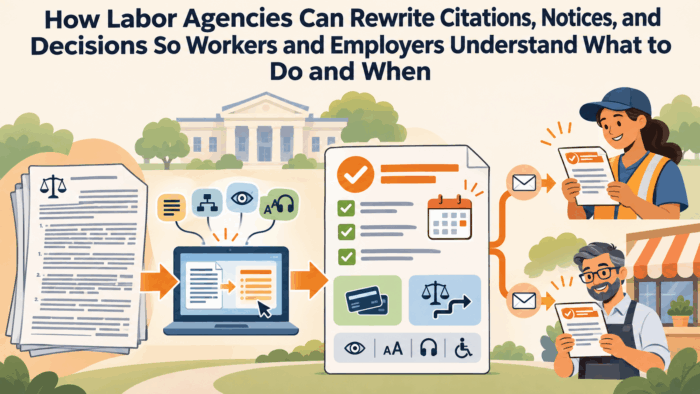
How Labor Agencies Can Rewrite Citations, Notices, and Decisions So Workers and Employers Understand What to Do and When
Labor agencies often communicate some of their most important information through documents that are also among the hardest for workers and employers to understand. Citations, notices, determinations, hearing documents, corrective-action letters, and final decisions may need to satisfy legal and procedural requirements, but they also need to tell people what happened, what it means, what they are required to do, and when they must act. When those answers are buried beneath technical language, long sentences, statutory references, or unfamiliar procedural terms, even accurate documents can fail as communication tools.
The consequences of poor document design can be significant. Workers may miss a filing deadline because they cannot tell whether a notice requires a response, while employers may misunderstand what corrective action is expected or when payment is due. Parties may call the agency repeatedly for basic clarification, submit incomplete responses, miss hearings, or assume that a preliminary notice is a final decision. In each case, the communication problem creates additional administrative work and can affect how people experience the fairness of the process.
Plain language does not require labor agencies to remove legal precision or eliminate formal terminology that must appear in an official document. It requires the agency to organize that information around the decisions the reader must make. A person should be able to identify the outcome, understand the reason at an appropriate level, see what action is required, locate the deadline, and know where to go for further procedural information without having to interpret the document like an attorney.
The strongest approach treats citations, notices, and decisions as part of the service experience rather than as documents written only for the administrative record. Labor agencies can preserve the legal authority of official communication while making the practical meaning more visible. When documents are structured around what the recipient needs to know and do, agencies can improve compliance, reduce confusion, lower repeat inquiries, and strengthen confidence in the enforcement process.
Start With the Reader’s Immediate Questions
 Official documents are often written in the order that makes sense to agency staff rather than the order that makes sense to the recipient. A citation may begin with legal authority, a determination may open with procedural history, and a notice may spend several paragraphs describing the program before explaining why the person received it. Workers and employers, however, usually begin with a much simpler set of questions.
They want to know what happened, whether the agency found a problem, what they need to do next, and when they need to do it. Those answers should appear early enough that the reader does not have to search through several pages before understanding the practical significance of the document. Legal authority and detailed reasoning can still follow in the appropriate place.
Agencies should therefore review documents from the recipient’s perspective. If a person reads only the first page, will they understand the current status and required action? If not, the document may be technically complete but operationally weak.
This shift also helps agencies distinguish between information that is essential for immediate action and information that supports the formal record. Both may be necessary, but they do not need to carry equal visual weight. Clear hierarchy allows the document to serve both functions.
Separate the Outcome From the Explanation
Workers and employers can become confused when the agency’s conclusion is embedded inside a long discussion of facts and law. A reader may finish several paragraphs without knowing whether the agency found a violation, denied a claim, scheduled a hearing, or simply requested more information. Agencies should make the outcome visible before explaining the reasoning in detail.
A plain-language outcome statement can identify what the agency has decided or what stage the matter has reached. The formal findings, citations, statutory references, calculations, and procedural history can then provide the supporting explanation. This allows the reader to understand the bottom line while still preserving the substance of the official record.
The distinction is particularly important when only part of a matter has been resolved. A decision may find one violation but not another, or it may require some corrective actions while rejecting others. Clear organization should separate each result so the recipient does not have to infer the outcome from dense legal analysis.
Agencies should also distinguish between preliminary and final actions. A proposed citation, initial determination, hearing notice, and final order should not sound interchangeable. The document should make clear whether the recipient still has an opportunity to respond or whether the agency has reached a final stage.
Put Required Actions in a Dedicated Section
One of the most important improvements agencies can make is to separate required actions from explanatory text. Workers and employers should not have to discover an obligation inside a paragraph describing legal authority or procedural history. A dedicated section can state exactly what the recipient must do next.
That section should identify the action, the deadline, the method for responding, and where the response must be sent or submitted. If multiple actions are required, they should be listed separately and in a logical sequence. The reader should be able to distinguish between mandatory steps, optional rights, and general information.
Agencies should also explain what happens if the person does not act. A missed deadline may affect appeal rights, hearing participation, payment obligations, corrective action, or another part of the case. Those consequences should be stated clearly without using unnecessarily threatening language.
The document should avoid vague instructions such as “respond promptly” when a specific deadline exists. Exact dates or clearly defined timeframes are more useful. The goal is to make compliance easier, not to test whether the reader can locate and interpret the requirement.
Make Deadlines Visually and Verbally Clear
Deadlines are among the most consequential pieces of information in an official notice, yet they are often buried in dense text. A worker may have limited time to request review, while an employer may need to correct a violation, submit records, or pay an amount by a specific date. Missing that information can create consequences that neither party fully anticipated.
Agencies should place deadlines near the action they govern. If a hearing request is due within a specified period, the deadline should appear in the same section as the hearing instructions. If payment is due separately from a document submission, those dates should not be combined in a way that makes the obligations difficult to distinguish.
The wording should also clarify how the deadline is calculated when necessary. If the period runs from service, receipt, issuance, or another event, the document should explain that clearly in plain language while preserving any required formal wording. A recipient should not need to guess which date starts the clock.
Where appropriate, agencies can also identify the actual calendar date in addition to the formal time period. This can reduce calculation errors and make the instruction easier to follow. Any such date should be generated carefully so it remains consistent with the governing rule.
Use Plain-Language Headings to Guide the Reader
Headings can transform a dense legal document into a navigable communication tool. Instead of relying only on formal section titles, agencies can use headings that answer the questions readers are likely to have. Examples might include what the agency decided, what you need to do, why the agency reached this conclusion, your options, and what happens next.
These headings do not need to replace legally required terminology. A formal heading can be retained while a plain-language subheading provides practical context. The objective is to create a hierarchy that lets readers scan the document and locate the information they need.
Consistent headings also help across multiple document types. If citations, notices, and decisions all use familiar structures for actions, deadlines, appeal rights, and contact information, users become more comfortable navigating agency correspondence. Consistency can reduce the learning burden each time a new document arrives.
Headings should remain specific rather than generic. “Important Information” tells the reader little, while “What You Must Do by June 15” immediately communicates relevance. Plain-language structure should make the document easier to act on, not merely more visually organized.
Explain Legal Terms When They First Appear
Some legal and procedural terms cannot be removed because they have specific meaning within the enforcement process. The problem arises when agencies assume recipients already understand them. Terms such as citation, abatement, determination, hearing request, appeal, final order, penalty, or restitution may be familiar to staff but unfamiliar to the people receiving the document.
Agencies should define important terms when they first appear. The explanation can be brief and should focus on what the term means for the reader in that context. Once the term has been introduced clearly, the document can use it consistently throughout.
Definitions should avoid replacing one technical term with another. A plain-language explanation is only useful if the words used to define the concept are easier to understand than the original term. Short examples can sometimes help when the concept is especially difficult.
Consistency matters here as well. The same term should not be explained differently across notices, webpages, call center scripts, and hearing instructions. A shared terminology framework can help workers and employers build understanding over time.
Separate Legal Authority From Practical Instructions
Official documents may need to cite statutes, regulations, rules, or other authority. Those references are important, but they should not compete with the practical instructions the recipient needs to follow. Agencies can preserve legal citations while placing them in a structure that supports rather than obscures understanding.
For example, the document can first explain that the agency determined certain wages are owed or that a workplace condition must be corrected. The relevant statutory or regulatory authority can then appear in the explanation or findings section. This allows the reader to understand the practical meaning before encountering the formal legal basis.
Agencies should also avoid inserting long quotations from law when a concise explanation would serve the reader better. If exact language is required, it can be included in an appendix, footnote, or clearly separated section where appropriate. The main communication should remain focused on the decision and the action required.
This separation supports both audiences. Lawyers and representatives can still locate the authority they need, while workers and employers can understand the practical obligation without reading through pages of legal text first.
Explain What Is Optional and What Is Required
Official notices often contain a mix of mandatory actions, available rights, recommendations, and general information. If those categories are not clearly separated, recipients may misunderstand an optional appeal as something they must file or treat a required response as merely informational.
Agencies should label these distinctions explicitly. “You must submit” communicates something different from “you may request,” and the document should preserve that difference. The wording should remain precise enough that the reader understands the consequences of choosing or declining an option.
This is especially important when a person has several possible procedural paths. A worker may be able to accept a determination or request review, while an employer may have the option to contest a citation or complete corrective action. The document should explain each pathway without making one appear mandatory unless it actually is.
Clear distinctions also reduce unnecessary calls. People are more likely to contact the agency when they cannot tell whether a step is required. A document that clearly separates obligations from options can answer that question before the call occurs.
Make Appeal and Hearing Rights Understandable
Appeal and hearing rights are often explained through highly formal language because they are legally significant. Yet these are exactly the provisions recipients need to understand clearly if they are going to exercise their rights effectively. Agencies should preserve procedural accuracy while making the practical steps visible.
The document should explain who may request review, what must be submitted, where it must be filed, and what deadline applies. If a particular form is required, the document should identify it directly. If filing an appeal affects the status of the underlying order or obligation, that relationship should also be explained where appropriate.
Agencies should avoid suggesting that staff can advise recipients whether they should appeal. The role of the agency is to explain the procedure, not to provide legal strategy. Clear communication can still help people understand their options without crossing that boundary.
Plain-language hearing information can also reduce missed appearances. Recipients should know whether a hearing is already scheduled, whether they must request one, and what generally happens if they do not participate. Procedural rights are more meaningful when people can understand how to use them.
Explain Monetary Amounts and Calculations Clearly
Citations and decisions involving wages, penalties, interest, restitution, or other monetary amounts can be difficult to understand when several components are combined into one total. Workers may not know how an award was calculated, while employers may be uncertain which amounts are owed to the worker and which are payable to the agency.
Agencies should provide a clear breakdown wherever the process allows. Separate lines can identify wages, penalties, interest, fees, or other components so the recipient can see how the total was reached. The explanation should also identify the period or conduct to which the amount relates.
Calculations should be described in plain language without replacing the official findings. A worker should be able to understand whether the calculation reflects unpaid hours, an incorrect rate, deductions, or another issue. An employer should be able to identify what must be paid and to whom.
Where amounts can change over time, such as through accruing interest or additional penalties, the document should explain that possibility. People should not assume that the number printed on the original notice will remain unchanged if the governing process says otherwise.
Use Companion Summaries When the Formal Document Cannot Be Simplified Enough
Some notices and decisions contain required language that cannot be substantially changed. In those situations, agencies can add a plain-language cover page, summary box, or companion explanation that helps the recipient navigate the formal document. The official version remains intact while the communication layer becomes easier to use.
A companion summary can identify the outcome, required action, deadline, amount involved, appeal rights, and contact information. It should clearly state that the formal document remains the authoritative record and should not create new obligations or alter legal meaning. Careful review is therefore essential.
These summaries can be especially useful for long decisions or notices involving several issues. A reader can understand the practical result first and then turn to the detailed findings if they need more information. This layered approach serves both accessibility and legal precision.
Agencies should also ensure that translations and accessible versions include the same practical summary. A document is not truly understandable if the plain-language layer exists only in English or only in one format.
Treat Official Documents as Part of the Enforcement Experience
Citations, notices, and decisions are not simply records of enforcement activity. They are moments when workers and employers must understand the agency well enough to take action. The clarity of those documents can affect compliance, appeals, hearings, payments, corrective action, and trust in the process.
Poor communication creates an avoidable workload. Staff may spend substantial time explaining what a notice means, recalculating deadlines for confused recipients, correcting incomplete submissions, or responding to people who misunderstood what they were required to do. Better document design can reduce those problems before they occur.
Agencies should therefore evaluate official correspondence through both a legal and communication lens. The document must remain accurate, complete, and procedurally sound, but it should also be navigable, actionable, and understandable to people encountering the process for the first time.
When labor agencies rewrite citations, notices, and decisions around what recipients need to know and do, they strengthen more than readability. They improve the connection between enforcement authority and practical compliance. Clear documents help workers and employers participate more effectively in the process while allowing agency staff to spend less time correcting preventable confusion.
Rewrite Citations So the Violation, Required Correction, and Deadline Are Immediately Clear
A citation should allow the recipient to understand the alleged or established violation without searching through several pages of legal references. Workers and employers need to know what conduct or condition the agency identified, which requirement applies, and what the agency expects to happen next. If those elements are separated across several sections, the document may be legally complete but difficult to act on.
Agencies can improve citations by presenting the violation in plain language first and placing the formal legal authority alongside or immediately after it. The explanation should identify the conduct, time period, worksite, or other relevant context with enough specificity that the recipient understands what the citation concerns. This can reduce disputes caused by confusion rather than substantive disagreement.
The required correction should be equally clear. If the employer must pay wages, correct a workplace condition, provide records, change a practice, post a notice, or take another action, the citation should state that obligation directly. The agency should avoid forcing the recipient to infer the remedy from the discussion of the violation.
Where multiple violations are included in one citation, each should have its own understandable structure. The reader should be able to distinguish the violation, legal basis, required correction, amount or consequence, and deadline associated with each item. This makes compliance easier and reduces the risk that one requirement is overlooked because it was buried inside a larger document.
Clarify Whether a Notice Is Informational, Preliminary, or Action-Required
Labor agencies issue many different kinds of notices, and recipients may not immediately understand the legal or procedural significance of each one. A notice may simply provide information, request records, announce a hearing, communicate a preliminary determination, or require immediate action. These differences should be visible before the reader reaches the detailed explanation.
The document should state near the beginning whether the recipient must respond. If no action is required, that should be said clearly. If a response is required, the notice should identify what must be submitted, where it must go, and when it is due.
Preliminary notices deserve special attention because recipients may mistake them for final decisions. Agencies should explain what remains open, what opportunity the recipient has to respond, and what may happen after the response period ends. This makes the procedural stage easier to understand.
Clear status language also supports fairness. Workers and employers should not have to determine from legal terminology alone whether they still have an opportunity to provide information or challenge a proposed action. The document should explain the practical significance of its own status.
Organize Decisions Around the Questions Recipients Will Ask First
A formal decision may contain findings of fact, legal conclusions, procedural history, calculations, and appeal information. All of those elements may be necessary, but most recipients begin with a simpler question: what did the agency decide? The document should make that answer easy to find.
The next question is usually why. A plain-language summary can explain the main reason for the outcome before the decision moves into more detailed findings and legal analysis. This allows workers and employers to understand the basic logic without reducing the authority of the formal reasoning that follows.
Recipients then need to know what happens next. If payment is due, corrective action is required, an appeal is available, or the matter is closed, that information should appear in a clearly labeled section. Readers should not need to reach the last page before learning whether they have a deadline.
A strong decision structure therefore separates outcome, reasoning, required action, rights, and next steps. Each section serves a different communication purpose. This organization helps readers navigate the document while preserving the detail required for the official record.
Explain Findings of Fact in Everyday Language Without Losing Precision
Findings of fact can become difficult to read when they are written entirely in formal or compressed language. Yet these findings are often where workers and employers look to understand what the agency believed happened. Agencies should write them in a way that preserves accuracy while making the underlying events recognizable.
Chronological structure can help. If the case involves several events, presenting them in the order they occurred may be easier to follow than organizing them around internal legal categories. The agency can still connect those facts to the relevant legal standards later.
Agencies should also avoid unnecessary repetition between the factual and legal sections. Facts should describe what the record showed, while legal conclusions should explain how those facts relate to the governing requirement. Mixing both functions in every paragraph can make the reasoning harder to understand.
Where the evidence is disputed, the decision can explain which account the agency accepted and why at an appropriate level. This does not require exhaustive discussion of every piece of evidence, but it should give the reader enough information to understand the basis for the conclusion. Clear factual explanation supports confidence even when the recipient disagrees with the outcome.
Make Corrective Actions Specific Enough to Follow
A corrective-action requirement should tell the recipient exactly what the agency expects. General phrases such as “come into compliance” may be legally meaningful in context but provide little operational guidance on their own. Employers and other regulated parties should be able to identify the action that will satisfy the requirement.
The document should specify the expected correction, the deadline, and any documentation required to demonstrate completion. If several actions are necessary, they should be separated so each obligation can be tracked. Clear sequencing can be especially useful when one step must occur before another.
Agencies should also explain whether the recipient must notify the agency after completing the correction. If proof of payment, revised records, photographs, certifications, or other documentation must be submitted, that requirement should be visible. Otherwise, an employer may believe the obligation ended when the correction occurred.
Where the agency cannot prescribe one exact method of compliance, it can still explain the required outcome. This gives the recipient flexibility while making the enforcement expectation understandable. The goal is to remove ambiguity about what success looks like.
Rewrite Payment Instructions So Recipients Know What Is Owed, to Whom, and by When
Monetary obligations can create confusion when wages, penalties, interest, fees, and other amounts appear together. Workers need to understand what they are expected to receive, while employers need to know what amounts must be paid to the worker, the agency, or another recipient. The document should separate those obligations clearly.
A payment table or structured breakdown can show each amount, the reason for it, the payee, and the due date. This is often easier to understand than a paragraph containing several numbers and legal references. The total can still appear prominently, but recipients should be able to see how it was calculated.
Payment instructions should also explain the method of payment where applicable. If the agency requires proof that wages were paid, that requirement should appear near the payment instructions rather than in an unrelated section. Workers should likewise know whether payment will come directly from the employer, through the agency, or through another process.
If amounts may change because of interest or additional penalties, the document should explain that possibility. Recipients should not assume that an earlier amount remains fixed if delay changes the obligation. Clear financial communication can prevent later disputes about what the decision actually required.
Make Appeal and Review Instructions Actionable
Appeal language is often one of the most technical parts of an official decision, even though it may be the section with the most immediate consequences. Agencies should organize review rights around the practical actions the recipient must take. The reader should be able to identify the deadline, filing method, required form, destination, and any other essential procedural requirement.
The instructions should distinguish between asking the agency a procedural question and receiving legal advice. Staff may be able to explain where to file or which form is required, but they may not be able to tell a worker or employer whether an appeal is strategically wise. The document should make that boundary clear.
Where different kinds of review are available, each should be explained separately. A reconsideration request, administrative appeal, or judicial review process should not be blended together in one paragraph if they have different requirements. Clear separation reduces the risk of filing through the wrong pathway.
The consequences of missing the deadline should also be stated directly where appropriate. Recipients should understand whether the decision may become final or whether another right may be lost. This information should be visible without relying on threatening or excessively formal language.
Use Plain Language to Explain Consequences Without Making Notices Sound Punitive
Enforcement documents often need to explain what may happen if a recipient does not comply. Additional penalties, collection activity, finalization of an order, loss of appeal rights, or other consequences may be legally significant. The challenge is to communicate them clearly without making the entire document sound accusatory or threatening.
Agencies should describe consequences as part of the process. For example, the document can explain that if payment is not made by the deadline, additional collection steps may follow. This is more useful than broad warnings that do not tell the reader what the next step actually is.
The tone should remain professional and neutral. Strong enforcement authority does not require aggressive wording. Clear descriptions of obligations and consequences can be firm without sounding hostile.
This approach also supports voluntary compliance. Recipients are more likely to act correctly when they understand both the requirement and the consequence of not meeting it. Confusion should not be the mechanism through which enforcement pressure is created.
Design Notices So Important Information Is Easy to Scan
Many recipients will not read an official document from beginning to end before looking for the information that affects them immediately. Agencies should design documents with that behavior in mind. Clear headings, short sections, tables, bold labels, and adequate spacing can make critical information easier to locate.
Important items such as deadlines, required actions, hearing dates, payment amounts, and contact information should be visually prominent. They should not depend on color alone because the document may be printed or used by people with visual limitations. Structure should carry the hierarchy.
Agencies should also avoid excessive use of bold, capitalization, or warning boxes. When everything is emphasized, nothing stands out. Visual emphasis should be reserved for the information that genuinely requires immediate attention.
Good document design supports plain language rather than replacing it. A beautifully formatted notice can still be confusing if the underlying wording is unclear. The strongest documents combine readable language with a visual structure that guides the recipient through the process.
Build Language Access Into Official Correspondence
Workers and employers who use another language need access to the practical meaning of official documents, not just general information about the agency. Citations, hearing notices, decisions, payment instructions, and appeal guidance can all involve deadlines or obligations that make language access especially important.
Agencies should determine which portions of official correspondence can be translated directly and where a translated summary or companion document may be more appropriate. The approach will depend on the governing requirements and available resources. Whatever model is used, recipients should be able to understand what action is required and when.
Translated materials should preserve the distinction between official legal language and explanatory communication. If the English document contains a plain-language summary, comparable support should be available in translated versions where feasible. Language access should not disappear at the moment a case becomes formal.
Agencies should also provide clear information about interpretation or language assistance for hearings, calls, or questions about the process. A translated notice is more useful when the recipient can continue navigating the next step in the same language.
Coordinate Official Documents With Websites, Portals, and Staff Guidance
A citation or decision does not exist in isolation. Recipients may look at the agency website, call a staff member, access a portal, or ask a community partner to help interpret what the document means. Those channels should reinforce the same explanation.
If the decision says a hearing request must be filed one way while the website describes another process, the recipient may not know which instruction is current. Agencies should therefore review related web pages, FAQs, scripts, and portal content whenever official document templates change.
The same terminology should also carry across channels. If a notice refers to a “request for administrative review” while the website calls the same step an “appeal,” the relationship between those terms should be clear. Consistency reduces unnecessary interpretation.
Front-line staff should receive guidance before new templates are released. They should understand the new structure, where critical information appears, and how to answer procedural questions. This helps the communication improvement continue after the document reaches the public.
Use Document Redesign to Reduce Avoidable Calls and Procedural Errors
Agencies should measure whether rewritten documents actually improve outcomes. A clearer notice should reduce calls asking what the recipient needs to do, while better hearing instructions may reduce missed appearances or incomplete filings. Document redesign should be evaluated through actual behavior rather than readability alone.
Call center questions can provide useful evidence. If staff repeatedly explain the same deadline, payment instruction, or appeal process, the document may still be unclear. Those patterns should inform future revisions.
Agencies can also examine incomplete responses, rejected filings, missed deadlines, and other procedural errors. Not every error is caused by communication, but recurring patterns may indicate that instructions are not working as intended. User testing can help confirm where confusion occurs.
The long-term goal is to make official documents operationally effective as well as legally sound. When workers and employers can quickly understand what happened, what they need to do, and when they need to do it, the agency reduces preventable confusion while strengthening compliance and participation.
Explain Procedural History Without Letting It Take Over the Document
Procedural history can be important in a formal citation, notice, or decision because it shows how the matter reached the current stage. However, long descriptions of filings, conferences, continuances, correspondence, and prior actions can overwhelm the reader before they understand the outcome. Agencies should include the history needed for the record while keeping the practical meaning of the current document easy to find.
One approach is to summarize the procedural history before presenting more detailed chronology where needed. A short overview can explain that a complaint was filed, information was gathered, the parties had an opportunity to respond, and the matter proceeded to the current stage. This gives readers context without requiring them to reconstruct the sequence themselves.
The more detailed history can then be organized chronologically and separated from the action-oriented sections. Workers and employers who need the full record can review it, while readers focused on current obligations can go directly to the relevant instructions. This layered structure serves both legal completeness and practical usability.
Agencies should also avoid repeating procedural history across multiple sections unless the repetition serves a clear purpose. Repetition can make an already long document feel more complicated and may obscure which facts are actually relevant to the decision. Clear organization helps recipients distinguish background from present obligations.
Explain the Difference Between Allegations, Findings, and Final Conclusions
Workers and employers may struggle to understand whether a statement in an official document is an allegation, a preliminary agency view, a factual finding, or a final legal conclusion. When these categories are blended together, recipients may believe the agency has already decided an issue that is still under review. Agencies should make these distinctions explicit.
Allegations should be described as claims or assertions that have been raised and are subject to review. Findings should identify what the agency determined based on the available record. Final conclusions should explain how those findings relate to the governing legal or regulatory framework.
This distinction is especially important in preliminary notices, investigative findings, and decisions that may still be subject to review. The document should make clear what remains open and what has already been decided. That helps workers and employers understand both the current stage and their remaining options.
Rewrite Evidence Summaries So Readers Can Follow the Reasoning
Evidence summaries can become difficult to understand when they list documents, statements, and records without explaining why they matter. Recipients need enough context to see how the agency moved from the evidence to the conclusion. The summary should therefore connect the information reviewed to the issue being decided.
A clear structure can group evidence by topic. For example, records related to hours worked can be discussed together, while payroll records and employer explanations can appear in another section. This helps readers understand the pattern rather than encountering a disconnected inventory of exhibits.
Agencies should avoid overwhelming the recipient with unnecessary detail. The official record may contain far more information than needs to appear in the plain-language explanation. The goal is to summarize the evidence sufficiently to show the basis for the decision without reproducing the entire case file.
Where evidence conflicts, the agency should explain the disagreement in neutral terms. A worker and employer may remember events differently, or records may point in different directions. A plain-language decision should show how the agency evaluated those differences without turning the explanation into an adversarial narrative.
Clarify When an Amount Is Proposed, Determined, or Final
Monetary amounts can appear at several stages of an enforcement matter, and recipients may not understand whether the number is preliminary or final. A proposed wage calculation, tentative penalty, final award, or collection amount can all look similar on paper if the document does not explain the status clearly. Agencies should label each amount in a way that shows what it represents.
If the amount is preliminary, the document should explain what may still change it. Additional evidence, a response, a hearing, or further calculation may affect the total. Workers and employers should know whether the amount is an estimate, a proposed finding, or a binding obligation.
If the amount is final, the document should explain when payment becomes due and whether any review rights remain. If interest or additional penalties may continue to accrue, that should also be stated clearly. Financial clarity is especially important because recipients may make decisions based on the number they see.
Explain When Several Deadlines Apply to the Same Matter
 Some citations and decisions contain multiple deadlines. An employer may need to correct a condition by one date, submit proof by another, and request review by a different deadline. A worker may have one deadline to respond to a notice and another to seek appeal. These obligations should not be presented as one block of dates without clear separation.
Agencies can use a structured deadline section that identifies the action, due date, and consequence associated with each requirement. This format makes it easier to distinguish which date applies to which task. A timeline or table may be especially useful when several deadlines occur close together.
The document should also explain whether completing one action affects another. For example, requesting review may or may not change a payment or corrective-action obligation depending on the governing process. Recipients should not be expected to infer that relationship from scattered legal provisions.
Where deadlines are based on service or receipt rather than a fixed calendar date, the agency should explain how the date is calculated. The clearer the sequence, the lower the risk that a recipient misses an important procedural step because several dates appeared in the same notice.
Make Compliance Verification Easy to Understand
An employer may complete the required corrective action but still fail to satisfy the agency because proof of compliance was not submitted correctly. Citations and orders should therefore explain not only what the employer must do but also how the agency will verify completion. These are separate responsibilities and should be communicated separately.
The document can identify acceptable forms of verification where appropriate. Proof may include payroll records, photographs, written certification, revised policies, payment records, or another form of documentation. The recipient should know what to submit and where to send it.
Agencies should also explain whether the correction itself must occur before the verification deadline. A business should not assume that submitting a statement of intent satisfies an obligation to correct the underlying condition. Clear sequencing reduces this kind of misunderstanding.
Workers may also need to understand verification when a decision involves payment or another remedy. They should know whether the agency will confirm compliance, whether they need to report nonpayment, or whether another process begins if the employer does not comply. This makes enforcement outcomes easier to follow.
Explain Extensions, Continuances, and Rescheduling in Plain Language
Extensions and continuances can be confusing because recipients may not know which deadline or event has changed. A notice that says an extension was granted without restating the new date can create uncertainty. Agencies should always connect the change to the specific requirement it affects.
The updated communication should identify the original event or deadline, the new date, and whether any other obligations remain unchanged. This is especially important when only one part of a case has been postponed. Recipients should not assume that every deadline moved simply because one event did.
Agencies should also explain whether the recipient needs to do anything because of the change. If no action is required, that should be stated directly. If new documents or confirmation are needed, those instructions should appear in the same notice.
Rewrite Closure Notices So Recipients Know What Ended and Why
A case closure notice can be one of the most confusing documents if it does not explain what “closed” means. A matter may close because the agency completed its review, the parties resolved the issue, jurisdiction was lacking, the claim was withdrawn, the worker did not respond, or another procedural condition occurred. Those outcomes should not be communicated through one generic closure message.
The notice should identify why the matter ended and whether the agency made a substantive determination. A closure for jurisdictional reasons is different from a finding that no violation occurred. Workers and employers should be able to distinguish those outcomes.
The notice should also explain whether any further action is available. Review rights, referral to another agency, collection activity, or other next steps may still exist even though the case is closed within one program. The document should state whether the agency’s role is finished or whether another stage remains.
A clear closure notice can also reduce repeated calls. People often contact the agency because they understand that the case ended but not what that ending means. Plain-language explanation makes the final communication more useful and more credible.
Use Layered Communication for Long or Complex Decisions
Some enforcement decisions are necessarily lengthy because they involve multiple parties, legal issues, factual disputes, or calculations. Trying to compress every complex decision into a short document may reduce accuracy. A better approach is to layer the communication so recipients can first understand the essential outcome and then access more detail.
The first layer can summarize the decision, required action, monetary amounts, deadlines, and review rights. A second layer can explain the major findings and reasoning. The full formal analysis can then provide the detailed legal and factual record required by the process.
This approach allows different readers to use the same document effectively. A worker may need the practical outcome first, while a representative or attorney may need the full reasoning. Both audiences can access what they need without forcing every recipient to begin with the most technical material.
Agencies should ensure that the layers remain consistent. The summary should not oversimplify the decision to the point that it changes meaning. Careful review is necessary so the plain-language explanation accurately reflects the formal findings.
Test Whether Recipients Can Find the Required Action Quickly
Readability testing should go beyond asking whether sentences are understandable. Agencies should test whether actual users can locate the action, deadline, amount, hearing information, and appeal rights quickly. A document can contain plain language and still fail if the information is poorly organized.
User testing can involve workers, employers, community partners, advocates, or other representative readers completing simple tasks. They might be asked to identify what they must do, by when, where payment should go, or how to request review. Difficulty answering those questions reveals where the document structure still needs work.
Testing should include people with different levels of familiarity with labor agency processes. Staff and attorneys may find a document obvious because they already understand the terminology and procedure. First-time recipients provide a more realistic measure of whether the document works.
Use Call Center and Front-Line Questions to Identify Document Problems
Official correspondence generates a predictable set of follow-up questions. If workers and employers repeatedly call to ask what a notice means, whether they need to respond, or when payment is due, the agency should treat those calls as evidence about document performance. The same questions should not need to be answered indefinitely.
Call center staff can categorize recurring questions by document type. Investigators, hearing staff, and administrative employees can also identify sections that regularly cause confusion. These patterns can show where wording or structure needs revision.
The agency can then compare call patterns before and after redesign. A decline in basic clarification calls may indicate that the new document is working better. If questions simply shift to a different issue, further refinement may be needed.
This creates a continuous feedback loop between communication and operations. Official documents become living tools that improve as the agency learns how workers and employers actually use them.
Treat Document Clarity as Part of Procedural Fairness and Compliance
Clear official correspondence helps people understand both their responsibilities and their rights. A worker who understands a decision is better positioned to evaluate the outcome and decide whether further review is appropriate. An employer who understands a citation is better positioned to correct the violation, provide required documentation, or exercise available review rights.
This supports procedural fairness because people can participate more meaningfully when they understand what the agency has done and what options remain. Confusing language can create the appearance that the process is inaccessible even when formal rights technically exist. Plain-language communication makes those rights more usable.
Clarity also supports compliance. Recipients are more likely to take the correct action when instructions, deadlines, amounts, and consequences are visible and understandable. This reduces avoidable errors that create additional enforcement work.
Rewriting citations, notices, and decisions is therefore not merely an editorial improvement. It strengthens the connection between agency authority and public action. When official documents clearly explain what happened, what must happen next, and when action is required, labor agencies can improve both the fairness and effectiveness of enforcement communication.
Build Governance Around Official Document Language
Citations, notices, decisions, and hearing communications should not be rewritten independently by each program or individual staff member. When document language varies across units, recipients may receive different explanations of similar rights, obligations, deadlines, or procedural stages. Labor agencies should establish governance that keeps official correspondence consistent while still allowing program-specific requirements to remain intact.
That governance should identify who is responsible for legal review, plain-language review, accessibility, translation, template maintenance, and final approval. Program staff may define the substantive requirements, legal staff may protect procedural accuracy, and communications staff may help organize the information around what the recipient needs to understand and do. A coordinated process reduces the likelihood that clarity improvements are later undone by isolated revisions.
Agencies should also define when document changes require broader review. A new hearing procedure, appeal deadline, payment process, or corrective-action requirement may affect several templates at once. Updating one notice without reviewing related decisions, webpages, scripts, and forms can create new inconsistencies.
A formal governance model helps official documents remain accurate over time. It also prevents plain-language improvements from depending entirely on one staff member who happens to be skilled at writing. Document clarity becomes an institutional responsibility rather than an individual preference.
Create Standard Document Structures Across Programs
Workers and employers should not have to learn a completely new document format every time they interact with another labor program. Agencies can create standard structural elements that appear consistently across citations, notices, determinations, and decisions even when the underlying subject matter differs. Familiar organization makes official correspondence easier to navigate.
Core sections might include what the agency decided, what you need to do, deadlines, payment or corrective-action requirements, your options, what happens next, and where to get procedural help. The exact wording can vary by program, but the basic order should remain recognizable. This creates a predictable reading experience.
Standardization also helps staff. New templates can be developed more efficiently when there is an established framework for presenting actions, deadlines, rights, and next steps. Reviewers can focus on substantive accuracy rather than rebuilding the structure from the beginning.
The goal is not to make every document identical. A workplace safety citation and a wage claim decision may require very different content. Standard structure simply ensures that recipients can reliably locate the most important practical information.
Build a Controlled Library of Approved Plain-Language Terms
Official documents often become inconsistent because staff use different words for the same procedural concept. One notice may refer to a hearing request, another to an appeal, and another to administrative review even when the relationship among those terms is not obvious to the public. Agencies should maintain an approved terminology library that defines how key concepts are explained.
The library can include formal terms, preferred plain-language explanations, and examples of wording to avoid. It should also identify when a legal term must remain because it has a specific procedural meaning. This supports consistency without oversimplifying distinctions that matter.
The terminology library should be used across document templates, websites, portals, call center guidance, and outreach materials. Repeated exposure to the same language helps workers and employers build familiarity with the agency’s process over time. It also reduces the burden on staff who would otherwise need to explain why different documents use different terminology.
The library should be reviewed when statutes, regulations, procedures, or agency structures change. A term that was accurate under an older process may become misleading after a program redesign. Maintaining the language system is therefore part of maintaining the enforcement system.
Establish Review Standards for Required Actions and Deadlines
Required actions and deadlines should receive a dedicated review because they are among the most consequential parts of any official document. Agencies should confirm not only that the deadline is legally accurate but also that the recipient can locate and understand it quickly. A technically correct deadline that is difficult to find still creates avoidable risk.
Reviewers should check whether each obligation clearly identifies who must act, what they must do, when they must do it, and where or how the action must be completed. If several deadlines apply, each should be paired with the specific task it governs. Ambiguous references such as “within the required period” should be avoided when a more concrete explanation is possible.
Agencies should also verify how deadlines are calculated. If the time period runs from service, issuance, receipt, or another event, that trigger should be stated clearly. Where the process allows, providing the actual calendar date can reduce calculation errors.
Any automated date calculation should be subject to quality control. A system-generated due date can still be wrong if the underlying rule or triggering date is entered incorrectly. Clear communication depends on accurate operational data as much as good writing.
Build Quality Control Around Monetary Information
Monetary amounts require careful review because small errors can create significant confusion. Wage awards, penalties, interest, restitution, and other obligations should be checked for both numerical accuracy and communication clarity. Recipients should be able to understand what each amount represents and who is responsible for payment.
Agencies should establish a consistent way to display monetary information. Tables or structured summaries can separate wages, penalties, fees, interest, and totals while showing the relevant payee and due date. This format is easier to verify internally and easier to understand externally.
The review process should also examine whether calculations are explained sufficiently. A worker may understand that money was awarded but still want to know how the total was reached. An employer may need to distinguish what must be paid to the worker from what is payable to the agency.
Where amounts can change after issuance, the document should explain that clearly. Interest, continuing penalties, or other adjustments should not surprise the recipient later. Financial transparency reduces disputes and strengthens confidence in the decision.
Coordinate Legal Review With Plain-Language Review
Legal review and plain-language review should reinforce each other rather than occur as competing steps. Legal staff protect accuracy, authority, and procedural integrity, while communications staff help make the meaning accessible. Agencies should design a review process where both functions understand the purpose of the other.
Plain-language edits should never change substantive rights or obligations. At the same time, legal precision does not always require dense sentences or extensive quotations from law. Many complex ideas can be explained more clearly without changing their legal meaning.
Agencies can improve collaboration by distinguishing between language that is legally required and language that has simply been used historically. Some phrases may have remained in templates for years without any current requirement that they appear exactly as written. Identifying that difference creates more room for improvement.
Joint review can also reduce repeated revision cycles. When legal and communication considerations are addressed together, agencies are less likely to produce a clear draft that later becomes difficult to understand after additional technical language is inserted. The goal should be one document that works for both the record and the reader.
Build Translation and Accessibility Into the Template Process
Language access and accessibility should be incorporated when official templates are created, not after the English version is finalized. Documents with long sentences, dense tables, unclear headings, or complicated formatting can become even harder to use when translated or accessed through assistive technology. Designing for broader access from the beginning improves the entire document system.
Agencies should identify which sections require full translation, which may use approved summaries, and what additional language assistance must be available. The approach will vary based on legal requirements, agency capacity, and document type. Regardless of the model, recipients should be able to understand required actions, deadlines, and procedural options.
Accessibility review should include structure as well as visual presentation. Headings, tables, lists, reading order, and form fields should be usable with assistive technologies. Critical information should not depend on color, placement, or visual cues alone.
Translated and accessible versions should also remain synchronized with the source document. If a deadline section or procedural instruction changes, related versions should be updated at the same time. Uneven updates can create different levels of access to current information.
Use Template Version Control to Prevent Outdated Notices
Official correspondence can remain in circulation long after procedures change. Staff may keep local copies of old templates, partners may retain outdated examples, and automated systems may continue generating language that no longer reflects current practice. Agencies need strong version control to prevent these inconsistencies.
Each official template should have a clear owner, effective date, and current version. Older versions should be retired from shared drives, case-management systems, and staff resources when they are no longer valid. Employees should know where to find the authoritative template rather than relying on saved personal copies.
Version control should also extend to companion materials. If a decision template changes, related FAQs, call scripts, hearing instructions, and website guidance may need review. A document system is only as consistent as the channels surrounding it.
Periodic audits can help identify outdated materials that survived earlier transitions. These audits are especially important after reorganizations, statutory changes, or technology migrations. Removing obsolete language protects both accuracy and public confidence.
Train Staff to Explain Documents Without Reinterpreting Them
Even the clearest official document will generate some questions. Call center employees, investigators, inspectors, administrative staff, and hearing personnel should know how to explain where information appears and what procedural steps mean. They should also know where their role ends.
Staff can explain what a deadline applies to, where an appeal must be filed, or which section shows the amount due. They should not rewrite the decision verbally, predict the outcome of an appeal, or provide legal advice. Clear boundaries protect neutrality while still allowing staff to provide useful assistance.
Training should use actual redesigned documents. Staff should know the structure well enough to guide a caller directly to the relevant section. This makes the improved document more valuable in practice.
Front-line questions should also feed back into the document review process. If staff repeatedly need to explain the same section, that pattern may show that the document still needs revision. Training and document improvement should therefore operate as a continuous loop.
Create a Testing Process Before New Templates Are Rolled Out
Agencies should test major document redesigns before implementing them across an entire program. Internal review alone may not reveal whether a worker or employer can actually find the information they need. User testing can show where structure, terminology, or instructions remain confusing.
Testing can involve representative workers, employers, community organizations, advocates, or other users completing practical tasks. They might be asked to identify the required action, deadline, payment amount, hearing information, or appeal procedure. Difficulty completing those tasks provides direct evidence about where the template still needs work.
Agencies should also test different formats. A document may work well on a large screen but become difficult to use on a phone or when printed in black and white. Accessibility and translation testing can reveal additional issues.
Piloting allows agencies to revise before confusion becomes widespread. A smaller implementation can also help staff identify workflow issues, such as whether the new template requires data fields that existing systems do not reliably provide. Testing protects both the public experience and agency operations.
Measure Whether Clearer Documents Improve Compliance and Reduce Workload
Document redesign should be evaluated through real outcomes rather than appearance alone. Agencies should examine whether clarification calls decline, whether fewer people miss deadlines, and whether required responses are more complete. These measures show whether the communication is actually working.
Compliance indicators may also improve. Employers may complete corrective actions more accurately when instructions are specific, while workers may be more likely to exercise review rights correctly when procedures are clear. These outcomes can reduce avoidable rework across the enforcement process.
Agencies should compare performance before and after significant template changes where feasible. Call reasons, rejected filings, incomplete submissions, missed hearings, and payment errors can all provide useful evidence. User feedback can supplement those operational measures.
The purpose is not to prove that every problem can be solved through writing. Some procedural errors will occur regardless of document quality. The objective is to identify the confusion the agency can reasonably prevent and continue improving the documents accordingly.
Make Official Document Clarity a Long-Term Management Responsibility
Citations, notices, and decisions should not be viewed as finished products once templates are approved. Laws, procedures, technology, agency structures, and public expectations change over time. Documents need ongoing maintenance to remain accurate and usable.
Leadership should assign responsibility for periodic review of templates, terminology, deadlines, monetary displays, translation, accessibility, and related web guidance. These reviews should be connected to operational data and front-line feedback rather than conducted only as editorial exercises.
Document clarity should also be considered when new policies or enforcement procedures are developed. Agencies can avoid future confusion by designing the public communication at the same time as the underlying process. Waiting until implementation is complete often forces communications staff to translate a system that was never designed with the recipient in mind.
A mature document system combines legal precision, plain language, visual hierarchy, accessibility, and continuous quality control. When labor agencies manage official correspondence this way, workers and employers are more likely to understand what happened, what they must do, and when they must act. That clarity supports compliance, procedural fairness, and more efficient enforcement administration.
Strategic Communication Support for Citations, Notices, and Decisions
 Labor agencies rely on official documents to communicate some of their most consequential actions. Citations, notices, determinations, corrective-action letters, hearing communications, and final decisions must often satisfy legal and procedural requirements while also helping workers and employers understand what happened, what the agency expects, what deadlines apply, and what options remain. When those documents are difficult to navigate, the agency may face more clarification calls, missed deadlines, incomplete responses, and avoidable disputes about what the communication actually required.
Stegmeier Consulting Group (SCG) can support labor agencies by reviewing official correspondence for plain language, structure, visual hierarchy, action clarity, deadline communication, monetary explanations, hearing instructions, appeal guidance, accessibility, and consistency across related materials. SCG can also help agencies develop standardized document frameworks, terminology libraries, companion summaries, staff guidance, template governance, and testing methods that make formal communications easier to use without weakening substantive accuracy.
External strategic communication support can be particularly valuable when an agency has accumulated document templates over many years or across several programs. Different units may use inconsistent language, place required actions in different locations, or rely on legacy wording that remains difficult for recipients to understand. A structured review can identify where the agency can simplify, reorganize, or clarify communication while legal and program staff retain control over the official substance.
SCG’s role remains focused on communication strategy, plain-language systems, document structure, accessibility, internal alignment, stakeholder communication, and testing. SCG does not provide legal advice, determine enforcement outcomes, establish official deadlines, adjudicate disputes, calculate binding penalties or awards, interpret law on behalf of regulated parties, or replace agency counsel, investigators, hearing officers, or other authorized professionals. Strategic communication support helps agencies make official documents more understandable while preserving the agency’s substantive legal and enforcement responsibilities.
Future Trends
Labor agencies are likely to place greater emphasis on layered official communication. Rather than relying on one dense document to serve every audience, agencies may increasingly pair formal decisions and citations with plain-language summaries, digital explanations, portal messages, and action-focused cover pages. This approach can preserve the authoritative record while giving workers and employers a clearer way to understand what they need to do next.
Digital delivery will also change how official correspondence is designed. Notices viewed on a phone or through a case portal need stronger hierarchy, shorter sections, clear action labels, and easily accessible deadlines. Agencies may need to design documents for both print and digital use instead of assuming the recipient will read a multi-page PDF on a desktop computer.
Automation and AI-assisted drafting may also play a larger role in generating routine notices, summaries, and explanations. These tools may improve consistency, but they will require strong governance, approved language, human review, and careful separation between explanatory communication and substantive legal determinations. A faster drafting process is only useful if the resulting document remains accurate and understandable.
The broader trend will be toward treating document clarity as part of enforcement performance. Agencies may increasingly measure whether rewritten notices reduce procedural errors, improve compliance, decrease clarification calls, and make appeal or hearing rights easier to use correctly. Official correspondence will be evaluated not only for whether it contains the required language, but also for whether recipients can act on it successfully.
Conclusion
Citations, notices, and decisions are some of the most important communication tools labor agencies produce. They tell workers and employers what the agency has found, what obligations exist, what rights remain, and what deadlines govern the next step. When those messages are difficult to understand, the enforcement process becomes harder to navigate for everyone involved.
Plain-language redesign does not require agencies to remove legal authority or simplify away important procedural distinctions. It requires a clearer hierarchy in which the outcome, required action, deadline, payment obligation, hearing information, and review rights are easy to locate. Detailed findings, legal reasoning, and formal authority can remain in the document without obscuring the information recipients need first.
The strongest systems also treat official correspondence as part of a larger communication environment. Websites, portals, call center scripts, hearing guidance, translated materials, and staff explanations should reinforce the same terminology and instructions. That consistency reduces the likelihood that workers and employers receive conflicting explanations after reading the formal document.
Clearer official communication can improve more than readability. It can support compliance, reduce repeat inquiries, lower the risk of missed procedural steps, and strengthen perceptions of fairness. When labor agencies make citations, notices, and decisions easier to understand, they make the enforcement process itself easier to participate in.
Stegmeier Consulting Group’s Strategic Approach to Communication Systems
Build official labor agency documents that make outcomes, obligations, deadlines, and next steps clear without weakening legal or procedural precision.
Labor agencies need communication systems that connect citations, notices, decisions, hearing instructions, payment guidance, appeal information, translated materials, staff scripts, and digital case tools into one consistent framework. Stegmeier Consulting Group (SCG) helps agencies develop plain-language document structures, terminology standards, companion summaries, template governance, accessibility approaches, testing methods, and internal guidance that make official correspondence easier for workers and employers to understand and use.
Use the form below to connect with our team and explore how strategic communication support can strengthen citations, notices, decisions, deadline communication, and the overall clarity of labor agency enforcement documents.