
How Labor Agencies Can Explain the Wage Claim Process From Filing to Hearing to Collection in Plain Language
For many workers, filing a wage claim is not a familiar administrative process. It may be the first time they have contacted a labor agency, submitted evidence to the government, responded to formal notices, or participated in a hearing. Even when the agency has a clear internal process, workers can become confused if that process is explained through legal terminology, procedural labels, or assumptions about how enforcement systems work.
The challenge becomes more significant because the wage claim process is rarely one simple step. A worker may need to file a claim, provide information, respond to follow-up questions, participate in an investigation or conference, prepare for a hearing, wait for a decision, and then understand what happens if wages are awarded but not paid. If those stages are not explained clearly, workers may lose confidence, miss deadlines, fail to provide useful information, or misunderstand what the agency has and has not decided.
Plain-language communication should therefore describe the wage claim process as a sequence of understandable stages rather than as a collection of legal procedures. Workers should know what they are being asked to do, why each step matters, what the employer may be asked to do, what the agency is evaluating, and what outcomes may follow. The goal is not to eliminate necessary procedural detail but to organize it in a way that helps people move through the system without needing legal training.
A clear process explanation also supports agency operations. Workers who understand what happens next are more likely to submit relevant information, respond to requests, appear when required, and distinguish between an initial filing, a hearing decision, and actual collection of unpaid wages. By improving communication across the full claim lifecycle, labor agencies can reduce preventable confusion while preserving the formal structure required for fair administration.
Explain the Wage Claim Process as a Series of Stages
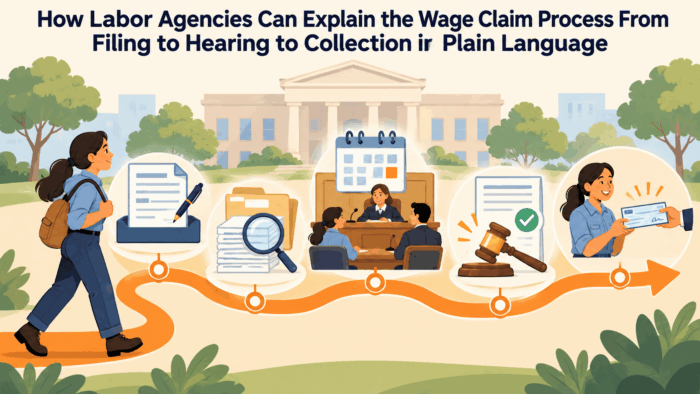
 Workers are more likely to understand a wage claim when the agency presents it as a series of connected stages. Instead of beginning with technical terms such as investigation, adjudication, appeal, or enforcement, agencies can first explain the overall journey in plain language. A simple framework might show that the worker files, the agency reviews, both sides may provide information, a decision may be made, and collection may follow if money is owed.
This high-level explanation should appear before the worker encounters detailed procedural instructions. It gives people a mental map of the process and helps them understand why later requests are being made. Without that map, each notice or form may feel like an isolated requirement rather than part of a larger sequence.
The agency should also make clear that not every claim follows exactly the same path. Some matters may be resolved earlier, some may require additional review, and some may proceed to a hearing. Plain-language communication should explain the typical process while acknowledging that specific steps can vary based on the facts, applicable law, and agency procedures.
Clarify What Filing a Wage Claim Actually Does
Workers may assume that filing a wage claim means the agency has already accepted the worker’s version of events or determined that wages are owed. Others may believe that filing immediately triggers payment or enforcement. Agencies should explain that filing begins a process rather than ending one.
The filing stage should be described as the worker’s opportunity to tell the agency what happened and provide enough information for the matter to be reviewed. The agency can explain what information is useful, what may be requested later, and whether additional details will be needed before the claim can move forward. This helps workers understand that intake is the beginning of fact gathering.
Communication should also explain what the agency does after receiving the claim. Depending on the process, staff may review whether the agency has jurisdiction, determine whether the filing is complete, request more information, or notify the employer. Clear expectations reduce the risk that workers interpret an initial period of review as inactivity.
Explain the Employer’s Role Without Making the Process Sound Adversarial From the Start
Workers should understand that the employer may have an opportunity to respond, provide records, or contest aspects of the claim. If this is not explained early, workers may be surprised when the agency requests employer information or communicates with the employer. That surprise can create unnecessary concern about whether the agency still believes the worker.
The process should be framed as fact gathering and fair review rather than as the agency taking sides. Workers can be told that the agency may need information from both parties before determining what happened and what rules apply. This reinforces procedural fairness without minimizing the worker’s concern.
Agencies should also explain that disagreement from an employer does not automatically mean the worker’s claim has failed. Workers may interpret an employer response as a final decision if they do not understand the process. Clear communication can distinguish between evidence being submitted and the agency making a formal determination.
Explain Requests for Records in Plain Language
Workers may receive requests for pay stubs, schedules, time records, text messages, contracts, or other documents and may not understand why each item matters. Agencies should explain that records help staff compare the worker’s account with available information about hours, pay, deductions, or employment arrangements. This makes document requests feel connected to the claim rather than arbitrary.
The agency should also be clear about what happens when workers do not have every record. Some documents may be controlled by the employer, while others may no longer be available to a former worker. Instructions should distinguish between information the worker must provide and information that is helpful but can be requested or verified later.
Workers should also know how to submit records and how to identify what each document shows. Simple upload instructions, labeling guidance, and examples can make evidence easier for both workers and staff to manage. The objective is to support useful documentation without creating the impression that the worker must independently prove the entire case before the agency reviews it.
Explain Informal Resolution and Early Case Activity Clearly
Some wage claim systems include opportunities for early resolution before a formal hearing. Workers may encounter settlement discussions, conferences, agency contacts, or other attempts to clarify or resolve the dispute. These stages should be explained carefully because workers may not understand whether they are optional, required, binding, or part of the formal decision process.
Plain-language materials should describe the purpose of the early stage and what the worker may need to do. If the agency is facilitating discussion rather than deciding the claim, that distinction should be clear. Workers should know whether agreeing to a resolution affects further proceedings and where they can obtain more information before accepting an outcome.
The agency should also avoid presenting early resolution as either a guaranteed shortcut or a sign that the claim is weak. It is simply one possible stage in the process where appropriate. Clear explanations help workers evaluate what is happening without drawing conclusions from unfamiliar procedural labels.
Prepare Workers for a Hearing Before the Hearing Notice Arrives
A formal hearing can sound intimidating, particularly to workers who have never participated in a government proceeding. Agencies should begin explaining the possibility of a hearing earlier in the process so the first hearing notice does not become the worker’s introduction to what it means. Early communication can reduce anxiety and improve preparation.
Workers should understand the basic purpose of a hearing. It is an opportunity for relevant information, testimony, and evidence to be considered through the agency’s formal process before a decision is made. The explanation should avoid unnecessary legal terminology while still making clear that the hearing is an important procedural stage.
The agency can also explain what workers may need to prepare, such as records, dates, witnesses, or a clear account of what occurred. Guidance should remain neutral and should not cross into providing legal advice. The goal is to help workers understand the mechanics of participation so procedural unfamiliarity does not become an avoidable disadvantage.
Explain What Happens During the Hearing
Workers may imagine a hearing as identical to a courtroom trial, which can create unnecessary fear. Depending on the agency’s process, the hearing may still be formal, but communication can explain who will participate, who will make the decision, how information is presented, and what the worker may be asked to do. Knowing the structure can make the event more manageable.
The agency should explain that both parties may have an opportunity to present relevant information and respond to the other side. Workers should understand that questions from a hearing officer or other decision-maker do not necessarily signal disbelief. Questions may simply be part of developing a complete record.
Practical guidance is also important. Workers should know when and where to appear, how remote participation works if applicable, what happens if they need interpretation or accessibility support, and how to ask procedural questions. Clear logistics reduce the risk that avoidable confusion interferes with participation.
Distinguish the Hearing From the Decision
Workers may expect to learn the result immediately at the end of a hearing. Agencies should explain whether a decision is issued later and what happens during the period between the hearing and the formal determination. This prevents workers from leaving the hearing uncertain about whether they missed something.
The decision stage should be explained in terms of what the agency has determined and what the document means. Workers may need help understanding whether wages were awarded, whether some parts of the claim were denied, or whether additional procedural steps remain. Plain-language summaries can help workers interpret formal decisions without replacing the official document.
Where review or appeal rights exist, those options should be presented clearly and separately from the underlying decision. Workers should understand that a decision may not always be immediately final and that specific deadlines or procedures may apply. Because these rules can vary, agencies should provide program-specific guidance rather than broad generalizations.
Explain That Winning a Claim and Collecting Money Are Different Stages
One of the most important distinctions in the wage claim process is the difference between receiving a favorable decision and actually receiving payment. Workers may understandably believe that an award means the agency will immediately deliver the money owed. When payment does not arrive, they may assume the process failed or that the agency changed its decision.
Agencies should explain collection before workers reach the end of the case. A favorable determination may establish that money is owed, but additional steps may be necessary if the employer does not pay voluntarily. The specific collection process may depend on agency authority, available enforcement tools, court procedures, or other jurisdiction-specific mechanisms.
This distinction should be communicated carefully so it does not discourage workers at the beginning. The purpose is not to emphasize difficulty but to set realistic expectations about the full process. Workers are better prepared when they understand that determination and collection are related but separate stages.
Explain Collection Options and Agency Limits Clearly
If an employer does not pay an award, workers need to know what role the agency can play next. Some agencies may have enforcement or collection tools, while other systems may require additional administrative or judicial steps. Public guidance should describe the agency’s actual authority without implying that every unpaid award will be collected automatically.
Workers should also understand whether they need to take any action themselves. If forms, deadlines, court filings, payment arrangements, or other steps may be required, those expectations should be explained before the worker reaches that stage. Waiting until payment has already failed can leave the worker feeling that an unexpected second process has suddenly begun.
Agencies should be equally clear about limits. A labor agency may establish that wages are owed but still face practical constraints when an employer lacks assets, has closed, or does not comply voluntarily. Accurate communication protects trust by distinguishing a legal determination from the practical realities of collection.
Use One Consistent Process Map Across Every Channel
Workers should receive the same basic explanation of the wage claim process from the website, complaint form, call center, hearing notices, community partners, and agency staff. If each channel describes the stages differently, workers may become uncertain about where they are in the process or what comes next. Consistency is especially important in a process that may last long enough for workers to interact with several different parts of the agency.
A standard process map can provide the foundation. It can show filing, review, information gathering, early resolution where applicable, hearing, decision, review options, and collection in a sequence that workers can recognize. More detailed guidance can then be attached to each stage without changing the overall structure.
The process map should also be maintained as procedures change. Outdated diagrams, partner materials, or call scripts can create confusion even when the current website is accurate. Version control helps ensure that workers receive one coherent explanation from the beginning of the claim through its final stage.
Treat Process Clarity as Part of Procedural Fairness
Plain-language communication is not merely a convenience for workers. It helps people understand what the agency expects, what opportunities they have to provide information, and how decisions are made. That understanding is an important part of experiencing the process as fair, even when the final outcome is not what the worker hoped for.
Clear communication also benefits employers and agency staff. When both parties understand the stages, deadlines, evidence requests, hearing procedures, and collection steps, fewer misunderstandings need to be corrected later. Staff can spend less time explaining basic process questions and more time administering the claim.
A wage claim process will still involve formal procedures, legal standards, and case-specific decisions. Plain language does not remove that complexity, but it can prevent the agency’s communication from adding unnecessary complexity of its own. When workers understand the path from filing through hearing and collection, they are better equipped to participate meaningfully in the system.
Explain What the Agency Reviews After a Claim Is Filed
Workers often assume that once a wage claim is submitted, the agency immediately begins determining whether wages are owed. In practice, the first stage may involve reviewing whether the filing is complete, whether the agency appears to have authority over the issue, and whether additional information is needed. Agencies should explain this early review in simple terms so workers understand why there may be a period of administrative processing before the claim moves forward.
The communication should clarify what the worker may be asked to do during this stage. Staff may request missing dates, employer information, records, or clarification about the type of pay issue involved. Workers should understand that a request for more information does not necessarily mean the claim is weak or that the agency has rejected it.
Agencies should also distinguish between accepting a filing for review and determining that a violation occurred. Those are separate decisions, and workers may otherwise confuse an administrative acknowledgment with a legal finding. Clear wording helps set expectations before the agency begins more substantive case activity.
Help Workers Understand Why the Employer Is Contacted
Workers may become anxious when they learn that the agency will contact the employer. They may worry that the agency is revealing information too quickly or that the employer’s response will automatically outweigh their own account. Agencies should explain why employer participation may be necessary and how it fits within a fair review process.
The employer may be asked to respond to allegations, provide payroll records, explain pay practices, or submit other information relevant to the claim. Workers should understand that receiving an employer response is part of fact gathering rather than a sign that the agency has taken the employer’s side. The agency is gathering information needed to evaluate what happened.
Communication should also address what workers may need to do after the employer responds. They may be asked to clarify a discrepancy, provide additional records, or respond to information that affects the claim. Explaining this possibility in advance helps workers understand that the process may involve several exchanges before a decision is reached.
Make Case Status Updates Easier to Understand
Long periods of uncertainty can become one of the most frustrating parts of a wage claim. Workers may not know whether the agency is actively reviewing the matter, waiting for employer information, preparing for a conference, or determining the next procedural step. Generic status labels may not provide enough information to help them understand where the claim stands.
Agencies should use plain-language status descriptions tied to actual stages of the process. Instead of relying only on internal labels, the agency can explain that it is reviewing the claim, waiting for information, preparing the matter for a hearing, or issuing a decision. These descriptions give the worker a clearer sense of movement.
Status communication should also make clear when no action is currently required from the worker. If the agency is waiting for an employer response, the worker should not have to wonder whether they missed a notice. A short explanation of the next expected event can reduce unnecessary calls and anxiety.
Explain Conferences, Meetings, and Informal Resolution Before They Occur
Workers may receive a notice requiring participation in a conference or meeting without understanding whether it is a hearing, settlement discussion, fact-finding session, or another type of proceeding. Agencies should explain the purpose of each event in ordinary language and show where it fits within the overall claim process.
The explanation should clarify whether the worker needs to prepare documents, speak about the facts, respond to questions, or consider a potential resolution. It should also explain who is expected to participate and whether the event can result in a binding outcome. Workers should not have to infer the importance of the event from a technical title.
If early resolution is possible, agencies should explain what accepting a resolution may mean for the claim. The communication should remain neutral and should not pressure either party toward settlement. The goal is to make sure workers understand the consequences of the procedural choices presented to them.
Prepare Workers for Evidence and Recordkeeping Expectations
Workers may not realize that the information they provide throughout the claim can become important later if the matter proceeds to a hearing. Agencies should explain early that records, written communications, schedules, pay documents, and other materials may help establish what happened. This allows workers to preserve information before it becomes difficult to retrieve.
The agency should also explain that workers may not possess every relevant record. Employers may control payroll systems, timekeeping records, or other documentation. The worker’s role is to provide what they have and describe what they know, while the agency determines what additional information should be requested or reviewed.
Plain-language guidance can also help workers organize evidence. They may benefit from knowing how to label documents, explain what a record shows, or identify the period it covers. Better organization can improve both worker participation and agency review.
Explain Hearing Preparation as a Practical Process
Workers may assume they need extensive legal knowledge to prepare for a wage claim hearing. Agencies can reduce that anxiety by explaining preparation in practical terms. The worker may need to review the claim, organize records, identify relevant witnesses, and be prepared to describe what happened in a clear sequence.
The agency should explain what kinds of information are generally useful without telling the worker how to argue the case. Guidance can focus on logistics, evidence organization, deadlines, interpretation, and procedural expectations. This supports meaningful participation while preserving the agency’s neutral role.
Workers should also know what happens if they cannot attend at the scheduled time. If postponement, rescheduling, or remote participation procedures exist, those rules should be explained clearly and early. Missing a hearing because the process was not understood can create consequences that clear communication might have prevented.
Make Hearing Notices Easier to Read
Formal hearing notices often contain legally necessary language, but that language may be difficult for workers to interpret. Agencies can supplement official notices with plain-language explanations that identify the date, time, format, location, required actions, and available support. The legal notice can remain authoritative while the companion guidance improves usability.
Critical instructions should be visually easy to find. Workers should not have to search through several paragraphs to determine whether the hearing is in person, remote, or hybrid, what documents they should bring, or whom to contact with procedural questions. Clear organization reduces the risk that important requirements are overlooked.
Notices should also explain the consequences of failing to participate where applicable. That information should be direct without sounding unnecessarily punitive. Workers need to understand why attendance matters and what options may exist if an unavoidable problem arises.
Explain the Difference Between Testimony, Documents, and Argument
Workers may not understand the different ways information is presented during a hearing. They may assume that submitting documents means they do not need to explain them or that simply stating a conclusion is the same as providing supporting facts. Plain-language communication can clarify these distinctions.
Testimony can be explained as information a person gives about what they saw, did, heard, or experienced. Documents can be described as records that may support or clarify those facts. Argument can be described as the explanation of what the person believes the evidence shows and why it matters.
Workers do not need a law-school explanation of evidence to participate meaningfully. They need enough information to understand how the hearing will work and why they may be asked questions about both their written records and their personal experience. This preparation can make the process feel more manageable.
Explain What the Decision Means in Practical Terms
 A written decision may include formal findings, legal reasoning, calculations, and procedural language that is difficult for workers to interpret. Agencies should provide plain-language guidance that helps workers identify the bottom-line outcome without replacing or altering the official decision.
Workers should be able to determine whether the claim was granted, denied, partially granted, or resolved in another way. If money is awarded, they should understand the amount identified by the decision and whether additional steps may affect when or how payment occurs. If some issues were not accepted, the explanation should distinguish those portions from the parts that were successful.
The agency should also explain what happens next. A decision may become final immediately, after a waiting period, or after review rights have been exhausted, depending on the applicable process. Workers should not have to infer finality from legal terminology alone.
Explain Review and Appeal Rights Without Overwhelming Workers
Review or appeal rights are important, but they can be difficult to explain because they may involve specific procedures and deadlines. Agencies should separate this information from the general decision summary so workers can clearly see whether further action is possible and what they need to do.
The communication should explain who may seek review, where the request must be filed, and what deadline applies under the specific program. Workers should also understand that an appeal or review process may examine particular legal or procedural issues rather than simply repeat the original hearing. The level of detail should match what the worker needs to take the next step.
Agencies should avoid generic language when the rules are jurisdiction-specific. The most useful guidance identifies the actual process that applies to that decision. This reduces the risk that workers rely on general information that does not match their case.
Prepare Workers for the Transition From Decision to Collection
When a decision awards wages, the worker’s focus naturally shifts from proving the claim to receiving the money. Agencies should explain this transition before the worker reaches it. The decision stage and the collection stage may involve different responsibilities, timelines, and agency powers.
Workers should understand whether the employer is expected to pay voluntarily, whether the agency monitors payment, and what happens if payment does not occur. If the worker must notify the agency or take another action, that requirement should be clearly stated. If the agency initiates collection activity automatically, the worker should know that as well.
The communication should also acknowledge that collection may take time. A favorable decision establishes an important outcome, but actual payment can depend on employer compliance, available assets, enforcement tools, or additional procedures. Setting this expectation early can reduce confusion later.
Explain Payment and Collection Status With the Same Clarity as Claim Status
Agencies often provide more information about the claim itself than about collection after a decision. Workers may know exactly when a hearing occurred but have little understanding of what is happening once payment becomes due. Collection communication should be treated as part of the same service journey.
Status updates can explain whether payment has been received, whether the employer has been contacted, whether another enforcement step is underway, or whether the worker needs to take action. The exact information available will vary by program, but the worker should not feel that communication disappears immediately after the decision.
A consistent process map can include collection as a visible final stage rather than ending at “decision issued.” This reinforces the idea that the claim lifecycle continues until the agency’s role has concluded. Workers are better able to understand the system when filing, hearing, decision, and collection are communicated as parts of one connected process.
Explain What Happens When a Claim Becomes More Complicated
Some wage claims remain relatively straightforward, while others become more complex as additional facts emerge. A worker may discover that several pay periods are involved, the employer may dispute the hours worked, multiple businesses may be connected to the employment relationship, or the parties may disagree about how compensation was structured. Agencies should explain that complexity does not necessarily mean something has gone wrong with the claim.
Workers should understand that additional questions, document requests, or procedural steps may be necessary when the agency needs more information to evaluate competing accounts. Those requests should be connected to the issue being reviewed so they do not feel random or repetitive. Plain-language explanations can help workers see why the process is taking another step rather than assuming the agency has lost confidence in their claim.
Communication should also prepare workers for the possibility that different parts of a claim may move differently. One wage issue may be easier to evaluate than another, or the agency may need additional evidence before making a determination on a disputed portion. Explaining that possibility early can make a more complicated case easier to follow.
Help Workers Understand Disputed Facts Without Requiring Them to Think Like Lawyers
Workers may become confused when the employer describes events differently from the way they remember them. They may interpret a factual dispute as evidence that the agency believes the employer or assume they must immediately prove that the other side is lying. Agencies should explain that disagreement between the parties is a normal reason for further review.
Plain-language communication can show that the agency may compare records, ask follow-up questions, consider testimony, and evaluate other available information before deciding what happened. Workers should know that their role is to provide the most accurate account they can and respond to requests for clarification. They do not need to convert every disagreement into a legal argument.
This distinction can reduce unnecessary anxiety during the claim process. A worker may still strongly disagree with the employer’s response, but understanding how disputed information is evaluated can make the process feel more predictable. The agency maintains neutrality while helping both parties understand why additional fact finding may be necessary.
Explain Calculations So Workers Understand How an Award May Be Determined
Wage calculations can be one of the most difficult parts of the process for workers to understand. A worker may believe a certain amount is owed based on missing hours, while the agency’s calculation may involve pay rates, time periods, deductions, overtime rules, credits, penalties, or other factors that depend on the applicable law. If the final number differs from the worker’s expectation, the decision can feel arbitrary unless the calculation is explained.
Agencies should provide plain-language descriptions of the information used in calculations wherever possible. Workers should be able to understand which period was reviewed, what pay rate was applied, which hours or amounts were included, and whether other components were added or excluded. The explanation does not need to replace the formal legal analysis, but it should help the worker follow the basic reasoning.
Calculation tools or worksheets can also improve understanding when appropriate. A structured breakdown can make a complex award easier to interpret than a single total buried in a formal decision. Clear calculations help workers distinguish between disagreement about the facts and disagreement about how the applicable rules were applied.
Prepare Workers for Situations Where Only Part of the Claim Is Successful
Workers may assume that a wage claim will end with one simple outcome in which the entire claim is either accepted or denied. In practice, an agency may find that some allegations are supported while others are not, or that only part of the amount requested can be awarded. Plain-language communication should prepare workers for these mixed outcomes.
The decision should clearly separate the different components of the claim. Workers should be able to see which issues were accepted, which were not, and what information or reasoning supports each result. This is especially important when the worker receives some money but substantially less than expected.
A partial award should not be communicated as though the entire claim succeeded, nor should the denied portions overshadow what was established. Clear organization helps workers understand the decision on its own terms. It also makes any available review or appeal options easier to evaluate.
Explain What Happens When a Claim Ends Before a Hearing
Not every wage claim reaches a formal hearing. A matter may be resolved, withdrawn, dismissed, redirected, or concluded through another process depending on the facts and applicable procedures. Workers should understand what each type of ending means and whether any additional action is available.
If a claim is resolved before hearing, the agency should explain whether the resolution is final and what obligations remain. If the worker withdraws the claim, communication should clarify what that means for the proceeding and whether future action is affected. If the agency cannot proceed because of jurisdiction or another threshold issue, the explanation should distinguish that outcome from a finding that the worker’s underlying concern lacked merit.
These distinctions are important because workers may otherwise interpret every closed case in the same way. A plain-language closure notice should answer what happened, why the matter ended, and what the worker should do next if another option remains. That clarity reduces confusion at one of the most consequential points in the process.
Explain Appeals and Reviews as a New Stage Rather Than a Continuation of the Hearing
Workers may assume that an appeal simply means presenting the entire case again to someone new. Depending on the system, review may be narrower and may focus on specific legal, procedural, or factual issues. Agencies should explain this difference before workers decide whether to pursue the next stage.
Plain-language guidance should identify the available review process, who may request it, the applicable deadline, and where the request must be submitted. It should also explain whether the original decision remains in effect while review is pending and whether collection activity may be affected. These details should be specific to the governing procedure rather than generalized across programs.
Workers should also understand what the agency can and cannot explain about review. Staff may be able to describe procedural requirements without advising the worker whether an appeal is strategically advisable. Clear boundaries help workers obtain useful process information while preserving the agency’s neutral role.
Explain Collection Before Workers Reach the End of the Case
Collection should be introduced well before the worker receives a favorable decision. If workers spend months moving through filing, review, evidence gathering, and hearing without learning that payment may require another stage, the transition to collection can feel like an unexpected barrier. Agencies should describe collection as part of the full wage claim lifecycle from the beginning.
Workers should understand that a decision establishing wages owed and actual receipt of money are related but distinct outcomes. An employer may pay voluntarily, the agency may have enforcement mechanisms, or additional procedures may be necessary depending on the jurisdiction and type of decision. The agency should explain its own role accurately without suggesting that every award will be collected automatically.
Introducing this distinction early does not need to discourage workers. It can instead create more realistic expectations and help them understand why the agency continues communicating after a decision. Process transparency is strongest when workers know the entire path rather than discovering major stages one at a time.
Make Collection Communication Specific About Who Must Act Next
Collection becomes especially confusing when workers do not know whether they are supposed to wait, contact the employer, notify the agency, complete another form, or pursue an outside process. Agencies should clearly identify who is responsible for the next step after an award becomes enforceable. That responsibility may vary across programs, which makes program-specific communication essential.
If the agency automatically begins collection activity, workers should know what that means and when they can expect an update. If the worker must take action, instructions should identify what is required and where to obtain assistance with procedural questions. If responsibility shifts partly outside the agency, that transition should be explained before the worker reaches it.
Status information should continue during this stage when possible. Workers may have spent considerable time participating in the claim and should not feel that communication ends as soon as the agency issues a decision. Clear collection updates reinforce that the agency understands payment as part of the worker’s overall experience.
Explain Why Collection May Be Difficult Even After the Worker Prevails
A favorable wage decision does not always mean payment will be immediate or easy to obtain. Employers may delay payment, dispute the obligation further, cease operations, lack readily available assets, or create other practical complications. Agencies should explain these realities carefully without making workers feel that a favorable decision has little value.
The communication should distinguish between the agency’s legal determination and the practical work of securing payment. A decision may establish an enforceable obligation even when collection takes additional time or effort. Workers benefit from understanding that difficulty collecting does not necessarily mean the underlying decision has changed.
Agencies should also be clear about the limits of their authority. If certain collection tools are available only through another agency, court, or legal process, workers should be told where the agency’s role ends. This transparency helps prevent workers from assuming that government has abandoned the case when the process has actually moved into another stage.
Use Milestone Communication to Keep Workers Oriented Throughout Long Cases
Wage claims can last long enough that workers lose track of where they are in the process. Agencies can reduce that confusion by communicating at major milestones rather than relying only on formal notices that appear when action is required. A short explanation when the case moves from intake to review, from review to hearing, or from decision to collection can help preserve continuity.
Milestone communication should answer three basic questions: what just happened, what happens next, and whether the worker needs to do anything now. These answers do not need to be lengthy. Their value comes from giving workers a clear orientation each time the case changes stages.
This approach can also reduce unnecessary status inquiries. Workers are more likely to wait appropriately when they know what stage the agency has reached and what the next expected event will be. Clear milestone communication supports both worker confidence and administrative efficiency.
Use Plain Language Without Removing Important Procedural Meaning
Simplifying the wage claim process does not mean replacing precise procedural concepts with vague language. Workers still need to understand when a filing deadline applies, when a hearing is formal, when a decision becomes final, and when collection requires another step. The challenge is to explain those concepts in ordinary language while preserving their significance.
Agencies can use technical terms when they are necessary, but each term should be defined when it first appears. A worker who understands that an “appeal” means a request for another level of review can then recognize the term in later notices. Plain language supports procedural literacy rather than avoiding formal terminology altogether.
The strongest communication therefore layers information. Workers receive a simple explanation first, followed by more detailed procedural guidance when they need it. This allows the agency to maintain legal and administrative precision while making the process understandable to people who may be experiencing it for the first time.
Treat the Full Claim Lifecycle as One Communication System
Workers experience filing, review, hearing, decision, appeal, and collection as parts of one wage claim even when the agency manages those stages through different units. Communication should reflect that reality. A worker should not feel as though each stage belongs to a completely different system with different terminology, expectations, and contact points.
Agencies can create a common process framework that follows the worker from the first filing through the agency’s final role in collection or closure. Each program or unit can then provide more detailed information within that shared structure. This creates continuity while preserving the distinct responsibilities of intake staff, investigators, hearing personnel, enforcement staff, and others.
A unified lifecycle approach also makes gaps easier to identify. Agencies can see where workers stop receiving status information, where terminology changes, or where responsibilities become unclear. Treating the wage claim process as one communication journey helps agencies improve not only individual notices but the entire experience from filing through final resolution.
Build Governance Around the Full Wage Claim Communication System
The wage claim process is often divided across intake staff, investigators, hearing personnel, enforcement teams, legal staff, call centers, and communications functions. Workers, however, experience those units as one agency and one claim. Labor agencies should therefore establish governance that treats filing, review, hearing, decision, appeal, and collection communication as parts of a single system.
Clear ownership is especially important when different units create their own notices, web pages, templates, and instructions. Without coordination, terminology can drift, explanations can conflict, and workers may receive one description of the process at filing and another later in the case. A shared governance structure can help preserve consistency while allowing each program area to communicate the details specific to its role.
Agencies should also define who is responsible for reviewing plain-language materials when procedures change. Changes to hearing practices, collection steps, deadlines, contact points, or internal routing should trigger updates across every affected communication channel. This prevents outdated information from remaining in circulation after the process itself has changed.
Create One Authoritative Process Map for Staff and the Public
A central process map can serve as the foundation for wage claim communication across the agency. It should show the major stages from filing through collection or closure and explain what generally happens at each point. The map does not need to capture every exception, but it should provide a stable framework workers and staff can use to understand the overall journey.
The public version should use plain-language stage names and concise explanations. An internal version can include more detail about responsibility, routing, deadlines, handoffs, and exceptions. Both versions should be based on the same underlying process so public communication does not drift away from actual operations.
The map should also identify where a claim may leave the standard pathway. Some matters may resolve early, be redirected, close for procedural reasons, proceed through appeal, or require additional collection steps. Showing these possibilities helps workers understand that variation does not necessarily mean the process has broken down.
Standardize Plain-Language Terminology Across the Claim Lifecycle
Workers should not have to relearn the agency’s vocabulary every time the claim changes stages. Agencies should establish standard definitions for common terms such as filing, review, conference, hearing, decision, appeal, award, collection, and closure. The wording should remain consistent across websites, notices, scripts, forms, and partner materials.
Technical terms can still appear where they are legally or procedurally necessary, but they should be paired with a short explanation. For example, a formal term can be followed by a plain-language description of what it means for the worker and what happens next. This approach builds familiarity rather than replacing precise terminology with vague substitutes.
Consistency also benefits staff. When every unit uses the same core definitions, workers are less likely to receive conflicting explanations from different employees. Standard language becomes part of procedural quality, not just editorial style.
Redesign Notices Around What the Worker Needs to Know and Do
Formal notices often contain legally required information, but they should also make practical instructions easy to find. Workers should be able to identify what happened, what the notice means, what action is required, and what deadline applies without searching through dense procedural language. Agencies can preserve the formal notice while improving its organization and adding plain-language companion information.
Each notice should answer a small set of practical questions. What stage has the claim reached? Does the worker need to respond? What information or documents are required? What happens if the worker does nothing? What is likely to happen next?
Agencies should review notices as part of the full communication journey rather than as isolated documents. A hearing notice, decision notice, and collection notice should feel connected to the same process map. Consistent structure can help workers recognize that they are moving through stages rather than receiving unrelated government correspondence.
Build Milestone Communication Into Case Management
Workers should not have to wait for a formal notice to understand whether their claim has moved forward. Agencies can identify major milestones and create short status messages that explain when the claim has entered a new stage. These messages can reduce uncertainty without requiring detailed case-specific updates.
A useful milestone message can explain what just happened, what happens next, and whether the worker needs to take action. The same approach can be used when the agency is waiting for employer information, preparing a hearing, issuing a decision, or beginning collection activity. The wording should remain realistic and avoid promising exact timelines unless the agency can reliably meet them.
Integrating these messages into case management can also reduce administrative burden. Workers who understand the current stage may be less likely to call repeatedly for basic status information. Clear milestone communication supports both public service and operational efficiency.
Coordinate Call Center, Investigator, and Hearing Staff Guidance
Workers may speak with several different employees over the life of a wage claim. Call center staff may explain filing, investigators may request records, hearing personnel may explain logistics, and collection staff may discuss payment status. If each unit uses different language, the worker may begin to question whether everyone is talking about the same process.
Agencies should provide shared guidance that explains the complete claim lifecycle, even if staff specialize in only one stage. Employees do not need to become experts in every function, but they should understand how their part connects to what came before and what may happen next. This makes referrals and explanations more coherent.
Escalation procedures should also be clear. When a worker asks a question outside a staff member’s role, the employee should know where to send the question without guessing. A strong internal handoff protects accuracy while reducing the frustration of repeated transfers.
Align Digital Status Tools With Plain-Language Communication
Online portals can improve transparency, but only if workers understand what the displayed status means. Internal labels such as pending review, conference scheduled, decision entered, or enforcement referral may be meaningful to staff but unclear to the public. Agencies should translate system statuses into plain-language descriptions.
Each status can be paired with a short explanation of what is happening and whether the worker needs to do anything. Where possible, the portal can also identify the next expected stage. This transforms the portal from a database view into a useful communication tool.
Agencies should ensure that digital statuses match the language used in notices and by staff. A worker who sees one term online and hears another on the phone may become uncertain about the claim’s actual position. Consistency across channels is essential for credibility.
Establish Quality Standards for Hearing Communication
Hearing communication deserves special attention because workers may view this stage as the most intimidating part of the process. Agencies should establish standards for how hearings are explained before, during, and after the event. These standards can cover notices, preparation guidance, logistics, interpretation, accessibility, evidence instructions, and post-hearing expectations.
The objective is not to coach workers on how to win a case. It is to make sure they understand how to participate. Workers should know where to appear, how information will be presented, what role the decision-maker plays, and when they can expect the next procedural step.
Agencies should periodically review hearing questions and missed-participation patterns for signs of communication problems. If workers repeatedly misunderstand remote access, document deadlines, or attendance requirements, the issue may be in the communication rather than the worker. Those patterns can guide targeted improvements.
Build Collection Communication Into Enforcement Operations
Collection should have the same communication discipline as filing and hearing. Workers who receive a favorable decision should know whether payment is expected voluntarily, whether the agency will initiate collection activity, and what role the worker may need to play. These expectations should be documented and communicated consistently.
Collection teams should also have standard status language. Workers should be able to understand whether payment has been received, another enforcement step is underway, or the agency’s available options have been exhausted. The agency should explain practical limits honestly without making the worker feel that the earlier decision has lost meaning.
If collection responsibility shifts outside the labor agency, the transition should be carefully explained. Workers should know which institution or process becomes relevant and what information they may need. A clear handoff can prevent the final stage from feeling like an abrupt end to government assistance.
Use Version Control Across All Wage Claim Materials
Wage claim communication can become fragmented when websites, PDFs, hearing instructions, partner materials, scripts, and translated resources are updated on different schedules. Agencies should establish version control so all major process materials reflect the current system. Each resource should have a clear owner and review date.
Changes should be assessed across the entire lifecycle. A new hearing procedure may affect the process map, FAQ, hearing notice, call center guidance, portal status descriptions, and partner training materials. Updating only one item can create contradictions that undermine otherwise accurate communication.
Translated materials should be included in the same update process. Workers using another language should not receive older descriptions of deadlines, hearings, or collection. Coordinated version control supports both accuracy and equitable access.
Measure Process Clarity as a Service Quality Indicator
Agencies should evaluate whether workers understand the process, not simply whether materials have been published. Repeated status calls, missed hearings, incomplete responses, confusion about collection, or frequent questions about what happens next can all signal communication gaps. These patterns should be treated as service data.
Worker feedback can provide additional insight. Short surveys, user testing, call center observations, and partner input can reveal whether people understand the process map, notices, hearing instructions, and collection guidance. The agency can then focus improvements on the stages generating the most uncertainty.
Measurement should also examine whether clearer communication improves operational outcomes. Better understanding may reduce missed deadlines, repeated inquiries, incomplete evidence submissions, and avoidable hearing problems. Process clarity can therefore support both access and administrative efficiency.
Make Plain-Language Process Communication a Long-Term Management Responsibility
Explaining the wage claim process should not be treated as a one-time writing project. Procedures, technology, staffing structures, legal requirements, and collection practices can all change. Agencies need an ongoing management process that keeps public communication aligned with actual operations.
Leadership should assign responsibility for reviewing the process map, terminology, notices, portal statuses, scripts, hearing guidance, collection communication, translations, and partner materials. Regular review can prevent small inconsistencies from accumulating into a confusing worker experience.
A mature communication system allows formal wage claim procedures to remain appropriately rigorous while making them understandable to people encountering them for the first time. Workers do not need every technical detail at every stage, but they do need to know where they are, what happens next, what they are expected to do, and when the agency’s role changes. That clarity strengthens meaningful participation from filing through hearing, decision, and collection.
Strategic Communication Support for Explaining the Wage Claim Process
 Labor agencies can have a well-established wage claim system and still create unnecessary confusion if workers do not understand how the process moves from filing to review, hearing, decision, and collection. Different units may communicate individual stages accurately while the overall journey remains difficult to follow. A strong communication system connects those stages so workers know where they are, what happens next, what they are expected to do, and when the agency’s role changes.
Stegmeier Consulting Group (SCG) can support labor agencies by developing plain-language process maps, worker-facing claim guides, milestone communication frameworks, hearing preparation materials, decision summaries, collection guidance, call center scripts, digital status language, partner toolkits, and internal communication standards. SCG can also review existing notices, webpages, forms, portal messages, and staff materials to identify where terminology changes across stages, where procedural explanations become overly technical, and where workers are likely to lose track of the process.
External strategic communication support can be especially valuable when several programs or units share responsibility for the wage claim lifecycle. Intake staff, investigators, hearing personnel, enforcement teams, legal staff, and collection functions may each understand their own responsibilities while workers experience all of them as one continuous claim. A coordinated communication framework can help those units present a more consistent public experience without erasing the legal and procedural distinctions among them.
SCG’s role remains focused on communication strategy, plain-language systems, public information, internal alignment, stakeholder guidance, process communication, and measurement. SCG does not provide legal advice, determine whether wages are owed, conduct investigations, calculate official awards, adjudicate claims, decide appeals, perform collections, or replace agency counsel, hearing officers, investigators, or other authorized professionals. Strategic communication support helps agencies make the process easier to understand while preserving formal decision-making and enforcement authority.
Future Trends
Labor agencies are likely to place greater emphasis on digital case transparency as workers increasingly expect to follow government processes online. Portals may provide more detailed claim statuses, document requests, hearing information, decision notices, and collection updates in one place. The communication challenge will be ensuring that these tools explain status in plain language rather than simply exposing internal administrative labels.
Agencies are also likely to move toward more proactive milestone communication. Instead of requiring workers to repeatedly check a portal or call for updates, systems may automatically notify them when a claim moves into a new stage, when action is required, or when another party has been asked to provide information. These updates can improve understanding if they clearly distinguish between procedural movement and substantive decisions.
Plain-language explanations may also become more integrated with guided digital assistance. Workers may receive step-by-step explanations of filing, hearings, appeals, and collection based on the stage of their own claim. Agencies will need strong governance so these tools provide procedural guidance without presenting automated explanations as legal advice or predicting case outcomes.
The broader trend will be toward managing the wage claim process as an end-to-end service experience rather than as a series of separate administrative transactions. Agencies will increasingly need to evaluate whether workers understand the process across its full lifecycle, not simply whether individual notices are technically accurate. Communication consistency, process visibility, and collection transparency will become more important measures of service quality.
Conclusion
The wage claim process can be difficult to understand because it combines administrative review, evidence gathering, hearings, decisions, possible review rights, and collection within one extended journey. Workers may encounter different staff, documents, deadlines, and terminology at each stage. Without a clear framework connecting those experiences, even a procedurally sound system can feel unpredictable.
Plain-language communication helps workers understand the difference between filing a claim and proving it, between a hearing and a decision, and between receiving an award and actually collecting payment. These distinctions are important because misunderstandings can affect participation, evidence submission, hearing attendance, expectations, and trust in the agency. The more clearly workers understand the process, the better positioned they are to respond appropriately at each stage.
The strongest systems communicate the process repeatedly and consistently. Websites, intake forms, status updates, notices, call center staff, hearing guidance, digital portals, and collection communication should reinforce the same basic process map. Workers should not have to reconstruct the claim lifecycle from separate pieces of agency communication.
Plain language does not remove the legal or procedural complexity of wage enforcement. It prevents the communication system from adding complexity that workers do not need. When labor agencies explain filing, review, hearing, decision, appeal, and collection as connected stages, workers can participate more meaningfully and understand both what the agency can do and where its role may eventually end.
Stegmeier Consulting Group’s Strategic Approach to Communication Systems
Build wage claim communication systems that help workers understand every stage from initial filing through hearing, decision, and collection.
Labor agencies need communication systems that connect process maps, claim notices, digital status information, hearing guidance, decision explanations, collection communication, call center support, and internal staff guidance into one coherent worker experience. Stegmeier Consulting Group (SCG) helps agencies develop plain-language frameworks, lifecycle communication strategies, milestone messaging, staff tools, partner resources, notice standards, and measurement approaches that make formal wage claim procedures easier to follow while preserving the agency’s legal and adjudicative responsibilities.
Use the form below to connect with our team and explore how strategic communication support can strengthen wage claim process communication, improve worker understanding from filing through hearing and collection, and create a more consistent experience across agency channels.