
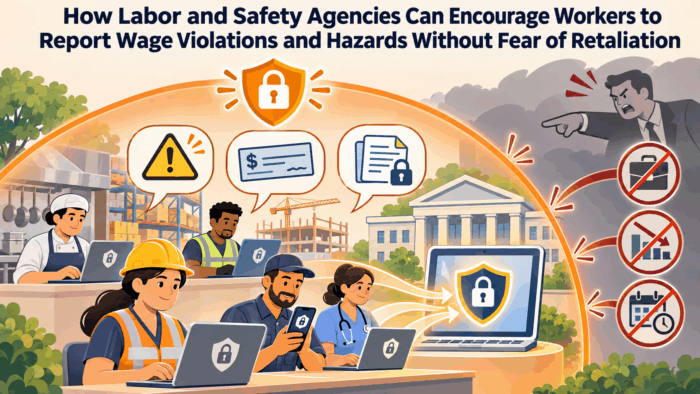
How Labor and Safety Agencies Can Encourage Workers to Report Wage Violations and Hazards Without Fear of Retaliation
Workers cannot benefit from labor standards and workplace safety protections if they are too afraid to raise concerns. A worker may recognize that wages are missing, conditions are unsafe, or an employer is ignoring a workplace requirement and still decide that reporting the problem creates too much personal risk. Fear of losing hours, being disciplined, being assigned worse shifts, losing a job, damaging future employment prospects, or being singled out by a supervisor can be powerful enough to prevent workers from contacting an agency even when they believe something is wrong.
For labor and safety agencies, this makes retaliation communication a core access issue rather than a narrow legal topic. Agencies may have complaint systems, enforcement authority, multilingual resources, and public education materials, but those systems will remain underused if workers do not believe they can engage safely. Communication must therefore address the questions workers are likely to ask before they ever file a complaint, including what happens after contact, what information may be requested, how retaliation concerns can be raised, and what the agency can realistically do if a worker believes adverse action followed protected activity.
The challenge is especially significant for workers who have limited economic flexibility or weak connections to formal support systems. Low-wage workers, temporary workers, immigrant workers, workers with limited English proficiency, young workers, and workers in industries with high turnover may perceive even a small employment consequence as serious. Agencies should avoid assuming that workers remain silent because they do not know their rights. In many cases, workers may understand the problem but believe reporting it could make their situation worse.
Effective communication should reduce uncertainty without making promises that the agency cannot guarantee. Workers need clear, practical explanations of retaliation protections, reporting options, confidentiality limits, documentation, timelines, and the agency’s role. When labor and safety agencies communicate these issues consistently across websites, outreach, call centers, field staff, partners, and complaint systems, they can make reporting feel more understandable and less intimidating while preserving accuracy and legal boundaries.
Treat Fear of Retaliation as a Barrier to Access
 Retaliation concerns should be treated as part of the agency’s overall access strategy because fear can prevent workers from using protections that already exist. A worker may know that unpaid wages or an unsafe condition can be reported but still believe that speaking up will lead to reduced hours, dismissal, unfavorable assignments, or other consequences. If agency communication focuses only on the underlying right and ignores that fear, the message may fail at the point where the worker must decide whether to act.
Agencies should therefore include retaliation information within general worker education rather than isolating it in a technical page that workers encounter only after filing. A wage rights campaign can explain that workers may have protections when raising covered concerns, while workplace safety communication can show how retaliation questions fit into the broader reporting process. The objective is to make retaliation part of the normal explanation of how the system works.
This approach also helps agencies acknowledge the reality of worker decision-making. Reporting is not simply a matter of knowing where a form is located. Workers may weigh financial risk, workplace relationships, family responsibilities, transportation, immigration concerns, future references, and the likelihood that the problem will actually be addressed.
When agencies recognize those concerns directly, communication becomes more credible. Workers do not need exaggerated reassurance, but they do need evidence that the agency understands why reporting may feel risky and has designed its process with those concerns in mind.
Explain Retaliation in Practical, Recognizable Terms
The word “retaliation” may be familiar to agency staff but still feel abstract to workers. Public communication should explain the concept through recognizable workplace situations while remaining careful not to imply that every unfavorable employment action automatically establishes unlawful retaliation. Workers should understand that retaliation concerns can involve changes that occur after someone raises a covered issue, participates in a protected process, or exercises a right recognized by the applicable law.
Examples can help workers identify when additional questions may be warranted. Reduced hours, discipline, termination, reassignment, threats, undesirable scheduling, or other adverse treatment may be relevant depending on the circumstances and applicable protections. The agency should present examples as illustrations rather than definitive legal conclusions.
Agencies should also explain that retaliation can be a separate issue from the original wage or safety concern. A worker may have one process related to unpaid wages or hazardous conditions and another question about what happened after raising the concern. Understanding that distinction can help workers recognize why they may need to provide additional information.
Plain-language explanations should appear consistently across worker education materials, complaint pages, FAQs, outreach presentations, and call center guidance. When retaliation is described differently across channels, workers may become uncertain about whether their situation qualifies for help. Consistency strengthens both understanding and credibility.
Explain What Happens When a Worker Contacts the Agency
Fear is often intensified by uncertainty about what happens after contact. Workers may not know whether an employer will immediately be notified, whether their identity will be disclosed, whether they will need to provide documents, or whether contacting the agency automatically begins a formal investigation. Agencies should explain the general process as clearly as their legal and procedural framework allows.
Public communication can describe the difference between requesting information, submitting an inquiry, filing a complaint, and participating in an investigation where those distinctions exist. Workers should know whether they can ask general questions before making a formal submission and what information may be needed if they decide to proceed. This gives workers more control over the decision-making process.
The agency should also explain where confidentiality has limits. Broad promises such as “your employer will never know” can create serious trust problems if the actual process eventually requires disclosure of information. Workers are better served by a clear explanation of what the agency can keep confidential, what may need to be shared, and when those decisions are made.
Process transparency can reduce fear even when the process itself is complex. Workers may still decide not to proceed, but the decision will be based on clearer information rather than assumptions about what government contact automatically triggers.
Make Retaliation Information Visible Before a Complaint Begins
Workers should not have to navigate deep into a complaint process before learning about retaliation protections or reporting options. Agencies should place this information at the points where workers are most likely to hesitate, including complaint landing pages, wage rights information, workplace safety pages, outreach materials, and digital intake systems.
A short statement near the beginning of the process can acknowledge that workers may be concerned about consequences for speaking up. That statement can then link to more detailed information about applicable protections, reporting options, and agency procedures. Layering information in this way keeps the initial message accessible while preserving room for necessary detail.
Visibility is especially important for workers who may leave a page before completing a form. If retaliation guidance appears only after several screens of intake questions, the worker may never encounter the information needed to feel comfortable continuing. Important reassurance and process information should therefore appear before the highest-friction points.
The same principle applies offline. Posters, fact sheets, presentations, and community outreach should address retaliation alongside the underlying labor or safety right. Workers are more likely to remember that protection when it is presented as part of the overall reporting system rather than as a separate legal concept.
Build Confidentiality Communication Around Accuracy Rather Than Reassurance
Confidentiality is often one of the first questions workers ask when considering whether to report a problem. Agencies should answer it directly, but the explanation must reflect the actual program and process. Different investigations, complaint types, and legal frameworks may involve different confidentiality rules, so one broad statement may not be appropriate for every program.
Public-facing guidance should explain what information the agency generally collects, how it may be used, and whether there are circumstances in which identifying information may need to be disclosed. Workers should also know whether anonymous or confidential reporting options exist and what limitations those options may create for investigation or enforcement. This allows workers to make informed choices rather than relying on assumptions.
Agency staff should use the same language when responding to questions by phone or in person. A worker who hears one explanation from a website and another from a call center may become more concerned than before. Standardized confidentiality guidance can reduce that inconsistency.
Accurate communication may sometimes feel less reassuring than an absolute promise, but it is more trustworthy. Agencies build long-term credibility by explaining the process honestly and avoiding assurances that cannot be maintained in every case.
Create Multiple Reporting Entry Points
Workers differ in how comfortable they are contacting government, so agencies should provide more than one reasonable pathway for seeking information or reporting concerns. Options may include phone, online intake, written complaints, in-person assistance, community referrals, or other channels appropriate to the agency. Multiple pathways reduce the likelihood that one barrier prevents a worker from reaching the system entirely.
The entry points should connect to the same underlying guidance and referral structure. Workers should not receive substantially different explanations of retaliation or confidentiality depending on whether they call, use a website, or speak with an outreach representative. Channel choice should improve accessibility rather than create different versions of the agency’s rules.
Language access should be built into each pathway where feasible. A worker may be willing to report a concern but abandon the process if the only available form or phone menu is difficult to understand. Multilingual access can therefore be directly connected to whether workers feel safe enough to continue.
Agencies should also make clear when a channel is intended for general questions versus formal complaints. That distinction can help workers who want information before deciding whether to submit a case. Giving workers an understandable first step can reduce the pressure associated with immediate formal action.
Use Trusted Community Partners to Reinforce Accurate Reporting Information
Workers who fear retaliation may be more willing to discuss their concerns first with organizations they already know. Worker centers, unions, legal aid organizations, immigrant-serving groups, workforce programs, and other trusted community partners can help workers understand that labor and safety agencies exist and explain where official information can be found.
Partners should receive clear guidance about retaliation, confidentiality, reporting pathways, and agency boundaries. They should know how to explain general protections and how to connect a worker with the agency without promising that a particular case will result in enforcement or a specific remedy. This preserves the value of trust while keeping formal determinations within the agency.
Community partners can also help agencies identify recurring fears that official materials may not address. Workers may be worried about scheduling changes, employer threats, immigration-related consequences, blacklisting, or the effect of reporting on future employment. These concerns can inform stronger public communication even when the agency cannot control every risk workers perceive.
Partnerships are most effective when they are sustained rather than activated only during campaigns. Workers may need repeated exposure to accurate information before they feel comfortable seeking help. Trusted organizations can provide that continuity while directing workers back to authoritative agency resources when case-specific questions arise.
Prepare Front-Line Staff to Respond Consistently to Fear-Based Questions
Call center staff, investigators, inspectors, reception staff, outreach teams, and other front-line employees may be the first agency representatives to hear a worker say they are afraid to report. Their response can determine whether the worker continues or withdraws. Staff need practical guidance for addressing these concerns accurately and respectfully.
Training should cover the difference between explaining available protections and guaranteeing safety from all negative consequences. Staff should know how to describe confidentiality, retaliation procedures, escalation options, and referral pathways without making case-specific conclusions before the relevant facts have been reviewed. They should also know when a question requires consultation with specialized program staff.
Consistency matters because workers may contact the agency more than once before deciding what to do. Conflicting answers about confidentiality or retaliation can magnify uncertainty. Standard scripts, decision guidance, and escalation procedures can help staff provide a more reliable experience.
Front-line preparation should also recognize that workers may not initially use the word retaliation. They may say their hours were cut after speaking up or that a supervisor threatened them after they asked about pay. Staff should be able to recognize when those descriptions may warrant additional questions or referral to the appropriate process.
Separate Education From Guarantees About Outcomes
Labor and safety agencies should encourage workers to understand and use available reporting systems without implying that every report will result in a finding, remedy, citation, or investigation. Overpromising outcomes can damage credibility and may discourage future reporting when the process does not match expectations.
Public communication should explain what filing or reporting allows the agency to do. Depending on the program, that may include reviewing information, conducting intake, determining jurisdiction, requesting additional evidence, inspecting a workplace, or opening an investigation. The exact process should be described in general terms without predicting the result of a particular case.
The same discipline should apply to retaliation communication. Agencies can explain that retaliation concerns may be reportable and that applicable protections may exist, but they should avoid suggesting that every employment action occurring after a complaint will be found unlawful. Workers benefit from understanding both the protection and the process for evaluating it.
This distinction strengthens trust because the agency is encouraging reporting through transparency rather than certainty. Workers know what the agency can offer and what remains subject to review.
Make Reporting Easier Without Weakening Intake Quality
A complicated reporting process can reinforce fear by making workers feel that they must build a legal case before the agency will listen. Intake should collect the information necessary for the program while avoiding unnecessary complexity at the entry point. Plain-language instructions can help workers understand what they need to provide and what can be clarified later.
Agencies should review whether forms require information that workers may not have readily available. If certain details are essential, the form can explain why they matter. If information can be provided later, the system should avoid making it appear that a worker cannot proceed without perfect documentation.
Reporting tools should also help workers describe both the original concern and any suspected retaliation. A worker may not know which details belong in which category, so guided questions can make the process easier to complete. The goal is to capture useful information without requiring the worker to understand the agency’s internal legal framework.
Simplifying intake does not mean lowering investigative standards. It means separating the initial act of seeking help from the more detailed evidence gathering that may follow. That distinction can make reporting more accessible while preserving the quality of the agency’s work.
Treat Reporting Confidence as a Communication Outcome
Labor and safety agencies often measure communication through page views, distributed materials, event attendance, or complaint volume. Those indicators can be useful, but they do not fully show whether workers feel able to use the reporting system. Agencies should also examine whether communication is reducing uncertainty about retaliation, confidentiality, and the complaint process.
Worker questions, call center patterns, outreach feedback, partner observations, and intake abandonment can all provide insight into where fear remains high. If workers repeatedly ask whether their employer will find out or whether they can be fired for contacting the agency, those questions signal a communication need even when the relevant protections already exist.
Agencies can use these patterns to improve public materials, staff guidance, outreach messages, and intake design. Clearer communication may not eliminate fear entirely, but it can reduce avoidable uncertainty and make workers better informed about their options.
Encouraging reporting therefore requires more than telling workers to speak up. It requires a communication system that explains protections, acknowledges risk, provides accessible entry points, and helps workers understand what will happen after they contact the agency. When that system is consistent and credible, workers are better positioned to make informed decisions about reporting wage violations and workplace hazards.
Build Reporting Communication Around the Worker’s Decision-Making Process
Workers rarely move directly from recognizing a problem to filing a complaint. They may first ask whether the issue is serious, whether someone else has experienced it, whether the employer will find out, whether they need proof, and whether the agency can actually help. Labor and safety agencies should design communication around this decision-making process rather than assuming that one rights notice or complaint link is enough.
The worker may need several different kinds of information before taking action. One message may explain the underlying wage or safety protection, another may address retaliation, and a third may clarify confidentiality or what happens after a report. These messages should connect clearly so the worker does not have to assemble the process from separate pages or programs.
Agencies can make the pathway more understandable by showing the progression from learning, to asking questions, to reporting, to participating in an investigation where applicable. This does not mean every worker must follow the same sequence. It means the agency should make each stage visible enough that workers can identify the next reasonable step without feeling forced into a process they do not understand.
Help Workers Understand What Information Is Useful Before They Report
Workers may delay reporting because they believe they need complete documentation before the agency will listen. They may assume they need every pay stub, photograph, schedule, witness statement, or written communication before contacting a labor or safety program. Agencies should explain what information is helpful while making clear that the initial reporting threshold may differ from the evidence eventually needed to investigate or resolve a matter.
Public guidance can identify common types of useful information in plain language. For a wage concern, this might include work dates, hours, pay records, schedules, or communications about compensation. For a safety concern, useful information may include descriptions of the hazard, when it occurs, where it is located, or whether supervisors have already been notified.
The communication should avoid turning a helpful checklist into a barrier. Workers who lack formal records should not automatically conclude that they cannot seek information or make a report. Agencies should distinguish between information that strengthens intake and information that is absolutely required under the applicable process.
Explain Timing Without Creating Unnecessary Panic
Workers may not know whether they need to report immediately, whether they can wait until they leave a job, or whether a delay could affect available options. Agencies should communicate timing carefully because deadlines and urgency can vary by law, program, and circumstance. Broad statements can create either false reassurance or unnecessary panic.
Public guidance should explain when immediate attention may be important, such as serious workplace hazards or rapidly changing conditions, while directing workers to the specific rules that govern filing periods where applicable. Agencies should avoid presenting one deadline as though it applies to every labor or safety matter. Clear program-specific information is more useful than generalized warnings.
Timing communication should also acknowledge that workers may need time to make a decision. Fear of retaliation can make immediate action difficult even when a worker recognizes the problem. Agencies can support informed decision-making by making relevant timelines easy to find and explaining what can happen at each stage.
Use Plain Language to Explain Confidentiality, Anonymity, and Disclosure
Workers may treat confidentiality and anonymity as the same concept, even when agency procedures distinguish between them. Public communication should explain those differences clearly. A report may be accepted without public disclosure of certain information in some circumstances, while another process may eventually require facts or identities to be shared.
Agencies should explain these distinctions in language that workers can understand before they submit information. Terms such as anonymous report, confidential information, protected identity, and disclosure should not appear without explanation. Workers need to know what each option means in practice and what limitations may accompany it.
This communication is particularly important for safety reporting, where anonymous or confidential pathways may exist but investigation needs can affect what the agency can verify. The same principle applies to wage enforcement when a worker expects complete secrecy throughout a process that may ultimately require employer participation. Accuracy at the beginning helps prevent distrust later.
Make Retaliation Reporting Easy to Recognize Within Existing Complaint Systems
Workers may report the original wage or safety problem without realizing that later treatment could raise a separate retaliation concern. Complaint systems should therefore make retaliation visible rather than requiring workers to know the correct legal category in advance. A worker should be able to describe what happened after speaking up and be guided toward the relevant process.
Intake forms can include plain-language prompts about changes in hours, discipline, threats, termination, reassignment, or other actions that occurred after the worker raised a concern. These questions should not imply that the agency has already determined that retaliation occurred. Their purpose is to help staff identify whether additional review may be needed.
Agencies should also explain how a worker can raise a retaliation concern after an original complaint has already been filed. Workers may not experience adverse treatment until days or weeks later. Clear instructions help prevent the worker from assuming that a closed or existing intake record means there is no way to report new conduct.
Prepare Inspectors and Investigators to Reinforce Reporting Confidence
Inspectors and investigators can influence whether workers feel comfortable providing information during enforcement activity. Workers may be hesitant to speak openly at a worksite if supervisors are nearby, coworkers can overhear, or they are uncertain whether their comments will be attributed to them. Agencies should prepare field staff to explain their role and communication process clearly.
Staff should know how to describe confidentiality, retaliation protections, and reporting pathways within the limits of the applicable program. They should also know how to respond when a worker asks whether speaking with the agency could affect their job. A vague or inconsistent answer can reinforce fear even when strong protections exist.
Field communication should be coordinated with public-facing guidance. Workers should hear the same basic explanation from an inspector that they saw on the agency website or received from a community partner. Consistency helps workers believe that the system is reliable rather than dependent on whom they happen to encounter.
Use Employer Communication to Reinforce Anti-Retaliation Expectations
Worker reporting communication should be supported by clear employer-facing messages. Employers should understand that workers may have protected rights to raise concerns, participate in investigations, or engage with labor and safety agencies under applicable law. Clear employer communication can reduce misunderstanding and reinforce expectations before a conflict arises.
Agencies can include retaliation information in compliance materials, inspection guidance, employer education, and post-investigation communication where relevant. This should explain general responsibilities without assuming that every employer action after a complaint is unlawful. Employers benefit from knowing what types of conduct may create additional risk and where to obtain authoritative guidance.
Consistent messages to both workers and employers also strengthen agency neutrality. Workers hear that retaliation concerns can be reported, while employers hear the same explanation of applicable expectations and process. The agency remains focused on fair enforcement rather than appearing to communicate only with one side.
Address Reporting Barriers in Small and Close-Knit Workplaces
Fear of retaliation may be especially strong in small workplaces where employees believe it will be obvious who contacted the agency. A worker may be one of only a few people performing a particular task or may have already raised the concern directly with a supervisor. In these settings, general assurances about confidentiality may feel unrealistic to the worker.
Agencies should acknowledge this concern rather than relying on broad statements that may not reflect the worker’s experience. Communication can explain what confidentiality protections the agency can provide while also recognizing that workplace circumstances may make workers feel identifiable. This allows the agency to be honest without discouraging reporting.
Trusted community partners and general inquiry channels may be particularly important for these workers. They can provide a place to ask questions before deciding whether to proceed. The agency should ensure that workers can understand their options without having to expose themselves to a formal process immediately.
Strengthen Reporting Access for Workers With Limited English Proficiency
Workers may understand that retaliation is prohibited and still be unable to use the reporting system if language access is weak. Retaliation information, complaint instructions, confidentiality explanations, and follow-up communication should be accessible in the languages most relevant to the communities the agency serves.
Language access should extend beyond translated fact sheets. Workers may need interpretation during calls, interviews, inspections, or follow-up discussions. If those services are difficult to request or inconsistently available, the worker may decide that the process is too risky or difficult to continue.
Agencies should also review whether translated terminology accurately conveys the concepts involved. Literal translations of retaliation, protected activity, confidentiality, or adverse action may not be meaningful without plain-language explanation. Community partners can help identify where wording is technically correct but still difficult for workers to understand.
Use Community Partners to Support Workers Before and After Reporting
Trusted community organizations can help workers understand the process before they contact the agency and remain connected after a report has been made. Workers may need help interpreting agency correspondence, understanding the difference between an inquiry and an investigation, or knowing where to raise new concerns if workplace conditions change.
Partners should not become intermediaries for every case, but they can help workers stay engaged with the process. Agencies can provide partners with general guidance about what workers may expect after reporting and where to direct questions that require official answers. This can be especially valuable for workers who are unfamiliar with administrative processes.
The agency should also protect direct communication with the worker. Partners can support access, but workers should not need a third party to receive official information or participate in a case. The strongest model combines trusted support with a clear, direct relationship between the worker and the agency.
Monitor Where Workers Abandon the Reporting Process
A worker may begin a complaint and stop before submitting it, call for information but never follow through, or repeatedly visit a retaliation page without completing intake. These patterns can reveal barriers that complaint counts alone do not capture. Agencies should examine where workers appear to disengage from the reporting pathway.
Abandonment may reflect confusing forms, unclear confidentiality language, excessive documentation requirements, language barriers, or uncertainty about what happens next. Digital analytics, call center feedback, partner observations, and user testing can help identify these friction points. The agency should treat them as service design problems rather than assuming that workers simply changed their minds.
Improvements can then be targeted to the point where hesitation is greatest. A clearer explanation, shorter initial form, better language access, or stronger process overview may help more workers complete the pathway. Measuring abandonment can therefore provide a valuable complement to traditional complaint statistics.
Build Reporting Confidence Through Consistency Over Time
Workers are more likely to trust a reporting system when they encounter the same core message repeatedly. Retaliation protections, confidentiality limits, reporting options, and agency processes should be explained consistently across websites, field staff, community partners, employer education, and public campaigns.
Consistency does not require identical wording in every format. A social media post may be brief while a complaint page provides detailed guidance, but the underlying explanation should not change. Workers should not receive contradictory messages about whether they can ask questions, how confidentiality works, or where retaliation concerns belong.
Over time, consistent communication helps establish the agency as a predictable source of information. That predictability can be especially important for workers who are deciding whether government contact is worth the perceived risk. Reporting confidence grows when the agency repeatedly demonstrates that its process is understandable, accessible, and transparent.
Explain How Reporting Pathways Differ Across Wage, Safety, and Retaliation Concerns
Workers may experience several workplace problems at once but still need to use different reporting pathways. A worker could be missing wages, exposed to an unsafe condition, and worried that a supervisor is punishing them for speaking up. If the agency does not explain how those concerns relate to one another, the worker may assume that a single complaint automatically covers everything.
Labor and safety agencies should make these distinctions visible without forcing workers to understand internal program structure. Public guidance can explain that wage, safety, and retaliation concerns may involve separate reviews, different staff, or different procedures depending on the applicable law and agency organization. The emphasis should remain on helping the worker identify the right starting point rather than memorizing program names.
Agencies should also explain whether information submitted through one process is automatically shared with another. Workers may assume that raising a safety concern means retaliation allegations are already part of the record or that a wage complaint automatically alerts another program. Clear communication helps prevent situations in which a worker believes an issue has been reported when the appropriate program has never actually received it.
Help Workers Understand the Difference Between Immediate Danger and Longer-Term Violations
 Not every workplace problem requires the same level of urgency. Some safety concerns may involve an immediate or serious hazard, while a wage issue may develop over multiple pay periods. Retaliation may emerge after a worker has already raised the original concern, which means communication should help workers recognize how urgency can differ across issues.
Agencies should provide clear guidance about when a worker should seek immediate assistance and when a standard complaint pathway may be appropriate. That guidance should remain general enough to avoid making legal conclusions before the facts are reviewed. The goal is to help workers understand that timing matters without creating unnecessary alarm.
This distinction is particularly important when workers are afraid of consequences for reporting. Someone may delay action because they are waiting for more evidence or hoping a supervisor will fix the problem. Communication should make clear that workers can seek information before the situation becomes more serious and should not assume they must wait until every detail is documented.
Build Better Communication for Workers Who Fear Being Identified
Some workers may believe that an employer will immediately know who reported a problem, especially in small workplaces or highly specific job roles. Even where confidentiality protections exist, the worker may feel identifiable because only a few employees had access to the information being reported. Agencies should acknowledge this concern directly rather than relying on generic assurances.
Public guidance should distinguish between what the agency can control and what it cannot. The agency may be able to protect certain identifying information under applicable procedures, but it may not be able to guarantee that an employer will never infer who raised a concern. Workers should understand those limits before deciding how to proceed.
This type of transparency can strengthen trust because it respects the worker’s actual situation. A worker who hears an unrealistic promise may become more skeptical, while a worker who receives a clear explanation can make a more informed decision. Accurate communication is often more reassuring than overly broad assurances because it shows that the agency understands the complexity of the risk.
Create Communication for Workers Who Are Considering Reporting as a Group
Workers may sometimes feel safer raising concerns collectively rather than individually. Coworkers may share information about unpaid wages, hazardous conditions, scheduling practices, or other workplace issues and consider whether to approach the agency together. Labor and safety agencies should explain how group reporting may work where applicable without implying that collective action automatically changes the legal process.
Public guidance can clarify whether several workers may provide related information, whether each person needs to submit an individual complaint, or whether the agency may identify broader workplace patterns through multiple reports. The exact process will vary, but workers benefit from knowing that they do not always have to think about reporting only as a solitary act.
Communication should also address expectations about confidentiality and participation when several workers are involved. Workers may assume that joining a group eliminates individual risk, which may not be true. Clear process information helps workers understand both the potential benefits and the limits of collective reporting.
Prepare Agencies for Reporting Concerns From Temporary, Contract, and Contingent Workers
Workers in temporary, contract, subcontracted, staffing, or other contingent arrangements may be especially uncertain about who is responsible for workplace conditions. They may interact with more than one company, supervisor, or worksite and may not know which entity is relevant to a wage or safety concern. This uncertainty can make reporting feel even more complicated when retaliation is also feared.
Agency communication should help these workers describe the work arrangement without requiring them to determine legal responsibility on their own. Intake can ask practical questions about who assigns work, who pays wages, where the work occurs, and who supervises daily tasks. Staff can then evaluate which relationships matter under the applicable program.
The agency should also avoid assuming that workers know the terminology used to describe their employment arrangement. A person may not know whether they are technically classified as a temporary employee, contractor, or another category. Plain-language intake reduces the risk that confusion about status becomes another barrier to reporting.
Strengthen Communication for Workers Who Have Already Left the Job
Some workers may wait until they are no longer employed before reporting a wage violation, safety concern, or suspected retaliation. Leaving the workplace may reduce immediate fear, but it can create new uncertainty about whether the agency can still help. Workers may assume that resigning or being terminated means the issue is now too old or no longer relevant.
Agencies should explain whether former workers can still seek information or file complaints under applicable rules. Where deadlines apply, those timelines should be visible and program-specific. Workers should not have to guess whether leaving a job ends their ability to raise a concern.
Communication should also address what information former workers may still be able to provide. Records, schedules, messages, photographs, coworker names, or other documentation may remain useful even after employment ends. Explaining this can help workers understand that separation from the workplace does not necessarily eliminate the value of their information.
Explain What Workers Can Expect During an Investigation or Inspection
Workers may hesitate to report because they do not know what participation will require after the initial complaint. They may wonder whether they will need to be interviewed, provide documents, speak during work hours, appear at a hearing, or continue communicating with the agency over an extended period. Agencies should provide a general overview of what participation may involve.
The explanation should remain flexible because processes differ across programs and cases. Workers should understand that some matters may require follow-up questions or additional evidence, while others may involve inspections or broader investigation. The goal is to reduce uncertainty rather than predict every procedural step.
Agencies should also explain how workers will receive updates where the process allows. Long periods of silence can make workers believe that nothing is happening or that their report was ignored. Even when detailed case information cannot be shared, basic expectations about communication can improve confidence in the process.
Build Communication for Situations Where the Employer Responds Quickly
An employer may change scheduling, pay disputed wages, correct a hazard, or take other action soon after learning that a worker raised a concern. Workers may then be uncertain whether they should continue with the agency process. They may believe that the problem has been resolved or worry that proceeding will increase tension at work.
Agencies should explain that corrective action and formal review are not necessarily the same thing. Depending on the circumstances, a worker may still need to provide information so the agency can determine whether further action is appropriate. Communication should avoid telling workers that every corrected issue must remain open or that every correction ends the matter.
This is another area where retaliation concerns may arise. A worker may interpret a sudden schedule change, apology, repayment, or reassignment in different ways. The agency should encourage workers to describe what happened rather than requiring them to decide whether the response was legally significant.
Prepare Communication for Situations Where Retaliation Appears Gradually
Retaliation may not always occur as one obvious event. Workers may describe a pattern of reduced hours, undesirable assignments, increased scrutiny, exclusion, or repeated disciplinary actions over time. These situations can be difficult for workers to interpret because no single event may seem severe enough to report.
Agencies should explain that workers can raise concerns about patterns and provide context about when changes began. Public guidance can encourage workers to preserve relevant records or notes without implying that personal documentation alone proves retaliation. The agency can then evaluate the information within the applicable legal framework.
This type of communication is particularly important because workers may wait until the situation becomes intolerable before seeking help. Clearer guidance can help them recognize that they do not need to understand the legal significance of every event before contacting the agency. They can describe what changed and allow the appropriate program to determine whether additional review is warranted.
Use Employer Education to Reduce Misunderstanding About Protected Reporting
Employers may not always recognize when a worker’s complaint, question, or participation in an agency process could be protected under applicable law. Supervisors may respond defensively to a report without understanding that their reaction could create a separate issue. Employer education can reduce these risks before a conflict escalates.
Agencies should include retaliation expectations in supervisor guidance, compliance education, inspection materials, and other employer-facing resources. The communication should explain that employees may have protected rights to raise covered concerns and participate in government processes. Employers should also know where to find authoritative information when they are uncertain about appropriate responses.
This communication should remain balanced and practical. The agency is not instructing employers to ignore legitimate performance or operational issues, nor is it suggesting that every employment action following a complaint is prohibited. It is helping employers recognize that timing, context, and applicable protections matter and that retaliation concerns can create additional regulatory risk.
Use Reporting Data to Identify Where Fear Remains Highest
Complaint volume alone does not show whether workers feel safe enough to report. Some industries or communities may generate very few complaints because workers face severe barriers, not because violations are uncommon. Agencies should therefore compare reporting patterns with outreach feedback, enforcement experience, language access data, and other available information.
Recurring questions about confidentiality, employer notification, job loss, or immigration-related consequences can also reveal where fear remains strong. These questions should be tracked as communication indicators rather than treated only as individual inquiries. Patterns can help agencies identify which audiences need clearer information or stronger referral support.
The agency should be careful not to interpret low reporting as proof of successful compliance. Silence can reflect many different conditions. A broader set of indicators provides a more realistic view of whether workers feel able to access the system.
Treat Retaliation Communication as an Ongoing System Rather Than a Campaign
Encouraging workers to report without fear cannot be achieved through one poster, one enforcement announcement, or one annual outreach effort. Workers need consistent information before a problem occurs, while they are considering reporting, during the complaint process, and if workplace conditions change afterward. The communication system must support each of those stages.
This requires coordination across labor standards, workplace safety, retaliation programs, communications teams, call centers, field staff, language access functions, and community partners. Each group should understand the core messages and know where workers should be referred when questions exceed their role.
A mature system also learns from worker behavior. Abandoned forms, repeated questions, partner feedback, staff observations, and misrouted complaints can all reveal where fear or confusion is still affecting access. Agencies can use that information to improve reporting pathways over time.
When retaliation communication is treated as permanent infrastructure, agencies move beyond simply telling workers to speak up. They create a more credible environment in which workers can understand their options, anticipate what happens next, and make informed decisions about reporting wage violations and workplace hazards.
Build Agency-Wide Governance for Retaliation Communication
Retaliation communication should not depend on individual programs developing their own explanations independently. Wage enforcement, workplace safety, complaint intake, field operations, legal staff, communications teams, and call centers may all address retaliation in different contexts. Without coordination, workers can receive inconsistent information about confidentiality, protected activity, reporting options, and what happens after they raise a concern.
Agencies should establish clear ownership for core retaliation messages and determine which functions are responsible for reviewing and updating them. Program staff may provide substantive expertise, legal staff may identify important boundaries, communications staff may translate those concepts into public-facing language, and front-line employees may identify recurring areas of confusion. A shared governance process helps each perspective inform the final communication system.
Governance should also define how changes are communicated across the agency. If a reporting process, form, contact point, or program responsibility changes, public materials and staff guidance should be updated together. Workers should not encounter one version of the process online and another when they call or speak with field staff.
Create a Standard Retaliation Communication Framework
Labor and safety agencies can improve consistency by developing a standard framework for how retaliation is explained across programs. The framework should address the underlying right or protected activity, examples of conduct that may raise concerns, available reporting pathways, confidentiality considerations, and what workers can generally expect after contacting the agency.
The framework should be detailed enough to guide staff while remaining flexible enough to accommodate differences among wage, safety, and other labor programs. Not every statute or process will use the same definitions or procedures, so the agency should avoid forcing artificial uniformity. The purpose is to standardize the communication structure while preserving program-specific accuracy.
A shared framework can support websites, FAQs, complaint forms, outreach materials, call scripts, training, and partner toolkits. When these channels draw from the same underlying source, workers are more likely to receive consistent guidance regardless of how they enter the system.
Integrate Retaliation Guidance Into Complaint and Intake Systems
Retaliation communication should be embedded within the systems workers actually use to report concerns. Intake forms, online portals, phone scripts, and in-person processes should help workers identify whether something happened after they raised a wage or safety concern. Workers should not need to understand the legal term before the agency can recognize the issue.
Digital and paper forms can use plain-language prompts about reduced hours, discipline, threats, termination, reassignment, or other changes after protected activity. These questions should help staff gather relevant information without suggesting that retaliation has already been established. Guided intake can make the process easier while preserving formal review.
The system should also make it possible to add retaliation information after an original complaint has already been filed. Workers may experience adverse treatment later, and they should know how to report new developments. Clear pathways prevent workers from assuming that their opportunity to raise retaliation ended with the initial submission.
Develop Consistent Confidentiality and Disclosure Guidance
Confidentiality communication is one of the most sensitive parts of retaliation reporting and should be managed carefully. Agencies should establish approved explanations that reflect the actual rules and procedures of each program. Staff should know what can be said confidently and where the answer depends on the specifics of a case.
Public guidance should distinguish among anonymity, confidentiality, protected information, and circumstances in which information may need to be disclosed. Workers should also understand whether choosing a particular reporting option may affect what the agency can investigate or verify. These distinctions should be explained in plain language rather than through technical legal terminology alone.
Version control is important because outdated confidentiality language can create serious trust problems. If a form or process changes, related web content, scripts, outreach materials, and partner guidance should be updated together. Workers should not be asked to rely on promises that no longer match the current process.
Build Clear Escalation Procedures for Difficult Retaliation Questions
Front-line employees will encounter questions that cannot be answered through standard scripts. A worker may ask whether a specific employment action is retaliation, whether an employer can identify them, or whether a particular form of workplace pressure is covered. Staff should have a clear escalation pathway rather than guessing or giving overly broad answers.
Agencies can identify which questions should be referred to specialized program staff, supervisors, or legal personnel. The escalation process should be efficient enough that workers are not repeatedly transferred or told to call back without direction. A well-designed internal handoff can preserve accuracy without making the worker navigate internal agency structure.
Staff should also be trained to distinguish between general process information and case-specific conclusions. They can explain how the agency reviews retaliation concerns without deciding the outcome during an initial call. This boundary protects both the worker and the integrity of the agency’s enforcement process.
Prepare Supervisors and Managers to Support Consistent Front-Line Communication
Supervisors play an important role in maintaining communication quality because they are often the first people staff consult when a worker asks a difficult question. They should understand the agency’s approved retaliation messages, confidentiality guidance, referral pathways, and escalation procedures. Their responses can either reinforce consistency or create another version of the process.
Manager training should include realistic scenarios involving wage complaints, safety concerns, employer threats, schedule changes, and requests for confidentiality. The objective is not to make supervisors legal decision-makers but to help them coach staff through difficult communication situations. Consistent supervisory guidance can significantly reduce variation across offices.
Managers can also identify patterns that warrant broader action. If staff repeatedly escalate the same question, the problem may not be individual uncertainty but unclear public guidance. Those patterns should feed back into the agency’s communication improvement process.
Coordinate Worker and Employer Retaliation Communication
Worker-facing and employer-facing communication should be developed together so both audiences receive a coherent explanation of agency expectations. Workers need to understand that they may have protections when raising covered concerns, while employers need to understand that certain responses to protected activity may create additional issues. These messages should reinforce each other without assuming the outcome of any specific dispute.
Employer materials can include retaliation guidance within compliance education, supervisor resources, inspection information, and post-enforcement communication where relevant. This helps organizations recognize that how they respond to a worker complaint can matter independently of the underlying wage or safety issue. Clear guidance may prevent avoidable escalation.
Coordinated communication also supports agency neutrality. The agency is not simply encouraging workers to complain or warning employers against taking any action. It is explaining the rights, responsibilities, and review process that apply to both sides.
Strengthen Coordination With Trusted Community Partners
Community organizations can reinforce agency retaliation messages, but they need current and precise information. Agencies should provide worker centers, unions, legal aid groups, immigrant-serving organizations, and other trusted partners with approved explanations of reporting pathways, confidentiality, retaliation concerns, and agency boundaries.
Partners should know when they can provide general education and when a worker should be connected directly with the agency. They should also understand that they should not guarantee confidentiality, enforcement, reinstatement, recovery, or any other outcome unless the agency’s actual process supports such a statement. Clear partner guidance protects workers from unrealistic expectations.
Agencies should maintain regular communication with these organizations rather than sending materials only during campaigns. Partners often hear about emerging fears and misconceptions before agency staff do. Their feedback can help identify where official retaliation communication is not reaching workers effectively.
Establish Quality Control Across Languages and Formats
Retaliation messages may appear in translated fact sheets, videos, web pages, social media posts, call scripts, presentations, and complaint instructions. Agencies should establish quality standards that ensure the meaning remains consistent across these formats. A short outreach message can be simpler than a legal FAQ, but it should not contradict the more detailed guidance.
Translation quality is particularly important because concepts such as protected activity, confidentiality, adverse action, and retaliation may not have simple one-to-one equivalents in every language. Agencies should combine accurate translation with plain-language review so workers can understand the practical meaning. Community feedback can help identify wording that is technically correct but still confusing.
Updates should be coordinated across languages whenever possible. If English guidance changes first and translated resources remain outdated for months, workers receive unequal access to current information. Strong quality control protects both accuracy and equity.
Use Data to Identify Where Reporting Barriers Persist
Agencies should monitor more than complaint volume when evaluating whether workers feel able to report. Repeated questions about confidentiality, high abandonment rates on complaint forms, partner reports of worker hesitation, or unusual differences across languages or industries can all signal persistent barriers. These patterns should be reviewed as communication data.
Misrouted complaints can also reveal confusion about where retaliation belongs. Workers may report retaliation through a wage form, safety line, or general inquiry because they do not know which program handles it. Tracking these patterns can help agencies improve routing and public explanations.
The purpose of measurement is not to create a single retaliation confidence score. It is to identify where communication is failing and where adjustments may reduce uncertainty. Agencies can then test changes in forms, scripts, web content, outreach, and staff training.
Preserve Institutional Knowledge About Reporting and Retaliation
Experienced staff often develop a practical understanding of the questions workers ask, the situations that create confusion, and the language that helps explain difficult concepts. Agencies should document that knowledge rather than allowing it to remain informal. Turnover can otherwise erase years of communication experience.
Frequently asked questions, escalation records, training scenarios, partner feedback, and intake observations can all contribute to an internal knowledge base. This material can help new employees understand not only the rules but also how workers experience the reporting process.
Documenting institutional knowledge also makes future revisions more strategic. Staff can see why certain messages or procedures were created and which problems they were designed to solve. That context helps prevent the agency from unintentionally reintroducing barriers that were previously addressed.
Make Reporting Confidence a Long-Term Leadership Priority
Leadership should treat worker confidence in reporting as part of agency effectiveness. Wage and safety protections are harder to enforce when workers do not feel able to raise concerns, and communication is one factor that can either reduce or reinforce that hesitation. Reporting access therefore deserves sustained attention beyond individual outreach campaigns.
Leaders can require regular review of retaliation messages, complaint pathways, confidentiality guidance, language access, staff training, partner systems, and reporting barriers. They can also ensure that operational changes trigger communication updates instead of leaving outdated explanations in circulation. This makes reporting confidence part of routine agency management.
A mature retaliation communication system does not promise that workers will never feel afraid or that every complaint will produce a particular outcome. It gives workers accurate information, understandable pathways, consistent support, and clear expectations about what happens after they speak up. That foundation makes it more likely that workers can make informed decisions about reporting wage violations and workplace hazards.
Strategic Communication Support for Worker Reporting and Retaliation Concerns
 Labor and safety agencies that want workers to report wage violations and workplace hazards need more than a complaint form and a statement that retaliation is prohibited. They need a communication system that explains worker protections, reporting options, confidentiality limits, investigative processes, language access, and follow-up expectations in a way that workers can understand before fear prevents them from acting. That system should also align websites, call centers, inspectors, investigators, community partners, and employer-facing communication so workers receive the same core message regardless of where they enter the process.
Stegmeier Consulting Group (SCG) can support labor and safety agencies by developing retaliation communication frameworks, reporting pathway maps, worker education materials, plain-language complaint guidance, multilingual outreach strategies, call center scripts, front-line staff tools, community partner toolkits, employer communication resources, and measurement approaches for identifying reporting barriers. SCG can also review existing intake systems, websites, FAQs, and outreach materials to identify where unclear confidentiality language, inconsistent terminology, or complicated reporting instructions may be discouraging workers from proceeding.
External strategic communication support can be particularly valuable when multiple programs share responsibility for wage, safety, retaliation, and complaint intake functions. A coordinated review can help agencies identify where workers are being misrouted, where staff are providing inconsistent explanations, and where communication is unintentionally creating expectations the agency cannot guarantee. The objective is to make the reporting system easier to understand without oversimplifying the legal or procedural distinctions that govern different types of complaints.
SCG’s role remains focused on communication strategy, public information, stakeholder engagement, internal alignment, reporting-system communication, language access, and measurement. SCG does not provide legal advice, determine whether retaliation or another labor violation occurred, conduct investigations or inspections, make enforcement decisions, adjudicate disputes, or replace agency counsel or other authorized professionals. Strategic communication support helps agencies explain their systems more clearly while preserving the agency’s responsibility for legal interpretation, investigation, enforcement, and case-specific determinations.
Future Trends
Worker reporting systems are likely to become more digitally integrated, with complaint portals, mobile access, multilingual interfaces, guided intake, and automated navigation playing a larger role in how workers first contact agencies. These tools can reduce friction, but they can also create new communication challenges if workers do not understand what information is being collected, how it may be used, or whether submitting an online inquiry begins a formal process. Agencies will need to pair digital convenience with stronger transparency.
Retaliation communication will also need to become more proactive. Workers increasingly encounter labor rights information through social media, community organizations, messaging platforms, and peer networks before they ever reach an official government website. Agencies that provide clear, reusable, and multilingual retaliation guidance will be better positioned to keep accurate information circulating through those channels.
The distinction between worker education and case-specific advice will remain important as agencies expand digital tools. Guided forms and automated assistants may help users understand reporting pathways, but they should not create the impression that a legal determination has already been made. Strong governance and clear boundaries will become increasingly important as technology plays a larger role in intake and public communication.
The broader trend will be toward treating reporting confidence as part of agency service design. Agencies will increasingly need to evaluate not only whether reporting mechanisms exist but whether workers can find them, understand them, trust them, and complete them without unnecessary barriers. Retaliation communication, confidentiality guidance, language access, and process transparency will become central components of that assessment.
Conclusion
Workers may recognize a wage violation or workplace hazard and still decide not to report it if they believe speaking up could cost them hours, income, employment, or standing with a supervisor. Fear of retaliation can therefore weaken the practical effectiveness of labor and safety protections even when strong enforcement systems exist. Agencies must address that fear directly through communication that is accurate, visible, consistent, and connected to the reporting process.
Effective communication begins before a complaint is filed. Workers need to understand what retaliation may look like, what protections may apply, how confidentiality works, what information is useful, and what happens after they contact the agency. They also need clear pathways for raising new concerns if workplace treatment changes after an initial report.
The strongest systems coordinate these messages across worker education, employer guidance, call centers, field staff, community partners, intake tools, and multilingual resources. When those channels reinforce one another, workers are more likely to encounter a predictable and understandable process. Consistency also protects agency credibility by reducing contradictory explanations and unrealistic expectations.
Encouraging workers to report without fear does not mean promising that reporting will be risk-free or that every complaint will produce a particular outcome. It means giving workers enough accurate information to understand their options and make informed decisions. When agencies build that communication infrastructure deliberately, reporting becomes more accessible, transparent, and credible.
Stegmeier Consulting Group’s Strategic Approach to Communication Systems
Build reporting systems that make retaliation protections, confidentiality, and next steps easier for workers to understand before fear prevents them from acting.
Labor and safety agencies need communication systems that connect worker education, complaint intake, language access, front-line guidance, community outreach, employer communication, and retaliation information into one clear reporting experience. Stegmeier Consulting Group (SCG) helps agencies develop reporting pathway frameworks, retaliation messaging, plain-language guidance, staff tools, partner resources, multilingual communication systems, governance processes, and measurement approaches that reduce uncertainty while preserving the agency’s legal and enforcement responsibilities.
Use the form below to connect with our team and explore how strategic communication support can strengthen worker reporting confidence, retaliation communication, complaint pathways, confidentiality guidance, and access to labor and workplace safety services.