How Labor Agencies Can Reach Low-Wage, Immigrant, and Limited English Proficient Workers Through Trusted Community Partners
Labor agencies often face their greatest communication challenges among workers who are least likely to seek information directly from the government. Low-wage workers may have limited time, unstable schedules, or little familiarity with labor standards systems. Immigrant workers may be uncertain about which government agencies are responsible for workplace protections, while workers with limited English proficiency may struggle to locate or interpret agency information even when the underlying rights apply to them. These barriers can prevent people from recognizing a workplace problem, understanding available protections, or knowing where to seek help before a violation becomes more serious.
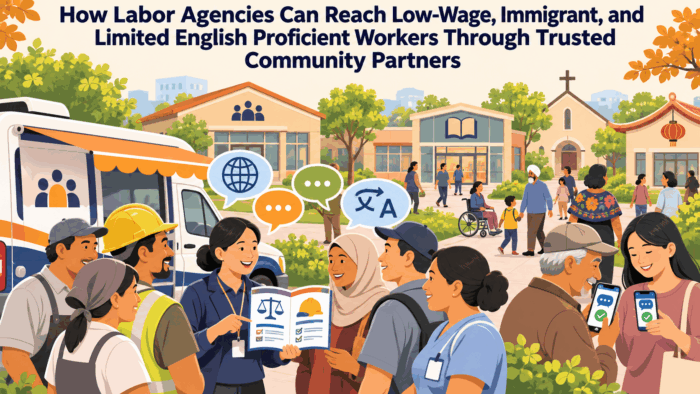
Traditional government communication channels are not always enough to overcome these obstacles. A well-designed agency website, social media account, or complaint portal is useful only if workers know the agency exists, trust the information, can understand it, and have enough confidence to engage. Some workers are much more likely to encounter workplace information through organizations they already know, such as worker centers, community-based organizations, legal aid providers, unions, faith-based groups, libraries, workforce programs, immigrant-serving organizations, or other trusted institutions.
Trusted community partners can therefore become an important extension of labor agency communication, but the relationship must be structured carefully. Partners can help distribute accurate information, explain where the agency fits within the broader employment system, identify recurring barriers, and connect workers with official resources. They should not be expected to make legal determinations, promise enforcement outcomes, or replace the agency’s responsibility to provide authoritative information and accessible services.
A strong partner strategy combines reach, trust, language access, and clear institutional boundaries. Labor agencies should identify which communities they are not reaching effectively, select partners based on the audiences they actually serve, provide current and usable materials, and create referral systems that make it easier for workers to move from community-based information to direct agency assistance. When these relationships are maintained year-round rather than activated only during major campaigns, they can improve worker awareness long before a complaint becomes the first meaningful contact with the labor standards system.
Understand Why Traditional Agency Communication May Not Reach Every Worker
 Labor agencies should begin by recognizing that communication barriers are not limited to language. A worker may understand English well enough for everyday conversation but still find legal terminology, online forms, agency acronyms, or procedural instructions difficult to interpret. Others may have limited digital access, work long or irregular hours, move frequently among employers, or have little experience navigating public institutions. These practical barriers can make even accurate communication inaccessible.
Trust is another important factor. Workers may hesitate to contact a government agency because they are uncertain about what information will be requested, whether an employer will learn that they sought help, or whether contacting the agency could create other consequences. The agency should not assume that lack of engagement means lack of interest in workplace protections. In many cases, workers need a clearer understanding of what the agency does, what it does not do, and what happens after contact.
Information may also compete with workplace norms and informal advice. A worker may rely on a supervisor, coworker, family member, community leader, or social media source to understand whether a practice is normal. If that informal explanation conflicts with agency guidance, the worker may never know that an authoritative public resource exists.
This is why communication planning should begin with the worker’s actual information environment. Agencies need to understand where workers hear about rights, whom they trust, what language they use to describe workplace problems, and what barriers prevent them from moving from awareness to action. Trusted community partners can help provide that understanding while also serving as a bridge to official information.
Select Partners Based on Reach, Trust, and Communication Function
Not every community organization is equally positioned to support labor standards outreach, and agencies should avoid building partnerships based only on familiarity or visibility. The strongest partners are those that already have sustained relationships with the workers the agency is trying to reach. They may provide legal services, workforce support, language assistance, community education, food assistance, housing support, or other services that create regular contact with workers.
Partner selection should also consider what communication function the organization can realistically perform. Some partners may be effective at distributing materials, while others can host workshops, provide interpretation support, identify recurring worker questions, or make referrals to agency programs. An organization does not need to perform every function to be valuable, but the agency should be clear about why the relationship exists.
Geography, industry, language, and work arrangement should also influence partner selection. A broad citywide organization may be useful for general outreach, while a smaller organization may have much stronger relationships within a particular immigrant community or industry. Agencies should map these differences rather than assuming that one well-known partner provides access to every worker population.
The goal is to build a network that reflects actual communication gaps. Partner selection should be tied to identifiable needs such as language access, geographic reach, industry concentration, trust, or limited contact with traditional government channels. This makes the network more strategic and easier to explain internally and publicly.
Build Language Access Into the Partnership From the Beginning
Language access should not be added after the agency has already developed the outreach campaign. If workers with limited English proficiency are a priority audience, translation, interpretation, terminology, and distribution should be considered during initial planning. This helps ensure that the agency is not simply translating an English-language message that was designed for a different audience and communication context.
Partners can help agencies identify which languages are most important, which terminology workers recognize, and where literal translation may not produce meaningful understanding. Community organizations may also know whether workers prefer written materials, audio, video, live presentations, messaging apps, or other formats. Their insight can improve accessibility without transferring responsibility for official interpretation away from the agency.
The agency should still maintain control over authoritative content. Translations and adapted materials should reflect the same current legal and procedural information available in English, and updates should occur together whenever possible. Allowing unofficial translated versions to circulate without coordination can create different levels of access to current information.
Language access should also extend to the referral process. A worker may understand a translated fact sheet but still encounter an English-only complaint page or phone menu when trying to seek help. Partner-based communication is most effective when the full pathway from awareness to agency contact is accessible.
Give Community Partners Clear and Usable Rights Education Materials
Partners are more effective when the agency gives them materials designed for distribution rather than expecting them to interpret dense regulatory guidance. Toolkits can include short rights explanations, common workplace examples, referral instructions, translated materials, presentation slides, social media language, and links to authoritative agency pages. These resources should be simple enough to use in community settings while still preserving important legal distinctions.
The agency should organize materials around recognizable workplace situations rather than relying only on statutory terminology. Workers may respond more readily to information about missing pay, unsafe conditions, retaliation concerns, or unexplained deductions than to a campaign centered on formal program titles. Partners can then help workers connect those situations to the relevant agency resources.
Materials should also explain what the agency can and cannot promise. Workers need to understand that raising a concern does not automatically establish a violation and that the agency may need to review facts before determining what process applies. This protects accuracy while still encouraging people to seek authoritative information.
Version control is essential because community materials can remain in circulation long after a campaign ends. Agencies should include revision dates, maintain a central source for current resources, and notify partners when older materials should no longer be used. Trusted distribution loses value if workers receive outdated guidance from organizations they rely on.
Create Referral Pathways That Move Workers From Trusted Partners to the Agency
A community partnership becomes most valuable when it helps workers move from general awareness to direct access when necessary. Agencies should create clear referral pathways so partners know where to send workers with wage concerns, safety complaints, retaliation questions, or other issues within the agency’s authority. A referral should not depend on the partner knowing every legal distinction.
The agency should also give partners a general entry point for situations that are unclear or involve multiple issues. Workers may describe several concerns at once, and a community organization should not be expected to determine jurisdiction. A central call line, general inquiry process, or guided intake system can allow the agency to absorb that complexity.
Warm referrals can be useful in high-barrier situations. Where operationally appropriate, a partner may help a worker identify the correct office, explain what to expect, or connect with interpretation assistance. The goal is to reduce the number of times the worker must explain the same problem before reaching the right program.
Direct access should always remain available. Workers should not need to belong to a partner organization or be referred by a trusted intermediary before receiving agency assistance. Partnerships should expand access to government, not create new gatekeepers.
Build Trust by Explaining the Agency’s Role and Boundaries Clearly
Trusted partners can help introduce labor agencies to workers who may have little familiarity with government, but the agency still needs to explain its own role. Workers should understand what the agency enforces, what it does not handle, what information it may request, and what process generally follows after contact. Uncertainty about these basic questions can prevent people from taking the next step even when they understand their rights.
Communication should also address confidentiality and retaliation carefully. Workers may want to know whether an employer will learn that they contacted the agency and what protections may apply if they raise a concern. Agencies should provide accurate, program-specific explanations rather than broad promises that may not apply in every situation.
Partners should receive the same guidance so they do not unintentionally overpromise. A worker center or community organization should not guarantee that the agency will maintain complete confidentiality, open an investigation, or produce a particular remedy unless the applicable process actually supports that conclusion. Trust is strengthened when the agency and partner give consistent information.
Clear boundaries also protect the partner relationship. Community organizations can remain advocates, educators, or service providers while the agency remains responsible for official interpretation, intake, investigation, and enforcement. Workers benefit when these roles are easy to distinguish.
Use Year-Round Partnerships Rather Than One-Time Outreach Campaigns
Short-term outreach can increase visibility temporarily, but it rarely creates the sustained familiarity needed to reach workers who are disconnected from government. Trusted relationships are built over time, and labor agencies should treat community partnerships as an ongoing communication system rather than as a list of organizations contacted only when a new campaign launches.
Year-round engagement can include regular updates, seasonal rights information, training for partner staff, community presentations, translated materials, and periodic discussions about the questions workers are raising. This rhythm keeps the agency visible even when there is no major regulatory announcement or enforcement campaign underway.
Ongoing relationships also improve communication quality. Partners can identify where workers remain confused, which materials are difficult to use, and whether new workplace issues are emerging. The agency can then adjust its education and referral systems based on actual community experience.
Sustained engagement creates a stronger bridge between agency communication and worker behavior. Workers are more likely to recognize the agency as a legitimate source of help when they encounter its information repeatedly through organizations they already trust.
Protect Neutrality While Working With Advocacy Organizations
Many trusted community partners have missions that include advocacy, representation, or organizing. Worker centers may advocate for stronger labor protections, unions may represent employees in disputes, and legal aid organizations may assist workers in pursuing claims. These roles can coexist with agency partnership as long as the distinction between the partner’s position and the agency’s official role remains clear.
Agencies should provide partners with official materials and make clear which content represents agency guidance. Partners may add their own commentary or advocacy, but they should not present those views as though they are the agency’s position. This separation protects both institutional neutrality and the partner’s independence.
The agency should also use transparent criteria for selecting partners. Relationships should be based on audience reach, language capacity, community trust, geographic presence, or other legitimate communication needs rather than ideological alignment. A clear rationale makes the partnership network easier to defend if questions arise about favoritism.
Neutrality does not require the agency to avoid organizations that take strong positions. It requires the agency to maintain control over official interpretation and enforcement decisions while using community relationships to improve access. That distinction allows labor agencies to extend their reach without compromising regulatory credibility.
Use Partner Feedback to Identify Communication Barriers
Trusted partners can provide insight into worker experiences that may not appear in agency data. They may hear that workers are confused about whether a certain practice is lawful, afraid to file because of retaliation concerns, unable to complete a complaint form, or uncertain whether the agency serves people in their language. These observations can reveal barriers before they become visible through formal complaints.
Agencies should create a structured way to collect this feedback rather than relying entirely on informal conversations. Periodic partner meetings, short surveys, outreach debriefs, or designated communication contacts can help capture recurring themes. The agency should distinguish between individual anecdotes and patterns that suggest a broader communication problem.
Partner feedback should inform communication, not replace agency analysis. A community organization may correctly identify a confusing message, but it may also advocate for a policy position the agency does not share. Leadership should evaluate the information against legal authority, operational data, staff experience, and broader communication goals.
When used carefully, partner feedback becomes a form of institutional intelligence. It helps the agency understand why workers may not be finding or using services and where public communication needs to improve.
Measure Whether Partnerships Are Closing Access Gaps
The success of community partnerships should not be measured only by the number of organizations involved or materials distributed. Agencies should examine whether the relationships are helping workers who were previously difficult to reach understand their rights and connect with agency resources.
Useful indicators may include increased use of translated information, referrals from partner organizations, attendance at community education events, improved awareness of complaint pathways, or fewer recurring questions caused by basic jurisdictional confusion. Agencies may also examine whether particular geographic, language, or industry gaps remain despite extensive outreach.
These measures should be interpreted carefully. An increase in inquiries or complaints after outreach may indicate greater awareness rather than worsening conditions. The objective is to understand whether communication is changing access and recognition, not simply to increase activity counts.
Over time, measurement can help agencies strengthen the partner network, shift resources toward underserved communities, and identify relationships that are producing meaningful public value. This makes trusted community engagement a measurable component of labor agency communication rather than an informal outreach practice.
Build Outreach Around the Places and Institutions Workers Already Use
Labor agencies can improve reach by identifying where priority worker populations already receive information, services, and support. Community organizations, workforce centers, libraries, schools, legal aid providers, worker centers, unions, faith-based organizations, and neighborhood groups may all serve as regular points of contact. Rather than expecting workers to seek out government communication independently, agencies can place accurate labor standards information within these existing networks.
The strongest outreach strategies recognize that trust is often attached to a relationship rather than to a channel. A worker may ignore a government social media post but pay attention when the same information is shared by an organization that has helped with housing, employment, language access, or other needs. Agencies should therefore think carefully about which partners are credible within different communities and why those relationships matter.
This approach also helps agencies avoid overreliance on large, well-known organizations that may not reach every subgroup. Smaller organizations may have deeper relationships with particular language communities, industries, neighborhoods, or worker populations. Mapping those differences allows agencies to create a more complete distribution system rather than assuming one partner can represent an entire community.
Match Communication Formats to How Workers Actually Receive Information
Written fact sheets and webpages remain important, but they should not be the only tools used in community outreach. Workers may be more likely to engage with short videos, live presentations, audio messages, text-based updates, community meetings, or brief social content. The format should reflect how the intended audience already communicates rather than requiring workers to adapt to government preferences.
Partners can help agencies understand which formats work best in different settings. A community group may know that workers respond well to messaging apps, while a workforce program may prefer printed handouts that can be distributed during appointments. Labor agencies can use this insight to adapt presentation and delivery while preserving the same underlying official message.
Format decisions should also account for complexity. A short video may be useful for introducing a right or explaining where to seek help, while a detailed webpage may be necessary for exceptions, definitions, or procedural information. The most effective approach uses simple formats as entry points and makes deeper guidance easy to access when workers need it.
Develop Community Partner Toolkits That Are Practical to Use
Trusted partners are more effective when agencies give them organized materials that can be used repeatedly rather than sending isolated links or documents. A partner toolkit can include short rights explanations, common workplace scenarios, referral guidance, translated materials, presentation slides, outreach messages, and links to current agency resources. The toolkit should make it easy for a community organization to communicate accurately without requiring staff to interpret complex labor law on their own.
Toolkits should also distinguish between what partners may explain and what should be referred back to the agency. A partner may be able to describe a general wage right or explain where a complaint can be filed, but it should not determine whether a violation occurred in a specific case. Clear boundaries help protect both the worker and the organization.
Agencies should build update procedures into the toolkit from the beginning. Materials should include revision dates or other version indicators, and partners should know how they will be notified when content changes. A toolkit becomes less useful if staff cannot determine whether the information is still current.
Train Partners to Recognize When a Worker Needs Direct Agency Assistance
Community partners frequently hear concerns before labor agencies do, which places them in an important referral role. They may hear about missing wages, unsafe conditions, retaliation, or other workplace issues during conversations that originally had nothing to do with labor standards. Training can help them recognize when a worker may benefit from direct contact with the agency.
The training should remain focused on recognition and referral rather than legal analysis. Partners should understand the major categories of issues the agency handles, what information may be helpful, and how to connect workers with the correct program. They should also know when a situation is too complex or ambiguous to route confidently.
This preparation can reduce delays in access. A worker who mentions a serious workplace concern during a community appointment may be connected with agency resources immediately rather than being told to search for help later. Early referral is especially valuable for workers who may otherwise hesitate to contact government on their own.
Create Clear Referral Pathways for Multilingual Workers
A referral is only useful if the worker can complete the next step in a language they understand. Agencies should make sure that translated outreach materials lead to accessible phone lines, forms, web pages, or interpretation services rather than into an English-only process. Otherwise, the communication pathway breaks at the point when the worker attempts to use the service.
Partners should know which language services are available and how workers can request them. If the agency uses interpretation services, multilingual call routing, translated forms, or designated language assistance contacts, these options should be included in partner guidance. Workers should not need to depend on the partner to interpret every future interaction.
Agencies should also review whether the referral process itself uses overly technical language. A translated form may still be difficult to understand if it is built around legal terminology that is unfamiliar even in the worker’s preferred language. Clear structure and plain language remain important across every translation.
Build Outreach Around Industries With Persistent Access Gaps
Some industries may require more targeted outreach because workers face recurring barriers related to language, turnover, scheduling, geographic isolation, or limited contact with government. Agencies can use complaint data, enforcement patterns, partner feedback, and workforce information to identify sectors where communication needs are especially significant.
Industry-specific outreach can use examples that reflect the actual work environment. Workers may be more likely to recognize a potential issue when information refers to scheduling, preparation time, travel, deductions, piece-rate work, seasonal employment, or other situations common in their sector. The examples should remain general enough to avoid implying that every employer in the industry is violating the law.
Trusted partners can also help agencies determine when and where outreach is most likely to reach workers. Evening events, weekend education, mobile outreach, or workplace-adjacent distribution may be more effective than standard business-hour communication. Matching outreach to the realities of the workforce increases the likelihood that information is actually encountered.
Address Fear and Uncertainty Before Asking Workers to Engage
Workers may understand that the agency can help and still hesitate to make contact. Fear of retaliation, uncertainty about confidentiality, unfamiliarity with government processes, or concern about possible consequences can become significant barriers. Community partners can help surface these concerns, but the agency should provide clear answers rather than leaving partners to improvise.
Public materials should explain what the agency generally does after someone contacts it, what information may be requested, and what confidentiality or retaliation protections may apply. The agency should be careful not to make promises that exceed the applicable legal or procedural framework. Workers need accurate expectations rather than broad reassurance.
Trusted partners can reinforce these explanations because workers may be more willing to ask sensitive questions in a familiar setting. The partner’s role should be to help the worker understand the agency process and connect with authoritative information. Clear explanations can reduce uncertainty without minimizing legitimate concerns.
Use Community Events as Education and Navigation Opportunities
Community events can provide labor agencies with opportunities to explain rights in environments where workers are already comfortable. These may include job fairs, cultural events, resource fairs, union meetings, workforce programs, community workshops, or other gatherings. The value is not simply the number of people reached but the opportunity to answer questions and make the agency more recognizable.
Events should be designed around practical education rather than long presentations. Workers may benefit more from short explanations of common rights, examples of potential concerns, and clear guidance about where to seek help. Printed or digital resources can then provide additional detail after the event.
Agencies should also capture the questions that arise during these interactions. Repeated questions may reveal where public materials are unclear or where workers are encountering new issues. Community outreach becomes more valuable when it informs future communication rather than functioning only as one-way distribution.
Maintain Neutrality When Partners Have Advocacy Roles
 Trusted community partners may advocate strongly on behalf of workers, and that advocacy can be one reason workers trust them. Labor agencies do not need to avoid these organizations, but they should maintain clear boundaries between partner advocacy and official agency communication. Workers should be able to distinguish what the partner believes from what the agency formally states.
Agencies can support this distinction by providing approved materials and encouraging partners to link directly to authoritative resources. Partners may discuss their own policy positions or experiences, but modified explanations should not be presented as official agency interpretation. The same principle applies when unions or legal organizations provide additional advice beyond the agency’s general information.
Neutrality is maintained through structure, not by requiring every partner to be neutral. The agency remains responsible for official guidance, intake, investigation, and enforcement, while community organizations retain their independent missions. Clear separation allows both roles to remain credible.
Use Community Feedback to Improve Agency Systems
Trusted partners can help agencies see communication barriers that internal staff may not recognize. They may hear that workers cannot understand a form, are unsure whether an agency serves them, or are abandoning an online process before completion. These observations can help the agency identify problems before they become visible through formal performance data.
Agencies should create a regular way to gather this feedback. Partner meetings, outreach debriefs, structured surveys, or designated communication contacts can help identify recurring issues. The information should be reviewed across communications, program, language access, and operational teams where appropriate.
Feedback should lead to specific improvements when patterns are clear. The agency may revise a translated page, simplify an intake instruction, improve a referral pathway, or create new education around a frequently misunderstood topic. This makes community partnership part of continuous improvement rather than simply an outreach mechanism.
Measure Whether Outreach Is Improving Access
Labor agencies should evaluate whether trusted community partnerships are changing how workers find and use agency information. Counting events or distributed materials can show activity, but those measures do not reveal whether workers are reaching the correct services or understanding their rights more clearly.
Agencies may examine referrals from partner organizations, use of translated resources, increased engagement from target communities, improved complaint quality, or reductions in basic navigation confusion. They may also assess whether geographic, language, or industry gaps remain even after significant outreach.
Measurement should be interpreted carefully because increased complaints can reflect improved awareness rather than worsening compliance. The objective is not to create a simplistic measure of success but to understand whether trusted partnerships are reducing access barriers. Over time, that analysis can help agencies strengthen the network and focus resources where communication gaps remain greatest.
Build Communication Around the Worker’s Full Path From Awareness to Action
Reaching workers through trusted community partners is most effective when agencies think beyond message distribution and design the full pathway from first exposure to actual agency access. A worker may first hear about a labor standard through a community organization, then seek more information online, call the agency, request language assistance, and eventually decide whether to file a complaint. If any step in that sequence is confusing, inaccessible, or inconsistent, the value of the original outreach can quickly be lost.
Agencies should therefore map the worker journey across partner communication, agency resources, intake, referrals, and follow-up. The same core message should remain recognizable as the worker moves from community-based information to official government channels. This reduces the risk that a trusted partner successfully builds awareness only for the worker to encounter a completely different vocabulary or process once they reach the agency.
The pathway should also account for workers who are not ready to file. Some may want to understand whether a situation is worth monitoring, ask a general question, or learn more about retaliation protections before deciding what to do. Providing several entry points allows the agency to support those earlier stages without forcing every interaction immediately into a formal complaint process.
Strengthen Communication With Workers Who Have Limited Time and Flexibility
Low-wage workers may face communication barriers that are less visible than language. Irregular schedules, multiple jobs, transportation demands, caregiving responsibilities, and limited ability to attend daytime events can make traditional outreach difficult to use. An agency may offer excellent information but still miss workers if access depends on participation during standard government hours.
Trusted partners can help agencies understand when and where workers are realistically available. Evening events, weekend workshops, short presentations before or after existing community programs, and mobile-friendly resources may reach people who cannot attend traditional government meetings. The agency should design outreach around the rhythms of the workforce rather than expecting workers to adapt to agency schedules.
This does not mean every program must operate at all hours, but communication should acknowledge practical constraints. Clear self-service information, multilingual digital resources, callback options, and simple referral instructions can extend access beyond the hours when staff are physically available. Partner organizations can then help workers identify which pathway is most realistic for them.
Prepare for Workers Who May Fear Government Contact
Some workers may be reluctant to engage with government even when they believe a workplace problem exists. Their hesitation may reflect unfamiliarity with public institutions, fear of retaliation, concern about privacy, or uncertainty about what information the agency will request. Trusted partners can help reduce that distance, but they cannot eliminate it through reassurance alone.
Agencies should explain the contact process in practical terms. Workers should know what typically happens when they call, submit an inquiry, request interpretation, or begin a complaint. Clear expectations can reduce anxiety because the worker is not entering an unknown process with no idea what will happen next.
Partner materials should also avoid making promises the agency cannot keep. Broad assurances about confidentiality, enforcement, or outcomes may feel reassuring at first but can damage trust later if the actual process differs. Accuracy and transparency are more sustainable foundations for trust than overpromising.
Use Community Partners to Explain Jurisdiction Before Workers Are Misrouted
Workers may know that something is wrong without knowing which government agency handles it. Wage concerns, workplace safety, discrimination, unemployment, workers’ compensation, immigration-related questions, and other employment issues may be administered through entirely different systems. For workers already hesitant about government, being sent from office to office can discourage further contact.
Trusted partners can help with basic navigation when the agency gives them simple issue-to-program guidance. They do not need to understand every legal distinction, but they should know the major categories the labor agency handles and where to send workers when the issue appears to fall elsewhere. The agency should also provide a general entry point for cases that are too complicated to route confidently.
This approach can reduce unnecessary referrals while keeping jurisdictional decisions within the agency. Partners help workers identify a reasonable starting point, and agency staff determine the formal pathway after reviewing the issue in more detail.
Build Stronger Communication Around Retaliation Concerns
Fear of retaliation can be one of the strongest barriers to engagement, particularly for workers who believe they have limited economic flexibility or few alternative employment options. A worker may recognize a wage or safety problem but decide that reporting it creates too much personal risk. Trusted partners often hear these fears before labor agencies do.
Agencies should make retaliation information visible throughout outreach rather than treating it as a specialized topic discussed only after a complaint begins. Workers should understand what types of protected activity may be covered, where retaliation concerns can be reported, and what the agency can or cannot determine at an early stage. The communication should remain precise because not every negative workplace event automatically establishes unlawful retaliation.
Partners can reinforce this information while helping workers separate general fear from questions that warrant direct agency review. This is especially important when a worker is trying to decide whether contacting the agency is safe. A consistent explanation from both the partner and the agency can make the process feel more understandable without promising a particular result.
Create Better Communication for Workers With Low Literacy or Limited Formal Education
Language proficiency and literacy are not the same issue, and agencies should account for both. A translated document can still be difficult to use if it relies on dense legal language, long paragraphs, unfamiliar terminology, or complex procedural instructions. Some workers may understand spoken information much more easily than a formal written guide.
Agencies can use plain language, short explanations, visual cues, examples, audio content, and live presentations to make information more usable. Trusted community partners can help identify which formats are most effective and where written materials are creating unnecessary barriers. The underlying legal meaning should remain accurate even when the presentation is simplified.
The goal is not to remove important detail but to layer information appropriately. Workers should be able to understand the basic issue first and then access more technical guidance if they need it. This structure makes rights information more practical without oversimplifying the law.
Use Partners to Reach Workers in High-Turnover and Informal Work Environments
Workers in high-turnover industries or unstable work arrangements may be especially difficult to reach through one-time campaigns. The audience changes constantly, and workers may move among employers, job sites, or assignments before traditional outreach has time to take hold. A sustained partner network can provide more continuity than agency-owned channels alone.
Community organizations, workforce programs, unions, and worker centers may maintain relationships with workers even as employment changes. This makes them useful distribution points for portable rights education that follows workers from job to job. Information should focus on recognizable workplace issues and where to find current agency guidance rather than on one employer or worksite.
Repeated outreach is particularly important in these settings because the audience is continually being renewed. A message that feels repetitive to agency staff may be completely new to a worker who entered the industry last month. Year-round partner communication can maintain visibility despite workforce turnover.
Prepare Partners for Difficult Worker Questions Without Turning Them Into Legal Advisors
Trusted organizations may receive questions that go well beyond general rights education. Workers may ask whether a particular employer definitely broke the law, whether they should quit, what evidence will guarantee success, or how much money they will recover. Partners need a clear way to respond without being pushed into roles they are not authorized or equipped to perform.
Agencies should provide boundaries and referral language for these situations. Partners can explain general rights, identify possible concerns, and connect the worker with official resources, but case-specific conclusions should remain with the appropriate agency process or other authorized professional. This protects workers from relying on informal advice that may not account for all relevant facts.
Training should also help partners recognize when an issue is urgent or complex enough to warrant immediate referral. The objective is not to make community organizations experts in labor law. It is to help them remain useful, accurate, and connected to the agency when questions exceed the limits of general outreach.
Use Front-Line Staff and Partner Feedback Together
Agency staff and community partners see different parts of the communication problem. Partners may know why workers hesitate to engage, while call center employees and investigators may know where workers become confused after they enter the system. Reviewing these perspectives together can reveal gaps that neither group would identify alone.
For example, a partner may report that workers are reluctant to call because they do not understand confidentiality, while agency staff may notice that many callers ask the same question once they finally make contact. That combination suggests a communication issue that should be addressed both before and during intake.
Agencies should create a regular process for comparing these signals. Partner feedback, front-line observations, complaint data, and website behavior can all inform future outreach. This turns community engagement into part of a broader communication learning system.
Measure Whether Workers Are Reaching the Right Service Earlier
The most meaningful outcome of trusted-partner outreach is not simply greater awareness. Agencies should examine whether workers are finding the correct program earlier, understanding their options more clearly, and reaching official services before a problem becomes entrenched. Those outcomes provide a stronger indication that communication barriers are actually being reduced.
Useful measures may include fewer misdirected referrals, greater use of language assistance, increased engagement with specific rights resources, or improved quality of initial complaints and inquiries. Partner organizations may also help identify whether workers are approaching the agency sooner after recognizing a problem.
The agency should avoid treating one metric as definitive because many factors influence complaint and inquiry patterns. The purpose of measurement is to understand whether the communication pathway is becoming easier to use. Over time, that insight can guide decisions about which partners, languages, formats, and referral systems deserve greater investment.
Treat Trusted Community Partnerships as Part of Core Communication Infrastructure
Community partnerships are most effective when agencies stop treating them as supplementary outreach and begin integrating them into the broader communication system. Trusted organizations can help with worker education, language access, referrals, feedback, seasonal messaging, and identification of emerging barriers. Their value increases when those functions are planned and supported consistently.
This requires governance, current materials, clear boundaries, staff ownership, and regular communication with partners. Without those elements, even strong relationships can become inconsistent or overly dependent on individual contacts. Institutionalizing the network helps preserve its usefulness when staff, leadership, or community organizations change.
A mature partnership system allows the agency to extend its reach while keeping official interpretation, intake, investigation, and enforcement within government. That balance gives low-wage, immigrant, and limited English proficient workers more opportunities to encounter accurate labor standards information through organizations they already trust, while preserving the agency’s responsibility for authoritative public service.
Build Formal Governance for Community Partnership Outreach
Trusted community partnerships become more effective when agencies define who is responsible for managing them and how decisions are made. Without clear governance, one program may maintain strong relationships with community organizations while another develops separate outreach practices with little coordination. Over time, that can produce inconsistent materials, uneven partner access, duplicated effort, and confusion about which relationships represent official agency strategy.
Agencies should establish ownership for partner outreach, language access coordination, content review, and referral systems. Communications, program, legal, outreach, and front-line staff may all need a role, but the responsibilities should be clear enough that partners know where to go for updates and staff know who can approve changes. Governance should also define when a relationship is routine outreach and when it requires additional review because of funding, co-branding, sensitive information, or a more formal operational role.
A shared governance model also helps maintain continuity when staff change. Community relationships often depend heavily on individual employees who understand local organizations and have built trust over time. Documenting the purpose, audience, communication role, and history of each partnership helps preserve that institutional knowledge rather than allowing it to disappear when one person leaves.
Create a Central Partner Inventory and Coverage Map
Labor agencies should understand who their partners are, which communities they serve, and where meaningful gaps remain. A central inventory can identify worker centers, immigrant-serving organizations, unions, legal aid providers, workforce programs, faith-based groups, libraries, schools, and other community organizations involved in labor standards outreach. The inventory should capture more than organization names by noting language capacity, geographic reach, industries served, communication channels, and the specific role each partner performs.
A coverage map can then help agencies identify where the network is strong and where workers may still be difficult to reach. One neighborhood may have several active organizations serving the same language community while another region has few trusted intermediaries. A large partner may have broad name recognition but limited contact with workers in a particular industry, while a smaller organization may have much deeper reach among the exact population the agency is trying to serve.
This type of mapping helps agencies make partnership decisions based on access rather than habit. It can guide where new relationships are needed, where existing partners may be overburdened, and where the agency should invest in alternative communication channels. The result is a more deliberate network that reflects actual worker populations and communication barriers.
Establish Content Standards for Partner-Distributed Information
Community outreach is only as reliable as the information partners receive. Agencies should establish clear content standards so rights education, referral guidance, retaliation information, complaint instructions, and language-access messages remain consistent across organizations. Partners should have approved materials that are easy to use without having to rewrite technical agency guidance on their own.
The standards should distinguish between information partners can distribute directly and issues that should be referred back to the agency. Short rights explanations, general examples, and referral instructions may be appropriate for broad use, while case-specific interpretation, legal conclusions, and predictions about enforcement outcomes should remain within the proper agency process. Clear boundaries protect workers from receiving unofficial answers that may not reflect all relevant facts.
Agencies should also define how partners may adapt materials for local use. Some customization may be useful for language, format, or community context, but changes should not alter the meaning of the underlying guidance. A simple approval or review process can preserve both flexibility and accuracy.
Build Strong Version Control Across Languages and Partner Networks
Version control is essential when information is distributed through many organizations and languages. An outdated wage rights flyer or complaint instruction can remain in a community center, website, messaging group, or training deck long after the agency has updated the official source. Workers may continue relying on it because they trust the organization that shared it.
Each major outreach resource should have a clear owner, revision date, and current version. When content changes, the agency should notify affected partners and identify which older materials should be replaced or removed. A central resource page or partner portal can make it easier for organizations to confirm that they are using the latest guidance.
Translated materials should be updated as part of the same process rather than after the English version has already changed. Delays can create a two-tiered communication system in which some workers receive current information while others continue seeing an older standard or process. Coordinated version control helps preserve equity as well as accuracy.
Coordinate Language Access With Outreach Operations
Language access should be integrated into outreach planning, partner management, and service delivery rather than managed as a separate translation function. Agencies should know which languages are most relevant to specific communities, which materials require translation, and how workers can continue receiving language support once they move from partner outreach into direct agency contact.
This coordination should extend to phone systems, complaint forms, online portals, live interpretation, and follow-up communication. A successful multilingual campaign can still fail if the worker reaches an intake system that is difficult to use in the same language. Outreach and operations should therefore be reviewed together.
Partners can help identify where language gaps remain, but the agency should maintain responsibility for official translation and interpretation systems. Community input can improve terminology and usability, while centralized agency review protects consistency and accuracy across languages.
Standardize Referral and Handoff Procedures
Trusted partners often become the first place workers raise concerns, which makes referral quality especially important. Agencies should establish standard procedures for how partners direct workers toward wage enforcement, workplace safety, retaliation resources, or other relevant services. The procedures should be simple enough to use without requiring the partner to become an expert in labor law.
A strong referral system should include both specific pathways and a general option for ambiguous cases. Partners should know where to direct common concerns and where to send workers whose situations involve several issues or do not fit neatly into one category. The agency should absorb the complexity when formal jurisdiction is uncertain.
Warm handoffs may be appropriate for some high-barrier situations, especially when a worker faces language, accessibility, or significant trust barriers. The exact model will vary, but the goal should be to make the transition from community support to agency service as clear as possible. Workers should not feel as though they are starting over every time they move between systems.
Prepare Agency Staff for Partner-Generated Referrals
Community outreach can increase calls, inquiries, and complaints, so front-line staff should understand the campaigns and partnerships that are generating them. Call center employees, investigators, inspectors, outreach staff, and supervisors should know what messages were distributed and what questions workers are likely to ask after seeing them.
Internal briefings should also explain any partner-specific referral process. If workers are being directed to a dedicated resource, multilingual line, or general intake pathway, staff should understand how that process works. A partner should not successfully encourage someone to contact the agency only for the worker to encounter an employee who is unfamiliar with the outreach.
Preparing staff helps close the gap between external communication and internal service delivery. It also allows the agency to anticipate operational demand rather than treating increased contact as an unexpected consequence of successful outreach.
Create Quality Standards for Community Events and Presentations
Community events can vary widely in format, audience, and purpose, so agencies should establish basic standards for how labor rights information is presented. Staff should know the core messages that must remain consistent, how to describe jurisdiction, what examples are appropriate, and where to direct workers who ask case-specific questions. These standards help preserve quality without making every presentation identical.
Events should also be designed around practical worker needs. Short explanations, recognizable examples, translated materials, and clear next steps are often more useful than lengthy technical presentations. The agency should make it easy for attendees to leave with a way to verify information or contact the appropriate program later.
Agencies can also use event debriefs to improve future outreach. Questions that appear repeatedly can reveal where public guidance is weak or where workers are encountering new problems. Community events then become both communication channels and sources of insight for the agency.
Establish a Process for Addressing Partner Miscommunication
Even trusted partners may occasionally distribute outdated, incomplete, or inaccurate information. Agencies should have a consistent process for correcting these problems without treating every mistake as a reason to end the relationship. The first response may simply involve clarification, updated materials, or additional training.
More serious issues may arise if an organization repeatedly misrepresents agency guidance, guarantees outcomes, or presents itself as speaking officially for the agency without authorization. In those situations, the agency may need to limit certain activities or redefine the relationship. The response should focus on accuracy and representation rather than the partner’s independent advocacy or policy positions.
A documented process helps agencies respond proportionately and consistently. It also gives partners clear expectations about what is required when they distribute official labor standards information.
Measure Partner Network Performance Across Access, Accuracy, and Reach
The effectiveness of trusted community partnerships should be evaluated through more than participation counts. Agencies should examine whether the network is reaching workers who were previously difficult to engage, whether referrals are accurate, and whether workers are successfully moving from partner contact into agency services. These measures provide a more meaningful picture of communication value.
Performance review can also examine geographic and language coverage. A large number of active partners may still leave significant gaps if most organizations serve the same communities or industries. Mapping outcomes against identified access needs helps leadership determine where new relationships or communication approaches are necessary.
Accuracy should be part of performance as well. Agencies should know whether partners are using current materials and whether workers arrive with realistic expectations about the agency’s role. A partnership that generates high volume but significant confusion may require a different support model.
Preserve Institutional Knowledge About Community Outreach
Community partnerships are often built through years of relationship development, and that knowledge can disappear quickly when agency staff or partner leaders change. Agencies should document important relationships, communication practices, recurring concerns, language needs, and lessons from past outreach. This creates continuity without reducing partnerships to impersonal contact lists.
The agency should also preserve information about why particular strategies were adopted. Future staff may otherwise remove a review step, change a referral pathway, or stop using a partner without understanding the problem the original approach was designed to solve. Institutional memory helps the network mature rather than restart with every staffing transition.
Documentation should remain practical and current. Partner histories, coverage maps, toolkit records, and outreach debriefs can all contribute to a useful knowledge base. The objective is to preserve strategic learning while allowing relationships to evolve.
Make Trusted Community Outreach a Permanent Part of Agency Operations
The strongest outreach systems are integrated into the agency’s operating model rather than dependent on temporary campaigns or discretionary attention. Leadership should consider community partnerships when planning worker education, regulatory rollouts, complaint access, language services, seasonal communication, and enforcement prevention. This positions trusted networks as part of core communication infrastructure.
Institutionalizing the strategy also creates more predictable support for partners. Organizations know when updates will arrive, whom to contact, and how referrals should work. Agency staff likewise understand that community engagement is an ongoing responsibility rather than something activated only when leadership wants greater visibility.
When trusted community outreach is governed, measured, updated, and connected to operational systems, it can expand access without weakening agency authority. Low-wage, immigrant, and limited English proficient workers gain more opportunities to encounter accurate information through organizations they already know, while the agency maintains responsibility for official guidance, intake, investigation, and enforcement.
Strategic Communication Support for Trusted Community Outreach
 Labor agencies that want to reach low-wage, immigrant, and limited English proficient workers need more than translated materials or occasional outreach events. They need a communication system that connects trusted community partners, language access, worker education, referrals, public information, front-line staff, and agency services into one coordinated structure. Without that structure, outreach may generate awareness while still leaving workers uncertain about what the agency does, how to seek help, or whether the next step will be accessible to them.
Stegmeier Consulting Group (SCG) can support labor agencies by developing community outreach strategies, partner maps, multilingual communication frameworks, worker education materials, referral systems, partner toolkits, outreach calendars, internal staff guidance, content governance processes, and measurement approaches. SCG can also help agencies review existing outreach systems to identify where workers encounter barriers between community-based information and direct agency access, including gaps in language support, confusing intake pathways, weak partner coordination, or inconsistent messaging across programs.
External strategic communication support can be especially valuable when agencies already have strong community relationships but lack a consistent structure for managing them across programs and regions. A coordinated review can help leadership determine which communities remain underserved, which partners are best positioned to reach them, and how to strengthen the pathway from first awareness to agency engagement. The goal is to make trusted community outreach part of the agency’s operating model rather than a collection of disconnected campaigns.
SCG’s role remains focused on communication strategy, public information, stakeholder engagement, partner systems, language-access communication, internal alignment, and measurement. SCG does not provide legal advice, determine whether a labor standards violation occurred, make enforcement decisions, represent workers or employers, or replace investigators, attorneys, interpreters, or other authorized agency professionals. Strategic communication support helps agencies improve access and understanding while preserving the agency’s responsibility for official interpretation, intake, investigation, and enforcement.
Future Trends
Trusted community outreach is likely to become more important as workers receive information through increasingly fragmented networks. Government websites will remain essential, but many workers will continue relying on community organizations, messaging platforms, social networks, workforce programs, unions, and informal peer networks for practical information. Agencies that build strong partner systems will be better positioned to place accurate information within those existing channels.
Language access will also become more integrated with digital service delivery. Workers may encounter translated outreach materials, multilingual websites, digital assistants, automated translation, and online intake tools within the same communication journey. Agencies will need stronger quality control so the language used across those systems remains accurate, current, and consistent with official guidance.
Community partners may also play a larger role in helping agencies identify emerging communication barriers. Rapid changes in industries, workforce composition, employment arrangements, and technology can create new questions before they become visible through formal complaint data. Sustained partner relationships can help agencies detect those issues earlier and adapt outreach more quickly.
The broader trend will be toward treating trusted community networks as a formal part of labor agency communication infrastructure. Agencies that combine relationship management, language access, version control, referrals, internal staff preparation, and measurement will be better positioned to expand access without weakening regulatory authority or relying too heavily on one-time campaigns.
Conclusion
Low-wage, immigrant, and limited English proficient workers may face multiple barriers before they ever contact a labor agency. Language, work schedules, unfamiliarity with government, fear of retaliation, limited digital access, and uncertainty about agency processes can all make accurate information harder to reach and harder to use. Traditional communication channels alone may not be enough to overcome those barriers.
Trusted community partners can help bridge that gap because they already have relationships with workers who may not engage directly with government. Worker centers, unions, legal aid organizations, workforce programs, immigrant-serving groups, libraries, faith-based organizations, and other community institutions can extend labor standards information into places where workers already seek help. Their value is greatest when the agency gives them current materials, clear referral pathways, and well-defined communication boundaries.
The strongest outreach systems also connect community communication with agency operations. Workers should be able to move from a trusted partner to a multilingual call line, accessible intake process, current public guidance, or appropriate agency program without encountering a completely different communication experience. Internal staff should understand the outreach being conducted and be prepared for the questions and referrals that result.
Ultimately, trusted community outreach should be treated as a core access strategy rather than as supplemental engagement. When partnerships are sustained, multilingual, well governed, and connected to agency services, workers have more opportunities to recognize workplace concerns, understand available options, and reach authoritative help before barriers or uncertainty prevent them from acting.
Stegmeier Consulting Group’s Strategic Approach to Communication Systems
Build trusted community outreach systems that connect workers with accurate labor standards information, accessible language support, and clear pathways into agency services.
Labor agencies need community communication systems that extend beyond translation alone and create a reliable bridge between trusted organizations and official agency resources. Stegmeier Consulting Group (SCG) helps agencies develop partner strategies, multilingual communication frameworks, worker education materials, referral systems, outreach toolkits, internal guidance, governance processes, and measurement approaches that strengthen access while preserving clear institutional roles.
Use the form below to connect with our team and explore how strategic communication support can strengthen trusted community partnerships, multilingual worker outreach, referral systems, and access to labor agency services.