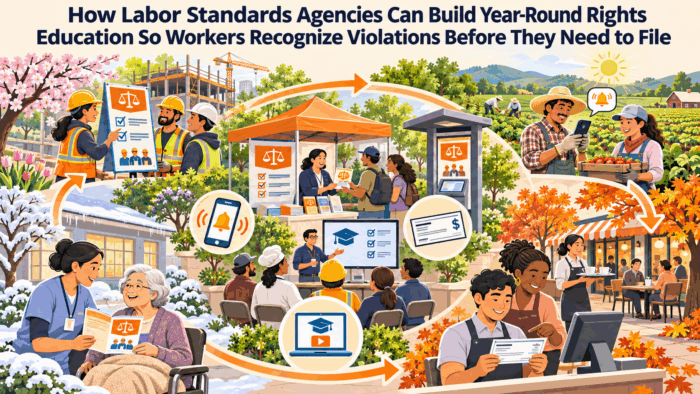
How Labor Standards Agencies Can Build Year-Round Rights Education So Workers Recognize Violations Before They Need to File
Labor standards agencies often encounter workers at the point when something has already gone wrong. A worker believes wages are missing, overtime was not paid, a required break was denied, a deduction seems improper, retaliation may have occurred, or another workplace requirement may not have been followed. By the time the worker reaches the agency, the problem may have continued for weeks or months, documentation may be incomplete, and the worker may already be under financial or professional stress.
This reactive pattern makes complaint intake and enforcement essential, but it also reveals a larger communication opportunity. Workers cannot act on rights they do not recognize. If labor standards information is primarily available through complaint pages, dense legal guidance, workplace posters, or occasional enforcement announcements, many workers may never encounter it until they are already experiencing a problem.
Year-round rights education gives agencies a way to move some communication earlier. Instead of waiting for workers to search for government assistance after a suspected violation, agencies can maintain a steady public education presence that explains common protections, recurring workplace situations, complaint pathways, retaliation concerns, and the types of records workers may want to retain. The objective is not to encourage unnecessary complaints. It is to help workers recognize when a workplace issue may warrant closer attention and understand where authoritative information is available.
A continuous education model also strengthens prevention. Workers who understand basic standards are better able to notice problems earlier, ask informed questions, preserve useful documentation, and seek help before an issue becomes more difficult to resolve. Employers benefit as well because clearer public understanding can reinforce compliance expectations across entire workplaces and industries.
For labor standards agencies, the challenge is building this education in a way that is accurate, accessible, multilingual where needed, and sustained throughout the year. Rights communication should not depend entirely on annual campaigns or isolated awareness weeks. It should function as part of the agency’s ongoing public service and enforcement strategy.
Move Rights Education Upstream
 Many agencies organize communication around the moment a worker is ready to file a complaint. Complaint pages may explain eligibility, required information, and submission procedures in detail, while earlier-stage education receives less attention.
That approach serves workers who already know they may have a problem, but it does less for people who do not recognize the warning signs. A worker may notice an unfamiliar deduction, unpaid time before or after a shift, a change in classification, or a pattern of missed compensation without knowing whether any of it relates to labor standards law.
Year-round education moves communication upstream by helping workers recognize categories of concern before they reach the filing stage. The agency can explain common workplace situations in practical language and direct people toward more detailed guidance when needed.
This does not require the agency to tell workers that every questionable situation is a violation. The communication can distinguish between potential concerns and formal findings while still giving workers enough information to identify when further review may be appropriate.
Build Education Around Workplace Situations, Not Regulatory Vocabulary
Workers do not necessarily think about their experiences in the same terms agencies use internally. Someone may know that their paycheck looks wrong without knowing which wage law, recordkeeping requirement, or classification rule could be relevant.
Rights education should therefore begin with recognizable workplace situations. Examples might include being asked to work before clocking in, not receiving expected overtime, seeing an unfamiliar deduction, being paid differently than anticipated, being told not to discuss wages, or experiencing an adverse action after raising a workplace concern.
The agency can then connect those situations to the relevant legal concepts and authoritative guidance. This sequence helps workers begin with what they are experiencing rather than requiring them to identify the correct statutory category first.
Organizing information around real-life situations also improves searchability. Workers are more likely to search for the problem they see than for the formal name of the law that governs it.
Use Plain-Language Entry Points Into Technical Guidance
A short plain-language explanation should function as an entry point, not as a substitute for complete guidance.
Workers who need more detail should be able to move easily from a practical example to definitions, exceptions, formal requirements, complaint information, and other authoritative resources.
This layered structure preserves accuracy while making the first interaction easier to understand.
Establish a Year-Round Rights Education Calendar
Continuous education becomes easier to manage when agencies plan it rather than relying on spontaneous outreach. A year-round calendar can organize recurring topics, seasonal risks, major employment cycles, regulatory anniversaries, and planned outreach activities.
Certain issues may be especially relevant at predictable times. Youth employment may receive greater attention during school breaks, seasonal industries may generate recurring wage questions, holiday periods may create scheduling or overtime concerns, and agricultural or outdoor work may bring particular communication needs at certain times of year.
The agency can also rotate evergreen topics throughout the year so workers encounter core rights repeatedly. Wage basics, retaliation protections, complaint access, recordkeeping, and jurisdiction are not one-time messages.
A calendar helps agencies maintain visibility without repeating identical content. Different formats and examples can reinforce the same underlying protections over time.
Identify the Rights Workers Most Need to Recognize Early
Agencies should prioritize education based on the problems workers are most likely to encounter, the areas where misunderstanding is common, and the issues where early recognition can make a meaningful difference.
Complaint data, call center questions, enforcement patterns, partner feedback, and investigator observations can help identify these topics. The agency may find that workers consistently misunderstand overtime, deductions, scheduling practices, retaliation, worker classification, or another recurring issue.
Prioritization should also consider severity. Some workplace practices may create significant financial or professional consequences even if they occur less frequently.
The goal is not to explain every provision of labor law in every campaign. Year-round education should create a strong foundation around high-value topics and direct workers toward more detailed resources when necessary.
Explain the Difference Between a Concern and a Confirmed Violation
Rights education can become misleading if examples are written as though every suspicious situation automatically proves a violation. Labor standards often depend on specific facts, definitions, exemptions, and procedural requirements.
Agencies should therefore explain that certain circumstances may raise a concern without guaranteeing a particular legal conclusion. Workers can be encouraged to learn more, preserve relevant information, and contact the agency without being told that the outcome is already established.
This distinction protects both accuracy and credibility. Workers receive meaningful guidance without being given false certainty, while employers are not publicly presumed to have violated the law based on a simplified example.
Clear language about potential concerns also makes the transition into complaint intake more realistic because workers understand that the agency will review the facts rather than simply confirm their initial interpretation.
Teach Workers What Information May Be Useful Before a Problem Escalates
Workers may not realize the importance of records until after a dispute develops. Year-round education can help people understand what kinds of information may be useful without suggesting that they need to build a complete legal case on their own.
Depending on the issue, workers may benefit from keeping pay statements, schedules, time records, written communication, policy documents, or other employment-related information they already receive or lawfully possess.
The agency should frame this carefully. Workers should not be encouraged to obtain information they are not authorized to access or to engage in conduct that could create additional workplace problems.
The communication should simply help people understand that contemporaneous records can make it easier to explain what happened if they later need assistance.
Make Retaliation Education Visible Before Workers Need It
Workers may avoid asking questions or reporting problems because they fear retaliation. If information about retaliation appears only after someone begins the complaint process, the agency may miss workers who never reach that stage.
Year-round education should therefore include basic information about protected activity, retaliation concerns, and available reporting pathways where applicable. Workers should know that raising certain workplace concerns or participating in an agency process may carry protections under relevant law.
The agency should also explain that retaliation determinations depend on facts. Not every negative workplace event automatically establishes retaliation.
Making this information visible early helps workers evaluate risk more realistically and signals that the agency recognizes fear of retaliation as a practical barrier to enforcement access.
Use Repetition to Improve Rights Recognition
Workers are unlikely to remember complex labor standards after seeing one fact sheet or social media post. Year-round education should use repetition strategically.
The same underlying right can be explained through different formats. A short social message may introduce the issue, a webpage may provide more detail, a webinar may walk through examples, and a partner toolkit may help community organizations reinforce the same information.
Repetition also helps agencies reach workers at different moments. Someone who ignores a message in January may pay close attention to the same topic months later when it becomes relevant to their workplace.
The objective is not constant duplication. It is sustained visibility that makes core rights recognizable over time.
Build Rights Education for Workers Who Rarely Visit Agency Websites
Agency websites are important, but workers who do not know the agency exists are unlikely to visit them. A year-round education strategy should therefore extend beyond agency-owned digital channels.
Worker centers, unions, libraries, workforce programs, community organizations, legal aid groups, training providers, schools, and other trusted institutions may help distribute information to people who would not otherwise encounter it.
Agencies can provide shareable materials, approved language, translated resources, and links to authoritative pages so partners extend reach without becoming unofficial legal interpreters.
The stronger the distribution network, the less the agency must depend on workers already knowing what to search for.
Design Rights Education for Mobile and Search Behavior
Many workers will encounter labor standards information through a phone and a search engine rather than by navigating an agency website from the homepage.
Content should therefore be structured around practical questions and concise entry points. Page titles and headings should use language workers are likely to recognize, while the body provides the technical detail necessary for accuracy.
Mobile usability matters as well. A long page may still be appropriate for complex guidance, but the most important information should be easy to locate, and complaint or contact pathways should be visible.
Search-friendly rights education allows the agency to reach workers at the moment they begin wondering whether something at work is normal or lawful.
Make Multilingual Rights Education Part of the Core Program
Workers who use languages other than English should not have to wait for a major campaign before receiving translated rights information. If a topic is important enough to be part of the agency’s core education strategy, language access should be considered from the beginning.
Agencies can prioritize translation based on workforce demographics, complaint patterns, regional needs, and partner feedback. High-value materials should be maintained and updated alongside the English versions rather than treated as separate products.
Translation should also account for readability and terminology. A technically accurate translation may still be difficult to understand if it relies heavily on legal language unfamiliar to the intended audience.
Building multilingual communication into the core program helps ensure that early recognition of rights is not limited to workers who can easily navigate English-language government content.
Connect Rights Education to Complaint Access Without Turning Every Message Into a Complaint Campaign
Year-round rights education should tell workers where to go if they need help, but not every piece of content needs to lead aggressively toward filing a complaint.
Some workers may simply need clarification. Others may want to review additional information before deciding what to do. A person may also discover that the issue falls outside the agency’s jurisdiction.
Education should therefore provide several pathways, such as reading more detailed guidance, contacting the agency with a question, locating the correct program, or filing a complaint where appropriate.
This approach respects different stages of worker awareness and makes the agency more useful before the person reaches a formal enforcement process.
Use Front-Line Questions to Shape Future Education
Call center employees, investigators, inspectors, and outreach staff hear worker confusion directly. Their observations should be incorporated into the year-round education program.
If staff repeatedly explain the same issue, that topic may deserve a public FAQ, short educational campaign, video, translated resource, or revised webpage. If workers consistently misunderstand the same phrase, the agency may need to change its terminology.
Creating a formal feedback loop between front-line staff and communications teams helps the education program remain grounded in actual public needs.
The strongest rights education systems learn from the questions workers are already asking rather than relying only on what agency staff assume people need to know.
Treat Rights Education as Part of Enforcement Prevention
Public education does not replace enforcement. It can, however, reduce the likelihood that violations continue unnoticed for long periods and reinforce compliance expectations before a formal case begins.
Workers who understand basic protections are more likely to notice problems earlier. Employers operating in an environment where rights information is widely visible may also be more aware that workers understand the standards the agency enforces.
Year-round education can therefore complement inspections, investigations, complaint systems, and employer compliance communication. It strengthens the broader regulatory environment by making labor standards more visible in everyday workplace life.
When rights education is sustained, practical, and connected to agency operations, workers are better equipped to recognize when something may be wrong before the situation becomes severe enough that filing a complaint is their first point of contact with the labor standards system.
Build a Core Rights Curriculum That Can Be Reused Throughout the Year
A year-round education program becomes much easier to sustain when the agency identifies a core set of topics that can be revisited in different formats throughout the year. Rather than creating every campaign from scratch, staff can build a repeatable curriculum around the issues workers most need to recognize early.
The curriculum may include wage basics, overtime, deductions, recordkeeping, retaliation, worker classification, complaint access, jurisdiction, and other recurring areas within the agency’s authority. The exact mix should reflect complaint patterns, enforcement experience, worker questions, and the laws the agency administers.
Each topic should have a plain-language explanation, a more detailed resource, examples of common workplace situations, links to complaint or inquiry pathways, and translated versions where needed. Those building blocks can then support web content, social posts, presentations, partner toolkits, webinars, and printed outreach.
A core curriculum creates consistency while still allowing the agency to vary emphasis throughout the year. Workers can encounter the same essential protections repeatedly without every communication looking identical.
Organize Rights Education Around Recognition, Documentation, and Next Steps
Workers often need more than a statement of the law. They need help understanding what to notice, what information may matter, and what they can do if something seems wrong.
A useful education structure can therefore move through three stages: recognition, documentation, and next steps. Recognition explains the workplace situation that may raise concern. Documentation explains what records or information may be helpful. Next steps explain how to learn more, contact the agency, or use a formal complaint process where appropriate.
This structure is practical because it mirrors how workers actually experience problems. They notice something first, then try to make sense of it, and only later decide whether to seek help.
Using the same structure across topics also makes the education system easier to navigate. Workers learn what to expect from agency materials even as the underlying issue changes.
Keep the First Layer Simple and the Deeper Layers Available
Not every worker needs to read a long technical explanation before understanding the basic issue. The agency can begin with a short plain-language overview and then provide links to more detailed guidance.
This layered model makes information easier to use on mobile devices and through partner channels while preserving access to the full legal and procedural detail.
Workers can stop when they have enough information or continue deeper when the situation requires it.
Build Rights Education Around Common Moments in the Employment Lifecycle
Rights questions often arise at predictable points in the employment relationship. Agencies can organize education around those moments so information reaches workers when it is most relevant.
A worker may need different information when starting a job, receiving a first paycheck, working overtime, changing schedules, being reclassified, raising a workplace concern, leaving employment, or experiencing another significant change.
Employment-lifecycle communication can help agencies place rights information in context. Instead of presenting labor standards as isolated rules, the agency can show how protections may become relevant at different stages of work.
This approach also creates opportunities for partnerships with workforce programs, schools, unions, community organizations, and other institutions that interact with workers at specific points in the employment cycle.
Develop a Seasonal Education Strategy
Some labor standards issues are more visible or more likely to arise during certain periods. A year-round strategy should account for these patterns without allowing seasonal campaigns to replace evergreen education.
Youth employment may become especially relevant during school breaks. Seasonal hiring may increase in hospitality, retail, agriculture, recreation, or other sectors at predictable times. Holiday periods may generate questions about scheduling, overtime, or pay practices.
Agencies can prepare seasonal content in advance and update it annually based on current law and recurring questions. This creates a reliable rhythm for public education.
Seasonal planning also gives partners time to prepare distribution, translations, and outreach before worker demand peaks.
Use Complaint and Enforcement Patterns to Prioritize Topics
Agencies should not rely only on intuition when deciding which rights to emphasize. Complaint data, enforcement findings, call center questions, and investigator observations can help identify where workers most often misunderstand or fail to recognize potential problems.
A rise in complaints about one issue may indicate a compliance problem, a communication problem, or both. The agency can use that information to determine whether additional education is warranted.
Repeatedly incomplete complaints may also reveal where workers need better explanation before filing. If people consistently omit the same type of information, pre-filing education can help improve intake quality.
Data-informed prioritization makes the education program more responsive and helps agencies focus limited communication resources where they may have the greatest value.
Create Short Educational Formats for Repeated Exposure
Year-round education should not depend entirely on long guides and formal presentations. Short, repeatable formats can help workers encounter key messages more frequently.
These may include short videos, simple graphics, brief social posts, question-and-answer features, email reminders, wallet-sized cards, workplace handouts, or short partner messages.
The content should always connect back to a more detailed authoritative source. Short formats are most useful when they introduce the issue clearly and make the next step obvious.
Repeated exposure through varied formats helps workers remember key protections without forcing every communication to carry the full legal explanation.
Use Long-Form Guidance for Complex Rights
Some topics require more detail because the legal standard depends on multiple factors. Agencies should not force every issue into a simplified format if that risks losing important distinctions.
Long-form guidance can explain definitions, exceptions, examples, procedures, and common misunderstandings in greater depth. It can also address related questions that workers may encounter after the initial recognition stage.
The agency should structure these resources carefully so workers can find the section most relevant to them. Clear headings, summaries, examples, and links can make a long page easier to navigate.
The goal is not to choose between short and detailed content. A strong education system uses both and connects them.
Build Rights Education Into Existing Worker Touchpoints
Labor agencies do not need to create a new communication channel for every topic. Rights education can be integrated into places where workers already interact with the agency or other public systems.
Complaint confirmation pages, call center hold messages, email responses, outreach events, training programs, workforce centers, public libraries, and other touchpoints may all provide opportunities to reinforce basic rights information.
The agency should avoid overwhelming people with unrelated content, but carefully selected messages can increase exposure without requiring workers to seek out a separate campaign.
Embedding education into existing touchpoints also improves efficiency. The agency can extend reach without depending entirely on additional advertising or outreach resources.
Build Partner Distribution Into the Annual Plan
Worker centers, unions, community organizations, legal aid providers, workforce programs, and other intermediaries can help sustain year-round education. Their role should be planned rather than activated only during major campaigns.
Agencies can establish a regular distribution schedule so partners receive updated materials, seasonal messages, translated content, and links to authoritative resources throughout the year.
Partners should also know which materials are current and which have been replaced. Version control is important because older rights information may continue circulating long after the agency updates its own website.
A structured partner calendar turns external networks into a sustained education system rather than an occasional outreach tool.
Give Partners Clear Boundaries Around Rights Education
Trusted organizations may be asked by workers whether a particular situation is definitely illegal or what outcome the agency will reach. Agencies should prepare partners for these questions.
Partner guidance should distinguish between sharing general rights information and making case-specific legal conclusions. Partners can explain what the agency generally covers, identify potential concerns, and direct workers toward official resources.
They should not be expected to determine whether a violation occurred or predict enforcement outcomes.
Clear boundaries protect both accuracy and trust. Workers can benefit from the partner’s accessibility without confusing the partner’s role with the agency’s authority.
Build Education for Workers Who Are New to the Labor Market
Young workers, first-time employees, recently arrived workers, and people entering unfamiliar industries may not know what workplace practices are normal or what protections exist.
Year-round education can include basic introductory content designed specifically for people with limited experience navigating employment systems. The language should avoid assuming familiarity with payroll, classification, complaint processes, or government agencies.
These materials can explain where workers can find authoritative information and what kinds of workplace questions are appropriate to ask.
Early education may help prevent confusion from becoming normalized simply because the worker has no prior reference point.
Reach Workers in Industries With High Turnover
High-turnover industries create a special communication challenge because the workforce changes constantly. A one-time campaign may reach workers who are gone months later while new employees arrive with no exposure to the information.
Agencies should consider recurring education in sectors where turnover is high. Partner networks, onboarding resources, industry-specific materials, and periodic outreach can help maintain continuity.
The agency should avoid assuming that repeated messages are redundant. In a changing workforce, repetition may be necessary simply to reach new people.
A sustained strategy keeps rights education present even when the audience itself is continually changing.
Make Complaint Pathways Easy to Understand Before They Are Needed
 Workers are more likely to use agency services effectively if they already understand the basic complaint process before a crisis develops.
Year-round education can explain what the agency handles, how to contact it, what happens after a complaint is submitted, what information may be useful, and what the agency cannot promise in advance.
This process education should be integrated into rights content rather than hidden only on complaint pages.
When workers understand the pathway early, they are less likely to delay seeking help simply because the process seems unfamiliar or intimidating.
Use Rights Education to Clarify Jurisdiction
Workers may recognize that something is wrong but contact the wrong agency because employment-related responsibilities are divided across multiple systems.
Education should include clear jurisdictional guidance so workers understand what the labor standards agency handles and when another agency may be responsible.
This can be done through simple examples and referral language rather than relying on organizational charts.
Helping workers reach the correct agency earlier reduces frustration and improves the efficiency of complaint intake across the broader government system.
Connect Education With Retaliation Prevention
Retaliation education should not be treated as a specialized topic separate from the rest of the program. It can be integrated into communications about reporting, complaint processes, and worker participation.
Workers should understand that certain protected activities may carry legal protections and know where to find more information if they believe retaliation occurs.
Employer-facing education can reinforce the same principle by explaining that retaliation concerns can create separate legal issues from the underlying complaint.
Coordinated education can help make retaliation prevention part of the broader compliance environment rather than something discussed only after a worker reports harm.
Build Internal Alignment Around the Rights Education Program
Front-line staff, investigators, inspectors, outreach teams, and communications staff should understand the agency’s education priorities and the messages being distributed publicly.
If workers respond to a campaign by calling the agency, employees should know what materials they saw and be prepared for the questions likely to follow.
Internal alignment is particularly important when campaigns use simplified language. Staff should understand the fuller legal context so they can provide accurate clarification when needed.
A coordinated internal approach prevents public education from operating separately from the agency staff responsible for responding to it.
Measure Whether Workers Are Recognizing Rights Earlier
The ultimate objective of year-round education is not simply greater content production. Agencies should examine whether workers appear to be recognizing issues earlier and navigating the system more effectively.
Possible indicators may include changes in the timing or quality of complaints, increased use of educational resources, fewer jurisdictional misdirects, improved awareness in surveys, or recurring questions that show deeper understanding of the issue.
These measures should be interpreted carefully because enforcement patterns are influenced by many factors. An increase in complaints may reflect greater awareness rather than more violations.
Even imperfect measurement can help agencies move beyond counting posts and events toward understanding whether education is changing how workers interact with the labor standards system.
Treat Year-Round Education as a Long-Term Communication System
The strongest rights education programs are not built around a single campaign. They operate continuously, using recurring topics, seasonal communication, partner networks, digital content, staff feedback, multilingual resources, and measurement to keep worker protections visible.
The agency should update the system as laws change, new workplace patterns emerge, and workers demonstrate new areas of confusion. Education should evolve without losing the consistent core that helps people recognize fundamental rights.
Over time, a sustained program can make labor standards more familiar even to workers who have never filed a complaint or spoken directly with the agency.
That familiarity is valuable. When workers recognize potential violations earlier, understand what information may matter, and know where to seek authoritative help, the labor standards system becomes easier to access before a workplace problem has already become entrenched.
Use Enforcement Patterns to Identify Education Gaps
Year-round rights education should be informed by what labor standards agencies are actually seeing through complaints, investigations, enforcement actions, call center questions, and field experience. These sources can reveal where workers consistently fail to recognize a potential problem until it has continued for a significant period of time.
If investigators repeatedly encounter workers who did not realize certain unpaid activities might count as compensable time, the agency may need stronger education around that issue. If many complaints involve the same type of deduction or classification question, those patterns may signal that workers need earlier and clearer explanations.
Agencies should avoid assuming that every enforcement trend is primarily a communication problem. Some patterns may reflect employer practices, industry conditions, or changes in the labor market. Education is one tool among several.
The value comes from connecting operational evidence to communication planning. Instead of selecting outreach topics only because they are familiar or easy to explain, agencies can focus education where worker understanding appears weakest and the consequences of delay may be greatest.
Use Complaint Timing to Understand When Workers Recognize Problems
The timing of complaints can provide insight into whether workers are recognizing potential violations early or only after a problem becomes severe. A worker who waits months before contacting the agency may have lacked awareness, feared retaliation, been uncertain about jurisdiction, or simply not known where to seek help.
Agencies can examine whether certain types of complaints tend to arrive only after employment ends, after repeated incidents, or after workers have already attempted several informal remedies. Those patterns may point toward opportunities for earlier education.
This does not mean workers should be pressured to file immediately. Individuals may have legitimate reasons for waiting, and different legal timelines may apply depending on the issue.
The communication objective is to reduce delays caused primarily by lack of knowledge. Workers should understand enough about their rights and available options to make an informed decision about when to seek assistance.
Build Education Around Common Misunderstandings
Workers may know that a labor standard exists while misunderstanding how it works. These misunderstandings can be particularly important because the worker may believe they already understand the rule and therefore never seek additional information.
Agencies should identify misconceptions that appear repeatedly in calls, complaints, outreach events, or partner conversations. A worker may believe that a certain employment label automatically determines legal status, that an employer’s internal policy overrides a statutory requirement, or that a complaint cannot be filed without extensive documentation.
Rights education can address these misunderstandings directly through short explanations, myth-versus-fact formats, examples, or frequently asked questions. The agency should be careful not to oversimplify issues that depend on multiple factors.
Correcting recurring misunderstandings can sometimes be more valuable than introducing completely new topics because the worker already has enough awareness to engage with the issue but needs a more accurate framework.
Distinguish Simplification From Overstatement
Educational content should make a complex rule easier to understand without presenting a simplified statement as universally true when important exceptions exist.
Agencies can use qualifiers, examples, and links to fuller guidance to preserve necessary nuance.
The objective is to help workers recognize when a question is worth exploring further, not to turn every educational message into a definitive legal conclusion.
Create Industry-Specific Rights Education Where Patterns Justify It
General rights information is important, but some industries have recurring employment structures or workplace practices that make targeted education especially useful. Seasonal employment, tipped work, agricultural labor, construction, domestic work, temporary staffing, hospitality, or other sectors may raise distinct communication needs depending on the agency’s jurisdiction.
Industry-specific education can use examples workers are more likely to recognize. The agency can explain how general labor standards may appear in the context of scheduling, travel, preparation time, wage statements, deductions, or other common workplace situations.
The agency should base targeted education on evidence rather than assumptions about a sector. Complaint patterns, enforcement data, partner input, and worker questions can help determine where more focused communication is justified.
Targeted education should also avoid implying that every employer in the industry is likely to violate the law. The purpose is to improve recognition and prevention across a setting where recurring questions have been identified.
Build Rights Education for Temporary, Contract, and Nontraditional Work Arrangements
Workers in nontraditional employment arrangements may have particular difficulty understanding which organization is responsible for certain workplace obligations. They may interact with staffing agencies, subcontractors, platform companies, client businesses, or several entities within the same work arrangement.
Year-round education can help workers understand that labels alone may not answer every legal question and that different laws may apply different tests or definitions. Agencies should avoid providing broad statements that exceed the scope of the law they administer.
Communication can instead explain what kinds of relationships the agency examines, which factors may matter generally, and how a worker can obtain more authoritative information.
This is especially important because uncertainty about who the employer is can prevent workers from recognizing that labor standards protections may still be relevant to their situation.
Reach Workers Before They Enter High-Risk or Unfamiliar Jobs
Rights education can be most valuable before a worker becomes accustomed to workplace practices that may not comply with applicable standards. Agencies can partner with workforce programs, vocational schools, apprenticeship programs, community colleges, job placement organizations, and other institutions that interact with people entering new occupations.
The education does not need to turn job preparation programs into legal training. A short introduction can help workers understand where to find reliable information, what kinds of workplace issues the labor agency handles, and what basic records they may want to review.
Workers entering unfamiliar industries may otherwise assume that a questionable practice is normal simply because everyone around them appears to accept it.
Early education provides a reference point before workplace norms become the worker’s only source of information about what is permitted.
Integrate Rights Education With Youth Employment Outreach
Young workers may have limited experience evaluating workplace practices and may be especially dependent on supervisors, parents, schools, or peers for information about what is normal.
Labor standards agencies can integrate basic rights education into youth employment communication so young workers understand where to find information about pay, hours, scheduling, workplace conditions, and other protections within the agency’s authority.
Schools, career programs, recreation departments, youth employment initiatives, and community organizations may provide useful distribution channels.
The communication should also be designed for the worker, not only for parents or employers. Young people should be able to understand the information directly and know how to contact the agency themselves when appropriate.
Build Rights Education for Workers Who Change Jobs Frequently
Workers who move frequently among employers may face recurring confusion about rights, especially when each workplace uses different scheduling systems, payroll practices, policies, or classification language.
A year-round education program can provide portable knowledge that follows the worker from job to job. The worker may not remember every technical requirement, but they can learn to recognize common warning signs and know where to verify information.
This is particularly useful in industries with frequent job changes, short-term assignments, or seasonal employment.
Portable rights knowledge reduces dependence on any one employer’s explanation of the law and gives workers a stable source of information across different employment settings.
Use Multichannel Education to Reinforce Recognition
Workers encounter information in different ways, so agencies should distribute rights education through a mix of channels rather than relying on one platform.
A webpage can provide authoritative detail, social media can introduce a topic, email can reinforce a seasonal issue, printed material can reach workers without reliable digital access, and partner organizations can distribute the same information through trusted networks.
Each channel should direct workers toward the same authoritative source so the underlying guidance remains consistent.
The objective is to create multiple opportunities for recognition. Workers may overlook the first message but notice the issue after encountering it again through another channel or at a more relevant point in their employment experience.
Build a Search Strategy Around the Questions Workers Actually Ask
Workers may search online using language that differs substantially from the terminology labor agencies use. A person may search “boss changed my timecard,” “not paid for opening store,” or “hours cut after complaint” rather than the formal legal term associated with the issue.
Agencies should examine search behavior, common call center language, and partner feedback to identify the phrases workers use when describing problems.
Public webpages can then incorporate those practical questions while still connecting them to the correct legal terminology and complete guidance.
This approach improves discoverability without sacrificing accuracy. Workers are more likely to find authoritative agency information when the content begins with the words they naturally use to describe the problem.
Use Social Media as an Entry Point, Not the Final Explanation
Social media can help agencies maintain year-round visibility, but short posts rarely provide enough space to explain complex labor standards fully.
The strongest use of social media is often to introduce a recognizable workplace situation, identify the relevant issue, and direct the worker toward a more complete agency resource.
Posts should avoid oversimplified statements that may be widely shared without the context available on the agency website. The short format should remain accurate even when seen alone.
A planned series of recurring posts can reinforce core rights throughout the year while the website remains the authoritative source for deeper explanation.
Build Rights Education Into Enforcement Announcements
Enforcement actions can attract attention from workers who may never read general educational materials. Agencies can use that visibility to explain the broader right or requirement involved.
An announcement can describe the case accurately while also directing workers toward general guidance on the underlying issue. This allows a high-profile enforcement action to become an educational opportunity without turning the case itself into a generalized conclusion about an entire industry.
The agency should distinguish clearly between the facts of the specific case and the broader legal standard.
When done carefully, enforcement communication can help workers recognize similar issues in their own workplaces while preserving procedural accuracy.
Connect Worker Education With Employer Compliance Messaging
Year-round worker education is stronger when the agency also communicates corresponding responsibilities to employers. If workers are being educated about a particular right, employers should have clear access to guidance explaining the related compliance requirement.
This parallel communication reinforces the legitimacy of the education program. The agency is not simply encouraging workers to identify problems. It is also helping employers understand how to prevent them.
Coordinated messaging can be particularly valuable around recurring or seasonal issues. Worker awareness and employer compliance education can be timed together so both sides receive the relevant information before problems become widespread.
The result is a more balanced prevention strategy in which rights recognition and compliance understanding reinforce one another.
Prepare for Increased Questions After Successful Education
A strong rights education campaign may increase calls, website visits, and complaints. Agencies should plan for this possibility rather than treating the increase automatically as evidence that something went wrong.
Front-line staff should know which messages were distributed and what questions they are likely to generate. Complaint intake systems should be prepared for increased interest, especially after large campaigns or high-profile enforcement actions.
Leadership should also interpret volume carefully. An increase in inquiries may indicate that workers are recognizing issues earlier and using the system more effectively.
Communication success can create operational demand. Planning for that demand ensures that greater awareness is matched by the agency’s ability to respond.
Use Worker Feedback to Improve Rights Education
Workers themselves can help agencies understand whether educational materials make sense. Feedback can be gathered through outreach events, surveys, partner organizations, complaint processes, or user testing of high-priority content.
Workers may identify terminology that feels overly technical, questions the agency has overlooked, or examples that do not resemble real workplace situations.
The agency should evaluate this feedback carefully rather than treating every suggestion as a required change. Legal accuracy and program authority remain essential.
When worker feedback is incorporated appropriately, education becomes easier to understand without sacrificing the integrity of the underlying standard.
Measure Recognition, Not Just Reach
Reach measures such as impressions, page views, event attendance, and material distribution can show whether people encountered the education, but they do not show whether workers can recognize the issue afterward.
Agencies should look for ways to assess understanding where practical. Short surveys, event questions, partner feedback, complaint quality, or recurring call patterns may reveal whether workers are learning to identify rights and navigate agency resources more effectively.
The agency can also compare educational topics with subsequent changes in the kinds of questions workers ask. More specific or informed questions may indicate that baseline understanding has improved.
Recognition is the more meaningful objective because the education is intended to help workers notice a potential issue before they reach the filing stage.
Treat Year-Round Education as an Early Intervention Strategy
A strong rights education system allows labor standards agencies to intervene through information before a workplace problem becomes entrenched. That does not mean every issue will be resolved without enforcement, nor should education be used as a substitute for investigation when violations occur.
Its value is earlier awareness. Workers can identify potential concerns sooner, preserve relevant information, ask better questions, and seek assistance before uncertainty turns into prolonged harm.
Employers may also respond to a workforce that has greater awareness by improving internal compliance and communication.
When education, compliance assistance, complaint access, and enforcement operate together, the agency creates a stronger regulatory environment in which labor standards are understood before a formal dispute becomes the worker’s first exposure to the system.
Build a Formal Governance Structure for Rights Education
Year-round rights education is difficult to sustain when responsibility is scattered across communications staff, enforcement programs, outreach teams, legal offices, regional staff, and external partners. A formal governance structure helps the agency determine who owns the education program, who approves content, how topics are prioritized, and how updates move through the organization.
The governance model should define which materials require legal or policy review, which can be updated by communications or program staff, and which topics need executive attention because of their sensitivity or public impact. Routine educational content may move through a lighter process, while materials involving retaliation, classification, jurisdiction, or a major policy change may require additional review.
The agency should also identify who is responsible for maintaining alignment between worker education and employer compliance communication. Rights messaging should not evolve separately from the agency’s explanation of corresponding employer obligations.
Clear governance turns year-round education from a series of campaigns into an institutional program with defined ownership, accountability, and continuity.
Create a Central Content Architecture for Rights Education
Labor standards agencies often build content topic by topic over many years. The result can be a mix of webpages, PDFs, social posts, presentations, translated materials, complaint instructions, and partner resources that are difficult to manage as one system.
A dedicated content architecture can organize these materials around the worker journey. Workers should be able to move from recognizing a workplace concern to understanding the relevant right, reviewing examples, identifying what information may be useful, and determining what next step is available.
The architecture should also distinguish between introductory content and technical guidance. Short educational materials can serve as entry points, while more detailed pages provide the nuance needed for complex legal standards.
Organizing content intentionally makes the system easier for workers to navigate and easier for staff to maintain.
Establish Version Control Across All Worker Education
Rights education can become harmful if outdated materials remain in circulation after the agency changes a rule, process, form, or interpretation. Version control should therefore be treated as a core operational requirement.
Each major resource should have a clear owner, review date, and revision history. Superseded materials should be removed from active channels where possible, and partners should be notified when older versions should no longer be used.
The agency should also coordinate updates across formats. A revised webpage should trigger review of related social content, presentations, printed handouts, translated resources, partner toolkits, and internal staff guidance.
This creates a single current system rather than a collection of materials updated at different speeds.
Update Translations and Accessible Formats at the Same Time
When the agency changes a core rights message, translated and accessible versions should be part of the same update process rather than treated as follow-up work.
Delayed updates can create a system in which some workers receive current information while others continue relying on older guidance.
Coordinated version control helps make year-round education equitable as well as accurate.
Build an Annual Planning Cycle Around Evergreen and Emerging Topics
A sustainable education program should balance recurring rights topics with new issues that emerge during the year. An annual planning cycle can establish the core evergreen calendar while preserving capacity for new legislation, regulatory changes, enforcement trends, or workplace developments.
Leadership can identify which topics should appear every year, which are seasonal, and which require targeted campaigns based on current conditions. This creates predictability without making the program rigid.
The annual plan should also include review periods for major resources, partner distribution schedules, translation timelines, and staff preparation.
A structured planning cycle helps agencies maintain year-round visibility while remaining responsive to changing worker needs.
Coordinate Education With Major Regulatory and Policy Changes
When labor standards change, agencies should treat worker education as part of implementation rather than as a final communications task. Workers may need advance notice, plain-language explanations, examples, effective dates, and information about how the change affects existing workplace practices.
The communication plan should develop alongside the substantive rollout. This allows the agency to identify likely worker questions before the change takes effect.
Employers should receive coordinated compliance information so both audiences understand the same underlying requirement from their respective perspectives.
Early integration reduces confusion and helps the agency avoid a period in which a new rule is technically in effect but poorly understood by the people it protects.
Build Internal Briefings Into Every Major Rights Campaign
Front-line employees should understand what the agency is promoting publicly before workers begin responding to it. Call center staff, investigators, inspectors, outreach teams, and supervisors should know the campaign message, relevant legal context, expected questions, and available escalation routes.
This is particularly important when the public content uses simplified language. Staff need the fuller explanation so they can clarify nuance without contradicting the campaign.
Internal briefings should also identify what workers are being asked to do next. If a campaign directs people toward a complaint process, inquiry line, or educational resource, staff should be prepared for increased demand.
Connecting internal preparation to public outreach makes the education program more credible and operationally sustainable.
Build a Formal Partner Distribution System
Trusted organizations can extend year-round rights education far beyond what the agency can accomplish alone, but partner distribution should be organized rather than ad hoc.
Agencies can maintain segmented partner lists, regular update schedules, approved toolkits, and defined points of contact for worker centers, unions, legal aid organizations, workforce programs, libraries, schools, and other community networks.
Partners should receive current materials, clear source links, and notice when guidance changes. They should also understand which information can be shared directly and when a worker should be referred back to the agency.
A formal system turns external relationships into an ongoing distribution network rather than a collection of one-time outreach opportunities.
Create Standards for Co-Branded and Partner-Hosted Education
Some education may be delivered through events or materials that involve outside organizations. Agencies should establish clear standards for co-branding, hosting, and use of agency names or logos.
The agency should remain responsible for official content. A partner may provide the venue, audience, or additional perspective, but the underlying rights information should be clearly identified as agency guidance.
Promotional materials should also avoid implying that the agency endorses the partner’s unrelated policy positions or organizational activities.
Clear standards allow agencies to benefit from partner credibility without creating confusion about institutional roles.
Build a Rapid Response Process for New Worker Questions
A year-round system should be able to respond when a new issue suddenly begins generating worker concern. This may result from a new workplace practice, regulatory change, high-profile enforcement case, media coverage, or broader economic development.
Agencies should have a rapid process for identifying the issue, verifying the applicable guidance, preparing a plain-language explanation, and distributing it through public and partner channels.
The process should distinguish between information that is settled and information that remains under review. Workers should not be given false certainty simply because the agency is trying to respond quickly.
Rapid response capacity helps the agency remain relevant while preserving accuracy.
Use a Central Editorial Standard Across Rights Content
Year-round education becomes easier to recognize and trust when materials follow consistent editorial principles. Agencies should establish standards for tone, terminology, examples, headings, definitions, disclaimers, and links to deeper guidance.
The standard should emphasize plain language without stripping away important legal distinctions. Workers should be able to understand the basic issue quickly while still having access to the full explanation.
Editorial consistency also helps multiple programs produce content that feels like part of one agency system rather than unrelated campaigns.
A shared standard improves both usability and maintenance.
Build Quality Control Into Educational Content
Rights education should undergo periodic quality review even when the underlying law has not changed. A technically accurate page may become harder to use as worker questions evolve, digital standards change, or better explanations become available.
Quality review can examine readability, mobile usability, translation quality, accessibility, navigation, search behavior, and whether examples still reflect common worker experiences.
The agency can also compare public materials with the questions front-line staff continue receiving. If workers repeatedly misunderstand an issue that has been explained online for years, the content may need redesign rather than simple republication.
Quality control keeps the education program useful rather than merely current.
Develop a Measurement Framework for Year-Round Education
Agencies should measure the program in ways that go beyond counting materials produced. Output metrics can show activity, but they do not reveal whether workers understand their rights earlier.
A broader measurement framework might include awareness, page engagement, partner distribution, quality of complaints, changes in referral accuracy, recurring questions, use of multilingual resources, and other indicators of improved recognition.
The agency should interpret these measures carefully. More complaints may indicate more violations, greater awareness, easier access, or some combination of factors.
Measurement should support learning rather than simplistic claims of success. The objective is to understand whether education is helping workers navigate the system more effectively.
Use Continuous Improvement to Refine Topics and Formats
A strong year-round education system should evolve based on what workers, staff, partners, and enforcement data reveal. Some topics may need greater emphasis, while others may be well understood and require less frequent attention.
The agency should periodically review which formats are working. Short videos may perform well for one audience, while printed materials or partner presentations may be more effective for another.
Continuous improvement should also include retiring content that no longer serves a clear purpose. More content is not always better if workers cannot find the most important information.
A focused and adaptive system is more effective than one that simply accumulates materials over time.
Preserve Institutional Knowledge About Rights Education
The success of a year-round education program should not depend on a small number of experienced employees. Agencies should document the logic behind topic priorities, partner strategies, editorial standards, campaign calendars, and measurement practices.
Past lessons should also be preserved. If a campaign created confusion, if a particular example proved especially effective, or if a partner network significantly improved reach, that information should inform future planning.
Institutional knowledge becomes especially important during leadership, staffing, or organizational changes.
Documentation allows the program to mature over time rather than repeatedly rebuilding its approach from the beginning.
Make Rights Education a Permanent Part of the Agency’s Operating Model
Year-round rights education is most effective when it is not treated as an optional outreach activity that expands or contracts depending on short-term attention. It should be integrated into the agency’s broader regulatory and public-service model.
Leadership should consider worker education when planning enforcement priorities, regulatory rollouts, complaint systems, partner engagement, technology changes, and performance measurement.
This integration helps ensure that workers encounter rights information before a dispute becomes their first meaningful interaction with the agency.
When rights education is governed, sustained, measured, and connected to agency operations, it becomes a form of early intervention. Workers are better able to recognize potential violations, understand available options, and seek authoritative help before workplace problems become deeply entrenched.
Strategic Communication Support for Year-Round Worker Rights Education
 Year-round rights education requires more than producing additional outreach materials. Labor standards agencies need a coordinated communication system that connects worker education, complaint access, partner outreach, multilingual communication, digital content, internal staff preparation, enforcement trends, and employer compliance messaging. Without that structure, agencies may produce useful materials that remain fragmented, outdated, difficult to find, or disconnected from the questions workers are actually asking.
Stegmeier Consulting Group (SCG) can support labor standards agencies by developing year-round communication strategies, worker rights education frameworks, annual content calendars, audience segmentation approaches, plain-language standards, partner distribution systems, multilingual communication plans, campaign toolkits, internal staff guidance, content governance processes, and measurement frameworks. SCG can also help agencies review existing rights information to identify where workers encounter technical language, unclear jurisdiction, outdated resources, weak search visibility, or gaps between public education and complaint processes.
External strategic communication support can be especially useful when an agency has strong substantive expertise but limited capacity to organize worker education across programs and channels. A structured communication review can help leadership determine which rights should receive recurring attention, how seasonal and emerging issues should fit into the annual plan, which audiences are difficult to reach, and how partner networks can extend communication without creating inconsistent interpretations.
SCG’s role remains focused on communication strategy, public information, stakeholder outreach, internal alignment, content systems, and measurement. SCG does not provide legal advice, determine whether a violation occurred, advise individual workers about the merits of a claim, make enforcement decisions, or replace investigators, attorneys, or other authorized agency professionals. Strategic communication support helps the agency make authoritative rights information easier to understand and easier to encounter before a worker reaches the point of filing.
Future Trends
Worker rights education will increasingly need to compete for attention in a fragmented information environment. Workers may receive workplace information from employers, coworkers, social media, online searches, unions, community organizations, legal service providers, and automated digital tools. Labor standards agencies will need stronger communication strategies to ensure authoritative information is visible when workers begin asking basic questions about what is happening at work.
Search behavior will become even more important. Workers are unlikely to begin with statutory terminology when they believe something may be wrong. They will continue searching in practical language that describes an experience, such as missing pay, changed time records, unexpected deductions, reduced hours after raising a concern, or other workplace situations. Agencies that structure content around recognizable questions while connecting those questions to authoritative legal guidance will be better positioned to reach workers before misinformation does.
Multilingual communication will also become more deeply integrated into rights education rather than treated as a secondary translation task. Agencies serving diverse workforces will increasingly need to plan language access alongside content development, digital distribution, partner engagement, and campaign scheduling. Maintaining translated materials will become as important as producing them initially because outdated versions can create different levels of access to current rights information.
Partner networks will likely play a larger role in sustained education. Worker centers, unions, workforce organizations, schools, libraries, legal aid providers, community organizations, and other trusted intermediaries can help agencies maintain visibility among workers who may rarely visit government websites. The challenge will be managing those networks through current toolkits, version control, referral standards, and clear boundaries around official interpretation.
Technology may also expand the ways workers interact with rights information. Search tools, guided digital assistants, automated translation, personalized website navigation, and conversational interfaces may help people locate relevant resources more quickly. Agencies will need to ensure that these tools direct workers toward authoritative information and do not generate simplified answers that appear to make legal determinations without the necessary facts.
The broader trend will be toward rights education becoming a permanent part of regulatory operations. Agencies will increasingly benefit from connecting communication data with complaint trends, enforcement experience, partner feedback, and front-line staff observations so that education evolves alongside the workplace issues workers are actually experiencing.
Conclusion
Labor standards agencies should not have to wait until a worker is ready to file a complaint before explaining the rights they enforce. A worker who recognizes a potential problem earlier has more opportunity to ask questions, retain useful information, understand available options, and make an informed decision about whether to contact the agency.
Year-round rights education makes that earlier recognition possible. It shifts some communication away from a purely reactive model and creates a sustained public presence around core protections, recurring workplace situations, retaliation concerns, complaint access, documentation, jurisdiction, and available agency resources.
The strongest programs do not rely on one annual campaign or one website section. They use recurring communication, seasonal planning, practical examples, search-friendly content, multilingual resources, trusted partners, internal staff alignment, and data-informed topic selection to keep rights visible throughout the year.
Agencies should also maintain a clear distinction between education and legal determination. Workers should be able to recognize when something may warrant additional attention without being told that every concerning situation is automatically a confirmed violation. That balance allows the agency to communicate rights confidently while preserving the role of investigation, evidence review, and formal enforcement processes.
Year-round education also supports the broader regulatory environment. Workers gain greater awareness of the protections available to them, while employers operate in a setting where labor standards are more visible and better understood. Education does not replace enforcement, but it can strengthen prevention, improve access, and help identify problems before they become more difficult to address.
Ultimately, worker rights education is most effective when it becomes part of how the labor standards agency operates rather than a separate outreach function. When communication is sustained, governed, measurable, and closely connected to complaint and enforcement systems, workers are more likely to recognize potential violations before filing becomes their first meaningful introduction to the agency.
Stegmeier Consulting Group’s Strategic Approach to Communication Systems
Build year-round worker rights education systems that help people recognize potential labor standards violations earlier, understand their options, and connect with authoritative agency information before problems become entrenched.
Labor standards agencies need communication systems that make worker protections visible throughout the year rather than only when a complaint is ready to be filed. Stegmeier Consulting Group (SCG) helps agencies develop rights education strategies, annual content calendars, plain-language frameworks, multilingual communication systems, partner toolkits, digital content structures, internal staff guidance, governance processes, and measurement approaches that improve recognition and access while preserving legal and enforcement boundaries. Use the form below to connect with our team and explore how strategic communication support can strengthen worker education, complaint access, partner outreach, prevention, and agency-wide communication systems.
Use the form below to connect with our team and explore how strategic communication support can help your agency build year-round worker rights education, explain workplace protections in clear and accessible language, and help workers recognize potential violations and understand their options before problems escalate.