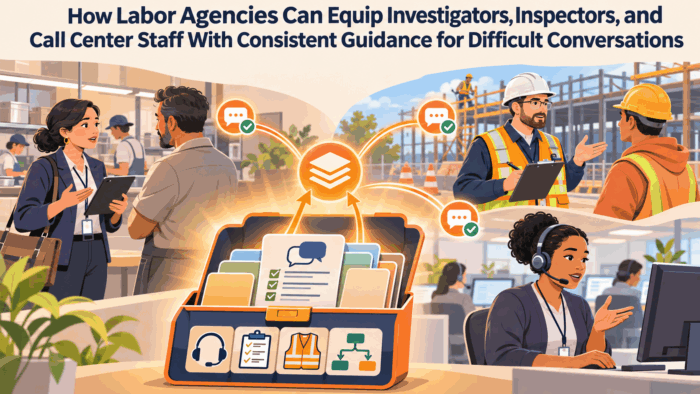
How Labor Agencies Can Equip Investigators, Inspectors, and Call Center Staff With Consistent Guidance for Difficult Conversations
Investigators, inspectors, and call center staff are often the people through whom workers and employers experience a labor agency most directly. They answer questions about rights and responsibilities, explain complaint and inspection processes, respond to frustration, clarify what the agency can and cannot do, and interact with people who may already be angry, worried, defensive, or distrustful. These conversations can shape public confidence just as strongly as formal guidance, enforcement announcements, or agency websites.
The challenge is that front-line staff frequently operate in situations where there is no simple answer. A worker may want confirmation that an employer violated the law before an investigation has begun. An employer may want an inspector to say whether a proposed corrective action guarantees compliance. A caller may be upset about a delay, insist that the agency take immediate action, or ask questions that belong to another program. Staff must be helpful without prejudging cases, providing unauthorized legal advice, contradicting policy, or making promises the agency cannot keep.
Consistency is therefore essential. Workers and employers should not receive significantly different explanations depending on which investigator, inspector, call center employee, regional office, or program they contact. Individual staff should retain the flexibility to respond naturally to different situations, but they need a common framework for explaining agency authority, process, uncertainty, referrals, escalation, confidentiality, and next steps.
A strong guidance system does more than provide scripts. It helps staff understand the principles behind the agency’s communication approach so they can respond effectively when the exact question is not covered in a prepared answer. It defines where staff have discretion, where precise language matters, when to escalate a question, and how to remain neutral during difficult or emotionally charged interactions.
Equipping front-line staff with consistent guidance also strengthens agency operations. Clearer explanations can reduce repeat calls, prevent unnecessary escalation, improve complaint intake, support inspections, and give workers and employers more realistic expectations about what happens next. Communication becomes a core operational skill rather than something staff are expected to develop independently through experience.
Recognize Front-Line Communication as Part of Regulatory Operations
 Labor agencies sometimes separate communication from enforcement and service delivery, treating public messaging as the responsibility of a communications office while investigators, inspectors, and call center employees focus on substantive work. In practice, front-line communication is inseparable from those functions.
An investigator explaining why additional information is needed is communicating agency process. An inspector explaining what will happen during a site visit is shaping employer understanding of enforcement. A call center employee explaining whether a concern belongs to wage enforcement, workplace safety, labor relations, or another agency is helping the public navigate regulatory jurisdiction.
These interactions affect whether people understand what the agency expects and whether they remain willing to participate in the process. Poor communication can turn a routine request for information into a conflict. Clear communication can reduce uncertainty even when the answer itself is disappointing.
Agencies should therefore treat front-line communication as an operational competency. Staff should receive structured guidance, training, updates, and supervisory support comparable to other elements of their professional responsibilities.
Define What Staff Can Explain and What They Cannot Decide
One of the most important elements of front-line guidance is a clear distinction between providing information and making substantive determinations. Workers and employers may ask questions that sound simple but require legal, investigative, or adjudicative judgment.
A worker may ask, “Is what my employer did illegal?” An employer may ask, “If we make this change, are we definitely compliant?” A call center employee may be asked to predict whether a complaint will succeed. An inspector may be asked to say whether an issue will result in a citation before the review is complete.
Staff should know how to explain the general rule, describe the agency’s process, and identify relevant public guidance without making conclusions that belong to investigators, supervisors, legal staff, hearing officers, or other authorized decision-makers.
Clear boundaries protect both the agency and the public. They allow staff to remain helpful without creating informal decisions that later conflict with the formal process.
Give Staff Language for Explaining Those Boundaries
Telling a caller, “I can’t answer that,” may be accurate but can sound dismissive. Staff should have language that explains why a question cannot yet be resolved and what can be provided instead.
For example, staff may be able to explain the general requirement, identify the facts the agency typically reviews, describe how to submit information, and explain what happens after a complaint or inspection begins.
This approach preserves the boundary while still moving the conversation forward.
Establish a Common Framework for Difficult Conversations
Difficult conversations are easier to manage when staff have a consistent structure for responding. The framework should be simple enough to use in real time but flexible enough to apply across many situations.
A useful structure may begin with identifying the person’s concern, clarifying what they are asking the agency to do, explaining the agency’s role, providing the available information, and identifying the next step. Staff can then determine whether the issue should be resolved through routine guidance, referral, escalation, or formal process.
The framework should also help employees separate emotion from substance. A caller may be angry because the process is taking longer than expected, but the underlying need may simply be a status explanation. An employer may sound defensive because they do not understand why an inspection is occurring.
A shared approach gives staff a reliable method even when the details of the conversation are unpredictable.
Prepare Staff to Explain Jurisdiction Clearly
Jurisdiction questions are among the most common and frustrating interactions labor agencies handle. Members of the public may not understand the distinctions among wage enforcement, workplace safety, discrimination, unemployment, workers’ compensation, labor relations, civil service, or other employment-related systems.
Front-line staff should have current referral guidance and plain-language explanations of what their agency or program handles. They should also understand enough about related systems to direct users appropriately without offering substantive advice outside their authority.
A poor referral can leave the person feeling passed around government. A strong referral explains why another office is responsible and gives the person a practical next step.
Agencies should update referral materials regularly because organizational structures, websites, telephone numbers, and program responsibilities can change over time.
Give Staff a Consistent Way to Explain Process
Workers and employers often become frustrated because they do not understand what happens after they contact the agency. Staff should be able to explain complaint intake, inspections, investigations, evidence review, findings, appeals, referrals, or other relevant stages in a consistent way.
Process explanations should distinguish what typically happens from what is guaranteed. Staff may be able to describe the usual sequence without promising an exact timeline or outcome.
The explanation should also be appropriate to the person’s role. A worker may need to know what happens after submitting a complaint, while an employer may need to understand what to expect after receiving notice of an inspection or investigation.
Consistent process communication reduces uncertainty and helps both audiences understand that agency decisions occur through established procedures rather than informal judgments made during individual conversations.
Prepare Staff to Communicate Uncertainty Without Sounding Evasive
Front-line employees frequently encounter questions for which the agency does not yet have a complete answer. A case may still be under review, a new regulation may still require additional guidance, or an investigation may depend on information that has not yet been collected.
Staff should be trained to communicate uncertainty directly. They can explain what is known, what remains under review, and what the next step will be without speculating.
Avoiding speculation is particularly important because informal statements can be repeated later as though they were official agency conclusions. Workers and employers may remember a staff member’s tentative comment more strongly than a later written explanation.
Clear uncertainty language builds credibility. People may not receive the immediate answer they want, but they understand why the answer is not yet available.
Build Consistent Guidance Around Timelines
Questions about timing are common across complaints, investigations, inspections, hearings, and enforcement. Workers may fear that a long delay means the agency has abandoned their case. Employers may be concerned about how long an unresolved matter will remain open.
Staff should have approved guidance explaining what affects timelines and what information they can provide about status. If the agency can provide typical ranges, staff should know how to describe them without turning them into promises.
When delays occur, staff should be able to acknowledge them and explain whether the matter remains active. Silence or vague responses can increase frustration and lead to repeated contacts.
Consistent timeline guidance helps the agency manage expectations without creating commitments it cannot reliably meet.
Equip Staff for Conversations About Confidentiality
Workers may ask whether an employer will know who contacted the agency. Employers may ask who filed a complaint or what witnesses have said. These questions can involve significant legal and procedural limitations.
Front-line staff need program-specific guidance about what confidentiality protections apply, what information may become part of a formal process, and what they are permitted to disclose.
The agency should avoid one universal confidentiality script if different programs operate under different rules. Staff need enough detail to explain the appropriate standard accurately.
Clear guidance protects sensitive information while preventing staff from making overly broad promises that later cannot be honored.
Train Staff to Discuss Retaliation Carefully
Retaliation concerns often arise before, during, and after contact with labor agencies. Workers may be afraid that an employer will reduce hours, terminate employment, change assignments, or take other action because they raised a concern.
Staff should be prepared to explain available retaliation protections and reporting pathways where applicable. They should also avoid guaranteeing that a particular employer action will ultimately be found unlawful without reviewing the facts.
Employer-facing staff may similarly need to explain that certain actions taken after protected activity can raise additional concerns and that employers should consult authoritative agency guidance or appropriate professional resources.
Consistent communication helps staff take retaliation fears seriously without prejudging an eventual determination.
Prepare Staff for Angry or Distrustful Callers
Some people contact labor agencies after months of conflict, financial stress, workplace injury, or unsuccessful attempts to resolve a problem elsewhere. Others may already believe that government will not help them or that the agency is biased against their interests.
Front-line staff should be trained to recognize the underlying concern without accepting abusive behavior or abandoning procedural boundaries. Acknowledging frustration does not require agreeing with every allegation or criticism.
Staff can redirect the conversation toward what the agency can do, what information is needed, and what next step is available. Clear structure often helps reduce conflict because the person begins to see a path forward.
Agencies should also establish standards for when threatening, abusive, or persistently disruptive interactions should be escalated or ended. Employees need support as well as communication guidance.
Prepare Inspectors for Difficult Onsite Conversations
Inspectors may encounter difficult conversations in environments where the agency’s physical presence already creates anxiety. Employers may worry about citations, workers may be uncertain about speaking with the agency, and supervisors may want immediate answers about what the inspector has observed.
Inspectors should have clear guidance for explaining the purpose and scope of the visit, what information may be requested, what happens next, and what conclusions cannot yet be made.
They should also know how to respond when someone attempts to debate the underlying law during the inspection. The inspector can identify authoritative guidance and explain the process without turning the site visit into an informal legal argument.
Consistent onsite communication helps inspectors preserve professionalism while maintaining the authority necessary to perform their work.
Equip Investigators to Communicate Without Revealing Investigative Strategy
Investigators often need cooperation from workers, employers, witnesses, and other parties, but they may not be able to explain every detail of what the agency is reviewing.
Staff guidance should help investigators distinguish between useful process transparency and information that could compromise the investigation. They can explain what information is requested, how it should be provided, and what the general process involves without revealing confidential evidence, witness information, or internal investigative strategy.
This balance can be difficult when parties demand to know exactly what the agency believes or what another person has said.
A consistent framework protects the investigation while still allowing parties to understand their responsibilities and the agency’s procedural role.
Give Call Center Staff More Than a Script
Scripts can be valuable for recurring questions, but call center employees need more than fixed wording. Difficult conversations rarely follow a predictable sequence, and rigid scripts can make staff sound unhelpful when a caller’s situation does not fit the prepared example.
Call center guidance should include core messages, decision trees, jurisdiction maps, escalation rules, referral pathways, and explanations of why certain boundaries exist.
Staff should understand the principles behind the answers so they can adapt naturally while maintaining consistency. Supervisors should also have a process for updating guidance when new questions begin appearing repeatedly.
A knowledgeable call center becomes an important part of the agency’s communication and intake system rather than simply a routing function.
Create Clear Escalation Paths for Questions Staff Cannot Resolve
No guidance system can anticipate every situation. Front-line staff need to know when a question exceeds their authority and where to send it.
Escalation paths may include supervisors, program specialists, legal staff, communications staff, language access coordinators, enforcement managers, or other designated resources depending on the issue.
The process should be practical. If escalation is too cumbersome, staff may attempt to answer questions themselves rather than delay the interaction.
Clear escalation supports consistency because difficult questions move toward authorized decision-makers instead of being answered differently by individual employees.
Treat Consistent Guidance as Protection for Staff and the Public
Front-line employees should not have to invent their own approach every time a difficult conversation occurs. Without guidance, experienced staff may develop effective personal methods while newer employees struggle, and the public receives uneven service as a result.
A structured communication system gives staff confidence about what they can say, what they should avoid, and where they can turn for help. It also reduces pressure on employees to make informal decisions simply because someone insists on an immediate answer.
For the public, consistency means greater predictability. Workers and employers may still disagree with an agency decision, but they should receive the same explanation of authority, process, and next steps regardless of who answers the phone, conducts the inspection, or manages the investigation.
That consistency is a core component of institutional credibility. When front-line communication is treated as a professional capability rather than an individual talent, labor agencies become better equipped to handle difficult conversations without compromising fairness, accuracy, or regulatory authority.
Build Role-Specific Communication Guidance From a Shared Agency Framework
Investigators, inspectors, and call center employees need different communication tools because they interact with the public in different settings and for different purposes. A call center employee may have only a few minutes to determine jurisdiction and explain a next step. An inspector may be speaking with an employer during an onsite visit where tension is already high. An investigator may be communicating repeatedly with parties over the course of a complex case. The exact language and level of detail should vary by role.
At the same time, those role-specific tools should come from a shared agency framework. The same definitions, procedural explanations, jurisdictional boundaries, confidentiality rules, escalation standards, and communication principles should apply across the organization. Staff should not be expected to memorize identical scripts, but they should operate from the same institutional foundation.
This shared framework helps prevent one office or role from developing communication habits that conflict with another. A caller who first speaks with the call center and later interacts with an investigator should not hear a substantially different explanation of the agency’s authority or process.
Role-specific guidance becomes more effective when it is tailored to the realities of the job while remaining anchored to the same agency-wide standards.
Develop Scenario-Based Guidance for Recurring Difficult Situations
Front-line staff often face the same categories of difficult conversations repeatedly, even though the facts differ. Agencies can improve consistency by identifying those recurring scenarios and developing practical guidance around them.
Common situations may include workers demanding an immediate determination, employers challenging the agency’s authority, callers upset about delays, parties asking for confidential information, people seeking legal advice, individuals who have contacted the wrong agency, and participants who become hostile or threatening.
Scenario-based guidance should explain the communication objective, key facts staff can provide, boundaries they should maintain, and the point at which escalation is appropriate. This is more useful than relying only on general principles because it helps employees see how those principles apply in real interactions.
The scenarios should remain flexible enough to support professional judgment. The objective is to create consistent decision-making, not to force every conversation into identical wording.
Build Decision Trees for Complex Calls and Encounters
Some interactions are difficult because several possible pathways exist. A worker may describe wage concerns, retaliation, safety issues, and discrimination in the same call. An employer may ask a question that begins as general compliance guidance but becomes case-specific as the conversation develops.
Decision trees can help staff identify which questions to ask, which program may be involved, and when the issue should be transferred or escalated. They can also help employees distinguish routine informational inquiries from situations that require formal intake.
A useful decision tree should be simple enough to use quickly. Overly complex charts can become another obstacle during a stressful conversation.
When designed well, decision trees improve consistency without requiring staff to know every program in depth. They help employees recognize the correct pathway and connect the person with the appropriate resource.
Build Escalation Directly Into the Decision Tree
Staff should not have to leave the guidance tool and search elsewhere to determine what to do when a question exceeds their authority.
Decision trees should identify the specific trigger for escalation and the role or office that receives the issue.
This makes escalation part of the normal communication process rather than something staff use only after a conversation has already become difficult.
Create Guidance for People Who Want a Yes-or-No Answer
Workers and employers frequently ask questions that appear to require a simple yes or no even when the answer depends on facts the agency has not reviewed. These interactions can become frustrating because the person may interpret a qualified answer as evasive.
Staff should have a consistent way to explain why the answer depends on additional information. They can identify the general rule, describe the types of facts that may matter, and explain what process is available for obtaining a formal determination.
The employee should avoid transforming a hypothetical conversation into an informal ruling. Even if the facts presented sound straightforward, there may be information the caller has not provided.
A consistent framework helps staff remain useful while protecting the integrity of the formal decision-making process.
Give Staff Guidance for Conversations About Delays and Backlogs
Delays are among the most difficult issues for front-line employees because they may have little control over the underlying workload while still receiving the public’s frustration directly.
Agencies should give staff accurate information about typical process stages, factors that affect timing, what status information can be shared, and when a delayed matter should be escalated internally.
Staff should not be expected to defend the agency by minimizing delays or making promises that cannot be kept. They should be able to acknowledge the concern, explain what is known, and identify the next available step.
Clear internal guidance also helps supervisors distinguish between normal processing time and cases that may require additional attention.
Prepare Staff for Conversations About Unfavorable Outcomes
Workers and employers may become upset when a complaint is closed, a citation is issued, a requested remedy is unavailable, or another decision does not match their expectations. These conversations require both clarity and discipline.
Staff should explain what the decision means, what authority supports it, and what formal options remain where applicable. They should avoid debating whether the person should agree with the result.
The communication should also distinguish between explaining the decision and providing individualized legal strategy. If appeal, hearing, reconsideration, or another process is available, staff can explain how that process works without advising the person about what argument to make.
A consistent approach helps preserve professionalism when the underlying outcome is inherently disappointing to one side.
Equip Staff to Handle Accusations of Bias
Labor agencies operate in areas where workers and employers may both accuse the agency of favoring the other side. Front-line employees should be prepared for these accusations without becoming defensive.
Staff can explain the agency’s role, the legal standard, and the process used to evaluate information. They can also clarify what has or has not been decided in the specific matter.
Employees should avoid trying to prove neutrality by arguing about the agency’s reputation or by claiming that criticism from both sides demonstrates fairness. The stronger response is to point to the procedures that guide the work.
This keeps the conversation focused on institutional process rather than personal defensiveness.
Create Specific Guidance for Conversations Involving Fear of Retaliation
 Workers may contact the agency while deciding whether it is safe to report a concern. Their questions may focus less on the underlying violation and more on what might happen if the employer learns they contacted the agency.
Staff should be prepared to explain retaliation protections, confidentiality limits, reporting pathways, and what the agency can and cannot guarantee. They should avoid giving absolute assurances where the applicable program does not support them.
The conversation should also help the worker distinguish between fear of retaliation and an actual retaliatory act that may require separate reporting.
Clear guidance helps employees respond consistently to one of the most sensitive barriers to agency access.
Prepare Staff for Employer Questions About Corrective Action
Employers may ask whether making a particular change will resolve an issue, eliminate liability, or guarantee that no enforcement action will occur. These questions can put inspectors and investigators in a difficult position.
Staff should be able to explain what corrective action the agency expects in general terms while avoiding promises about case outcomes that depend on additional review.
Where consultation or compliance assistance programs exist, staff can direct employers toward those resources when appropriate. They should also explain that voluntary correction may be relevant without necessarily resolving every enforcement issue.
Consistent guidance helps employers understand how to move toward compliance without turning front-line staff into informal legal advisors.
Build De-Escalation Into the Communication Framework
Some difficult conversations become challenging primarily because the person feels ignored, confused, or trapped in a process they do not understand. Staff can often reduce tension by clarifying the issue, explaining what they can do, and identifying a concrete next step.
De-escalation guidance should help employees listen for the underlying concern rather than reacting only to the tone. A caller who repeatedly complains about the agency may actually be asking for status information. An employer who challenges an inspector may be uncertain about the scope of the visit.
At the same time, de-escalation should not require staff to tolerate threats or abuse. Agencies need clear boundaries and supervisory protocols for interactions that become unsafe or persistently disruptive.
A balanced approach supports both customer service and employee protection.
Give Supervisors Tools for Coaching Difficult Conversations
Supervisors play an important role in maintaining communication consistency because they hear escalated cases, review complaints about staff interactions, and help employees develop judgment over time.
Agencies should equip supervisors with coaching tools that reflect the same communication framework used by front-line staff. They should be able to identify whether a problem involved inaccurate information, poor tone, weak boundary-setting, or a broader gap in agency guidance.
Supervisory review should not focus only on whether the employee ended the conversation successfully. It should consider whether the explanation was accurate, consistent, and appropriate to the employee’s role.
Regular coaching can turn difficult interactions into learning opportunities for both the individual employee and the agency.
Create a Feedback Loop Between Front-Line Staff and Policy Teams
Investigators, inspectors, and call center employees often identify communication problems before leadership does because they hear public questions repeatedly. A recurring difficult conversation may indicate that the agency’s public guidance is unclear rather than that staff need additional training.
Agencies should create a formal way for employees to report recurring questions, confusing policies, weak referral pathways, or new issues that are generating conflict.
Program, policy, legal, and communications staff can then determine whether the solution is new guidance, a revised FAQ, a process change, or additional staff training.
This feedback loop makes front-line communication part of continuous organizational improvement rather than a one-way system in which staff simply receive instructions.
Maintain a Central Source of Current Guidance
Staff consistency depends on everyone using the same current information. Agencies should maintain a central repository where investigators, inspectors, call center employees, and supervisors can find approved guidance, talking points, referral information, escalation contacts, and updates.
The system should make it obvious which version is current and when information was last reviewed. Staff should not need to rely on old emails, locally saved documents, or personal notes.
When guidance changes, the agency should notify affected staff and identify what has changed rather than expecting employees to discover the update independently.
A reliable internal source reduces the risk that outdated information continues circulating through verbal habits long after formal policy has changed.
Build Communication Updates Into Policy and Regulatory Rollouts
When the agency changes a process, implements a new standard, or revises public guidance, front-line employees should receive communication preparation before the public rollout whenever possible.
Training should explain the substance of the change, likely worker and employer questions, new referral pathways, any temporary uncertainty, and the boundaries staff should observe.
This is especially important for call centers, inspectors, and investigators because they often receive immediate questions once a change becomes public.
Integrating staff communication preparation into rollout planning helps prevent the common situation in which the public learns about a change before the employees expected to explain it.
Measure Consistency Across Front-Line Interactions
Agencies should evaluate whether workers and employers are receiving similar explanations across staff, programs, and offices. This can be assessed through call reviews, supervisory observations, complaint patterns, staff feedback, quality assurance processes, or targeted testing of recurring questions.
The purpose should not be to punish minor wording differences. Professional employees should be able to communicate naturally.
The stronger measure is whether staff explain the same authority, process, boundaries, and next steps consistently. Significant differences may indicate outdated guidance, unclear policy, weak training, or inadequate escalation systems.
Measurement helps leadership identify where communication consistency is strong and where additional support is needed.
Treat Guidance as a Living Operational System
Front-line guidance should evolve as laws change, new programs are introduced, public questions shift, and staff identify new challenges. A static manual produced once and left untouched will quickly become less useful.
Agencies should establish a routine review cycle and a faster update process for urgent changes. Front-line employees and supervisors should participate in identifying content that no longer reflects the situations they encounter.
The guidance system should also preserve lessons from difficult cases. If a recurring conversation exposed a major weakness in referral language or confidentiality explanations, the agency should capture that improvement for future staff.
Treating guidance as a living system helps investigators, inspectors, and call center employees remain consistent even as the regulatory environment around them continues to change.
Prepare Staff for Conversations About Evidence and Documentation
Investigators, inspectors, and call center employees frequently speak with people who are uncertain about what information they need to provide. Workers may believe they need complete proof before contacting the agency, while employers may assume that producing one document resolves the issue. Staff need consistent guidance for explaining how evidence fits into the agency’s process without giving individualized legal advice or prejudging the outcome.
Worker-facing explanations should make clear that a person can contact the agency even if they do not possess every relevant record. Staff may be able to identify the kinds of information that can be useful, such as schedules, pay records, written communication, photographs, or other documentation, while explaining that the agency determines what information is necessary through its own review process.
Employer-facing explanations should similarly describe documentation requests in practical terms. Staff can explain why records are being requested, how they should be provided, and what happens if additional information is needed without implying that producing a particular document automatically proves compliance.
Consistent evidence communication helps both audiences understand that agency decisions are based on an investigative or regulatory process rather than on whichever party speaks most confidently during an early conversation.
Help Staff Explain the Difference Between General Guidance and Case-Specific Advice
Front-line employees are often asked to move from explaining a general rule to advising someone what to do in a specific dispute. The transition can happen quickly and may not always be obvious to the employee.
A caller may begin by asking what overtime rules generally require and then ask whether a particular schedule violates the law. An employer may ask about a recordkeeping requirement and then request confirmation that its current system is legally sufficient. At that point, the conversation has moved beyond general public information.
Agencies should give staff clear signals for recognizing that shift. Employees can continue explaining the general requirement and direct the person toward formal agency processes, authoritative guidance, or other appropriate resources without turning the conversation into an individualized legal determination.
This boundary should be framed as part of accurate service rather than as a refusal to help. Staff are protecting the integrity of the agency’s formal processes by not substituting an informal conversation for an investigation, inspection, or other authorized review.
Prepare Staff to Respond When Someone Disagrees With the Law
Difficult conversations do not always arise because a person misunderstands the agency. Workers or employers may understand the rule and simply disagree with it. Front-line staff need guidance for recognizing when the issue is disagreement rather than confusion.
An employer may argue that a requirement is unreasonable, while a worker may believe the law does not provide enough protection. Staff should not be expected to defend the political or policy wisdom of the law unless that is part of their authorized role.
They can explain the agency’s responsibility to administer the applicable requirement, identify where official information is available, and describe any formal process for public comment, appeal, rulemaking participation, or other input where relevant.
This approach allows staff to remain respectful without turning operational interactions into policy debates they are neither authorized nor equipped to resolve.
Equip Staff to Handle Disputes Over What Was Previously Said
Workers and employers may tell staff that another employee gave them different information. These situations can become especially difficult because the person may feel misled and may expect the current employee to honor an earlier statement.
Agencies should give staff a consistent process for handling these claims. The employee can review the current authoritative guidance, acknowledge that the person may have received a different explanation, and avoid criticizing colleagues or speculating about what occurred.
If the discrepancy is significant, the issue should be escalated so the agency can determine whether inaccurate information was provided or whether the underlying guidance changed.
These situations are also useful quality-control signals. Repeated reports of inconsistent explanations may indicate that internal guidance needs improvement.
Correct the Record Without Assigning Blame
When staff determine that earlier information was inaccurate, the priority should be correcting the public understanding and explaining the current guidance.
Employees should avoid shifting responsibility to another staff member or office during the conversation.
A professional correction protects credibility more effectively than defensiveness or internal blame.
Prepare Staff for Conversations Involving Multiple Agencies
Labor-related problems often cross agency boundaries. A worker may raise wage, discrimination, workplace safety, workers’ compensation, unemployment, and immigration-related concerns in the same conversation. Employers may similarly face overlapping regulatory systems.
Front-line staff should have guidance for explaining what their agency handles and where another agency may have responsibility. The goal is not for one employee to become an expert in every external program.
Staff should instead know enough to identify the likely referral and provide accurate contact information or public resources. They should also avoid giving substantive advice about another agency’s rules unless specifically authorized.
Strong cross-agency referral guidance reduces the frustration of being passed from office to office without explanation and helps the public understand why different issues may require separate processes.
Give Staff Tools for Conversations With People Who Have Limited English Proficiency
Difficult conversations become more difficult when language barriers interfere with understanding. Labor agencies should ensure that investigators, inspectors, and call center employees know how to access interpretation and translated resources rather than relying on informal workarounds.
Staff should understand when professional interpretation is available, how to request it, and what to do if the person’s preferred language is not immediately supported. They should avoid asking family members, coworkers, or other untrained individuals to interpret sensitive information when agency procedures provide a more appropriate option.
Translated materials should also align with the same current guidance staff use in English. Employees need confidence that the document they are sharing reflects the latest policy or process.
Language access should be treated as part of communication quality rather than as a separate accommodation that occurs only after the conversation has already broken down.
Prepare Staff for Accessibility-Related Communication Needs
Workers and employers may need communication in accessible formats or may require adjustments to participate fully in an interaction with the agency. Staff should understand how to respond without making the person repeatedly explain or justify the need.
Guidance can identify available services, accessibility contacts, alternative formats, relay options, or other procedures relevant to the agency. Employees should know when they can address the need directly and when specialized support is required.
Accessibility should also be considered when staff communicate complex procedural information. A lengthy verbal explanation may not be the most effective format for every person.
Consistent accessibility guidance helps the agency provide comparable service without forcing front-line employees to improvise accommodations during difficult interactions.
Equip Staff to Handle Questions From Attorneys and Representatives
Investigators, inspectors, and call center employees may interact with attorneys, union representatives, employer representatives, advocates, or other individuals acting on behalf of a worker or business. These conversations can involve different procedural expectations from ordinary public inquiries.
Staff should understand what information may be shared with an authorized representative, what documentation may be required, and when communication must continue directly with a party rather than through the representative.
They should also avoid assuming that the presence of an attorney changes the agency’s process or creates special access to nonpublic information.
Clear representative guidance helps staff remain professional and consistent regardless of how sophisticated or assertive the person contacting the agency may be.
Prepare Staff for Media-Like Questions From Members of the Public
Employees sometimes receive questions that appear to be ordinary inquiries but are actually requests for comments about policy, enforcement trends, high-profile cases, or agency performance. A caller may identify themselves as a member of the public while asking questions that would normally be handled by communications staff.
Front-line guidance should help employees recognize when a question should be transferred to a designated spokesperson or public information office. Staff should not feel pressured to provide an unofficial agency position simply because they were reached directly.
At the same time, routine public information should not be over-escalated. Employees should still be able to explain basic agency processes and published guidance.
A clear distinction between operational information and formal public comment protects consistency and reduces the risk of conflicting statements.
Develop Guidance for High-Emotion Workplace Incidents
Workplace fatalities, severe injuries, large layoffs, major enforcement actions, or other significant events can generate highly emotional interactions. Workers and family members may be distressed, employers may be under intense scrutiny, and staff may be working with incomplete information.
Agencies should prepare front-line employees for these situations before they occur. Guidance should identify what information can be confirmed, what remains under investigation, what referral resources may be available, and which questions require escalation.
Staff should be especially careful not to speculate about cause, liability, or enforcement outcomes during the early stages of an incident.
Prepared communication gives employees structure during events where both emotional pressure and public consequences are unusually high.
Give Staff Clear Boundaries for Threatening or Abusive Interactions
Customer service expectations should not require employees to remain indefinitely in conversations that become threatening, discriminatory, or abusive. Agencies should establish clear standards for when staff can warn the person, end the interaction, involve a supervisor, or follow a security protocol.
The guidance should distinguish frustration from threatening behavior. An angry caller may still be able to continue productively once the issue is clarified, while another interaction may cross a threshold that requires immediate escalation.
Employees should know that using these protocols will be supported by supervisors. Uncertainty about whether leadership will back them can cause staff to remain in unsafe or unproductive interactions longer than necessary.
Strong boundaries protect employees while preserving the agency’s commitment to respectful public service.
Create Quality Assurance Processes for Call Center Communication
Call centers can become a major source of inconsistent guidance because employees handle high volumes of complex questions under time pressure. Agencies should use quality assurance processes that evaluate accuracy and decision-making rather than focusing only on call duration.
Supervisors can review whether the employee correctly identified jurisdiction, explained the process accurately, maintained appropriate boundaries, and provided the correct next step.
Patterns across multiple calls can reveal broader problems. If several employees struggle with the same question, the issue may be inadequate guidance rather than individual performance.
Quality assurance should therefore feed directly into training, content updates, and policy clarification.
Use Field Observation to Improve Inspector Communication
Inspector communication can be difficult to evaluate because many conversations occur onsite rather than through recorded channels. Supervisors may need other methods to assess consistency.
Field observation, debriefing, peer review, and review of recurring employer questions can help identify where inspectors need additional communication support. Staff themselves can also describe situations that are difficult to explain during site visits.
The objective should not be to force inspectors into scripted interactions. It is to ensure that the same authority, process, and expectations are communicated consistently across different workplaces.
Field-based feedback can reveal practical communication challenges that may not appear in written policy manuals.
Use Case Debriefs to Improve Investigator Guidance
Investigators often encounter communication challenges that develop over weeks or months rather than during one conversation. Difficult cases can therefore provide valuable lessons for future guidance.
After significant or unusually complicated matters, agencies can review where communication became difficult, whether parties misunderstood the process, and whether staff lacked appropriate language or escalation support.
The debrief should focus on system improvement rather than assigning blame. A difficult interaction may reveal a gap in public guidance, internal procedure, or staff training.
Capturing these lessons allows the agency to strengthen future investigator communication based on actual case experience.
Connect Front-Line Guidance to Public-Facing Content
Internal and external communication should reinforce each other. If staff routinely explain a process one way but the agency website describes it differently, workers and employers may conclude that one source is unreliable.
Agencies should compare internal talking points with public FAQs, complaint instructions, inspection guidance, and regulatory materials. Significant differences should be resolved.
Front-line employees should also be able to send people directly to public resources that support what they just explained. This gives the worker or employer something authoritative to review after the conversation.
Alignment between internal and external communication makes staff guidance more credible and reduces repeated questions.
Treat Consistency as a Management Responsibility
Consistent front-line communication cannot depend only on individual staff discipline. Agency leadership and supervisors must create the conditions that allow employees to communicate accurately.
That includes maintaining current guidance, providing training, making escalation accessible, coordinating policy updates, reviewing recurring problems, and responding when staff identify gaps.
Managers should also recognize that communication inconsistency may be a symptom of unclear policy. If experienced employees repeatedly interpret the same issue differently, additional scripting may not solve the underlying problem.
Treating consistency as a management responsibility helps agencies address both staff performance and the systems that shape it.
Build a Culture Where Staff Are Comfortable Saying They Need to Verify an Answer
One of the greatest risks in difficult conversations is pressure to provide an immediate answer even when the employee is uncertain. Staff may worry that checking with a supervisor will make them appear inexperienced or unhelpful.
Agencies should normalize verification as part of professional communication. Employees should be able to tell a worker or employer that they want to confirm the correct information before providing an answer.
Supervisors should reinforce that accuracy is more important than appearing certain. The internal system should also make verification fast enough that staff are not discouraged from using it.
A culture that rewards careful verification reduces misinformation and strengthens public confidence. It communicates that the agency would rather provide a correct answer after checking than a confident answer that later has to be reversed.
Build a Formal Communication Governance Structure for Front-Line Staff
Consistent guidance is difficult to sustain when investigators, inspectors, call center employees, supervisors, legal staff, and communications teams each maintain separate reference materials. Over time, those materials can diverge even when everyone is trying to follow the same policy. A formal governance structure helps the agency determine who owns front-line communication guidance, who approves changes, and how updates move through the organization.
Governance should identify which issues require legal review, which can be handled by program leadership, and which belong to communications or operational management. Routine wording changes may need a lighter process, while changes involving confidentiality, enforcement procedure, retaliation, jurisdiction, or case status may require more careful review.
The agency should also define who resolves disagreements when program, legal, and communications staff interpret a difficult question differently. Front-line employees should not be left to reconcile those differences on their own.
A clear governance structure creates accountability. Staff know where authoritative guidance comes from and can have greater confidence that the materials they are using reflect the agency’s current position.
Create a Centralized Knowledge Base for Difficult Conversations
Investigators, inspectors, and call center staff should have access to one current internal source for approved guidance. Relying on old emails, personal notes, printed binders, or locally saved documents makes inconsistency almost inevitable.
The knowledge base can include talking points, process explanations, jurisdiction guidance, referral pathways, scenario-based responses, escalation contacts, policy updates, and links to public-facing resources. It should also identify when a particular issue requires supervisory or legal review.
Searchability is important. Employees dealing with a difficult conversation need to locate the correct information quickly rather than navigate a complex internal filing system while the person waits.
A centralized system also improves management. Leadership can see what guidance exists, identify gaps, and update one authoritative source instead of trying to correct multiple informal versions across the agency.
Establish Strong Version Control for Internal Guidance
Front-line staff may continue using outdated information even after the agency has issued a new policy or revised public guidance. Version control should therefore be built into the internal communication system.
Each major guidance item should include a revision date, owner, and clear indication of whether it remains active. Superseded material should be removed from routine access rather than simply left alongside the new version.
When guidance changes, staff should receive a concise explanation of what changed and why. Simply replacing a document without highlighting the difference can cause employees to continue relying on old habits.
Strong version control reduces the risk that workers or employers receive conflicting information because one employee is using current guidance while another is relying on an older interpretation.
Coordinate Internal and Public Updates at the Same Time
When the agency changes a public webpage, complaint process, FAQ, inspection procedure, or regulatory explanation, the internal guidance used by front-line staff should be reviewed at the same time.
Employees should not be expected to discover that a public message changed only after a worker or employer points it out.
Coordinated updates make internal and external communication reinforce each other.
Build a Formal Process for Updating Guidance
Front-line guidance should not depend on occasional large-scale manual revisions. Agencies need a predictable process for identifying when an update is necessary and moving that update through review.
Triggers may include new laws, policy changes, court decisions, organizational restructuring, recurring public questions, new enforcement priorities, or repeated staff confusion. Supervisors and front-line employees should be able to flag issues that appear to require clarification.
The update process should distinguish urgent changes from routine improvements. An immediate legal or procedural change may require a rapid interim update, while broader wording improvements can follow the regular review cycle.
A formal process keeps guidance responsive without allowing every isolated question to generate unnecessary revisions.
Create a Structured Escalation Matrix
Employees need to know not only that escalation is available but exactly where different types of questions should go. A vague instruction to “ask a supervisor” can create bottlenecks and inconsistent results.
An escalation matrix can identify the appropriate contact for legal questions, media inquiries, threats, language access, accessibility needs, unusual jurisdiction questions, case-status concerns, policy interpretation, or sensitive enforcement matters.
The matrix should also clarify when the front-line employee should remain the primary contact and when another staff member should take over the interaction entirely.
Clear escalation pathways help staff avoid improvising answers simply because they are uncertain whom to contact.
Build Rapid Support for Live Difficult Conversations
Some situations require immediate assistance. An inspector may encounter a contentious workplace interaction, or a call center employee may receive a highly sensitive question that cannot be placed on hold for an extended period.
Agencies should consider whether supervisors or designated specialists can provide real-time support during high-risk interactions. The exact model will vary by organization, but staff should know what urgent support is available.
Real-time assistance can prevent escalation and reduce the likelihood that employees provide speculative answers under pressure.
It also reinforces that difficult communication is an organizational responsibility rather than something individual employees must manage alone.
Standardize Handoffs Between Staff and Programs
Workers and employers can become frustrated when they are transferred repeatedly and must explain the same issue from the beginning each time. Poor handoffs also increase the risk that important context is lost.
Agencies should establish standards for warm transfers or internal referrals when feasible. The receiving employee should understand why the person is being referred and what has already been explained.
Staff should also avoid transferring someone merely because the conversation is difficult. The transfer should solve a jurisdiction, expertise, or authority problem rather than simply move frustration to another employee.
Consistent handoff practices make the agency feel more coordinated and reduce the public’s burden of navigating internal organizational boundaries.
Coordinate Guidance Across Regional Offices
Regional offices may encounter different industries, languages, and local conditions, but workers and employers should still receive a consistent explanation of statewide or agency-wide requirements where applicable.
Agencies should allow regional staff to adapt examples, outreach methods, and local referrals while preserving common standards for authority, process, confidentiality, escalation, and legal boundaries.
Regular coordination across offices can help identify where interpretations are beginning to diverge. Regional staff can also share difficult scenarios that may warrant agency-wide guidance.
The goal is not rigid uniformity. It is consistent institutional messaging with enough flexibility to respond to local operational realities.
Build Communication Training Into New Employee Onboarding
New investigators, inspectors, and call center employees should receive communication guidance as part of their initial preparation rather than learning primarily through observation.
Onboarding can introduce the agency’s communication principles, difficult-conversation framework, jurisdiction rules, referral systems, escalation paths, and boundaries around legal advice or case-specific conclusions.
Scenario-based practice is particularly valuable because new staff may understand a policy intellectually but struggle to apply it during a stressful interaction.
Early training establishes expectations before informal habits develop and helps new employees see communication as a core professional responsibility.
Provide Refresher Training as Policies and Risks Change
Initial training is not enough. Labor agencies operate in changing regulatory environments, and staff may face new questions as laws, processes, technology, and public expectations evolve.
Refresher training can focus on recurring problem areas, major policy updates, new public guidance, difficult case trends, or lessons identified through quality assurance.
Training should also revisit boundaries that employees may gradually become less cautious about as they gain experience. Highly experienced staff can sometimes become too comfortable giving informal interpretations because they have handled similar situations many times.
Regular refreshers help maintain consistency without implying that experienced employees lack competence.
Train Supervisors to Reinforce the Same Communication Standards
Supervisors are essential to maintaining consistency because employees often rely on them when written guidance does not fully resolve a situation. If supervisors give conflicting advice, front-line inconsistency will continue regardless of how strong the formal materials are.
Supervisor training should reinforce the same agency framework and help managers coach staff on difficult conversations, escalation, accuracy, tone, and boundaries.
Supervisors should also know how to recognize when a repeated staff problem is actually a system problem. If several employees struggle with the same issue, the agency may need better guidance rather than more individual correction.
Strong supervisory alignment makes communication standards part of everyday management rather than a separate training initiative.
Use Quality Assurance as a Learning System
Quality assurance should help agencies improve communication systems, not simply score individual employees. Call reviews, supervisory observations, complaint analysis, field debriefs, and case reviews can all reveal patterns that deserve attention.
If several employees misstate the same process, the agency should investigate whether the internal guidance is unclear. If callers repeatedly become frustrated at the same point, the public-facing information may need revision.
Individual coaching remains important when an employee consistently ignores established standards, but systemic patterns should generate systemic solutions.
Treating quality assurance as a learning function encourages staff to surface problems rather than hide them.
Create a Process for Capturing New Difficult Scenarios
Front-line employees will inevitably encounter questions that were not anticipated when the guidance was created. Agencies should have a simple way for staff to report those situations.
A recurring scenario can then be reviewed by program, legal, communications, and operational staff to determine whether new guidance is warranted.
The agency should avoid creating excessive material for every unusual question, but patterns should be captured before they become widespread inconsistency.
Over time, the scenario library becomes stronger because it reflects actual interactions rather than only hypothetical planning.
Measure Whether Guidance Is Improving Public Experience
The value of consistent guidance should be assessed through outcomes, not just training completion. Agencies can examine whether repeat calls decline, referrals improve, complaints about inconsistent answers decrease, or public understanding of process becomes clearer.
Staff feedback can also be useful. Employees should be asked whether the guidance helps them handle real situations and where they still feel uncertain.
Different roles may require different measures. Call centers may focus on accurate routing and resolution, while inspectors may focus on clarity during onsite interactions and investigators may focus on process communication over longer cases.
Measurement helps leadership determine whether the guidance system is improving actual interactions rather than simply producing more internal documentation.
Preserve Institutional Knowledge About Difficult Communication
Experienced staff often develop valuable judgment about how to explain complex issues, calm tense situations, and recognize when a conversation requires escalation. Agencies should capture that knowledge before employees retire, transfer, or leave.
Structured debriefs, scenario libraries, supervisor notes, training examples, and updated guidance can preserve useful lessons without turning individual habits into unofficial policy.
The agency should also document why certain communication standards exist. Future employees may otherwise remove safeguards because they do not understand the problem that originally led to them.
Preserving institutional knowledge allows the guidance system to become stronger over time rather than starting over whenever personnel changes.
Make Consistent Guidance Part of Organizational Culture
The strongest communication systems are not built only through manuals and scripts. They depend on an organizational culture that values accuracy, consistency, verification, and respectful public interaction.
Employees should feel supported when they need to check an answer, escalate a sensitive issue, or acknowledge that the agency has not yet made a determination. Supervisors should reinforce that careful communication is a sign of professionalism rather than uncertainty.
Leadership should also demonstrate the same standards in public statements and internal communication. Front-line employees are more likely to follow communication principles when they see them modeled consistently throughout the organization.
When consistent guidance becomes part of culture, investigators, inspectors, and call center staff are better prepared to handle difficult conversations without sacrificing fairness, accuracy, employee safety, or public trust.
Strategic Communication Support for Front-Line Labor Agency Communication
 Investigators, inspectors, and call center staff are often responsible for some of the most consequential communication a labor agency conducts. They explain process, respond to frustration, clarify jurisdiction, discuss timelines, describe evidence requirements, manage confidentiality questions, and help workers and employers understand what the agency can and cannot do. These interactions often occur under pressure, which makes consistency, accuracy, and strong internal guidance especially important.
Stegmeier Consulting Group (SCG) can support labor standards, workplace safety, labor relations, and personnel agencies by developing front-line communication frameworks, difficult-conversation guidance, scenario libraries, decision trees, escalation matrices, call center talking points, inspection communication guidance, investigator communication protocols, internal knowledge bases, supervisor coaching tools, training materials, and quality assurance frameworks. SCG can also help agencies align internal guidance with public-facing content so staff explanations reinforce what workers and employers see on agency websites, forms, FAQs, and formal notices.
External strategic communication support can be particularly useful when agencies have multiple programs, regional offices, complex jurisdictional boundaries, high call volumes, or recurring complaints about inconsistent answers. A structured review can identify where staff are relying on different terminology, outdated materials, informal workarounds, or personal judgment in situations that would benefit from stronger agency-wide standards.
SCG’s role remains focused on communication strategy, internal guidance, message systems, training support, public information alignment, and communication governance. SCG does not provide legal advice, determine enforcement outcomes, conduct investigations or inspections, decide case-specific questions, or replace supervisors, attorneys, hearing officers, or other authorized agency decision-makers. Strategic communication support strengthens the systems staff use to explain the agency’s work while preserving the authority of the professionals responsible for substantive decisions.
Future Trends
Front-line communication will become more complex as labor agencies operate across more channels and service models. Workers and employers may move among call centers, online portals, chat systems, email, regional offices, field inspections, digital forms, and in-person assistance during the same issue. Agencies will need stronger internal communication systems so the explanation of authority, process, and next steps remains consistent regardless of which channel a person uses first.
Knowledge management will also become increasingly important. Agencies that depend on shared drives, old emails, personal notes, or static manuals will struggle to keep front-line staff aligned as laws, procedures, and public guidance change. Centralized and searchable internal knowledge systems will become more important for ensuring that staff can locate authoritative guidance quickly during live interactions.
Automated tools may also become more common in call routing, internal search, drafting, translation, and guided public assistance. These tools may help staff retrieve information more quickly, but they will also increase the need for governance. Automated systems should support staff judgment and direct users toward authoritative information rather than create unofficial legal interpretations or case-specific conclusions.
Training will likely become more scenario-based and continuous. Agencies will benefit from using real recurring interactions, call reviews, field observations, and case debriefs to identify where staff need additional support. Communication training will increasingly function as an operational learning system rather than an occasional customer service exercise.
The broader trend will be toward treating front-line communication as professional infrastructure. Agencies that invest in current guidance, rapid verification, supervisory support, quality assurance, and continuous improvement will be better positioned to handle difficult interactions without sacrificing accuracy, employee confidence, or public trust.
Conclusion
Investigators, inspectors, and call center staff need more than good instincts to handle difficult conversations consistently. They need a shared framework that explains what they can say, what they should not decide, when they need to escalate, and how to communicate uncertainty without appearing evasive. They also need role-specific tools that reflect the realities of a call center, an onsite inspection, or a long-running investigation.
Consistency does not mean forcing every employee to use identical language. Staff should be able to communicate naturally and adapt to the person in front of them. The essential requirement is that the same authority, procedures, boundaries, confidentiality rules, and next steps remain consistent across interactions.
Strong guidance also protects staff. Employees are less likely to feel pressured into giving speculative answers when they know they can verify information, consult a supervisor, or use a clear escalation pathway. Structured support can reduce the burden of managing anger, uncertainty, accusations of bias, and emotionally difficult situations alone.
Agencies should also view front-line interactions as a source of organizational intelligence. Recurring questions, inconsistent referrals, repeated misunderstandings, and difficult case patterns can reveal weaknesses in public guidance or internal policy. When those observations flow back to program, legal, communications, and management teams, the agency can improve the system rather than repeatedly coaching staff around the same underlying problem.
Ultimately, consistent front-line communication strengthens regulatory credibility. Workers and employers may not always receive the answer they want, but they should receive an accurate explanation of what the agency can do, what happens next, and why. When that experience is consistent across investigators, inspectors, call centers, supervisors, and regional offices, the agency becomes easier to understand and more reliable to navigate.
Stegmeier Consulting Group’s Strategic Approach to Communication Systems
Build front-line communication systems that help investigators, inspectors, and call center staff handle difficult conversations with greater consistency, accuracy, confidence, and clarity.
Labor agencies need internal communication systems that give front-line staff practical guidance without replacing professional judgment. Stegmeier Consulting Group (SCG) helps agencies develop difficult-conversation frameworks, scenario libraries, decision trees, escalation protocols, internal knowledge systems, supervisor coaching tools, training materials, and quality assurance approaches that strengthen consistency across calls, inspections, investigations, referrals, and public interactions. Use the form below to connect with our team and explore how strategic communication support can improve front-line guidance, staff confidence, public understanding, and agency-wide communication consistency.
Use the form below to connect with our team and explore how strategic communication support can help your agency equip investigators, inspectors, and call center staff with consistent guidance, strengthen difficult conversations, clarify procedures, and deliver accurate, respectful information across every point of contact.